
ABCs OF DIABETES EDUCATION AN INTERPROFESSIONAL EDUCATION MODEL
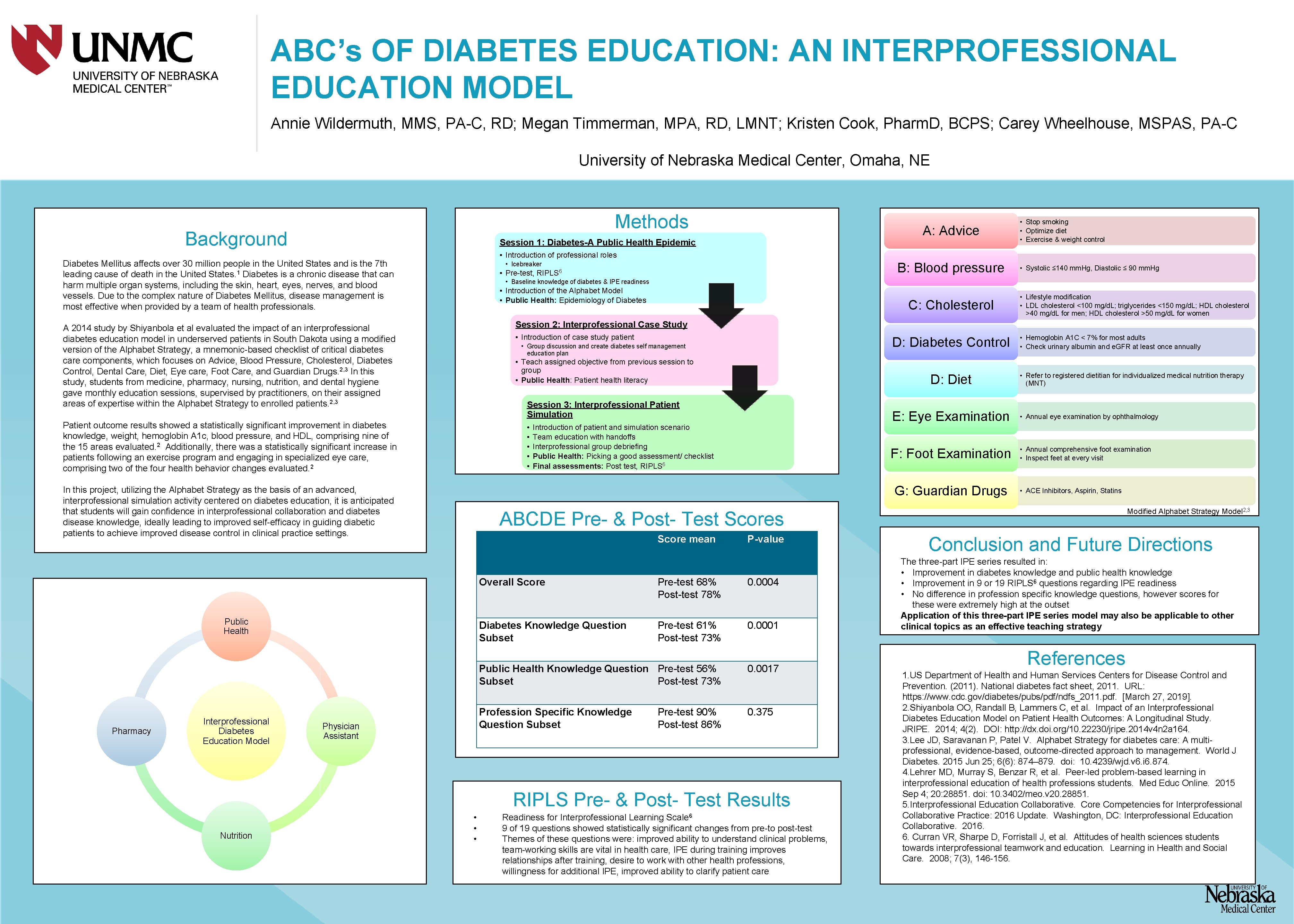
ABC’s OF DIABETES EDUCATION: AN INTERPROFESSIONAL EDUCATION MODEL Annie Wildermuth, MMS, PA-C, RD; Megan Timmerman, MPA, RD, LMNT; Kristen Cook, Pharm. D, BCPS; Carey Wheelhouse, MSPAS, PA-C University of Nebraska Medical Center, Omaha, NE Methods Background Session 1: Diabetes-A Public Health Epidemic • Introduction of professional roles Diabetes Mellitus affects over 30 million people in the United States and is the 7 th leading cause of death in the United States. 1 Diabetes is a chronic disease that can harm multiple organ systems, including the skin, heart, eyes, nerves, and blood vessels. Due to the complex nature of Diabetes Mellitus, disease management is most effective when provided by a team of health professionals. • Pre-test, RIPLS 6 • Introduction of the Alphabet Model • Public Health: Epidemiology of Diabetes C: Cholesterol • Lifestyle modification • LDL cholesterol <100 mg/d. L; triglycerides <150 mg/d. L; HDL cholesterol >40 mg/d. L for men; HDL cholesterol >50 mg/d. L for women Session 2: Interprofessional Case Study • Introduction of case study patient D: Diabetes Control • Group discussion and create diabetes self management education plan • Teach assigned objective from previous session to group • Public Health: Patient health literacy D: Diet Session 3: Interprofessional Patient Simulation • • • Introduction of patient and simulation scenario Team education with handoffs Interprofessional group debriefing Public Health: Picking a good assessment/ checklist Final assessments: Post test, RIPLS 6 • Hemoglobin A 1 C < 7% for most adults • Check urinary albumin and e. GFR at least once annually • Refer to registered dietitian for individualized medical nutrition therapy (MNT) E: Eye Examination • Annual eye examination by ophthalmology F: Foot Examination • Annual comprehensive foot examination • Inspect feet at every visit G: Guardian Drugs In this project, utilizing the Alphabet Strategy as the basis of an advanced, interprofessional simulation activity centered on diabetes education, it is anticipated that students will gain confidence in interprofessional collaboration and diabetes disease knowledge, ideally leading to improved self-efficacy in guiding diabetic patients to achieve improved disease control in clinical practice settings. • ACE Inhibitors, Aspirin, Statins Modified Alphabet Strategy Model 2, 3 ABCDE Pre- & Post- Test Scores Score mean Public Health Physician Assistant P-value Overall Score Pre-test 68% Post-test 78% 0. 0004 Diabetes Knowledge Question Subset Pre-test 61% Post-test 73% 0. 0001 Public Health Knowledge Question Pre-test 56% Subset Post-test 73% 0. 0017 Profession Specific Knowledge Question Subset 0. 375 Pre-test 90% Post-test 86% RIPLS Pre- & Post- Test Results Nutrition • Systolic ≤ 140 mm. Hg, Diastolic ≤ 90 mm. Hg • Baseline knowledge of diabetes & IPE readiness Patient outcome results showed a statistically significant improvement in diabetes knowledge, weight, hemoglobin A 1 c, blood pressure, and HDL, comprising nine of the 15 areas evaluated. 2 Additionally, there was a statistically significant increase in patients following an exercise program and engaging in specialized eye care, comprising two of the four health behavior changes evaluated. 2 Pharmacy B: Blood pressure • Icebreaker A 2014 study by Shiyanbola et al evaluated the impact of an interprofessional diabetes education model in underserved patients in South Dakota using a modified version of the Alphabet Strategy, a mnemonic-based checklist of critical diabetes care components, which focuses on Advice, Blood Pressure, Cholesterol, Diabetes Control, Dental Care, Diet, Eye care, Foot Care, and Guardian Drugs. 2, 3 In this study, students from medicine, pharmacy, nursing, nutrition, and dental hygiene gave monthly education sessions, supervised by practitioners, on their assigned areas of expertise within the Alphabet Strategy to enrolled patients. 2, 3 Interprofessional Diabetes Education Model A: Advice • Stop smoking • Optimize diet • Exercise & weight control • • • Readiness for Interprofessional Learning Scale 6 9 of 19 questions showed statistically significant changes from pre-to post-test Themes of these questions were: improved ability to understand clinical problems, team-working skills are vital in health care, IPE during training improves relationships after training, desire to work with other health professions, willingness for additional IPE, improved ability to clarify patient care Conclusion and Future Directions The three-part IPE series resulted in: • Improvement in diabetes knowledge and public health knowledge • Improvement in 9 or 19 RIPLS 6 questions regarding IPE readiness • No difference in profession specific knowledge questions, however scores for these were extremely high at the outset Application of this three-part IPE series model may also be applicable to other clinical topics as an effective teaching strategy References 1. US Department of Health and Human Services Centers for Disease Control and Prevention. (2011). National diabetes fact sheet, 2011. URL: https: //www. cdc. gov/diabetes/pubs/pdf/ndfs_2011. pdf. [March 27, 2019]. 2. Shiyanbola OO, Randall B, Lammers C, et al. Impact of an Interprofessional Diabetes Education Model on Patient Health Outcomes: A Longitudinal Study. JRIPE. 2014; 4(2). DOI: http: //dx. doi. org/10. 22230/jripe. 2014 v 4 n 2 a 164. 3. Lee JD, Saravanan P, Patel V. Alphabet Strategy for diabetes care: A multiprofessional, evidence-based, outcome-directed approach to management. World J Diabetes. 2015 Jun 25; 6(6): 874– 879. doi: 10. 4239/wjd. v 6. i 6. 874. 4. Lehrer MD, Murray S, Benzar R, et al. Peer-led problem-based learning in interprofessional education of health professions students. Med Educ Online. 2015 Sep 4; 20: 28851. doi: 10. 3402/meo. v 20. 28851. 5. Interprofessional Education Collaborative. Core Competencies for Interprofessional Collaborative Practice: 2016 Update. Washington, DC: Interprofessional Education Collaborative. 2016. 6. Curran VR, Sharpe D, Forristall J, et al. Attitudes of health sciences students towards interprofessional teamwork and education. Learning in Health and Social Care. 2008; 7(3), 146 -156.
- Slides: 1