
ABC of protein purification basic chromatography Purified proteins
ABC of protein purification: basic chromatography Purified proteins are essential for all structural and functional proteomic studies. Several chromatographic purification techniques have been developed which separate proteins based on parameters such as size, shape, charge or chemical specificity. Harini Chandra Affiliations

1 Master Layout Chromatography Gel filtration Ion exchange chromatography Affinity chromatography 2 3 4 5 Action The three images must appear with each of them being a separate tab. Description of the action (Please redraw all figures. ) The main heading of chromatography must appear followed by the 3 images and the remaining headings & figures below. User must be allowed to click on any of them so that he is redirected to the appropriate section. When the user moves the cursor over the sub-headings, the definitions given in the next slide must appear. Audio Narration Chromatography refers to a collection of lab techniques that carry out separation of complex mixtures by making use of inherent properties of the components of the mixture. It involves the differential partitioning of molecules between a suitable stationary phase and mobile phase. The most commonly used chromatographic techniques are gel filtration, ion exchange chromatography and affinity chromatography. Source: Biochemistry by A. L. Lehninger, 4 th edition (ebook)
1 Definitions of the components: (Master layout) 2 1. Chromatography: Chromatography refers to a collection of lab techniques that carry out separation of complex mixtures by making use of inherent properties of the components of the mixture. It involves the differential partitioning of molecules between a suitable stationary phase and mobile phase. The most commonly used chromatographic techniques are gel filtration, ion exchange chromatography and affinity chromatography. 3 2. Gel filtration chromatography: Gel filtration or size exclusion chromatography separates molecules according to their sizes. Small molecules enter the pores of the stationary phase matrix and move slowly through the column while larger molecules pass in between the pores and are removed quickly from the column. 4 3. Ion exchange chromatography: This technique makes use of a charged stationary phase that binds and retains molecules from a mixture bearing the opposite charge. Components having the same or neutral charge flow through the column without binding. 4. Affinity chromatography: This separation procedure makes use of specific interactions to purify the molecule of interest. The stationary phase matrix is functionalized with a suitable ligand that will selectively bind to the molecule of interest thereby purifying it. 5
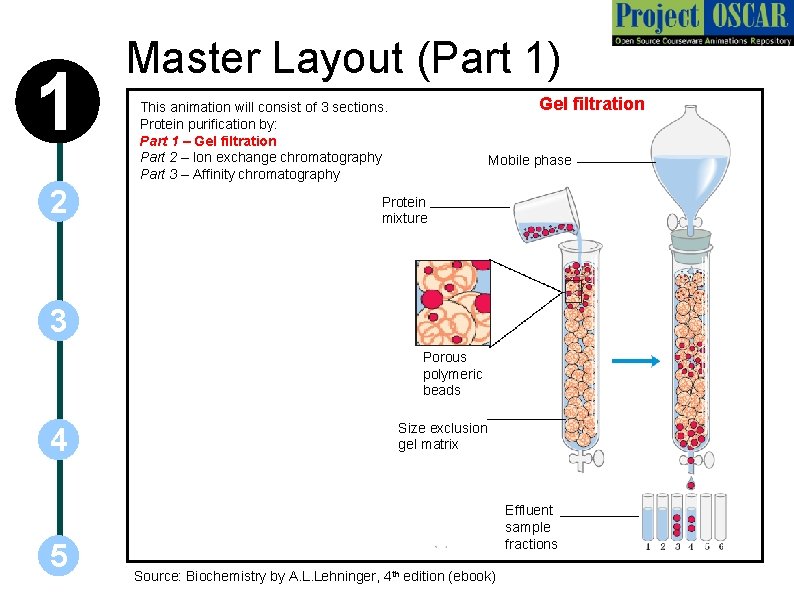
1 2 Master Layout (Part 1) Gel filtration This animation will consist of 3 sections. Protein purification by: Part 1 – Gel filtration Part 2 – Ion exchange chromatography Part 3 – Affinity chromatography Mobile phase Protein mixture 3 Porous polymeric beads 4 5 Size exclusion gel matrix Effluent sample fractions Source: Biochemistry by A. L. Lehninger, 4 th edition (ebook)
1 2 Definitions of the components (Part 1 – Gel filtration) 1. Size exclusion gel matrix: The matrix filling the gel filtration column consists of a highly hydrated polymeric material, commonly dextran, agarose or polyacrylamide, which is porous in nature thereby allowing molecules below a particular specified size to pass through them. 2. Protein mixture: The mixture of unpurified proteins of different sizes which is applied to the top of the column for separation. 3 3. Mobile phase: Following sample application, the proteins are eluted out of the column by means of a suitable mobile phase that carries the protein out with it. For gel filtration, a salt solution of appropriate strength is commonly used which will not have any effect on properties of the proteins being purified. Solvents or buffer systems are often used in other types of chromatography. 4 4. Effluent sample fractions: The solution leaving the column is collected in suitably sized fractions. Initial fractions will contain only the mobile phase while latter fractions will have purified proteins. 5
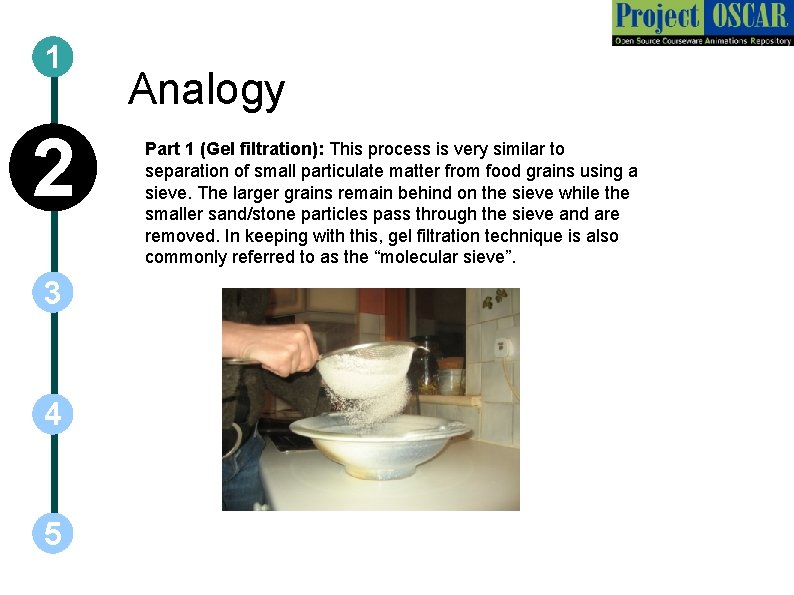
1 2 3 4 5 Analogy Part 1 (Gel filtration): This process is very similar to separation of small particulate matter from food grains using a sieve. The larger grains remain behind on the sieve while the smaller sand/stone particles pass through the sieve and are removed. In keeping with this, gel filtration technique is also commonly referred to as the “molecular sieve”.

1 Part 1, Step 1: 2 3 4 Chromatography column Action Showing the column being filled with a material. Packed gel column Description of the action Audio Narration (Please redraw all figures. ) • First show only empty column on the left. • Then the filled column must be shown. The column is first packed with a hydrated porous gel matrix suitable for the required protein separation. • 5 Source: Biochemistry by A. L. Lehninger, 4 th edition (ebook)

1 Part 1, Step 2: Sample loading 2 Packed gel column 3 Unpurified protein mixture 4 5 Action Pouring the solution from the container on the left into the column on the right. Description of the action (Please redraw all figures. ) • First show only the beaker on the left and the column on the right. • Then the beaker must be lifted and poured into the column as shown on the right. • Audio Narration This packed gel matrix is then loaded with the protein sample containing a mixture of unpurified proteins of different sizes. Source: Biochemistry by A. L. Lehninger, 4 th edition (ebook)
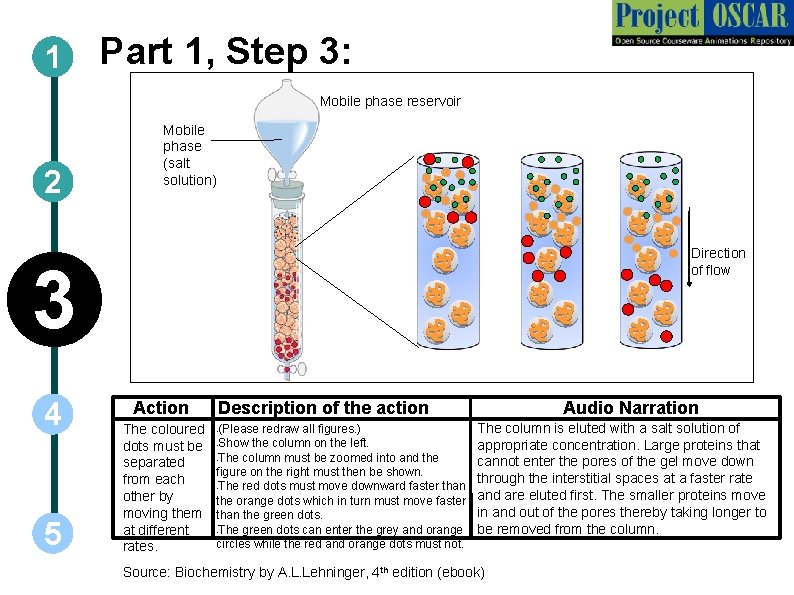
1 Part 1, Step 3: Mobile phase reservoir 2 Mobile phase (salt solution) Direction of flow 3 4 5 Action The coloured dots must be separated from each other by moving them at different rates. Description of the action (Please redraw all figures. ) Show the column on the left. • The column must be zoomed into and the figure on the right must then be shown. • The red dots must move downward faster than the orange dots which in turn must move faster than the green dots. • The green dots can enter the grey and orange circles while the red and orange dots must not. • • Audio Narration The column is eluted with a salt solution of appropriate concentration. Large proteins that cannot enter the pores of the gel move down through the interstitial spaces at a faster rate and are eluted first. The smaller proteins move in and out of the pores thereby taking longer to be removed from the column. Source: Biochemistry by A. L. Lehninger, 4 th edition (ebook)
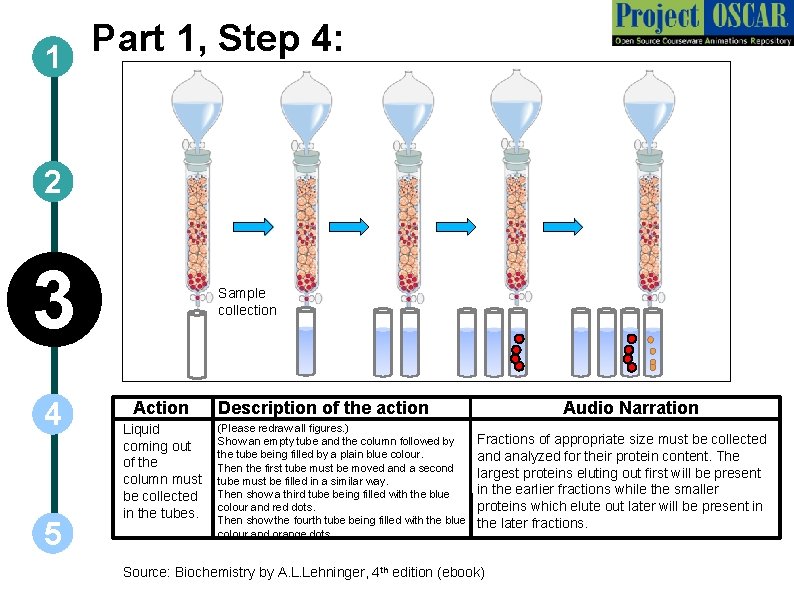
Part 1, Step 4: 1 2 3 4 5 Sample collection Action Liquid coming out of the column must be collected in the tubes. Description of the action (Please redraw all figures. ) Show an empty tube and the column followed by the tube being filled by a plain blue colour. Then the first tube must be moved and a second tube must be filled in a similar way. Then show a third tube being filled with the blue colour and red dots. Then show the fourth tube being filled with the blue colour and orange dots. Audio Narration Fractions of appropriate size must be collected analyzed for their protein content. The largest proteins eluting out first will be present in the earlier fractions while the smaller proteins which elute out later will be present in the later fractions. Source: Biochemistry by A. L. Lehninger, 4 th edition (ebook)

Protein concentration Part 1, Step 5: 1 2 UV-Vis spectrophotometer 1 5 Lowest molecular weight Volume of eluant 3 4 Highest molecular weight 2 3 4 5 6 7 8 9 10 Collected fractions Action The tubes shown must be moved towards the instrument above one at a time with appearance of the graph. 11 12 13 14 Description of the action (Please redraw all figures. ) Move the tubes one at a time in the numbered order towards the instrument shown to indicate they are being analyzed. • A graph must simultaneously appear as shown on right. When tubes 3, 4 & 5 are analyzed, the red hump must appear. When tubes 7, 8 & 9 are analyzed, the orange hump must appear and when 11, 12 & 13 are analyzed, the green hump must appear. • • Audio Narration The fractions are then analyzed for their protein content using a UV-Visible Spectrophotometer at 280 nm. A graph of eluant volume versus protein concentration is then plotted.

1 2 Master Layout (Part 2) Ion exchange chromatography This animation will consist of 3 sections. Protein purification by: Part 1 – Gel filtration Part 2 – Ion exchange chromatography Part 3 – Affinity chromatography Eluting buffer Protein mixture 3 4 5 Charged stationary phase Effluent sample fractions Source: Biochemistry by A. L. Lehninger, 4 th edition (ebook)
1 2 Definitions of the components (Part 2 – Ion exchange chromatography) 1. Charged stationary phase: The column stationary phase consists of a positively or negatively charged polymeric matrix which will bind molecules of the opposite charge. Commonly used ion exchangers include negatively charged caboxymethyl-cellulose (CM-cellulose), which is a cation exchanger and positively charged diethylaminoethyl cellulose (DEAEcellulose), which is an anion exchanger. 3 2. Protein mixture: The unpurified protein mixture which consists of proteins of different net charges that are loaded onto the column. The proteins having charges opposite to that of the stationary matrix will bind to it while the remaining proteins will be eluted from the column. 4 3. Mobile phase: Following sample application, the proteins are eluted out of the column by means of a suitable mobile phase that carries the protein out with it. For ion exchange chromatography, buffer systems of suitable p. H are used which will first remove the unbound proteins. The buffer is then changed such that the charge of bound proteins is modified and they are also eluted out of the column. 5 4. Effluent sample fractions: The solution leaving the column is collected in suitably sized fractions for further analysis. The unbound proteins having same charge as the column matrix will be eluted out in the initial fractions while the bound proteins will be eluted later upon changing the buffer system.
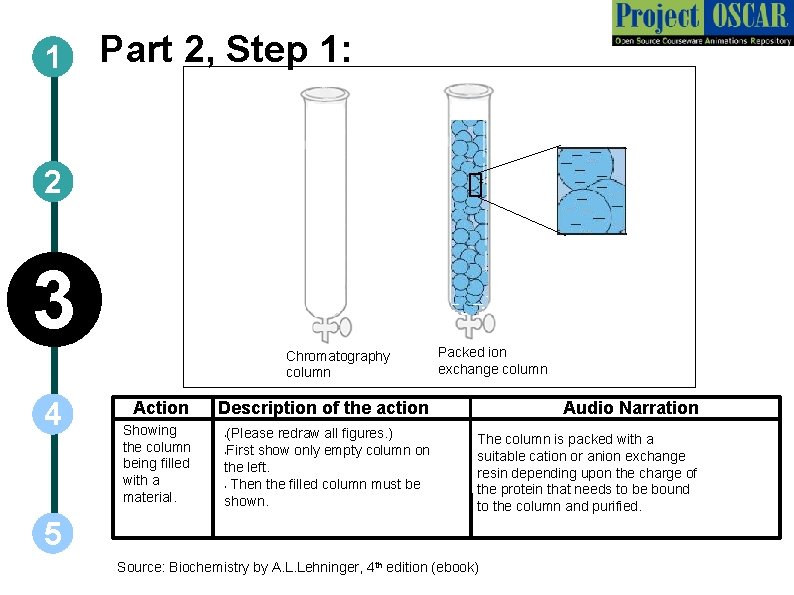
1 Part 2, Step 1: 2 3 Chromatography column 4 Action Showing the column being filled with a material. Packed ion exchange column Description of the action Audio Narration (Please redraw all figures. ) • First show only empty column on the left. • Then the filled column must be shown. The column is packed with a suitable cation or anion exchange resin depending upon the charge of the protein that needs to be bound to the column and purified. • 5 Source: Biochemistry by A. L. Lehninger, 4 th edition (ebook)

1 Part 2, Step 2: Sample loading 2 Packed ion exchange column 3 Unpurified protein mixture 4 5 Action Pouring the solution from the container on the left into the column on the right. Description of the action (Please redraw all figures. ) • First show only the beaker on the left and the column on the right. • Then the beaker must be lifted and poured into the column as shown on the right. • Audio Narration The anion exchange column is then loaded with the impure protein mixture consisting of various positively and negatively charged proteins. Source: Biochemistry by A. L. Lehninger, 4 th edition (ebook)
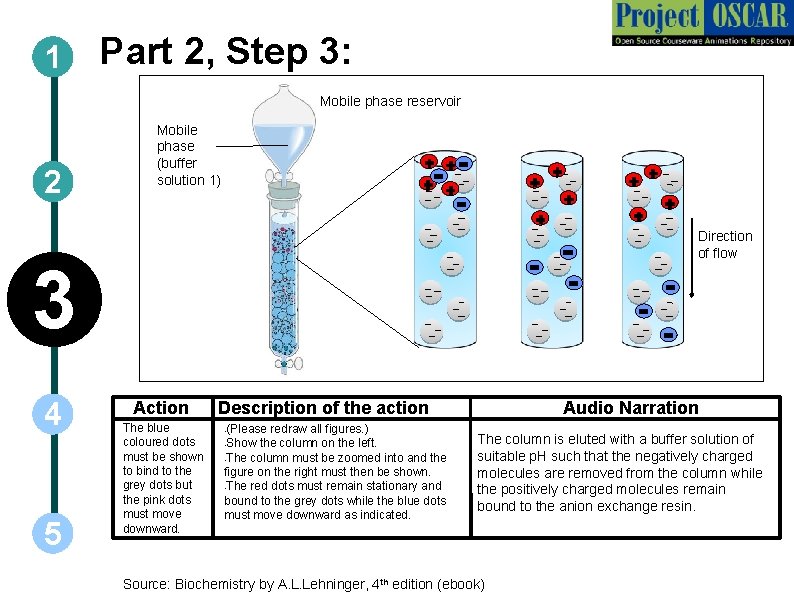
1 Part 2, Step 3: Mobile phase reservoir 2 Mobile phase (buffer solution 1) Direction of flow 3 4 5 Action The blue coloured dots must be shown to bind to the grey dots but the pink dots must move downward. Description of the action (Please redraw all figures. ) Show the column on the left. • The column must be zoomed into and the figure on the right must then be shown. • The red dots must remain stationary and bound to the grey dots while the blue dots must move downward as indicated. • • Audio Narration The column is eluted with a buffer solution of suitable p. H such that the negatively charged molecules are removed from the column while the positively charged molecules remain bound to the anion exchange resin. Source: Biochemistry by A. L. Lehninger, 4 th edition (ebook)
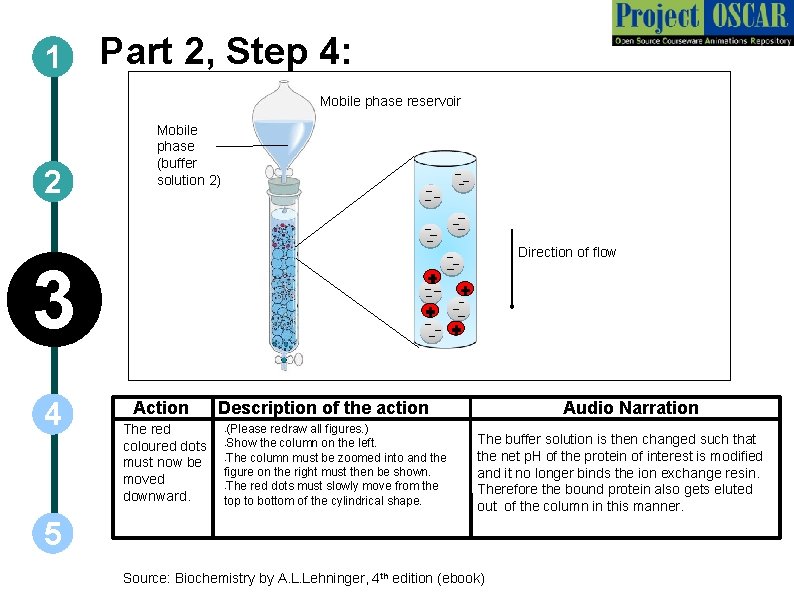
1 Part 2, Step 4: Mobile phase reservoir 2 Mobile phase (buffer solution 2) Direction of flow 3 4 Action The red coloured dots must now be moved downward. Description of the action (Please redraw all figures. ) Show the column on the left. • The column must be zoomed into and the figure on the right must then be shown. • The red dots must slowly move from the top to bottom of the cylindrical shape. • • Audio Narration The buffer solution is then changed such that the net p. H of the protein of interest is modified and it no longer binds the ion exchange resin. Therefore the bound protein also gets eluted out of the column in this manner. 5 Source: Biochemistry by A. L. Lehninger, 4 th edition (ebook)
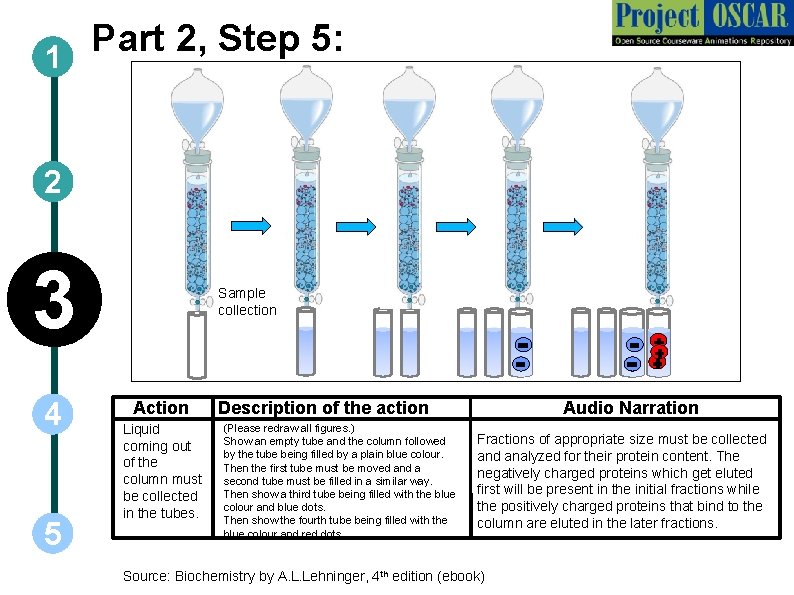
Part 2, Step 5: 1 2 3 4 5 Sample collection Action Liquid coming out of the column must be collected in the tubes. Description of the action (Please redraw all figures. ) Show an empty tube and the column followed by the tube being filled by a plain blue colour. Then the first tube must be moved and a second tube must be filled in a similar way. Then show a third tube being filled with the blue colour and blue dots. Then show the fourth tube being filled with the blue colour and red dots. Audio Narration Fractions of appropriate size must be collected analyzed for their protein content. The negatively charged proteins which get eluted first will be present in the initial fractions while the positively charged proteins that bind to the column are eluted in the later fractions. Source: Biochemistry by A. L. Lehninger, 4 th edition (ebook)
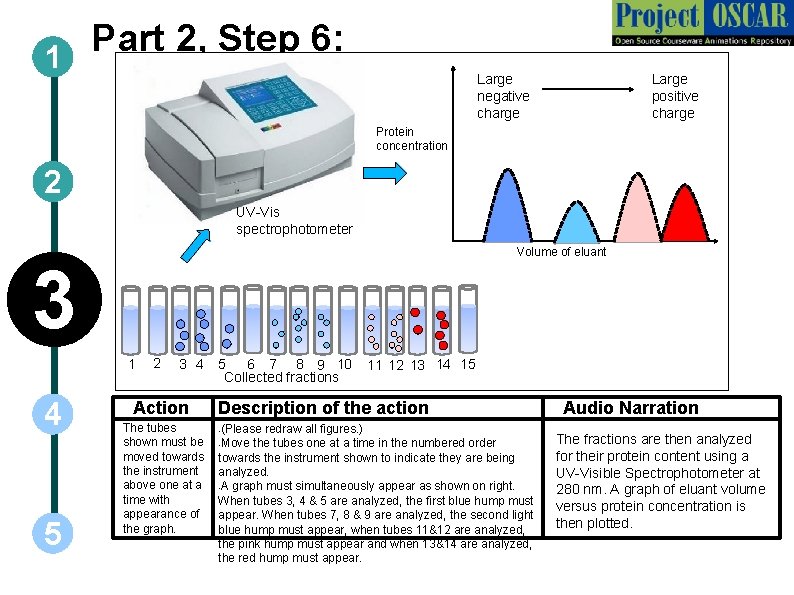
Part 2, Step 6: 1 Large negative charge Large positive charge Protein concentration 2 UV-Vis spectrophotometer Volume of eluant 3 1 4 5 2 3 4 Action The tubes shown must be moved towards the instrument above one at a time with appearance of the graph. 5 6 7 8 9 10 Collected fractions 11 12 13 14 15 Description of the action (Please redraw all figures. ) Move the tubes one at a time in the numbered order towards the instrument shown to indicate they are being analyzed. • A graph must simultaneously appear as shown on right. When tubes 3, 4 & 5 are analyzed, the first blue hump must appear. When tubes 7, 8 & 9 are analyzed, the second light blue hump must appear, when tubes 11&12 are analyzed, the pink hump must appear and when 13&14 are analyzed, the red hump must appear. • • Audio Narration The fractions are then analyzed for their protein content using a UV-Visible Spectrophotometer at 280 nm. A graph of eluant volume versus protein concentration is then plotted.
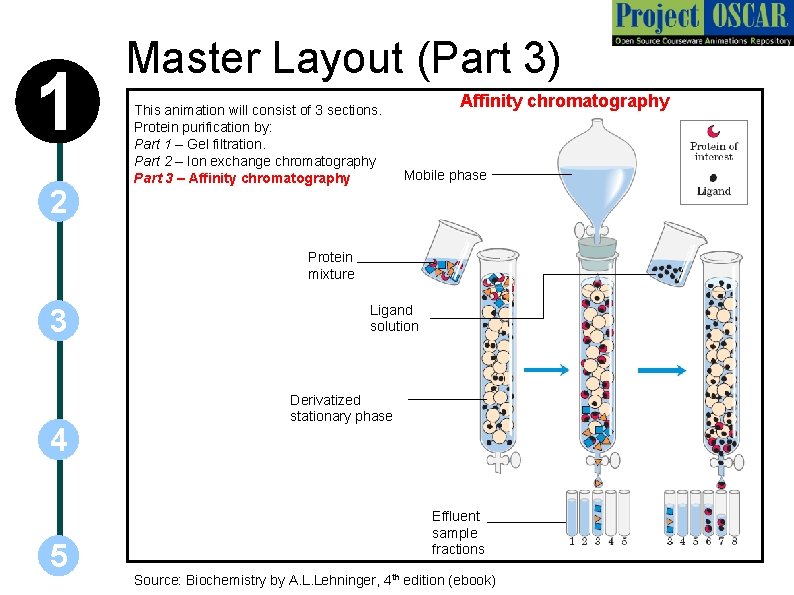
1 2 Master Layout (Part 3) This animation will consist of 3 sections. Protein purification by: Part 1 – Gel filtration. Part 2 – Ion exchange chromatography Part 3 – Affinity chromatography Mobile phase Protein mixture 3 4 5 Ligand solution Derivatized stationary phase Effluent sample fractions Source: Biochemistry by A. L. Lehninger, 4 th edition (ebook)
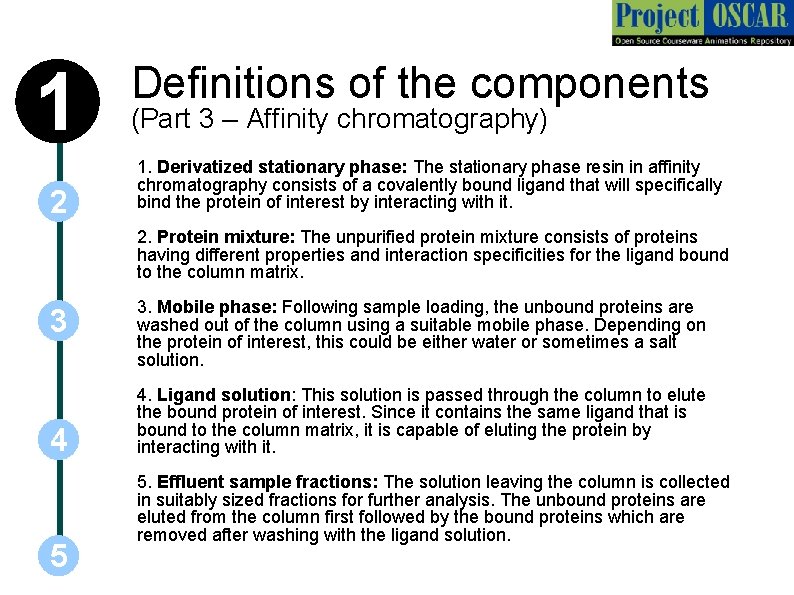
1 2 Definitions of the components (Part 3 – Affinity chromatography) 1. Derivatized stationary phase: The stationary phase resin in affinity chromatography consists of a covalently bound ligand that will specifically bind the protein of interest by interacting with it. 2. Protein mixture: The unpurified protein mixture consists of proteins having different properties and interaction specificities for the ligand bound to the column matrix. 3 4 5 3. Mobile phase: Following sample loading, the unbound proteins are washed out of the column using a suitable mobile phase. Depending on the protein of interest, this could be either water or sometimes a salt solution. 4. Ligand solution: This solution is passed through the column to elute the bound protein of interest. Since it contains the same ligand that is bound to the column matrix, it is capable of eluting the protein by interacting with it. 5. Effluent sample fractions: The solution leaving the column is collected in suitably sized fractions for further analysis. The unbound proteins are eluted from the column first followed by the bound proteins which are removed after washing with the ligand solution.
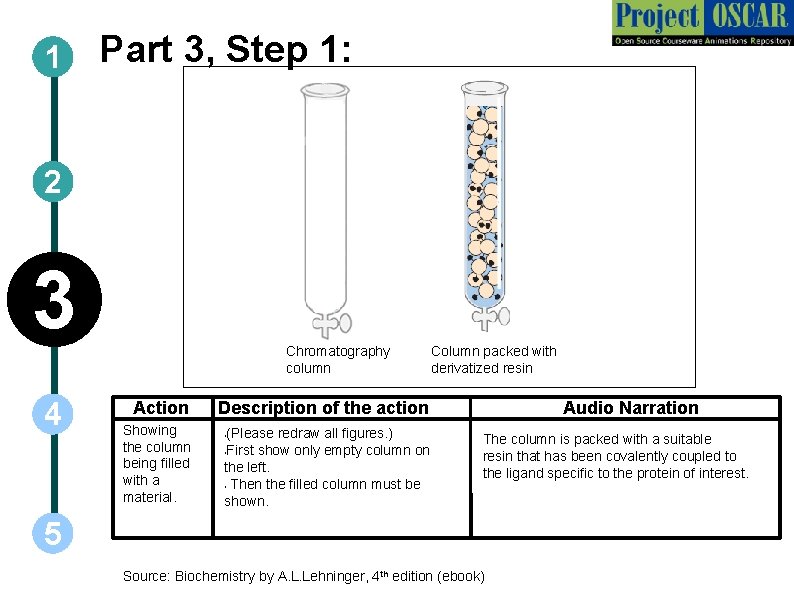
1 Part 3, Step 1: 2 3 4 Chromatography column Action Showing the column being filled with a material. Column packed with derivatized resin Description of the action (Please redraw all figures. ) • First show only empty column on the left. • Then the filled column must be shown. • Audio Narration The column is packed with a suitable resin that has been covalently coupled to the ligand specific to the protein of interest. 5 Source: Biochemistry by A. L. Lehninger, 4 th edition (ebook)
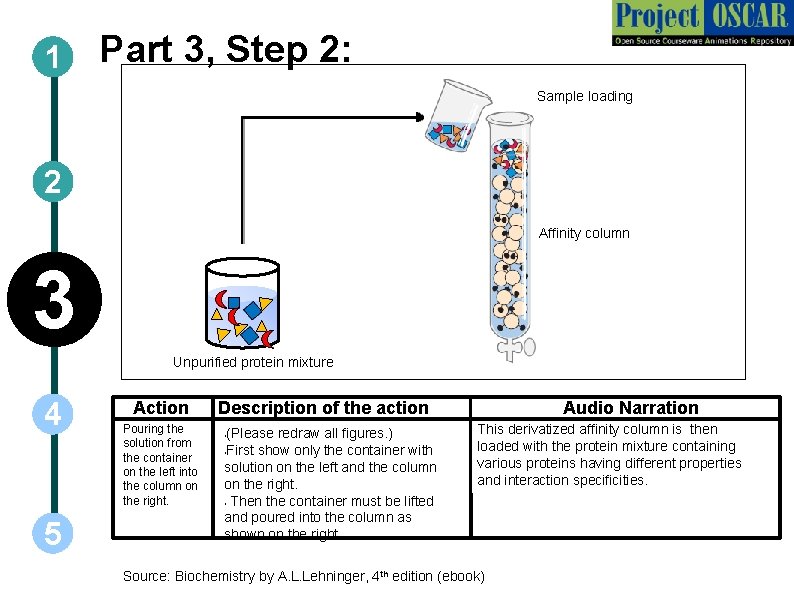
1 Part 3, Step 2: Sample loading 2 Affinity column 3 Unpurified protein mixture 4 5 Action Pouring the solution from the container on the left into the column on the right. Description of the action (Please redraw all figures. ) • First show only the container with solution on the left and the column on the right. • Then the container must be lifted and poured into the column as shown on the right. • Audio Narration This derivatized affinity column is then loaded with the protein mixture containing various proteins having different properties and interaction specificities. Source: Biochemistry by A. L. Lehninger, 4 th edition (ebook)
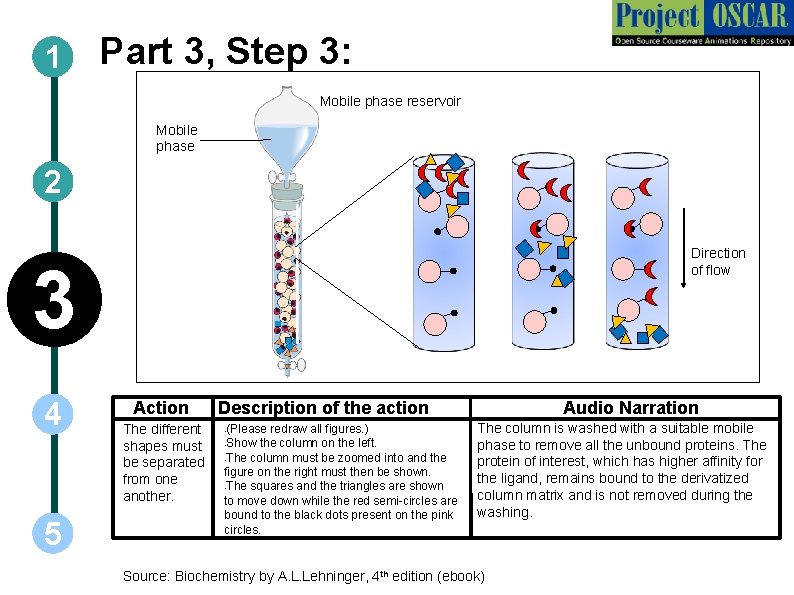
1 Part 3, Step 3: Mobile phase reservoir Mobile phase 2 Direction of flow 3 4 5 Action The different shapes must be separated from one another. Description of the action (Please redraw all figures. ) Show the column on the left. • The column must be zoomed into and the figure on the right must then be shown. • The squares and the triangles are shown to move down while the red semi-circles are bound to the black dots present on the pink circles. • • Audio Narration The column is washed with a suitable mobile phase to remove all the unbound proteins. The protein of interest, which has higher affinity for the ligand, remains bound to the derivatized column matrix and is not removed during the washing. Source: Biochemistry by A. L. Lehninger, 4 th edition (ebook)
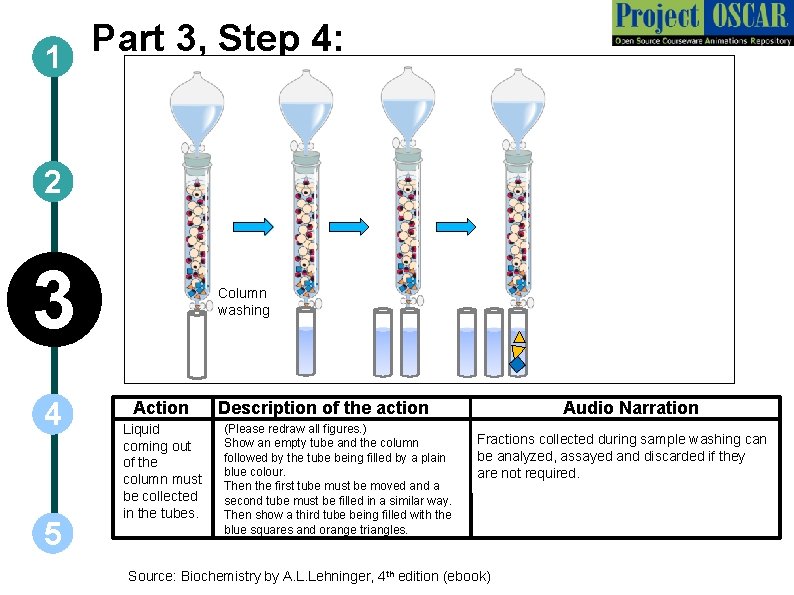
Part 3, Step 4: 1 2 3 4 5 Column washing Action Liquid coming out of the column must be collected in the tubes. Description of the action (Please redraw all figures. ) Show an empty tube and the column followed by the tube being filled by a plain blue colour. Then the first tube must be moved and a second tube must be filled in a similar way. Then show a third tube being filled with the blue squares and orange triangles. Audio Narration Fractions collected during sample washing can be analyzed, assayed and discarded if they are not required. Source: Biochemistry by A. L. Lehninger, 4 th edition (ebook)
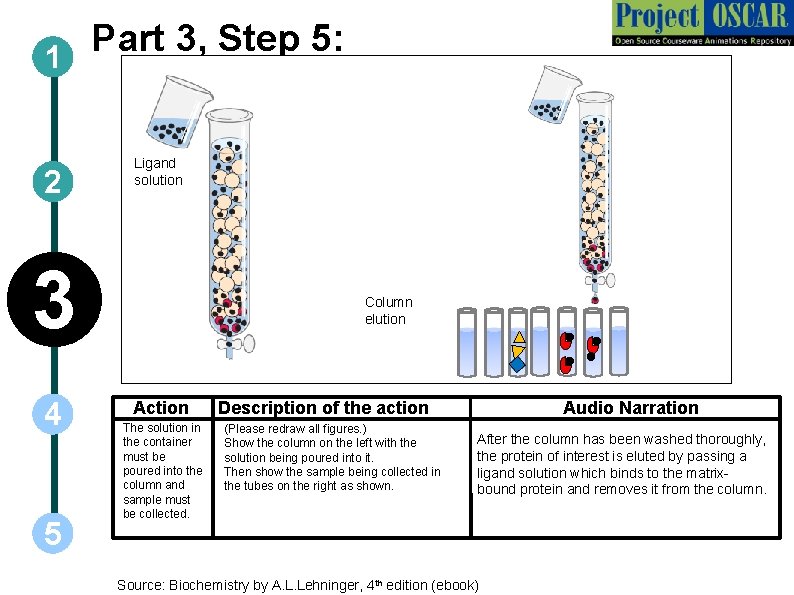
Part 3, Step 5: 1 2 Ligand solution 3 4 5 Column elution Action The solution in the container must be poured into the column and sample must be collected. Description of the action (Please redraw all figures. ) Show the column on the left with the solution being poured into it. Then show the sample being collected in the tubes on the right as shown. Audio Narration After the column has been washed thoroughly, the protein of interest is eluted by passing a ligand solution which binds to the matrixbound protein and removes it from the column. Source: Biochemistry by A. L. Lehninger, 4 th edition (ebook)

Part 3, Step 6: 1 Protein impurities Desired pure protein Protein concentration 2 UV-Vis spectrophotometer Volume of eluant 3 1 4 5 2 3 Action The tubes shown must be moved towards the instrument above one at a time with appearance of the graph. 4 7 5 6 Collected fractions Description of the action (Please redraw all figures. ) Move the tubes one at a time in the numbered order towards the instrument shown to indicate they are being analyzed. • A graph must simultaneously appear as shown on right. When tube 3 is analyzed, blue-orange hump must appear. When tube 5 & 6 are analyzed, the red hump must appear. • • Audio Narration The fractions are then analyzed for their protein content using a UV-Visible Spectrophotometer at 280 nm. A graph of eluant volume versus protein concentration is then plotted.
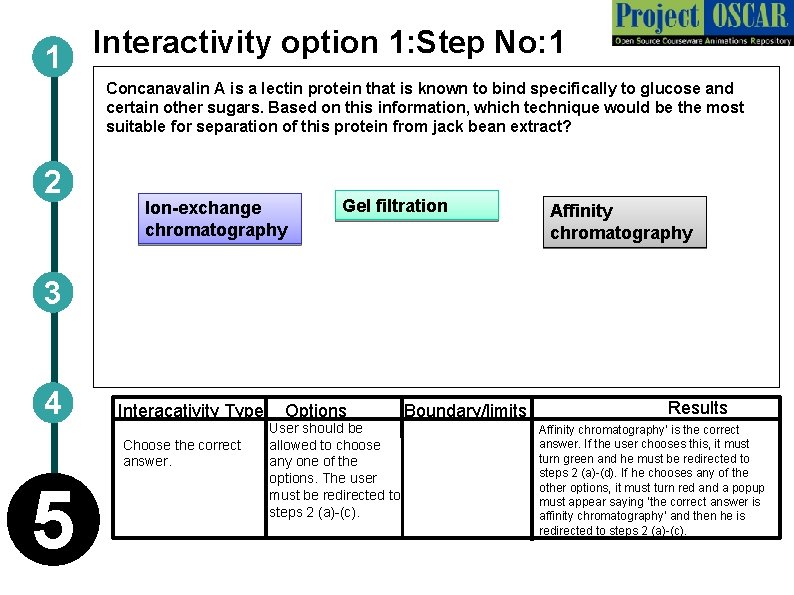
Interactivity option 1: Step No: 1 1 Concanavalin A is a lectin protein that is known to bind specifically to glucose and certain other sugars. Based on this information, which technique would be the most suitable for separation of this protein from jack bean extract? 2 Ion-exchange chromatography Gel filtration Affinity chromatography 3 4 Interacativity Type Choose the correct answer. 5 Options User should be allowed to choose any one of the options. The user must be redirected to steps 2 (a)-(c). Boundary/limits Results Affinity chromatography’ is the correct answer. If the user chooses this, it must turn green and he must be redirected to steps 2 (a)-(d). If he chooses any of the other options, it must turn red and a popup must appear saying ‘the correct answer is affinity chromatography’ and then he is redirected to steps 2 (a)-(c).

1 Interactivity option 1: Step No: 2 (a) Affinity chromatography experiment: Separation of Concanavalin A from jack bean extract based on its affinity for sugar molecules like glucose. 2 Sample loading Glucose ligand 3 Glucose-agarose column Concanavalin A 4 5 Column packed with glucose-derivatized agarose resin. Unpurified jack bean extract

1 Interactivity option 1: Step No: 2 (b) Affinity chromatography experiment: Separation of Concanavalin A from jack bean extract based on its affinity for sugar molecules like glucose. 2 3 Mobile phase reservoir Mobile phase (salt solution) Glucose. Con. A interaction Direction of flow 4 5 Unbound proteins Unwanted protein impurities
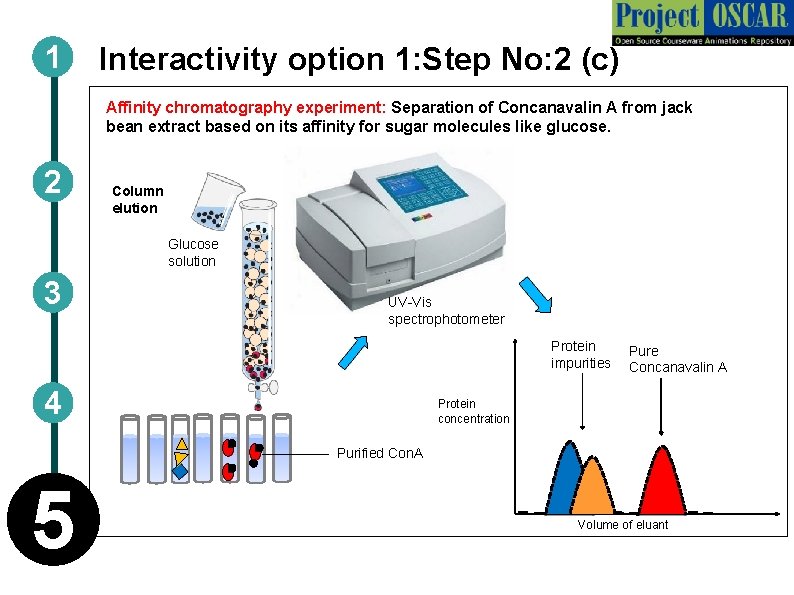
1 Interactivity option 1: Step No: 2 (c) Affinity chromatography experiment: Separation of Concanavalin A from jack bean extract based on its affinity for sugar molecules like glucose. 2 Column elution Glucose solution 3 UV-Vis spectrophotometer Protein impurities 4 Pure Concanavalin A Protein concentration Purified Con. A 5 Volume of eluant
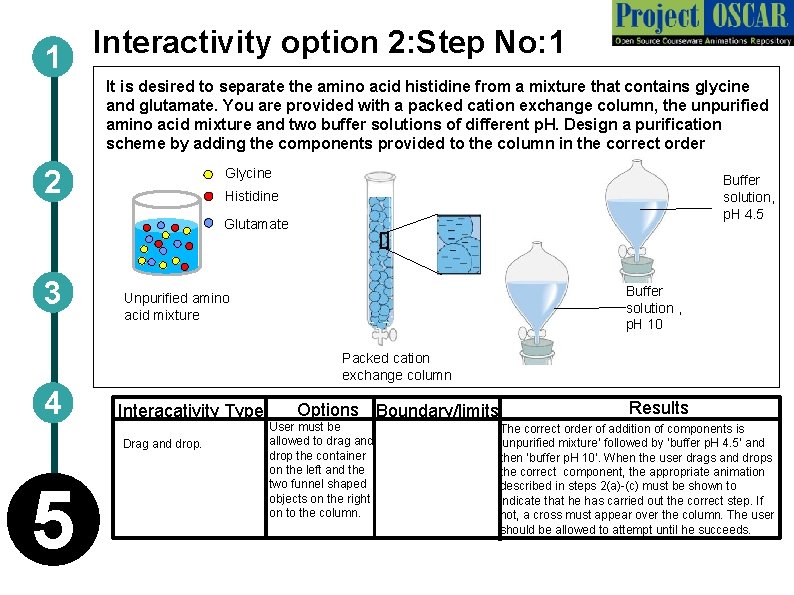
Interactivity option 2: Step No: 1 1 It is desired to separate the amino acid histidine from a mixture that contains glycine and glutamate. You are provided with a packed cation exchange column, the unpurified amino acid mixture and two buffer solutions of different p. H. Design a purification scheme by adding the components provided to the column in the correct order 2 Glycine Buffer solution, p. H 4. 5 Histidine Glutamate 3 Buffer solution , p. H 10 Unpurified amino acid mixture Packed cation exchange column 4 Interacativity Type Drag and drop. 5 Options Boundary/limits User must be allowed to drag and drop the container on the left and the two funnel shaped objects on the right on to the column. Results The correct order of addition of components is ‘unpurified mixture’ followed by ‘buffer p. H 4. 5’ and then ‘buffer p. H 10’. When the user drags and drops the correct component, the appropriate animation described in steps 2(a)-(c) must be shown to indicate that he has carried out the correct step. If not, a cross must appear over the column. The user should be allowed to attempt until he succeeds.
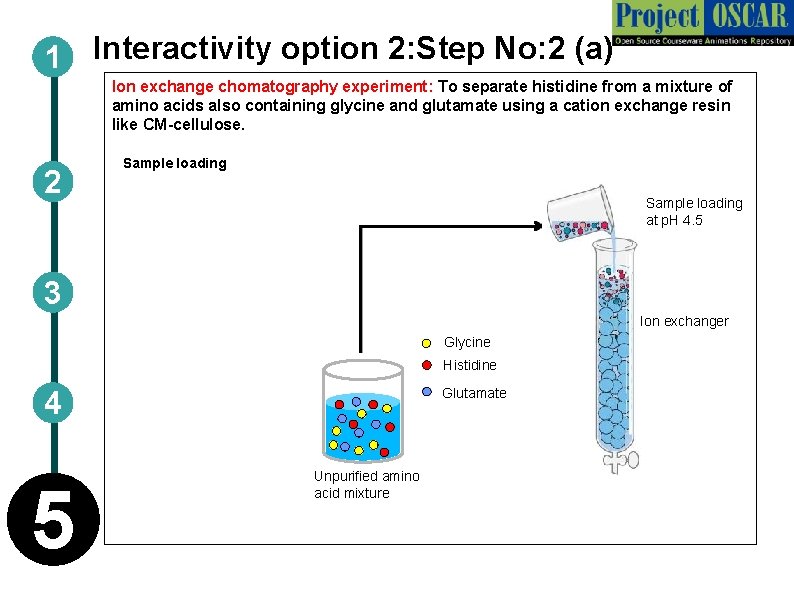
1 Interactivity option 2: Step No: 2 (a) Ion exchange chomatography experiment: To separate histidine from a mixture of amino acids also containing glycine and glutamate using a cation exchange resin like CM-cellulose. 2 Sample loading at p. H 4. 5 3 Ion exchanger Glycine Histidine Glutamate 4 5 Unpurified amino acid mixture
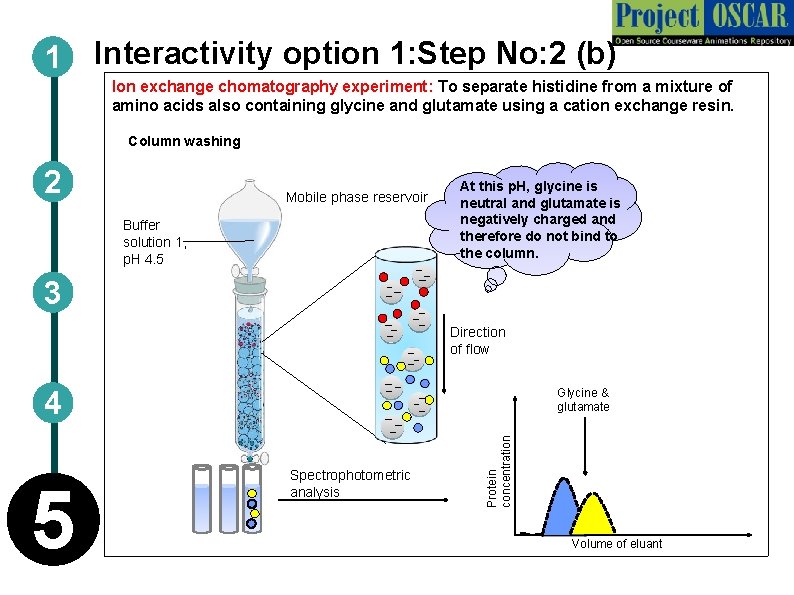
1 Interactivity option 1: Step No: 2 (b) Ion exchange chomatography experiment: To separate histidine from a mixture of amino acids also containing glycine and glutamate using a cation exchange resin. Column washing 2 Mobile phase reservoir Buffer solution 1, p. H 4. 5 At this p. H, glycine is neutral and glutamate is negatively charged and therefore do not bind to the column. 3 Direction of flow 4 Spectrophotometric analysis Protein concentration 5 Glycine & glutamate Volume of eluant

Interactivity option 1: Step No: 2 (c) 1 Ion exchange chomatography experiment: To separate histidine from a mixture of amino acids also containing glycine and glutamate using a cation exchange resin. 2 Column elution Mobile phase reservoir Buffer solution 2, p. H 10 At p. H 10, histidine is also negatively charged and therefore gets eluted from the column. 3 Direction of flow Glycine & glutamate 5 Spectrophotometric analysis Protein concentration 4 Purified histidine Volume of eluant
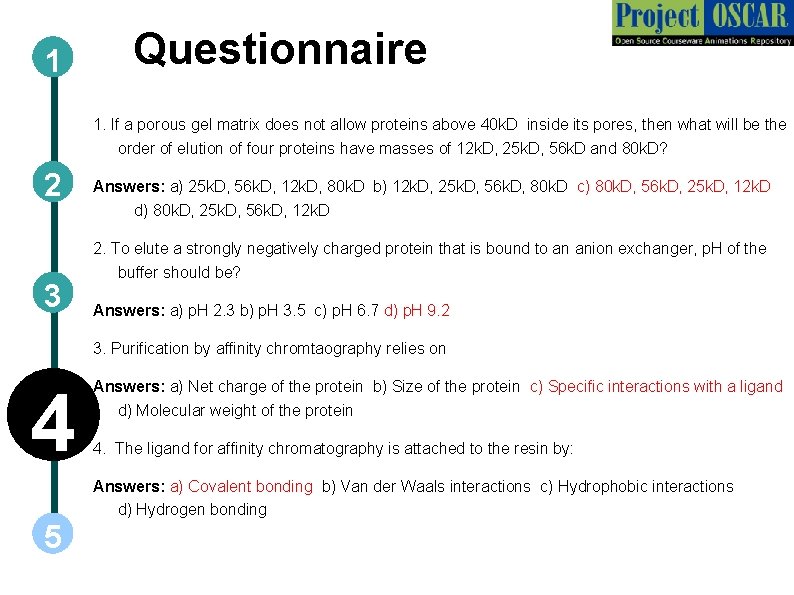
1 Questionnaire 1. If a porous gel matrix does not allow proteins above 40 k. D inside its pores, then what will be the order of elution of four proteins have masses of 12 k. D, 25 k. D, 56 k. D and 80 k. D? 2 3 Answers: a) 25 k. D, 56 k. D, 12 k. D, 80 k. D b) 12 k. D, 25 k. D, 56 k. D, 80 k. D c) 80 k. D, 56 k. D, 25 k. D, 12 k. D d) 80 k. D, 25 k. D, 56 k. D, 12 k. D 2. To elute a strongly negatively charged protein that is bound to an anion exchanger, p. H of the buffer should be? Answers: a) p. H 2. 3 b) p. H 3. 5 c) p. H 6. 7 d) p. H 9. 2 3. Purification by affinity chromtaography relies on 4 Answers: a) Net charge of the protein b) Size of the protein c) Specific interactions with a ligand d) Molecular weight of the protein 4. The ligand for affinity chromatography is attached to the resin by: Answers: a) Covalent bonding b) Van der Waals interactions c) Hydrophobic interactions d) Hydrogen bonding 5
Links for further reading Books: Biochemistry by Stryer et al. , 5 th edition Biochemistry by A. L. Lehninger et al. , 3 rd edition Biochemistry by Voet & Voet, 3 rd edition
- Slides: 37