
ABC and VED Analysis in Healthcare Case study
ABC and VED Analysis in Healthcare . שיטות וכלי ניהול במערכות בריאות פרופ' חיים שנידרמן Case study ABC and VED Analysis of the Pharmacy Store of a Tertiary Care Teaching, Research and Referral Healthcare Institute of India M Devnani, AK Gupta, and R Nigah 1
ABC and VED Analysis in Healthcare • About one-third of the annual hospital budget is spent on buying materials and supplies, including medicines. • The pharmacy is one of the most extensively used therapeutic facilities of the hospital and one of the few areas where a large amount of money is spent on purchases on a recurring basis. • This emphasizes the need for planning, designing and organizing the pharmacy in a manner that results in efficient clinical and administrative services. • The goal of the hospital supply system is to ensure that there is adequate stock of the required items so that an uninterrupted supply of all essential items is maintained.
ABC and VED Analysis in Healthcare ABC analysis • ABC analysis is a method of classifying items or activities according to their relative importance. ” because, for any group of things that contribute to a common effect, a relatively few contributors account for a majority of the effects.
ABC and VED Analysis in Healthcare • The analysis classifies the items into three categories: • the first 10 -15% of the items account for approximately 70% of cumulative value (cost) (category A), • 20 -25% are category B items that account for a further 20% of the cumulative value • The remaining 65 -70% are category C items, amounting for a mere 10% of the total value.
ABC and VED Analysis in Healthcare VED analysis • VED analysis is based on critical values and shortage cost of the item. Based on their criticality, • The items could be classified into three categories: vital, essential and desirable.
ABC and VED Analysis in Healthcare ABC-VED matrix • A combination of ABC and VED analysis: • Category I includes all vital and expensive items (AV, BV, CV, AE, AD). • Category II includes the remaining items of the E and B groups (BE, CE, BD). • Category III includes the desirable and cheaper group of items (CD).
ABC and VED Analysis in Healthcare The drug formulary of the hospital consisted of: • 421 items. • ADE 40, 012, 612 $
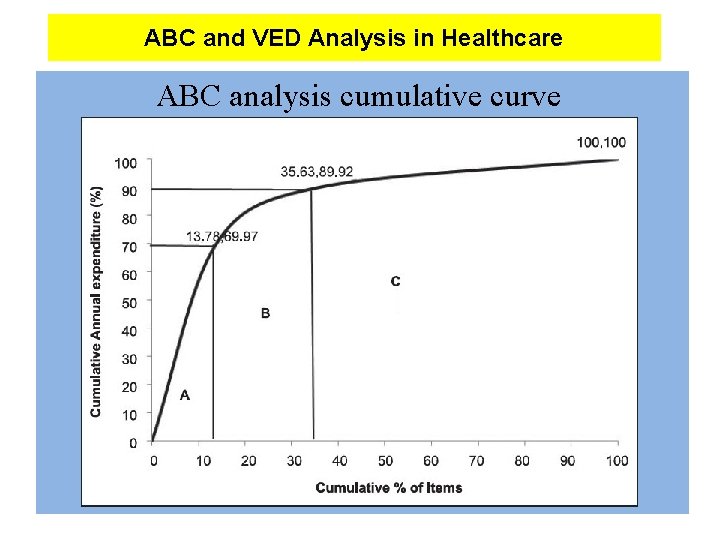
ABC and VED Analysis in Healthcare ABC analysis • The annual expenditure of individual items was arranged in descending order. • The cumulative cost of all the items was calculated. The cumulative percentage of expenditure and the cumulative percentage of number of items were calculated. • This list was then subdivided into three categories: A, B and C, based on the cumulative cost percentage of 70%, 20% and 10%, respectively.
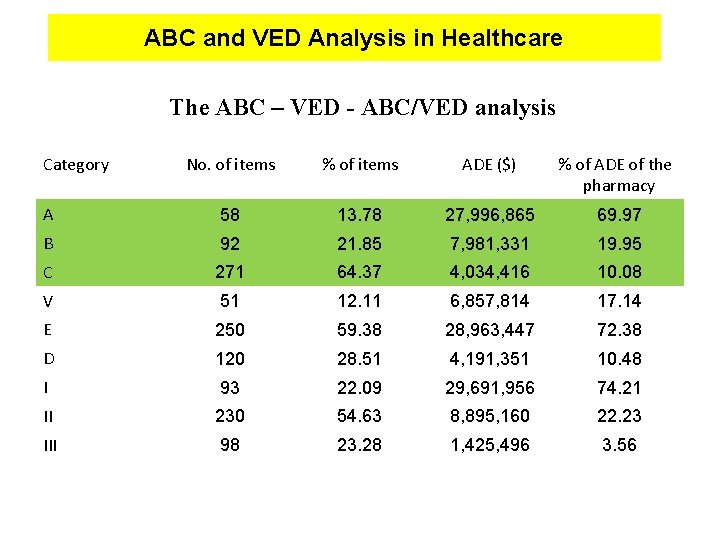
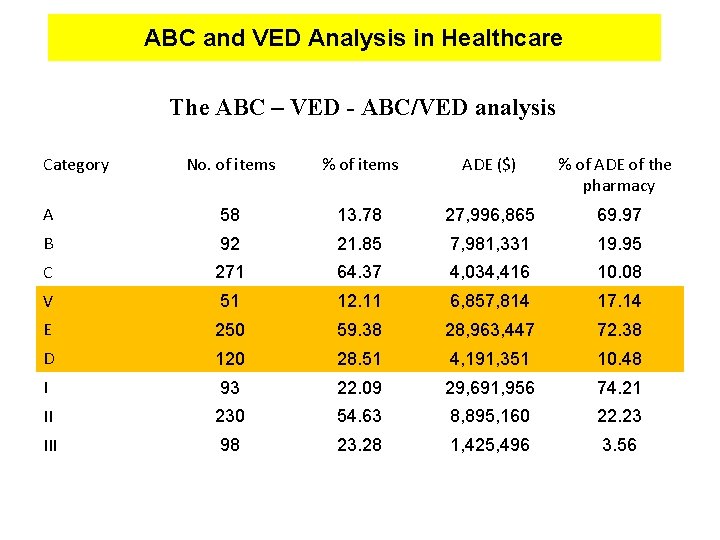
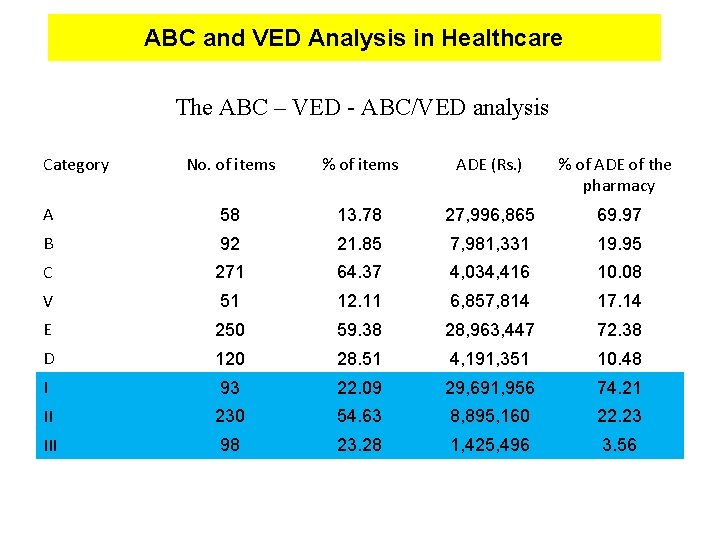
ABC and VED Analysis in Healthcare The ABC – VED - ABC/VED analysis Category No. of items % of items ADE ($) % of ADE of the pharmacy A 58 13. 78 27, 996, 865 69. 97 B 92 21. 85 7, 981, 331 19. 95 C 271 64. 37 4, 034, 416 10. 08 V 51 12. 11 6, 857, 814 17. 14 E 250 59. 38 28, 963, 447 72. 38 D 120 28. 51 4, 191, 351 10. 48 I 93 22. 09 29, 691, 956 74. 21 II 230 54. 63 8, 895, 160 22. 23 III 98 23. 28 1, 425, 496 3. 56
ABC and VED Analysis in Healthcare ABC analysis 13. 78% (58), 21. 85% (92) and 64. 37% (271) items were found to be A, B and C category items, respectively. Amounting for 69. 97% ($ 27, 996, 865), 19. 95% ($ 7, 981, 331) and 10. 08% ($ 4, 034, 416) of ADE of the pharmacy
ABC and VED Analysis in Healthcare ABC analysis cumulative curve
ABC and VED Analysis in Healthcare VED analysis • The VED criticality analysis of all the listed items was performed by classifying the items into vital (V), essential (E) and desirable (D) categories. • The items critically needed for the survival of the patients and those that must be available at all times were included in the V category. • The items with a lower criticality need and those that may be available in the hospital were included in the E group. • The remaining items with lowest criticality, the shortage of which would not be detrimental to the health of the patients, were included in the D group.
ABC and VED Analysis in Healthcare The ABC – VED - ABC/VED analysis Category No. of items % of items ADE ($) % of ADE of the pharmacy A 58 13. 78 27, 996, 865 69. 97 B 92 21. 85 7, 981, 331 19. 95 C 271 64. 37 4, 034, 416 10. 08 V 51 12. 11 6, 857, 814 17. 14 E 250 59. 38 28, 963, 447 72. 38 D 120 28. 51 4, 191, 351 10. 48 I 93 22. 09 29, 691, 956 74. 21 II 230 54. 63 8, 895, 160 22. 23 III 98 23. 28 1, 425, 496 3. 56
ABC and VED Analysis in Healthcare VED analysis The findings of the VED analysis: • About 12. 11% (51), 59. 38% (250) and 28. 51% (120) items were found to be V, E and D category items. • Respectively, amounting for 17. 14% ($ 6, 857, 814), 72. 38% ($ 28, 963, 447) and 10. 48% ($ 4, 191, 351) of ADE of the pharmacy.
ABC and VED Analysis in Healthcare VED analysis cumulative curve
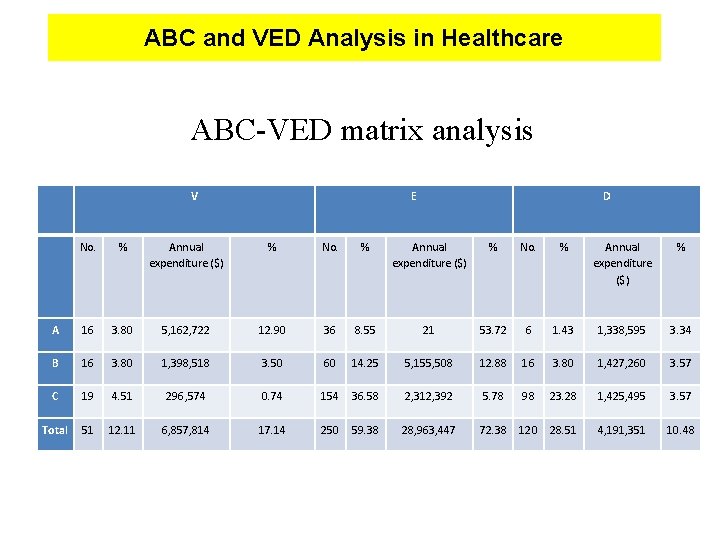
ABC and VED Analysis in Healthcare ABC-VED matrix analysis • The ABC-VED matrix was formulated by cross-tabulating the ABC and VED analysis. • From the resultant combination, three categories were classified (I, II and III). • Category I was constituted by items belonging to AV, AE, AD, BV and CV subcategories. • The BE, CE and BD subcategories constituted category II, • The CD subcategory constituted category III.
ABC and VED Analysis in Healthcare ABC-VED matrix analysis V E D No. % Annual expenditure ($) % A 16 3. 80 5, 162, 722 12. 90 36 8. 55 21 53. 72 6 1. 43 1, 338, 595 3. 34 B 16 3. 80 1, 398, 518 3. 50 60 14. 25 5, 155, 508 12. 88 16 3. 80 1, 427, 260 3. 57 C 19 4. 51 296, 574 0. 74 154 36. 58 2, 312, 392 5. 78 98 23. 28 1, 425, 495 3. 57 Total 51 12. 11 6, 857, 814 17. 14 250 59. 38 28, 963, 447 72. 38 120 28. 51 4, 191, 351 10. 48
ABC and VED Analysis in Healthcare ABC-VED matrix analysis The table shows the ABC-VED matrix analysis. Nine different subcategories (AV, AE, AD, BV, BE, BD, CV, CE and CD) were studied using this analysis. These nine were further grouped into three main categories, categories I, II and III.
ABC and VED Analysis in Healthcare The ABC – VED - ABC/VED analysis Category No. of items % of items ADE (Rs. ) % of ADE of the pharmacy A 58 13. 78 27, 996, 865 69. 97 B 92 21. 85 7, 981, 331 19. 95 C 271 64. 37 4, 034, 416 10. 08 V 51 12. 11 6, 857, 814 17. 14 E 250 59. 38 28, 963, 447 72. 38 D 120 28. 51 4, 191, 351 10. 48 I 93 22. 09 29, 691, 956 74. 21 II 230 54. 63 8, 895, 160 22. 23 III 98 23. 28 1, 425, 496 3. 56
ABC and VED Analysis in Healthcare ABC-VED matrix cumulative curve
ABC and VED Analysis in Healthcare DISCUSSION Provision of care in tertiary care hospitals is sensitive to the timely availability of facilities, including drugs. In case of drugs, besides the criticality factor, the cost factor must also be taken into consideration, as can be seen from our study, where about 10% of the drugs consumed about 70% of ADE of the pharmacy. This is the group requiring greater monitoring as it has fewer drugs consuming most of the money. We also noted that not all the drugs in this group were vital or essential. It also had drugs from the desirable category. Categorization of drugs by the ABCVED matrix model helps to narrow down on fewer drugs requiring stringent control.
ABC and VED Analysis in Healthcare ABC analysis The present study showed that if ABC analysis is considered alone for drug inventory, it would help effectively control the recommended 58 (13. 78%) items in the A category, with almost 70% of ADE of the pharmacy, but it would compromise on the availability of items of vital nature from B and C categories (35 items, 8. 31%).
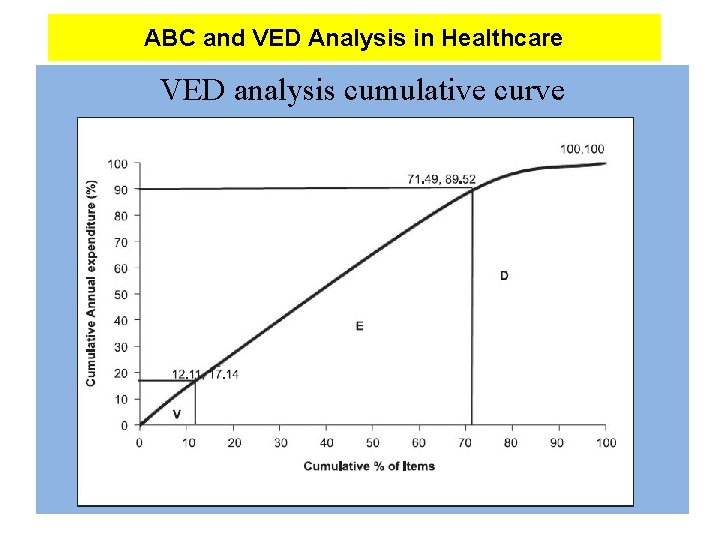
ABC and VED Analysis in Healthcare VED analysis If VED analysis alone is considered, ideal control can be exercised on the identified vital and/or essential items, accounting for 89. 52% of ADE of the pharmacy. However, category A also contains six desirable items with 3. 34% of ADE of the pharmacy and hence it is not possible to ignore the desirable group completely.
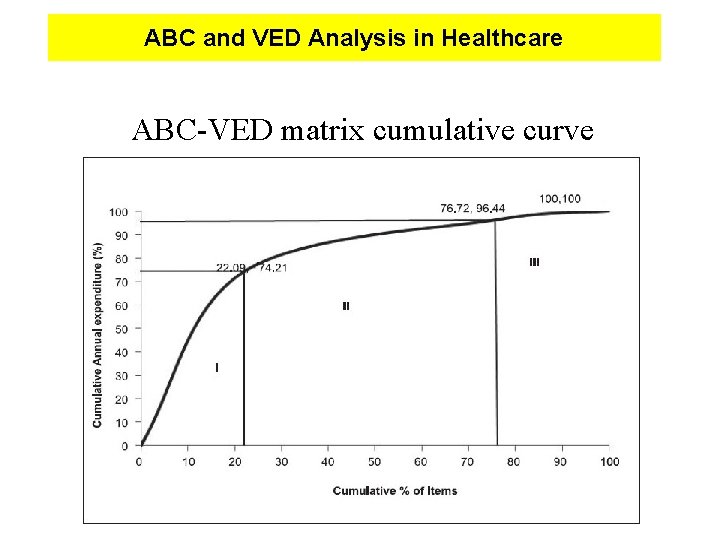
ABC and VED Analysis in Healthcare ABC-VED matrix analysis • In a combination of ABC and VED analysis, the resultant matrix makes it possible to focus on 93 (22. 09%) items belonging to category I for strict managerial control as these items are either expensive or vital. The annual expenditure of these items was 74. 21% of ADE of the pharmacy. • AV, AE and BV subgroups of category I consist of 68 items (16. 15%) that are expensive (70. 12% of ADE), and their being out of stock is unacceptable as they are either vital or essential. • To prevent locking up of capital due to these items, low buffer stock needs to be maintained while keeping a strict vigil on the consumption level and the stock in hand.
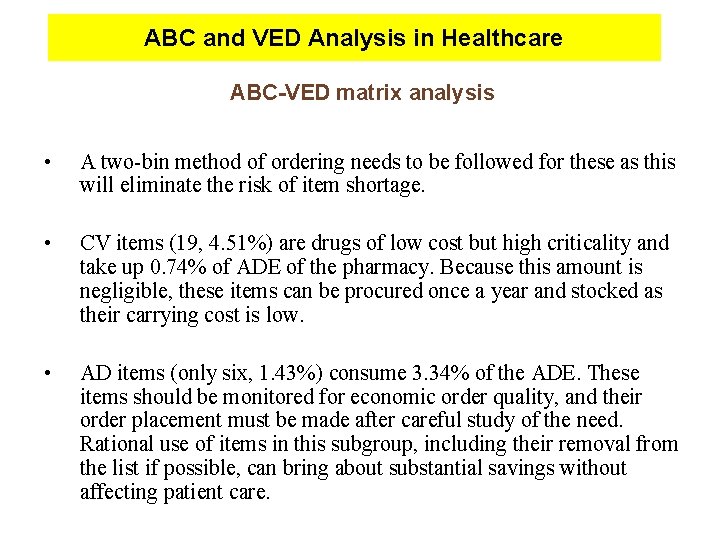
ABC and VED Analysis in Healthcare ABC-VED matrix analysis • A two-bin method of ordering needs to be followed for these as this will eliminate the risk of item shortage. • CV items (19, 4. 51%) are drugs of low cost but high criticality and take up 0. 74% of ADE of the pharmacy. Because this amount is negligible, these items can be procured once a year and stocked as their carrying cost is low. • AD items (only six, 1. 43%) consume 3. 34% of the ADE. These items should be monitored for economic order quality, and their order placement must be made after careful study of the need. Rational use of items in this subgroup, including their removal from the list if possible, can bring about substantial savings without affecting patient care.
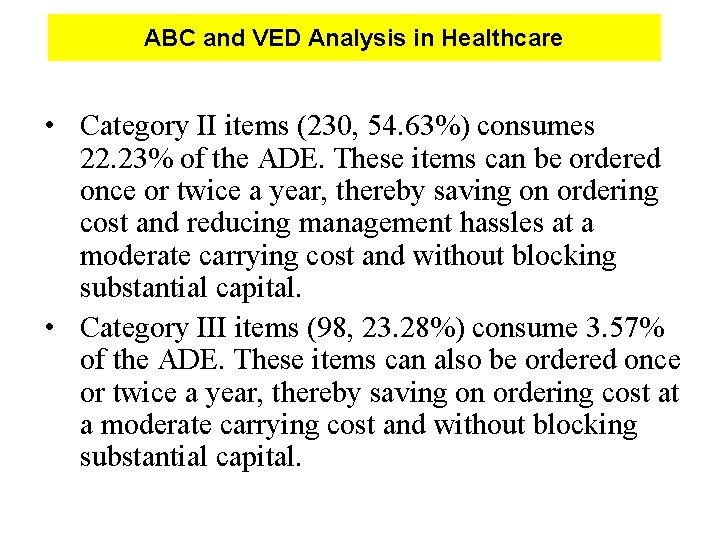
ABC and VED Analysis in Healthcare • Category II items (230, 54. 63%) consumes 22. 23% of the ADE. These items can be ordered once or twice a year, thereby saving on ordering cost and reducing management hassles at a moderate carrying cost and without blocking substantial capital. • Category III items (98, 23. 28%) consume 3. 57% of the ADE. These items can also be ordered once or twice a year, thereby saving on ordering cost at a moderate carrying cost and without blocking substantial capital.
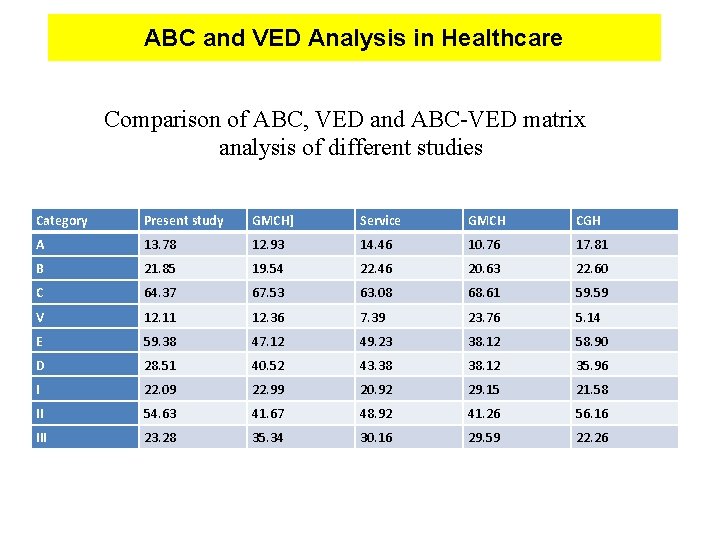
ABC and VED Analysis in Healthcare Comparison of ABC, VED and ABC-VED matrix analysis of different studies Category Present study GMCH] Service GMCH CGH A 13. 78 12. 93 14. 46 10. 76 17. 81 B 21. 85 19. 54 22. 46 20. 63 22. 60 C 64. 37 67. 53 63. 08 68. 61 59. 59 V 12. 11 12. 36 7. 39 23. 76 5. 14 E 59. 38 47. 12 49. 23 38. 12 58. 90 D 28. 51 40. 52 43. 38 38. 12 35. 96 I 22. 09 22. 99 20. 92 29. 15 21. 58 II 54. 63 41. 67 48. 92 41. 26 56. 16 III 23. 28 35. 34 30. 16 29. 59 22. 26
The comparison with similar studies showed high variation in the percentage of vital, essential and desirable This could be because different institutes have different service profiles, depending on the specialty services available.
- Slides: 28