
ABC Adaptive Beacon Control for RearEnd Collision Avoidance

ABC: Adaptive Beacon Control for Rear-End Collision Avoidance in VANETs Feng Lyu, Hongzi Zhu, Minglu Li Date: Jun 13, 2018 Dept. of Computer Science & Engineering, Shanghai Jiao Tong University 1

Outline Background and Motivation System Model Collision-Avoidance Beacon Rate Control ABC Protocole Design Simulation Setup & Evaluation 2
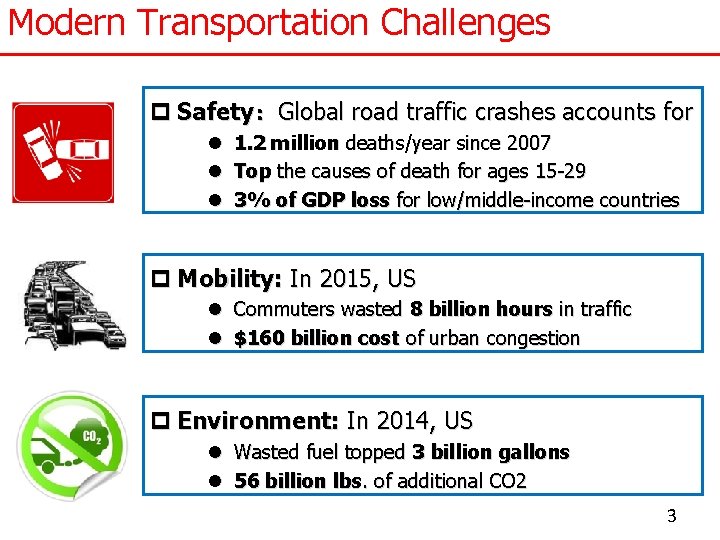
Modern Transportation Challenges p Safety:Global road traffic crashes accounts for l 1. 2 million deaths/year since 2007 l Top the causes of death for ages 15 -29 l 3% of GDP loss for low/middle-income countries p Mobility: In 2015, US l Commuters wasted 8 billion hours in traffic l $160 billion cost of urban congestion p Environment: In 2014, US l Wasted fuel topped 3 billion gallons l 56 billion lbs. of additional CO 2 3
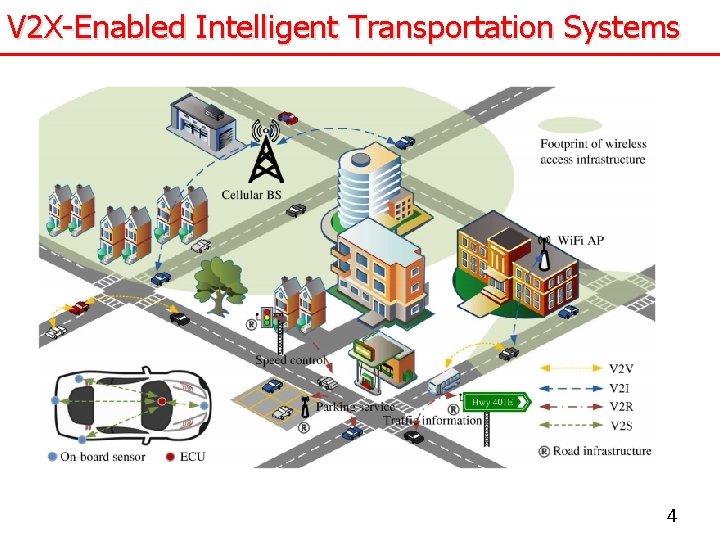
V 2 X-Enabled Intelligent Transportation Systems 4
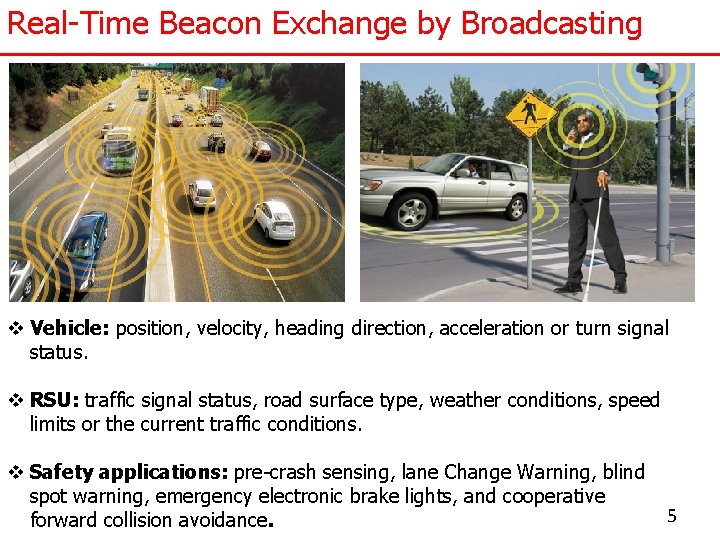
Real-Time Beacon Exchange by Broadcasting v Vehicle: position, velocity, heading direction, acceleration or turn signal status. v RSU: traffic signal status, road surface type, weather conditions, speed limits or the current traffic conditions. v Safety applications: pre-crash sensing, lane Change Warning, blind spot warning, emergency electronic brake lights, and cooperative forward collision avoidance. 5
Challenges of Widely Employing Broadcasting p Given the limited available bandwidth for V 2 X communications, how to guarantee the safety requirement of each vehicle, especially for dense traffic scenarios, is not trivial: l aggressive beaconing rates make some vehicles have no required bandwidth (channel congested); l moderate beaconing rates make the status of neighboring vehicles may be out-of-date. p The lack of a global central unit in VANETs makes an optimal beaconing scheme very hard to achieve. p Due to the high mobility of vehicles and fast changing environments, the distributed beaconing scheme should minimize the communication overhead and react fast to keep the pace. Goal: Adaptively control beacon rates with safety-awareness 6
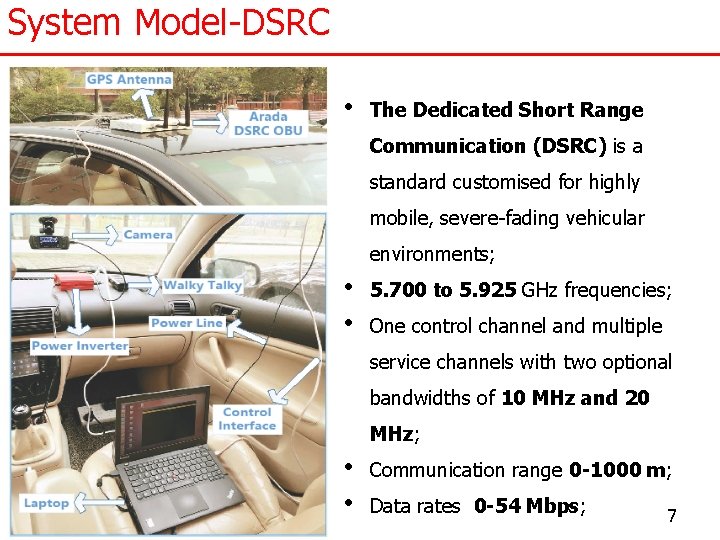
System Model-DSRC • The Dedicated Short Range Communication (DSRC) is a standard customised for highly mobile, severe-fading vehicular environments; • • 5. 700 to 5. 925 GHz frequencies; One control channel and multiple service channels with two optional bandwidths of 10 MHz and 20 MHz; • • Communication range 0 -1000 m; Data rates 0 -54 Mbps; 7
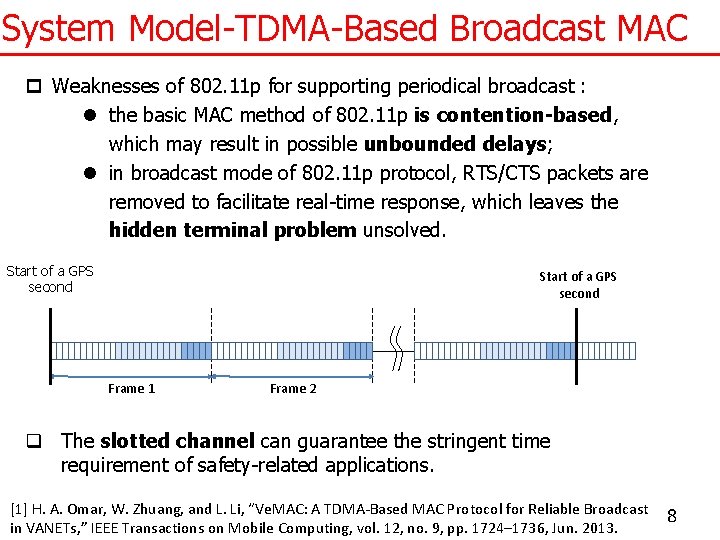
System Model-TDMA-Based Broadcast MAC p Weaknesses of 802. 11 p for supporting periodical broadcast : l the basic MAC method of 802. 11 p is contention-based, which may result in possible unbounded delays; l in broadcast mode of 802. 11 p protocol, RTS/CTS packets are removed to facilitate real-time response, which leaves the hidden terminal problem unsolved. Start of a GPS second Frame 1 Frame 2 q The slotted channel can guarantee the stringent time requirement of safety-related applications. [1] H. A. Omar, W. Zhuang, and L. Li, “Ve. MAC: A TDMA-Based MAC Protocol for Reliable Broadcast in VANETs, ” IEEE Transactions on Mobile Computing, vol. 12, no. 9, pp. 1724– 1736, Jun. 2013. 8
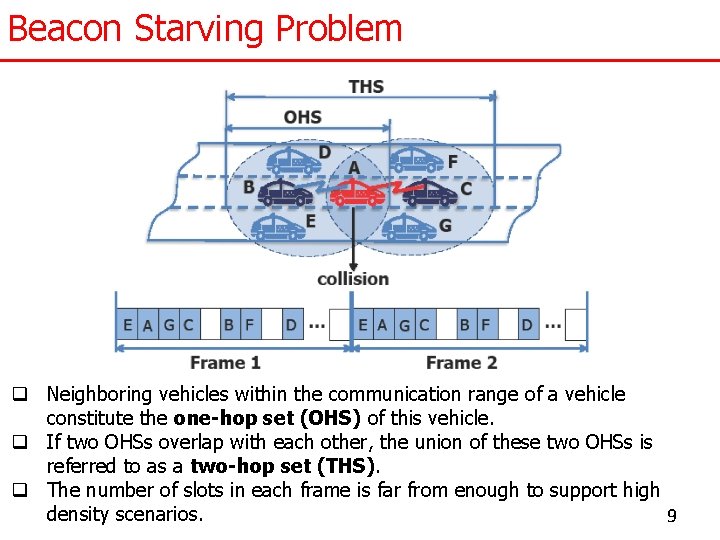
Beacon Starving Problem q Neighboring vehicles within the communication range of a vehicle constitute the one-hop set (OHS) of this vehicle. q If two OHSs overlap with each other, the union of these two OHSs is referred to as a two-hop set (THS). q The number of slots in each frame is far from enough to support high density scenarios. 9
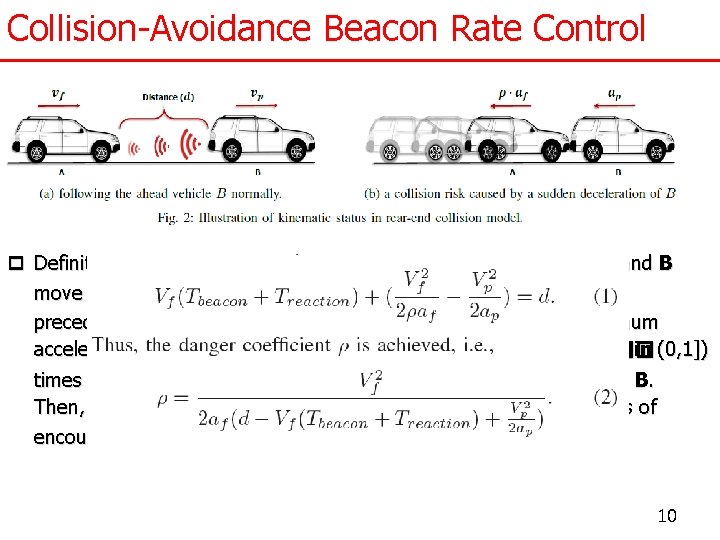
Collision-Avoidance Beacon Rate Control p Definition 1: (Danger coefficient �� ) Considering two vehicles A and B move in the same lane and A is the following vehicle while B is the preceding vehicle, if vehicle B decelerates suddenly with the maximum acceleration, after knowing the situation, vehicle A has to take �� (�� in (0, 1]) times of its maximum acceleration to brake to avoid a collision with B. Then, vehicle B is said to be dangerous with a coefficient �� in terms of encountering a rear-end collision. 10
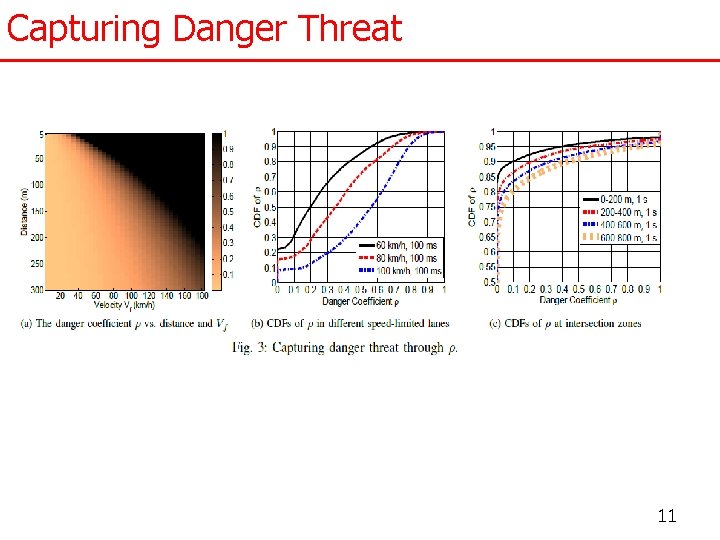
Capturing Danger Threat 11
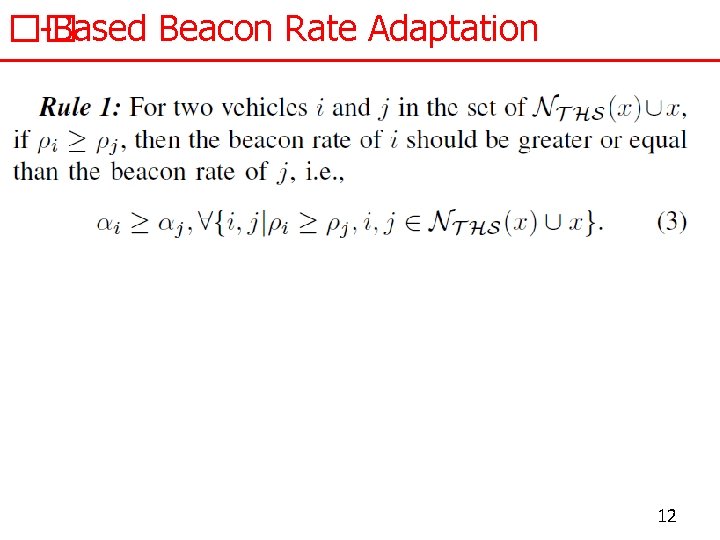
�� -Based Beacon Rate Adaptation 12
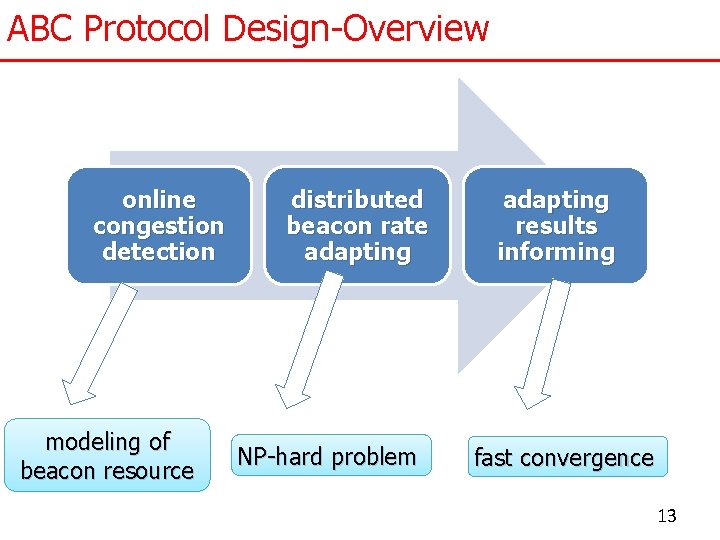
ABC Protocol Design-Overview online congestion detection modeling of beacon resource distributed beacon rate adapting NP-hard problem adapting results informing fast convergence 13
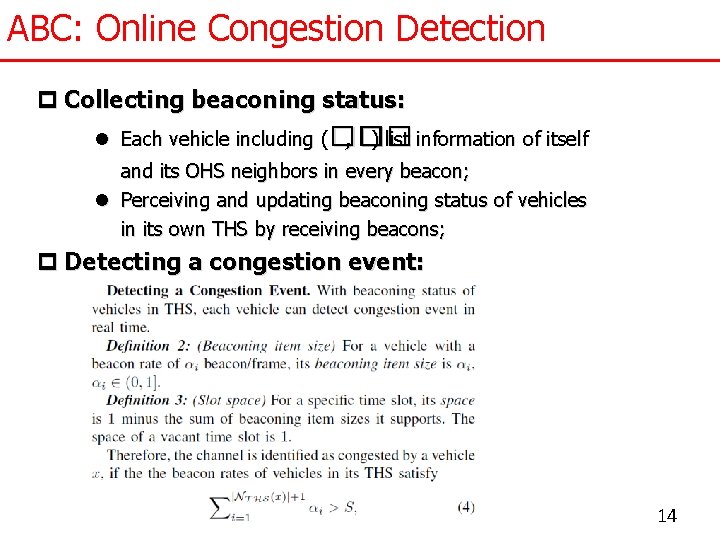
ABC: Online Congestion Detection p Collecting beaconing status: l Each vehicle including (�� , �� ) list information of itself and its OHS neighbors in every beacon; l Perceiving and updating beaconing status of vehicles in its own THS by receiving beacons; p Detecting a congestion event: 14
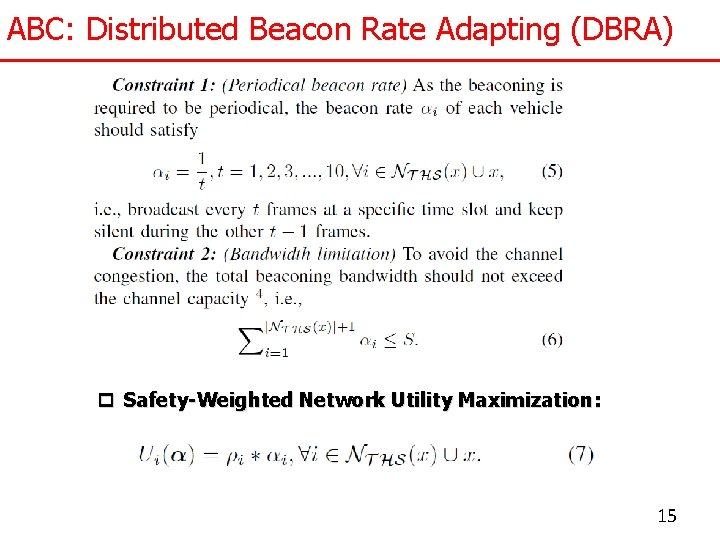
ABC: Distributed Beacon Rate Adapting (DBRA) p Safety-Weighted Network Utility Maximization: 15

ABC: Distributed Beacon Rate Adapting (DBRA) 16
ABC: Distributed Beacon Rate Adapting (DBRA) 17
ABC: Distributed Beacon Rate Adapting (DBRA) 18
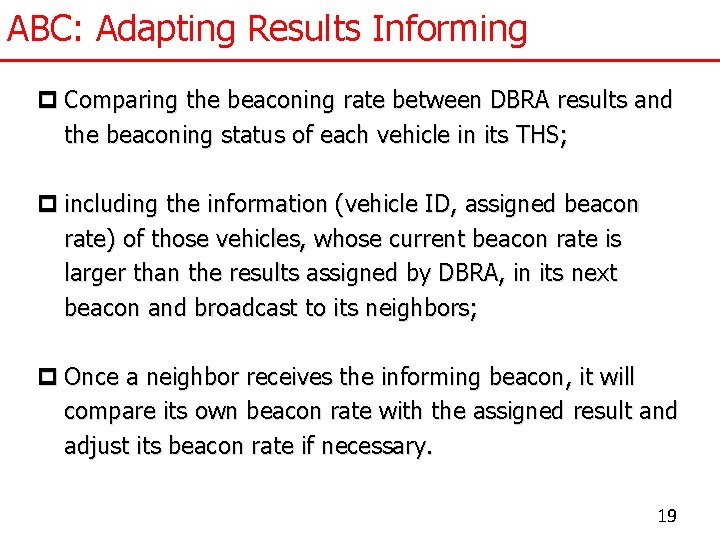
ABC: Adapting Results Informing p Comparing the beaconing rate between DBRA results and the beaconing status of each vehicle in its THS; p including the information (vehicle ID, assigned beacon rate) of those vehicles, whose current beacon rate is larger than the results assigned by DBRA, in its next beacon and broadcast to its neighbors; p Once a neighbor receives the informing beacon, it will compare its own beacon rate with the assigned result and adjust its beacon rate if necessary. 19
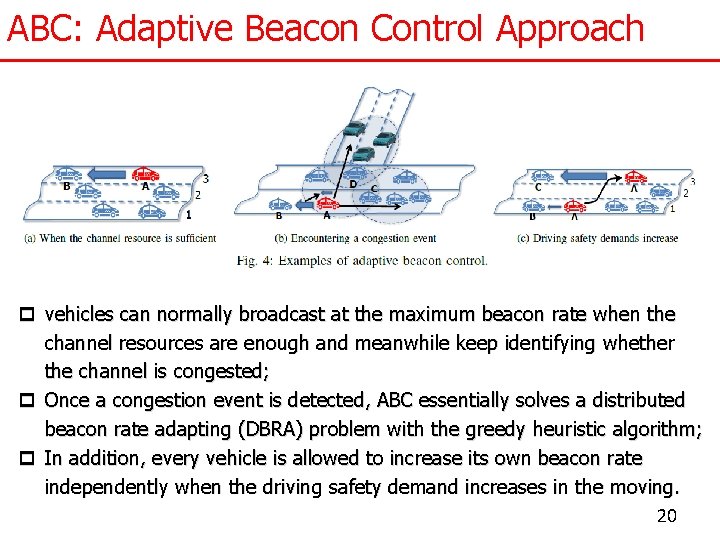
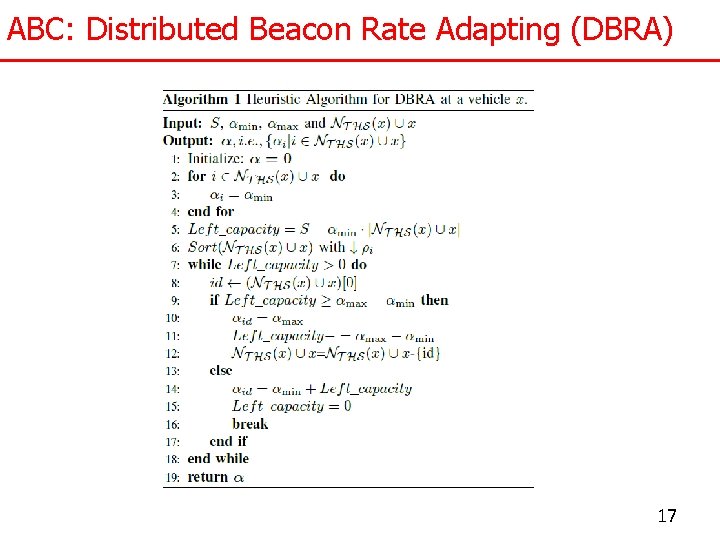
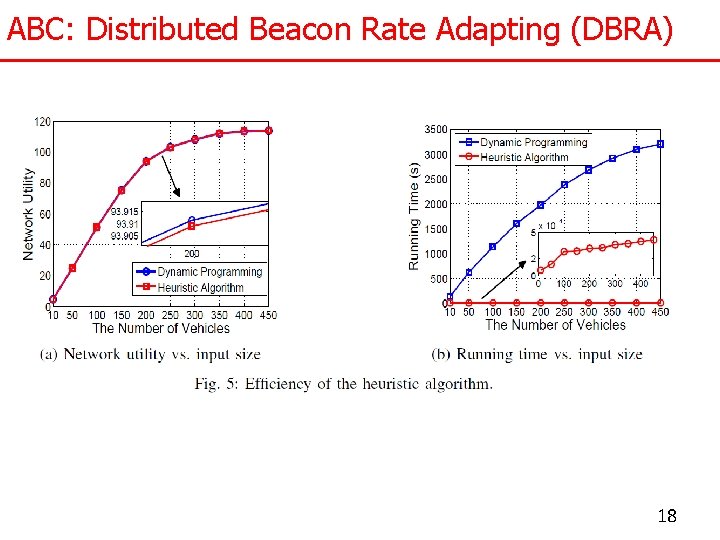
ABC: Adaptive Beacon Control Approach p vehicles can normally broadcast at the maximum beacon rate when the channel resources are enough and meanwhile keep identifying whether the channel is congested; p Once a congestion event is detected, ABC essentially solves a distributed beacon rate adapting (DBRA) problem with the greedy heuristic algorithm; p In addition, every vehicle is allowed to increase its own beacon rate independently when the driving safety demand increases in the moving. 20
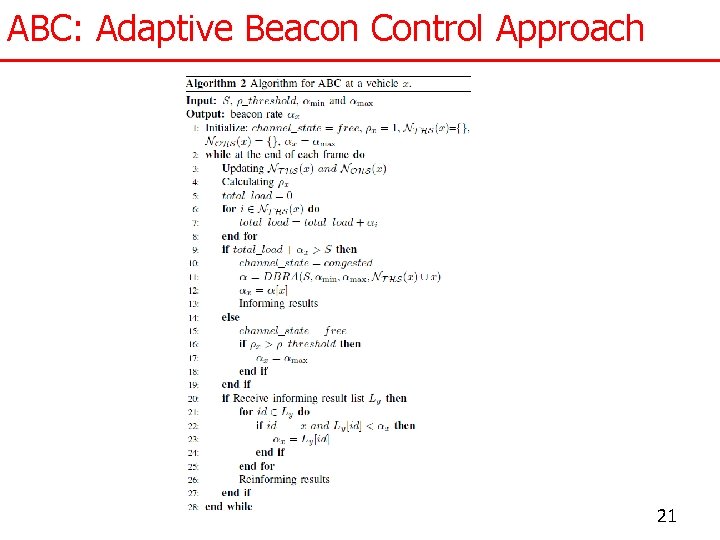
ABC: Adaptive Beacon Control Approach 21

Performance Evaluation p Candidate Schemes: l Conventional 802. 11 p: In broadcast mode of 802. 11 p protocol, each vehicle broadcasts at maximum beacon rate without any congestion control schemes; l LIMERIC: It treats all nodes equally regardless of the driving context, i. e. , controlling with fairness. p Performance Metrics: l Rate of beacon transmissions: refers to the average number of beacon transmissions per frame; l Efficiency ratio of transmissions: refers to the number of successful transmissions to the total number of transmissions; l Rate of beacon receptions: refers to the average number of successfully received beacons per frame; l Rate of reception collisions: refers to the average number of reception collisions per frame happened at receivers. 22
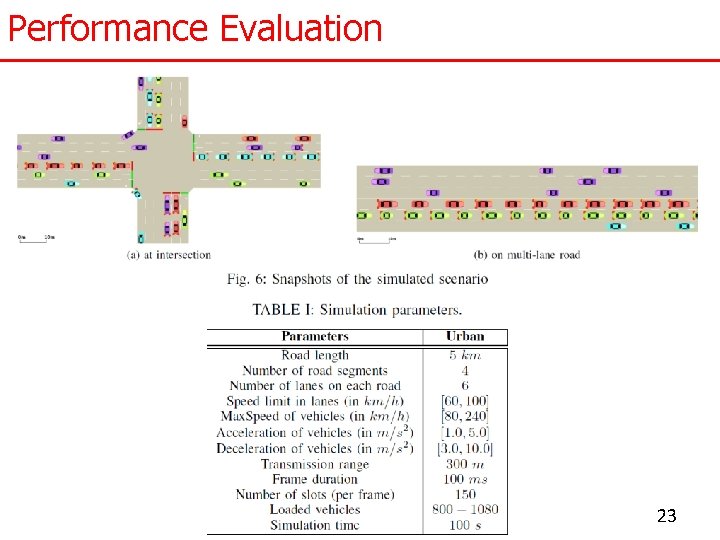
Performance Evaluation 23

Overall Results 24
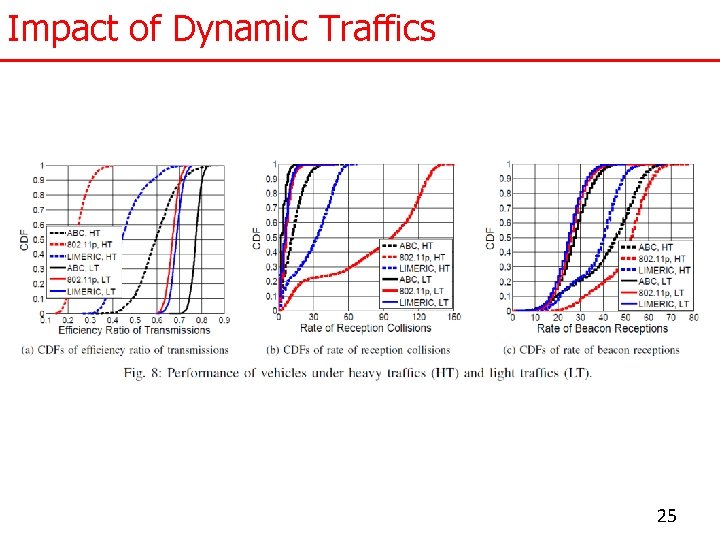
Impact of Dynamic Traffics 25
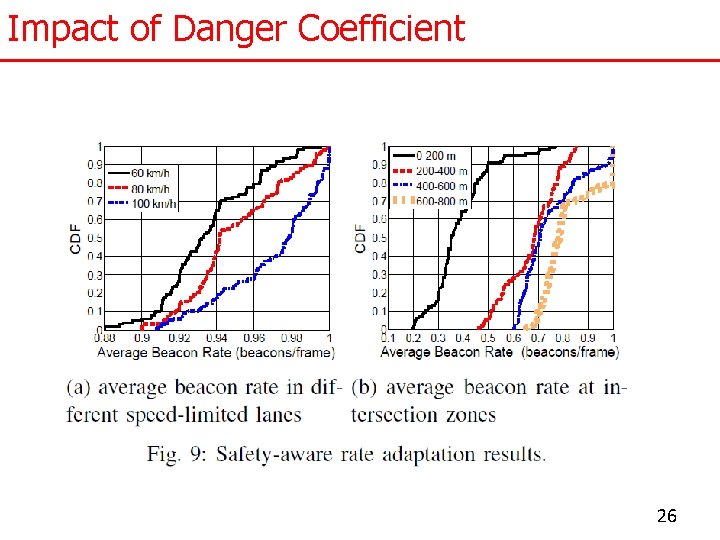
Impact of Danger Coefficient 26

Summary u We have analyzed the broadcast requirements for safety applications in VANETs and disclosed the necessary of beacon congestion control to prevent the control channel being blocked. u We have proposed a distributed adaptive beacon control scheme, called ABC, to dynamically adapt beacon rate for each vehicle, which is sufficient to avoid a rear-end collision without exceeding the capacity limit. u We have implemented the ABC scheme over SUMOgenerated traces by python (with about 500 lines of code) and conducted extensive simulations to demonstrate the efficiency of ABC. 27

Questions? • Feng Lyu (fenglv@sjut. edu. cn) • Date: Jun 13, 2018 • Shanghai Jiao Tong University 28
- Slides: 28