
ABBE Level 3 Diploma in Non Domestic Assessor
ABBE Level 3 Diploma in Non. Domestic Assessor Course 2. Pre-course reading - Course introduction § Training Overview Acronyms § Background § Stroma Certification – ABBE Level 3 NDEA Course (Pre-course material) © Stroma Certification 2016 | Version 1. 0
Training Overview The aim of the course is: To provide attendees with a basic knowledge of how to carry out i. SBEM Level 3 Assessments. To verify the competence and suitability of attendees to become i. SBEM Level 3 Assessors. Stroma Certification – ABBE Level 3 NDEA Course (Pre-course material) © Stroma Certification 2016 | Version 1. 0
Training Overview This session will consist of the following: § Acronyms commonly referred to in the course. § DCLG – Department of Communities and Local Government. § EPBD – Energy Performance of Building’s Directive. (Why, what, when, who? ) § Energy Performance Certificates (EPCs). § Part ‘L’ Compliance. (New Build and Existing) Stroma Certification – ABBE Level 3 NDEA Course (Pre-course material) © Stroma Certification 2016 | Version 1. 0
Acronyms CLG Department of Government department responsible for (amongst other Communities things) building regulations, planning policy, and & Local Government implementation of EPBD The Energy Performance in Buildings Directive EPC Energy Performance The output from an Energy Assessment that shows that Certificate calculated energy and CO 2 emissions performance of a building, rated from A (best) to G (worst). Similar in appearance to the format used for electrical appliances. An EU Directive, adopted by the UK and other Member States, that requires energy rating of buildings to help reduce CO 2 emissions through consumer demand for greater energy efficiency. Stroma Certification – ABBE Level 3 NDEA Course (Pre-course material) © Stroma Certification 2016 | Version 1. 0
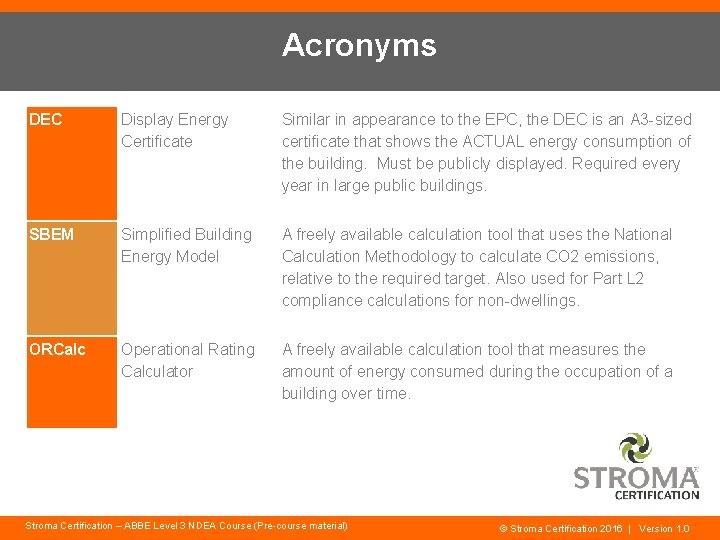
Acronyms DEC Display Energy Certificate Similar in appearance to the EPC, the DEC is an A 3 -sized certificate that shows the ACTUAL energy consumption of the building. Must be publicly displayed. Required every year in large public buildings. SBEM Simplified Building Energy Model A freely available calculation tool that uses the National Calculation Methodology to calculate CO 2 emissions, relative to the required target. Also used for Part L 2 compliance calculations for non-dwellings. ORCalc Operational Rating Calculator A freely available calculation tool that measures the amount of energy consumed during the occupation of a building over time. Stroma Certification – ABBE Level 3 NDEA Course (Pre-course material) © Stroma Certification 2016 | Version 1. 0
DCLG Department of Communities and Local Government “We would all like to be part of a safe, prosperous and healthy community. A community where everyone has the right to the same opportunities, freedom and respect. Somewhere we can be proud of. ” DCLG is working hard to create thriving, sustainable, vibrant communities that improve everyone’s quality of life. To achieve this we are: § Building more and better homes – and reducing homelessness. § Improving local public services. § Regenerating areas to create more jobs. § Working to produce a sustainable environment. § Tackling anti-social behavior and extremism. Stroma Certification – ABBE Level 3 NDEA Course (Pre-course material) © Stroma Certification 2016 | Version 1. 0
DCLG Department of Communities and Local Government (DCLG) continued. § DCLG sets policy on local government, housing, urban regeneration, planning and fire and rescue. We have responsibility for all race equality, equality and community cohesion related issues in England for building regulations, fire safety and some housing issues in England Wales. www. communities. gov. uk Stroma Certification – ABBE Level 3 NDEA Course (Pre-course material) © Stroma Certification 2016 | Version 1. 0
EPBD Energy Performance of Buildings Directive. (2002) (EPBD) • Reducing energy consumption and eliminating wastage are among the main goals of the European Union (EU). EU support for improving energy efficiency will prove decisive for competitiveness, security of supply and for meeting the commitments on climate change made under the Kyoto protocol. – There is significant potential for reducing consumption. With 50% of our energy consumed in buildings, the EU has introduced legislation to ensure that less energy is consumed. – A key part of this legislation is the Energy Performance of Buildings Directive (EPBD) which requires all EU countries to enhance their building regulations and to introduce energy certification schemes for buildings. All countries are also required to have inspections of boilers and air-conditioners. Stroma Certification – ABBE Level 3 NDEA Course (Pre-course material) © Stroma Certification 2016 | Version 1. 0
EPBD The introduction of national laws meeting EU requirements is challenging, as the legislation has many advanced aspects. It is a great opportunity to mobilise energy efficiency in EU buildings, but is also a formidable and continuing challenge for many EU countries. To support EU countries in this task, the Concerted Action (CA) EPBD was launched by the European Commission to promote dialogue and exchange of best practice between them. This forum now includes representatives from 29 countries and focuses on finding common approaches to the most effective implementation of this legislation. When initiated in 2005, most countries were still at the planning stage, but are now well advanced, and the approach was enhanced in 2007. The CA is funded under Intelligent Energy-Europe under the European Union’s Competitiveness and Innovation Programme. Stroma Certification – ABBE Level 3 NDEA Course (Pre-course material) © Stroma Certification 2016 | Version 1. 0
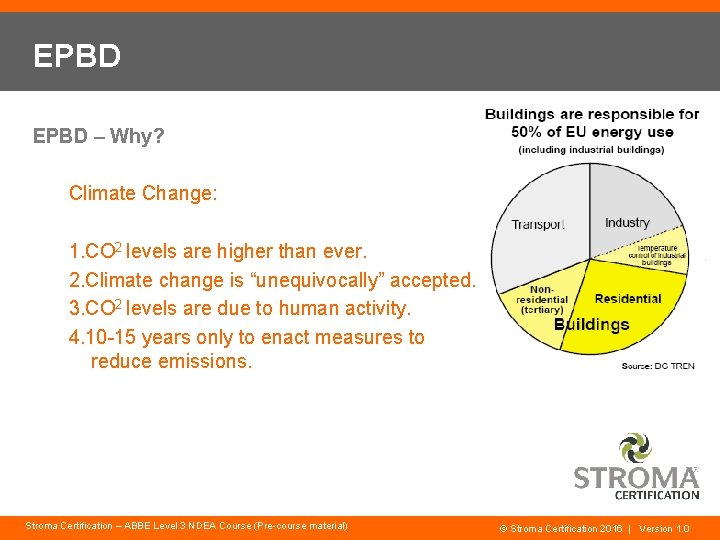
EPBD – Why? Climate Change: 1. CO 2 levels are higher than ever. 2. Climate change is “unequivocally” accepted. 3. CO 2 levels are due to human activity. 4. 10 -15 years only to enact measures to reduce emissions. Stroma Certification – ABBE Level 3 NDEA Course (Pre-course material) © Stroma Certification 2016 | Version 1. 0
EPBD – What? Energy Labels: 1. First we had washing machines and white goods. 2. Then we had cars. 3. Now we have buildings. Introduced through EU Directive 2002. Stroma Certification – ABBE Level 3 NDEA Course (Pre-course material) © Stroma Certification 2016 | Version 1. 0
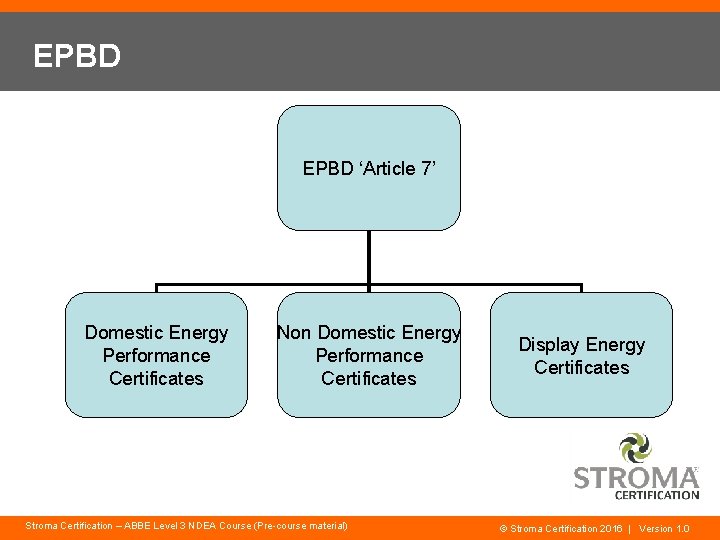
EPBD ‘Article 7’ Domestic Energy Performance Certificates Non Domestic Energy Performance Certificates Stroma Certification – ABBE Level 3 NDEA Course (Pre-course material) Display Energy Certificates © Stroma Certification 2016 | Version 1. 0
EPBD Timeline: By October 2008, all buildings whenever ‘sold’, ‘built’ or ‘rented’, will need an ‘Energy Performance Certificate (EPC)’. 1 st October 2008, ‘Display Energy Certificates’ required for ‘public buildings’ > 1, 000 m 2 4 th January 2009, Inspection of all existing air-conditioning systems > 250 k. W must have occurred by this date. 4 th January 2011 First inspection of all remaining air-conditioning systems > 12 k. W must have occurred by this date. 9 th January 2013, ‘Display Energy Certificates’ required for ‘public buildings’ > 500 m 2 Stroma Certification – ABBE Level 3 NDEA Course (Pre-course material) © Stroma Certification 2016 | Version 1. 0
EPBD Also on the 9 th January 2013 the following items was approved by the Government to Recast the EPBD: § Property advertisements must include details of the Energy Performance Certificate (EPC) rating where available. § Display Energy Certificates (DEC) are required in public buildings more than 500 m² in size, But now DECs for buildings under 1, 000 m² are valid for ten years. § Private sector buildings larger than 500 m² that already have an EPC, and are visited by the public, must now display that EPC. § The EPC should include a list of energy efficiency recommendations that could be carried out as part of a major refurbishment, and signpost consumers to more detailed information about carrying them out. Stroma Certification – ABBE Level 3 NDEA Course (Pre-course material) © Stroma Certification 2016 | Version 1. 0
EPBD – Who? Energy Assessors: Only accredited Energy Assessors are able to carry out assessments and produce EPCs. Must be a member of a recognised Certification Scheme (STROMA) in order to lodge their EPC reports. Stroma Certification – ABBE Level 3 NDEA Course (Pre-course material) © Stroma Certification 2016 | Version 1. 0
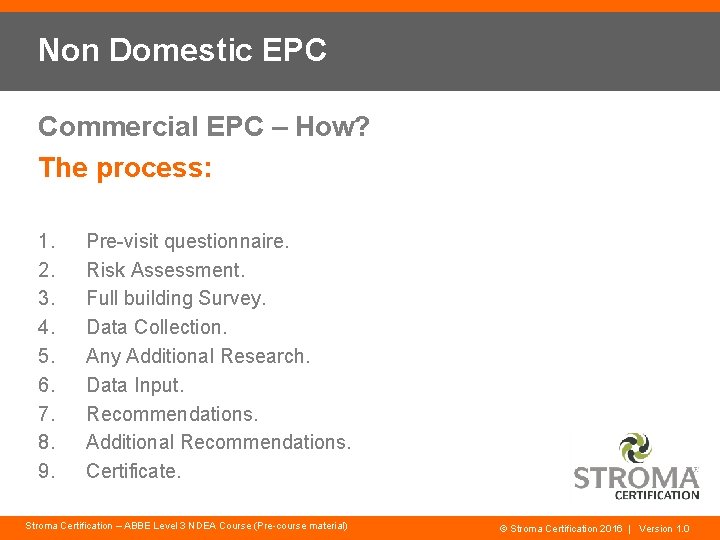
Non Domestic EPC Commercial EPC – How? The process: 1. 2. 3. 4. 5. 6. 7. 8. 9. Pre-visit questionnaire. Risk Assessment. Full building Survey. Data Collection. Any Additional Research. Data Input. Recommendations. Additional Recommendations. Certificate. Stroma Certification – ABBE Level 3 NDEA Course (Pre-course material) © Stroma Certification 2016 | Version 1. 0
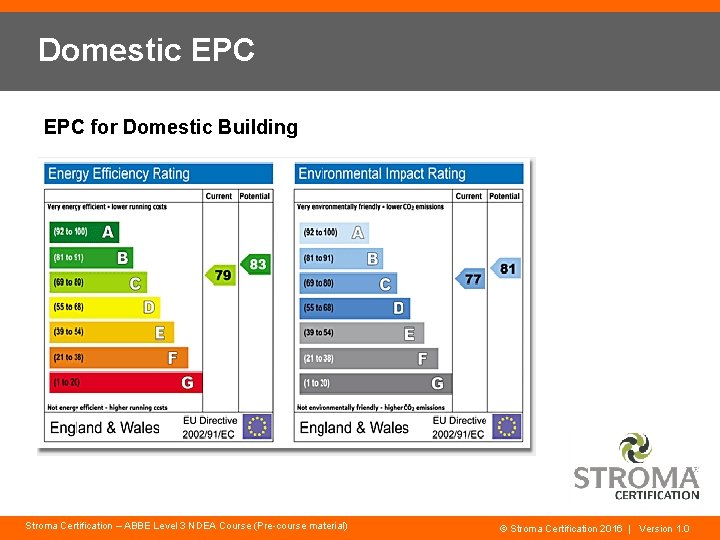
Domestic EPC for Domestic Building Stroma Certification – ABBE Level 3 NDEA Course (Pre-course material) © Stroma Certification 2016 | Version 1. 0
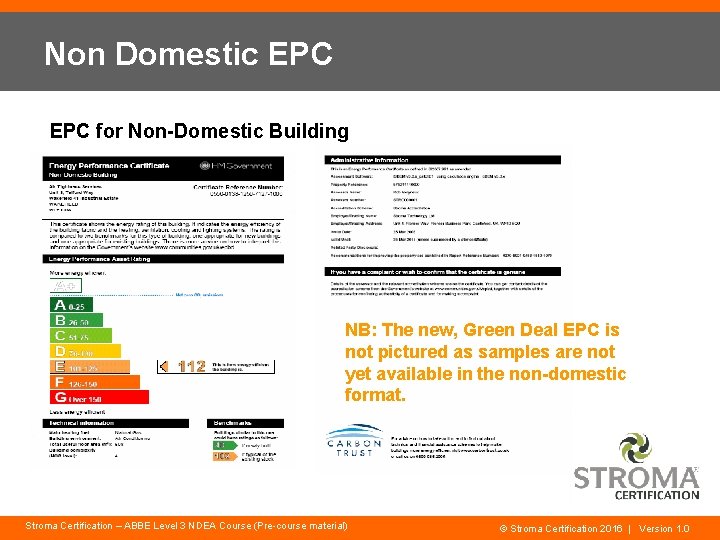
Non Domestic EPC for Non-Domestic Building NB: The new, Green Deal EPC is not pictured as samples are not yet available in the non-domestic format. Stroma Certification – ABBE Level 3 NDEA Course (Pre-course material) © Stroma Certification 2016 | Version 1. 0
Non Domestic EPC Non Domestic ‘Energy Performance Certificates’: § § § Asset Ratings (Numerical indication of the amount of energy needed to meet the standardised use of the building). Calculated using SBEM. Normalised for ‘Occupancy’ and ‘Weather’. It Recognises a variety of ‘Activities’ within the building. Applies to both ‘New’ and ‘Existing buildings’. Stroma Certification – ABBE Level 3 NDEA Course (Pre-course material) © Stroma Certification 2016 | Version 1. 0
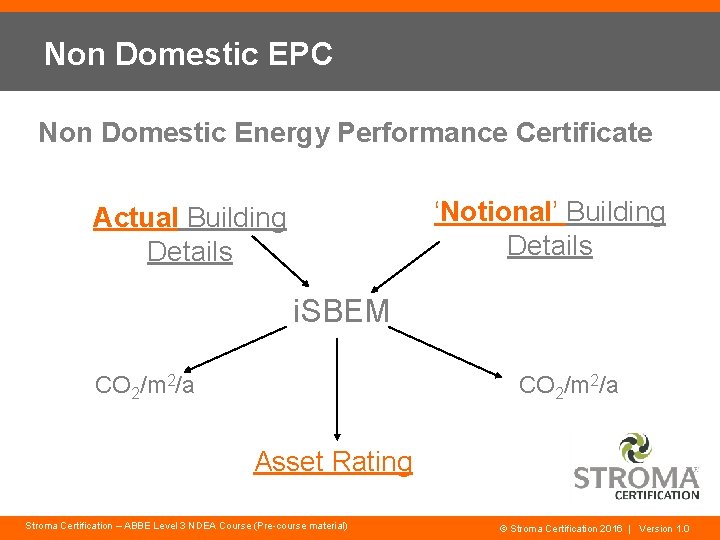
Non Domestic EPC Non Domestic Energy Performance Certificate ‘Notional’ Building Details Actual Building Details i. SBEM CO 2/m 2/a Asset Rating Stroma Certification – ABBE Level 3 NDEA Course (Pre-course material) © Stroma Certification 2016 | Version 1. 0
Non Domestic EPC Non Domestic Energy Performance Certificate The Notional Building: This is defined in the Advisory Documents. In essence, it is a building of the same size, shape and use as the actual building, but with U-values etc. that are compliant with current building regulations. Stroma Certification – ABBE Level 3 NDEA Course (Pre-course material) © Stroma Certification 2016 | Version 1. 0
Non Domestic EPC Energy Performance Certificate 1. 2. 3. 4. 5. ‘A-G’ Rating Demonstrate Compliance Benchmark for the Building (type) Recommendations Report Is valid for up to 10 years But there is no obligation to: Either ‘Implement’ the recommendations or Display the Certificate Stroma Certification – ABBE Level 3 NDEA Course (Pre-course material) © Stroma Certification 2016 | Version 1. 0
Non Domestic EPC Levels of EPC Assessors: § Level 3 – Simple existing buildings using SBEM calculation methodolody § Level 4 – All buildings (‘New and Existing’) using SBEM calculation methodology § Level 5 – Highly qualified consultants able to survey complex buildings using dynamic simulation modelling Stroma Certification – ABBE Level 3 NDEA Course (Pre-course material) © Stroma Certification 2016 | Version 1. 0
Non Domestic EPC Exemptions: § § Places of Worship Temporary buildings in use for less than 2 years. (e. g. Site Offices) Stand-alone buildings less than 50 m 2 (Sheds, Summer Houses). Buildings that do not use energy to condition the indoor climate (no HVAC systems present). Stroma Certification – ABBE Level 3 NDEA Course (Pre-course material) © Stroma Certification 2016 | Version 1. 0
Part L 2 A – New Non-Domestic Buildings PART ‘L’ COMPLIANCE: (New build only – Level 4) For compliance with Part L 2 A the ‘BER’ < ‘TER’ BER = Building Emission Rating TER = Target Emission Rating Stroma Certification – ABBE Level 3 NDEA Course (Pre-course material) © Stroma Certification 2016 | Version 1. 0
Part L 2 A – New Non-Domestic Buildings What influences compliance with Part L 2? 1. As with domestic EPC, commercial EPC compliance is influenced by ‘U’-Values, Plant Efficiency, Lighting and Air Leakage. 2. A higher Improvement Factor is applied if the building is Mechanically Ventilated or Air Conditioned. This reduces the Target Emission Rate, making Compliance more challenging. 3. Effective lighting control, energy metering and heat recovery ventilation all influence compliance. 4. Limiting of Solar Gains is required in addition to Emission Rate calculation. 5. Looking at improved solar properties of glazing and potential shading devices may be required to achieve compliance within this criteria. 6. Emission Rate Calculation links into Rating for EPC’s by providing Asset Rating. Stroma Certification – ABBE Level 3 NDEA Course (Pre-course material) © Stroma Certification 2016 | Version 1. 0
- Slides: 26