
ABB Analytical Intelligent Self Describing Process Analytical Systems
ABB Analytical Intelligent, Self Describing Process Analytical Systems Chemicals Life Sciences Cement Metals & Minerals Oil, Gas & Petrochemicals Automotive Utility
Vision A self reliant, intelligent, “self describing” process analytical system that receives, sends and acts on multivariate data to monitor, communicate and control its status and health via any networked client.
Ne. SSI Generation 2 n Opportunities For Improvement n Component Centric n Location of system level intelligence n Method for accessing, controlling, and graphically representing Ne. SSI system undefined n All components are networked
NETWORKED SHS DEVICES n SYSTEM LEVEL ADVANTAGES n Access and automatically observe and gather component ID, supplier data, etc. n Multivariate data are provided at a single node n Reduction in and management of communication cables n A/D conversion local to the SHS component
NETWORKED SHS DEVICES n SYSTEM LEVEL DISADVANTAGES n Higher costs n IS requirements for the physical layer limit the choices for a communication bus; network link budgets tend to degrade
Ne. SSI Generation 2 Opportunities n Pervasive System Philosophy n System centric architecture n System level control, awareness, access resides in a local SHS controller/server n System is object oriented and “Self Describing”
Concept Building Blocks n SHS (Networked and Non-networked Components) n Process Analyzer (Including Non-network Enabled 3 RD Party) n SHS Server/Controller
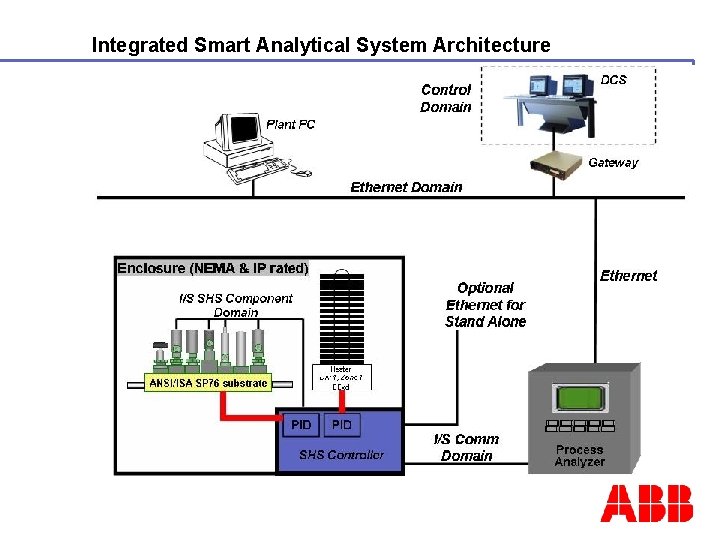
Integrated Smart Analytical System Architecture
The Value Proposition n Improved System Reliability and Serviceability n Reduced Capital Costs n Reduced Operational and Maintenance Costs
The Methodology n SHS Component Visibility Framework n n Networked and Non-Networked Components Self Describing SHS n System Level Control
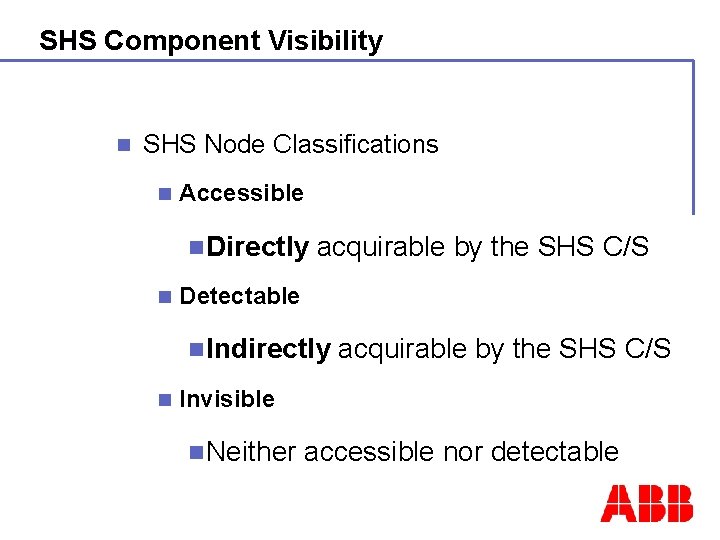
SHS Component Visibility n SHS Node Classifications n Accessible n Directly n acquirable by the SHS C/S Detectable n Indirectly n acquirable by the SHS C/S Invisible n Neither accessible nor detectable
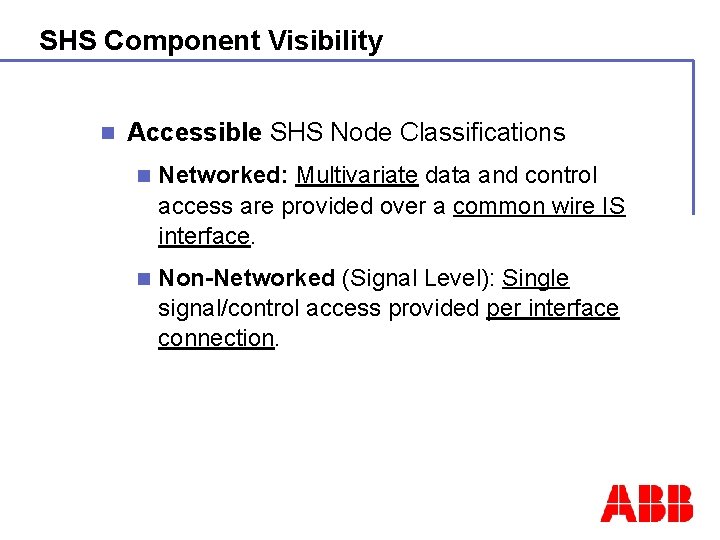
SHS Component Visibility n Accessible SHS Node Classifications n Networked: Multivariate data and control access are provided over a common wire IS interface. n Non-Networked (Signal Level): Single signal/control access provided per interface connection.
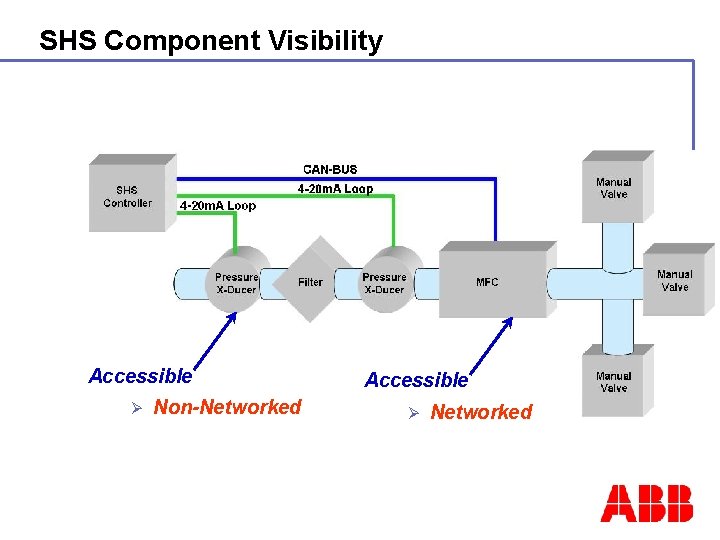
SHS Component Visibility Accessible Ø Non-Networked Accessible Ø Networked
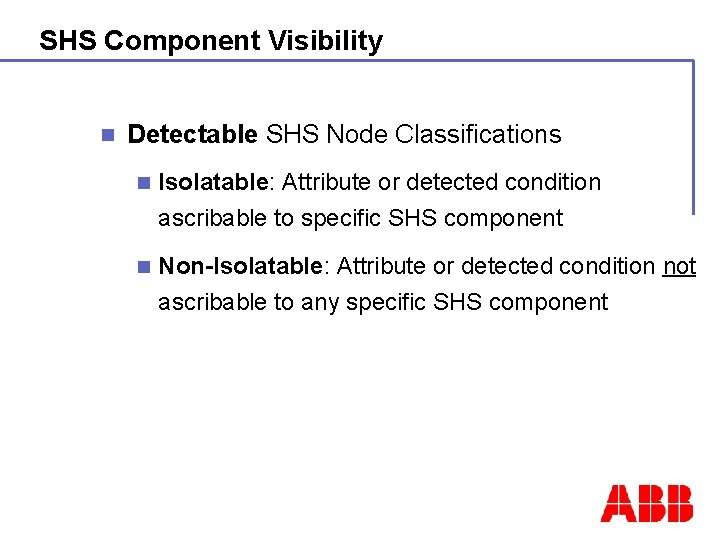
SHS Component Visibility n Detectable SHS Node Classifications n Isolatable: Attribute or detected condition ascribable to specific SHS component n Non-Isolatable: Attribute or detected condition not ascribable to any specific SHS component
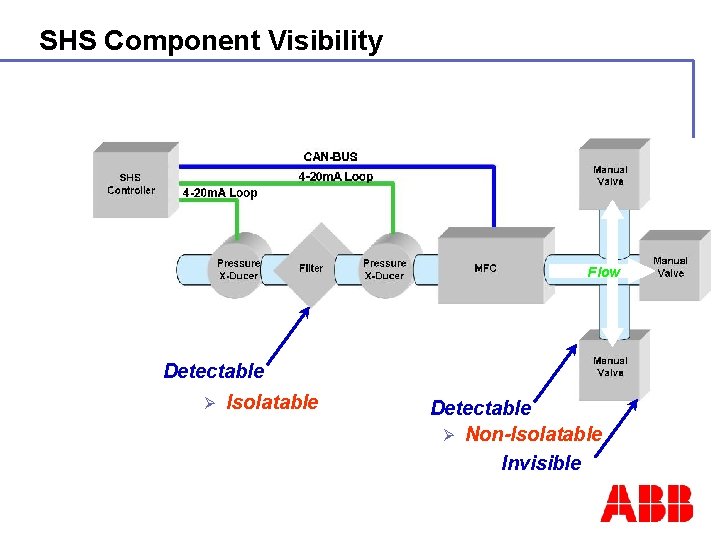
SHS Component Visibility Flow Detectable Ø Isolatable Detectable Ø Non-Isolatable Invisible
Interim Conclusions n Making all SHS components network accessible is not entirely practical nor necessary n A unified procedure for acquiring data from all SHS components (Networked and nonnetworked) and “self describing” the SHS are still needed.
The Methodology n Sample System Component Visibility n n Networked and Non-Networked Components Self Describing SHS n System Level Control
SHS SYSTEM LEVEL CONTROL n Object Orientation n Each SHS component described by an object model using standard XML schema n n Icon, port names and locations, predefined values and control fields to display component status or provide a graphical control handle, supplier specific data The component class models coupled with structures and procedures (interconnection and collective operation) make up a composite SHS class
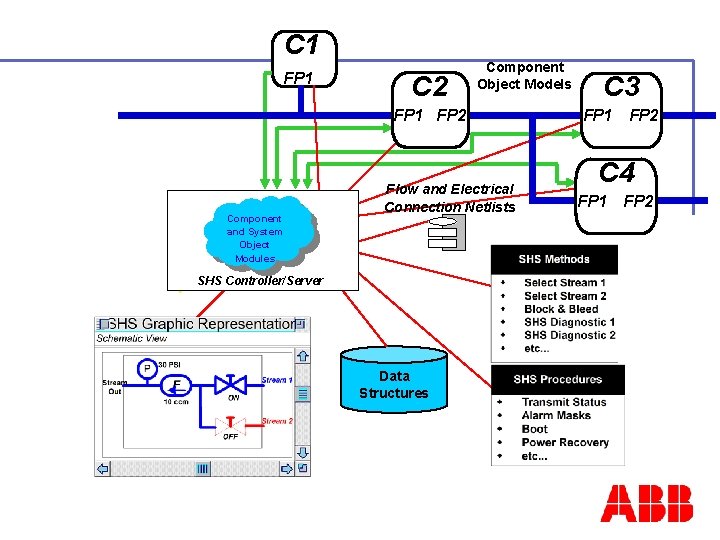
C 1 FP 1 C 2 Component Object Models FP 1 FP 2 Component and System Object Modules Flow and Electrical Connection Netlists SHS Controller/Server Data Structures C 3 FP 1 FP 2 C 4 FP 1 FP 2
SHS SYSTEM LEVEL CONTROL n SHS system centric approach n Control and access services are made available to external clients (PC, process analyzer, etc. ) via a standardized XML schema served from the SHS Controller/Server n The SHS becomes “self describing” via this server-client relationship The object oriented approach for system self description embraces a holistic view of the SHS as a coherent system of both physical and logical components that must be combined to work collectively to realize SHS functionality.
SHS SYSTEM LEVEL CONTROL n The “As-Built” Configuration n The system level representation of the SHS is now captured and described in an “As-Built” configuration file n The “As-Built” configuration file is flashed to the SHS server/controller and presented on various networked clients
SUMMARY Reduced maintenance staffs; need for increased reliability and serviceability strongly dictate the need for a system centric, self describing Smart Process Analytical System n Ne. SSI Generation 2 does not address all of the requirements for such a system n A fully functional and cost effective smart SHS is achievable with a hybrid of networked and nonnetworked n Data from all SHS components (especially nonnetworked!) can be acquired and completely represented using a self describing SHS XML approach and the Server-Client Concept n

QUESTIONS?
- Slides: 23