
AATCC TM 179 2019 Skew Change in Fabrics
AATCC TM 179 -2019 Skew Change in Fabrics After Home Laundering AATCC TM 207 -2019 Seam Twist in Garments Before and After Home Laundering

Purpose and Scope (TM 179) • Determine the change in skew of woven and knitted fabrics as a result of home laundering AATCC TM 179 & TM 207

Purpose & Scope (TM 207) • Determines the seam twist of garments before, as well as after, home laundering • Intended for garments with vertical seams AATCC TM 179 & TM 207

ASTM D 3882 Bow and Skew in Woven & Knitted Fabrics • Determination of bow and skew of filling yarns in woven fabrics and the courses in knitted fabrics. • Can also be used to measure the bow and skew of printed geometric designs. • Original state AATCC TM 179 & TM 207

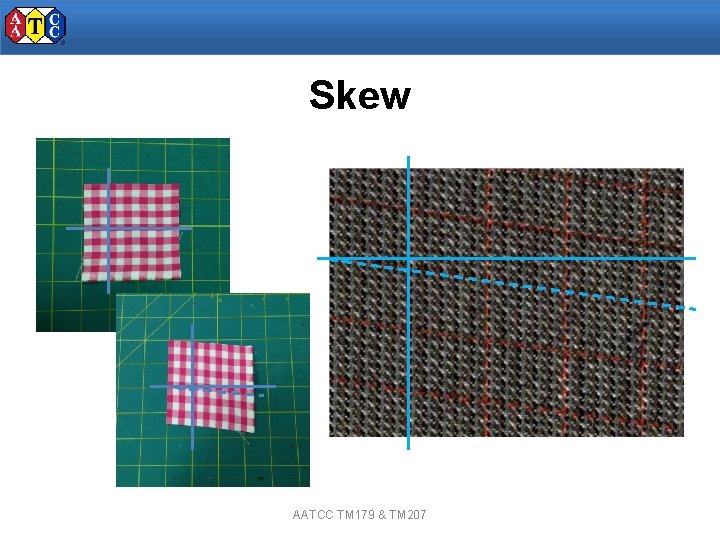
Terminology Skew (n) • A fabric condition resulting when filling yarns or knitted courses are angularly displaced from a line perpendicular to the edge or side of the fabric. rn Skew Perpendicular Line AATCC TM 179 & TM 207 ←Selvage→ Fill Ya
Skew AATCC TM 179 & TM 207

Terminology Seam twist (n) • a rotation, usually lateral, between different panels of a garment connected by a seam. NOTE: Seam twist may also be referred to as twist, torque or spirality. AATCC TM 179 & TM 207
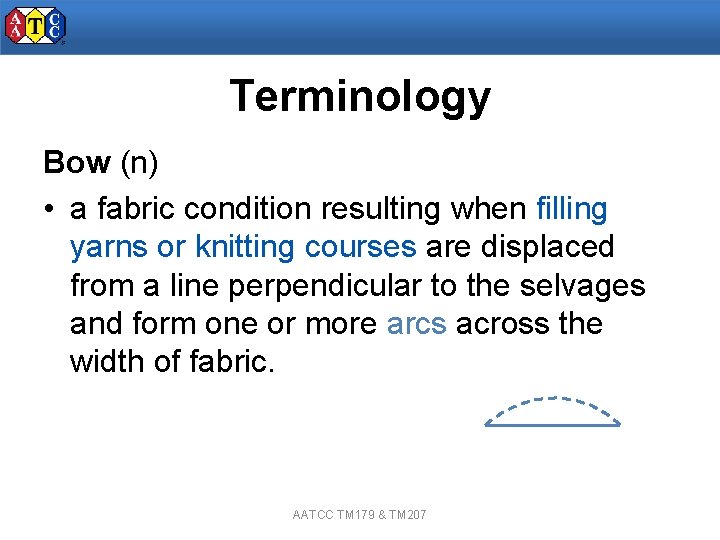
Terminology Bow (n) • a fabric condition resulting when filling yarns or knitting courses are displaced from a line perpendicular to the selvages and form one or more arcs across the width of fabric. AATCC TM 179 & TM 207

How Skew Happens • Uneven distribution of tension § § § Weaving/knitting Dyeing Tentering Finishing Other operations • Uneven release of tension in laundering AATCC TM 179 & TM 207

Why Skew Matters • Aesthetic problems § Particularly plaids and stripes § Matching patterns • Sewing problems • Draping problems AATCC TM 179 & TM 207
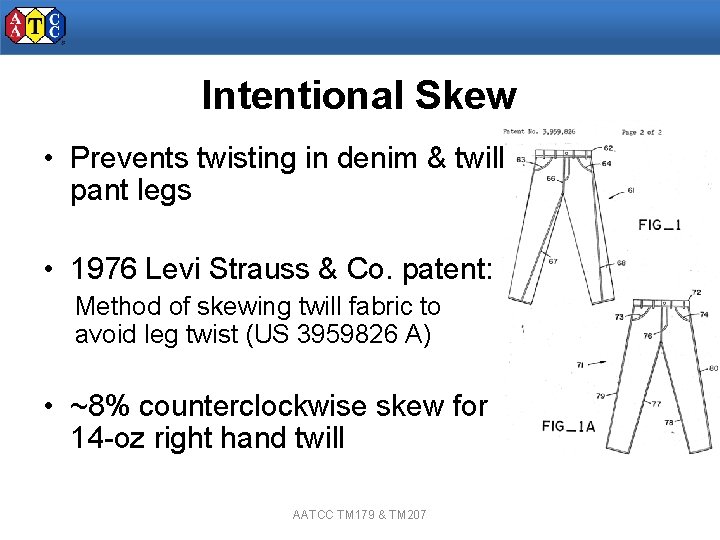
Intentional Skew • Prevents twisting in denim & twill pant legs • 1976 Levi Strauss & Co. patent: Method of skewing twill fabric to avoid leg twist (US 3959826 A) • ~8% counterclockwise skew for 14 -oz right hand twill AATCC TM 179 & TM 207

Materials • • • Conditioning facilities and racks Indelible marking pens Ruler with 0. 1 -in. or 1 -mm markings Right triangle or L-square (for TM 179) Digital imaging system (optional, for TM 179) AATCC TM 179 & TM 207

Materials • Standard washer § or facilities for hand wash • Standard tumble dryer § or facilities for drip/screen/line dry • Standard detergent • Ballast AATCC TM 179 & TM 207

Fabric Specimens (TM 179) • Three fabric specimens • Marking Method 1: 380 × 380 mm (15 × 15 in) • Marking Method 2: 380 × 660 mm (15 × 26 in) • Test in tubular state if not intended to be cut • Different warp and fill yarns • Identify location (left, center, right), if applicable • Identify face & warp direction • May also be used for TM 124, TM 135 AATCC TM 179

Fabric Specimens (TM 179) Different fill yarns Different warp yarns Mark lower right AATCC TM 179

Fabric Specimens (TM 179) • To determine if change in skew is different from one side of the fabric to the other AATCC TM 179

Garment Specimens (TM 179) • Three garment specimens, if available OR • Three areas of two garments • Use largest panel • May also be used for TM 143, TM 150, TM 207 AATCC TM 179

Garment Specimens (TM 179) AATCC TM 179

Garment Specimens (TM 207) • Three garment specimens, if available • May also be used for TM 143, TM 150, TM 179 • Determine seam(s) to evaluate for twist § Side seams § Inseams § Other vertical seams AATCC TM 207

Conditioning • • ASTM D 1776 Single layer No tension Air circulation through and around • 21°C ± 2°C (70°F ± 4°F) • 65% ± 5% relative humidity (RH) • Conditioned = moisture equilibrium AATCC TM 179 & TM 207

Fabric Marking Method 1 (TM 179) C A D Warp B AATCC TM 179

Garment Marking Method 1 (TM 179) • Bottom edge as reference • All marks ≥ 75 mm (3 in) from lower edge. B A AATCC TM 179 250 mm C 250 mm • If not straight, draw reference line perpendicular to the vertical axis of symmetry 75 mm D

Marking Method 2 (TM 179) 660 mm 380 mm Y Z 75 mm AATCC TM 179

Marking Method 2 (TM 179) B 20 500 mm (20 in) 480 mm (19 in) 15 10 5 Y Z A AATCC TM 179

Method 2, Simplified (TM 179) B 5 10 15 20 20 15 10 5 Y Z A AATCC TM 179

Marking (TM 207) • • • Lay specimen in “natural configuration” First seam visible Smooth all panels (do not stretch) Mark A at lower edge of seam Mark B 25 mm below intersection with cross seam • Measure AB AATCC TM 207

Twist Before Laundering (TM 207) • If seam falls along natural fold, original twist distance is 0. • If seam is NOT along fold, mark A' at lower edge of fold. • Measure AA' • Measure AB and AA' (if applicable) for all desired seams. AATCC TM 207
Wash: Traditional Top-Loading Washer • 1. 8 -kg or 3. 6 -kg (4 lb or 8 lb) load • 66 g AATCC 1993 Standard Reference Detergent (for either load size) • • Fill drum with water Add detergent Agitate to dissolve detergent Add load, distributing around agitator AATCC TM 179 & TM 207
Wash: High Efficiency (HE) Washer • 1. 8 -kg (4 lb) load • 50 m. L AATCC HE Standard Reference Detergent • Add detergent • Add load • Run cycle AATCC TM 179 & TM 207
Wash: Hand Wash • Refer to Monograph 5, Standardization of Hand Laundering for Fabrics and Apparel • • • Add detergent to water Add sample (no ballast) Soak Squeeze Rinse Repeat AATCC TM 179 & TM 207
Dry • • Tumble dry Line dry Drip dry Screen (flat) dry AATCC TM 179 & TM 207
Launder • Complete 3 full wash/dry cycles • Dry after every wash SH WA DRY AATCC TM 179 & TM 207
Re-Condition • Spread or hang specimens • Precondition (if needed) • Condition AATCC TM 179 & TM 207

Measurement Option 1 (TM 179) Diagonal Lines C Measure & record: • AC B • BD ALL measurements to nearest 1 mm or 0. 1 in D A For use with Marking Method 1 AATCC TM 179

Measurement Option 2 (TM 179) • Extend Line AD • Mark A' & D' • Measure & record: AA', DD' AB, CD Offset Marks C B D' D A' A For use with Marking Method 1

Measurement Option 3 (TM 179) Single Offset Mark B For use with Marking Method 2 • Mark A' • Measure & record: AA' AB Y A A' Z AATCC TM 179 ALL measurements to nearest 1 mm or 0. 1 in

Measurement After Laundering (TM 207) • • • Lay specimen in “natural configuration” First seam visible Smooth all panels (do not stretch) Mark A' at lower edge of natural side fold Measure AA' AATCC TM 179 & TM 207

Skew Direction • Skew direction is based on the apparent shift of the bottom edge. • Indicate left or right skew in report. ts f e L kew Rig h AATCC TM 179 & TM 207 t sk ew

Calculation Option 1 (TM 179) C B D A • X = |100% × [2(AC - BD)/(AC + BD)]| • X = % change in skew • (Report whether bottom edge skewed right or left) AATCC TM 179
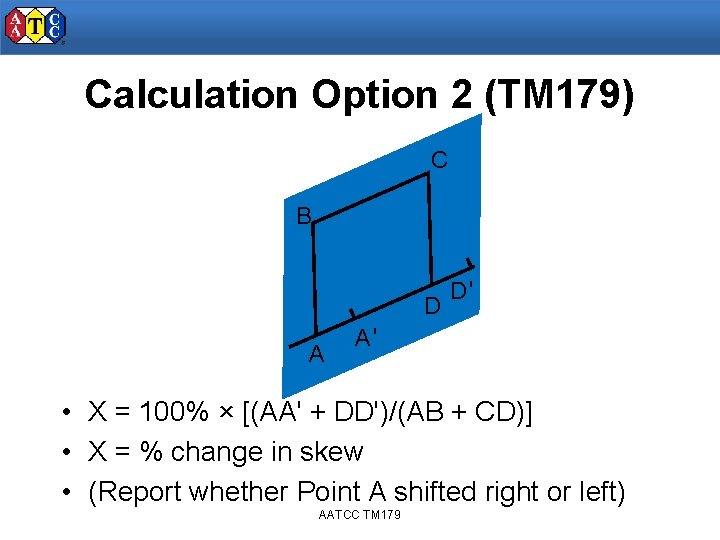
Calculation Option 2 (TM 179) C B D A D' A' • X = 100% × [(AA' + DD')/(AB + CD)] • X = % change in skew • (Report whether Point A shifted right or left) AATCC TM 179

Calculation Option 3 (TM 179) • X = 100 × (AA'/AB) • X = % change in skew • (Report whether Point A shifted right or left) B Y A A' Z AATCC TM 179

Calculation Summary (TM 179) All measurements to nearest 1 mm or 0. 1 in Calculate change in skew to nearest 0. 1% • Option 1 X = |100 × [2(AC-BD)/(AC+BD)]| • Option 2 X = 100 × [(AA'+DD')/(AB+CD)] • Option 3 X = 100 × (AA'/AB) AATCC TM 179

Calculation Summary (TM 179) • Average results for all specimens of a specific fabric or garment. • For comparisons across fabric width, average each area (left, middle, right) separately. _ X = (X 1 +X 2 + X 3) / 3 AATCC TM 179

Calculation (TM 207) Twist Before Laundering • X 0 = 100% × (AA'/AB) § X 0 = seam twist before laundering (%) § AB = seam length before laundering (mm or in. ) § AA' = twist distance before laundering (mm or in. ) AATCC TM 207
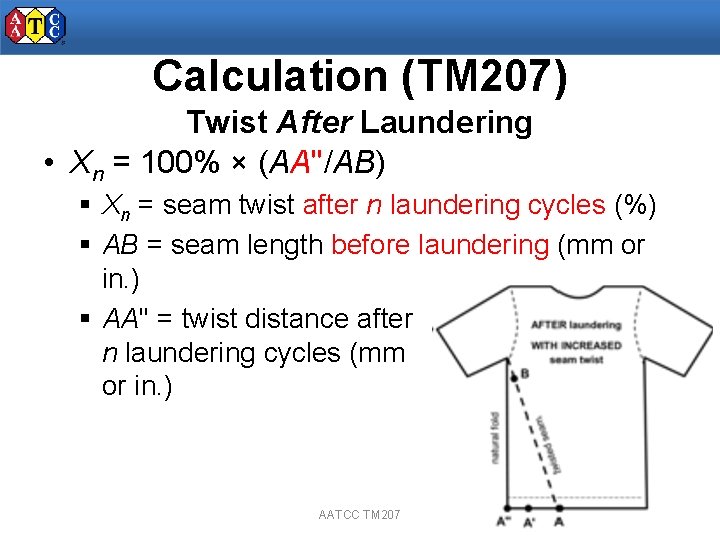
Calculation (TM 207) Twist After Laundering • Xn = 100% × (AA''/AB) § Xn = seam twist after n laundering cycles (%) § AB = seam length before laundering (mm or in. ) § AA'' = twist distance after n laundering cycles (mm or in. ) AATCC TM 207

Calculation (TM 207) Change in Twist • Xc = Xn – X 0 § Xc = change in seam twist after laundering (%) AATCC TM 207

Notes • Determine acceptable skew change or twist limits before testing. • For measurements at multiple endpoints (e. g. , 1 & 3 washes), use separate marks for each (e. g. , A' & A''). AATCC TM 179 & TM 207

Notes (TM 179) • Compare data ONLY if the same marking method and calculation option was used • If change in skew is within limits at first endpoint, continue testing. • If change in skew exceeds limits at first endpoint, terminate the test. AATCC TM 179
Notes (TM 207) • Compare data ONLY if the same seam was measured • Xn (total twist after laundering) is usually most relevant for pass/fail evaluation • Xc (change in twist) is more important for seams not initially along garment sides AATCC TM 207

Report • • Sample description/identification AATCC TM 179 -2017 or TM 207 -2017 Number of specimens Number of laundering cycles Marking method (TM 179) Calculation option (TM 179) Modifications of standard method AATCC TM 179 & TM 207
Report • Laundering conditions § § § Ballast type Load size Washing machine (if applicable) Dryer (if applicable) Procedures, settings & temperatures Detergent AATCC TM 179 & TM 207
Report (TM 179) • For each sample: § Average % change in skew for sample § Average % change per area (if applicable) § Direction of skew AATCC TM 179
Report (TM 207) • For each seam type: § § § Seam description and/or location Number of seams averaged Average % twist before laundering (X 0) Average % twist after laundering (Xn) % change in twist after laundering (Xc) AATCC TM 207
- Slides: 53