
AASPI Image processing of seismic attributes for automatic
AASPI Image processing of seismic attributes for automatic fault extraction Jie Qi*, Bin Lyu, Abdulmohsen Al. Ali, Gabriel Machado, Ying Hu, Kurt Marfurt (The University of Oklahoma) 1
Outline • Introduction • Seismic footprint and noise suppression • Multispectral coherence algorithm • Iterative directional fault smoothing and sharping • The preconditioned attribute for automatic fault extraction • Conclusions 2
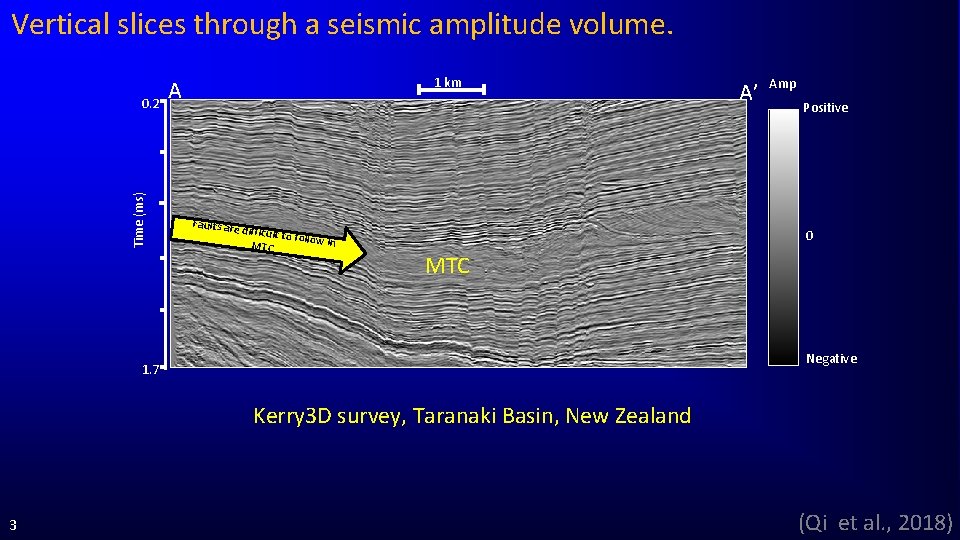
Vertical slices through a seismic amplitude volume. Time (ms) 0. 2 1 km A Faults are difficult to follow in MTC A’ Amp Positive 0 MTC Negative 1. 7 Kerry 3 D survey, Taranaki Basin, New Zealand 3 (Qi et al. , 2018)
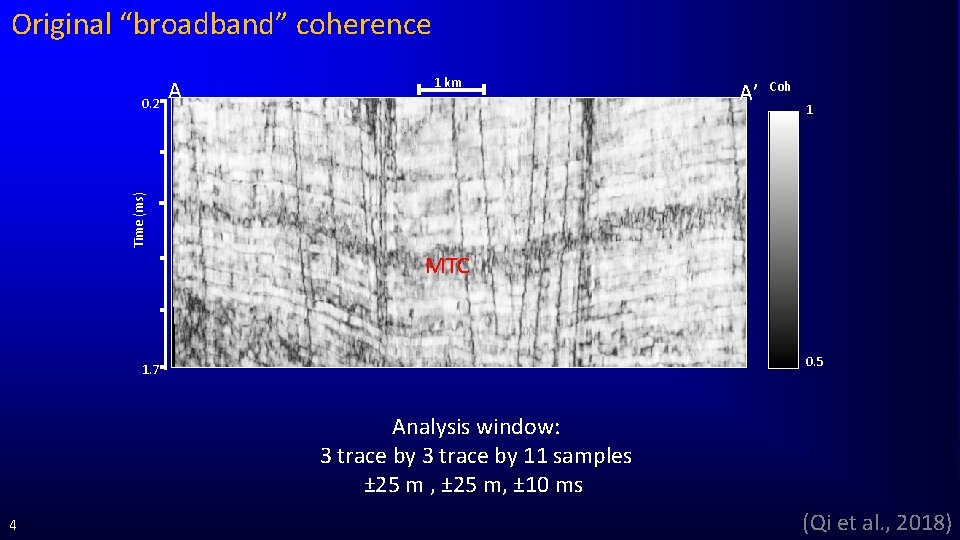
Original “broadband” coherence 1 km A’ Coh 1 Time (ms) 0. 2 A MTC 0. 5 1. 7 Analysis window: 3 trace by 11 samples ± 25 m , ± 25 m, ± 10 ms 4 (Qi et al. , 2018)
Objective Suppress coherence anomaly artifacts (acquisition footprint); Suppress coherence (noise or stratigraphic) anomalies subparallel to reflector dip; Sharpen fault and other discontinuities that cut reflectors; Preconditioning the fault images for subsequent automatic extraction. 5
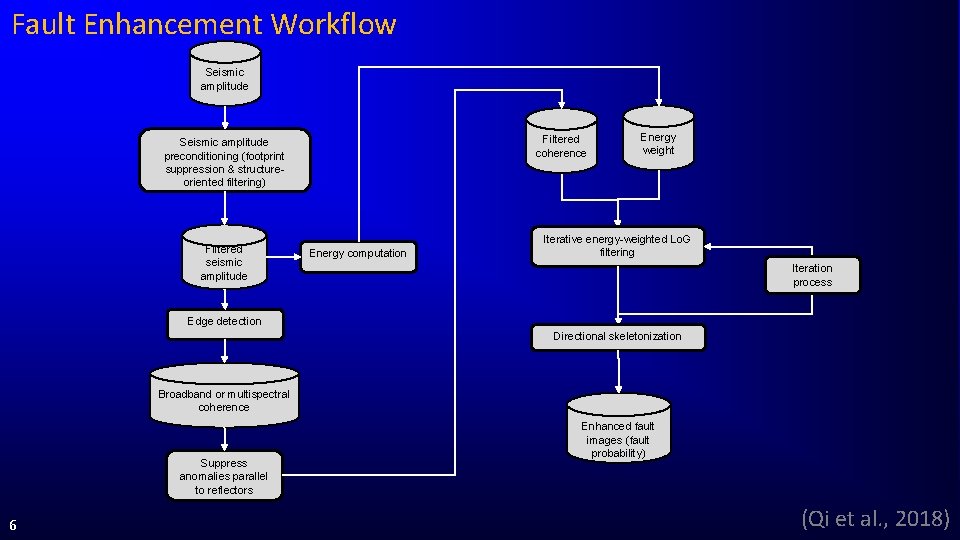
Fault Enhancement Workflow Seismic amplitude Filtered coherence Seismic amplitude preconditioning (footprint suppression & structureoriented filtering) Filtered seismic amplitude Energy computation Energy weight Iterative energy-weighted Lo. G filtering Iteration process Edge detection Directional skeletonization Broadband or multispectral coherence Suppress anomalies parallel to reflectors 6 Enhanced fault images (fault probability) (Qi et al. , 2018)
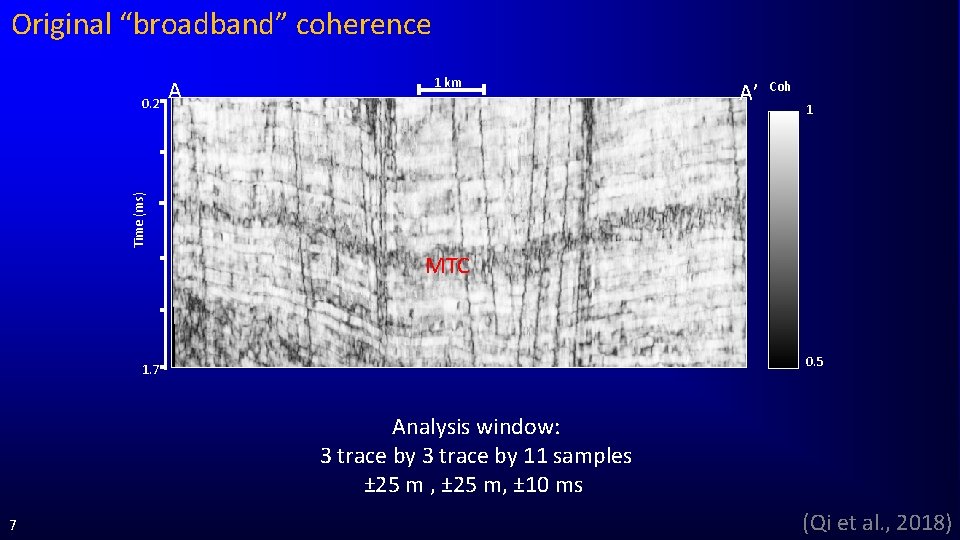
Original “broadband” coherence 1 km A’ Coh 1 Time (ms) 0. 2 A MTC 0. 5 1. 7 Analysis window: 3 trace by 11 samples ± 25 m , ± 25 m, ± 10 ms 7 (Qi et al. , 2018)

Coherence after footprint suppression and structure-oriented filtering 1 km A’ Coh 1 Time (ms) 0. 2 A MTC 1. 7 8 0. 5 (Qi et al. , 2018)
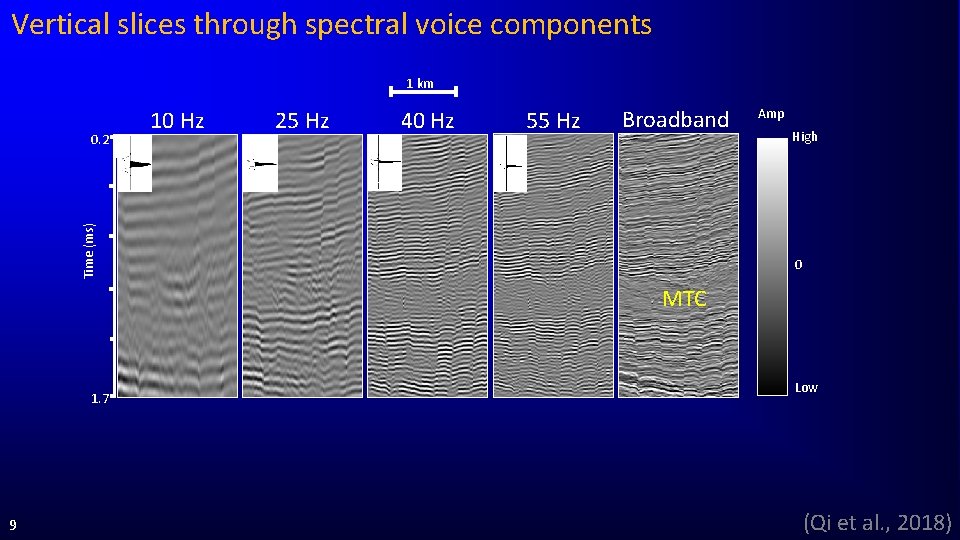
Vertical slices through spectral voice components 1 km 0. 2 -0. 15 s +0. 15 s 25 Hz -0. 15 s 40 Hz +0. 15 s -0. 15 s 55 Hz Broadband Amp High +0. 15 s Time (ms) +0. 15 s 10 Hz 0 MTC 1. 7 9 Low (Qi et al. , 2018)
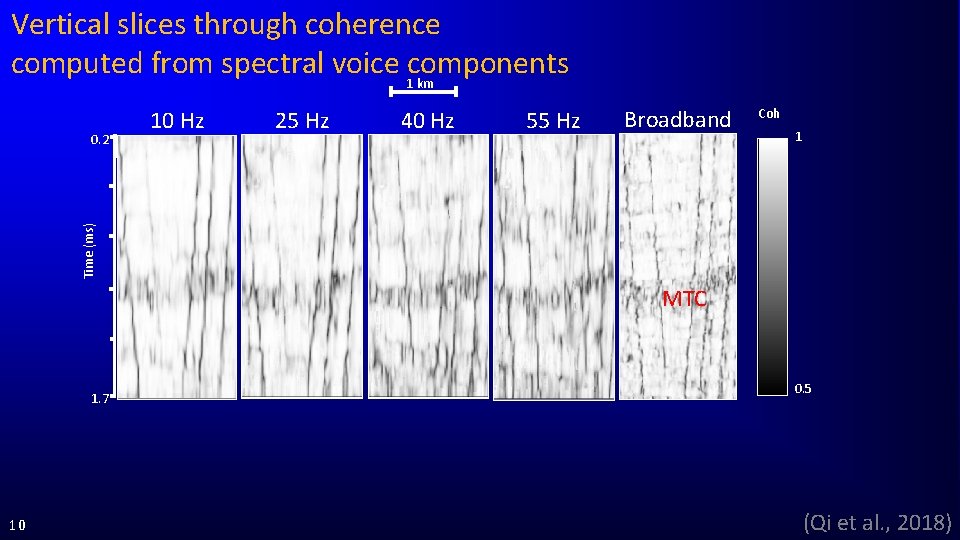
Vertical slices through coherence computed from spectral voice 1 components km 25 Hz 40 Hz 55 Hz Broadband Coh 1 Time (ms) 0. 2 10 Hz MTC 1. 7 10 0. 5 (Qi et al. , 2018)
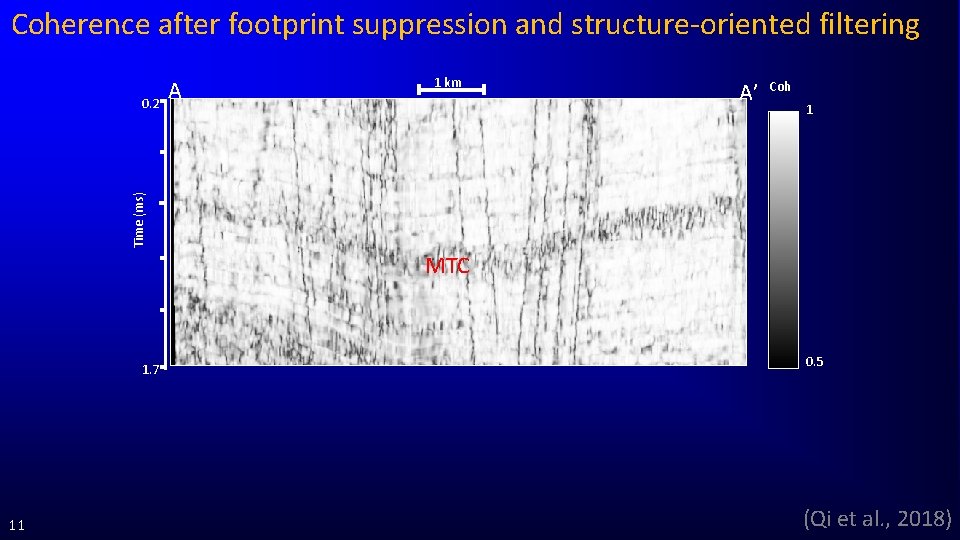
Coherence after footprint suppression and structure-oriented filtering 1 km A’ Coh 1 Time (ms) 0. 2 A MTC 1. 7 11 0. 5 (Qi et al. , 2018)
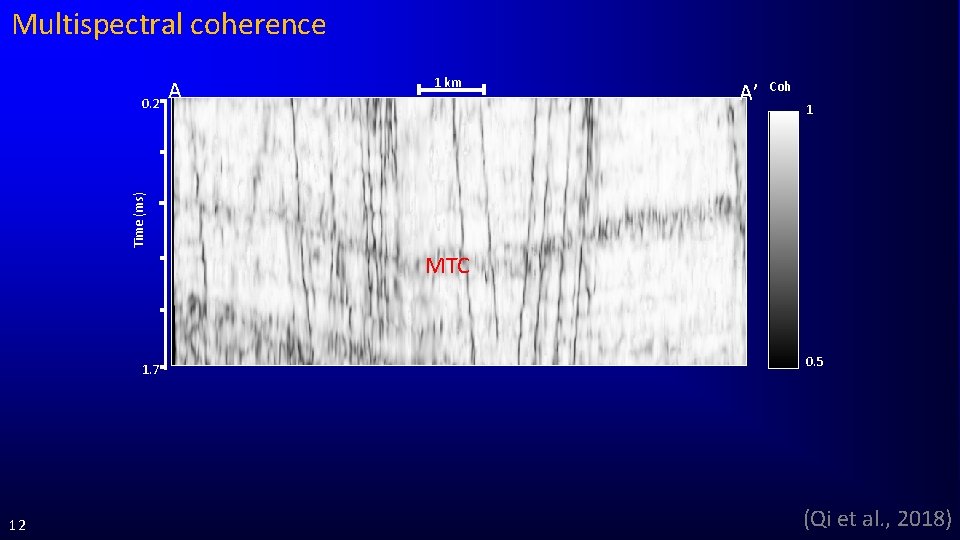
Multispectral coherence 1 km A’ Coh 1 Time (ms) 0. 2 A MTC 1. 7 12 0. 5 (Qi et al. , 2018)
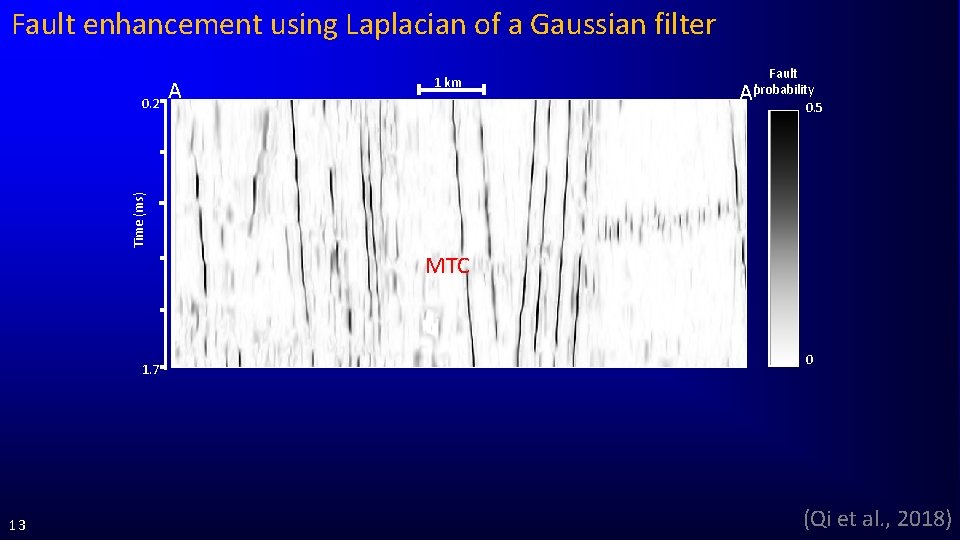
Fault enhancement using Laplacian of a Gaussian filter A Fault probability 0. 5 A’ Time (ms) 0. 2 1 km MTC 1. 7 13 0 (Qi et al. , 2018)
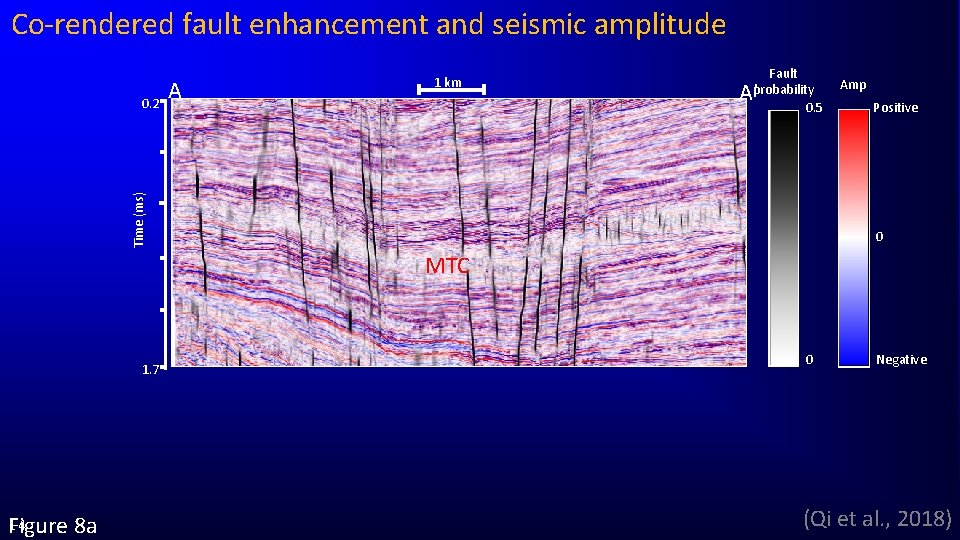
Co-rendered fault enhancement and seismic amplitude Fault probability 0. 5 A’ Time (ms) 0. 2 A 1 km Amp Positive 0 MTC 1. 7 14 Figure 8 a 0 Negative (Qi et al. , 2018)
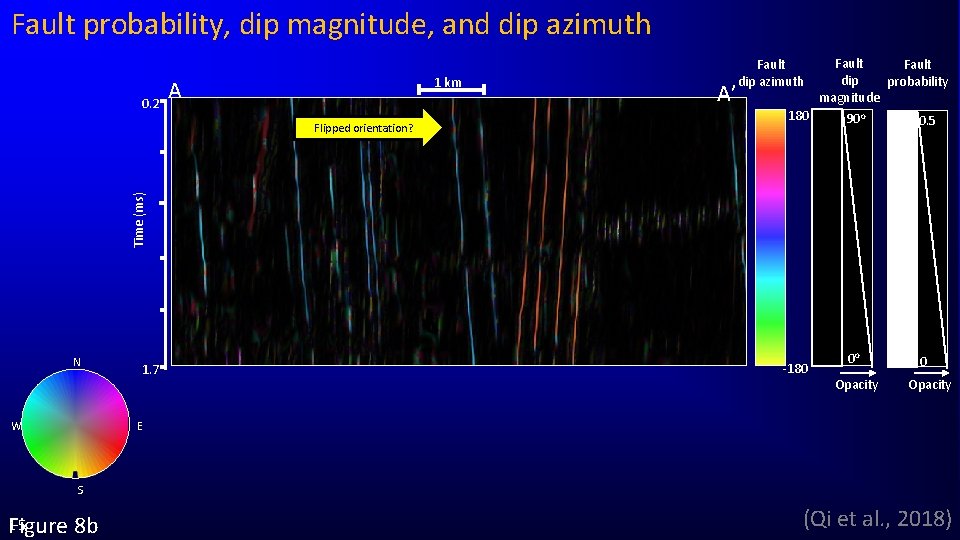
Fault probability, dip magnitude, and dip azimuth 0. 2 1 km A 180 Fault dip probability magnitude 90 o 0. 5 0 o 0 Time (ms) Flipped orientation? A’ Fault dip azimuth N W 1. 7 -180 Opacity E S 15 Figure 8 b (Qi et al. , 2018)
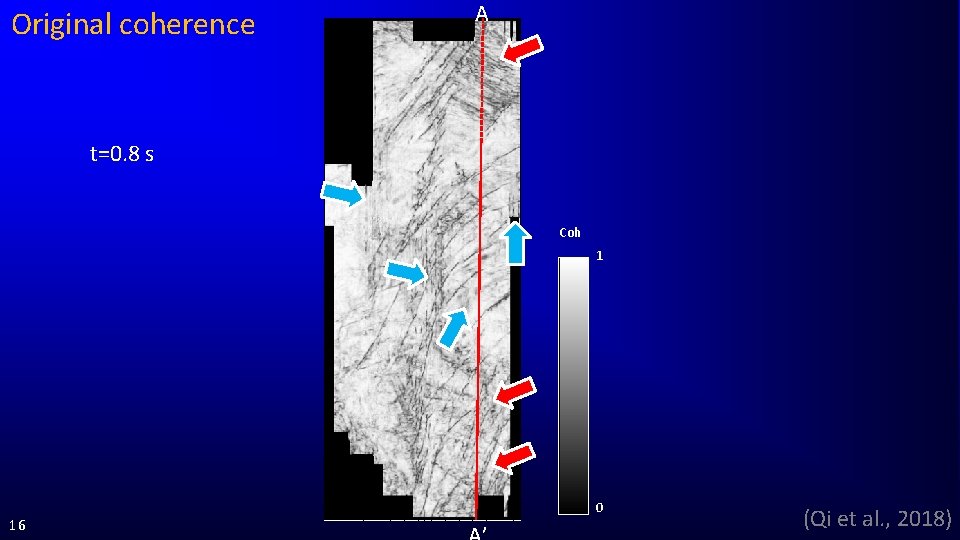
Original coherence A t=0. 8 s Coh 1 16 0 (Qi et al. , 2018)
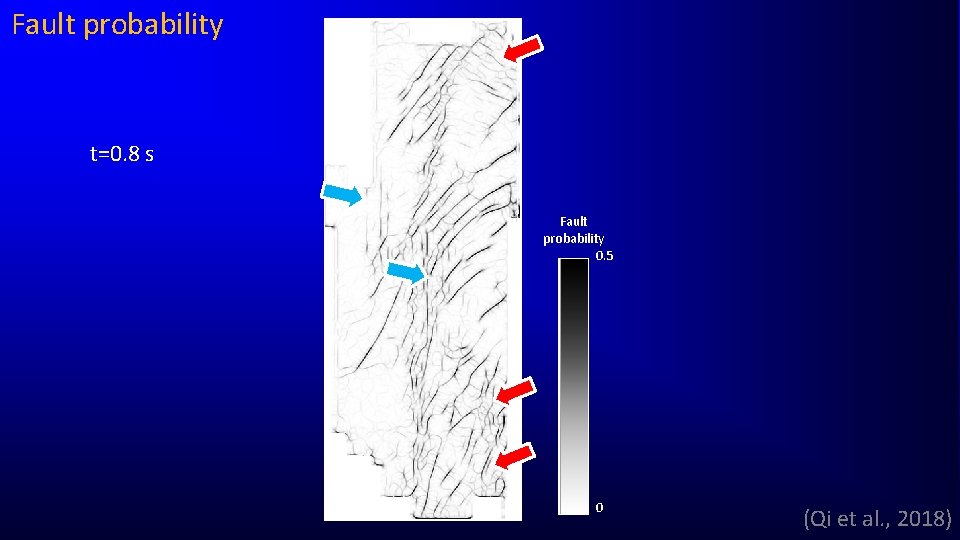
Fault probability t=0. 8 s Fault probability 0. 5 0 (Qi et al. , 2018)
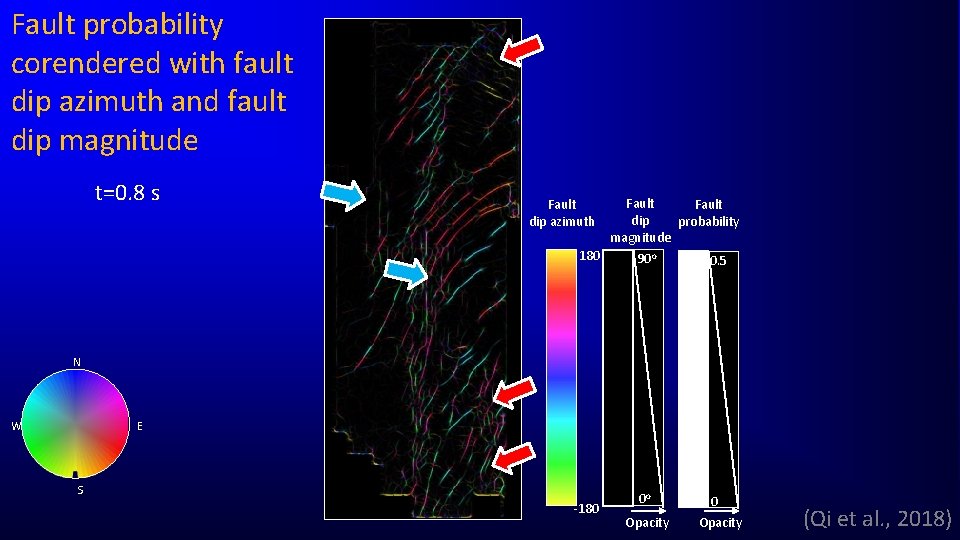
Fault probability corendered with fault dip azimuth and fault dip magnitude t=0. 8 s Fault dip azimuth 180 Fault dip probability magnitude 90 o 0. 5 0 o 0 Opacity N W E S -180 Opacity (Qi et al. , 2018)
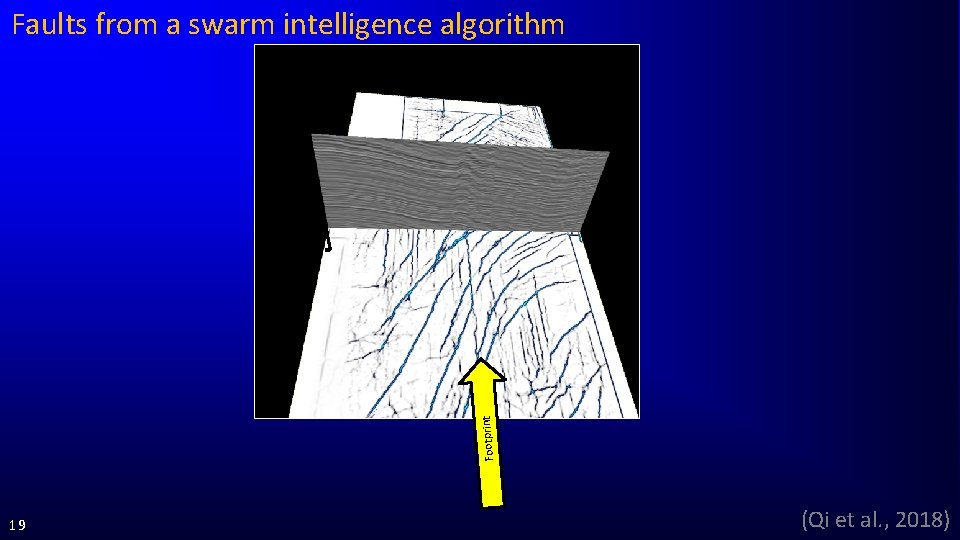
Faults from a swarm intelligence algorithm Time (m s) 0. 2 Footprint 1. 7 19 (Qi et al. , 2018)
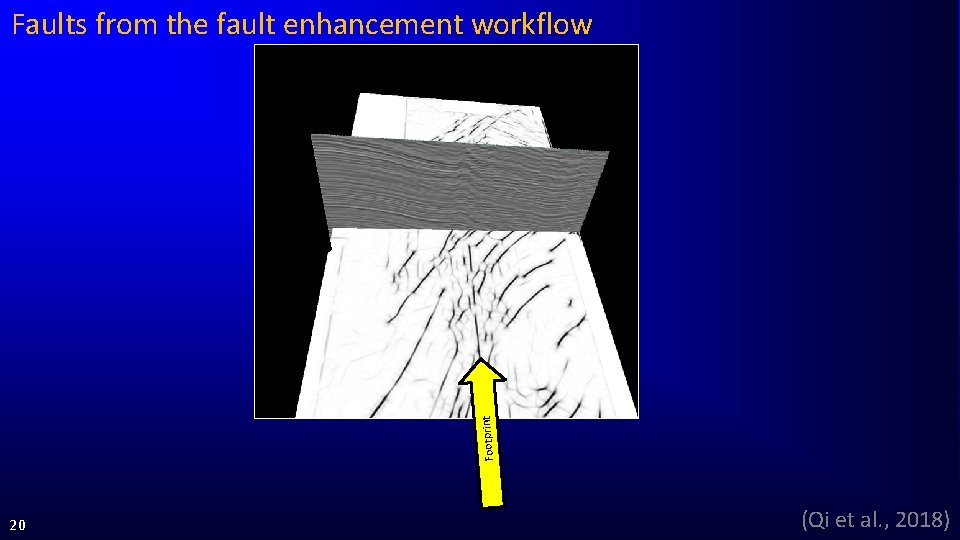
Faults from the fault enhancement workflow Time (m s) 0. 2 Footprint 1. 7 20 (Qi et al. , 2018)
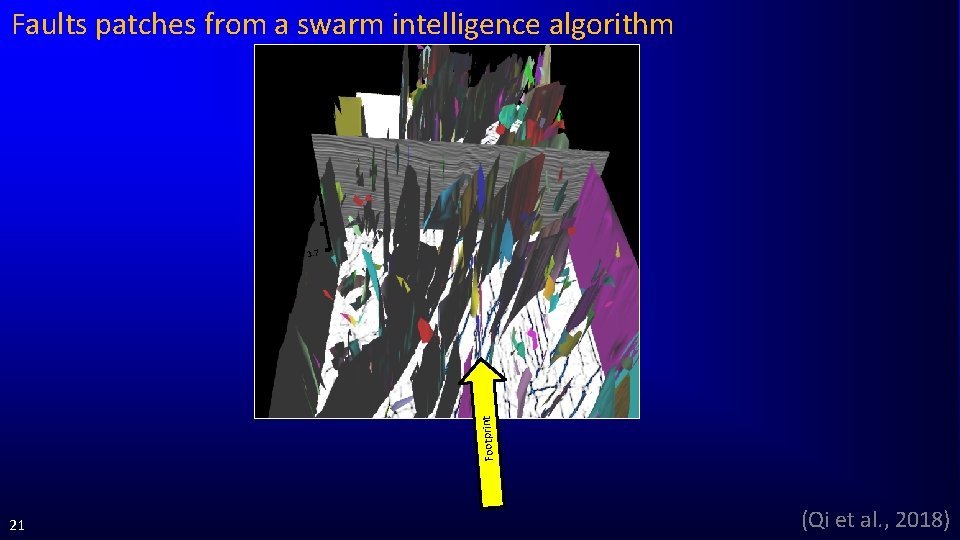
Faults patches from a swarm intelligence algorithm Time (m s) 0. 2 Footprint 1. 7 21 (Qi et al. , 2018)
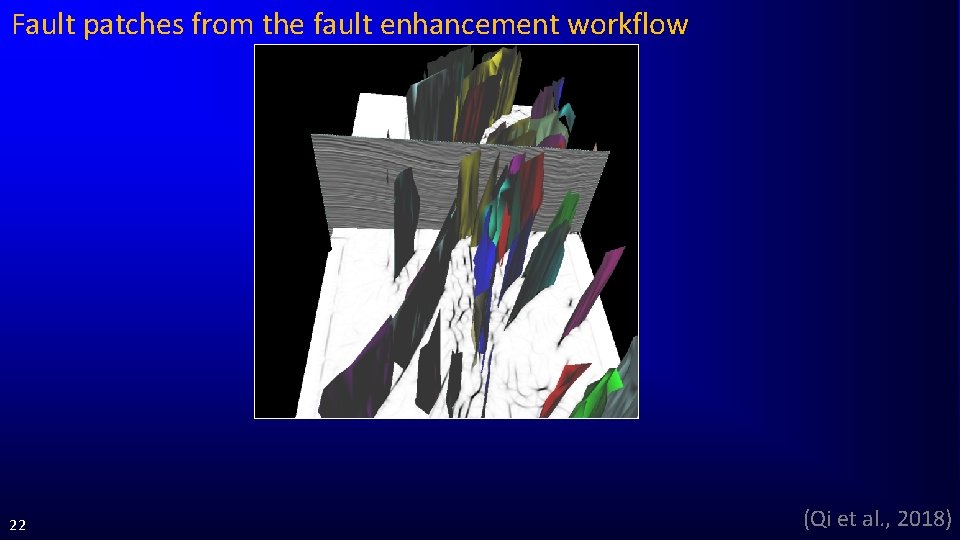
Fault patches from the fault enhancement workflow Time (m s) 0. 2 1. 7 22 (Qi et al. , 2018)
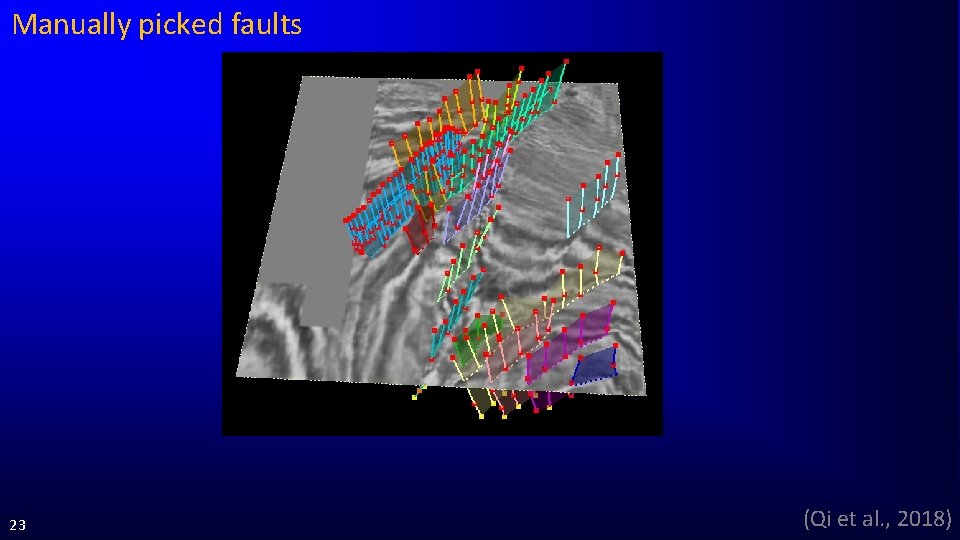
Manually picked faults 23 (Qi et al. , 2018)
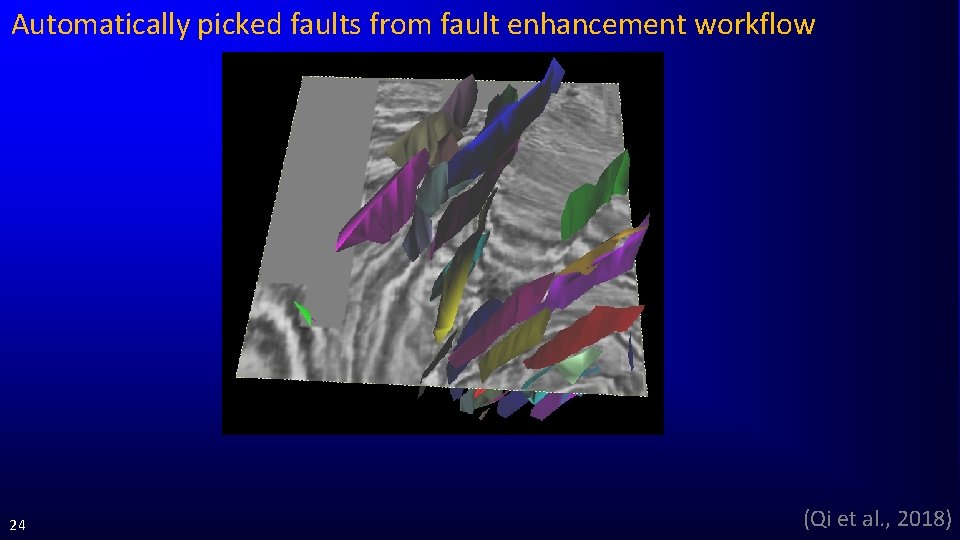
Automatically picked faults from fault enhancement workflow 24 (Qi et al. , 2018)
Outline • Introduction • Seismic footprint and noise suppression • Multispectral coherence algorithm • Iterative directional fault smoothing and sharping • The preconditioned attribute for automatic fault extraction • Conclusions 25
Conclusions Coherence algorithms show not only tectonic and stratigraphic edges that cut reflectors, but also unconformities, condensed sections, and low signal-to-noise ratio shale-on-shale reflectors that are subparallel to reflectors. Energy weighting reduces stair step fault anomalies commonly seen in coherence volumes. Using an iterative application of small-window LOG filters accommodates curvilinear fault surfaces and avoids joining faults across large gaps. The results after this attribute preconditioning workflow are improved fault images amenable to automatic fault extraction. We find the resulting fault images to compare very favorably with respect to traditional humaninterpreter generated on vertical slices through the seismic amplitude volume. 26

Acknowledgements We would like to thank New Zealand Petroleum and Minerals for providing the data to be used in research. We would also like to thank Schlumberger for the license of Petrel provided to the OU for research and education. Finally, we thank the sponsors of the OU Attribute-Assisted Processing and Interpretation Consortium for their guidance and their financial support. 27

AASPI Thank You For Your Attention! 28
- Slides: 28