
AAPI Women Voices Untold Stories Through Poetry Grades
- Slides: 21
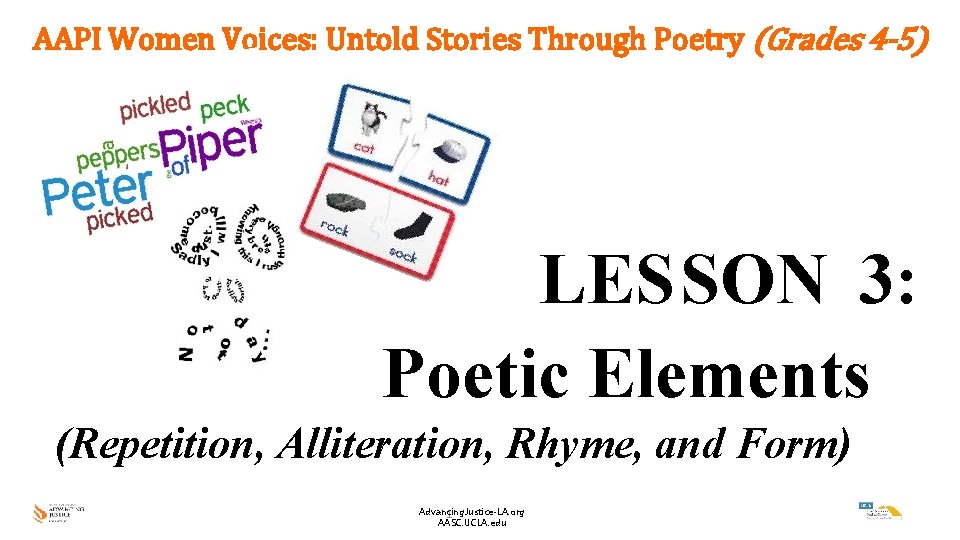
AAPI Women Voices: Untold Stories Through Poetry (Grades 4 -5) LESSON 3: Poetic Elements (Repetition, Alliteration, Rhyme, and Form) Advancing. Justice-LA. org 1 AASC. UCLA. edu
Poetic Elements Handout: Poetic Elements • Like figurative language, poets use other elements to make their work personal, unique, and more powerful. • Repetition, alliteration, rhyme, and form are some examples of these other elements poets might use. Advancing. Justice-LA. org 2 AASC. UCLA. edu
Poetic Elements Handout: Repetition • The use of the same words or phrases to create a beat, rhythm, or develop emphasis. “How they tinkle, in the icy air of night!” • In this example of repetition, the writer is emphasizing and bringing the audience’s attention to the tinkling of the subject [bells]. Advancing. Justice-LA. org 3 AASC. UCLA. edu
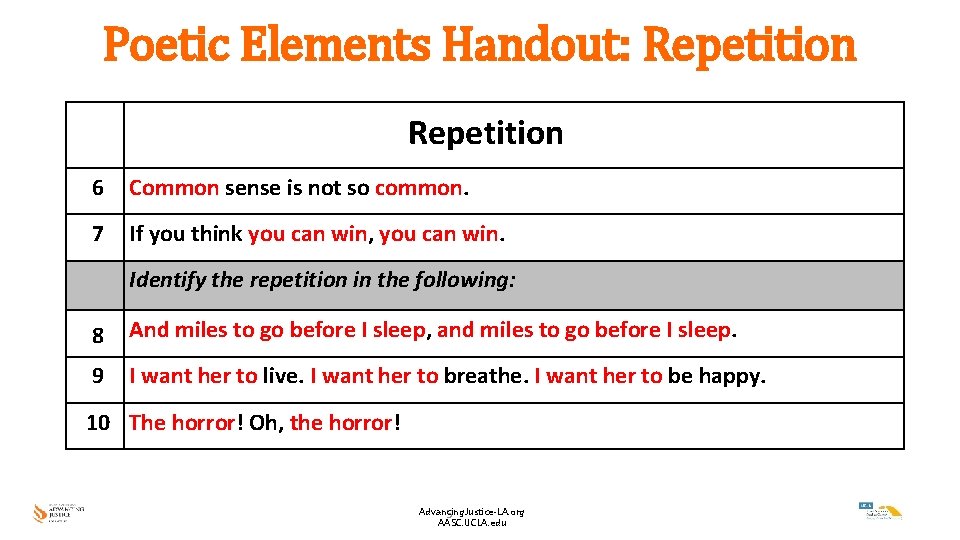
Poetic Elements Handout: Repetition Repetition 1 Common sense is not so common. 2 If you think you can win, you can win. Identify the repetition in the following: 3 And miles to go before I sleep, and miles to go before I sleep. 4 I want her to live. I want her to breathe. I want her to be happy. 5 The horror! Oh, the horror! Advancing. Justice-LA. org 4 AASC. UCLA. edu
Poetic Elements Handout: Repetition Repetition 6 Common sense is not so common. 7 If you think you can win, you can win. Identify the repetition in the following: 8 And miles to go before I sleep, and miles to go before I sleep. 9 I want her to live. I want her to breathe. I want her to be happy. 10 The horror! Oh, the horror! Advancing. Justice-LA. org 5 AASC. UCLA. edu
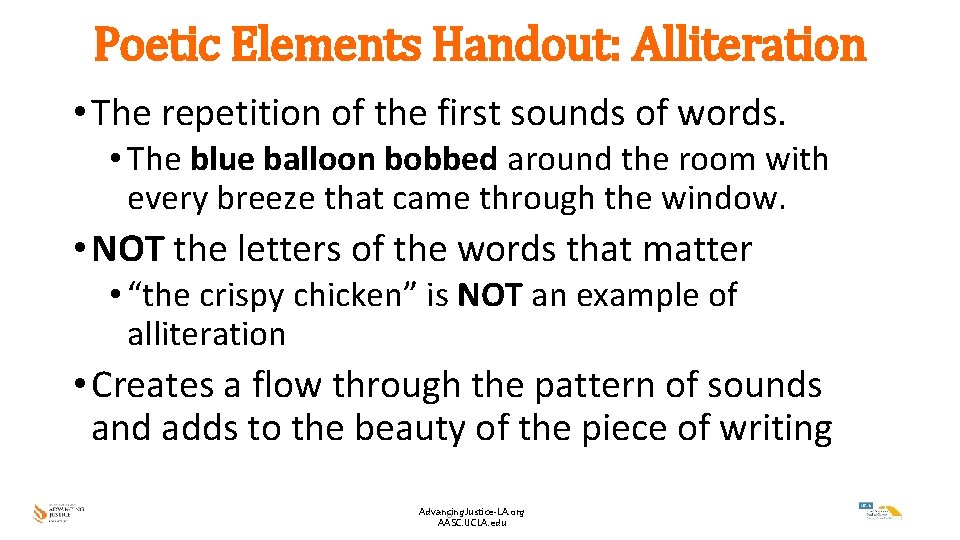
Poetic Elements Handout: Alliteration • The repetition of the first sounds of words. • The blue balloon bobbed around the room with every breeze that came through the window. • NOT the letters of the words that matter • “the crispy chicken” is NOT an example of alliteration • Creates a flow through the pattern of sounds and adds to the beauty of the piece of writing Advancing. Justice-LA. org 6 AASC. UCLA. edu
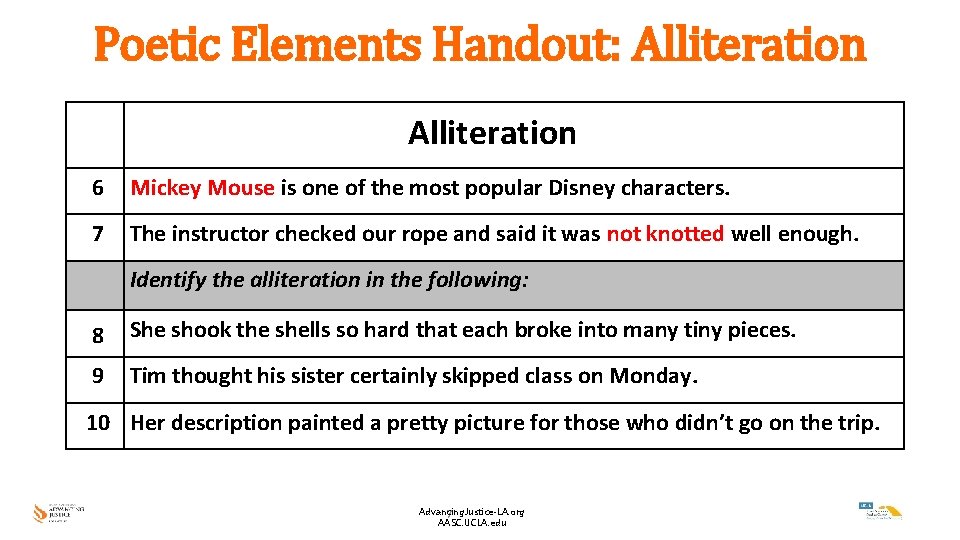
Poetic Elements Handout: Alliteration Alliteration 6 Mickey Mouse is one of the most popular Disney characters. 7 The instructor checked our rope and said it was not knotted well enough. Identify the alliteration in the following: 8 She shook the shells so hard that each broke into many tiny pieces. 9 Tim thought his sister certainly skipped class on Monday. 10 Her description painted a pretty picture for those who didn’t go on the trip. Advancing. Justice-LA. org 7 AASC. UCLA. edu
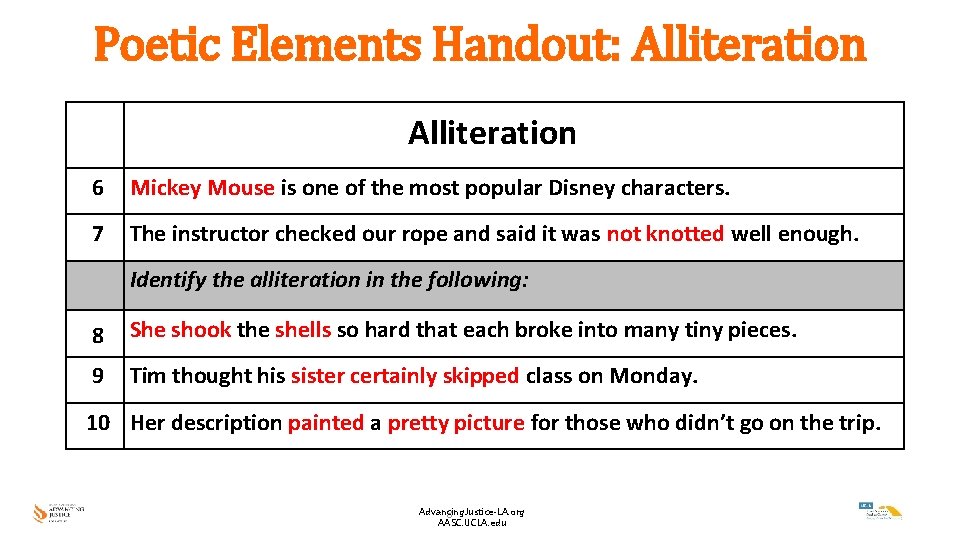
Poetic Elements Handout: Alliteration Alliteration 6 Mickey Mouse is one of the most popular Disney characters. 7 The instructor checked our rope and said it was not knotted well enough. Identify the alliteration in the following: 8 She shook the shells so hard that each broke into many tiny pieces. 9 Tim thought his sister certainly skipped class on Monday. 10 Her description painted a pretty picture for those who didn’t go on the trip. Advancing. Justice-LA. org 8 AASC. UCLA. edu
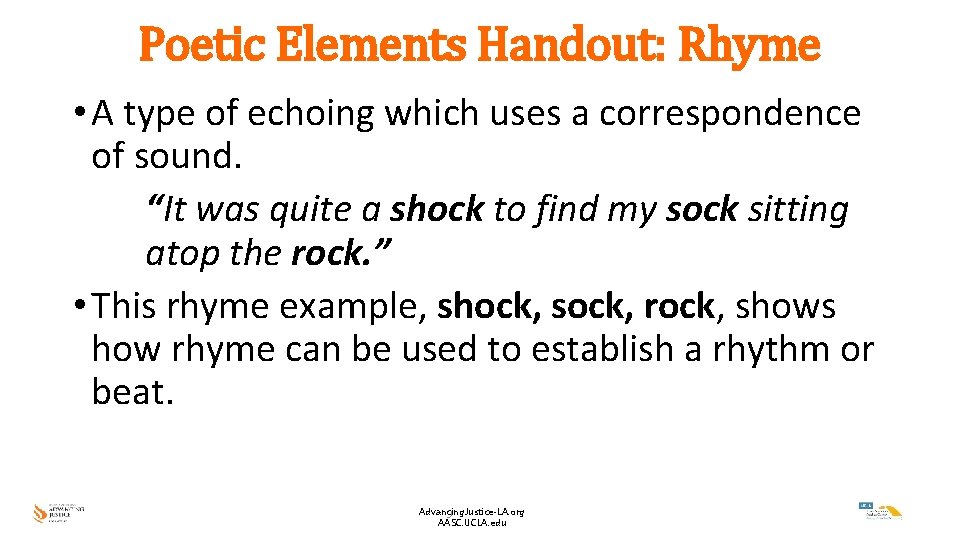
Poetic Elements Handout: Rhyme • A type of echoing which uses a correspondence of sound. “It was quite a shock to find my sock sitting atop the rock. ” • This rhyme example, shock, sock, rock, shows how rhyme can be used to establish a rhythm or beat. Advancing. Justice-LA. org 9 AASC. UCLA. edu
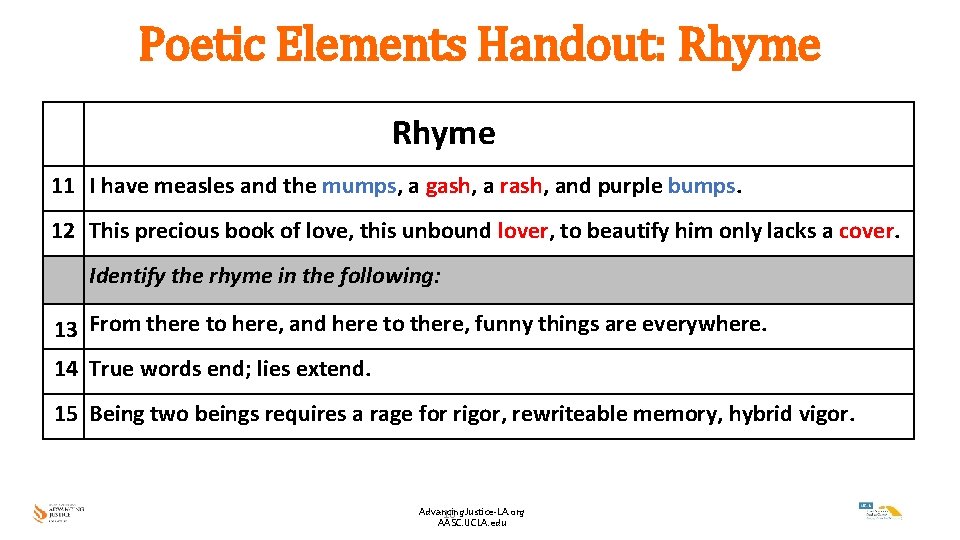
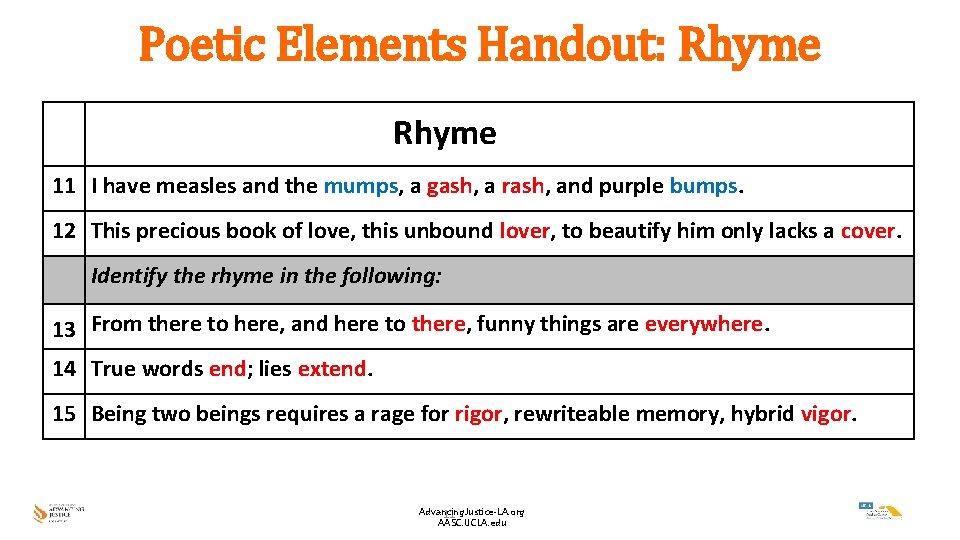
Poetic Elements Handout: Rhyme Rhyme 11 I have measles and the mumps, a gash, a rash, and purple bumps. 12 This precious book of love, this unbound lover, to beautify him only lacks a cover. Identify the rhyme in the following: 13 From there to here, and here to there, funny things are everywhere. 14 True words end; lies extend. 15 Being two beings requires a rage for rigor, rewriteable memory, hybrid vigor. Advancing. Justice-LA. org 10 AASC. UCLA. edu
Poetic Elements Handout: Rhyme Rhyme 11 I have measles and the mumps, a gash, a rash, and purple bumps. 12 This precious book of love, this unbound lover, to beautify him only lacks a cover. Identify the rhyme in the following: 13 From there to here, and here to there, funny things are everywhere. 14 True words end; lies extend. 15 Being two beings requires a rage for rigor, rewriteable memory, hybrid vigor. Advancing. Justice-LA. org 11 AASC. UCLA. edu
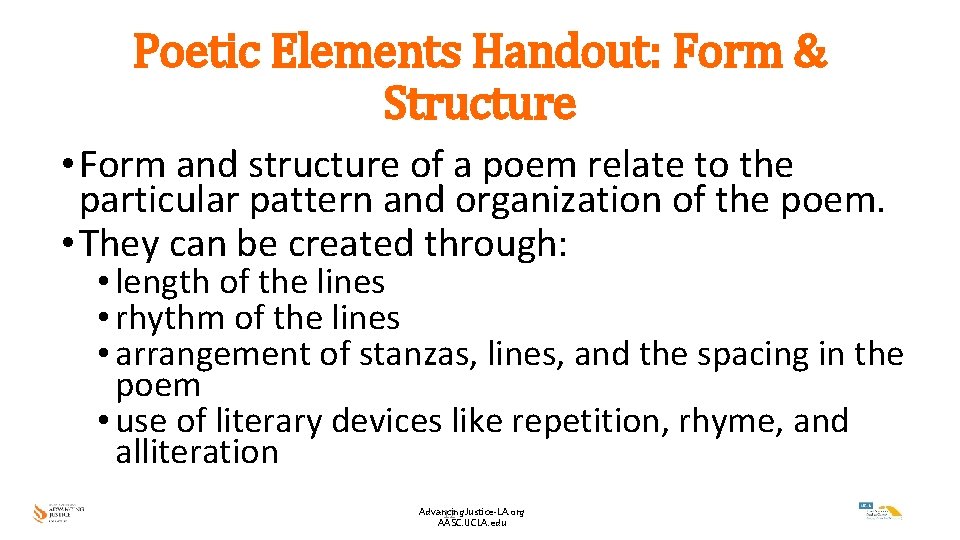
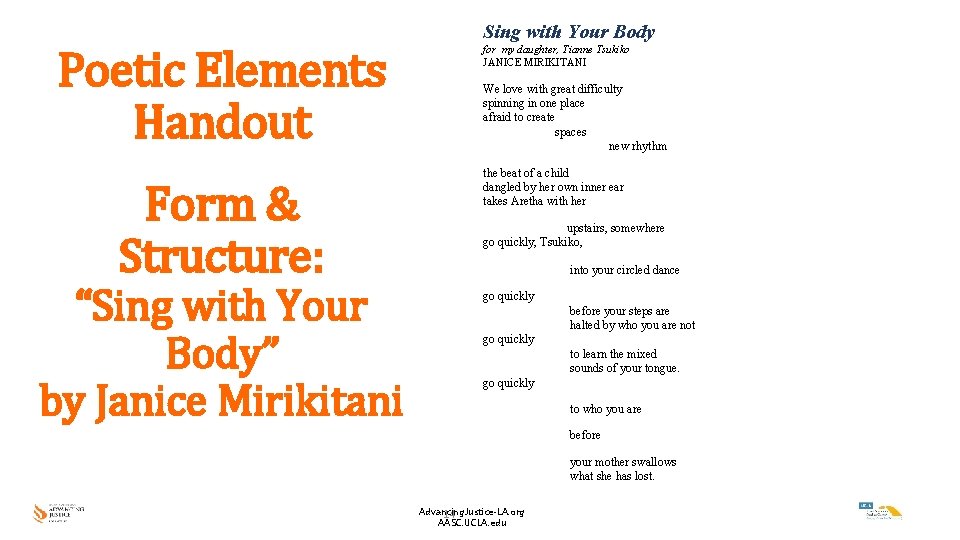
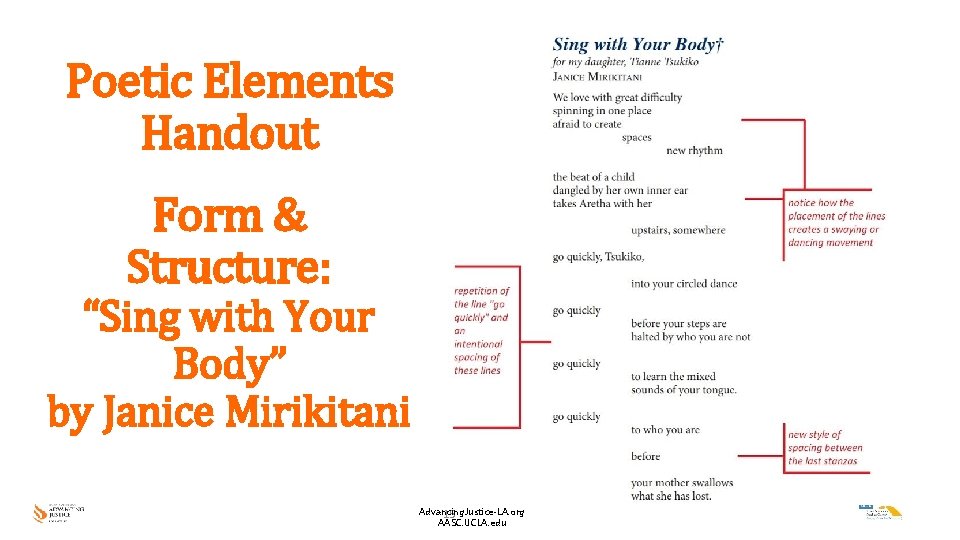
Poetic Elements Handout: Form & Structure • Form and structure of a poem relate to the particular pattern and organization of the poem. • They can be created through: • length of the lines • rhythm of the lines • arrangement of stanzas, lines, and the spacing in the poem • use of literary devices like repetition, rhyme, and alliteration Advancing. Justice-LA. org 12 AASC. UCLA. edu
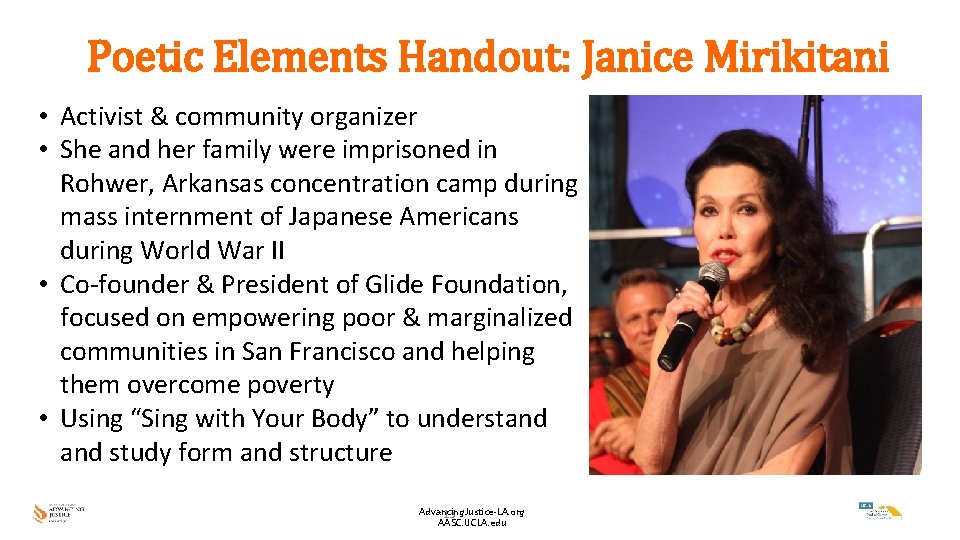
Poetic Elements Handout: Janice Mirikitani • Activist & community organizer • She and her family were imprisoned in Rohwer, Arkansas concentration camp during mass internment of Japanese Americans during World War II • Co-founder & President of Glide Foundation, focused on empowering poor & marginalized communities in San Francisco and helping them overcome poverty • Using “Sing with Your Body” to understand study form and structure Advancing. Justice-LA. org 13 AASC. UCLA. edu
Sing with Your Body Poetic Elements Handout Form & Structure: “Sing with Your Body” by Janice Mirikitani for my daughter, Tianne Tsukiko JANICE MIRIKITANI We love with great difficulty spinning in one place afraid to create spaces new rhythm the beat of a child dangled by her own inner ear takes Aretha with her upstairs, somewhere go quickly, Tsukiko, into your circled dance go quickly before your steps are halted by who you are not go quickly to learn the mixed sounds of your tongue. go quickly to who you are before your mother swallows what she has lost. Advancing. Justice-LA. org 14 AASC. UCLA. edu
Poetic Elements Handout Form & Structure: “Sing with Your Body” by Janice Mirikitani Advancing. Justice-LA. org 15 AASC. UCLA. edu
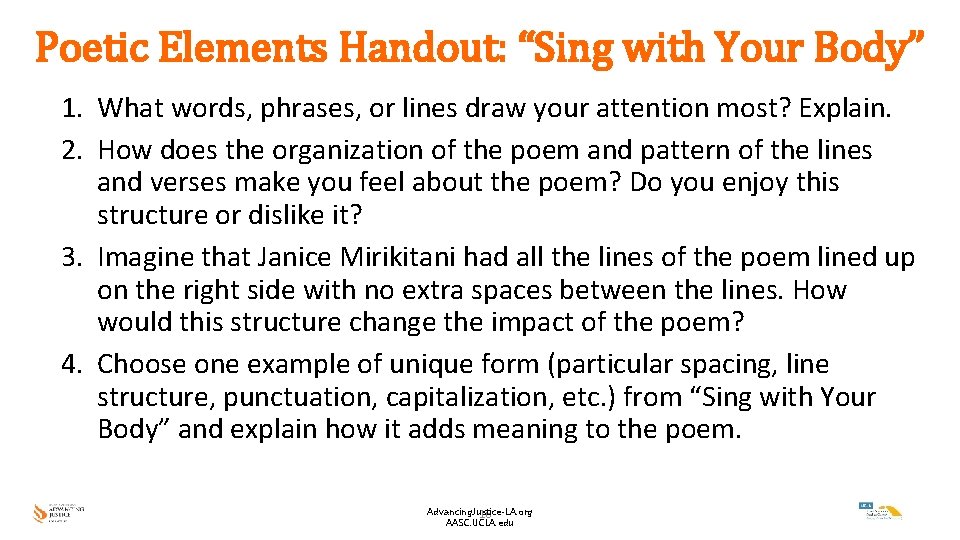
Poetic Elements Handout: “Sing with Your Body” 1. What words, phrases, or lines draw your attention most? Explain. 2. How does the organization of the poem and pattern of the lines and verses make you feel about the poem? Do you enjoy this structure or dislike it? 3. Imagine that Janice Mirikitani had all the lines of the poem lined up on the right side with no extra spaces between the lines. How would this structure change the impact of the poem? 4. Choose one example of unique form (particular spacing, line structure, punctuation, capitalization, etc. ) from “Sing with Your Body” and explain how it adds meaning to the poem. Advancing. Justice-LA. org 16 AASC. UCLA. edu
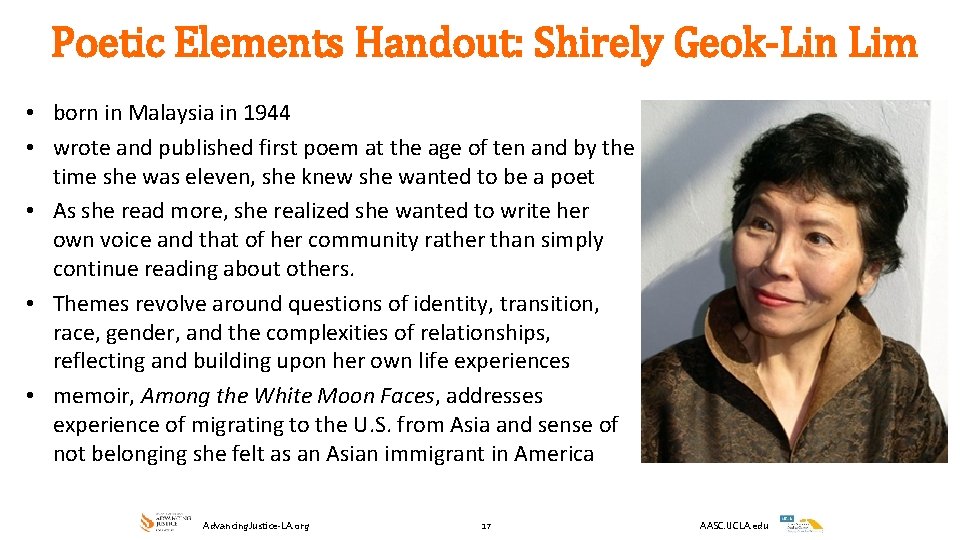
Poetic Elements Handout: Shirely Geok-Lin Lim • born in Malaysia in 1944 • wrote and published first poem at the age of ten and by the time she was eleven, she knew she wanted to be a poet • As she read more, she realized she wanted to write her own voice and that of her community rather than simply continue reading about others. • Themes revolve around questions of identity, transition, race, gender, and the complexities of relationships, reflecting and building upon her own life experiences • memoir, Among the White Moon Faces, addresses experience of migrating to the U. S. from Asia and sense of not belonging she felt as an Asian immigrant in America Advancing. Justice-LA. org 17 AASC. UCLA. edu
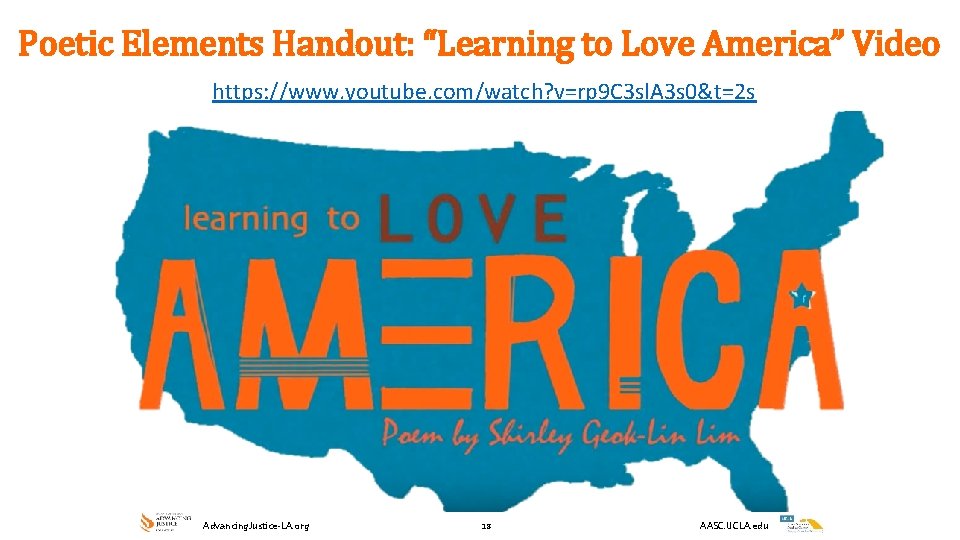
Poetic Elements Handout: “Learning to Love America” Video https: //www. youtube. com/watch? v=rp 9 C 3 sl. A 3 s 0&t=2 s Advancing. Justice-LA. org 18 AASC. UCLA. edu
Poetic Elements Handout: “Learning to Love America” 1. What is the central idea of "Learning to Love America”? 2. How does the repetition of the word “because” add meaning to the poem? How does it interact with or add to the central idea? 3. Choose one example of unique form and explain how it adds to meaning or significance to the poem’s message or overall effect? 4. What unique element of form (through spacing, punctuation, repetition, rhyme, etc. ) did you add to the poem? Why did you choose this particular change to make and how does it change the poem? Advancing. Justice-LA. org 19 AASC. UCLA. edu
Lesson 4 Preview • Unit Review: • Central Idea • Figurative Language • Poetic Elements • Unit Assignment: “Because Poem” • Unit Review + Practice Handout Advancing. Justice-LA. org 20 AASC. UCLA. edu
Women Poetry Lesson 3: Poetic Elements (Repetition, Rhyme, Alliteration, & Form) Curriculum Developer: Prabhneek Heer Curriculum Contributors: Patricia Kwoh Advancing. Justice-LA. org 21 AASC. UCLA. edu