
AAPG Presentation Commission Committee Internal Organization INTRODUCTION OF




- Slides: 32
AAPG Presentation – Commission & Committee Internal Organization
INTRODUCTION OF TOPICS: Ø Policy Manual Process Ø Succession Planning Ø New Member Onboarding Ø Continuing Education Ø Annual Board Performance Assessment Ø Document Management & Disclosure Ø Minute Taking
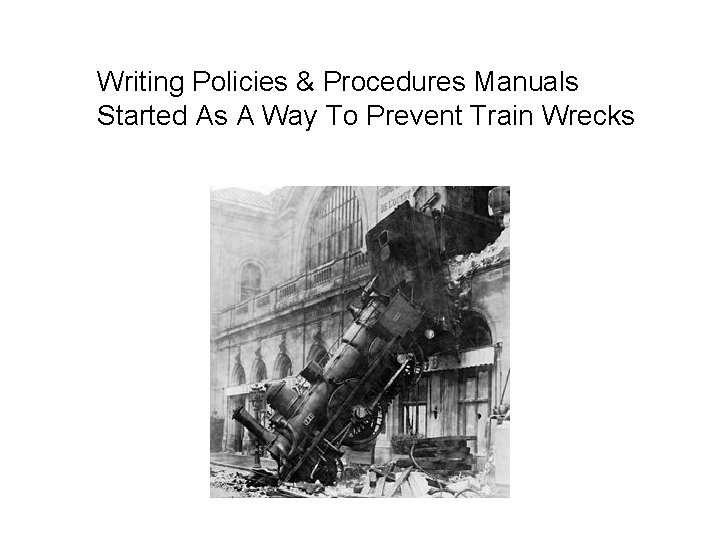
Writing Policies & Procedures Manuals Started As A Way To Prevent Train Wrecks
“A policy manual is a foundational document for operations within any police department”.
Alberta Policing Oversight Standards For Municipal Police Commissions: 1. 2. 3. 4. 5. 6. 7. 8. 9. Intent of the Policy/Procedure Manual Legislative Obligations of the Oversight Agency Role & Responsibilities of Oversight Members Roles & Responsibilities of Chair & Vice Chair Roles & Responsibilities of the Public Complaint Director Orientation & Training New Members Public Complaints Process Conduct/Ethics & Conflict of Interest Police Commission/Policing Committee Yearly Plan of Objectives 10. Police Commission/Policing Committee Yearly Reports of Achievements 11. Oversight Member Remuneration (if any) 12. Financial Management 13. Records Management 14. Communication & Media Relations
Alberta RCMP Policing Committee Handbook: 1. 2. 3. 4. 5. 6. 7. 8. Selection & appointment of policing committee members. Policing Committee responsibilities. How and when policy should be reviewed. Expecting policing committee member conduct Dealing with conflict of interest. How the committee works to orient and train new members. Roles & responsibilities of the Chair and Vice Chair. Role of the local Public Complaint Director and the role of the committee regarding complaints against the Chief. 9. The nature and frequency of committee meetings and who attends. 10. How information is communicated internally and externally. 11. The expectations of the Policing Committee’s Annual Plan.
3. 1. 6 RESPECTFUL WORKPLACE The Edmonton Police Commission (“Commission”) is committed to creating and maintaining a vibrant, healthy, safe and caring work environment for all Commission employees. The Commission promotes a work environment free from discrimination or harassment, one in which everyone treats each other with respect and dignity. Harassment in the workplace creates an intimidating and offensive climate, is a form of discrimination, affects individual’s dignity and selfesteem, and will not be tolerated by the Edmonton Police Commission. The Commission upholds all laws in place including, but not limited to, the Human Rights Act for the Province of Alberta.
7. 0 Public Complaints The Calgary Police Commission accepts and processes public complaints in accordance with the Police Act. In furtherance of this role, the Public Complaint Director is responsible for the administration and review of public complaints, on behalf of the Commission, and for meeting the responsibilities set out in section 28. 1(3) of the Act. The Public Complaint Director shall attend the public complaint training provided by the Ministry of Justice and Solicitor General. The Commission shall facilitate this attendance. The Public Complaint Director shall ensure that the public complaint brochure distributed by the Commission and the Calgary Police Service, in accordance with the Provincial Policing Standards, provides accurate, up-to-date information on the public complaint process.
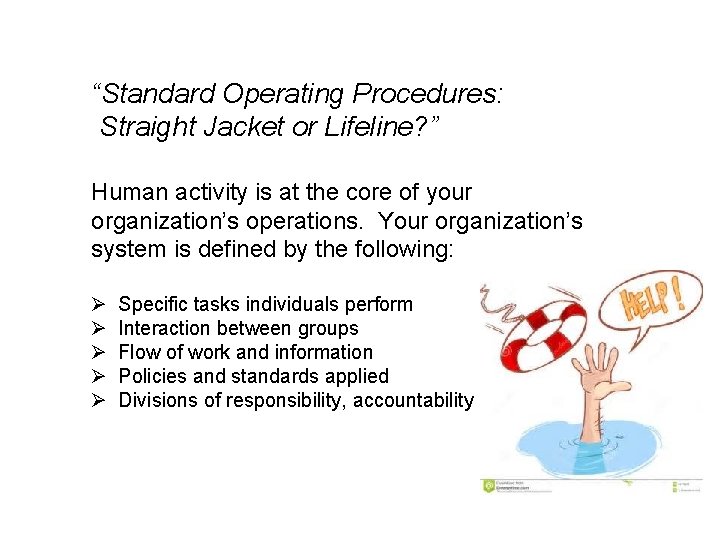
“Standard Operating Procedures: Straight Jacket or Lifeline? ” Human activity is at the core of your organization’s operations. Your organization’s system is defined by the following: Ø Ø Ø Specific tasks individuals perform Interaction between groups Flow of work and information Policies and standards applied Divisions of responsibility, accountability & authority
1. Write for an audience who do not know how to perform the task. 2. Present information in a logical order or sequence. 3. Try to anticipate possible problems, issues or concerns in advance of the final draft.
DON’T: Ø Get mired in the details Ø Mix up policy & procedure information Ø Forget to review regularly
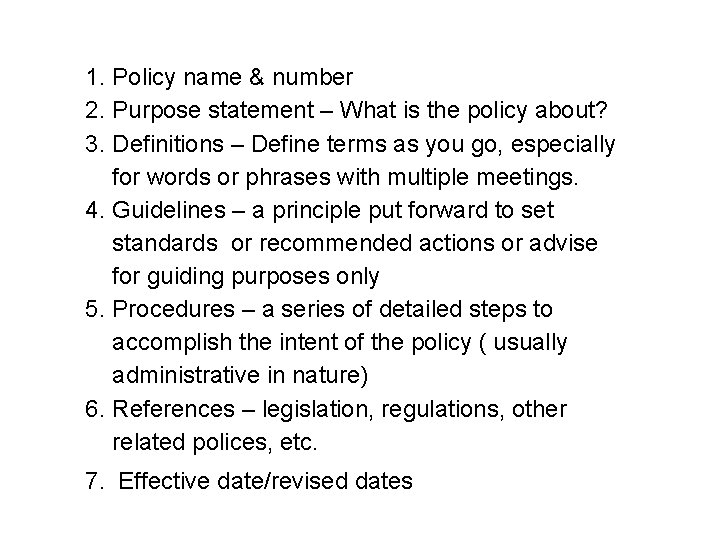
1. Policy name & number 2. Purpose statement – What is the policy about? 3. Definitions – Define terms as you go, especially for words or phrases with multiple meetings. 4. Guidelines – a principle put forward to set standards or recommended actions or advise for guiding purposes only 5. Procedures – a series of detailed steps to accomplish the intent of the policy ( usually administrative in nature) 6. References – legislation, regulations, other related polices, etc. 7. Effective date/revised dates
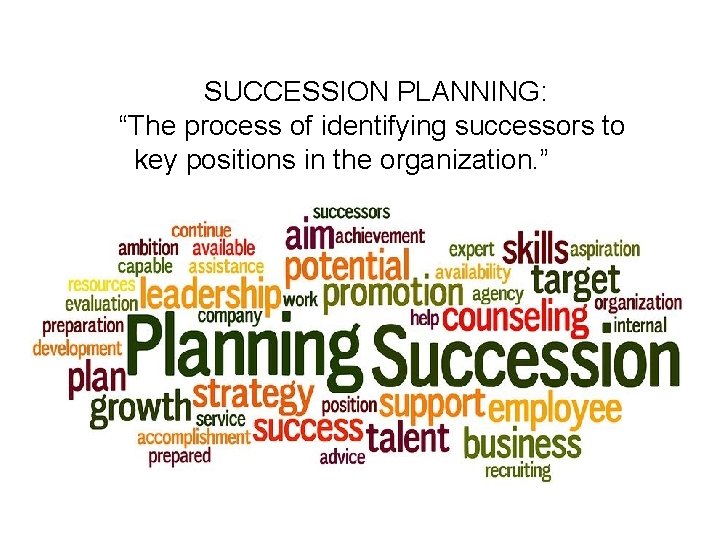
SUCCESSION PLANNING: “The process of identifying successors to key positions in the organization. ”
“By crafting thoughtful, strategic approach to succession – the board fully addresses its governance responsibilities and sets any new leader on a firm course toward future success. ”
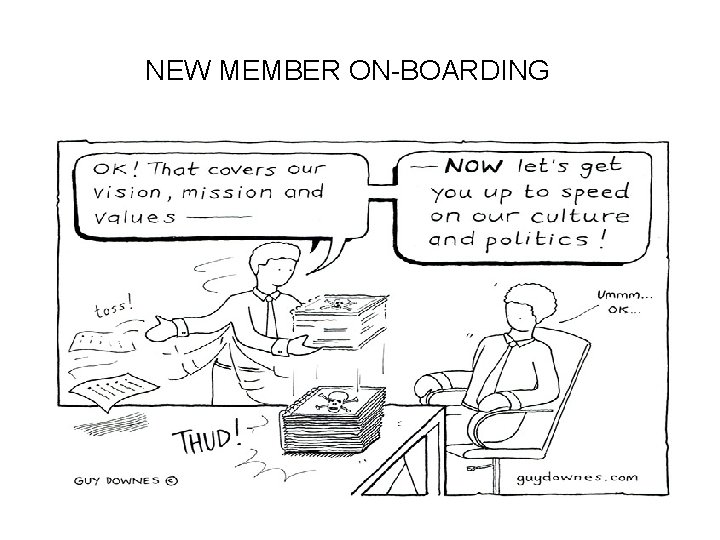
NEW MEMBER ON-BOARDING
1. Introduction to police governance and oversight in Alberta. 2. Overview of legislated roles and responsibilities, under the Police Act and Police Service Regulation, as well as applicable municipal bylaws, the Freedom of Information & Privacy Act (FOIP) and any other applicable provincial and federal legislation. 3. Overview of the public complaints process and the role of the Public Complaint Director. 4. Review of your policies and procedures manual (including agreeing to Code of Conduct). 5. Review of the Policing Oversight Standards. 6. Orientation on your specific organizations practises including: meeting procedures & schedules, office procedures, roles & responsibilities of any staff, budget & member expenses, attendance at events, structure & function of committees, communication protocols, and any other topics deemed necessary.
Orientation of New Members New policing committee members will participate in an orientation session regarding their roles and responsibilities. This orientation shall take place as soon as practicable upon appointment. New policing committee members will be given copies of (alphabetical): Canmore Policing Committee Bylaw 2015 -14; and Canmore Policing Committee Policy Manual. Policing committee members will receive an overview from the chair or designate regarding (alphabetical): Communication strategies and policies (with members, policing committee staff, external services, media, public, police service, etc. ); Current goals of the policing committee; Event schedules and expected attendance; Meeting procedures and schedules; Mission and vision of the policing committee; Municipal Policing Agreement (MPSA); Organizational structure of council; Organizational structure of the RCMP detachment;
Webinars Welcome to the CAPG Education Series! These webinars will bring CAPG stakeholders and colleagues together to explore a variety of topics of interest to our community. Our aim is to provide concrete resources to boards and other stakeholders to help in the development of effective governance. If you have a topic you would like us to cover, please contact us at: conference@capg. ca 2019 Webinar Series Bundle is available for purchase
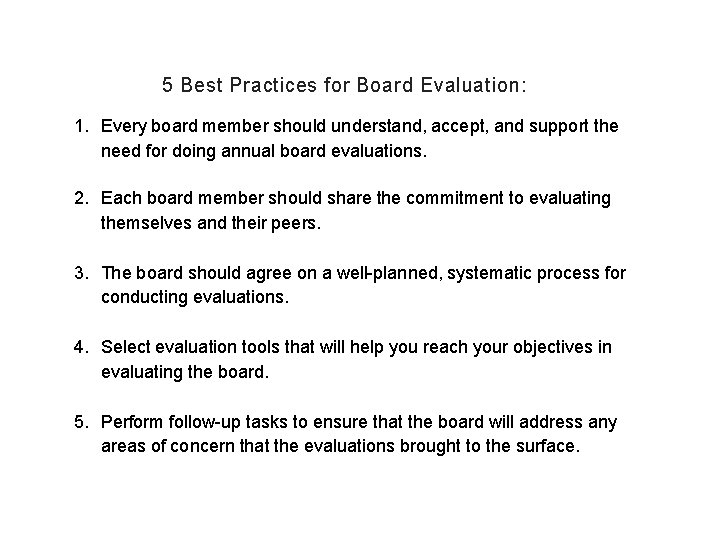
5 Best Practices for Board Evaluation: 1. Every board member should understand, accept, and support the need for doing annual board evaluations. 2. Each board member should share the commitment to evaluating themselves and their peers. 3. The board should agree on a well-planned, systematic process for conducting evaluations. 4. Select evaluation tools that will help you reach your objectives in evaluating the board. 5. Perform follow-up tasks to ensure that the board will address any areas of concern that the evaluations brought to the surface.
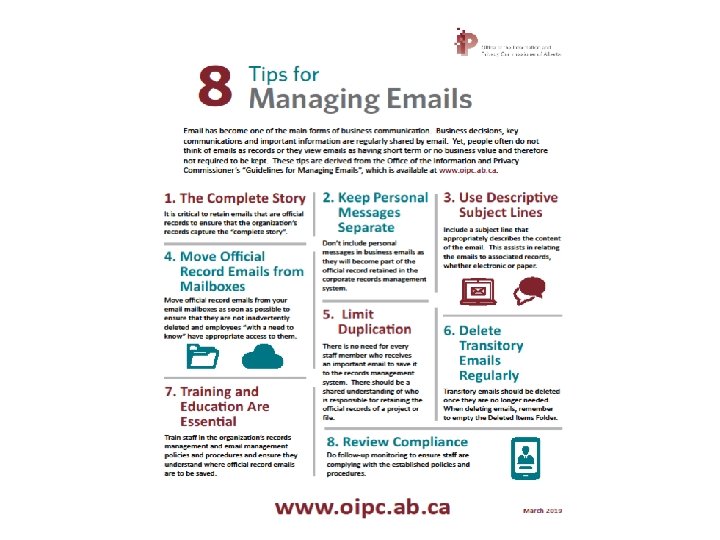
Why do you need Best Practises for Records Management?
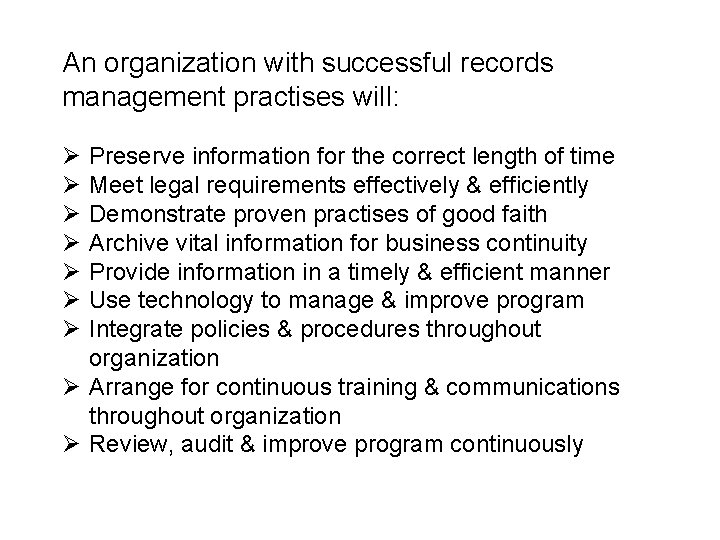
An organization with successful records management practises will: Ø Ø Ø Ø Preserve information for the correct length of time Meet legal requirements effectively & efficiently Demonstrate proven practises of good faith Archive vital information for business continuity Provide information in a timely & efficient manner Use technology to manage & improve program Integrate policies & procedures throughout organization Ø Arrange for continuous training & communications throughout organization Ø Review, audit & improve program continuously
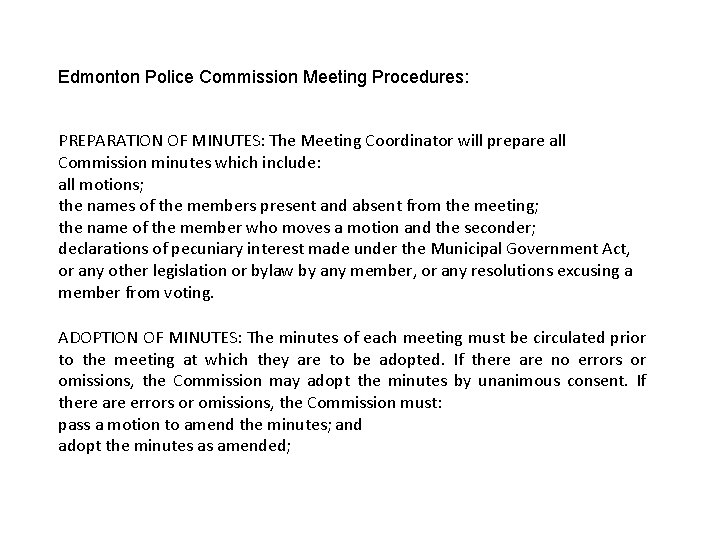
Edmonton Police Commission Meeting Procedures: PREPARATION OF MINUTES: The Meeting Coordinator will prepare all Commission minutes which include: all motions; the names of the members present and absent from the meeting; the name of the member who moves a motion and the seconder; declarations of pecuniary interest made under the Municipal Government Act, or any other legislation or bylaw by any member, or any resolutions excusing a member from voting. ADOPTION OF MINUTES: The minutes of each meeting must be circulated prior to the meeting at which they are to be adopted. If there are no errors or omissions, the Commission may adopt the minutes by unanimous consent. If there are errors or omissions, the Commission must: pass a motion to amend the minutes; and adopt the minutes as amended;