
AAP Review SCRF Introduction Akira Yamamoto Project Manager
- Slides: 11
AAP Review – SCRF Introduction Akira Yamamoto Project Manager, SCRF To be presented, April 19, 2009. 4. 19 AAP-SCRF-Introduction 1
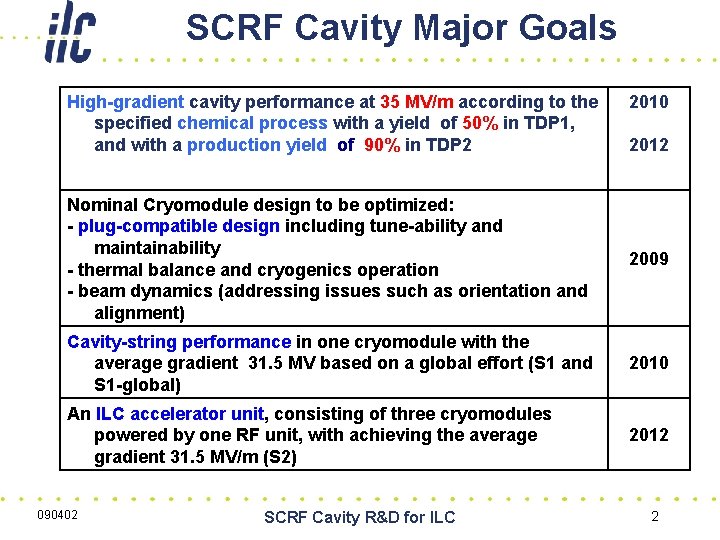
SCRF Cavity Major Goals High-gradient cavity performance at 35 MV/m according to the specified chemical process with a yield of 50% in TDP 1, and with a production yield of 90% in TDP 2 2010 2012 Nominal Cryomodule design to be optimized: - plug-compatible design including tune-ability and maintainability - thermal balance and cryogenics operation - beam dynamics (addressing issues such as orientation and alignment) 2009 Cavity-string performance in one cryomodule with the average gradient 31. 5 MV based on a global effort (S 1 and S 1 -global) 2010 An ILC accelerator unit, consisting of three cryomodules powered by one RF unit, with achieving the average gradient 31. 5 MV/m (S 2) 2012 090402 SCRF Cavity R&D for ILC 2
L. Lilje >> R. Geng • • Engineering and Scientific Management 25 (16 below PM) Susanna Guiducci (infn) – 7 Asia – 7 EU – 11 Americas 081209 Technical Areas and Groups ILC Global Design Effort 3
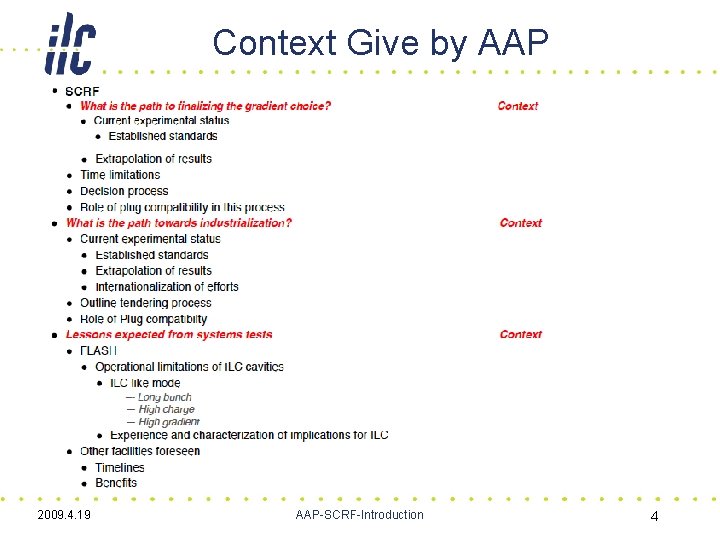
Context Give by AAP 2009. 4. 19 AAP-SCRF-Introduction 4
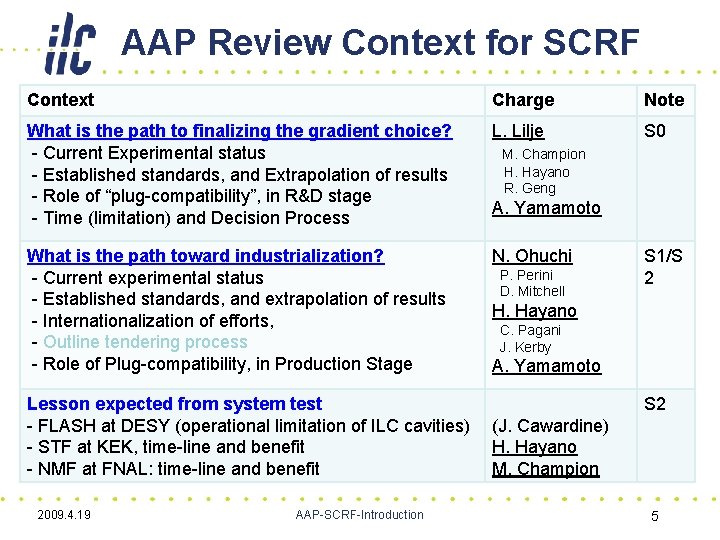
AAP Review Context for SCRF Context Charge Note What is the path to finalizing the gradient choice? - Current Experimental status - Established standards, and Extrapolation of results - Role of “plug-compatibility”, in R&D stage - Time (limitation) and Decision Process L. Lilje S 0 What is the path toward industrialization? - Current experimental status - Established standards, and extrapolation of results - Internationalization of efforts, - Outline tendering process - Role of Plug-compatibility, in Production Stage N. Ohuchi Lesson expected from system test - FLASH at DESY (operational limitation of ILC cavities) - STF at KEK, time-line and benefit - NMF at FNAL: time-line and benefit 2009. 4. 19 AAP-SCRF-Introduction M. Champion H. Hayano R. Geng A. Yamamoto P. Perini D. Mitchell S 1/S 2 H. Hayano C. Pagani J. Kerby A. Yamamoto S 2 (J. Cawardine) H. Hayano M. Champion 5
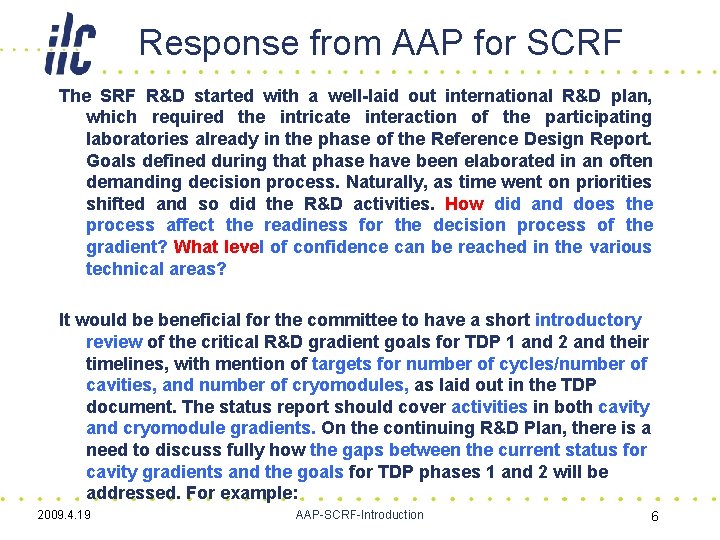
Response from AAP for SCRF The SRF R&D started with a well-laid out international R&D plan, which required the intricate interaction of the participating laboratories already in the phase of the Reference Design Report. Goals defined during that phase have been elaborated in an often demanding decision process. Naturally, as time went on priorities shifted and so did the R&D activities. How did and does the process affect the readiness for the decision process of the gradient? What level of confidence can be reached in the various technical areas? It would be beneficial for the committee to have a short introductory review of the critical R&D gradient goals for TDP 1 and 2 and their timelines, with mention of targets for number of cycles/number of cavities, and number of cryomodules, as laid out in the TDP document. The status report should cover activities in both cavity and cryomodule gradients. On the continuing R&D Plan, there is a need to discuss fully how the gaps between the current status for cavity gradients and the goals for TDP phases 1 and 2 will be addressed. For example: 2009. 4. 19 AAP-SCRF-Introduction 6
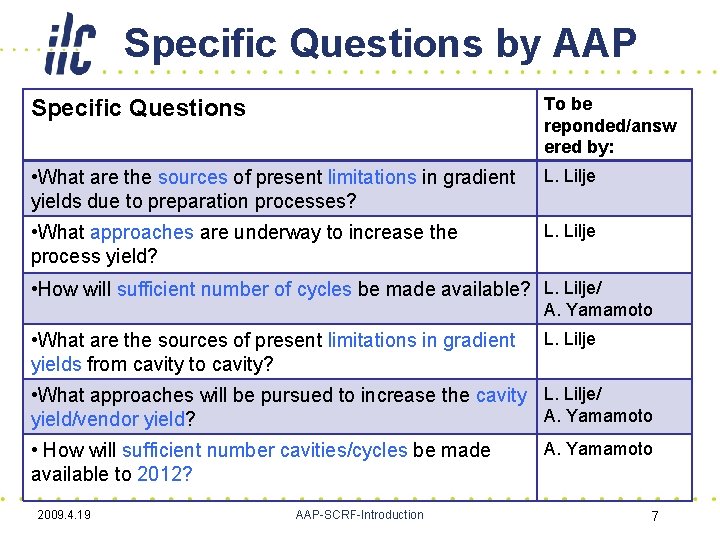
Specific Questions by AAP Specific Questions To be reponded/answ ered by: • What are the sources of present limitations in gradient yields due to preparation processes? L. Lilje • What approaches are underway to increase the process yield? L. Lilje • How will sufficient number of cycles be made available? L. Lilje/ A. Yamamoto • What are the sources of present limitations in gradient yields from cavity to cavity? L. Lilje • What approaches will be pursued to increase the cavity L. Lilje/ A. Yamamoto yield/vendor yield? • How will sufficient number cavities/cycles be made available to 2012? 2009. 4. 19 AAP-SCRF-Introduction A. Yamamoto 7
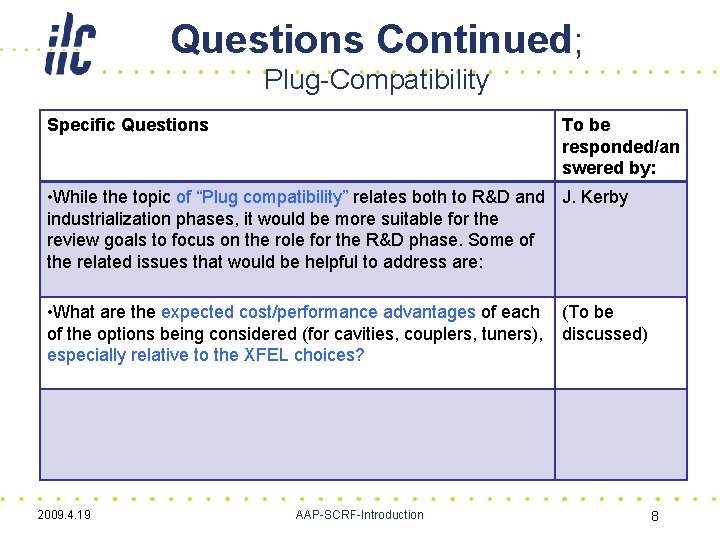
Questions Continued; Plug-Compatibility Specific Questions To be responded/an swered by: • While the topic of “Plug compatibility” relates both to R&D and J. Kerby industrialization phases, it would be more suitable for the review goals to focus on the role for the R&D phase. Some of the related issues that would be helpful to address are: • What are the expected cost/performance advantages of each of the options being considered (for cavities, couplers, tuners), especially relative to the XFEL choices? 2009. 4. 19 AAP-SCRF-Introduction (To be discussed) 8
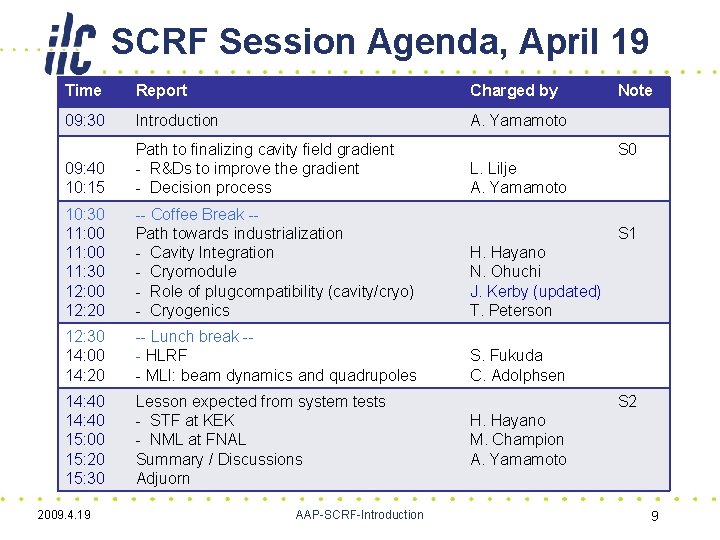
SCRF Session Agenda, April 19 Time Report Charged by 09: 30 Introduction A. Yamamoto 09: 40 10: 15 Path to finalizing cavity field gradient - R&Ds to improve the gradient - Decision process 10: 30 11: 00 11: 30 12: 00 12: 20 -- Coffee Break -Path towards industrialization - Cavity Integration - Cryomodule - Role of plugcompatibility (cavity/cryo) - Cryogenics H. Hayano N. Ohuchi J. Kerby (updated) T. Peterson 12: 30 14: 00 14: 20 -- Lunch break -- HLRF - MLI: beam dynamics and quadrupoles S. Fukuda C. Adolphsen 14: 40 15: 00 15: 20 15: 30 Lesson expected from system tests - STF at KEK - NML at FNAL Summary / Discussions Adjuorn 2009. 4. 19 AAP-SCRF-Introduction Note S 0 L. Lilje A. Yamamoto S 1 S 2 H. Hayano M. Champion A. Yamamoto 9
backup 2009. 4. 19 AAP-SCRF-Introduction 10
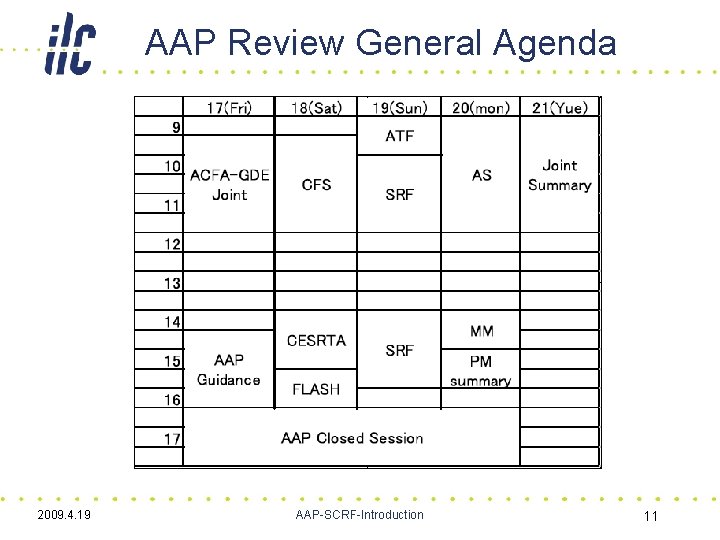
AAP Review General Agenda 2009. 4. 19 AAP-SCRF-Introduction 11