
AAF Functional Description The purpose of AAF Application
- Slides: 5
AAF Functional Description • The purpose of AAF (Application Authorization Framework) is to organize software authorizations so that applications, tools and services can match the access needed to perform job functions. This is a critical function for Cloud environments, as Services need to be able to be installed and running in a very short time, and should not be encumbered with local configurations of Users, Permissions and Passwords. • To be effective during a computer transaction, Security must not only be secure, but very fast. Given that each transaction must be checked and validated for Authorization and Authentication, it is critical that all elements on this path perform optimally. • AAF contains some elements of Role Based Authorization, but includes Attribute Based Authorization elements as well. Essential Functional Components: • The core component to deliver this Enterprise Access is a RESTful service, with runtime instances backed by a resilient Datastore (Cassandra as of release 1. 3) • The Data is managed by RESTful API, with Admin functions supplemented by Character Based User interface and certain GUI elements. • The Service accessible by provided Caching Clients and by specialized plugins • CADI (A Framework for providing Enterprise Class Authentication and Authorization with minimal configuration to Containers and Standalone Services) • Cassandra (GRID Core) 1
AAF Functional Description • CADI stands for Code, Access, Data and Identity, This Framework addresses the Runtime Elements of Access and Identity. • Many other tools address elements of this vision. For instance, Sonar and Fortify evaluate code for maintainability and security problems, while Voltage provides encryption for Data at Rest. However, CADI Framework contributes to these for runtime applications by: • Code - CADI provides reusable Security Client code, and ties in with appropriate Security Interfaces (i. e. J 2 EE Standard Filters) • Access - CADI provides links to Authorization tool(s) (AAF) for Fine-grained Authorization. Also, data from Identity servers is also made available to Coders easily. For instance, CADI provides a clean API to read the Course Grained Authorization information available within the CSP Cookie. • Data - CADI provides simple setup for certificates needed for TLS connectivity, so that barriers to using HTTPS are greatly reduced. It also ensures that no one using CADI uses clear-text passwords in Configuration files. • Identity - CADI Framework obtains the Identity of any callers by delegating to CSO approved Identity servers on behalf of the client, so that Applications can be assured of who is talking to them. 2
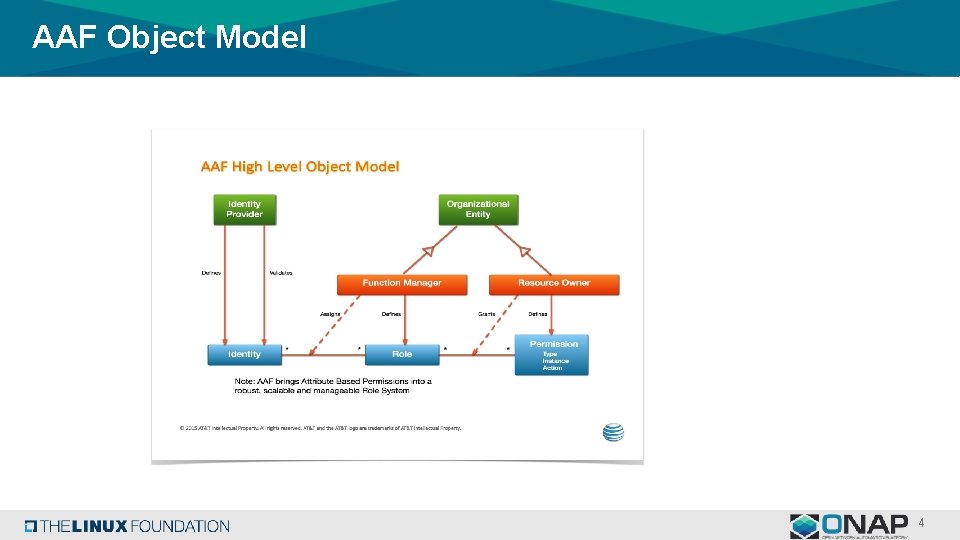
AAF Functional Description Entities within AAF Namespaces • A Namespace, in AAF, is the ensemble of Roles, Permissions and Identities controllable within the domain assigned to a member of the Organization's chain-ofcommand. • Namespaces are known by domain, in dot-delimited form. ex: com. att. aaf or com. att. wfa, and they are hierarchically managed. People in Namespaces • Owner (Responsible) • A key feature of how AAF works for an Enterprise is by supporting federated responsibility. This responsibility is clearly delineated by the owner entry. Organizations (i. e. companies) may establish their own policies Roles • I) "Roles" is a bit of an overloaded term in Security software. It has unfortunately been typically used as a flat, unscoped Group, known only to the Application. • Typical examples such as "user" and "admin" have no meaning outside the immediate context of the application. "admin"? ? ? "admin" of what? What are the behaviors allowed for "admin"? Is the "admin" of Application A, the same as Application B? (answer, no!) Permissions are the other side of the decoupled Authorization equation. Permissions represent some resource that needs to be protected by the Application in question. examples: • A GUI Admin page should be available to only those who job function is to administer this app. • SPI Data that this App accesses should only be accessible to those who are allowed to see SPI data. • Full data reporting dumps should only be accessible to Audit teams. 3
AAF Object Model 4
DMaap Functional Description • Data movement as a platform(DMaa. P) is a premier platform for high performing and cost effective data movement services that transports and processes data from any source to any target with the format, quality, security, and concurrency required to serve the business and customer needs. • DMaa. P consists of three major functional areas: • 1. Data Filtering - the data preprocessing at the edge via data analytics and compression to reduce the data size needed to be processed. • 2. Data Transport - the transport of data intra & inter data centers. The transport will support both file based and event based data movement. The Data Transport process needs to provide the ability to move data from any system to any system with minimal latency, guaranteed delivery and highly available solution that supports a self-subscription model that lowers initial cost and improves time to market. • 3. Data Processing - the low latency and high throughput data transformation, aggregation, and analysis. The processing will be elastically scalable and fault-tolerant across data centers. The Data processing needs to provide the ability to process both batch and near real-time data. This service is build using Apache Kafka and Restful API is created for message publishing, subscribing and admin activities 5