
AAE 490 B Week 3 Lecture 7 Functional
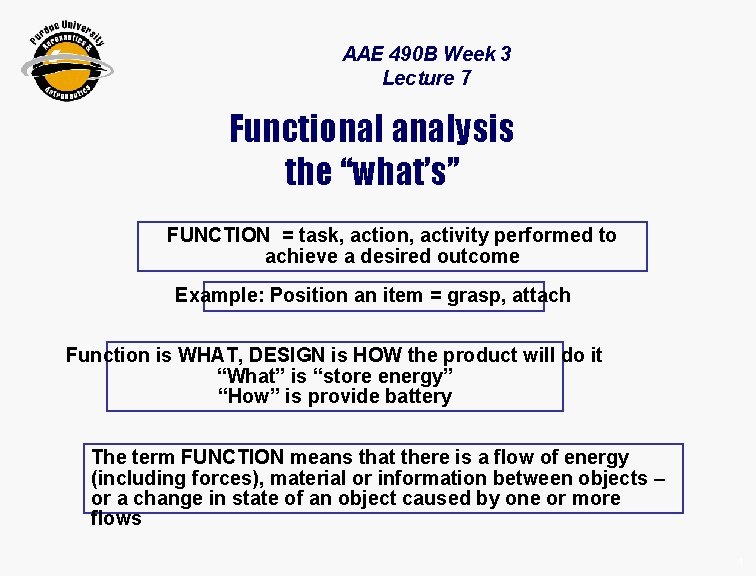
AAE 490 B Week 3 Lecture 7 Functional analysis the “what’s” FUNCTION = task, action, activity performed to achieve a desired outcome Example: Position an item = grasp, attach Function is WHAT, DESIGN is HOW the product will do it “What” is “store energy” “How” is provide battery The term FUNCTION means that there is a flow of energy (including forces), material or information between objects – or a change in state of an object caused by one or more flows 11
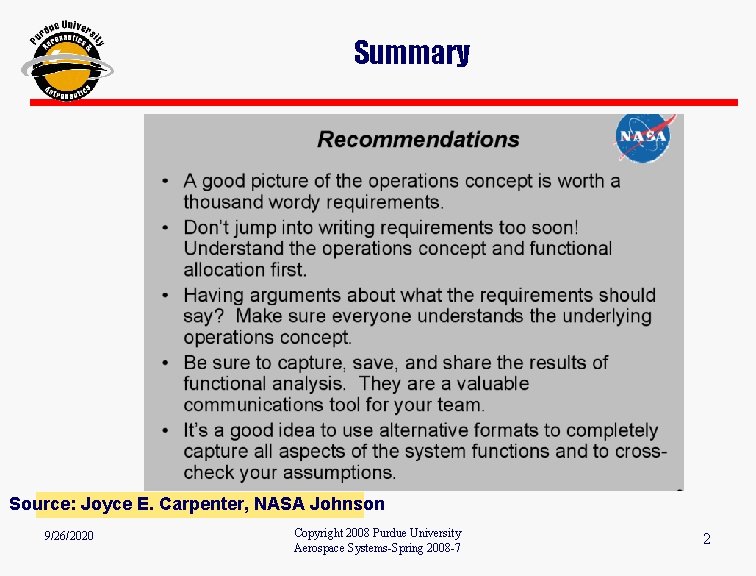
Summary Source: Joyce E. Carpenter, NASA Johnson 9/26/2020 Copyright 2008 Purdue University Aerospace Systems-Spring 2008 -7 2
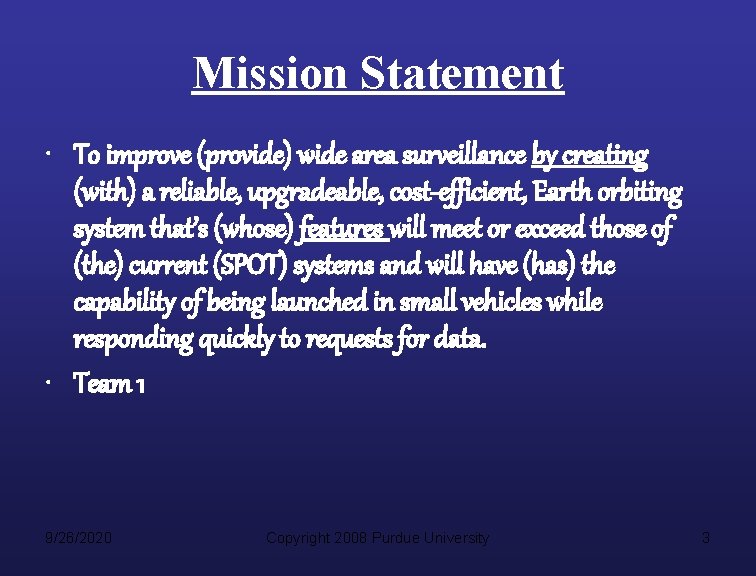
Mission Statement • To improve (provide) wide area surveillance by creating (with) a reliable, upgradeable, cost-efficient, Earth orbiting system that’s (whose) features will meet or exceed those of (the) current (SPOT) systems and will have (has) the capability of being launched in small vehicles while responding quickly to requests for data. • Team 1 9/26/2020 Copyright 2008 Purdue University 3
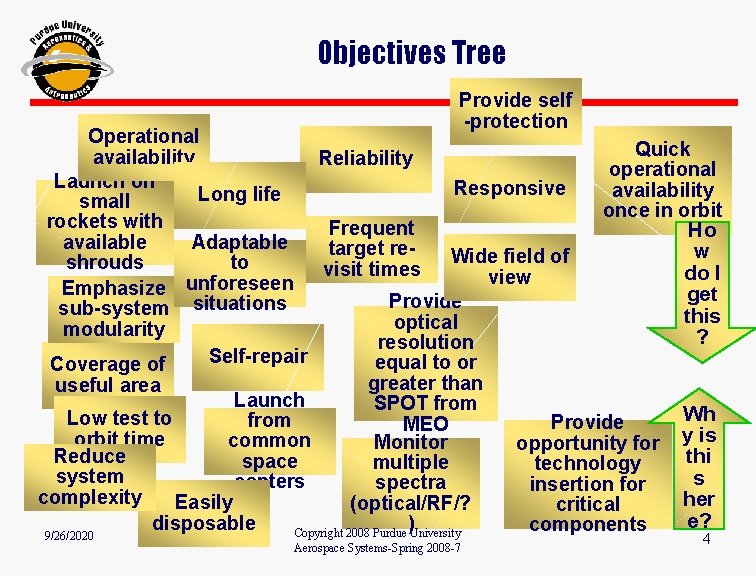
Objectives Tree Provide self -protection Operational Quick availability Reliability operational Launch on Responsive availability Long life small once in orbit rockets with Frequent Ho available Adaptable target rew Wide field of to shrouds visit times do I view unforeseen Emphasize get Provide sub-system situations this optical modularity ? resolution Self-repair equal to or Coverage of greater than useful area Launch SPOT from Wh Low test to from Provide MEO orbit time common Monitor opportunity for y is Reduce thi space multiple technology system s centers spectra insertion for complexity her Easily (optical/RF/? critical e? disposable ) components Copyright 2008 Purdue University 9/26/2020 Aerospace Systems-Spring 2008 -7 4
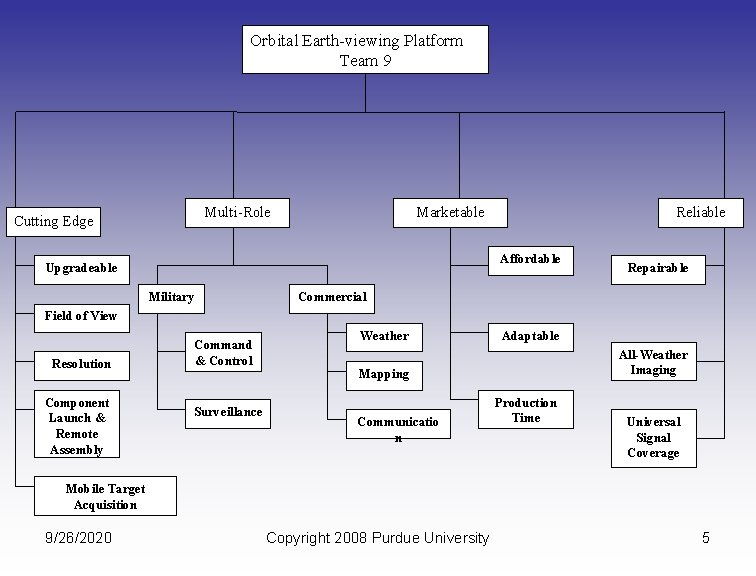
Orbital Earth-viewing Platform Team 9 Multi-Role Cutting Edge Marketable Reliable Affordable Upgradeable Military Repairable Commercial Field of View Resolution Component Launch & Remote Assembly Command & Control Surveillance Weather Adaptable All-Weather Imaging Mapping Communicatio n Production Time Universal Signal Coverage Mobile Target Acquisition 9/26/2020 Copyright 2008 Purdue University 5
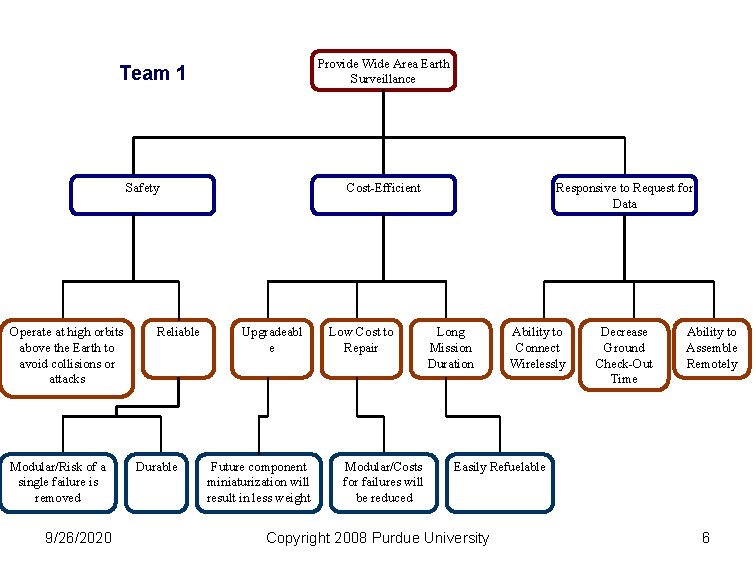
Provide Wide Area Earth Surveillance Team 1 Safety Operate at high orbits above the Earth to avoid collisions or attacks Modular/Risk of a single failure is removed 9/26/2020 Reliable Durable Responsive to Request for Data Cost-Efficient Upgradeabl e Future component miniaturization will result in less weight Low Cost to Repair Modular/Costs for failures will be reduced Long Mission Duration Ability to Connect Wirelessly Decrease Ground Check-Out Time Ability to Assemble Remotely Easily Refuelable Copyright 2008 Purdue University 6
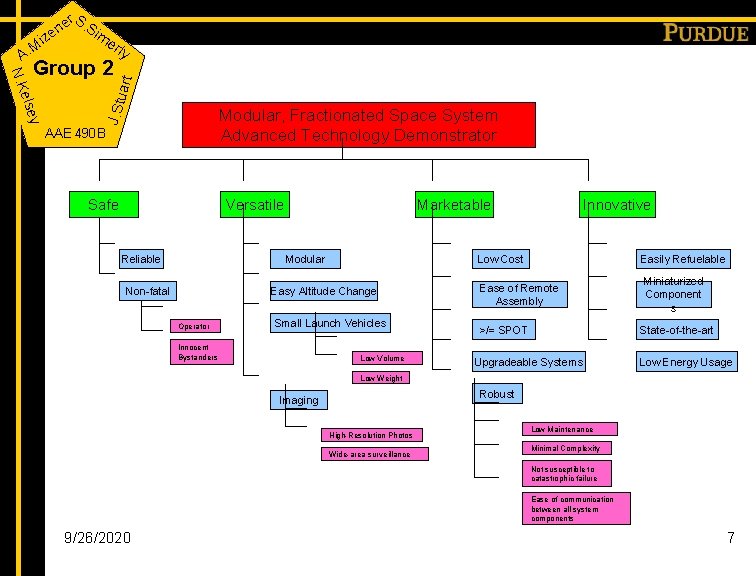
er. S. S n im ze i M A. er uart y else J. St N. K Group 2 ly Modular, Fractionated Space System Advanced Technology Demonstrator AAE 490 B Versatile Safe Modular Reliable Non-fatal Low Cost Easy Altitude Change Operator Innovative Marketable Small Launch Vehicles Innocent Bystanders Low Volume Easily Refuelable Ease of Remote Assembly >/= SPOT Miniaturized Component s State-of-the-art Upgradeable Systems Low Energy Usage Low Weight Robust Imaging High-Resolution Photos Wide-area surveillance Low Maintenance Minimal Complexity Not susceptible to catastrophic failure Ease of communication between all system components 9/26/2020 7
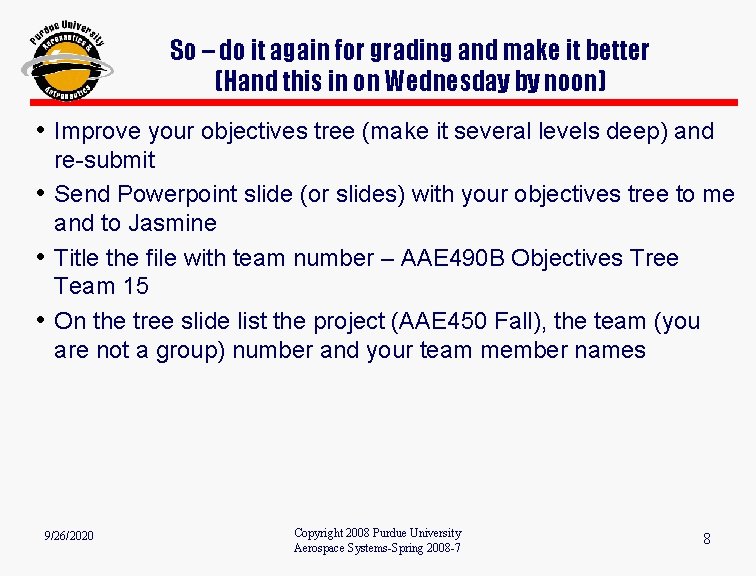
So – do it again for grading and make it better (Hand this in on Wednesday by noon) • Improve your objectives tree (make it several levels deep) and re-submit • Send Powerpoint slide (or slides) with your objectives tree to me and to Jasmine • Title the file with team number – AAE 490 B Objectives Tree Team 15 • On the tree slide list the project (AAE 450 Fall), the team (you are not a group) number and your team member names 9/26/2020 Copyright 2008 Purdue University Aerospace Systems-Spring 2008 -7 8
Homework for next Friday Feb. 1 1. Create a functional flow block diagram (FFBD) for the AAE 450 Fall project 2. Choose a design project from among the following 1. Spring 2008 AAE 450 2. Spring 2008 AAE 451 3. AIAA DBF current contest 3. Develop the Mission statement 4. Develop the objectives tree 5. Submit the results by noon next Friday February 1. 9/26/2020 Copyright 2008 Purdue University Aerospace Systems-Spring 2008 -7 9
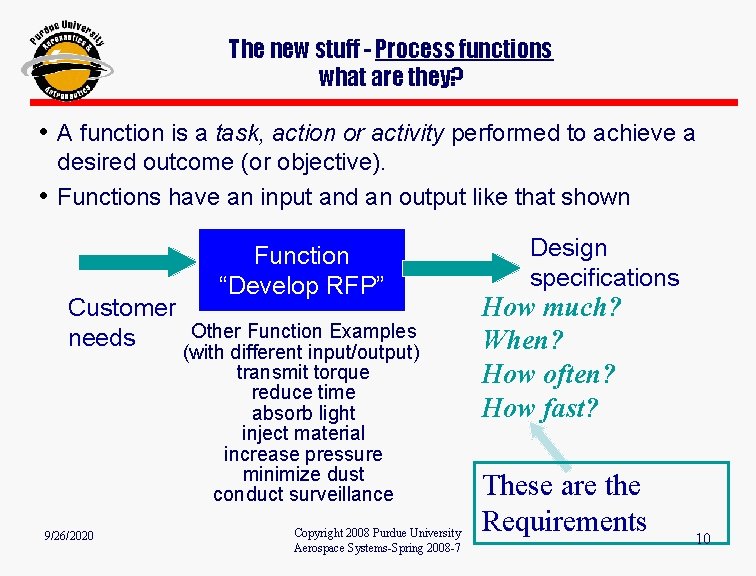
The new stuff - Process functions what are they? • A function is a task, action or activity performed to achieve a desired outcome (or objective). • Functions have an input and an output like that shown Function “Develop RFP” Customer Other Function Examples needs (with different input/output) transmit torque reduce time absorb light inject material increase pressure minimize dust conduct surveillance 9/26/2020 Copyright 2008 Purdue University Aerospace Systems-Spring 2008 -7 Design specifications How much? When? How often? How fast? These are the Requirements 10
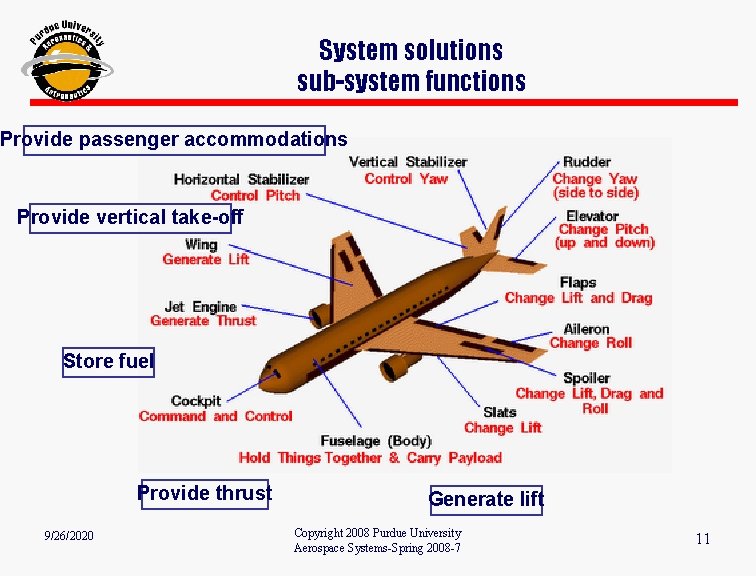
System solutions sub-system functions Provide passenger accommodations Provide vertical take-off Store fuel Provide thrust 9/26/2020 Generate lift Copyright 2008 Purdue University Aerospace Systems-Spring 2008 -7 11
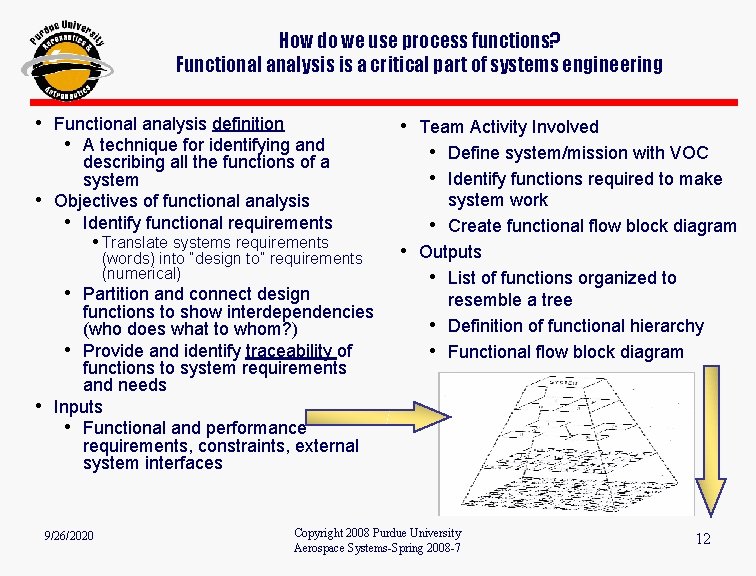
How do we use process functions? Functional analysis is a critical part of systems engineering • Functional analysis definition • A technique for identifying and describing all the functions of a system • Objectives of functional analysis • Identify functional requirements • Translate systems requirements (words) into “design to” requirements (numerical) • Partition and connect design functions to show interdependencies (who does what to whom? ) • Provide and identify traceability of functions to system requirements and needs • Inputs • Functional and performance requirements, constraints, external system interfaces 9/26/2020 • Team Activity Involved • Define system/mission with VOC • Identify functions required to make system work • Create functional flow block diagram • Outputs • List of functions organized to resemble a tree • Definition of functional hierarchy • Functional flow block diagram Copyright 2008 Purdue University Aerospace Systems-Spring 2008 -7 12
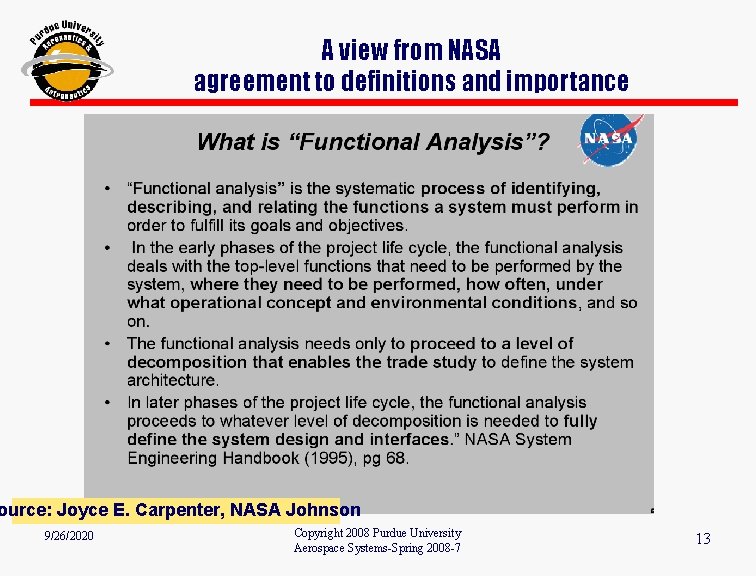
A view from NASA agreement to definitions and importance ource: Joyce E. Carpenter, NASA Johnson 9/26/2020 Copyright 2008 Purdue University Aerospace Systems-Spring 2008 -7 13
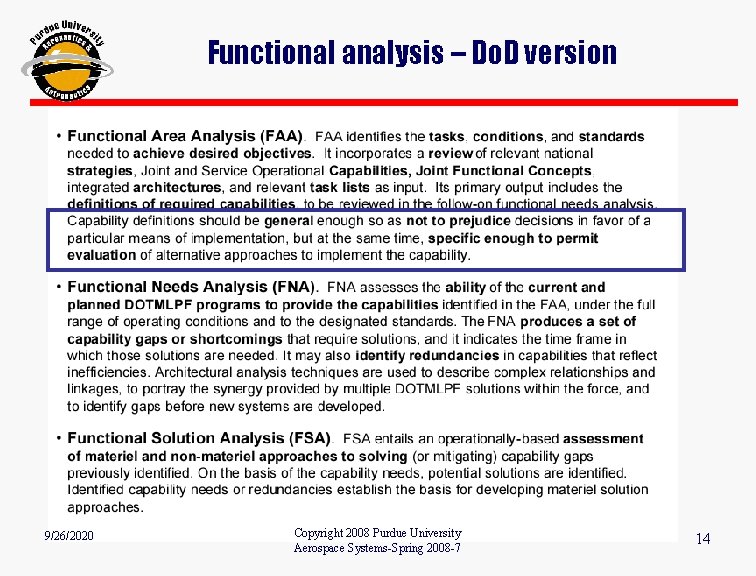
Functional analysis – Do. D version 9/26/2020 Copyright 2008 Purdue University Aerospace Systems-Spring 2008 -7 14
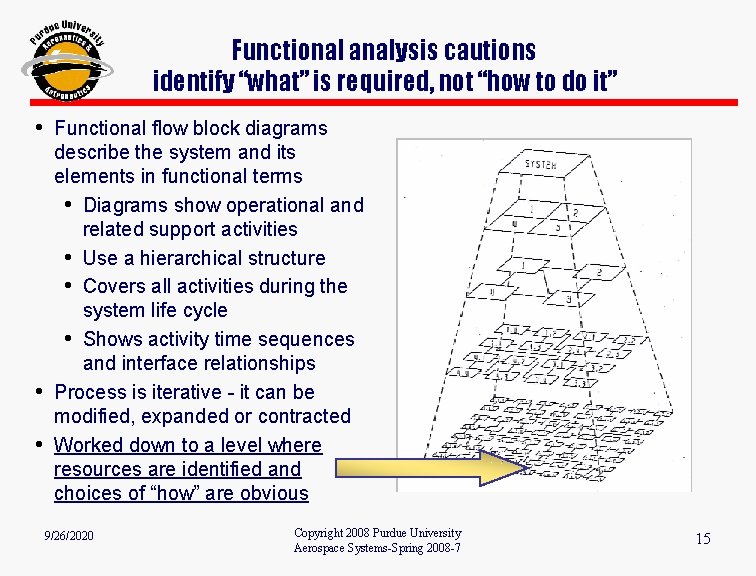
Functional analysis cautions identify “what” is required, not “how to do it” • Functional flow block diagrams describe the system and its elements in functional terms • Diagrams show operational and related support activities • Use a hierarchical structure • Covers all activities during the system life cycle • Shows activity time sequences and interface relationships • Process is iterative - it can be modified, expanded or contracted • Worked down to a level where resources are identified and choices of “how” are obvious 9/26/2020 Copyright 2008 Purdue University Aerospace Systems-Spring 2008 -7 15
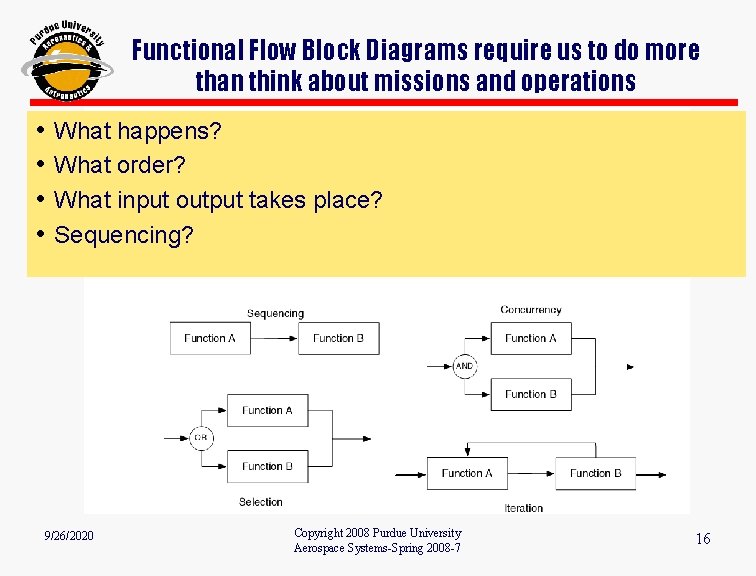
Functional Flow Block Diagrams require us to do more than think about missions and operations • • What happens? What order? What input output takes place? Sequencing? 9/26/2020 Copyright 2008 Purdue University Aerospace Systems-Spring 2008 -7 16
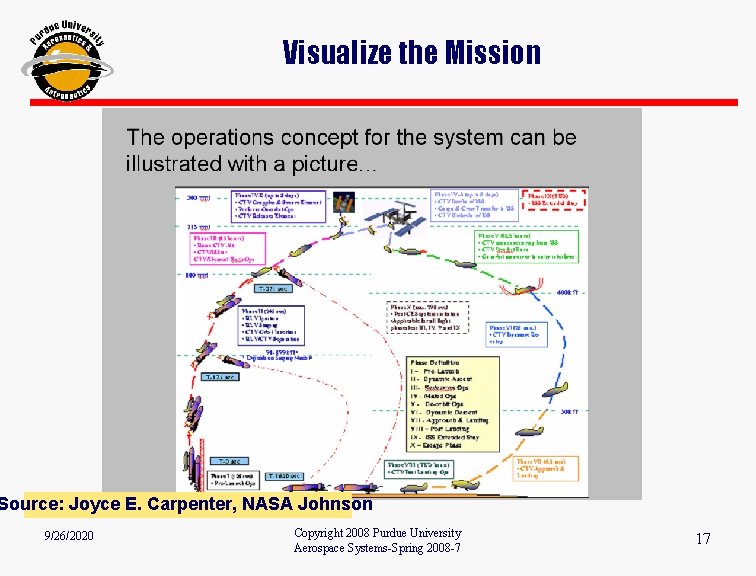
Visualize the Mission Source: Joyce E. Carpenter, NASA Johnson 9/26/2020 Copyright 2008 Purdue University Aerospace Systems-Spring 2008 -7 17
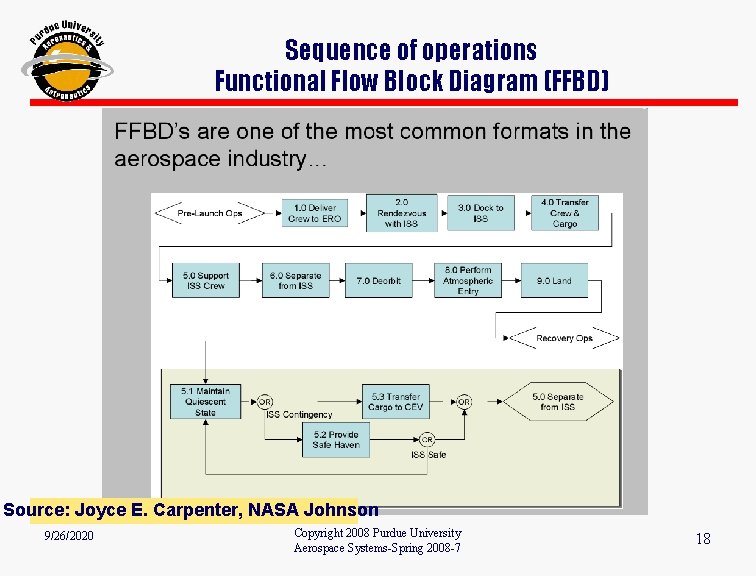
Sequence of operations Functional Flow Block Diagram (FFBD) Source: Joyce E. Carpenter, NASA Johnson 9/26/2020 Copyright 2008 Purdue University Aerospace Systems-Spring 2008 -7 18
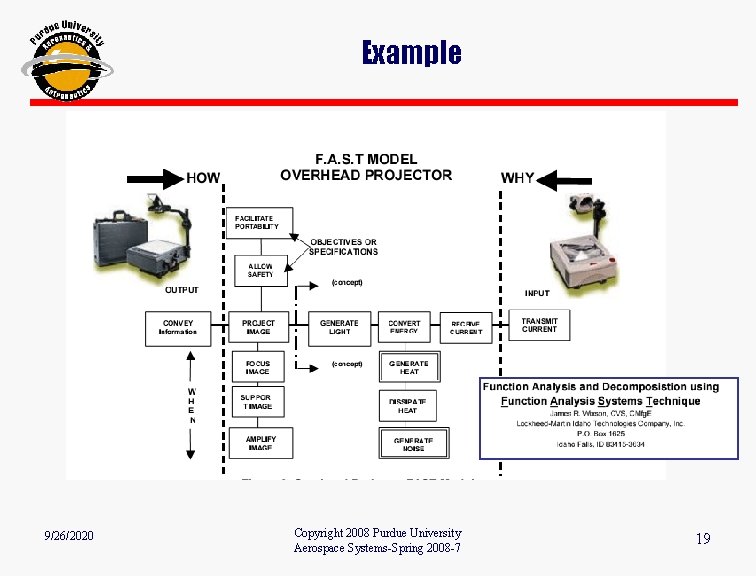
Example 9/26/2020 Copyright 2008 Purdue University Aerospace Systems-Spring 2008 -7 19
Knowing what types of function actions happen helps us - look at flows through the function block • As energy flows through a system it is transformed, stored, transferred/conducted, supplied and dissipated – these are “actions” or “action words” • Flow of energy = what type of energy & action flows within the system? • Mechanical, electrical, fluid, thermal • Flow of materials – three different types of flows • Through-flow – material conserving processes – material is manipulated to change position or shape • Position, lift, hold, support, move, translate, rotate, guide • Diverging flow – dividing material into two or more pieces • Disassemble, separate • Converging flow – assembling or joining • Mix, attach, “position relative to” • Information flow – mechanical signals, electrical signals, software 9/26/2020 Copyright 2008 Purdue University Aerospace Systems-Spring 2008 -7 20
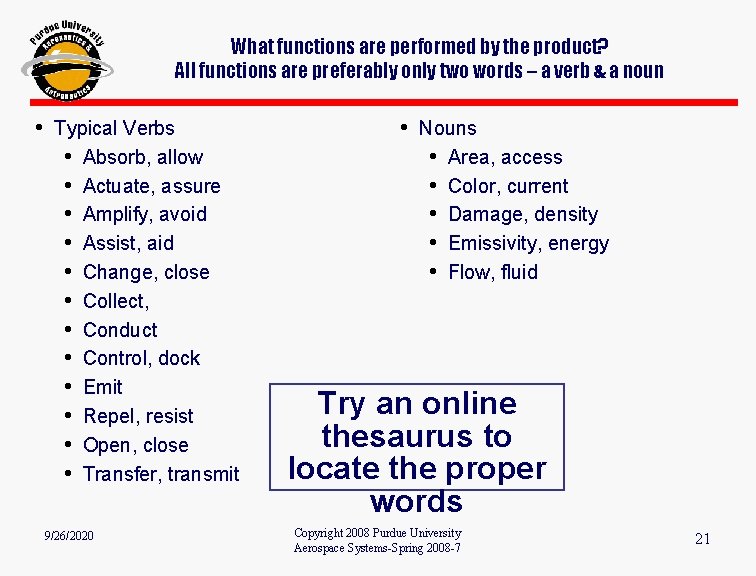
What functions are performed by the product? All functions are preferably only two words – a verb & a noun • Typical Verbs • Absorb, allow • Actuate, assure • Amplify, avoid • Assist, aid • Change, close • Collect, • Conduct • Control, dock • Emit • Repel, resist • Open, close • Transfer, transmit 9/26/2020 • Nouns • Area, access • Color, current • Damage, density • Emissivity, energy • Flow, fluid Try an online thesaurus to locate the proper words Copyright 2008 Purdue University Aerospace Systems-Spring 2008 -7 21
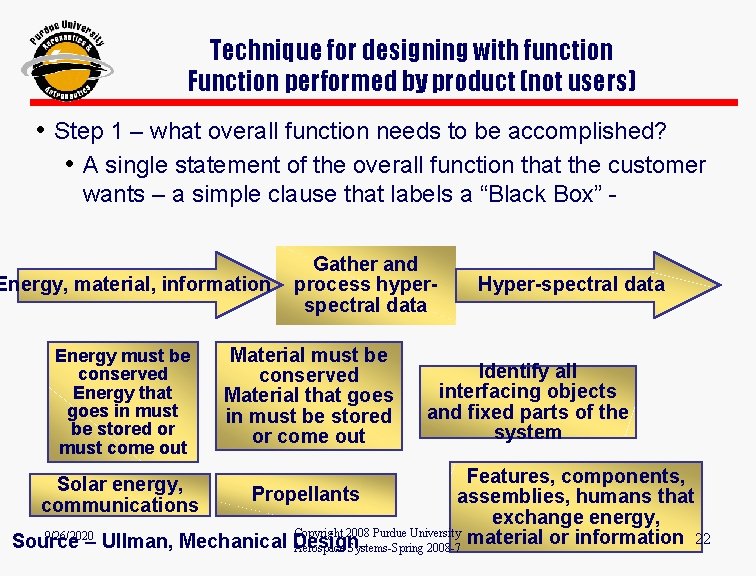
Technique for designing with function Function performed by product (not users) • Step 1 – what overall function needs to be accomplished? • A single statement of the overall function that the customer wants – a simple clause that labels a “Black Box” - Energy, material, information Energy must be conserved Energy that goes in must be stored or must come out Gather and process hyperspectral data Material must be conserved Material that goes in must be stored or come out Hyper-spectral data Identify all interfacing objects and fixed parts of the system Features, components, Propellants assemblies, humans that exchange energy, Copyright 2008 Purdue University 9/26/2020 material or information 22 Source – Ullman, Mechanical Design Aerospace Systems-Spring 2008 -7 Solar energy, communications
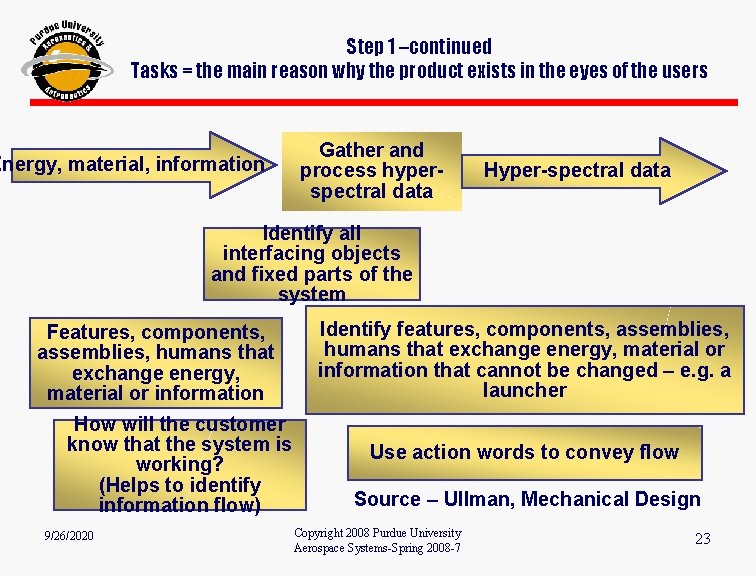
Step 1 –continued Tasks = the main reason why the product exists in the eyes of the users Energy, material, information Gather and process hyperspectral data Hyper-spectral data Identify all interfacing objects and fixed parts of the system Features, components, assemblies, humans that exchange energy, material or information How will the customer know that the system is working? (Helps to identify information flow) 9/26/2020 Identify features, components, assemblies, humans that exchange energy, material or information that cannot be changed – e. g. a launcher Use action words to convey flow Source – Ullman, Mechanical Design Copyright 2008 Purdue University Aerospace Systems-Spring 2008 -7 23
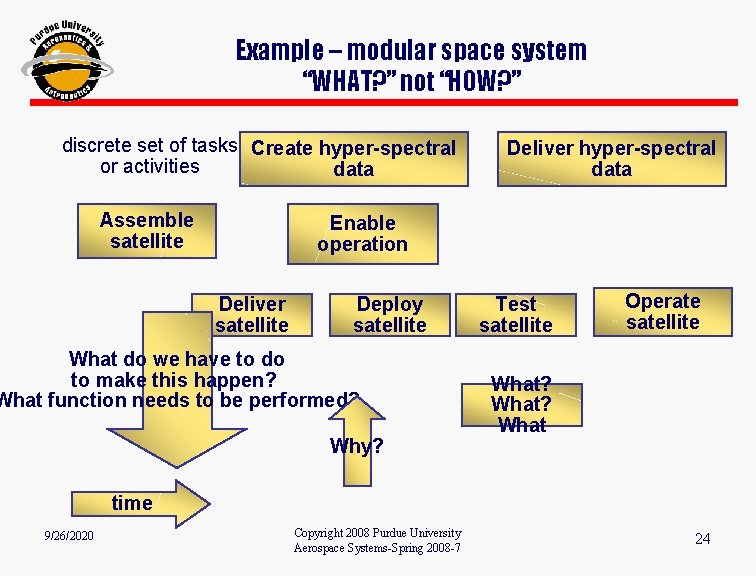
Example – modular space system “WHAT? ” not “HOW? ” discrete set of tasks Create hyper-spectral or activities data Assemble satellite Deliver hyper-spectral data Enable operation Deliver satellite Deploy satellite What do we have to do to make this happen? What function needs to be performed? Why? Test satellite Operate satellite What? What time 9/26/2020 Copyright 2008 Purdue University Aerospace Systems-Spring 2008 -7 24
Step 2 – Create basic and sub-function descriptions functions performed by product to support top level function • Decompose the overall system functions into basic and sub-functions • Identify sub-functions • Essential to success of product – basis of customer’s buying decisions • Division into finer detail leads to a better understanding of the design problem • Avoid words like “be” or “provide” (“provide cooling” becomes “cool space” • Sub-functioning – shows • An object whose state has changed • An object that has energy, material, or information transferred to it from another object • Decomposition • controls the search for solutions • leads to an awareness that some problems are already solved since some components that fulfill the functions already exist (solar cells and batteries for instance) • Don’t use the name of a part – like telescope - only a function 9/26/2020 Copyright 2008 Purdue University Aerospace Systems-Spring 2008 -7 25
Decomposition guidelines a recipe • Consider what – not how • Don’t add a lot of detail • If a specific device is known or required, document the assumptions – e. g. Orbital Express is the propellant delivery device • Use only objects described in the problem specification or overall function – don’t let a component or other system suddenly appear • Break the function down as finely as possible • Consider all operational sequences • A device may have multiple function – e. g. a computer • Is preparation required before a function? – e. g. deployment 9/26/2020 Copyright 2008 Purdue University Aerospace Systems-Spring 2008 -7 26
Step 3 – Order the sub-functions • Order the sub-functions so that they lead back to Step 1 • Flows must be logical or in temporal (timed) sequence • Output of one function should be an input to the other • Identify redundant functions and combine them • Eliminate functions that are not part of your system – define the system boundaries – • Look at energy conservation, information or material flows and match inputs to outputs 9/26/2020 Copyright 2008 Purdue University Aerospace Systems-Spring 2008 -7 27
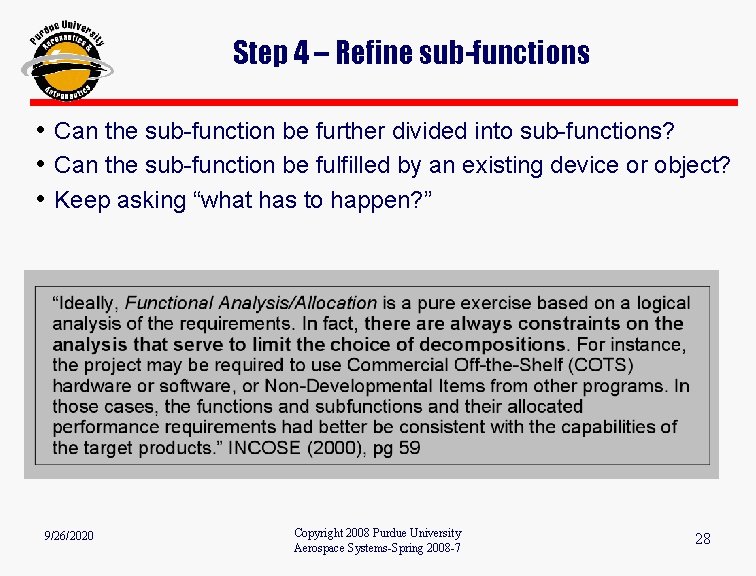
Step 4 – Refine sub-functions • Can the sub-function be further divided into sub-functions? • Can the sub-function be fulfilled by an existing device or object? • Keep asking “what has to happen? ” 9/26/2020 Copyright 2008 Purdue University Aerospace Systems-Spring 2008 -7 28
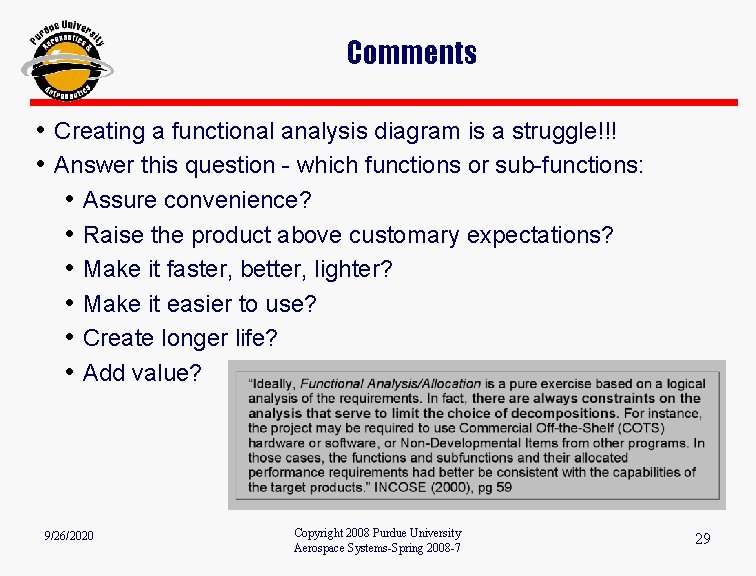
Comments • Creating a functional analysis diagram is a struggle!!! • Answer this question - which functions or sub-functions: • Assure convenience? • Raise the product above customary expectations? • Make it faster, better, lighter? • Make it easier to use? • Create longer life? • Add value? 9/26/2020 Copyright 2008 Purdue University Aerospace Systems-Spring 2008 -7 29
Guidance • Functions are conversion of inputs to outputs • Materials • Information • Energy • Establish functions required • Decompose functional requirements into a discrete set of tasks or activities • Stay focused on behavior, not technology • Convert functions to sub-functions • Look for obvious interactions • Do this hierarchically • Scope the project – draw system boundaries • Allocate functions to components 9/26/2020 Copyright 2008 Purdue University Aerospace Systems-Spring 2008 -7 30
Advice don’t be stampeded • Customers and managers may press your team to publish design requirements quickly or incompletely so that they can “get on with the design. ” They know that they have a tight schedule to meet. Don’t do it! • Take the time to do the job right. Do functional analysis first and then share it with all of your stakeholders to make sure you and they agree on the system functions and boundaries • Designers want to get with the design activity right away – after all they know the correct answer – at least to the problem that they have in mind • Take time to do the functional analysis and see if the “correct” answer can perform the required functions • Mono-disciplinary and sub-system/components experts may not see value in doing functional analysis. After all, they are experts on their sub-systems and know the right answer. • Take time to do the functional analysis first and discuss the results with the whole team 9/26/2020 Copyright 2008 Purdue University Aerospace Systems-Spring 2008 -7 31
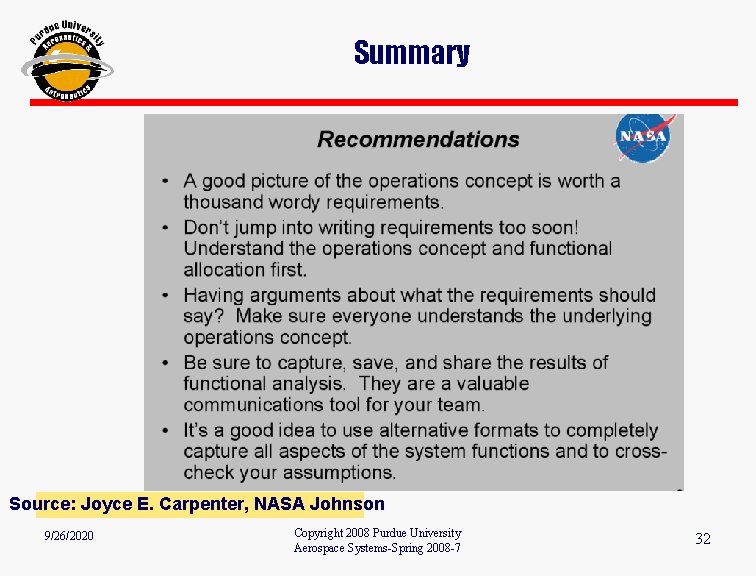
Summary Source: Joyce E. Carpenter, NASA Johnson 9/26/2020 Copyright 2008 Purdue University Aerospace Systems-Spring 2008 -7 32

Back-up slides 33 33
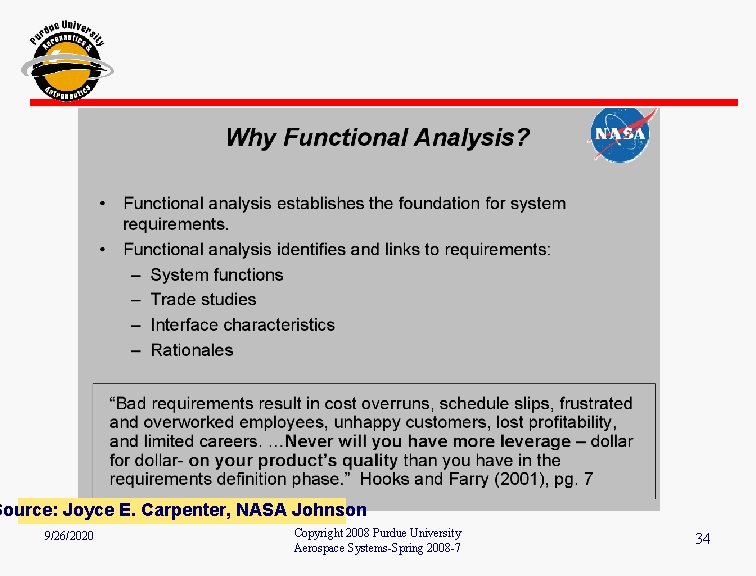
Source: Joyce E. Carpenter, NASA Johnson 9/26/2020 Copyright 2008 Purdue University Aerospace Systems-Spring 2008 -7 34
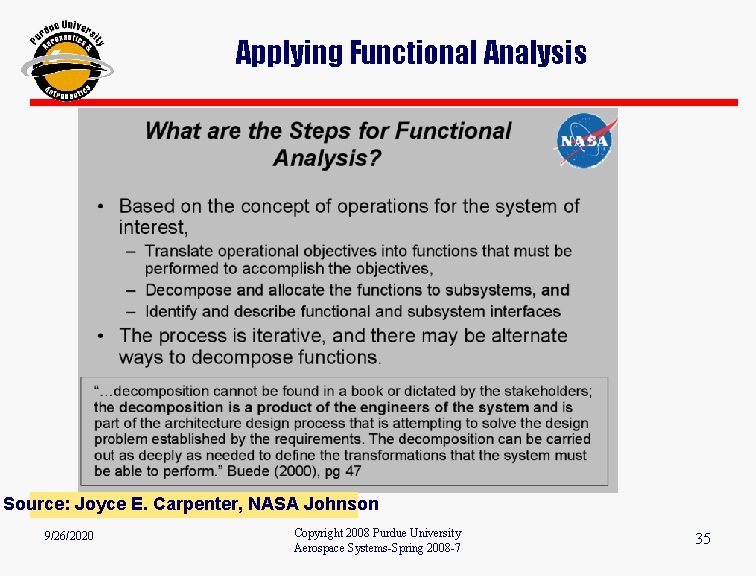
Applying Functional Analysis Source: Joyce E. Carpenter, NASA Johnson 9/26/2020 Copyright 2008 Purdue University Aerospace Systems-Spring 2008 -7 35
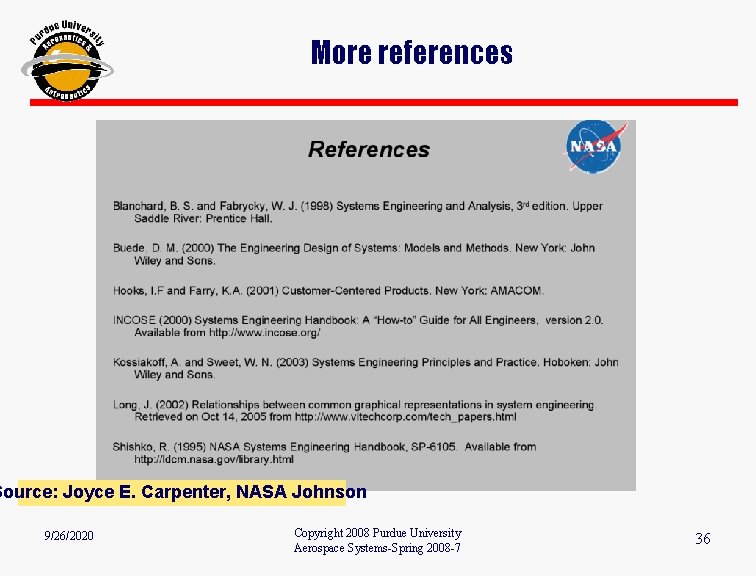
More references Source: Joyce E. Carpenter, NASA Johnson 9/26/2020 Copyright 2008 Purdue University Aerospace Systems-Spring 2008 -7 36
- Slides: 36