
AAE 451 Aircraft Design Critical Design Review Bolier
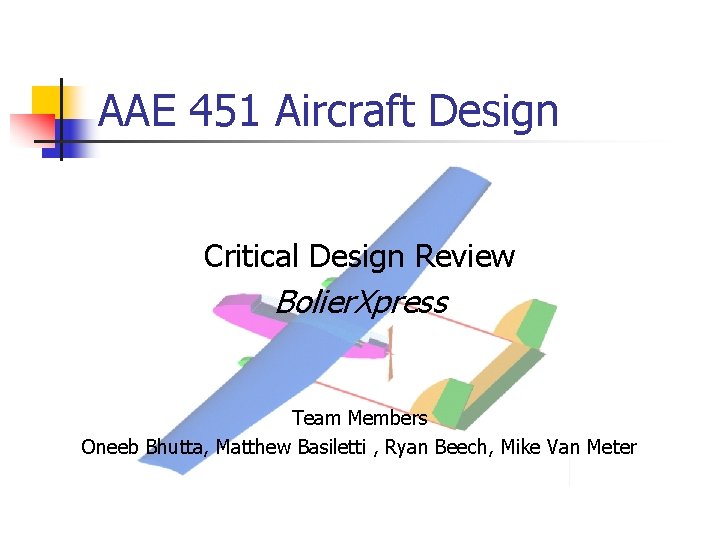
AAE 451 Aircraft Design Critical Design Review Bolier. Xpress Team Members Oneeb Bhutta, Matthew Basiletti , Ryan Beech, Mike Van Meter
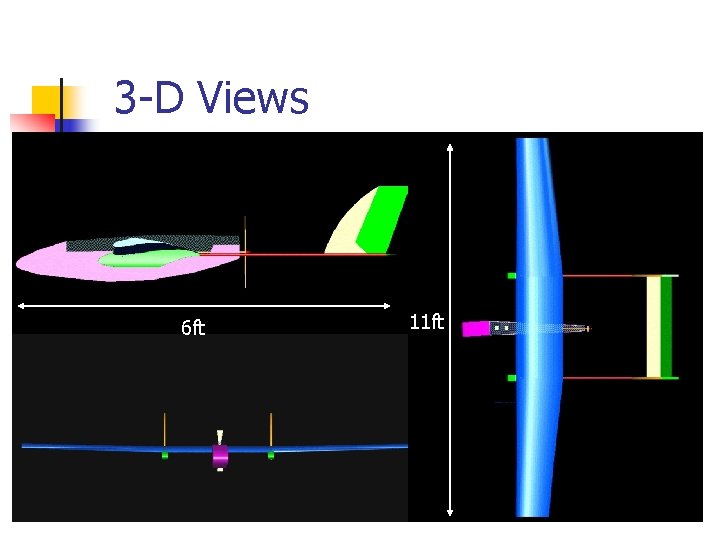
3 -D Views 6 ft 11 ft
Aerodynamic Design Issues Lift • Low Reynolds Number Regime • Slow Flight Requirements Drag • Power Requirements • Accurate Performance Predications Stability and Control • Trimmability • Roll Rate Derivatives
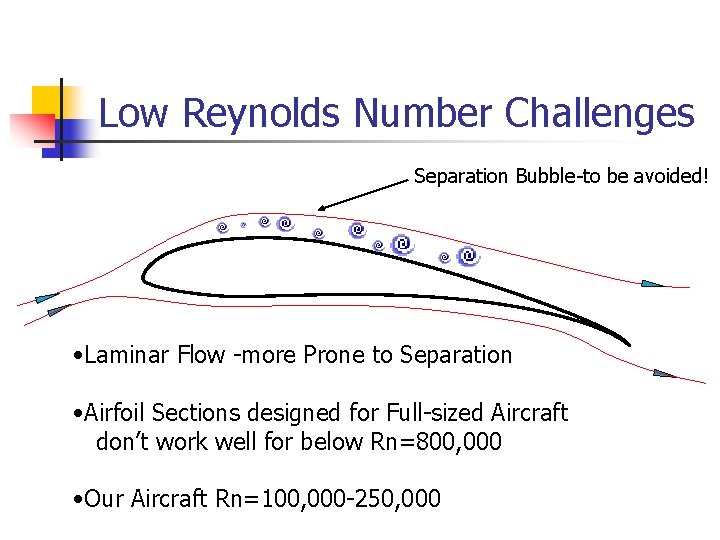
Low Reynolds Number Challenges Separation Bubble-to be avoided! • Laminar Flow -more Prone to Separation • Airfoil Sections designed for Full-sized Aircraft don’t work well for below Rn=800, 000 • Our Aircraft Rn=100, 000 -250, 000
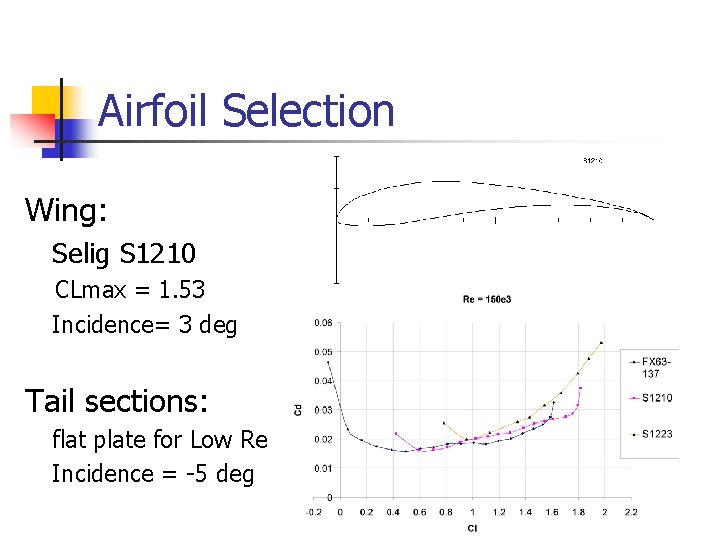
Airfoil Selection Wing: Selig S 1210 CLmax = 1. 53 Incidence= 3 deg Tail sections: flat plate for Low Re Incidence = -5 deg
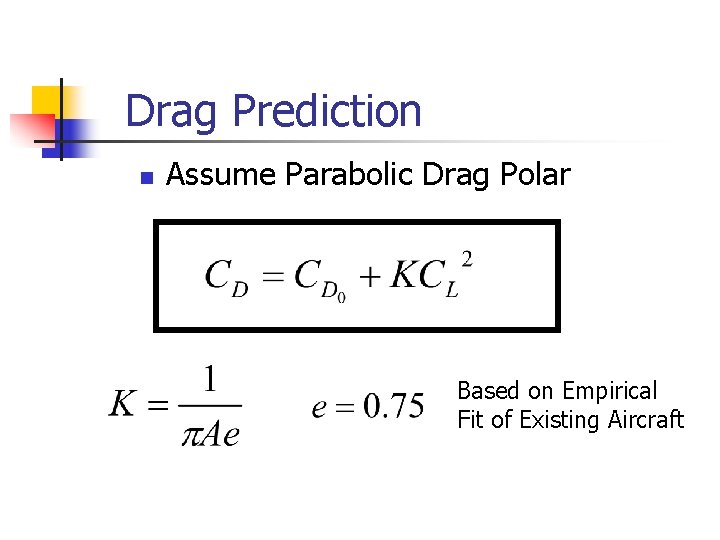
Drag Prediction n Assume Parabolic Drag Polar Based on Empirical Fit of Existing Aircraft
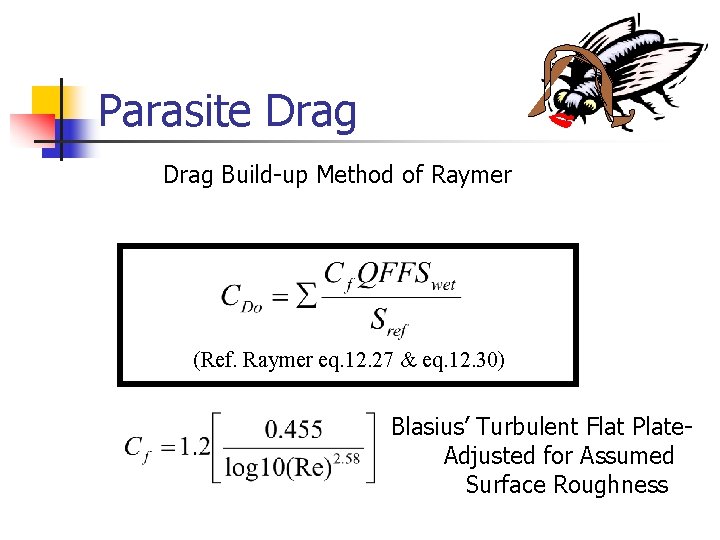
Parasite Drag Build-up Method of Raymer (Ref. Raymer eq. 12. 27 & eq. 12. 30) Blasius’ Turbulent Flat Plate. Adjusted for Assumed Surface Roughness

Drag Polar Aircraft Drag Polar 0. 16 CD CDi CDo 0. 14 0. 12 0. 1 0. 08 0. 06 0. 04 0. 02 0 0. 2 0. 4 0. 6 0. 8 1 CL 1. 2 1. 4 1. 6 1. 8
![Power Required 32 Predict: • Battery energy for cruise Power Required [ft-lb/s] • Power](http://slidetodoc.com/presentation_image/1141d7c5e4a8a8123bca331a0d01ec64/image-9.jpg "Power Required 32 Predict: • Battery energy for cruise Power Required [ft-lb/s] • Power")
Power Required 32 Predict: • Battery energy for cruise Power Required [ft-lb/s] • Power required for cruise 30 28 26 24 22 20 18 16 15 20 25 30 Velocity [ft/s] 35 40
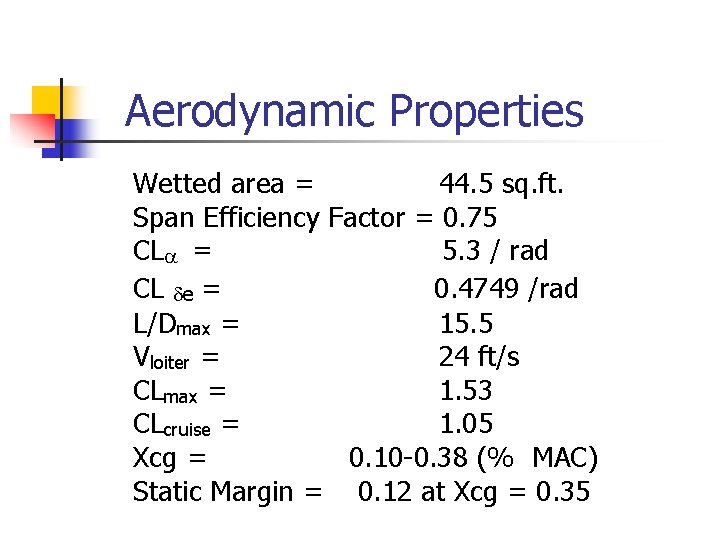
Aerodynamic Properties Wetted area = 44. 5 sq. ft. Span Efficiency Factor = 0. 75 CLa = 5. 3 / rad CL de = 0. 4749 /rad L/Dmax = 15. 5 Vloiter = 24 ft/s CLmax = 1. 53 CLcruise = 1. 05 Xcg = 0. 10 -0. 38 (% MAC) Static Margin = 0. 12 at Xcg = 0. 35
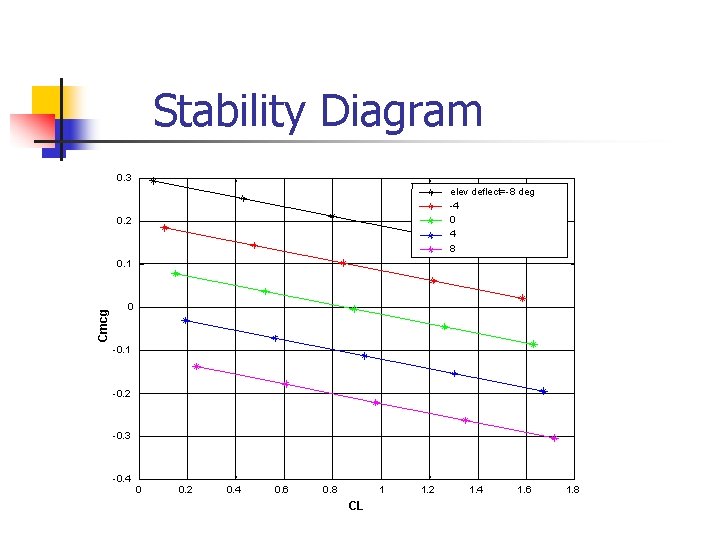
Stability Diagram 0. 3 elev deflect=-8 deg -4 0 4 8 0. 2 Cmcg 0. 1 elev deflect=-8 deg -4 0 0 4 8 -0. 1 -0. 2 -0. 3 -0. 4 0 0. 2 0. 4 0. 6 0. 8 1 CL 1. 2 1. 4 1. 6 1. 8
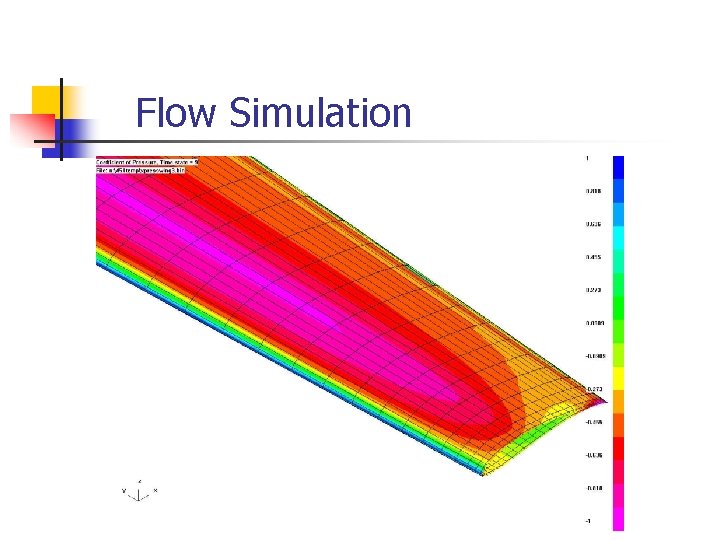
Flow Simulation
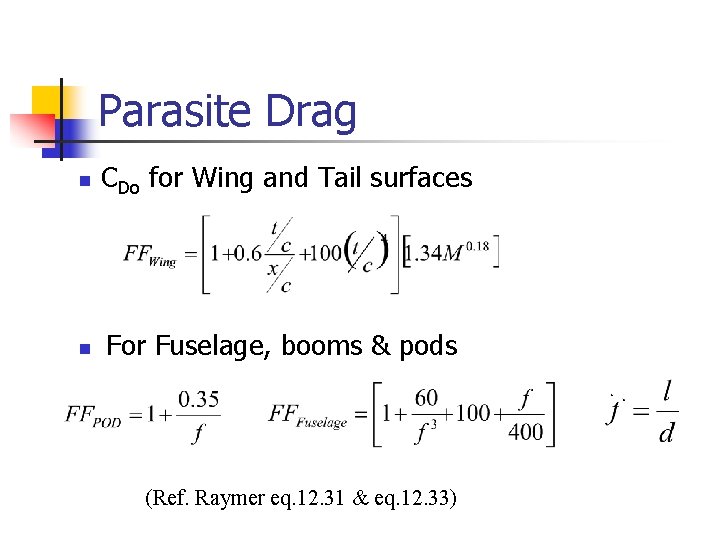
Parasite Drag n CDo for Wing and Tail surfaces n For Fuselage, booms & pods (Ref. Raymer eq. 12. 31 & eq. 12. 33)
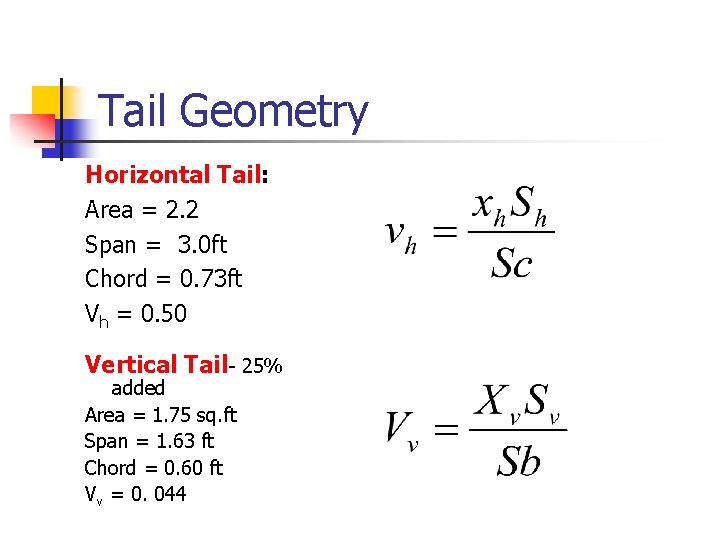
Tail Geometry Horizontal Tail: Area = 2. 2 Span = 3. 0 ft Chord = 0. 73 ft Vh = 0. 50 Vertical Tail- 25% added Area = 1. 75 sq. ft Span = 1. 63 ft Chord = 0. 60 ft Vv = 0. 044
Control Surface Sizing: Elevator Area Ratio = 0. 30 Chord = 2. 7 in. Rudder Area Ratio = 0. 40 Single rudder of chord = 7. 5 in. Ailerons Area Ratio = 0. 10 Aileron chord = 3 in.
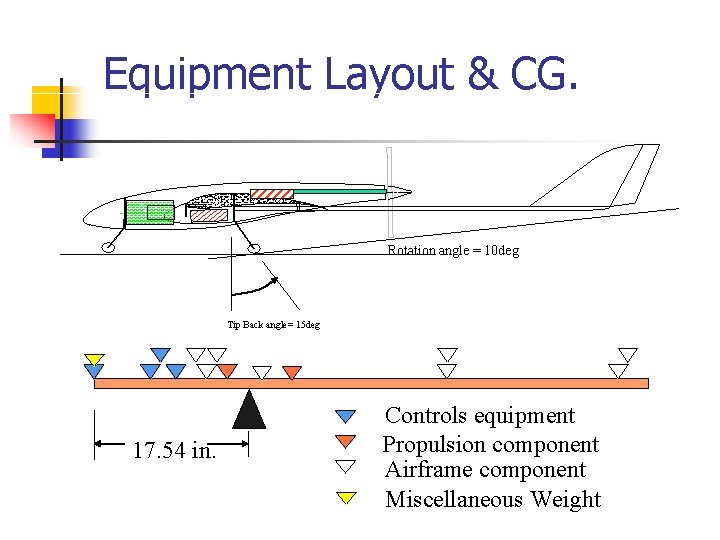
Equipment Layout & CG. Rotation angle = 10 deg Tip Back angle= 15 deg 17. 54 in. Controls equipment Propulsion component Airframe component Miscellaneous Weight
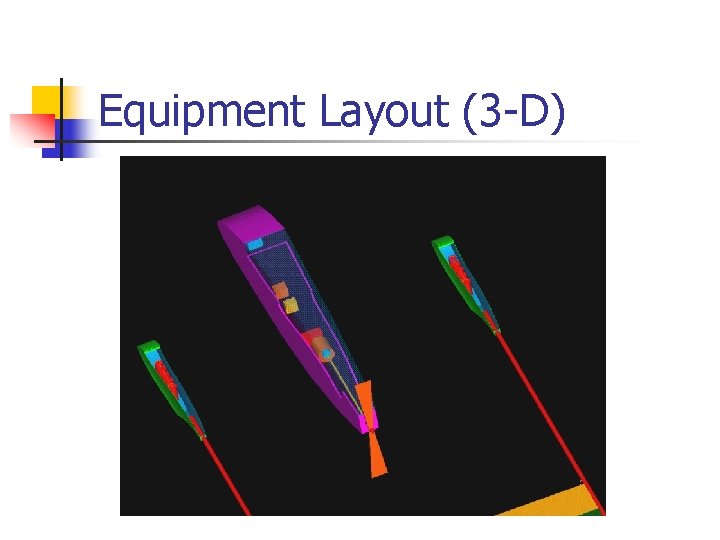
Equipment Layout (3 -D)
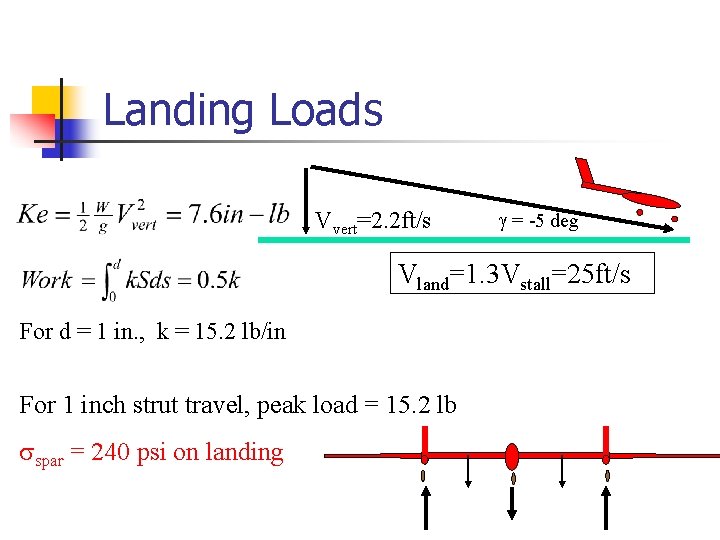
Landing Loads Vvert=2. 2 ft/s g = -5 deg Vland=1. 3 Vstall=25 ft/s For d = 1 in. , k = 15. 2 lb/in For 1 inch strut travel, peak load = 15. 2 lb sspar = 240 psi on landing
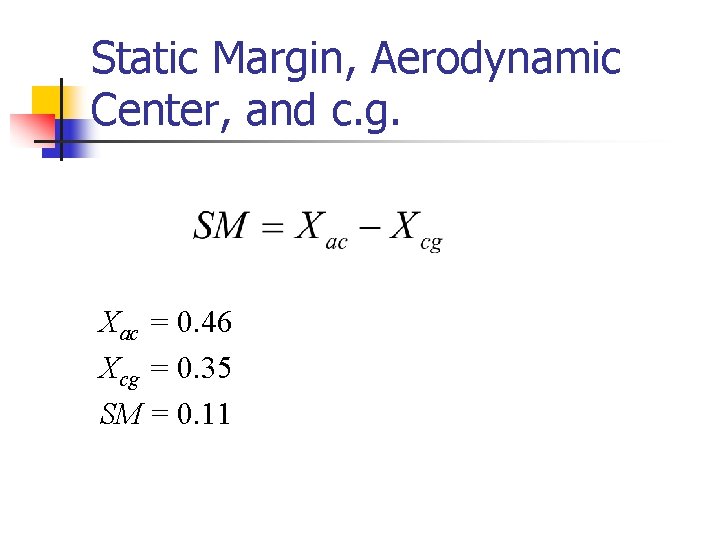
Static Margin, Aerodynamic Center, and c. g. Xac = 0. 46 Xcg = 0. 35 SM = 0. 11
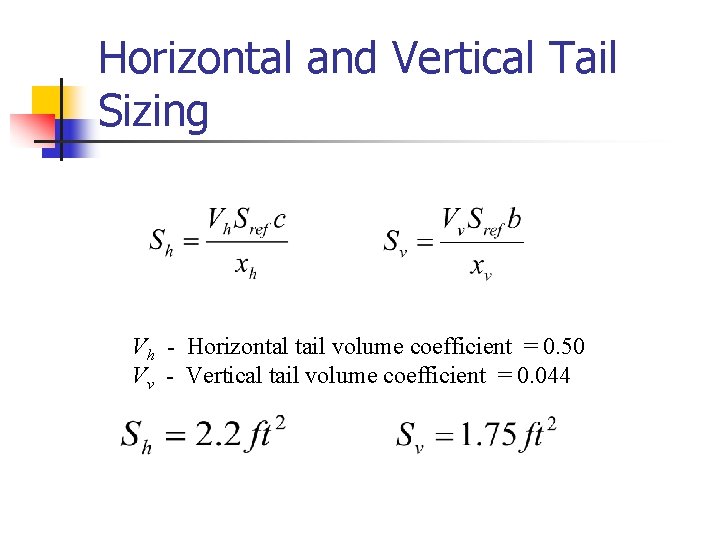
Horizontal and Vertical Tail Sizing Vh - Horizontal tail volume coefficient = 0. 50 Vv - Vertical tail volume coefficient = 0. 044
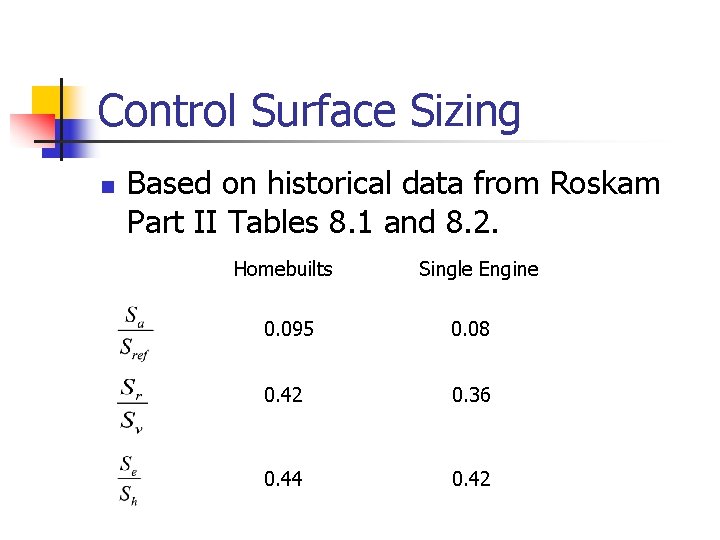
Control Surface Sizing n Based on historical data from Roskam Part II Tables 8. 1 and 8. 2. Homebuilts Single Engine 0. 095 0. 08 0. 42 0. 36 0. 44 0. 42
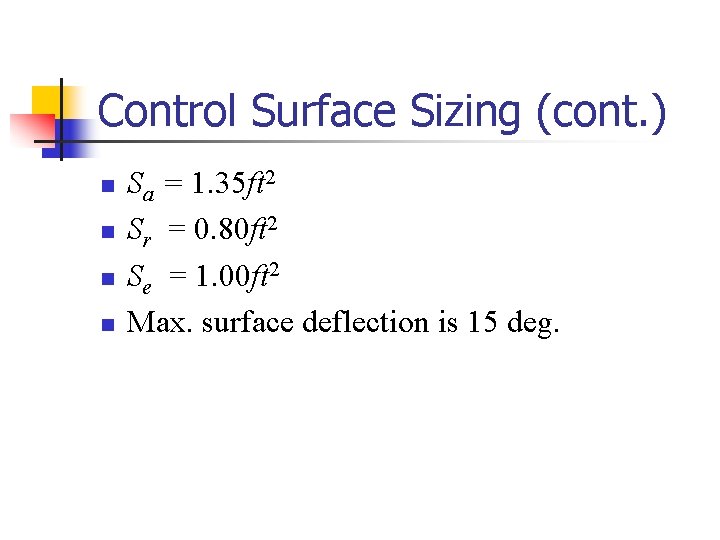
Control Surface Sizing (cont. ) n n Sa = 1. 35 ft 2 Sr = 0. 80 ft 2 Se = 1. 00 ft 2 Max. surface deflection is 15 deg.
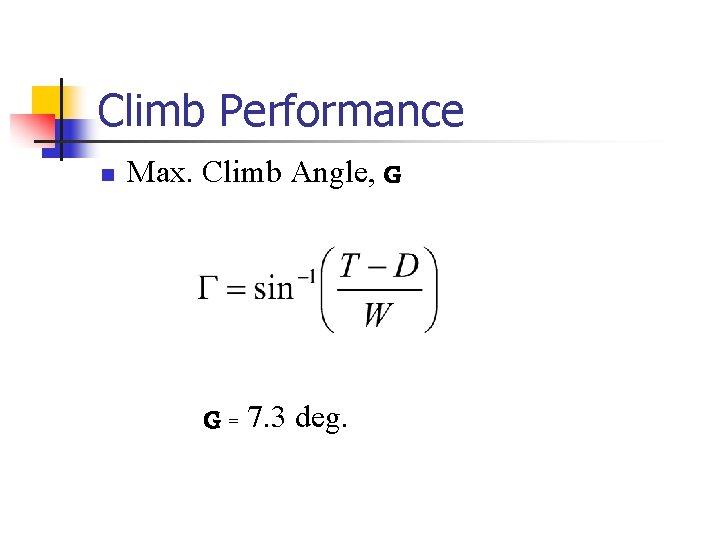
Climb Performance n Max. Climb Angle, G G = 7. 3 deg.
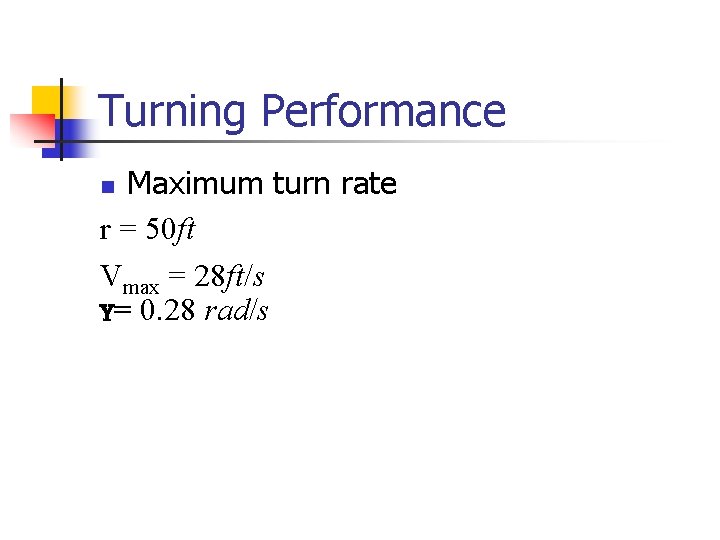
Turning Performance Maximum turn rate r = 50 ft Vmax = 28 ft/s Y= 0. 28 rad/s n

Propulsion Design Issues n Power n n n Endurance n n Power required Power available Can we complete the mission Verification n Motor test to take place this week
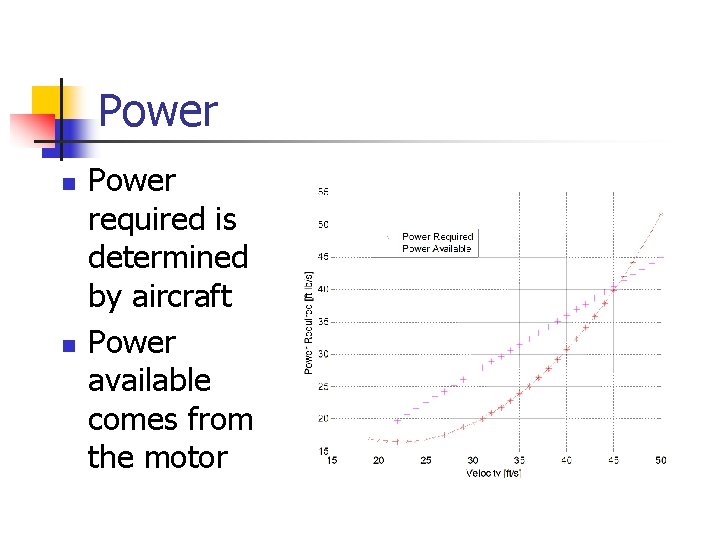
Power n n Power required is determined by aircraft Power available comes from the motor
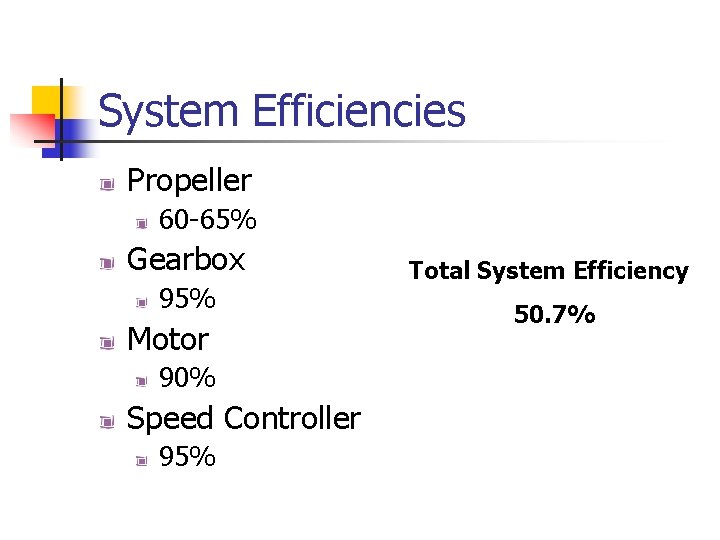
System Efficiencies Propeller 60 -65% Gearbox 95% Motor 90% Speed Controller 95% Total System Efficiency 50. 7%
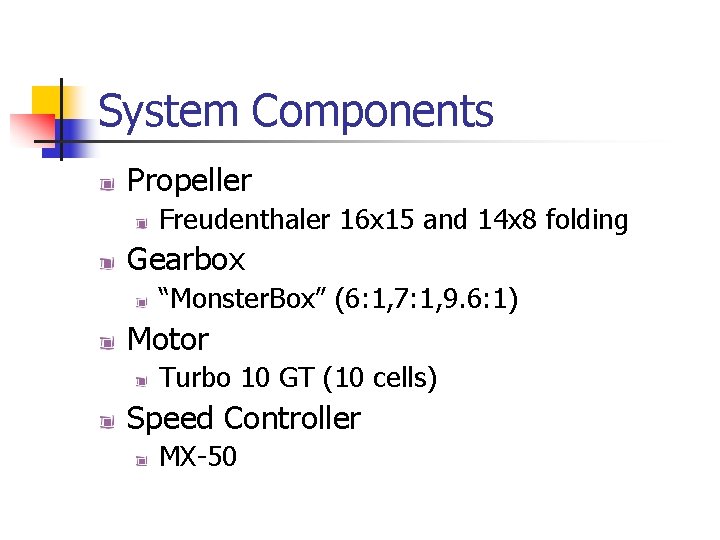
System Components Propeller Freudenthaler 16 x 15 and 14 x 8 folding Gearbox “Monster. Box” (6: 1, 7: 1, 9. 6: 1) Motor Turbo 10 GT (10 cells) Speed Controller MX-50
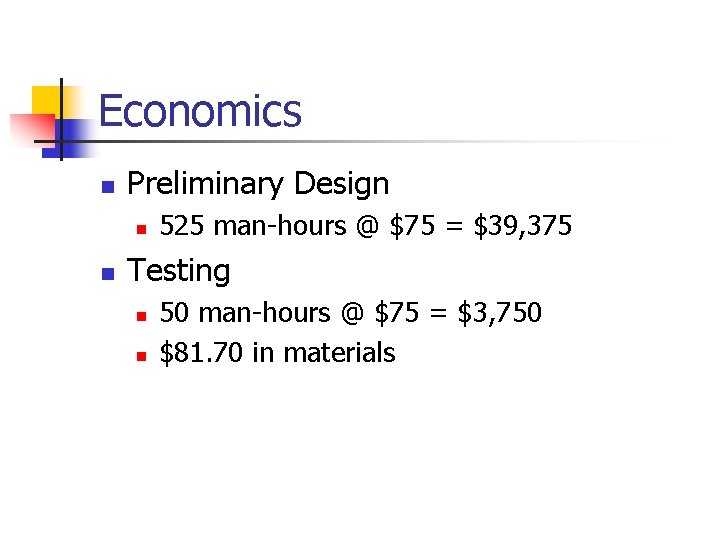
Economics n Preliminary Design n n 525 man-hours @ $75 = $39, 375 Testing n n 50 man-hours @ $75 = $3, 750 $81. 70 in materials
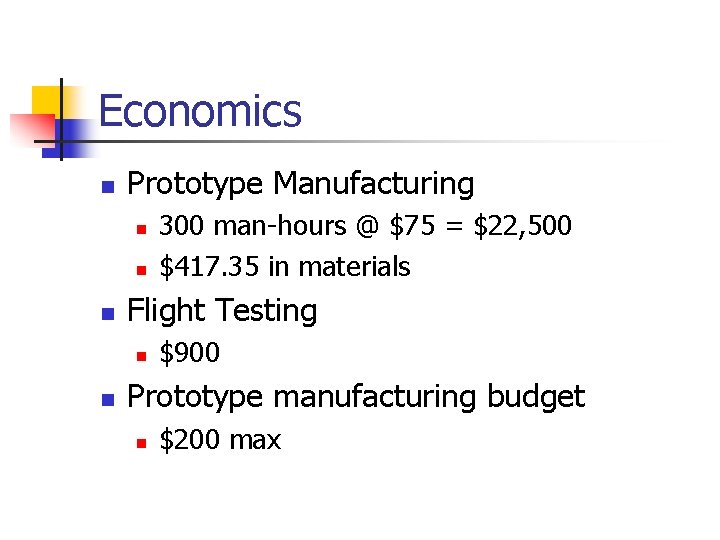
Economics n Prototype Manufacturing n n n Flight Testing n n 300 man-hours @ $75 = $22, 500 $417. 35 in materials $900 Prototype manufacturing budget n $200 max

The Budget
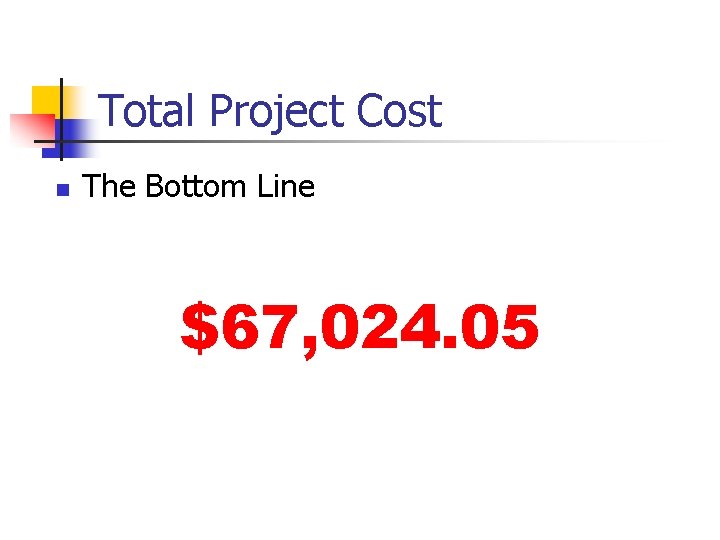
Total Project Cost n The Bottom Line $67, 024. 05
Questions?
- Slides: 33