
AACR 2s Strategic Plan and IFLA Work towards




- Slides: 30
AACR 2's Strategic Plan and IFLA Work towards an International Cataloguing Code Dr. Barbara B. Tillett Library of Congress Representative to the Joint Steering Committee for Revision of the Anglo-American Cataloguing Rules Presentation to the Commissione permanente per l’aggiornamento della RICA November 21, 2002 Rome, Italy
History of AACR • • Panizzi – British Museum – 91 rules (1841) Cutter – Rules for a dictionary catalog (1876) Paris Principles (1961) AACR (1967) – North American ed. – British ed. • ISBD (1969+) • AACR 2 (1978)
AACR 2 • AACR 2 (1978, 1988, 1998, 2002)
AACR Used Worldwide • Basis of the majority of records in machinereadable form – Over 48 million in OCLC – Worldwide publication coverage
AACR 2, 2002 Revision • • Now available Loose-leaf Binder with tabs Annual updates
LC Actions to Implement AACR Changes • Implementation of the 2002 Revision effective December 1, 2002 • Distribution of updates – LCRIs for internal consistency of rule application – Cataloger’s Desktop
Descriptive and Access Elements • Description – ISBD areas • • 1 2 3 4 5 6 7 8 • Access title and statement of responsibility edition material specific details publication, distribution, etc. physical description series notes standard numbers and terms of availability – Controlled vocabularies, syndetic structure of references – Classification, call numbers, standard numbers, barcodes – Direct links
Structure of the Rules Part I - Description • Chapter 1 – General rules • Chapter 2 -12 – Classes of material • • • Books, Pamphlets, and Printed Sheets Cartographic Materials Manuscripts Music Sound Recordings Motion Pictures and Videorecordings Graphic Materials Electronic Resources Three-dimensional Artefacts and Realia Microforms Serials • Chapter 13 - Analysis
Part II – Choice and Form of Access Points • Chapter 21 – Choice of Access Points • Chapter 22 -25 – Headings – Persons – Geographic Names – Corporate Bodies – Uniform Titles • Chapter 26 - References
Appendices • • • Capitalization Abbreviations Numerals Initial Articles Glossary • Index
JSC Meeting - Sept. 9 -11, 2002 York, England • FRBR terminology – So rules will be more precise • Format Variation Working Group – Expression-level citations – OPAC displays for collocation • Work level • Expression level (versions, translations, performances, etc. ) • Manifestation level
JSC Meeting - Sept. 9 -11, 2002 York, England • SMD (Special Material designators) • Ch. 9 - Electronic Resources – Class of materials (computer files, software, etc. ) vs. . – “Carrier” or “container” - “digital” as a type of manifestation • Area 8 Standard Numbers --> Area 7 Notes
Strategic Plan for AACR • AACR is a multinational code for bibliographic description and access • For all media • Developed for use in English-language communities • Independent of communication format • Rules constantly evolve to meet changing needs • Allow for different levels of description • Assure consistency of practice for shared cataloguing • Enable search precision through controlled forms of access points
Target 1 New edition (AACR 3) • 2005 (2007 or 2008? ) • For Web-environment • Compatible with international efforts • New Introductions – Cataloging principles and concepts for description and access • FRBR terminology and concepts – Work, Expression, Manifestation, Item • Revise ambiguous and inconsistent terms – main entry, added entry, entry • Authority control concepts • Class of materials & GMD problems to be resolved
Objectives of the Catalog User Tasks • Find – Locate a single resource – Collocate all resources at various levels • Gathering together all works of an author (by author’s name, title, subject, etc. ) • • Identify Select Obtain Navigate
Principles of Bibliographic Description and Access • • • User convenience Common usage Representation Accuracy Sufficiency and necessity Brevity and clarity Standardization Integration Independent of format
Target 2 Outreach to other communities • Build relationships with other groups – ISBD Review Group communications – Rule-making bodies worldwide • Participation in key conferences and meetings: – IFLA meeting of experts (1 st : Frankfurt, 2003) – Dublin Core, VRA, DOI, MARBI, etc. • Publicize “Strategic Plan” – JSC Web site: http: //www. nlc-bnc. ca/jsc/
Target 3 Add a Web-based version of rules • Identify issues with AACR publishers in 2002 -2003 • Resolve issues arising from advice and comments on requirements, functionality, etc. • Co-publishers will conduct market research in 2003
FRBR Impact on Cataloging Rules • • Conceptual model of bibliographic universe New vocabulary Clarifies concepts Renews focus on the objectives of a catalog – Collocation of works and expressions • Reinforces importance of controlled access – Relationships among bibliographic resources and agents
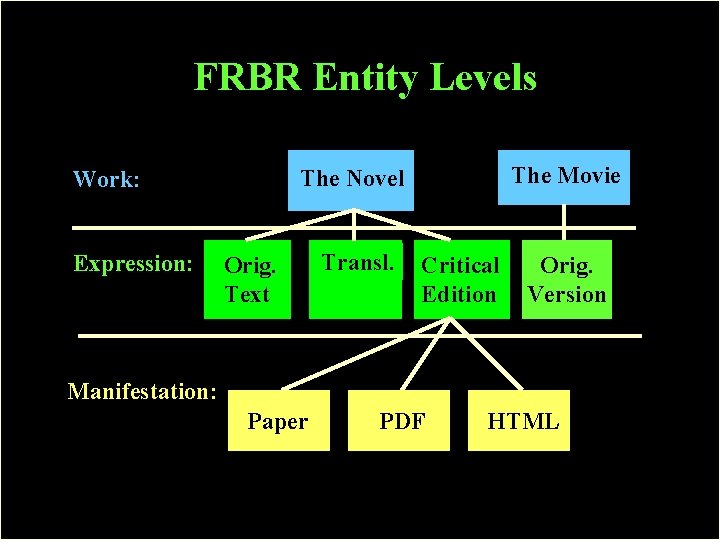
FRBR Entity Levels Expression: The Movie The Novel Work: Orig. Text Transl. Critical Edition Orig. Version Manifestation: Paper PDF HTML
FRBR Entity Levels Family of works The Movie The Novel Work: Expression: Orig. Text Transl. Critical Edition Orig. Version Manifestation: Paper Item: Copy 1 Autographed PDF Copy 2 HTML
Applications • OCLC Research (to be published) – ~20% of works have more than 1 manifestation • Classics of literature vs. scientific studies • Examples in the OCLC database – Shakespeare’s Hamlet • 1 work, 2696 manifestations – Rowling, J. K. (Harry Potter stories) • 28 works, 300 manifestations
Collocation by Expressions • Shakespeare, William, 1564 -1616. Hamlet. – Books – Danish – Books – Dutch – Books – English – Books – French – Books – Spanish – Motion Pictures – English
Collocation by Expressions • J. S. Bach’s Goldberg variations – Performances: Glen Gould (1981) – Scores
IFLA Work – International Cataloguing Code • 1960’s meetings of experts – Paris 1961 Paris Principles (access) • (International Conference on Cataloguing Principles) – Copenhagen 1969 ISBDs (description) • (International Meeting of Cataloging Experts) • Changes – Online/Web catalogs, machine-readable records – FRBR concepts (1998) – Electronic and future “carriers” for information
IFLA Activities • IFLA Meeting of Experts on an International Cataloguing Code – 2003, Frankfurt (European codes) – 2004, Buenos Aires (Central America, South America) – 2006, Seoul, Korea (Asian codes)
IFLA Meeting of Experts 2003 • Goals: • Objective: ü increase ability to share cataloguing worldwide ü Promote content standards for bibliographic and authority records ü Get our codes closer together – Examine European cataloguing codes • Similarities • Differences – Why different (cultural variations? )
IFLA Meeting of Experts 2003 • Commissioned papers on • Focus topics: Web – Names of persons – Discussion within countries and shared globally (April-June 2003) • Presentations and working groups in Frankfurt (July 2003) – Limited to 50 -60 participants – invitation only – Names of corporate bodies – Uniform titles / GMDs – Seriality / when to make a new record – Multilevel cataloging of multiple works in multiple volumes – Paris Principles: main and added entries
IFLA Meeting of Experts 2003 IFL A