
AAC Intervention for Infants Toddlers and Preschoolers Brittany
AAC Intervention for Infants, Toddlers, and Preschoolers Brittany Garay Katie Kampen Haley Schmitt

RESEARCH
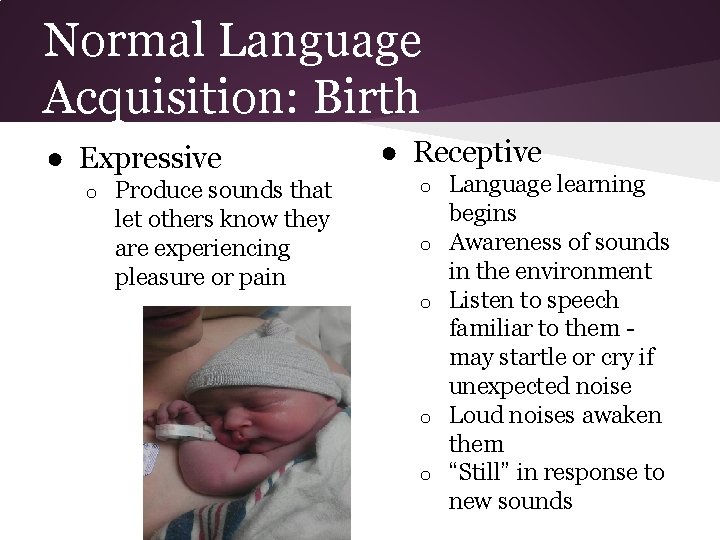
Normal Language Acquisition: Birth ● Expressive o Produce sounds that let others know they are experiencing pleasure or pain ● Receptive o o o Language learning begins Awareness of sounds in the environment Listen to speech familiar to them may startle or cry if unexpected noise Loud noises awaken them “Still” in response to new sounds
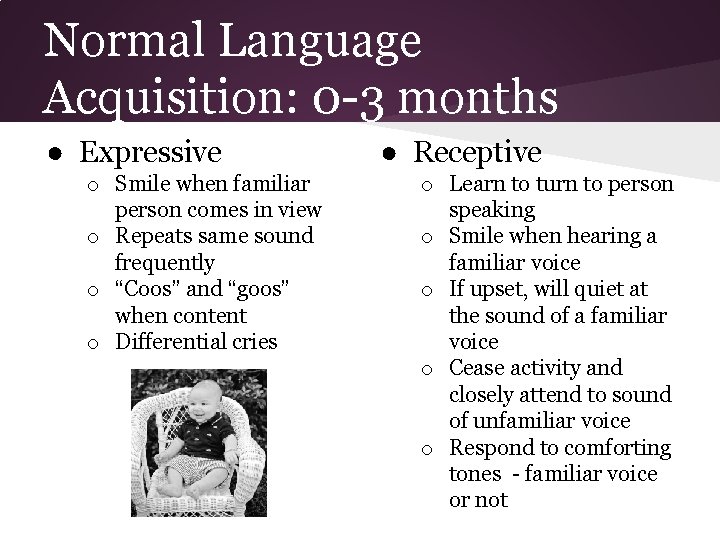
Normal Language Acquisition: 0 -3 months ● Expressive o Smile when familiar person comes in view o Repeats same sound frequently o “Coos” and “goos” when content o Differential cries ● Receptive o Learn to turn to person speaking o Smile when hearing a familiar voice o If upset, will quiet at the sound of a familiar voice o Cease activity and closely attend to sound of unfamiliar voice o Respond to comforting tones - familiar voice or not
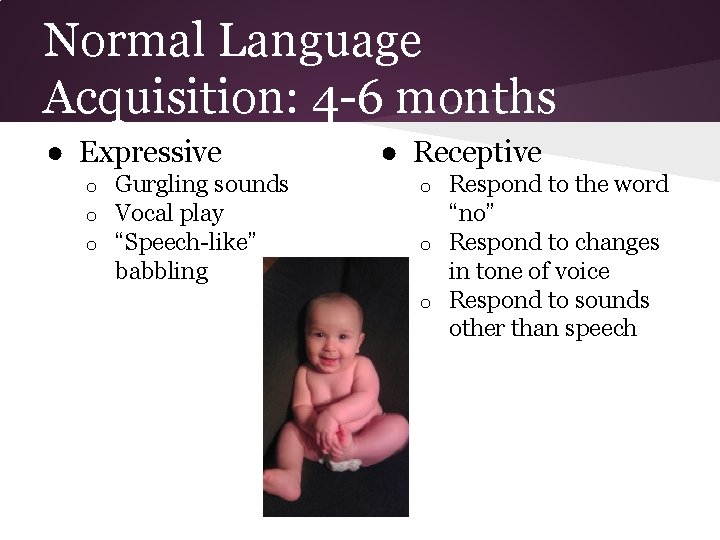
Normal Language Acquisition: 4 -6 months ● Expressive o o o Gurgling sounds Vocal play “Speech-like” babbling ● Receptive Respond to the word “no” o Respond to changes in tone of voice o Respond to sounds other than speech o
Normal Language Acquisition: 7 -12 months ● Expressive Sounds of babbling changes o Includes more consonants and long and short vowels o Uses speech or sounds to obtain attention and hold it o First words start to appear o ● Receptive o o o Listen when spoken to Turn and look at face when called by name Discovers the fun of games Recognize names of familiar objects Respond to requests and questions
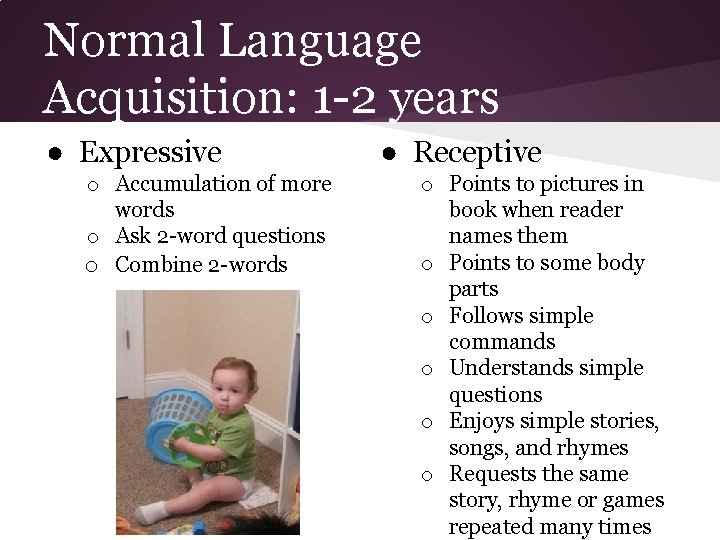
Normal Language Acquisition: 1 -2 years ● Expressive o Accumulation of more words o Ask 2 -word questions o Combine 2 -words ● Receptive o Points to pictures in book when reader names them o Points to some body parts o Follows simple commands o Understands simple questions o Enjoys simple stories, songs, and rhymes o Requests the same story, rhyme or games repeated many times
Normal Language Acquisition: 2 -3 years ● Expressive o o o Vocabulary explosion! Word for almost everything 1, 2, or 3 -word utterances Understood by family members Asks for or draws attention to an object by naming it or one of its characteristics Comments ● Receptive Understands 2 -step commands o Understands contrasting concepts and meanings o Notices familiar sounds like the telephone ringing o
Normal Language Acquisition: 3 -4 years ● Expressive Combining 4 or more words to form sentences o Talks about events that happen away from home o Clear and fluent speech o Understood by unfamiliar listeners most of the time o ● Receptive o Understands simple “who, ” “what, ” and “where” questions
Normal Language Acquisition: 4 -5 years ● Expressive o o o Constructs long, detailed sentences Maintains topic Uses “adult-like” grammar Correct production of most sounds Communicates with familiar adults and children ● Receptive Enjoy stories Answer simple questions about themselves o Hears and understands nearly everything that is said at home or school o o
Emergent Language ● “Individuals who currently have no reliable method of symbolic communication, no means of referring to the world around them through semantic references. ” ● Rely on non-symbolic communication means o o o sign/gestures body language some vocalizations facial expressions Pointing to objects or people
Does emergent communication mean cognitive deficits? ● NO!!!!!! ● Again, it means they don’t have a reliable means of expressive communication. ● it is impossible to test cognition of an individual with severe motor impairments who is a non-speaker. ● Reasons could include: 1. Device doesn't match motor capabilities, so unreliable. 2. Hidden hearing impairment 3. Hidden vision impairment 4. Low expectations of other people, so no AAC trials. 5. Lack of opportunities to communicate 6. Lack of AAC services
Emergent Language ● Does not begin with equipment trials ● Begins with identifying activities or objects that engage the individual and then using those to screen sensory and motor abilities. ● Start simple and increase difficulty over time: o o o Begin with one touch (Big Mac or Step-By-Step) Move to more complex (Base Trainer) Continue to increase language devices with age: § Voice pal plus super talker, Chat Box, Nova. Chat, Accent, etc.
Now that you know how typical children acquire language. . . What can we do for children who do not acquire language typically?
AAC Intervention and Young Children ● Young children who can benefit from an AAC devices include but are not limited to the following: o o o Expressive Language Disorders Autism Spectrum Disorders Oral Motor Difficulties (i. e. Dysarthria) Motor Planning Disorders or Apraxia Physical Challenges (i. e. Cerebral Palsy)
AAC Intervention and Young Children ● Start Early! ● Intervene during familiar activities in the daily environment ● Focus on sustaining interactions with familiar partners ● To support comprehension and expression, use experiences and contexts they’re familiar with.
AAC Intervention and Young Children ● Show parents how to provide appropriate support o o Frequent opportunities for communication Respond to child’s communicative attempts ● Provide models of AAC and speech o When talking to child and also to expand on what the child’s message ● Make sure AAC systems are dynamic o o This supports language learning Introduce and add new concepts as frequently as you can
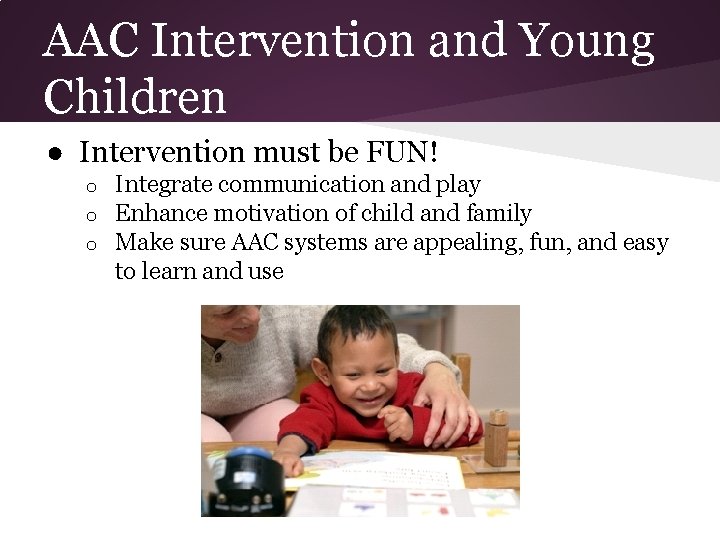
AAC Intervention and Young Children ● Intervention must be FUN! o o o Integrate communication and play Enhance motivation of child and family Make sure AAC systems are appealing, fun, and easy to learn and use
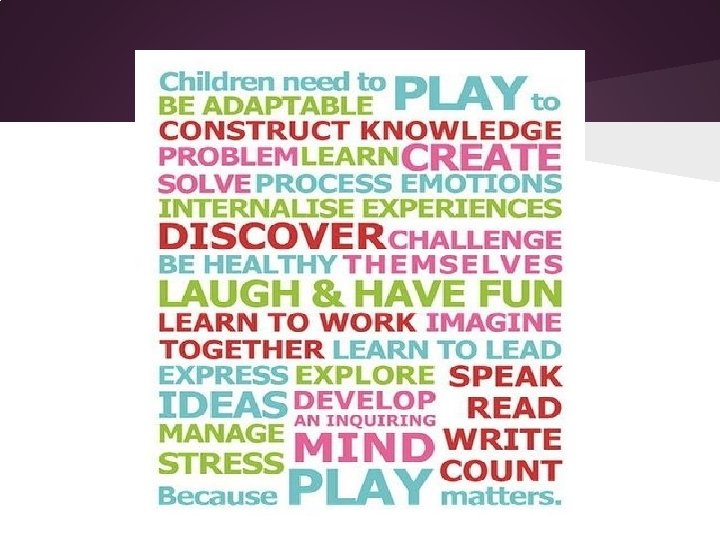
Importance of Play ● Play is a universal language for all children ● If an activity is fun and interesting to the child, the child will attend longer and get more out of the activity. ● Play contributes to the cognitive, physical, social and emotional well-being of children ● Children learn to engage and interact with the world around them
Effective AAC Intervention 1. Identify meaningful social contexts for communication 2. Develop appropriate AAC systems for child 3. Set up environment to support social interaction 4. Use appropriate strategies to support child’s communication
Develop Appropriate AAC systems ● Communication is multimodal o utilize the individual’s full communication capabilities, including any residual speech or vocalizations, gestures, signs, and aided communication ● Identify current modes used by the child o Vocalizations o Facial Expressions ● Introduce additional modes to enhance communication o Signs o Light tech symbols o Speech Generating Device (SGD) ● Ensure system is fun, easy for infants to use and understand, and dynamic
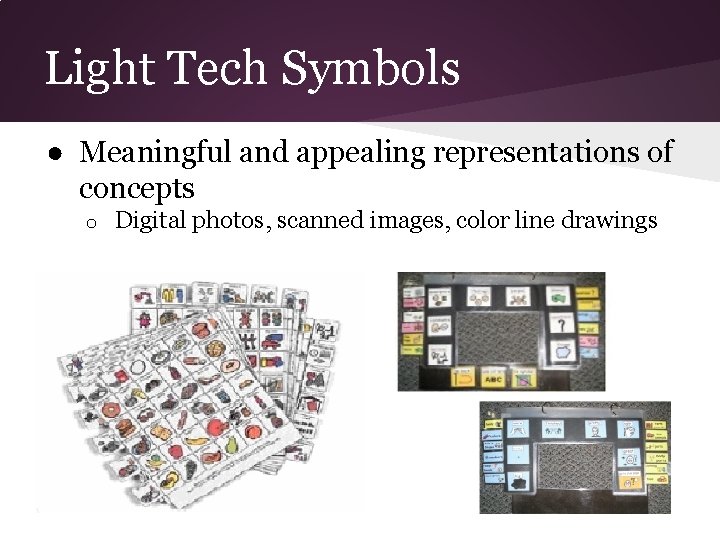
Light Tech Symbols ● Meaningful and appealing representations of concepts o Digital photos, scanned images, color line drawings
Light Tech Symbols ● Support language and literacy ● Support children who are: o o Verbal without enriched vocabularies Non-verbal without access to a high-tech communication device with sufficient vocabulary ● Allow children to learn a vocabulary set o o Expect to find vocabulary Know where to look for needed words ● Inexpensive ● Readily available
AAC = FUN ● Make it appealing to infants Use bright, primary colors Use familiar and motivating content Incorporate interactive play activities Alluring characters Inviting speech output, songs, instruments, sound effects, & laughter o Use objects that the child prefers o o o
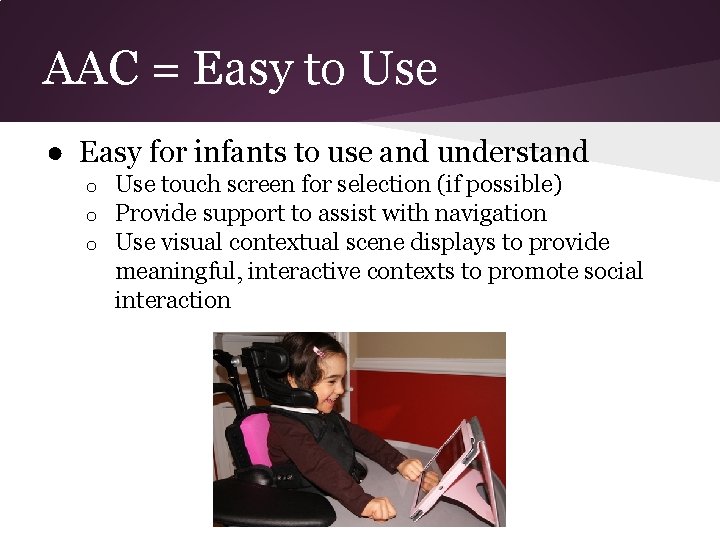
AAC = Easy to Use ● Easy for infants to use and understand o o o Use touch screen for selection (if possible) Provide support to assist with navigation Use visual contextual scene displays to provide meaningful, interactive contexts to promote social interaction
Visual Scene Display Layout ● Vocabulary is embedded under a “hotspot” in visual scene display (VSD) through digital photos of the child’s experiences or scanned images of a familiar book o Traditional Grid Layout: Vocabulary represented by separate AAC symbols in “boxes” - decontextualized ● The vocabulary is presented in meaningful context and concepts are related visually and conceptually as in life o Traditional Grid Layout: Concepts presented separately
Select Appropriate Vocabulary ● Identify appropriate “hotspots” in the VSD for vocabulary related to the context Be sure hotspots are an appropriate size Consider the child’s language and cognitive level when adding vocabulary o Make sure the child is interested in the VSD o o
AAC = Dynamic ● Begin with systems that are expandable ● Do not let AAC systems limit language development - gradually build language ● Young children experience qualitative and quantitative changes in development so AAC systems must reflect these changes o o o Introduce new activities regularly Introduce new concepts regularly Introduce more hotspots as motor skills develop
Supporting Environment for Social Interaction ● Ensure appropriate positioning o Accommodate motor skills and cognitive skills ● Minimize joint attention demands ● Maximize the child’s attention to partner and AAC system
Strategies to Support Communication ● Ensure meaningful opportunities for communication ● Ensure appropriate supports to ensure successful communication
Model AAC + Speech ● When talking to child, always model AAC ● You want to model AAC use to support the child’s comprehension, to show them how to communicate, and to provide opportunities for the child to learn new language concepts and structures.
Evaluation
KM ● Age: 6; 5 ● Diagnosis: Sensory Processing Disorder ● Seem on July 7, 2014 at LSUHSC Speech. Language-Hearing Clinic ● Referred by: Laura Triscuit, MCD, CCC-SLP o To obtain an augmentative and alternative communication (AAC) device due to concerns regarding overall communication, speech intelligibility, and social communication needs
KM ● Presently receives therapy at his school, Cypress Cove Elementary o o o Speech Therapy Occupational Therapy Adapted Physical Education ● He receives additional speech therapy services with Laura Triscuit at North. Shore Regional Hospital
Hearing Status ● No formal measures implemented to assess hearing ● Most recent hearing screening in fall 2012 o Results: Normal Hearing ● Functional listening performance during AAC assessment revealed no modifications regarding auditory output to use an AAC device effectively ● Attended and responded to auditory information at conversational loudness levels ● Parental report revealed no concerns regarding his hearing
Vision Status ● Parental report revealed no visual problems ● Most recent vision test was January 2013 o Results: Perfect vision. ● Did not demonstrate any visual impairments and no modifications were needed to the AAC devices during the evaluation to compensate for his vision.
Motor Functions ● Gross and fine motor skills were observed throughout the evaluation ● Gross Motor Skills: o o o Ambulated independently Wheelchair mounting system not required Able to carry device independently, but carrying case recommended for safe transportation ● Fine Motor Skills Accessed AAC devices with manual direct selection technique o Accessed locations of relatively small size without difficulty using right hand pointer finger o
Formal Language Evaluation ● The Receptive One-Word Picture Vocabulary Test 4 th Edition (ROWPVT-4) was administered to determine KM’s language skills. Norm-referenced assessment that helps to make accurate comparisons of a child’s receptive language skills o Evaluated KM’s ability to identify pictures of objects, concepts, and actions when given a field of 4 picture options o
Formal Language Evaluation ● Results indicated: Raw score: 65 Standard score: 89 Percentile rank: 23% Age equivalent: 5; 1 He understood the concepts of shapes and transportations o He had difficulty with the concepts of complex feelings and nouns o Overall: KM’s receptive language skills were within normal limits o o o
Informal Language Evaluation ● Used icons on the AAC devices to communicate wants and needs during functional play activities and requested actions and objects ● Followed simple instruction which demonstrated the linguistic capacity to generate simple requests on an AAC device while sequencing icons and symbols ● Had necessary language skills to functionally communicate using an AAC device
Informal Language Evaluation ● Used the Nova Chat 7, i. Pad with LAMP program, and Accent 1000 with UNITY program ● Verbally produced the words: “puzzle, ” “I want more, ” “stop, ” “go, ” “on, ” “I want drink” and “turn on” after selection of the icons ● Produced primarily one-word utterances and gestures to communicate o KM’s speech was echolalic and scripted
Oral Mechanism ● Informal oral mechanism examination was completed o o o o All oral structures appeared sufficient for communication purposes Protruded and retracted lips Protruded, lateralized, and elevated tongue Cheek tonicity not assessed due to reluctance to let clinician touch his cheks Velar mobility, uvula and tonsils not observed due to KM’s reluctance to open mouth adequately Dental hygiene was good Normal Occlusion (Class I) Diadochokinetic rate unable to be assessed
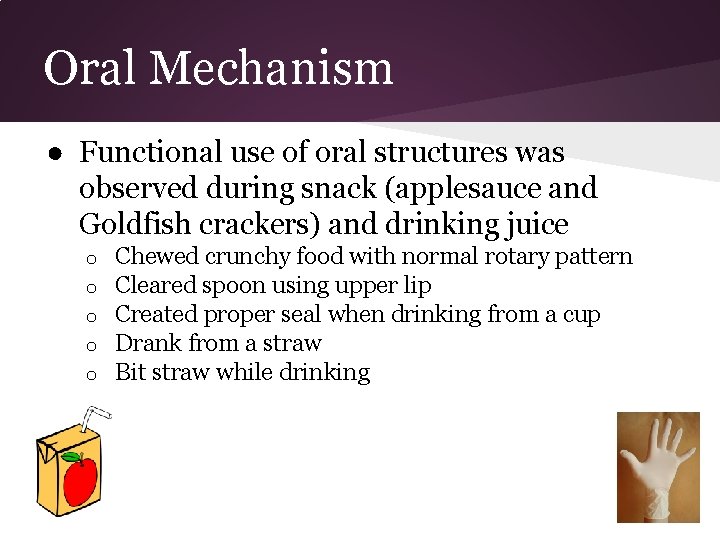
Oral Mechanism ● Functional use of oral structures was observed during snack (applesauce and Goldfish crackers) and drinking juice o o o Chewed crunchy food with normal rotary pattern Cleared spoon using upper lip Created proper seal when drinking from a cup Drank from a straw Bit straw while drinking
Cognitive Skills ● Evaluated informally during evaluation ● Alert and active participant ● Memory, attention, and problem solving skills appeared functional to learn AAC effectively and attain communication goals ● Followed simple instruction and modeling ● Accessed devices independently ● Enjoyed exploring icons and symbols on the device to determine the vocabulary programmed
Specific Daily Communication Needs ● Needs to functionally communicate with family members, classmates, teachers, and other communication partners ● Demonstrated cognitive, linguistic, and physical abilities to use an AAC device ● Critical for KM to: o o Express wants and needs Ask questions Make requests Respond during functional communication, especially emergencies and medical situations
Ability to Meet Communication Needs with Non-SGD Treatment ● Primarily one-word utterances and gestures ● Echolalic and scripted speech ● Needs to participate in decision-making, stories, conversations, ask questions and respond to questions ● Present communication status causes frustration and discouragement when he is not understood by others
Ability to Meet Communication Needs with Non-SGD Treatment ● It was in KM’s best interest to obtain an AAC device to be able to communicate his wants and needs ● KM was active so a durable and portable AAC device is recommended so it can be transported in all environments and meet functional communication goals during all daily activities.
General Features of Recommended AAC and Accessories Based on comprehensive assessment, daily communication needs, and functional communication goal, KM requires an AAC device with the following features: ● Input/Message Characteristic Features: o Visual word/picture communication symbol displays of a minimum of 45 symbols o Dynamic touchscreen/direct selection and generation of novel utterances using multi-meaning icons ● Output Features: o High quality synthesized voice output o Auditory feedback from device to assist in message preparation/selection
General Features of Recommended AAC and Accessories ● Other Features: o o o Lightweight, durable, and portable Minimum battery time 5 hours Unity program with multi-meaning symbols to display core and fringe vocabulary words ● Accessories: Carrying case so device can be transported safely and independently o 45 location touchguide o 60 location touchguide o
Trials with AAC Devices ● NOVA Chat 7 o Not considered most appropriate due to communication needs in a variety of environments and developing communication needs over time ● Accent 1000 with Unity program can grow will KM’s communication needs as he becomes more capable using the device o Accent 800 recommended as device that would best meet KM’s communication needs o ● i. Pad with LAMP app o Determined not functional due to KM’s activeness and the i. Pad’s lack of durability for easy and safe transportation and use in a variety of enviornments
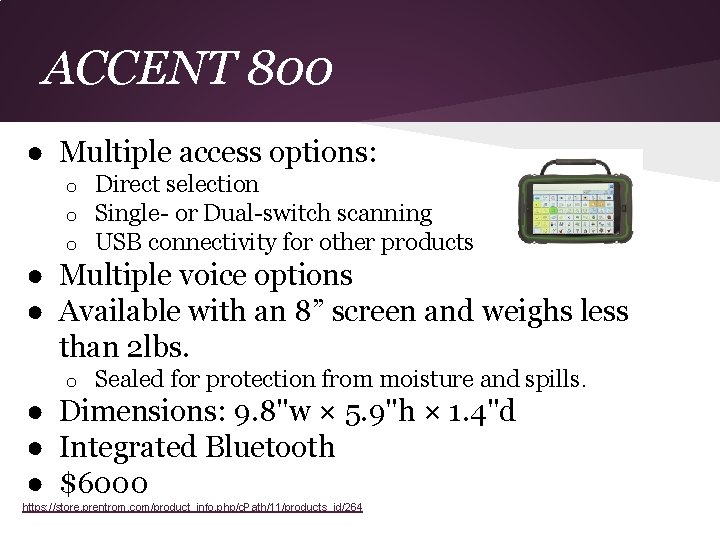
ACCENT 800 ● Multiple access options: o o o Direct selection Single- or Dual-switch scanning USB connectivity for other products ● Multiple voice options ● Available with an 8” screen and weighs less than 2 lbs. o Sealed for protection from moisture and spills. ● Dimensions: 9. 8"w × 5. 9"h × 1. 4"d ● Integrated Bluetooth ● $6000 https: //store. prentrom. com/product_info. php/c. Path/11/products_id/264
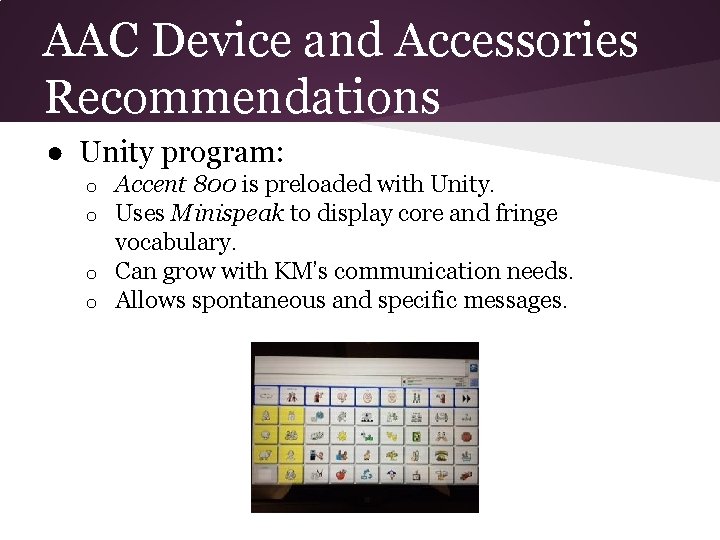
AAC Device and Accessories Recommendations ● Unity program: Accent 800 is preloaded with Unity. Uses Minispeak to display core and fringe vocabulary. o Can grow with KM’s communication needs. o Allows spontaneous and specific messages. o o
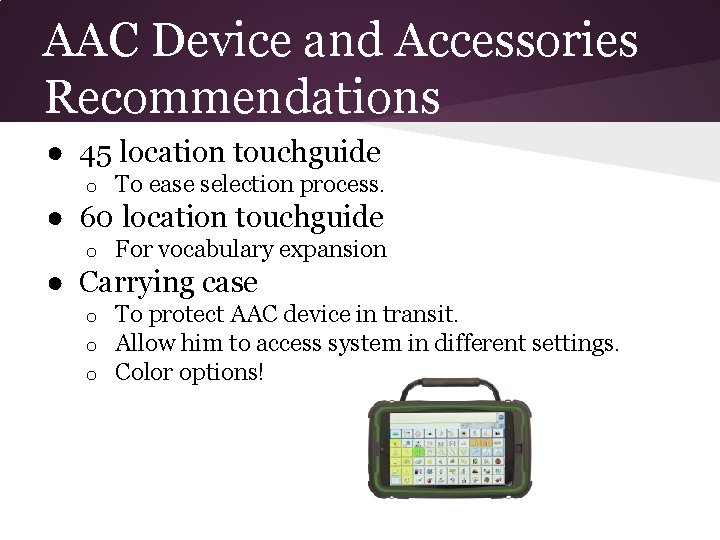
AAC Device and Accessories Recommendations ● 45 location touchguide o To ease selection process. ● 60 location touchguide o For vocabulary expansion ● Carrying case o o o To protect AAC device in transit. Allow him to access system in different settings. Color options!
Patient and Family Support ● Mother, father, and sister ● Sister also being recommended for a device ● Highly motivated and accepting
Treatment Plan ● Goal 1: Use an AAC device to engage in functional communication within the next 6 months o Objective 1: KM will combine 3 multi-meaning icons to generate novel utterances to communicate functionally with familiar and unfamiliar communication partners
Treatment Plan ● Goal 2: Use an AAC device to use age appropriate pragmatic skills Objective 1: KM will use an AAC device to initiate an activity while communicating with a variety of communication partners within 6 months. o Objective 2: KM will use an AAC device to take turns interacting with a variety of communication partners by combining two symbols on his device within 6 months. o Objective 3: KM will use an AAC device to terminate an activity within 6 months. o Objective 4: KM will use an AAC device to comment during an activity within 6 months. o
Treatment Plan ● Goal 3: Use an AAC device to express his needs during medical emergency situation or health related information to a variety of communication partners Objective 1: Use AAC device to indicate wants and needs independently to an unfamiliar listener within 6 months o Objective 2: Use an AAC device to express emotions independently to familiar and unfamiliar listeners within the next 6 months o
OVERLAY
Core versus Fringe ● Core Vocabulary o o o Frequently used words Useful in a variety of situations Small, commonly used words ● Fringe Vocabulary Situation specific words Importance changes from context to context and from person to person o Determined by informants who know the child’s likes and dislikes and communicative situations well o o
Core Vocabulary ● Core vocabulary was studied in 50 typically developing toddlers (24 -36 months) during two different activities in the preschool setting. ● Results revealed the most frequently used words by toddlers: o o o I No Yes My The Want
Core Vocabulary ● Common words included: o o o Pronouns Verbs Prepositions Demonstratives Words representing different pragmatic functions ● Nouns were absent from the list
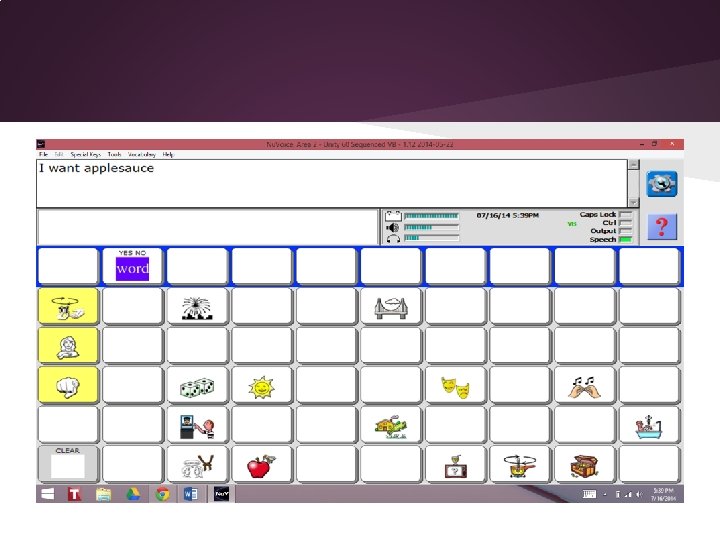
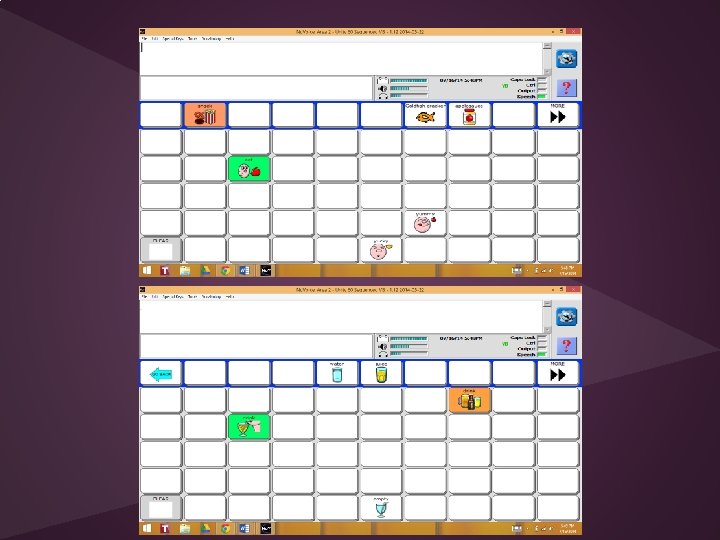
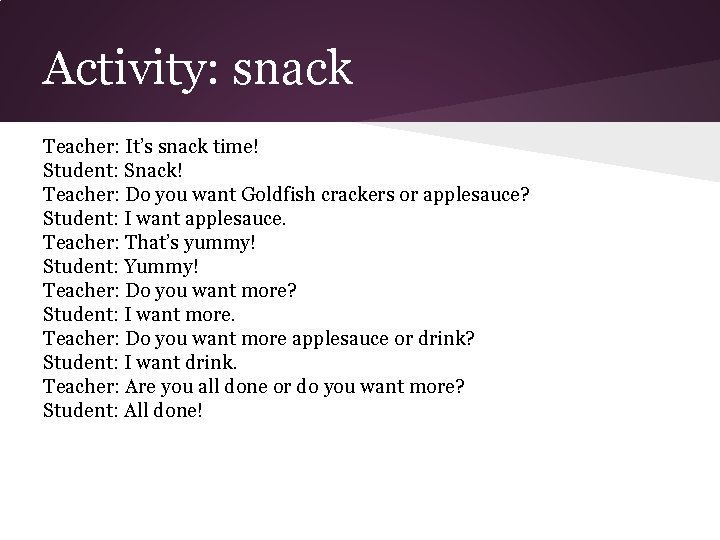
Activity: snack Teacher: It’s snack time! Student: Snack! Teacher: Do you want Goldfish crackers or applesauce? Student: I want applesauce. Teacher: That’s yummy! Student: Yummy! Teacher: Do you want more? Student: I want more. Teacher: Do you want more applesauce or drink? Student: I want drink. Teacher: Are you all done or do you want more? Student: All done!
Activity: snack Teacher: It’s snack time! Student: Snack! Teacher: Do you want Goldfish crackers or applesauce? Student: I want applesauce. Teacher: That’s yummy! Student: Yummy! Teacher: Do you want more? Student: I want more. Teacher: Do you want more applesauce or drink? Student: I want drink. Teacher: Are you all done or do you want more? Student: All done!
Vocabulary Used ● Core words used: o o I Want More All done ● Fringe words used: o o o Snack Applesauce Yummy
Activity: play ball Teacher: Who wants to play ball? Student: I want play ball. Teacher: Yes, I want to play ball. Student: Yes. Teacher: Do you want the ball to go? Student: I want go. Teacher: What now? Up or down? Student: Go up. Teacher: Do you want more? Student: I want more. Teacher: We’re all done. Student: All done.
Vocabulary Used ● Core words used: o o o o I Want Yes Go Up More All done ● Fringe words used: o Ball
References Banajee, M. , Dicarlo, C. , & Stricklin, S. (2003). Core vocabulary determination for toddlers. Augmentative and Alternative Communication, 19, 67 -73. Beukelman, D. R. , & Mirenda, P. (2013). Message management: vocabulary, small talk, and narratives. Augmentative & alternative communication: supporting children & adults with complex communication needs (pp. 17 -36, 239). Baltimore, MD: Paul H. Brookes. Beukelman, D. R. , Light, J. C. , & Reichle, J. (2002). Exemplary Practices for Beginning Communicators (pp 409 -410). Baltimore, MD: Paul H. Brookes. Bowen, C. (2013, August 30). Typical Speech and Language Acquisition in Infants and Young Children. Retrieved from http: //www. speech-languagetherapy. com/index. php? option=com_content&view=article&id=35: admin&catid= 2: uncategorised&Itemid=117.
References Drager, K. , & Light, J. (2007, November). Evidence-based AAC Interventions for Infants, Toddlers, and Preschoolers. Retrieved from www. aac-rerc. com. Ginsburg, K. R. (2007). The importance of play in promoting healthy child development and maintaining strong parent- child bonds. Pediatrics, 182 -184. doi: 10. 1542/peds. 2006 -2697 Musselwhite, C. , & Hanser, G. (2009). Write to Talk CD. Litchfield Park, AZ: AAC Intervention www. aacintervention. com Musselwhite, C. , & Hanser, G. (2011). Lite Tech Display Sets. Litchfield Park, AZ: AAC Intervention www. aacintervention. com
- Slides: 71