
AA famous political cartoon created by Benjamin Franklin
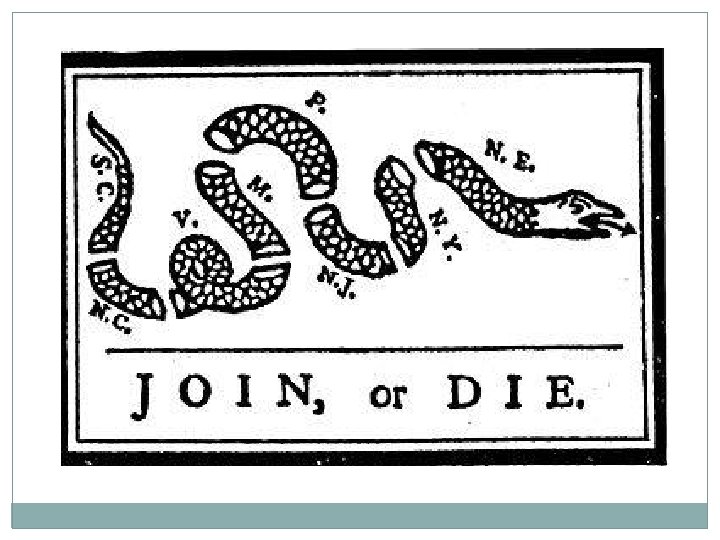
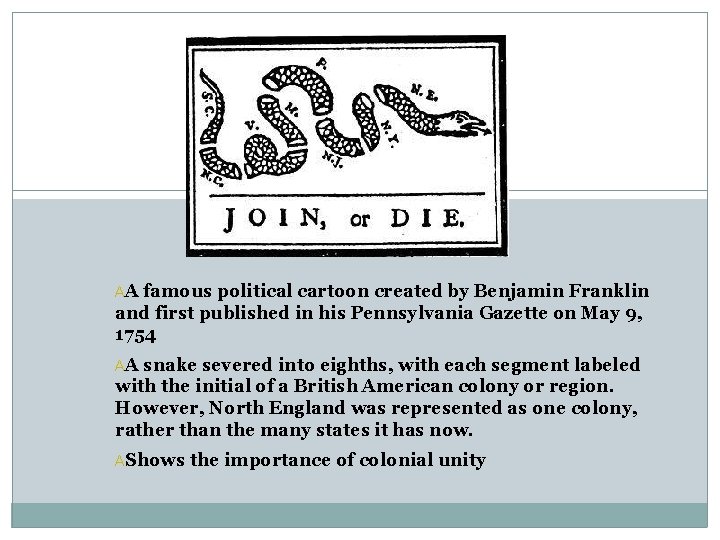
AA famous political cartoon created by Benjamin Franklin and first published in his Pennsylvania Gazette on May 9, 1754 AA snake severed into eighths, with each segment labeled with the initial of a British American colony or region. However, North England was represented as one colony, rather than the many states it has now. AShows the importance of colonial unity
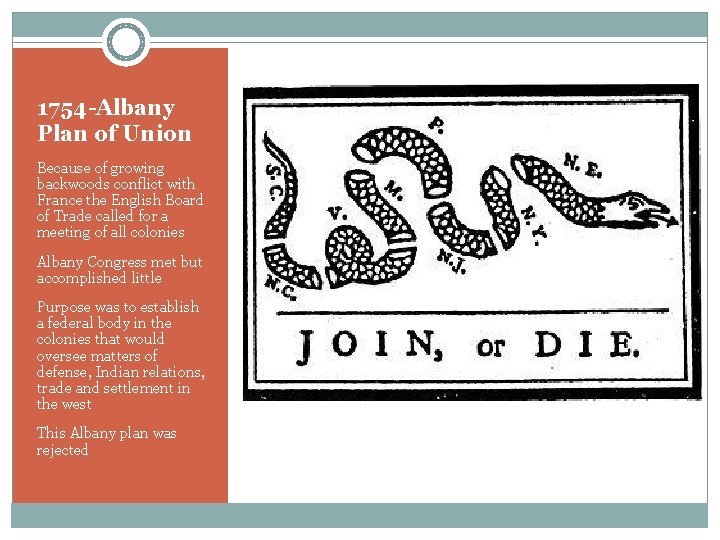
1754 -Albany Plan of Union Because of growing backwoods conflict with France the English Board of Trade called for a meeting of all colonies Albany Congress met but accomplished little Purpose was to establish a federal body in the colonies that would oversee matters of defense, Indian relations, trade and settlement in the west This Albany plan was rejected

Benjamin Franklin Enlightened Thinker ● 1718 - 1723 Apprenticed as a printer ● ● to his brother James Franklin 1727 Founded the Junta, a debating club, Philadelphia, Pa. (would become American Philosophical Society) 1729 Purchased Pennsylvania Gazette 1731 Established the Library Company of Philadelphia, Pa 1732 - 1758 Published Poor Richard, 1732 -1747, and Poor Richard Improved, commonly known as Poor Richard's Almanack
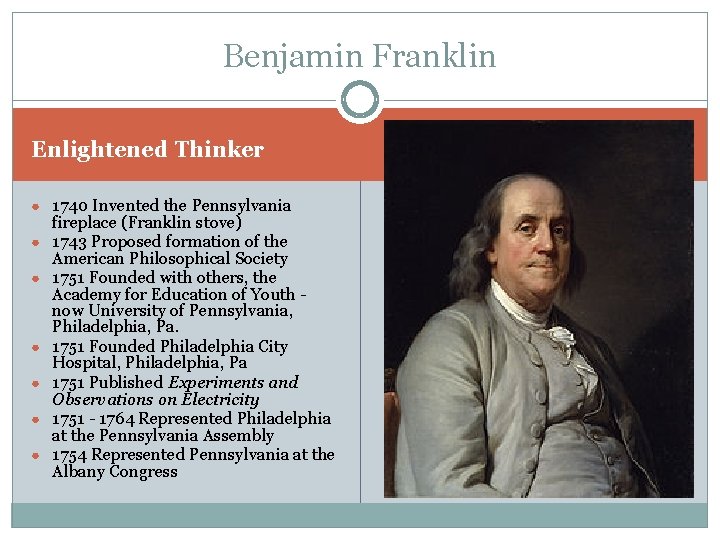
Benjamin Franklin Enlightened Thinker ● 1740 Invented the Pennsylvania ● ● ● fireplace (Franklin stove) 1743 Proposed formation of the American Philosophical Society 1751 Founded with others, the Academy for Education of Youth now University of Pennsylvania, Philadelphia, Pa. 1751 Founded Philadelphia City Hospital, Philadelphia, Pa 1751 Published Experiments and Observations on Electricity 1751 - 1764 Represented Philadelphia at the Pennsylvania Assembly 1754 Represented Pennsylvania at the Albany Congress
Bell Ringer ●Thesis Carousal Take out your inductive reasoning sheet and prepare to share your thesis. ○ Self-assess your thesis using the Long Essay Scoring Guide Rubric (Do you get the point? ) ○ Peer-assessment: You will exchange each other’s thesis statement at 30 second intervals. For each paper that you receive, score thesis (Do they get the point? If not, why? ) ○ Be prepared to debrief to the whole class ○

LEQ ●Review Rubric and Core Structure ●Use your inductive reasoning sheet, the long essay scoring guide, and the core structure to write an essay response. (40 minutes) ●Peer-assessment of LEQ
French & Indian War 1. Howdid the colonial wars of the late-seventeenthearly and eighteenthcenturies alter the relationship between Amerindians and the French and British Empires? 2. Howdid the outcome of the French and Indian War alter the balance of power in North America? 3. Howdid the French and Indian War alter the relationship between the British Empire and her American colonies?
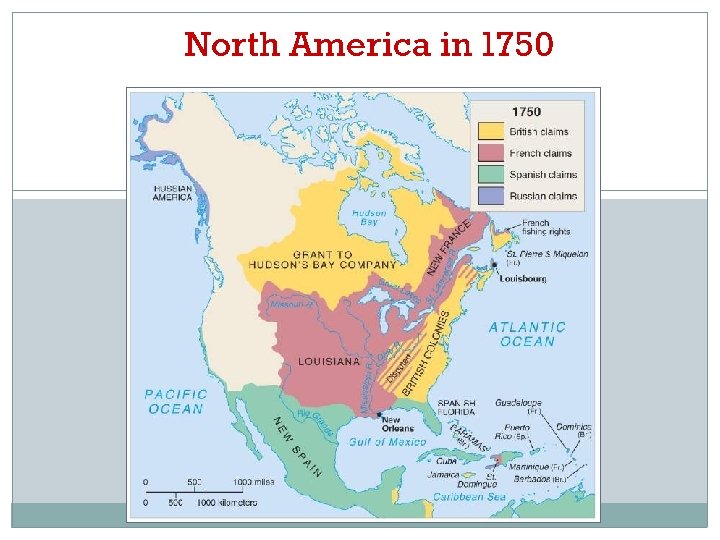
North America in 1750
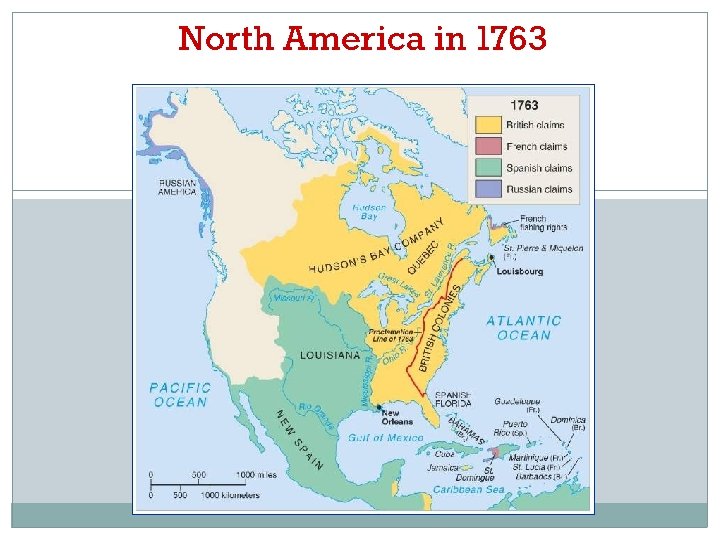
North America in 1763
French Canada ●France was late in coming to the New World 1. Much religious conflict between Catholics and Huguenots (Calvinists) in the late-16 th century stunted colonial expansion. ○ 2. Edict of Nantes (1598): Granted limited toleration to French Protestants ○ • • a. Religious wars ceased and France began looking at expanding its influence in the Atlantic trade. France later became the dominant power in 17 th -century Europe led by King Louis XIV.
New France ●The French established Quebec in 1608 (a year after England had established the Jamestown colony in Virginia) Founded by Samuel de Champlain ("Father of New France") ○ Entered a friendship with the local Huron, the enemies of the Iroquois Confederation. ○ • Significance: Iroquois, in retaliation, later kept the French from expanding into the Ohio Valley, ravaged French settlements, and allied with the British. ●Government Lacked popularly-elected assemblies or trial by jury. ○ French population in New France grew slowly ○
New France ●Of the European powers, the French were the most successful in creating an effective trading relationship with Native Americans. British settlers sought to remove or exterminate them. ○ Spain sought to Christianize and subdue them via the encomienda system (forced labor in towns), and the mission system where forced conversion often occurred. ○ The French became great gift givers (the key to getting along with Native Americans who based their inter-tribal relationships on gift giving) during last two decades of the 17 th century. ○ French fur traders often married Native American women and adopted tribal customs. ○ The beaver trade led to the exploration of much of North America ○
New France ●Jesuits: Catholic Missionaries sought to convert Native Americans and “save” them; (the missionaries typically lived among the tribes) ●France established posts in the Mississippi region (New Orleans was the most important) ●Sought to block Spanish expansion along the Gulf of Mexico
“The Great War for Empire” was a series of European and Colonial Wars for Empire King Williams’ War (1689 -1697) Queen Anne’s War (1702 -1713) King George’s War (1744 -1748) French and Indian War (1754 -1763) ●Goal of British in each conflict was to keep a balance of power against the French; Alliances would change, but in each conflict Britain and France would be against each other. ●In all but the last conflict, the greatest battles were in Europe.
“The Great War for Empire” was a series of European and Colonial Wars for Empire ● So, for much of the century the colonies were involved in these wars ● Consequences were tough on New England colonies because of their location ● All of the wars would lead to English debt, a need for a large navy and standing army ● Increased British nationalism (patriotism)
King George’s War (1744 -1748) ●First time English colonists were drawn into the conflicts ●New Englanders captured French post at Louisbourg on Cape Breton Island; peace treaty forced them to abandon it. ●After the war, relations among the English, French and Iroquois worsened ●Iroquois began to grant trading rights to English; French thought this would lead to English expansion into French lands and began to construct new fortresses in Ohio Valley ●The British protested and began making military preparations by building their own forts
French and Indian War (1754 -1763) (Seven Years' War): ●Most important of the colonial wars. ●Cause: conflict over the Ohio Valley British settlers continued to move into the region and were increasingly opposed to French dominance there. ○ Massachusetts, Connecticut, Virginia, Pennsylvania and New York all laid claim to the same territory as did the French ○ The French needed to retain the region so to link Canada with the lower Mississippi Valley and the Caribbean. ○ The French saw Iroquois trading concessions to British merchants in the late-1740 s as a threat to French interests in the Ohio Valley. ○
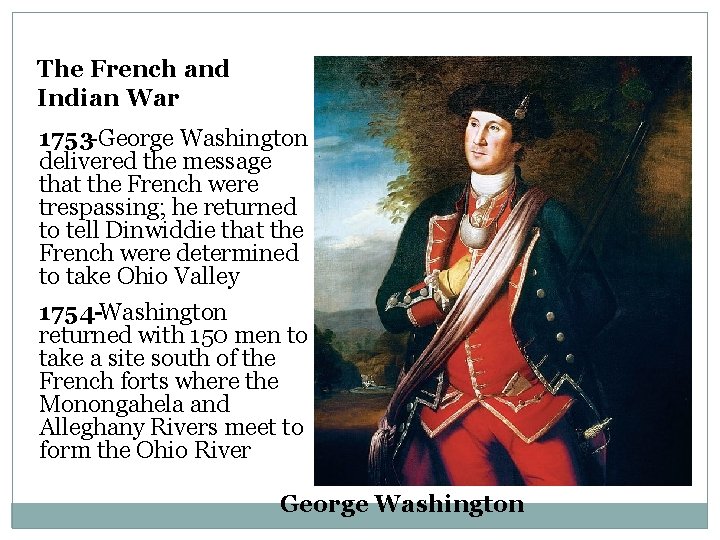
The French and Indian War 1753 -George Washington delivered the message that the French were trespassing; he returned to tell Dinwiddie that the French were determined to take Ohio Valley 1754 -Washington returned with 150 men to take a site south of the French forts where the Monongahela and Alleghany Rivers meet to form the Ohio River George Washington
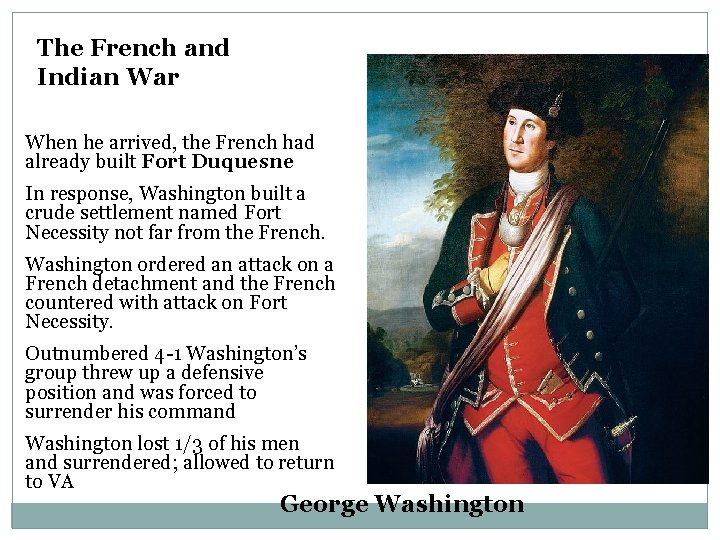
The French and Indian War When he arrived, the French had already built Fort Duquesne In response, Washington built a crude settlement named Fort Necessity not far from the French. Washington ordered an attack on a French detachment and the French countered with attack on Fort Necessity. Outnumbered 4 -1 Washington’s group threw up a defensive position and was forced to surrender his command Washington lost 1/3 of his men and surrendered; allowed to return to VA George Washington
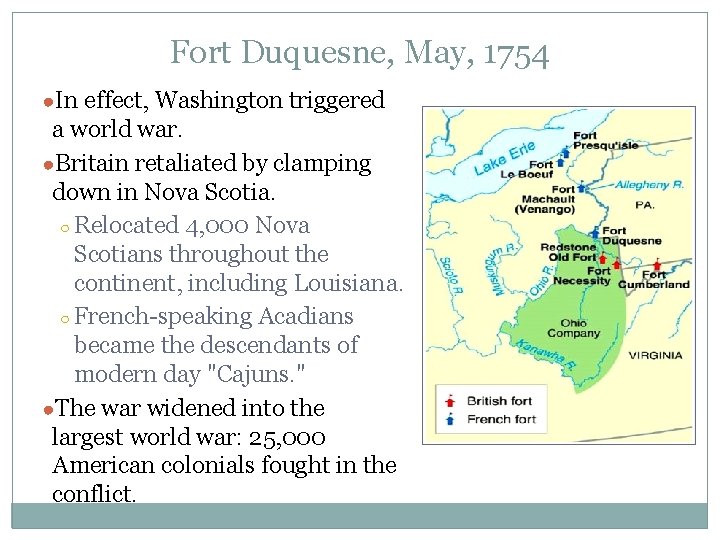
Fort Duquesne, May, 1754 ●In effect, Washington triggered a world war. ●Britain retaliated by clamping down in Nova Scotia. ○ Relocated 4, 000 Nova Scotians throughout the continent, including Louisiana. ○ French-speaking Acadians became the descendants of modern day "Cajuns. " ●The war widened into the largest world war: 25, 000 American colonials fought in the conflict.
English vs. French English Advantages by 1754 French Advantages by 1754 ● Over 150 years, British had established more permanent colonies in North America as opposed to French “courier de bois” ● British colonists outnumbered French in North America (1. 5 million to 80, 000 in 1750) ● Access to great water routes (Mississippi River and Great Lakes) ● Had established stronger trading relationships with Native Americans ● French governors could move more decisively without any worry from quarreling colonial assemblies and separate colonies
Review 9/30/16 ●Synthesis vs. Contextualization ●French and Indian War
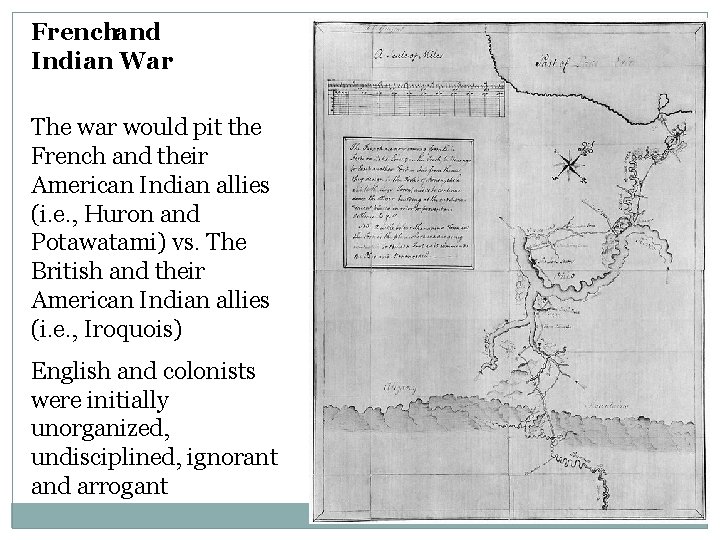
Frenchand Indian War The war would pit the French and their American Indian allies (i. e. , Huron and Potawatami) vs. The British and their American Indian allies (i. e. , Iroquois) English and colonists were initially unorganized, undisciplined, ignorant and arrogant
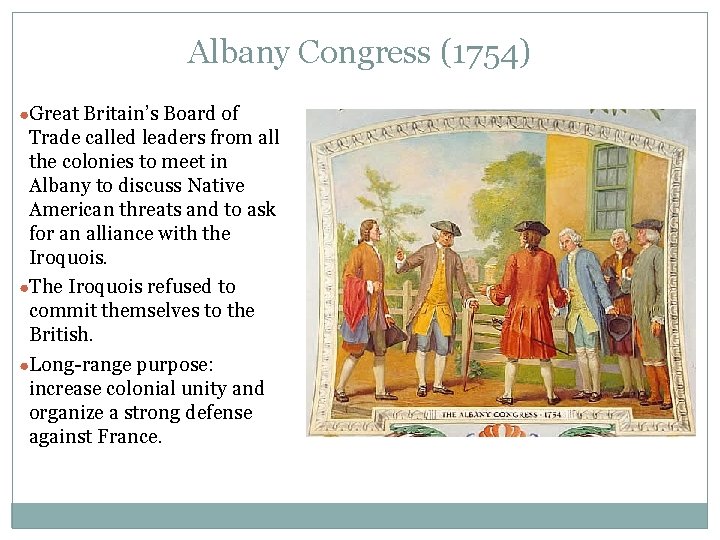
Albany Congress (1754) ●Great Britain’s Board of Trade called leaders from all the colonies to meet in Albany to discuss Native American threats and to ask for an alliance with the Iroquois. ●The Iroquois refused to commit themselves to the British. ●Long-range purpose: increase colonial unity and organize a strong defense against France.
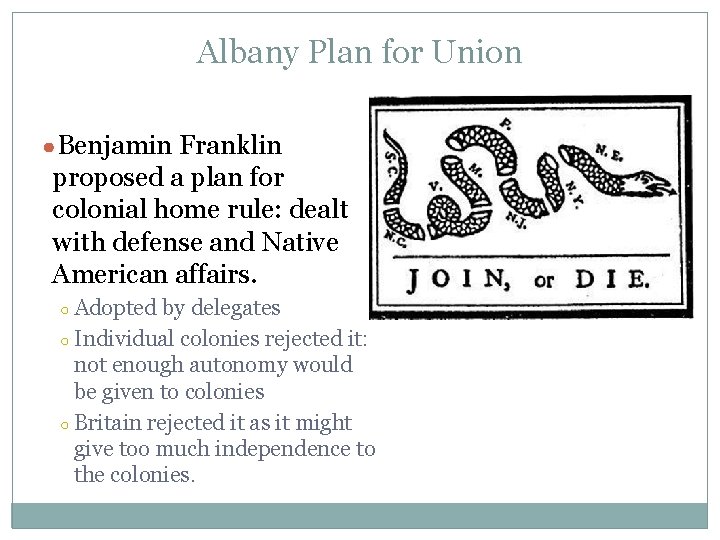
Albany Plan for Union ●Benjamin Franklin proposed a plan for colonial home rule: dealt with defense and Native American affairs. Adopted by delegates ○ Individual colonies rejected it: not enough autonomy would be given to colonies ○ Britain rejected it as it might give too much independence to the colonies. ○
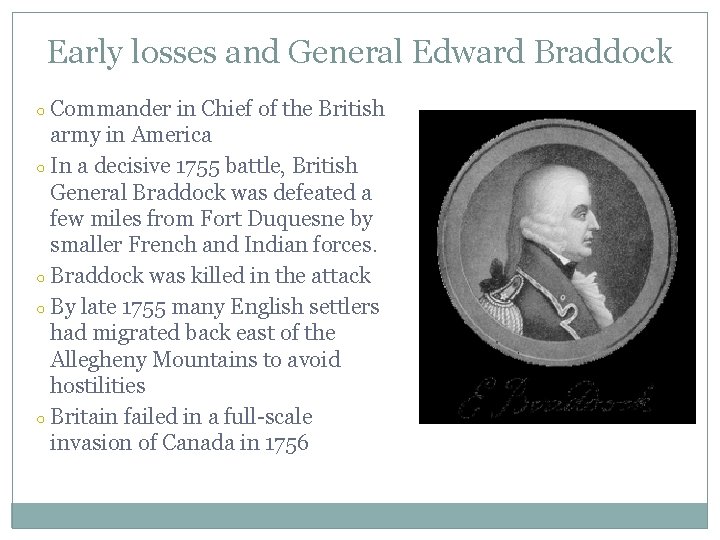
Early losses and General Edward Braddock Commander in Chief of the British army in America ○ In a decisive 1755 battle, British General Braddock was defeated a few miles from Fort Duquesne by smaller French and Indian forces. ○ Braddock was killed in the attack ○ By late 1755 many English settlers had migrated back east of the Allegheny Mountains to avoid hostilities ○ Britain failed in a full-scale invasion of Canada in 1756 ○
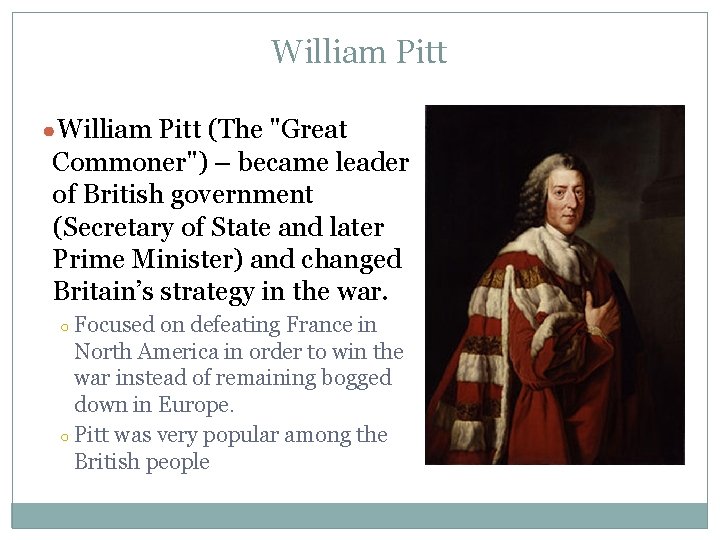
William Pitt ●William Pitt (The "Great Commoner") – became leader of British government (Secretary of State and later Prime Minister) and changed Britain’s strategy in the war. Focused on defeating France in North America in order to win the war instead of remaining bogged down in Europe. ○ Pitt was very popular among the British people ○
Tensions between British and Colonists ●Some colonists were forced into service without their consent (impressment) ●Supplies and equipment for the military were confiscated from farmers and tradesmen. ●British troops were quartered by colonists, without compensation. ○ These injustices were reversed by Pitt in 1758 who ordered colonists be compensated for property and that soldiers be enlisted by the colonies themselves.
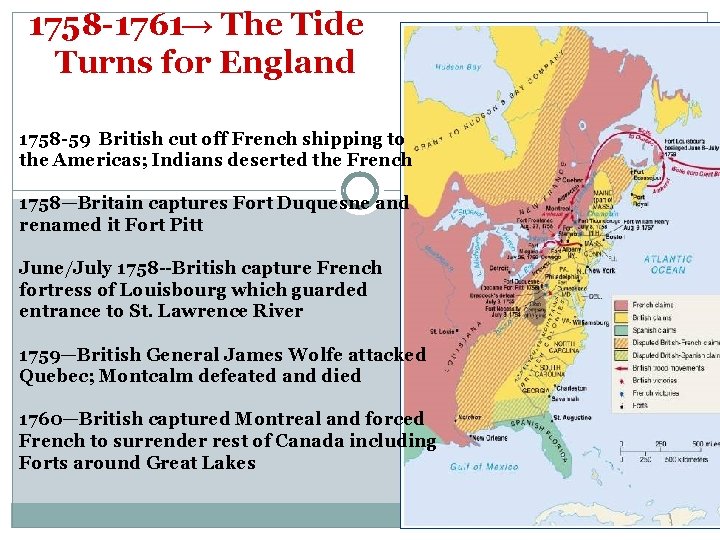
1758 -1761→ The Tide Turns for England 1758 -59 British cut off French shipping to the Americas; Indians deserted the French 1758—Britain captures Fort Duquesne and renamed it Fort Pitt June/July 1758 --British capture French fortress of Louisbourg which guarded entrance to St. Lawrence River 1759—British General James Wolfe attacked Quebec; Montcalm defeated and died 1760—British captured Montreal and forced French to surrender rest of Canada including Forts around Great Lakes
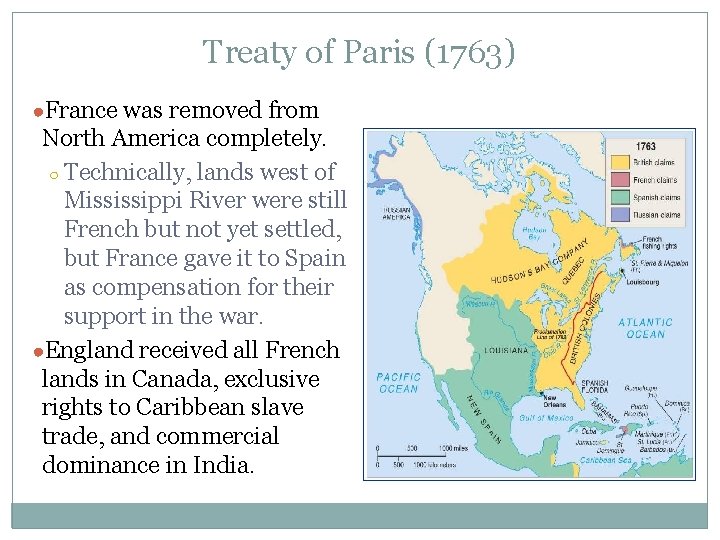
Treaty of Paris (1763) ●France was removed from North America completely. ○ Technically, lands west of Mississippi River were still French but not yet settled, but France gave it to Spain as compensation for their support in the war. ●England received all French lands in Canada, exclusive rights to Caribbean slave trade, and commercial dominance in India.
Significance of Britain’s victory over France in North America ●Great Britain emerged as the dominant power in North America and as the leading naval power in the world. ●Permanently altered the balance of power in North America between Britain, France, and the Native Americans ○ Native Americans were now increasingly at the mercy of British American settlers who moved westward without fearing French reprisals. ○ By 1800, many of the eastern woodlands Indians were removed or killed by American encroachment. ● The enormous war debt resulted in new imperial tax policies that eventually led to the American Revolution.
Tension between the colonies and Britain during and after French and Indian War. ●The colonies emerged from war with increased confidence in their military strength ○ 1. Colonial military leaders were angry that few Americans were promoted in the British army and that American officers were treated poorly. ○ 2. Yet, British leaders believed Americans had often performed poorly in the war and did not deserve the respect they desired.
Tension between the colonies and Britain during and after French and Indian War. ●British authorities were upset that American shippers traded with Spain and the French West Indies during the war. ○ 1. Natives who sided with the French were aided by increased foodstuffs. ○ 2. Britain prohibited the export of all supplies from the New England Middle colonies during last year of the war. ○ 3. Some colonies refused to supply troops: saw economic gain as more important than loyalty to Britain. • Only later agreed to commit troops when Pitt offered to substantially reimburse the colonies.
Tension between the colonies and Britain during and after French and Indian War. ●American westward colonial expansion increased significantly after the war ○ 1. The French barrier west of the Appalachians was removed ○ 2. Spanish and Indian threats were removed in many areas. ○ 3. Settlers were no longer as dependent on British protection in the frontier
Tension between the colonies and Britain during and after French and Indian War. ●The legitimacy of British rule in local colonial affairs came into question. ○ 1. Pitt’s reversal of harsh British policies toward the colonies beginning in 1858 convinced many colonists that the British should have little to no role in local matters. ○ 2. The colonies expected the autonomy they had enjoyed during the era of “salutary neglect. ”
Summary of Effects of the War on Great Britain ●It increased colonial empire in the Americas. ●It greatly enlarged England’s debt. ●Britain’s contempt for the colonials created bitter feelings. ●Therefore, England felt that a major reorganization of her American Empire was necessary
Summary of Effects of the War on the Colonists ●It united them against a common enemy for the first time. ●It created a socializing experience for all the colonists who participated ●It created bitter feelings towards the British that would only intensify.
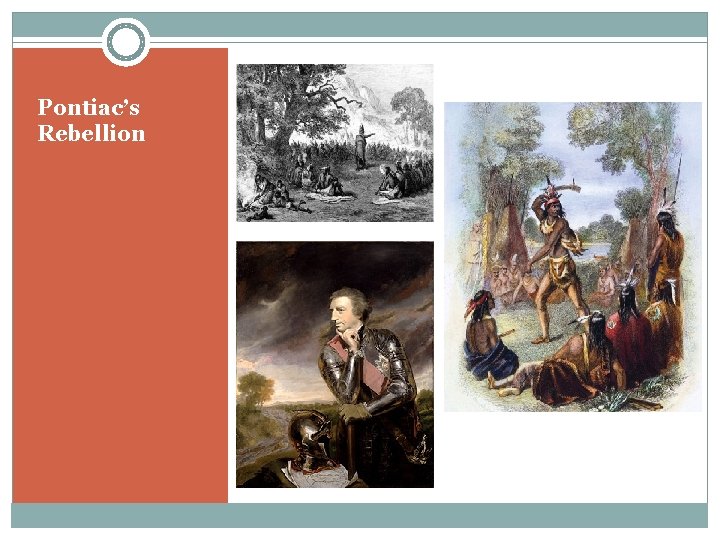
Pontiac’s Rebellion
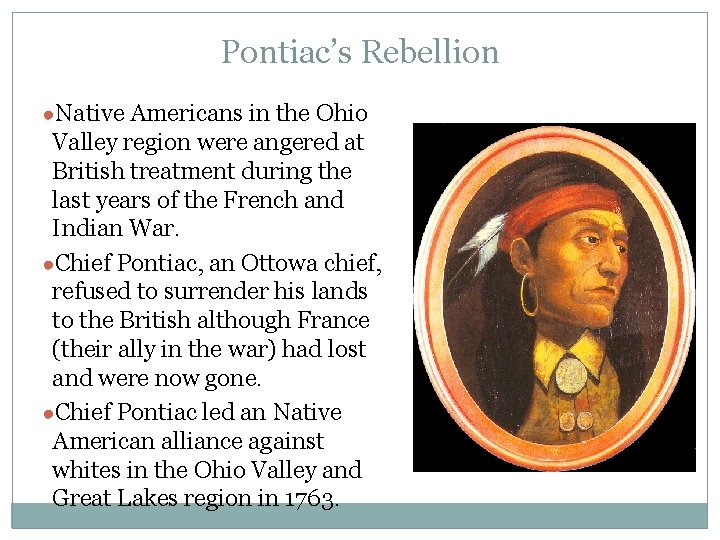
Pontiac’s Rebellion ●Native Americans in the Ohio Valley region were angered at British treatment during the last years of the French and Indian War. ●Chief Pontiac, an Ottowa chief, refused to surrender his lands to the British although France (their ally in the war) had lost and were now gone. ●Chief Pontiac led an Native American alliance against whites in the Ohio Valley and Great Lakes region in 1763.
Pontiac’s Rebellion ● 9 of 11 British forts were taken and several were wiped out. ●Perhaps 2, 000 lives were lost during first 6 months of the conflict, and many more colonists were driven from their homes on the frontier back to more settled areas. ●It took Britain 18 months to bring the rebellion under control. ○ Britain retaliated with germ warfare: blankets infected with smallpox were distributed among the Amerindians who thus died in droves.
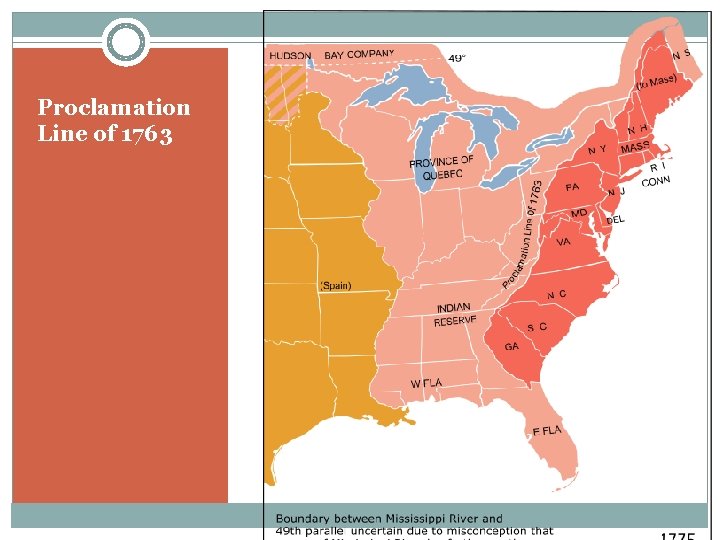
Proclamation Line of 1763
Proclamation of 1763 ●In response to Pontiac’s Rebellion, King George III signed an edict creating royal colonies in all newly acquired lands in the Treaty of Paris. ●The purpose of the proclamation was to organize Great Britain's new North American empire and to stabilize relations with Native North Americans ● Prohibited colonials from moving west of the Appalachians ○ The line drawn from Canada to Florida along the crest of the Appalachians was only intended to be temporary. ○ British aim: settle land disputes with Amerindians fairly to prevent more uprisings like Pontiac's and organize the eventual settlement and defense of the frontier.
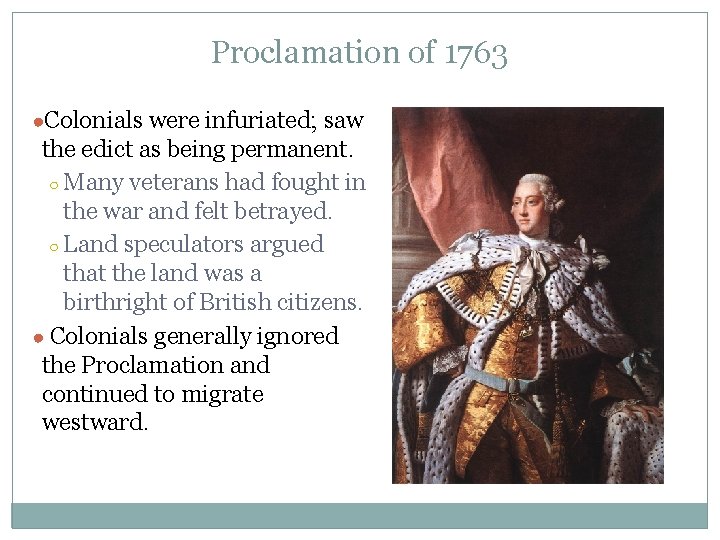
Proclamation of 1763 ●Colonials were infuriated; saw the edict as being permanent. ○ Many veterans had fought in the war and felt betrayed. ○ Land speculators argued that the land was a birthright of British citizens. ● Colonials generally ignored the Proclamation and continued to migrate westward.
Reading Check 1. 2. 3. Brinkley argues that colonial relations with Great Britain were altered by “two Georges”. What role did King George III and George Grenville play in changing that relationship after the French & Indian War? What impact did the Proclamation of 1763 have on the colonies? What was the purpose of each of the following acts? a. b. c. 4. Sugar Act of 1764 Currency Act of 1764 Stamp Act of 1765 Why did social movements, like the rise of the Paxton Boys in Pennsylvania and the Regulator Movement in North Carolina, develop in the colonies after the French and Indian War?
Bibliography ● College Board, AP United States History Course and Exam Description (Including the Curriculum Framework), 2014: History, New York: College Board, 2014 ● Bailyn, Bernard, The Origins of American Politics, New York: Vintage Books, 1968 _______, The Ideological Origins of the American Revolution, Cambridge, Massachusetts: Belknep, 1967 ● Brinkley, Alan, Williams, T. Harry, and Current, Richard N. , American History, 14 th Edition, New York: Mc. Graw-Hill, 2012 ● Cook, Don, The Long Fuse: How England Lost the American Colonies, 1760 -1785, New York: Atlantic Monthly Press 1995 ● Foner, Eric & Garraty, John A. editors: The Reader’s Companion to American History, Boston: Houghton Mifflin Company, 1991 ● Hofstadter, Richard, America at 1750: A Social Portrait, New York: Vintage Books, 1971 ● Josephy, Jr. , Alvin M. , 500 Nations: An Illustrated History of North American Indians, Alfred A Knopf, New York, 1994. ● Kennedy, David M. , Cohen, Lizabeth, Bailey, Thomas A. , The American Pageant (AP Edition), 13 th edition, Boston: Houghton Mifflin 2006 ● Murrin, John, et al, Liberty Equality Power: A History of the American People, Ft. Worth: Harcourt Brace 1999 Nash, Gary : American Odyssey, Lake Forest, Illinois: Glencoe, 1992
- Slides: 46