
A Zig Bee Network based Heart Rate Monitoring

A Zig. Bee Network based Heart Rate Monitoring System for Pre-mature babies Archana Sapkota Deepti Reddy Palden Lama
Project Goal �Develop a remote heart beat monitoring system using wireless technology for new-born premature babies kept in hospital incubators. �The main goal is to alert hospital staff in case a babies’ heart rate is detected as abnormal. �Currently most hospitals use ECG (Electrocardiography ) for monitoring a baby’s heart rate but do not have remote monitoring system. Our project proposes a solution to upgrade existing health monitoring systems in hospitals by providing remote monitoring capability.
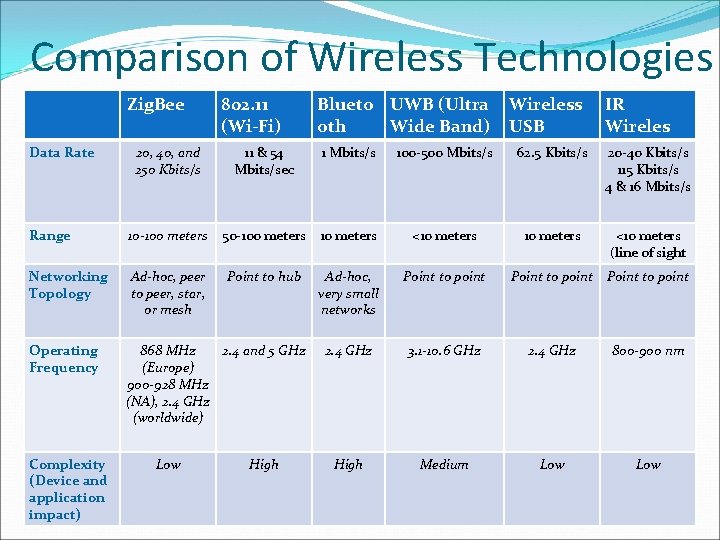
Comparison of Wireless Technologies Zig. Bee Data Rate 802. 11 (Wi-Fi) Blueto UWB (Ultra oth Wide Band) Wireless USB IR Wireles 20, 40, and 250 Kbits/s 11 & 54 Mbits/sec 1 Mbits/s 100 -500 Mbits/s 62. 5 Kbits/s 20 -40 Kbits/s 115 Kbits/s 4 & 16 Mbits/s Range 10 -100 meters 50 -100 meters 10 meters <10 meters (line of sight Networking Topology Ad-hoc, peer to peer, star, or mesh Point to hub Ad-hoc, very small networks Point to point 2. 4 GHz 3. 1 -10. 6 GHz 2. 4 GHz 800 -900 nm High Medium Low Operating Frequency Complexity (Device and application impact) 868 MHz 2. 4 and 5 GHz (Europe) 900 -928 MHz (NA), 2. 4 GHz (worldwide) Low High Point to point
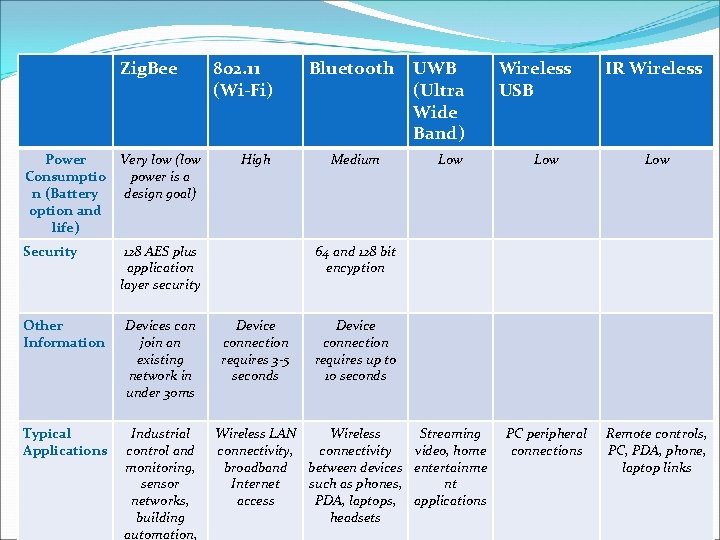
Zig. Bee Power Very low (low Consumptio power is a n (Battery design goal) option and life) 802. 11 (Wi-Fi) Bluetooth UWB (Ultra Wide Band) Wireless USB IR Wireless High Medium Low Low 128 AES plus application layer security 64 and 128 bit encyption Other Information Devices can join an existing network in under 30 ms Device connection requires 3 -5 seconds Device connection requires up to 10 seconds Typical Applications Industrial control and monitoring, sensor networks, building automation, PC peripheral connections Remote controls, PC, PDA, phone, laptop links Security Wireless LAN Wireless Streaming connectivity, connectivity video, home broadband between devices entertainme Internet such as phones, nt access PDA, laptops, applications headsets
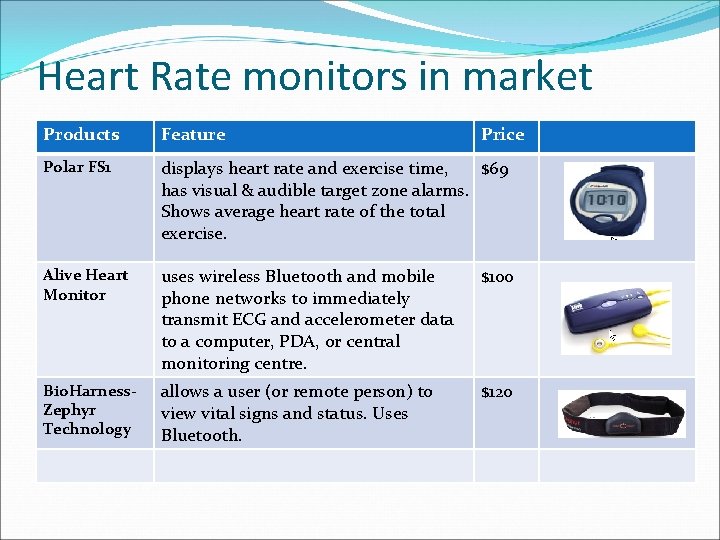
Heart Rate monitors in market Products Feature Price Polar FS 1 displays heart rate and exercise time, $69 has visual & audible target zone alarms. Shows average heart rate of the total exercise. Alive Heart Monitor uses wireless Bluetooth and mobile phone networks to immediately transmit ECG and accelerometer data to a computer, PDA, or central monitoring centre. $100 Bio. Harness. Zephyr Technology allows a user (or remote person) to view vital signs and status. Uses Bluetooth. $120
Why Zig. Bee? �Long range (10 -100 meters) �Long Battery Life (low power consumption) �Secure communication (128 AES plus application layer security) �Low complexity at application layer (lot of features available in the Zig. Bee stack) �Quick network formation (Devices can join an existing network in under 30 ms)

Zig. Bee Protocol Stack Application Layer Z-Stack
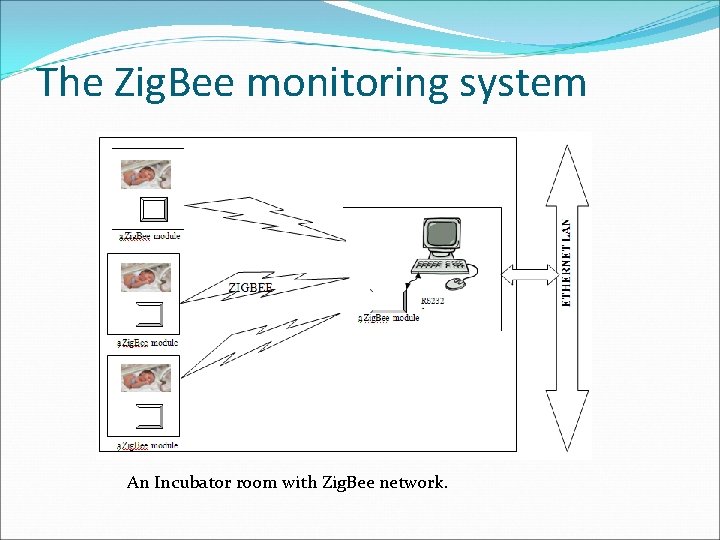
The Zig. Bee monitoring system An Incubator room with Zig. Bee network.
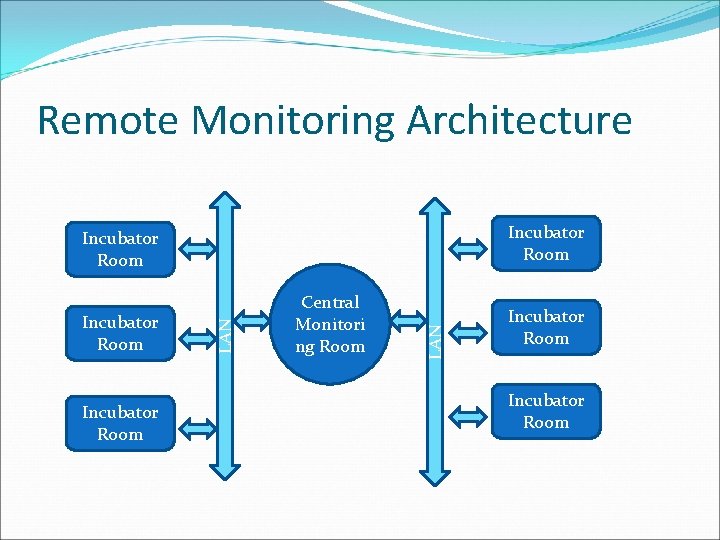
Remote Monitoring Architecture Incubator Room Central Monitori ng Room LAN Incubator Room
Experiments: Implementing a remote Zig. Bee monitoring system �We implemented a Zig. Bee wireless network using 1 Zig. Bee Co-ordinator and 3 end-devices. �A Zig. Bee Coordinator establishes the Zig. Bee network, and collects heart rate information from various end-devices within the network. �A Zig. Bee end-device transmits the heart rate information to the Coordinator periodically. On detecting, an abnormal heart rate (above 160 beats/min and below 120 beats/min) for new-born babies, it sends the information immediately. �Zig. Bee Coordinator transmits the received heart rate information to a computer using RS 232 serial communication. The computer will have a software that will display the heart rate information.
Experiments: Implementing a remote Zig. Bee monitoring system �Each end-device has a unique device address, which is used to map heart rate information to a particular baby in the incubator room. �Ideally, heart rate sensor would be based on electrodes attached to a baby. An analog input on the Zigbee device would collect electric signals from the sensor and Analogto-Digital converter would provide digital data. �In our experiment, we have used a random number generator on the Zigbee device to simulate baby’s heart rate. �An extension of this work would be to develop a software that transmits heart rate information to a central monitoring system over Ethernet LAN.
Reliability and Fail Safe measures �Since the heart rate is reported periodically, the receiver /coordinator can detect if any node in the Zig. Bee network has failed (whatever be the reason). �The computer receiving periodic data from the receiver/coordinator, can detect if the receiver failed. �According to battery life (depends on battery), the software running on the computer attached to zigbee coordinator, can estimate if one of the zigbee nodes is going to die.
Hardware Specification �CC 2430 system on a chip with 8051 microcontroller, an RS 232 interface, a USB Slave interface, an open A/D converter line plus an integrated accelerometer, light sensor, LEDs, a joystick and buttons. �CC 2430 System-on-Chip (So. C) is specifically tailored for IEEE 802. 15. 4 and Zig. Bee™ applications. Combined with the industry leading Zig. Bee™ protocol stack (ZStack) the CC 2430 provides the market’s most competitive Zig. Bee™ solution.
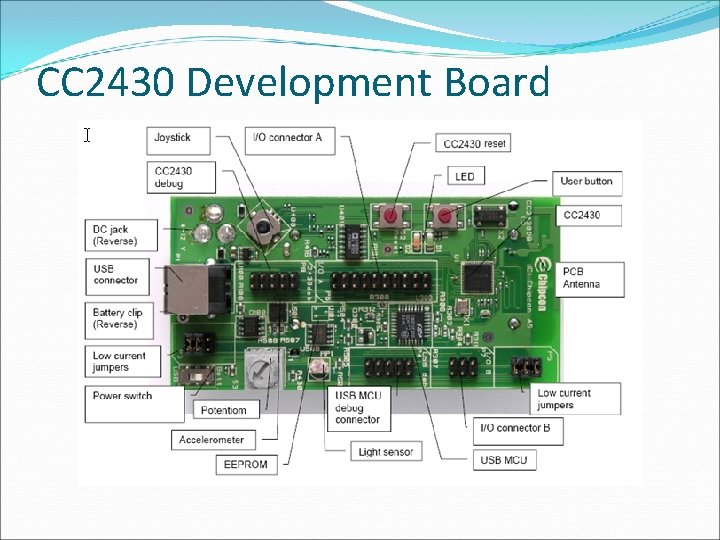
CC 2430 Development Board
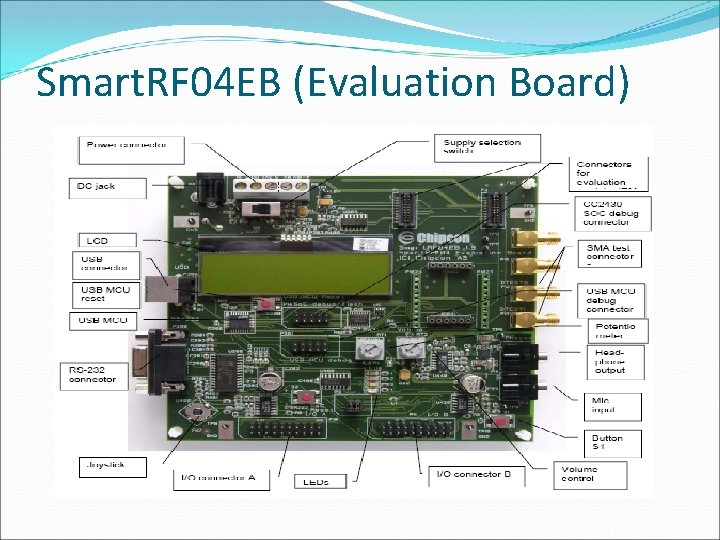
Smart. RF 04 EB (Evaluation Board)
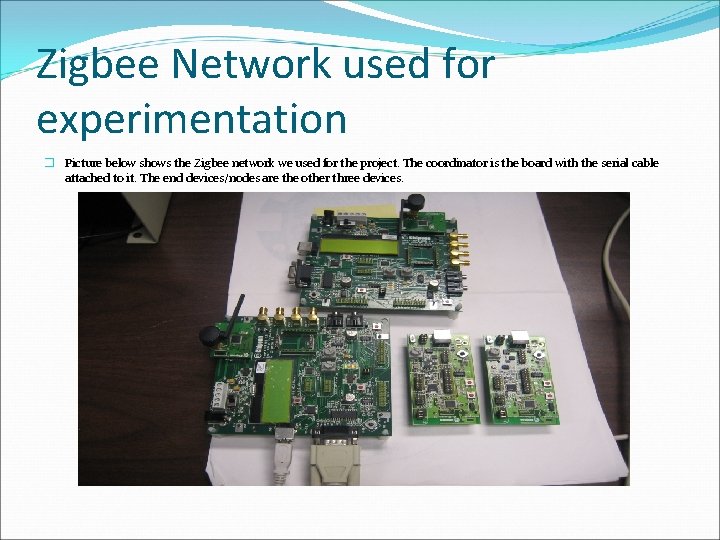
Zigbee Network used for experimentation � Picture below shows the Zigbee network we used for the project. The coordinator is the board with the serial cable attached to it. The end devices/nodes are the other three devices.
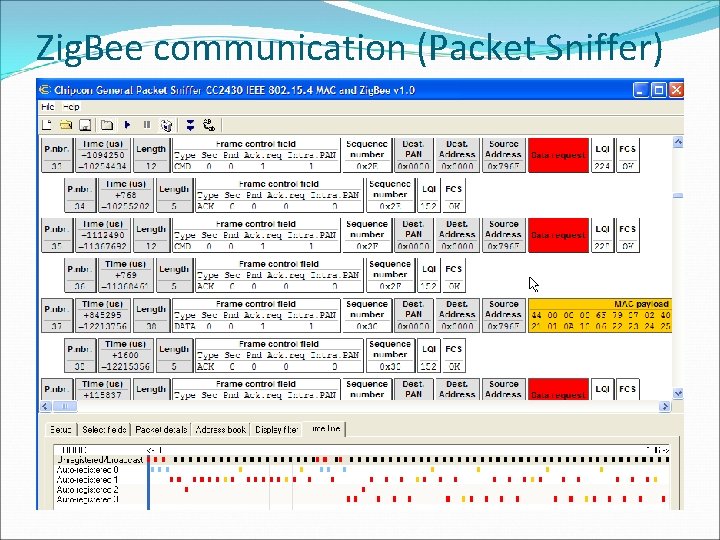
Zig. Bee communication (Packet Sniffer)
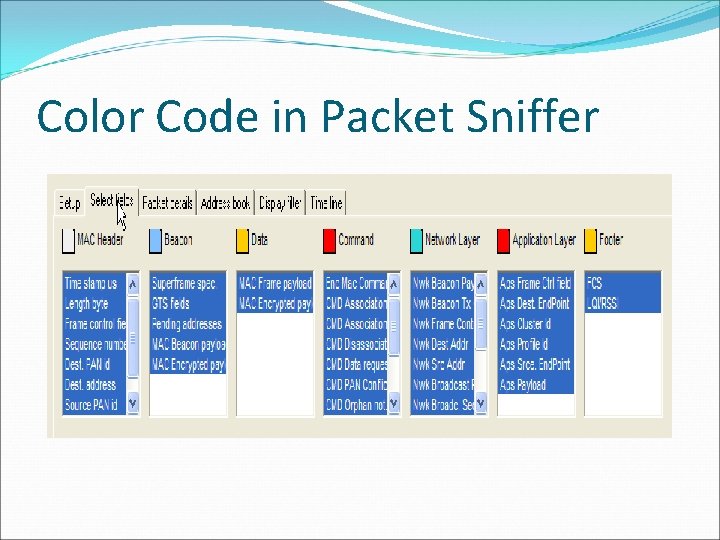
Color Code in Packet Sniffer
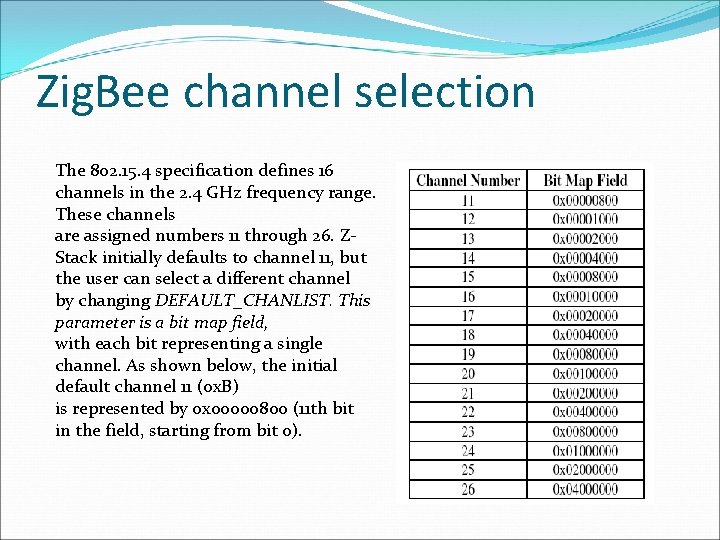
Zig. Bee channel selection The 802. 15. 4 specification defines 16 channels in the 2. 4 GHz frequency range. These channels are assigned numbers 11 through 26. ZStack initially defaults to channel 11, but the user can select a different channel by changing DEFAULT_CHANLIST. This parameter is a bit map field, with each bit representing a single channel. As shown below, the initial default channel 11 (0 x. B) is represented by 0 x 00000800 (11 th bit in the field, starting from bit 0).
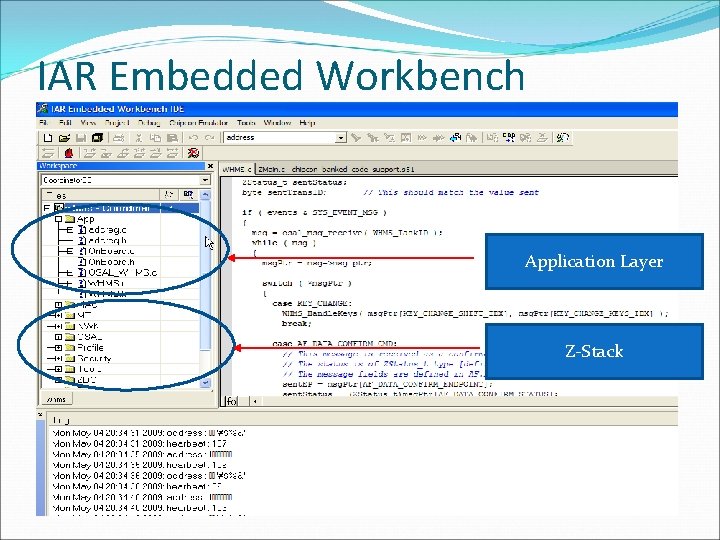
IAR Embedded Workbench Application Layer Z-Stack
Conclusion �We have proposed a low-cost solution to enhance the remote monitoring capability of existing health care system. �We conducted a feasibility study of using Zig. Bee network based heart rate monitoring system. �It is secure, robust and low-power consuming. �It can operate on multiple channels so as to avoid interference with other wireless devices or equipments in the hospital.
- Slides: 21