
A Yang Data Model for Optical Impairmentaware Topology
![Yang Model (Part 2) +--ro OMS-elements* [elt-index] +--ro elt-index uint 16 +--ro uid? string](https://slidetodoc.com/presentation_image_h2/f3f2776c961a1ebc5c930085a7e327c5/image-9.jpg "Yang Model (Part 2) +--ro OMS-elements* [elt-index] +--ro elt-index uint 16 +--ro uid? string")

- Slides: 13
A Yang Data Model for Optical Impairment-aware Topology draft-ietf-ccamp-optical-impairment-topology-yang-01 Co-authors: • Young Lee • Victor Lopez (Telefonica) • Gabriele Galimberti (Cisco) • Jean Luc Auge (Orange) • Dieter Beller (Nokia) Co-authors - contributors: • Haomian Zheng (Huawei) • Italo Busi (Huawei) • Nicola Sambo (Scuola superior S. Anna) • Julien Meuric (Orange) • Esther Le Rouzic (Orange) • Sergio Belotti (Nokia) • Enrico Griseri (Nokia) • Gert Grammel (Juniper) • Jonas Martenson (RISE) • Aihua Guo (Huawei)
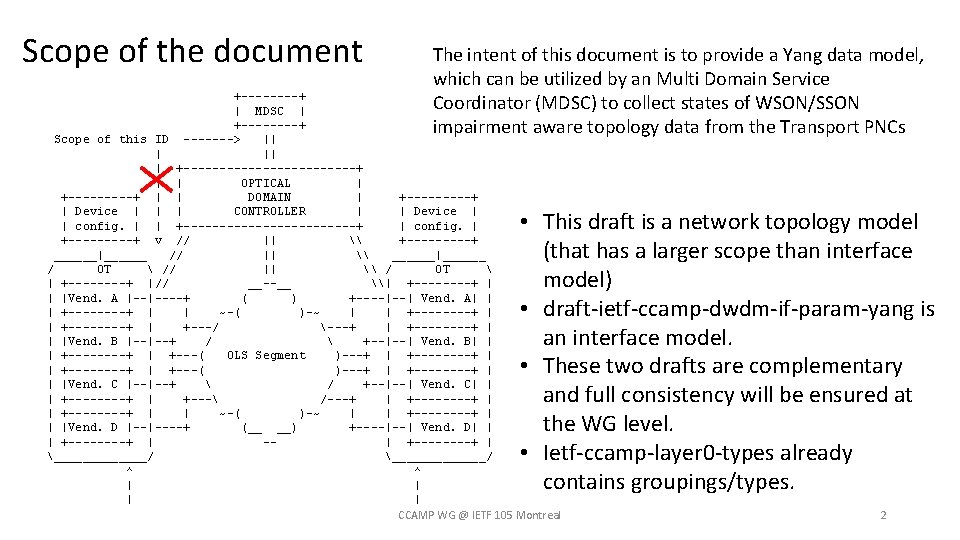
Scope of the document The intent of this document is to provide a Yang data model, which can be utilized by an Multi Domain Service Coordinator (MDSC) to collect states of WSON/SSON impairment aware topology data from the Transport PNCs +----+ | MDSC | +----+ Scope of this ID -------> || | +------------+ | | OPTICAL | +-----+ | | DOMAIN | +-----+ | Device | | | CONTROLLER | | Device | | config. | | +------------+ | config. | +-----+ v // || \ +-----+ ______|______ // || \ ______|______ / OT // || \ / OT | +----+ |// __--__ \| +----+ | | |Vend. A |--|----+ ( ) +----|--| Vend. A| | | +----+ | | ~-( )-~ | | +--------+ | +---/ ---+ | +----+ | | |Vend. B |--|--+ / +--|--| Vend. B| | | +----+ | +---( OLS Segment )---+ | +--------+ | +---( )---+ | +----+ | | |Vend. C |--|--+ / +--|--| Vend. C| | | +----+ | +--- /---+ | +--------+ | | ~-( )-~ | | +----+ | | |Vend. D |--|----+ (__ __) +----|--| Vend. D| | | +----+ | -| +----+ | _____________/ ^ ^ | | CCAMP WG @ IETF 105 Montreal • This draft is a network topology model (that has a larger scope than interface model) • draft-ietf-ccamp-dwdm-if-param-yang is an interface model. • These two drafts are complementary and full consistency will be ensured at the WG level. • Ietf-ccamp-layer 0 -types already contains groupings/types. 2
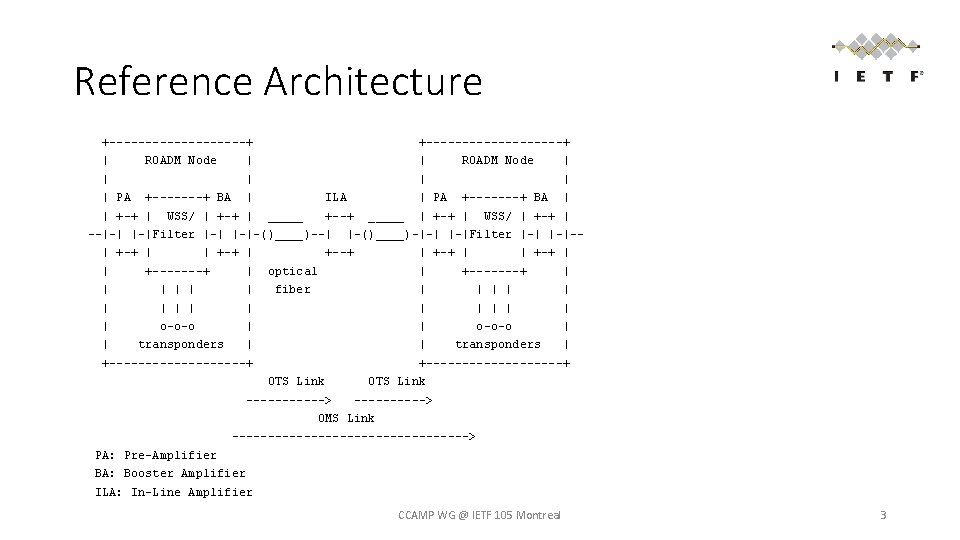
Reference Architecture +-------------------+ | | | ROADM Node | | PA +-------+ BA | +-+ | | WSS/ | +-+ | ILA _____ +--+ --|-| |-|Filter |-|-()____)--| | +-+ | | PA | +-+ | _____ ROADM Node | | +-------+ BA | +-+ | | WSS/ | +-+ | |-()____)-|-| |-|Filter |-|-- +--+ | +-+ | | +-------+ | optical | +-------+ | | | fiber | | | | o-o-o | | transponders | | +----------+ transponders | +----------+ OTS Link ------> OTS Link -----> OMS Link -----------------> PA: Pre-Amplifier BA: Booster Amplifier ILA: In-Line Amplifier CCAMP WG @ IETF 105 Montreal 3
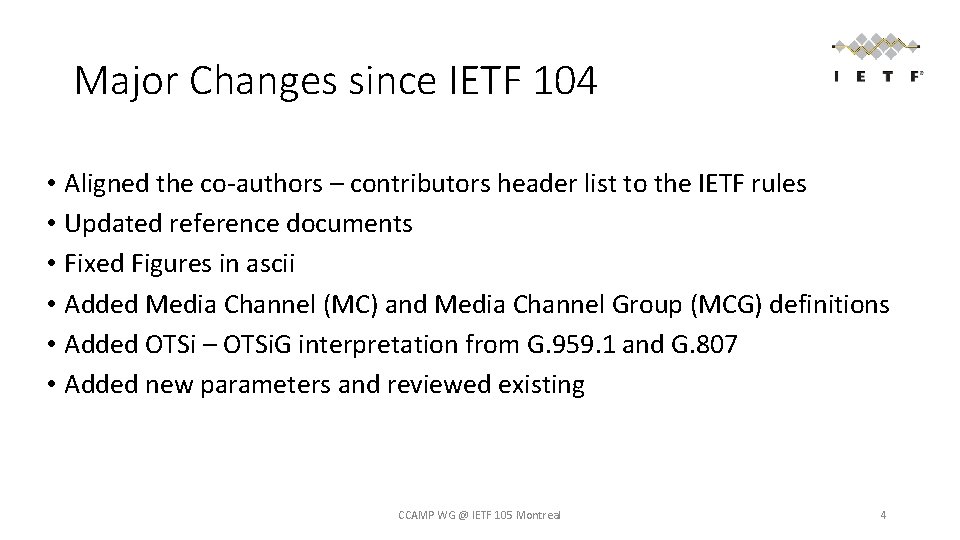
Major Changes since IETF 104 • Aligned the co-authors – contributors header list to the IETF rules • Updated reference documents • Fixed Figures in ascii • Added Media Channel (MC) and Media Channel Group (MCG) definitions • Added OTSi – OTSi. G interpretation from G. 959. 1 and G. 807 • Added new parameters and reviewed existing CCAMP WG @ IETF 105 Montreal 4
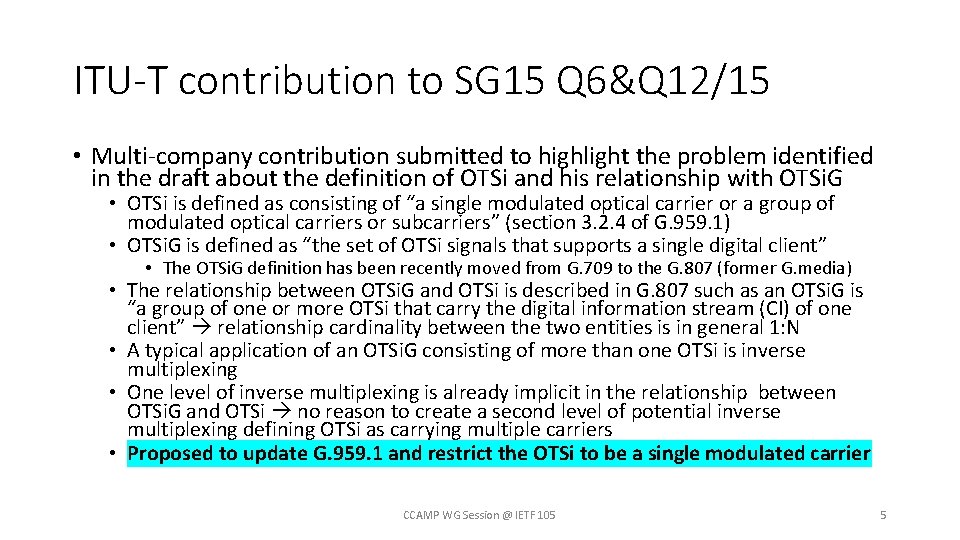
ITU-T contribution to SG 15 Q 6&Q 12/15 • Multi-company contribution submitted to highlight the problem identified in the draft about the definition of OTSi and his relationship with OTSi. G • OTSi is defined as consisting of “a single modulated optical carrier or a group of modulated optical carriers or subcarriers” (section 3. 2. 4 of G. 959. 1) • OTSi. G is defined as “the set of OTSi signals that supports a single digital client” • The OTSi. G definition has been recently moved from G. 709 to the G. 807 (former G. media) • The relationship between OTSi. G and OTSi is described in G. 807 such as an OTSi. G is “a group of one or more OTSi that carry the digital information stream (CI) of one client” relationship cardinality between the two entities is in general 1: N • A typical application of an OTSi. G consisting of more than one OTSi is inverse multiplexing • One level of inverse multiplexing is already implicit in the relationship between OTSi. G and OTSi no reason to create a second level of potential inverse multiplexing defining OTSi as carrying multiple carriers • Proposed to update G. 959. 1 and restrict the OTSi to be a single modulated carrier CCAMP WG Session @ IETF 105 5
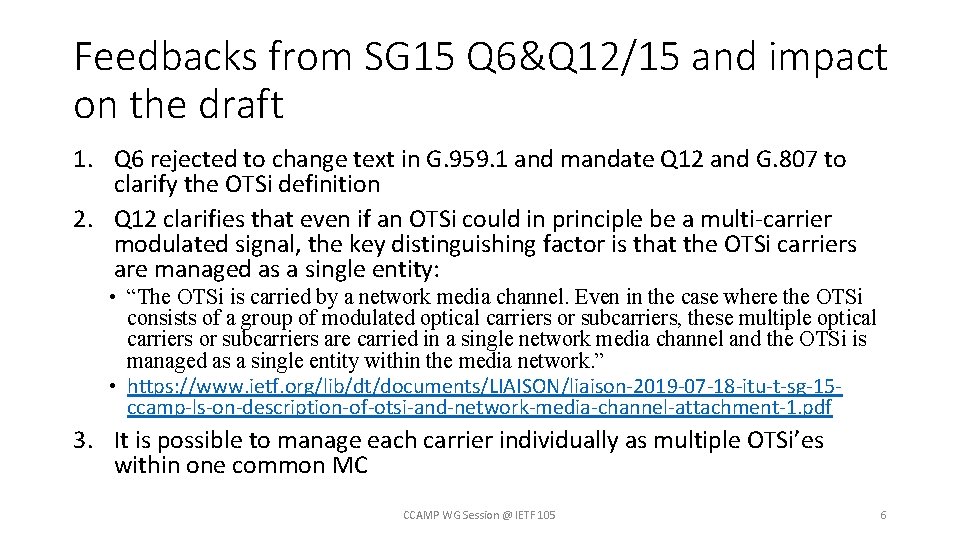
Feedbacks from SG 15 Q 6&Q 12/15 and impact on the draft 1. Q 6 rejected to change text in G. 959. 1 and mandate Q 12 and G. 807 to clarify the OTSi definition 2. Q 12 clarifies that even if an OTSi could in principle be a multi-carrier modulated signal, the key distinguishing factor is that the OTSi carriers are managed as a single entity: • “The OTSi is carried by a network media channel. Even in the case where the OTSi consists of a group of modulated optical carriers or subcarriers, these multiple optical carriers or subcarriers are carried in a single network media channel and the OTSi is managed as a single entity within the media network. ” • https: //www. ietf. org/lib/dt/documents/LIAISON/liaison-2019 -07 -18 -itu-t-sg-15 ccamp-ls-on-description-of-otsi-and-network-media-channel-attachment-1. pdf 3. It is possible to manage each carrier individually as multiple OTSi’es within one common MC CCAMP WG Session @ IETF 105 6
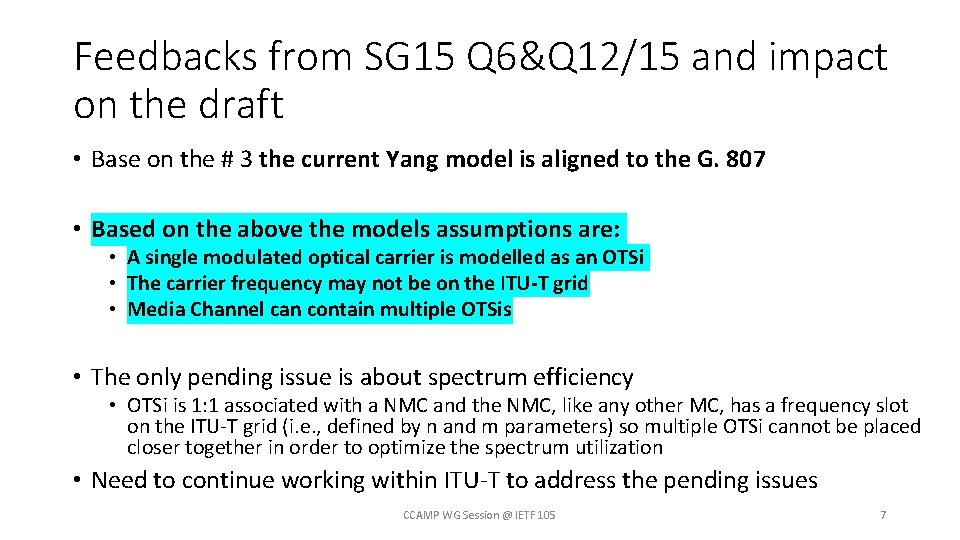
Feedbacks from SG 15 Q 6&Q 12/15 and impact on the draft • Base on the # 3 the current Yang model is aligned to the G. 807 • Based on the above the models assumptions are: • A single modulated optical carrier is modelled as an OTSi • The carrier frequency may not be on the ITU-T grid • Media Channel can contain multiple OTSis • The only pending issue is about spectrum efficiency • OTSi is 1: 1 associated with a NMC and the NMC, like any other MC, has a frequency slot on the ITU-T grid (i. e. , defined by n and m parameters) so multiple OTSi cannot be placed closer together in order to optimize the spectrum utilization • Need to continue working within ITU-T to address the pending issues CCAMP WG Session @ IETF 105 7
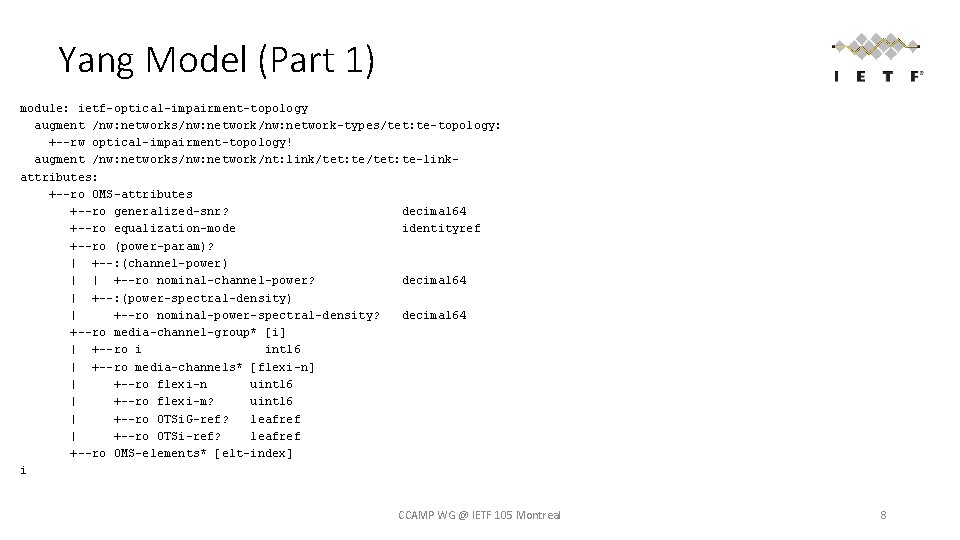
Yang Model (Part 1) module: ietf-optical-impairment-topology augment /nw: networks/nw: network-types/tet: te-topology: +--rw optical-impairment-topology! augment /nw: networks/nw: network/nt: link/tet: te-linkattributes: +--ro OMS-attributes +--ro generalized-snr? decimal 64 +--ro equalization-mode identityref +--ro (power-param)? | +--: (channel-power) | | +--ro nominal-channel-power? decimal 64 | +--: (power-spectral-density) | +--ro nominal-power-spectral-density? decimal 64 +--ro media-channel-group* [i] | +--ro i int 16 | +--ro media-channels* [flexi-n] | +--ro flexi-n uint 16 | +--ro flexi-m? uint 16 | +--ro OTSi. G-ref? leafref | +--ro OTSi-ref? leafref +--ro OMS-elements* [elt-index] i CCAMP WG @ IETF 105 Montreal 8
Yang Model (Part 2) +--ro OMS-elements* [elt-index] +--ro elt-index uint 16 +--ro uid? string +--ro type identityref +--ro element +--ro (element)? +--: (amplifier) | +--ro amplifier | +--ro type_variety string | +--ro operational | +--ro actual-gain | | decimal 64 | +--ro tilt-target | | decimal 64 | +--ro out-voa | | decimal 64 | +--ro in-voa | | decimal 64 | +--ro (power-param)? | +--: (channel-power) | | +--ro nominal-channel-power? | | decimal 64 | +--: (power-spectral-density) | +--ro nominal-power-spectral-density? | decimal 64 +--: (fiber) | +--ro fiber | +--ro type_variety string | +--ro length decimal 64 | +--ro loss_coef decimal 64 | +--ro total_loss decimal 64 | +--ro pmd? decimal 64 | +--ro conn_in? decimal 64 | +--ro conn_out? decimal 64 +--: (concentratedloss) CCAMP WG @ IETF 105 +--ro concentratedloss +--ro loss? decimal 64 Montreal 9
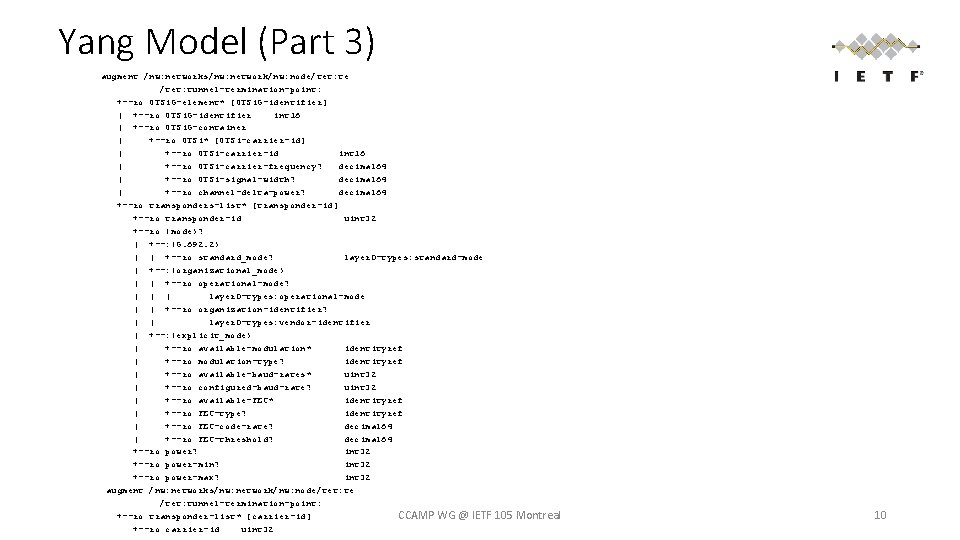
Yang Model (Part 3) augment /nw: networks/nw: network/nw: node/tet: te /tet: tunnel-termination-point: +--ro OTSi. G-element* [OTSi. G-identifier] | +--ro OTSi. G-identifier int 16 | +--ro OTSi. G-container | +--ro OTSi* [OTSi-carrier-id] | +--ro OTSi-carrier-id int 16 | +--ro OTSi-carrier-frequency? decimal 64 | +--ro OTSi-signal-width? decimal 64 | +--ro channel-delta-power? decimal 64 +--ro transponders-list* [transponder-id] +--ro transponder-id uint 32 +--ro (mode)? | +--: (G. 692. 2) | | +--ro standard_mode? layer 0 -types: standard-mode | +--: (organizational_mode) | | +--ro operational-mode? | | | layer 0 -types: operational-mode | | +--ro organization-identifier? | | layer 0 -types: vendor-identifier | +--: (explicit_mode) | +--ro available-modulation* identityref | +--ro modulation-type? identityref | +--ro available-baud-rates* uint 32 | +--ro configured-baud-rate? uint 32 | +--ro available-FEC* identityref | +--ro FEC-type? identityref | +--ro FEC-code-rate? decimal 64 | +--ro FEC-threshold? decimal 64 +--ro power? int 32 +--ro power-min? int 32 +--ro power-max? int 32 augment /nw: networks/nw: network/nw: node/tet: te /tet: tunnel-termination-point: CCAMP WG @ IETF +--ro transponder-list* [carrier-id] +--ro carrier-id uint 32 105 Montreal 10
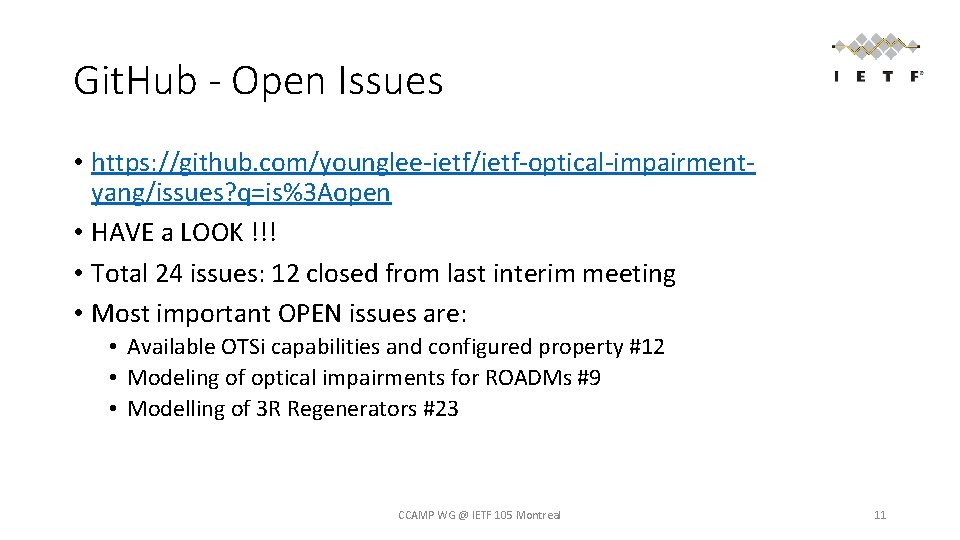
Git. Hub - Open Issues • https: //github. com/younglee-ietf/ietf-optical-impairmentyang/issues? q=is%3 Aopen • HAVE a LOOK !!! • Total 24 issues: 12 closed from last interim meeting • Most important OPEN issues are: • Available OTSi capabilities and configured property #12 • Modeling of optical impairments for ROADMs #9 • Modelling of 3 R Regenerators #23 CCAMP WG @ IETF 105 Montreal 11
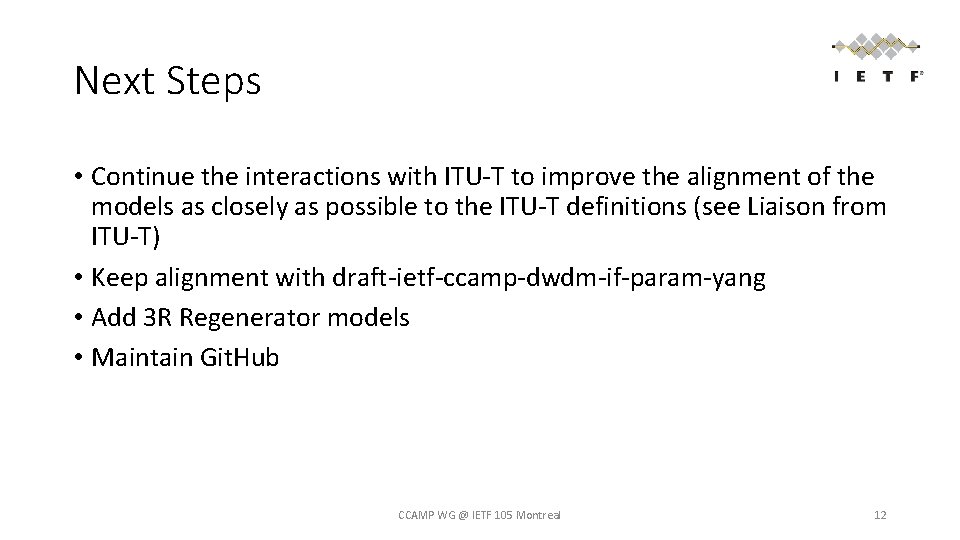
Next Steps • Continue the interactions with ITU-T to improve the alignment of the models as closely as possible to the ITU-T definitions (see Liaison from ITU-T) • Keep alignment with draft-ietf-ccamp-dwdm-if-param-yang • Add 3 R Regenerator models • Maintain Git. Hub CCAMP WG @ IETF 105 Montreal 12
Thank You! CCAMP WG @ IETF 105 Montreal 13