
A Yang Data Model for ACTN VN Operation
![ACTN VN Yang Tree module: ietf-actn-vn +--rw actn +--rw ap | +--rw access-point-list* [access-point-id]](https://slidetodoc.com/presentation_image_h2/53e6474245db370a38f67106a0befbf8/image-11.jpg "ACTN VN Yang Tree module: ietf-actn-vn +--rw actn +--rw ap | +--rw access-point-list* [access-point-id]")

- Slides: 17
A Yang Data Model for ACTN VN Operation draft-lee-teas-actn-vn-yang-12 Young Lee, Dhruv Dhody, Igor Bryskin Huawei Daniele Ceccarelli Ericsson Bin Yeong Yoon ETRI Haomian, Xian, Sergio, Qin, Takuya, Peter Contributors
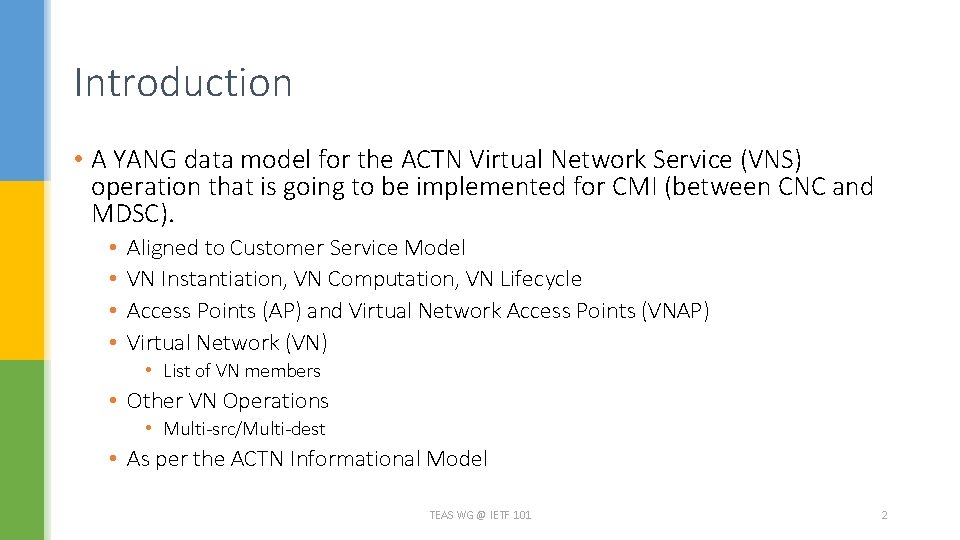
Introduction • A YANG data model for the ACTN Virtual Network Service (VNS) operation that is going to be implemented for CMI (between CNC and MDSC). • • Aligned to Customer Service Model VN Instantiation, VN Computation, VN Lifecycle Access Points (AP) and Virtual Network Access Points (VNAP) Virtual Network (VN) • List of VN members • Other VN Operations • Multi-src/Multi-dest • As per the ACTN Informational Model TEAS WG @ IETF 101 2
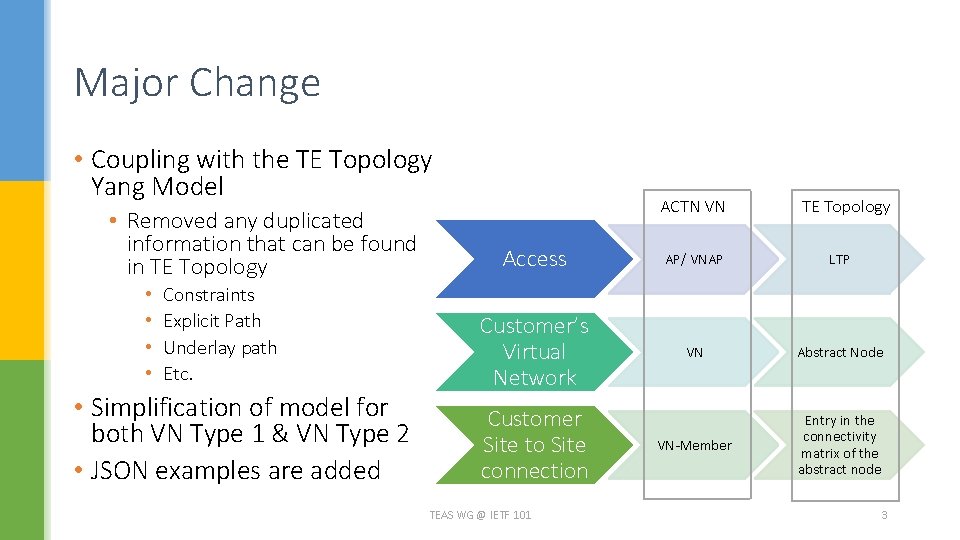
Major Change • Coupling with the TE Topology Yang Model • Removed any duplicated information that can be found in TE Topology • • Constraints Explicit Path Underlay path Etc. • Simplification of model for both VN Type 1 & VN Type 2 • JSON examples are added ACTN VN TE Topology Access AP/ VNAP LTP Customer’s Virtual Network VN Abstract Node VN-Member Entry in the connectivity matrix of the abstract node Customer Site to Site connection TEAS WG @ IETF 101 3
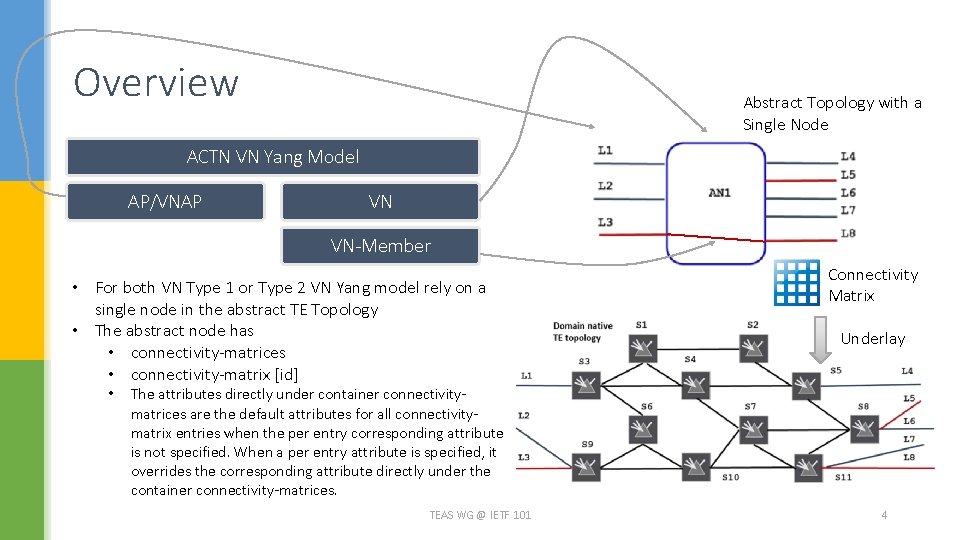
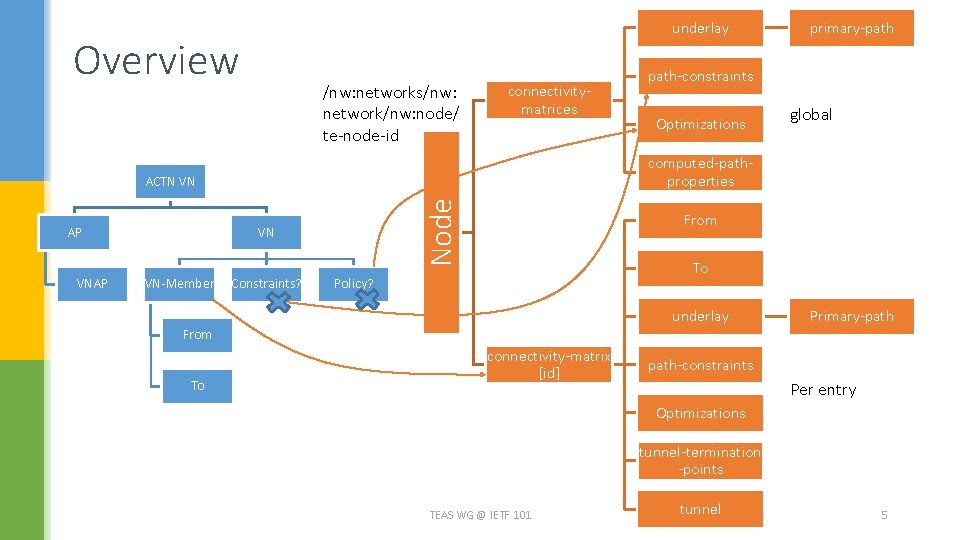
Overview Abstract Topology with a Single Node ACTN VN Yang Model AP/VNAP VN VN-Member • For both VN Type 1 or Type 2 VN Yang model rely on a single node in the abstract TE Topology • The abstract node has • connectivity-matrices • connectivity-matrix [id] • Connectivity Matrix Underlay The attributes directly under container connectivitymatrices are the default attributes for all connectivitymatrix entries when the per entry corresponding attribute is not specified. When a per entry attribute is specified, it overrides the corresponding attribute directly under the container connectivity-matrices. TEAS WG @ IETF 101 4
underlay Overview /nw: networks/nw: network/nw: node/ te-node-id connectivitymatrices VNAP Node VN VN-Member path-constraints Optimizations global computed-pathproperties ACTN VN AP primary-path Constraints? From To Policy? underlay Primary-path From To connectivity-matrix [id] path-constraints Per entry Optimizations tunnel-termination -points TEAS WG @ IETF 101 tunnel 5
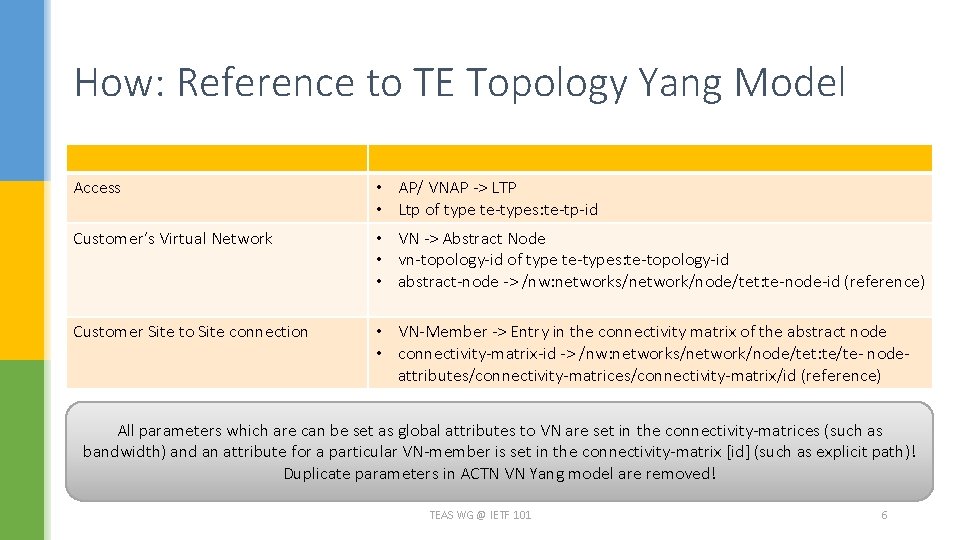
How: Reference to TE Topology Yang Model Access • AP/ VNAP -> LTP • Ltp of type te-types: te-tp-id Customer’s Virtual Network • VN -> Abstract Node • vn-topology-id of type te-types: te-topology-id • abstract-node -> /nw: networks/network/node/tet: te-node-id (reference) Customer Site to Site connection • VN-Member -> Entry in the connectivity matrix of the abstract node • connectivity-matrix-id -> /nw: networks/network/node/tet: te/te- nodeattributes/connectivity-matrices/connectivity-matrix/id (reference) All parameters which are can be set as global attributes to VN are set in the connectivity-matrices (such as bandwidth) and an attribute for a particular VN-member is set in the connectivity-matrix [id] (such as explicit path)! Duplicate parameters in ACTN VN Yang model are removed! TEAS WG @ IETF 101 6
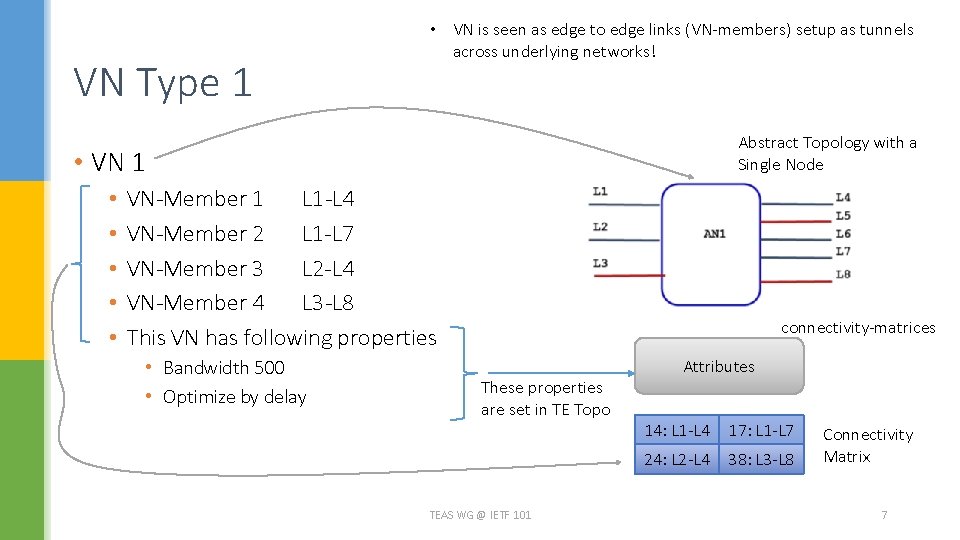
VN Type 1 • VN is seen as edge to edge links (VN-members) setup as tunnels across underlying networks! Abstract Topology with a Single Node • VN 1 • • • VN-Member 1 L 1 -L 4 VN-Member 2 L 1 -L 7 VN-Member 3 L 2 -L 4 VN-Member 4 L 3 -L 8 This VN has following properties • Bandwidth 500 • Optimize by delay connectivity-matrices These properties are set in TE Topo TEAS WG @ IETF 101 Attributes 14: L 1 -L 4 17: L 1 -L 7 24: L 2 -L 4 38: L 3 -L 8 Connectivity Matrix 7
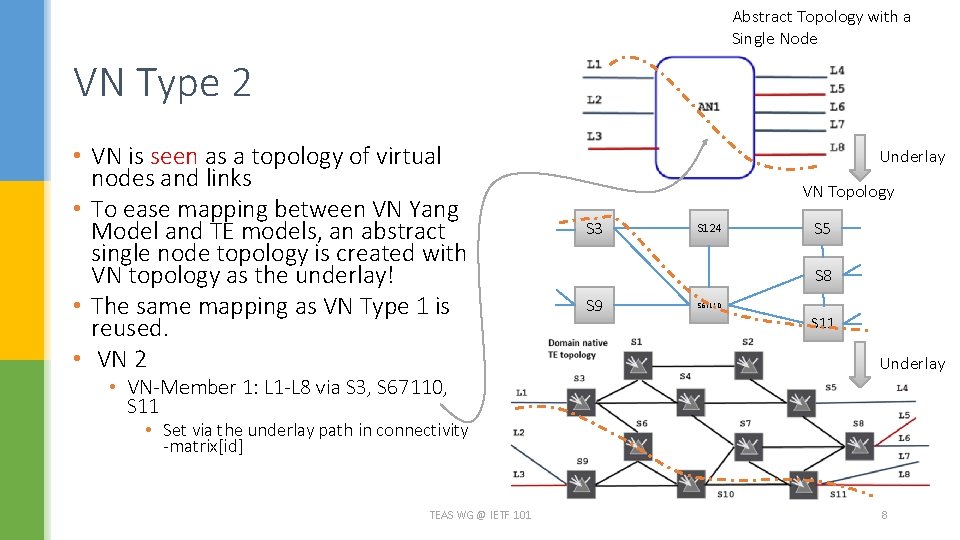
Abstract Topology with a Single Node VN Type 2 • VN is seen as a topology of virtual nodes and links • To ease mapping between VN Yang Model and TE models, an abstract single node topology is created with VN topology as the underlay! • The same mapping as VN Type 1 is reused. • VN 2 Underlay VN Topology S 3 S 124 S 5 S 8 S 9 S 67110 S 11 Underlay • VN-Member 1: L 1 -L 8 via S 3, S 67110, S 11 • Set via the underlay path in connectivity -matrix[id] TEAS WG @ IETF 101 8
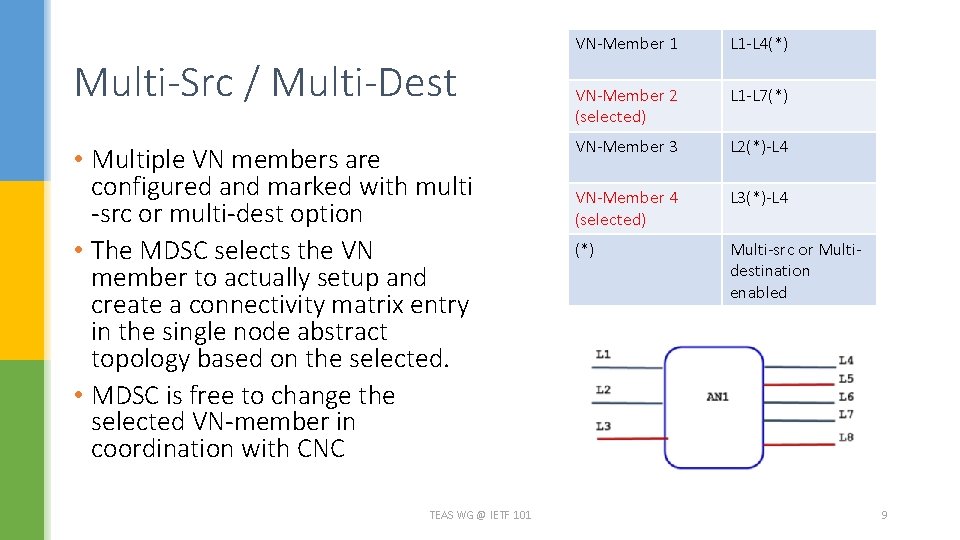
Multi-Src / Multi-Dest • Multiple VN members are configured and marked with multi -src or multi-dest option • The MDSC selects the VN member to actually setup and create a connectivity matrix entry in the single node abstract topology based on the selected. • MDSC is free to change the selected VN-member in coordination with CNC TEAS WG @ IETF 101 VN-Member 1 L 1 -L 4(*) VN-Member 2 (selected) L 1 -L 7(*) VN-Member 3 L 2(*)-L 4 VN-Member 4 (selected) L 3(*)-L 4 (*) Multi-src or Multidestination enabled 9
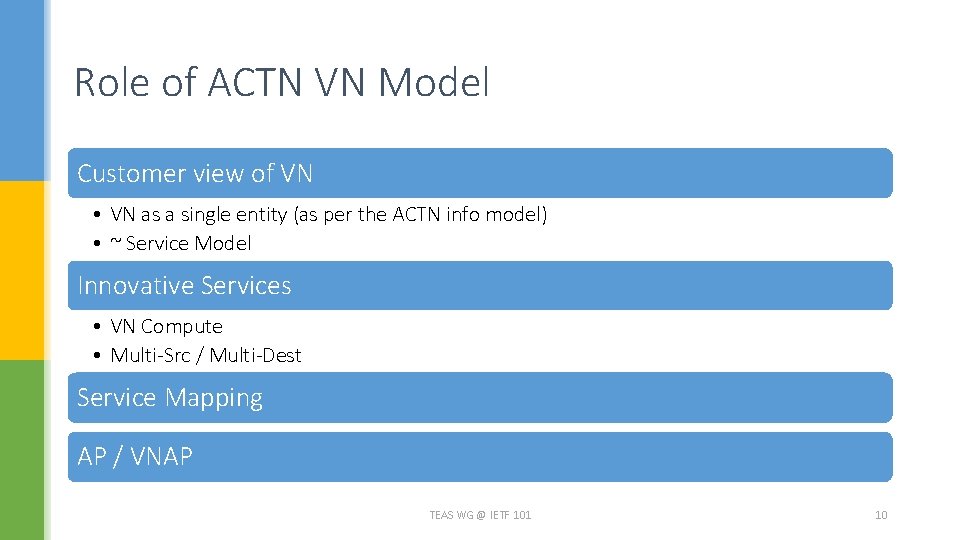
Role of ACTN VN Model Customer view of VN • VN as a single entity (as per the ACTN info model) • ~ Service Model Innovative Services • VN Compute • Multi-Src / Multi-Dest Service Mapping AP / VNAP TEAS WG @ IETF 101 10
ACTN VN Yang Tree module: ietf-actn-vn +--rw actn +--rw ap | +--rw access-point-list* [access-point-id] | +--rw access-point-id uint 32 | +--rw access-point-name? string | +--rw max-bandwidth? te-types: te-bandwidth | +--rw avl-bandwidth? te-types: te-bandwidth | +--rw vn-ap* [vn-ap-id] | +--rw vn-ap-id uint 32 | +--rw vn? -> /actn/vn/vn-list/vn-id | +--rw abstract-node? -> /nw: networks/network/node/tet: te-node-id | +--rw ltp? te-types: te-tp-id +--rw vn-list* [vn-id] +--rw vn-id uint 32 +--rw vn-name? string +--rw vn-topology-id? te-types: te-topology-id +--rw abstract-node? -> /nw: networks/network/node/tet: te-node-id +--rw vn-member-list* [vn-member-id] | +--rw vn-member-id uint 32 | +--rw src | | +--rw src? -> /actn/ap/access-point-list/access-point-id | | +--rw src-vn-ap-id? -> /actn/ap/access-point-list/vn-ap-id | | +--rw multi-src? boolean {multi-src-dest}? | +--rw dest | | +--rw dest? -> /actn/ap/access-point-list/access-point-id | | +--rw dest-vn-ap-id? -> /actn/ap/access-point-list/vn-ap-id | | +--rw multi-dest? boolean {multi-src-dest}? | +--rw connetivity-matrix-id? -> /nw: networks/network/node/tet: te/te-node-attributes/connectivity-matrices/connectivity-matrix/id | +--ro oper-status? identityref +--ro if-selected? boolean {multi-src-dest}? +--rw admin-status? identityref +--ro oper-status? identityref +--rw vn-level-diversity? vn-disjointness TEAS WG @ IETF 101 11
Next Step • This update of draft is based on feedback received during the last IETF to reuse existing TE yang model as much as possible. • This update does just that and works well with abstract TE topology model • Request for WG Adoption! TEAS WG @ IETF 101 12
Thank You!
Backup Slides TEAS WG @ IETF 101 14
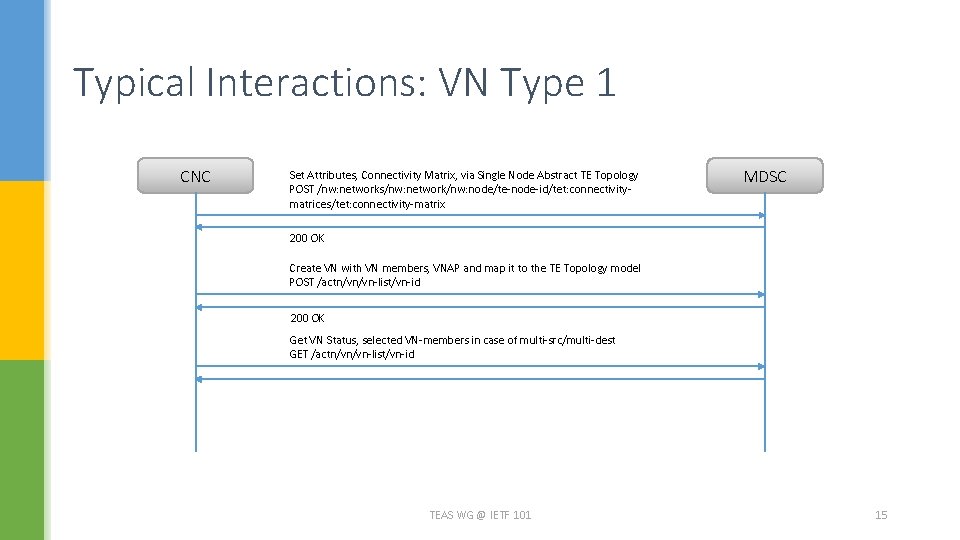
Typical Interactions: VN Type 1 CNC Set Attributes, Connectivity Matrix, via Single Node Abstract TE Topology POST /nw: networks/nw: network/nw: node/te-node-id/tet: connectivitymatrices/tet: connectivity-matrix MDSC 200 OK Create VN with VN members, VNAP and map it to the TE Topology model POST /actn/vn/vn-list/vn-id 200 OK Get VN Status, selected VN-members in case of multi-src/multi-dest GET /actn/vn/vn-list/vn-id TEAS WG @ IETF 101 15
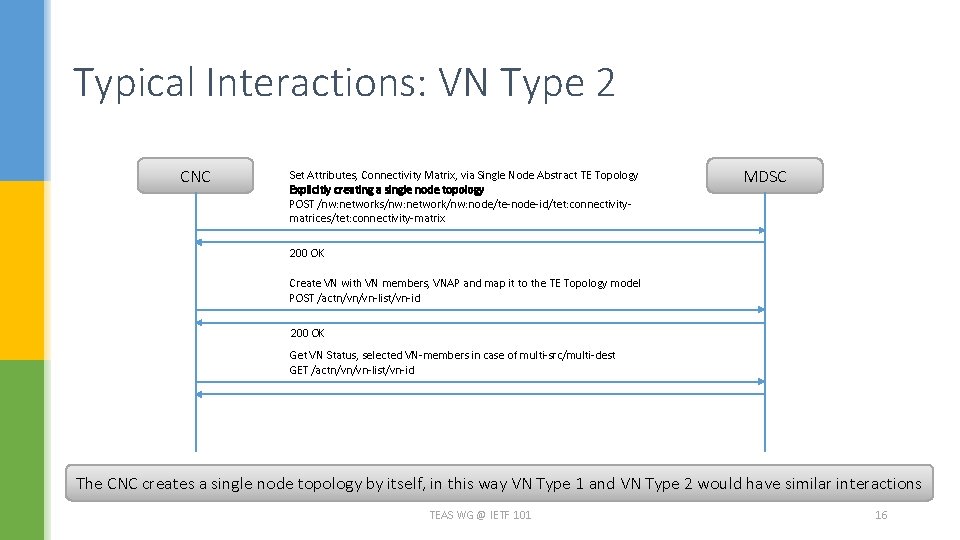
Typical Interactions: VN Type 2 CNC Set Attributes, Connectivity Matrix, via Single Node Abstract TE Topology Explicitly creating a single node topology POST /nw: networks/nw: network/nw: node/te-node-id/tet: connectivitymatrices/tet: connectivity-matrix MDSC 200 OK Create VN with VN members, VNAP and map it to the TE Topology model POST /actn/vn/vn-list/vn-id 200 OK Get VN Status, selected VN-members in case of multi-src/multi-dest GET /actn/vn/vn-list/vn-id The CNC creates a single node topology by itself, in this way VN Type 1 and VN Type 2 would have similar interactions TEAS WG @ IETF 101 16
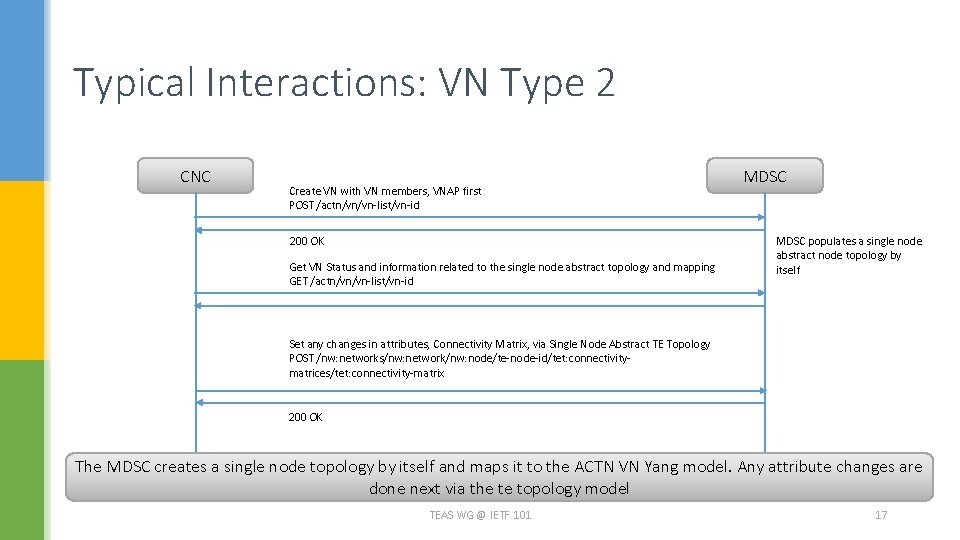
Typical Interactions: VN Type 2 CNC Create VN with VN members, VNAP first POST /actn/vn/vn-list/vn-id 200 OK Get VN Status and information related to the single node abstract topology and mapping GET /actn/vn/vn-list/vn-id MDSC populates a single node abstract node topology by itself Set any changes in attributes, Connectivity Matrix, via Single Node Abstract TE Topology POST /nw: networks/nw: network/nw: node/te-node-id/tet: connectivitymatrices/tet: connectivity-matrix 200 OK The MDSC creates a single node topology by itself and maps it to the ACTN VN Yang model. Any attribute changes are done next via the te topology model TEAS WG @ IETF 101 17