
A Worst Case Constant Time Priority Queue Beating

A Worst Case, Constant Time Priority Queue: Beating a Lower Bound Ian Munro University of Waterloo Joint work with • Andrej Brodnik (Ljubljana & Luleå) • Svante Carlsson (Blekinge Inst. Tech. ) • Johan Karlsson (Luleå)
Lower Bounds: What do they mean? • If upper and lower bounds match, the problem is solved. • If lower bound exceeds the time you can take … give up
Lower Bounds: What do they mean? • If upper and lower bounds match, the problem is solved. • If lower bound exceeds the time you can take … give up • Lower bounds, and upper bounds, are proven under a model. • So if you have to “get under” a lower bound -focus on the operations the model does not permit • It’s time to become imaginative in terms of permitted operations
Beating Lower Bounds: Examples • Searching: lg n lower bound on comparisons, so hash • lg n time becomes constant • Sorting: n lg n lower bound on comparisons, so use variants of bucketing • n lg n time easily linear on average • n lg n time becomes n lg lg n even in worst case
Beating the Lower Bound … Another Case Self organizing linear search… • Move to front heuristic ( rheuistic) is within a constant factor of offline optimal for linear search, amortized cost of searching is ~ 1/pi under “exchange adjacent” model • But 1 2 3 4 … n/2+1 … n costs (n 2) • Under “exchange any two” model offline cost is ~lg(1/pi) … comparable to splay trees
The Problem at hand: Extended Priority Queue • van Emde Boas (SWAT i. e. FOCS 1975) • Universe integers [1, . . m] {n of which are present} • Operations: insert / delete find least value x (or greatest ) • Bound: O(lg lg m) time • Space: Improved to O(m) bits • Model: Standard RAM, with bit twiddling
Some Subsequent Work • Kurt Mehlhorn, Stephan Näher and Helmut Alt (Si. Comp ‘ 88): v. EB is optimal Lower bound (lg lg m) on pointer machine • Peter Miltersen (STOC ‘ 94): Lower bound ( lg lg m) on a RAM • Paul Beame and Faith Fich (STOC ‘ 99): parameterization by number of values present matching upper & lower bounds- ( lg n/ lg lg n) • Ram model is rather powerful, how can we extend it for our problem?
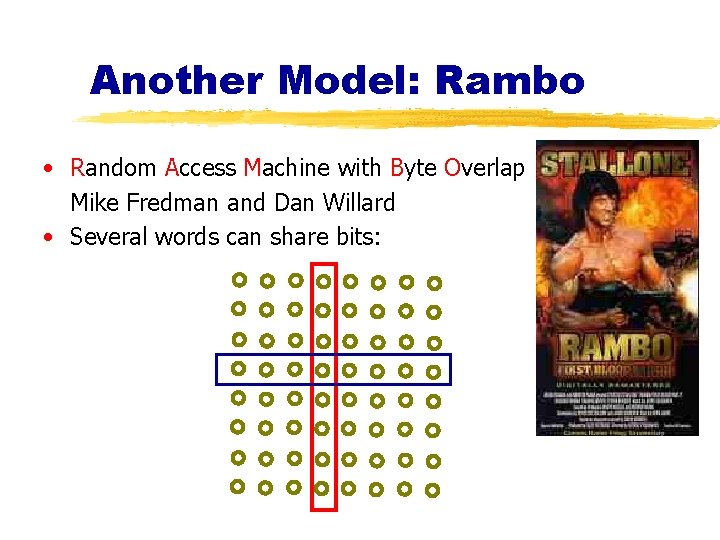
Another Model: Rambo • Random Access Machine with Byte Overlap Mike Fredman and Dan Willard • Several words can share bits:
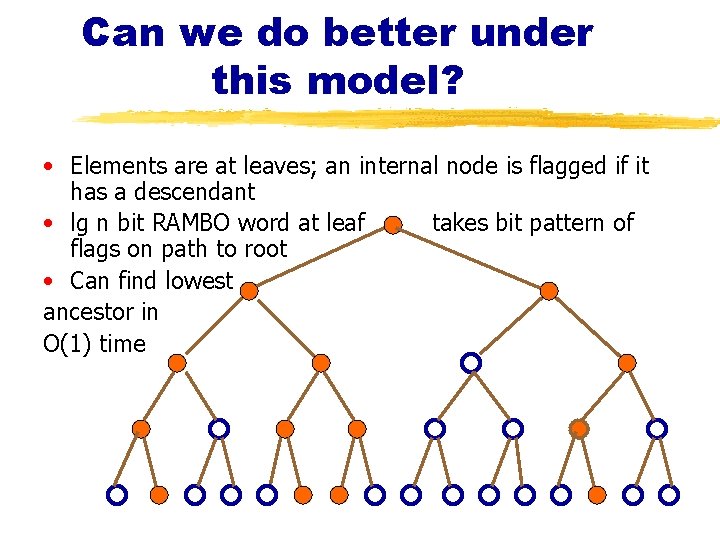
Can we do better under this model? • Elements are at leaves; an internal node is flagged if it has a descendant • lg n bit RAMBO word at leaf takes bit pattern of flags on path to root • Can find lowest ancestor in O(1) time
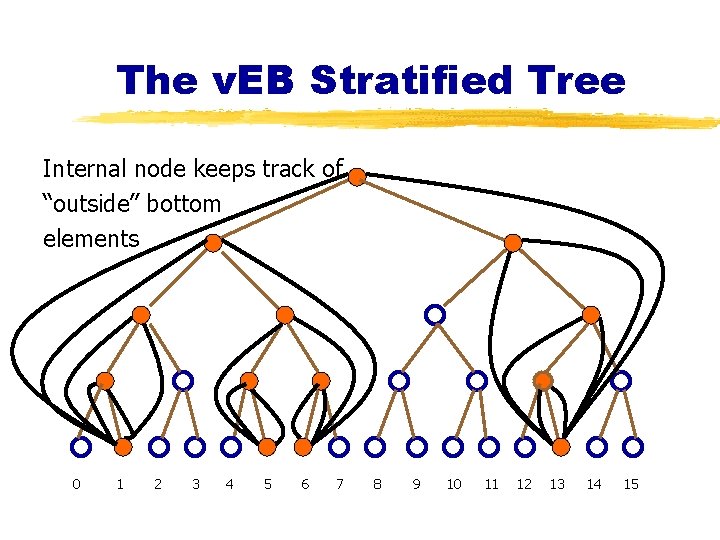
The v. EB Stratified Tree Internal node keeps track of “outside” bottom elements 0 1 2 3 4 5 6 7 8 9 10 11 12 13 14 15
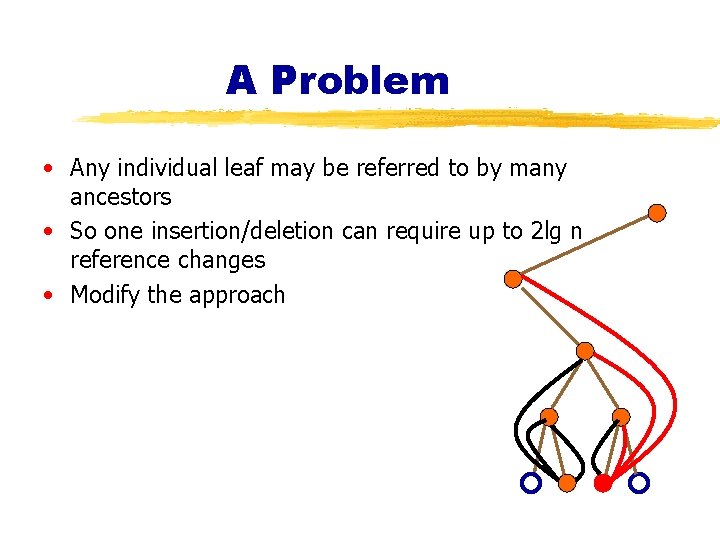
A Problem • Any individual leaf may be referred to by many ancestors • So one insertion/deletion can require up to 2 lg n reference changes • Modify the approach
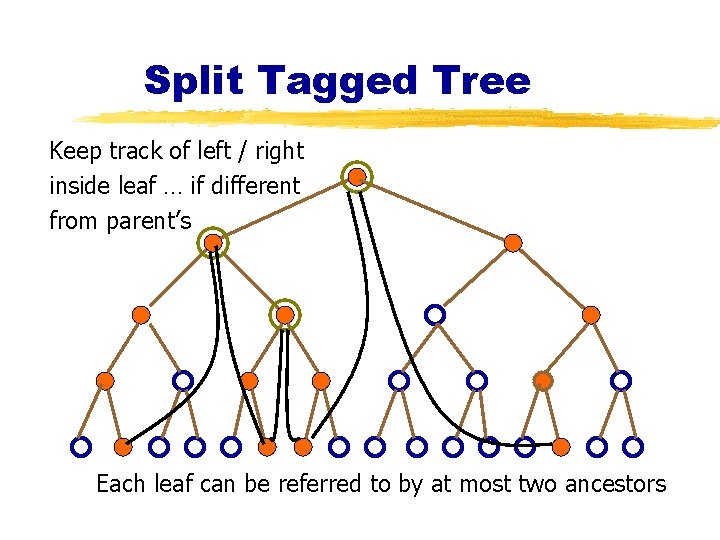
Split Tagged Tree Keep track of left / right inside leaf … if different from parent’s Each leaf can be referred to by at most two ancestors
So what do we have? • Constant time “extended priority queue” … two memory accesses for search, three for update on our model • How much space do we need? • 2 m + O(lg m) bits of ordinary RAM • m bits of RAMBO memory in a particular configuration we call Yggdrasil • and it has been implemented in hardware
- Slides: 13