
A World Built on Standards A Presentation for

A World Built on Standards A Presentation for Higher Education
A World Built on Standards These slides are produced as a companion to “A World Built on Standards – A Textbook for Higher Education” Written in collaboration between: With support from: All tables and figures, refer to those within the textbook. A full bibliography of the references used in this slide deck can be found in the textbook © Danish Standards Foundation 2015. Distribution allowed. Not for commercial use. 2
Contents Chapter 1 – What is a Standard? Chapter 2 – Why do Standards Exist? Chapter 3 – How are Standards Developed and Structured? Chapter 4 – Standards and Regulations Chapter 5 – Standards Supporting Innovation © Danish Standards Foundation 2015. Distribution allowed. Not for commercial use. 3
C H A P T E R O N E What is a Standard? Jørgen Hagelund, Standardization manager ISO/CEN, Danish Standards, Denmark © Danish Standards Foundation 2015. Distribution allowed. Not for commercial use. 4
Learning Objectives • To understand what a standard is. • To be able to differentiate between different types of standards including de jure and de facto standards. • To get knowledge of the relation between standards and patents. © Danish Standards Foundation 2015. Distribution allowed. Not for commercial use. 5

Standards in Everyday Life Figure 1: Examples of standards in everyday life © Danish Standards Foundation 2015. Distribution allowed. Not for commercial use. 6
Definition of a Standard There are many definitions of a standard. The one used in the formal standardization system is: • • A document, established by consensus and approved by a recognized body, that provides, for common and repeated use, rules, guidelines or characteristics for activities or their results, aimed at the achievement of the optimum degree of order in a given context. (EN 45020 - Standardization and related activities – General vocabulary). Standards should be based on the consolidated results of science, technology and experience, and aimed at the promotion of optimum community benefits. © Danish Standards Foundation 2015. Distribution allowed. Not for commercial use. 7
The Characteristics of a Standard • • • Voluntary and market driven – every interested party can participate in the making of a standard and provide comments when a standard is submitted to public consultation. The decision to develop new standards is driven by market needs/requests. Consensus based – all standards are subject to dialogue in order to establish general agreement characterized by the absence of sustained opposition to substantial issues by any important part of the concerned interests and by a process that involves seeking to take into account the views of all parties concerned and to reconcile any conflicting arguments (definition of consensus from EN 45020). Afterwards, to get it approved, it goes through a formal vote procedure. Approved by a recognized body – a recognized standards body such as CEN, CENELEC, ISO, IEC or a national standards body has approved the document and that the document has gone through the necessary procedures, public consultations, etc. © Danish Standards Foundation 2015. Distribution allowed. Not for commercial use. 8
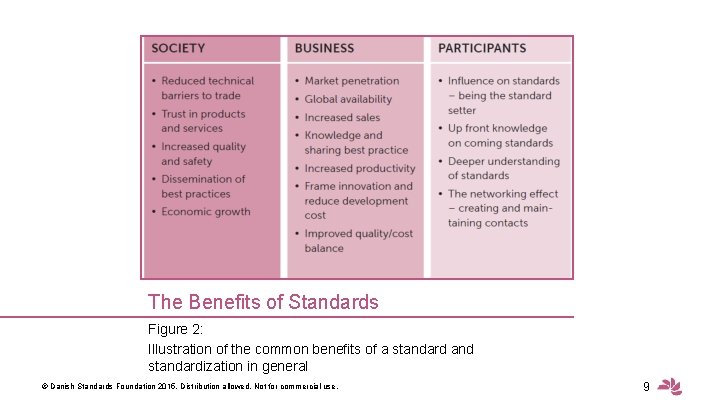
The Benefits of Standards Figure 2: Illustration of the common benefits of a standard and standardization in general © Danish Standards Foundation 2015. Distribution allowed. Not for commercial use. 9
Types of standards One way of categorising standards: • Dimension systems – e. g. paper formats, threads, classification systems. • Performance – e. g. breaking strength, energy performance, safety, ergonomics, noise. • Methods/testing – e. g. test schemes, chemical analysis, documentation of performance. • Management systems – e. g. quality, risk, energy or environmental management. • Symbols – e. g. pictograms, symbols for machines. • Terminology – e. g. definitions of main terms within different fields. • Products – e. g. toys, electrical equipment, construction products. • “Basic” standards – e. g. SI units (International System for units). © Danish Standards Foundation 2015. Distribution allowed. Not for commercial use. 10

De jure and de facto standards De jure standards Formal standards – standards developed by official standardization organizations. These organizations can be international (like ISO and IEC), regional (like the European CEN, CENELEC, ETSI) or national (like AFNOR, DIN, DS, etc. ) and have been given formal recognition to produce formal standards. De facto standards The remaining group of standards, i. e. standards that are not developed by one of the above-mentioned recognized bodies. These are standards that have gained currency over time e. g. music notes. Other de facto standards could be a result of one or more companies products where the products become the ‘standard’ on the market. © Danish Standards Foundation 2015. Distribution allowed. Not for commercial use. 11

Standards and patents A standard is normally intended to be used by all interested parties, whereas a patent is only used by the patent holder and by third parties who have been granted a license. © Danish Standards Foundation 2015. Distribution allowed. Not for commercial use. The European standardization organizations CEN and CENELEC have an intellectual property rights policy (CEN-CENELEC Guide 8 “Standardization and intellectual property rights (IPR)”). The purpose of these common guidelines is to provide practical and easy-to-understand guidance to the participants in their technical bodies in case patent or other intellectual property rights matters arise. 12
C H A P T E R O N E What is a Standard? Multiple Choice Questions © Danish Standards Foundation 2015. Distribution allowed. Not for commercial use. 13
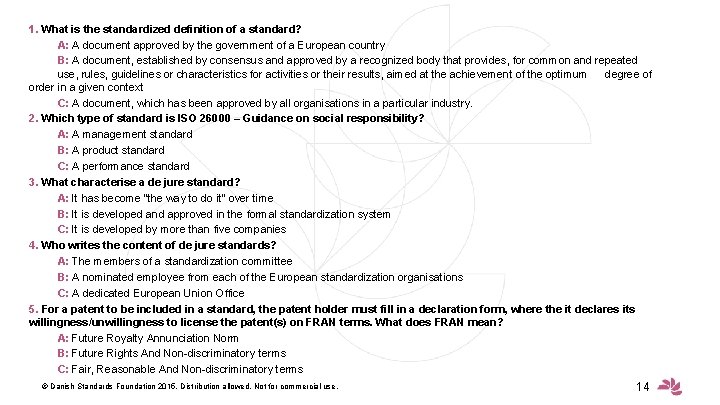
1. What is the standardized definition of a standard? A: A document approved by the government of a European country B: A document, established by consensus and approved by a recognized body that provides, for common and repeated use, rules, guidelines or characteristics for activities or their results, aimed at the achievement of the optimum degree of order in a given context C: A document, which has been approved by all organisations in a particular industry. 2. Which type of standard is ISO 26000 – Guidance on social responsibility? A: A management standard B: A product standard C: A performance standard 3. What characterise a de jure standard? A: It has become “the way to do it” over time B: It is developed and approved in the formal standardization system C: It is developed by more than five companies 4. Who writes the content of de jure standards? A: The members of a standardization committee B: A nominated employee from each of the European standardization organisations C: A dedicated European Union Office 5. For a patent to be included in a standard, the patent holder must fill in a declaration form, where the it declares its willingness/unwillingness to license the patent(s) on FRAN terms. What does FRAN mean? A: Future Royalty Annunciation Norm B: Future Rights And Non-discriminatory terms C: Fair, Reasonable And Non-discriminatory terms © Danish Standards Foundation 2015. Distribution allowed. Not for commercial use. 14
C H A P T E R T W O Why do Standards Exist? Jesper Jerlang Director of Standards, Danish Standardisation, Denmark © Danish Standards Foundation 2015. Distribution allowed. Not for commercial use. 15
Learning Objectives • To understand why standards exist and why they are important. • To understand where standards have an impact. © Danish Standards Foundation 2015. Distribution allowed. Not for commercial use. 16
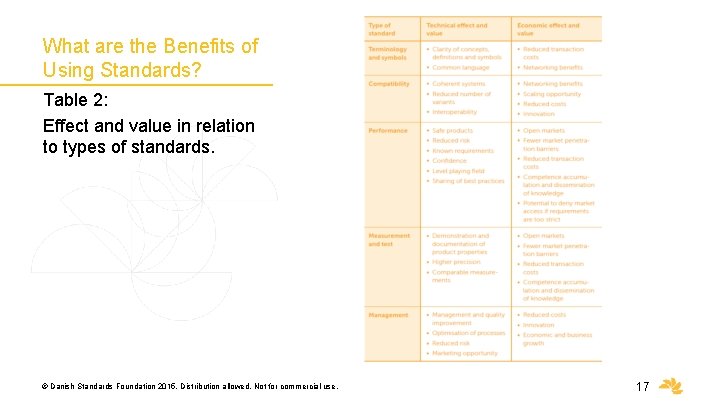
What are the Benefits of Using Standards? Table 2: Effect and value in relation to types of standards. © Danish Standards Foundation 2015. Distribution allowed. Not for commercial use. 17
The Value of Standards to a Company Standards offers a number of advantages for companies. A Danish survey (DAMVAD 2013) revealed that a majority of organizations primarily use standards because they are required to do so, either by the market or their customers or by legislation. However, the same group of organizations also replied that the use of standards offered a number of advantages: • acquiring knowledge and best practices, • easier communication with customers as well as suppliers, • higher quality, • increased efficiency, • fewer defects and complaints. © Danish Standards Foundation 2015. Distribution allowed. Not for commercial use. 18
The Value of Standards to Society • Standards create value for society in many ways. For example by stimulating productivity and innovation, standards becomes an essential driver for economic growth; a driver similar to patents, in fact. • A number of studies carried out in Denmark, Germany, United Kingdom, France, and Canada have investigated the connection between standards and economic growth and they show that standards account for 1% to 4% of the growth of the GNP (Swann 2010). © Danish Standards Foundation 2015. Distribution allowed. Not for commercial use. 19
The Value of Standards to Consumers • Standards have a direct value to the consumer, although few consumers are aware of the extent that standards affect their daily lives. • Standards are all over – furniture, textiles, coffee machine, bicycle helmets, emission of hazardous substances from, for example, child care products etc. Standards ensure safety, security, and affordable, compatible products in the everyday lives of consumers. © Danish Standards Foundation 2015. Distribution allowed. Not for commercial use. 20
Conformity Assessment Conformity assessment involves a set of processes that show that a product, service or a system meets the requirements of a standard. Undergoing conformity assessment has a number of benefits: • • It provides consumers and other stakeholders with added confidence. It gives a company a competitive edge by documenting that it meets the requirements of a standard. It ensures that health, safety and environmental conditions are met. It reduces technical barriers to trade and opens markets by making it easier to export and import products. © Danish Standards Foundation 2015. Distribution allowed. Not for commercial use. 21
Declarations of Conformity • • • It is often possible for a company to declare that they meet certain requirements by self declaration of conformity. However, in some areas it is required that a third party (certification organization) test and verify that a product, service etc. follow the criteria in a standard for it to be allowed to use a mark of conformity. In both cases the company is liable for the claim that they meet certain requirements and are therefore subject to liability legislation. Third party certification organizations must be given formal recognition by an authoritative party (accreditation body) that they are competent to carry out certain certification tasks in order to be allowed to certify. © Danish Standards Foundation 2015. Distribution allowed. Not for commercial use. 22
C H A P T E R T W O Why do Standards Exist? Multiple Choice Questions © Danish Standards Foundation 2015. Distribution allowed. Not for commercial use. 23
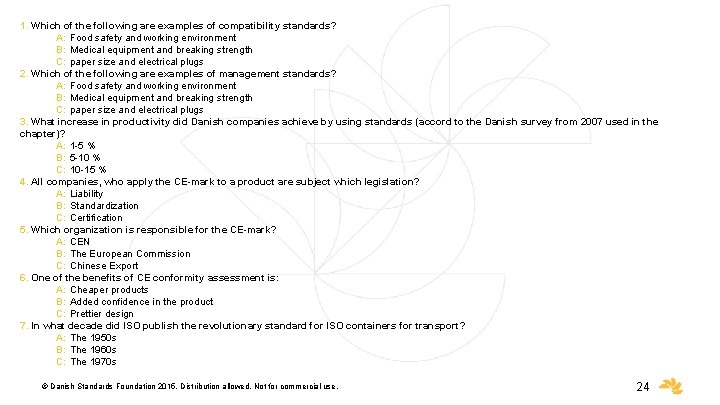
1. Which of the following are examples of compatibility standards? A: Food safety and working environment B: Medical equipment and breaking strength C: paper size and electrical plugs 2. Which of the following are examples of management standards? A: Food safety and working environment B: Medical equipment and breaking strength C: paper size and electrical plugs 3. What increase in productivity did Danish companies achieve by using standards (accord to the Danish survey from 2007 used in the chapter)? A: 1 -5 % B: 5 -10 % C: 10 -15 % 4. All companies, who apply the CE-mark to a product are subject which legislation? A: Liability B: Standardization C: Certification 5. Which organization is responsible for the CE-mark? A: CEN B: The European Commission C: Chinese Export 6. One of the benefits of CE conformity assessment is: A: Cheaper products B: Added confidence in the product C: Prettier design 7. In what decade did ISO publish the revolutionary standard for ISO containers for transport? A: The 1950 s B: The 1960 s C: The 1970 s © Danish Standards Foundation 2015. Distribution allowed. Not for commercial use. 24
C H A P T E R T H R E E How are Standards Developed and Structured? Antti Karppinen, Technical Director, Finnish Standards Association (SFS), Finland © Danish Standards Foundation 2015. Distribution allowed. Not for commercial use. 25
Learning objectives • To understand the basics of the standardization process. • To get knowledge of the difference between national, regional and international standards. • To understand what types of standards documents there and how standards are structured. © Danish Standards Foundation 2015. Distribution allowed. Not for commercial use. 26
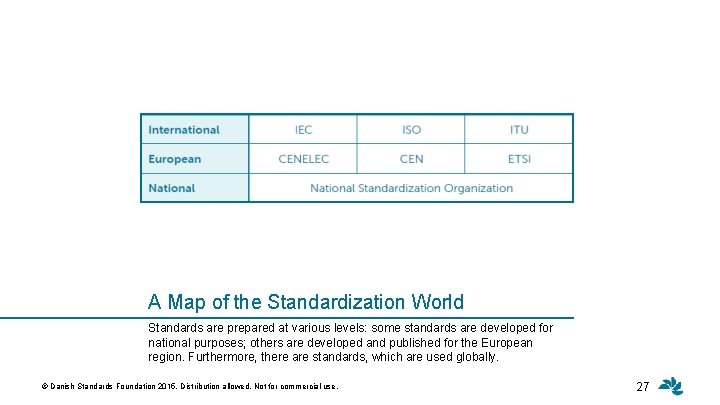
A Map of the Standardization World Standards are prepared at various levels: some standards are developed for national purposes; others are developed and published for the European region. Furthermore, there are standards, which are used globally. © Danish Standards Foundation 2015. Distribution allowed. Not for commercial use. 27
National, Regional and International Standardization • • • Member countries of the European Standardization Body CEN are obliged to implement CEN standards and withdraw contrasting national standards. There is no requirenment to implement ISO standards unless they are adopted as European standards. There is an agreement of technical cooperation between the European and International Standardization Organizations for: – the optimal use of resources and expertise available for standardization work; – information exchange between international and European Standardization Organizations to increase the transparency of ongoing work at international and European levels. © Danish Standards Foundation 2015. Distribution allowed. Not for commercial use. 28
Who Makes Standards? • Standardization is open to anyone. • Standards are developed in technical committees and their sub-committees as well as in working groups. • The easiest way to find out and to get involved in standardization is to contact your National Standardization Organization. © Danish Standards Foundation 2015. Distribution allowed. Not for commercial use. 29
How are Standards Made? • Drafting a standard goes through a certain process from a draft standard to the phase of a Public Enquiry, balloting, publishing and finally, the implementation of a standard. • Revising a standard is also part of the lifecycle of a standard. • A Technical Committee makes sure that a standard is up-to-date. © Danish Standards Foundation 2015. Distribution allowed. Not for commercial use. 30
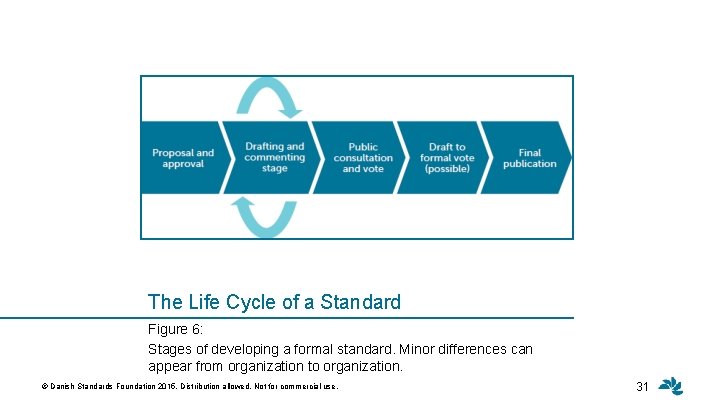
The Life Cycle of a Standard Figure 6: Stages of developing a formal standard. Minor differences can appear from organization to organization. © Danish Standards Foundation 2015. Distribution allowed. Not for commercial use. 31
How to Get Involved There are different way to get involved and different levels of involvement in the standards development process: • Becoming a member of a national mirror committee, • Becoming a delegate in a technical committee, • Membership of CEN working groups, • Submitting comments at the public consultation stage. Following standardization in your field of interest helps you to anticipate any forthcoming changes. © Danish Standards Foundation 2015. Distribution allowed. Not for commercial use. 32
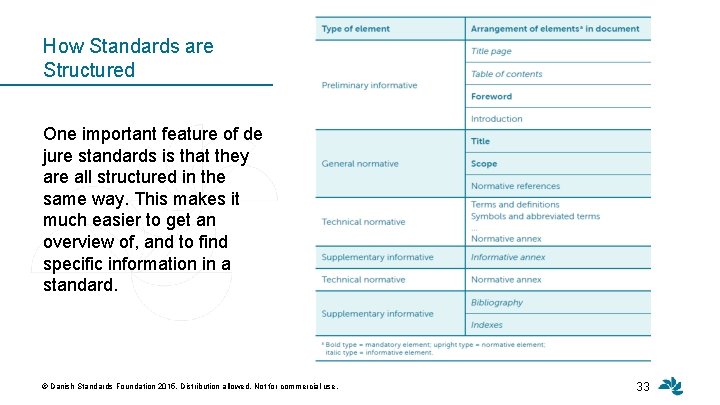
How Standards are Structured One important feature of de jure standards is that they are all structured in the same way. This makes it much easier to get an overview of, and to find specific information in a standard. © Danish Standards Foundation 2015. Distribution allowed. Not for commercial use. 33
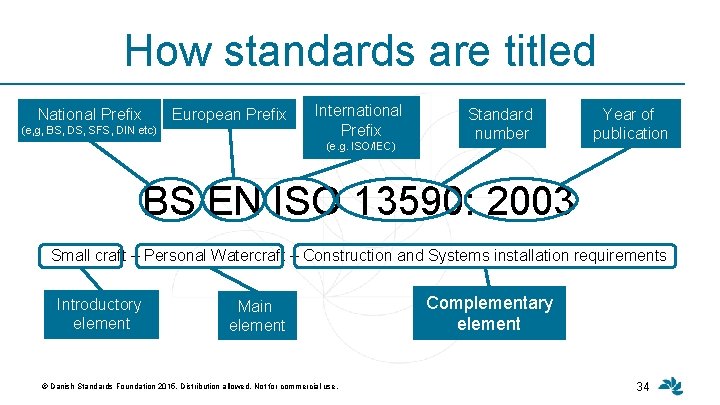
How standards are titled National Prefix European Prefix (e, g, BS, DS, SFS, DIN etc) International Prefix (e. g. ISO/IEC) Standard number Year of publication BS EN ISO 13590: 2003 Small craft – Personal Watercraft – Construction and Systems installation requirements Introductory element Main element © Danish Standards Foundation 2015. Distribution allowed. Not for commercial use. Complementary element 34
C H A P T E R T H R E E How are Standards Developed and Structured? Multiple Choice Questions © Danish Standards Foundation 2015. Distribution allowed. Not for commercial use. 35
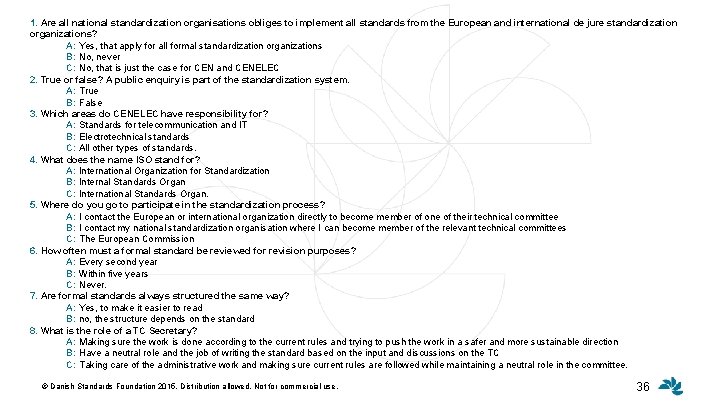
1. Are all national standardization organisations obliges to implement all standards from the European and international de jure standardization organizations? A: Yes, that apply for all formal standardization organizations B: No, never C: No, that is just the case for CEN and CENELEC 2. True or false? A public enquiry is part of the standardization system. A: True B: False 3. Which areas do CENELEC have responsibility for? A: Standards for telecommunication and IT B: Electrotechnical standards C: All other types of standards. 4. What does the name ISO stand for? A: International Organization for Standardization B: Internal Standards Organ C: International Standards Organ. 5. Where do you go to participate in the standardization process? A: I contact the European or international organization directly to become member of one of their technical committee B: I contact my national standardization organisation where I can become member of the relevant technical committees C: The European Commission 6. How often must a formal standard be reviewed for revision purposes? A: Every second year B: Within five years C: Never. 7. Are formal standards always structured the same way? A: Yes, to make it easier to read B: no, the structure depends on the standard 8. What is the role of a TC Secretary? A: Making sure the work is done according to the current rules and trying to push the work in a safer and more sustainable direction B: Have a neutral role and the job of writing the standard based on the input and discussions on the TC C: Taking care of the administrative work and making sure current rules are followed while maintaining a neutral role in the committee. © Danish Standards Foundation 2015. Distribution allowed. Not for commercial use. 36
C H A P T E R F O U R Standards and Regulations Dina Simunic, Professor at University of Zagreb, Faculty of Engineering and Computing, Croatia © Danish Standards Foundation 2015. Distribution allowed. Not for commercial use. 37
Learning Objectives • To understand the basic relation between standards and regulations. • To gain knowledge of the WTO Agreement on Technical Barriers to Trade. • To understand the New Approach and CE-marking. © Danish Standards Foundation 2015. Distribution allowed. Not for commercial use. 38
Regulations and Standards • Regulations are mandatory instruments set either by national governments, or by the European Parliament/Council, in order to define legal minimum context for the smooth functioning of society. • Standards are voluntary instruments for business facilitation and they are developed by the standardization organizations, which can have a national, regional (European) or international character. © Danish Standards Foundation 2015. Distribution allowed. Not for commercial use. 39
Why are Standards Used in Regulation? One of the strengths of using standards in regulation is that all the relevant market stakeholders are involved in the standards development. This means that standards are much easier to adapt to technological trends and to all the necessary modifications and updates than national regulations or EU directives or regulations. © Danish Standards Foundation 2015. Distribution allowed. Not for commercial use. 40
WTO Agreement on Technical Barriers to Trade • • Promotes free trade and avoidance of any kind of technical barriers, through clearly defining voluntary standards and mandatory regulations that give technical requirements (referred to as technical regulations). According to the WTO TBT Agreement, technical regulations should be based on international standards. © Danish Standards Foundation 2015. Distribution allowed. Not for commercial use. 41
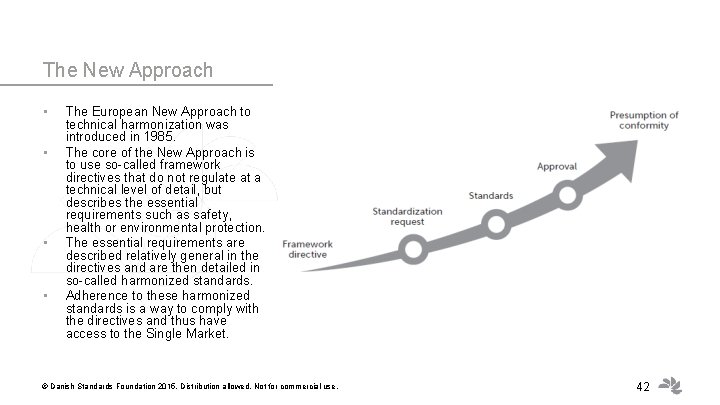
The New Approach • • The European New Approach to technical harmonization was introduced in 1985. The core of the New Approach is to use so-called framework directives that do not regulate at a technical level of detail, but describes the essential requirements such as safety, health or environmental protection. The essential requirements are described relatively general in the directives and are then detailed in so-called harmonized standards. Adherence to these harmonized standards is a way to comply with the directives and thus have access to the Single Market. © Danish Standards Foundation 2015. Distribution allowed. Not for commercial use. 42
Harmonized standards • A harmonized standard is a European standard developed by a recognized European Standardization Organization (CEN, CENELEC, or ETSI) and is created following a request from the European Commission. • Lists of all harmonized standards are published in EU’s Official Journal, and both the New Approach directives and the lists of harmonized standards can be found on the European Commission's website for the New Approach. © Danish Standards Foundation 2015. Distribution allowed. Not for commercial use. 43
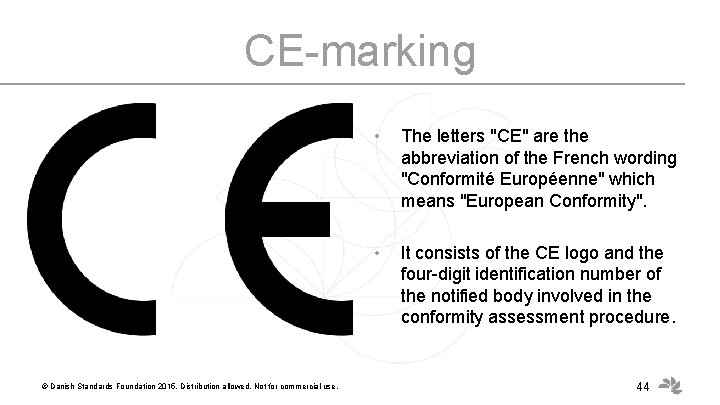
CE-marking © Danish Standards Foundation 2015. Distribution allowed. Not for commercial use. • The letters "CE" are the abbreviation of the French wording "Conformité Européenne" which means "European Conformity". • It consists of the CE logo and the four-digit identification number of the notified body involved in the conformity assessment procedure. 44
Using the CE-mark • The manufacturer affixes the CE mark, after carrying out a conformity assessment, setting up a technical file and signing an EC declaration of conformity. • The CE marking is the declaration that the product is assessed before being placed on the market and meets the essential requirements of the relevant European health, safety and environmental protection legislation, known in practice as “product directives”. • It is “a passport” of a product, because it ensures the free movement of the product within the EFTA & European Union (EU) single market. © Danish Standards Foundation 2015. Distribution allowed. Not for commercial use. 45
C H A P T E R F O U R Standards and Regulations Multiple Choice Questions © Danish Standards Foundation 2015. Distribution allowed. Not for commercial use. 46
1. How is a regulation defined according to ISO/IEC Guide 2? A: A document providing binding legislative rules B: An unwritten law or custom C: A document providing non-legislative rules 2. What are the steps in the New Approach? A: Framework Directive – Harmonized Standards – Approval – Presumption of Conformity B: Mandate – Framework Directive – Harmonized Standards – Approval – Presumption of Conformity C: Framework Directive – Mandate – Harmonized Standards – Approval – Presumption of Conformity 3. What is a harmonized standard? A: A European standard adopted on the basis of a request made by the European Commission for the application of Union harmonisation legislation B: A standard that has been approved by the European Commission to be correct and valid C: A standard that is compatible with another standard 4. Where are lists of all harmonized standards published? A: The Official Paper B: The Official Journal C: L’enregistrement correct 5. What is market control of compliance with the harmonized standards? A: Sampling the products that come on the market and checking them for conformity B: Controlling all products that come on the marked and checking them for conformity C: There is no market control to check compliance with the harmonized standards © Danish Standards Foundation 2015. Distribution allowed. Not for commercial use. 47
C H A P T E R F I V E Standard Supporting Innovation Newell Hampson-Jones, Strategic Engagement Manager, Education BSI, United Kingdom © Danish Standards Foundation 2015. Distribution allowed. Not for commercial use. 48
Learning objectives • To understand the relation between standards and innovation. • To understand how standards can be used in the innovation cycle. © Danish Standards Foundation 2015. Distribution allowed. Not for commercial use. 49
Standards support innovation in a number of ways. E. g. by: • Establishing common vocabularies upon which that market will be based. • Disseminating information and providing an accepted framework within which patents can be drawn up. • Getting market acceptance for an emerging technology. • Increasing quality and providing assurance of health, safety and other aspects crucial to the development of viable markets in new technologies. © Danish Standards Foundation 2015. Distribution allowed. Not for commercial use. 50
Standards support innovative research • Standards have been identified as key enablers for technologies in the European Union Framework Programme; Horizon 2020. • The European Commission encourages researchers who are preparing proposals to Horizon 2020 to address the relevance of standards and standardization in their projects. © Danish Standards Foundation 2015. Distribution allowed. Not for commercial use. 51
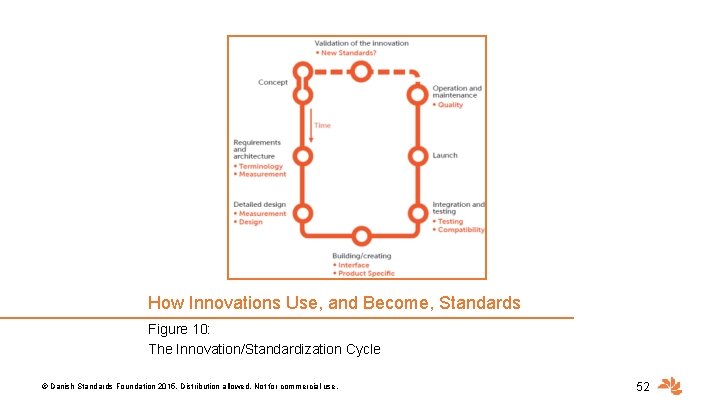
How Innovations Use, and Become, Standards Figure 10: The Innovation/Standardization Cycle © Danish Standards Foundation 2015. Distribution allowed. Not for commercial use. 52
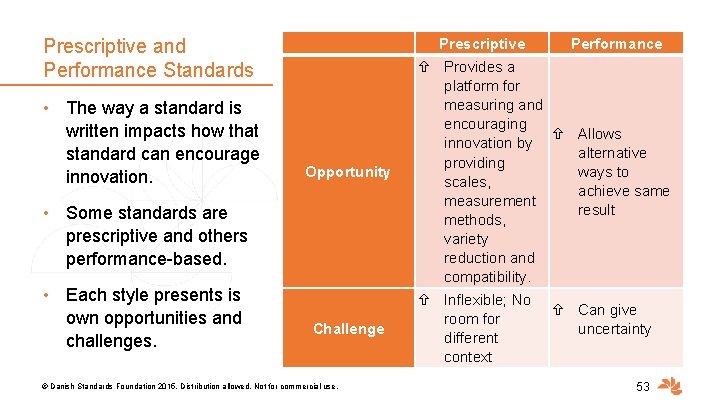
Prescriptive and Performance Standards • The way a standard is written impacts how that standard can encourage innovation. Prescriptive Opportunity • Some standards are prescriptive and others performance-based. • Each style presents is own opportunities and challenges. Challenge © Danish Standards Foundation 2015. Distribution allowed. Not for commercial use. Performance Provides a platform for measuring and encouraging Allows innovation by alternative providing ways to scales, achieve same measurement result methods, variety reduction and compatibility. Inflexible; No Can give room for uncertainty different context 53
C H A P T E R F I V E Standards Supporting Innovation Multiple Choice Questions © Danish Standards Foundation 2015. Distribution allowed. Not for commercial use. 54
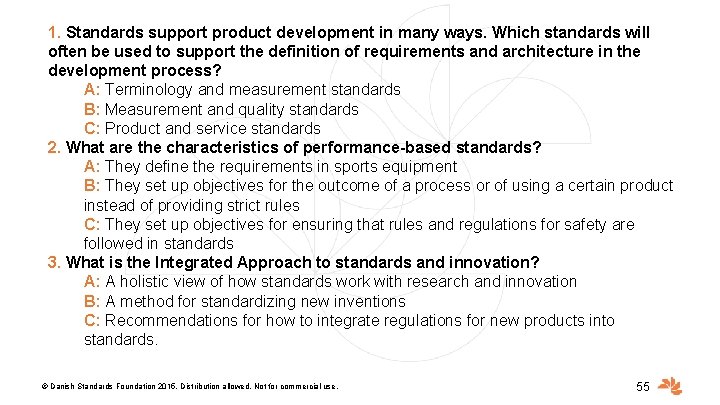
1. Standards support product development in many ways. Which standards will often be used to support the definition of requirements and architecture in the development process? A: Terminology and measurement standards B: Measurement and quality standards C: Product and service standards 2. What are the characteristics of performance-based standards? A: They define the requirements in sports equipment B: They set up objectives for the outcome of a process or of using a certain product instead of providing strict rules C: They set up objectives for ensuring that rules and regulations for safety are followed in standards 3. What is the Integrated Approach to standards and innovation? A: A holistic view of how standards work with research and innovation B: A method for standardizing new inventions C: Recommendations for how to integrate regulations for new products into standards. © Danish Standards Foundation 2015. Distribution allowed. Not for commercial use. 55

Thank you For Your Attention
A World Built on Standards These slides are produced as a companion to “A World Built on Standards – A Textbook for Higher Education” Written in collaboration between: With support from: All tables and figures, refer to those within the textbook. A full bibliography of the references used in this slide deck can be found in the textbook © Danish Standards Foundation 2015. Distribution allowed. Not for commercial use. 57
- Slides: 57