
A World Away David J Herren MD Super

- Slides: 39
A World Away David J. Herren, MD Super Bowl of Grand Rounds August 5, 2016
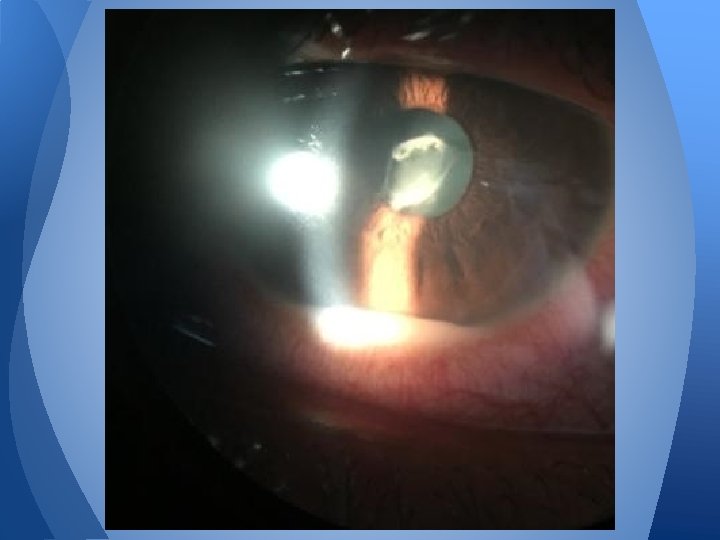
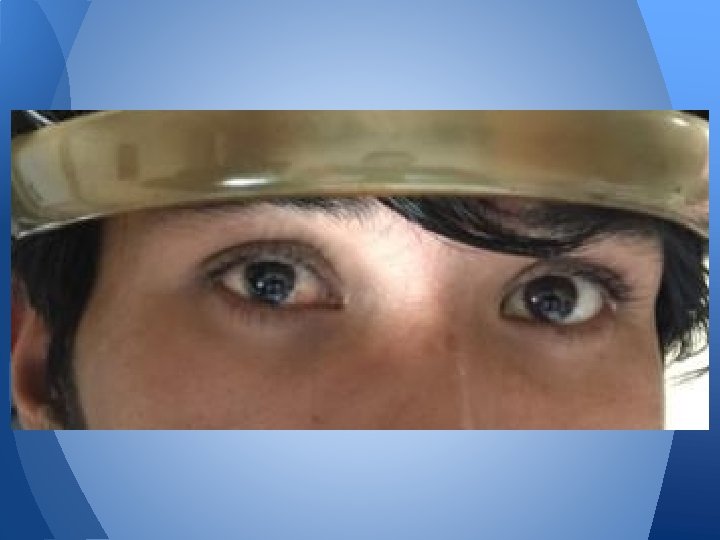
HPI ● 24 yo male ○ Tilganga Institute of Ophthalmology ■ Kathmandu, Nepal ○ 24 hour history of right eye pain, redness, and decreased vision. ■ Present upon awakening ■ “Moderate” severity
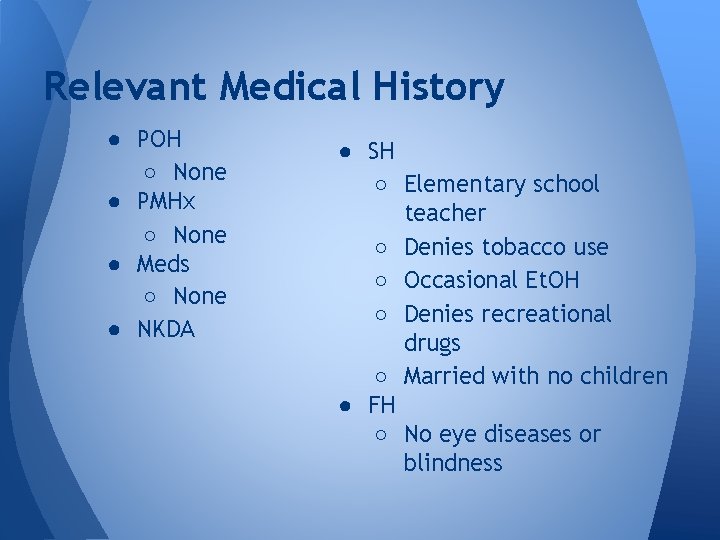
Relevant Medical History ● POH ○ None ● PMHx ○ None ● Meds ○ None ● NKDA ● SH ○ Elementary school teacher ○ Denies tobacco use ○ Occasional Et. OH ○ Denies recreational drugs ○ Married with no children ● FH ○ No eye diseases or blindness
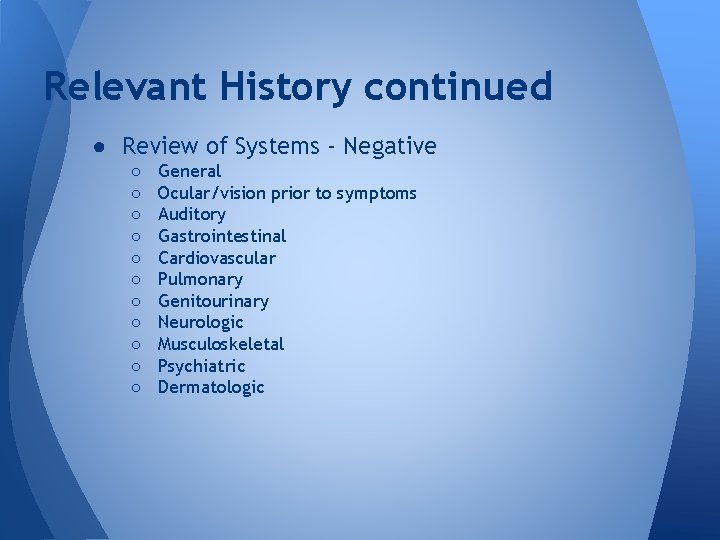
Relevant History continued ● Review of Systems - Negative ○ ○ ○ General Ocular/vision prior to symptoms Auditory Gastrointestinal Cardiovascular Pulmonary Genitourinary Neurologic Musculoskeletal Psychiatric Dermatologic
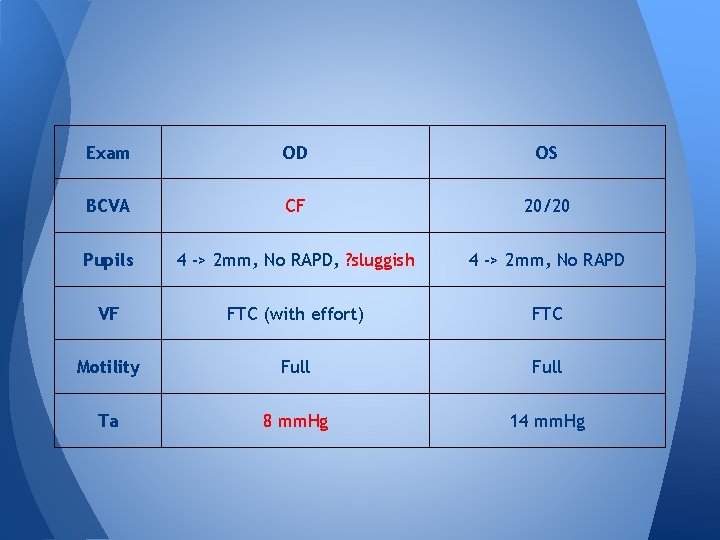
Exam OD OS BCVA CF 20/20 Pupils 4 -> 2 mm, No RAPD, ? sluggish 4 -> 2 mm, No RAPD VF FTC (with effort) FTC Motility Full Ta 8 mm. Hg 14 mm. Hg
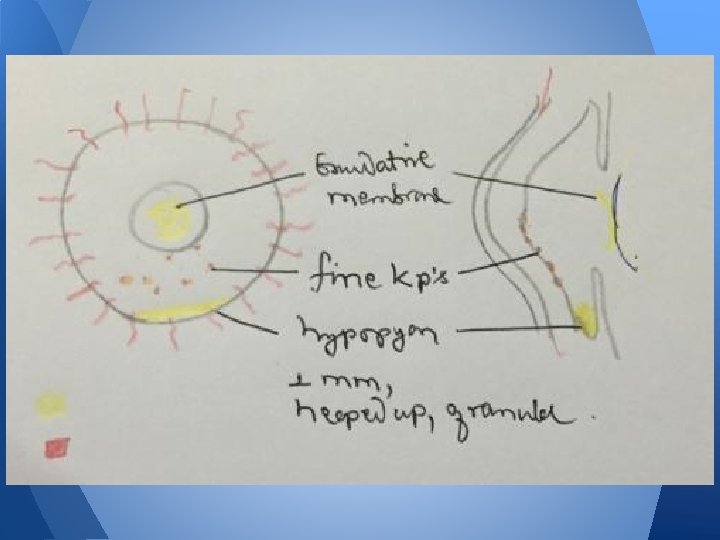
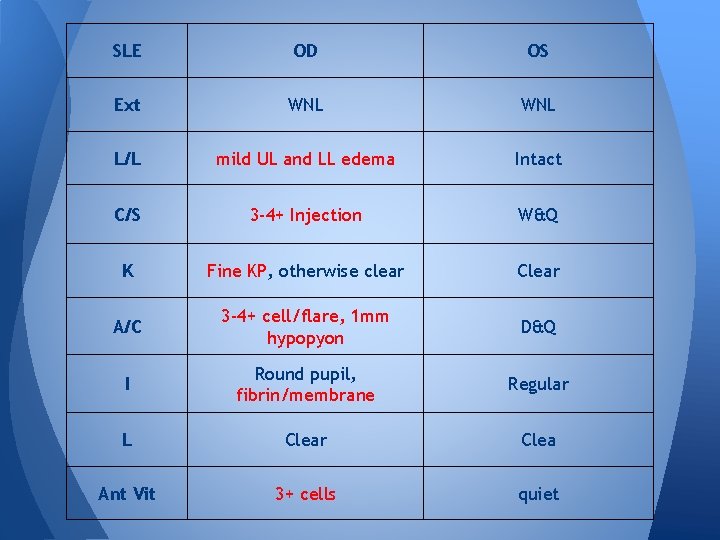
SLE OD OS Ext WNL L/L mild UL and LL edema Intact C/S 3 -4+ Injection W&Q K Fine KP, otherwise clear Clear A/C 3 -4+ cell/flare, 1 mm hypopyon D&Q I Round pupil, fibrin/membrane Regular L Clear Clea Ant Vit 3+ cells quiet
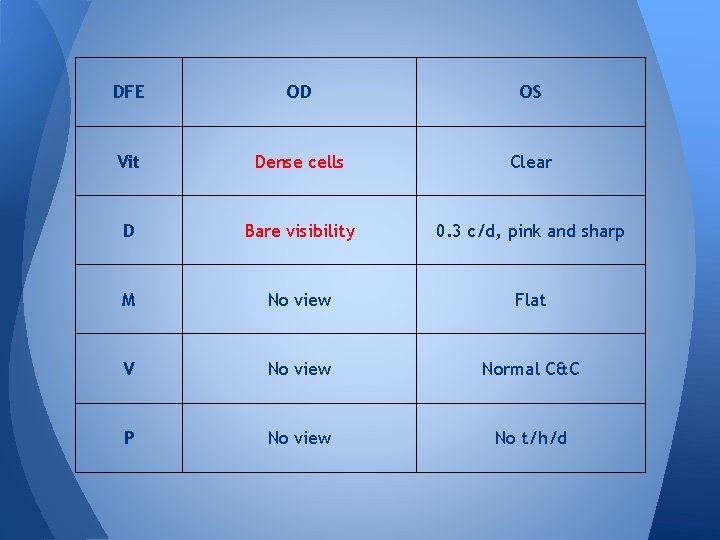
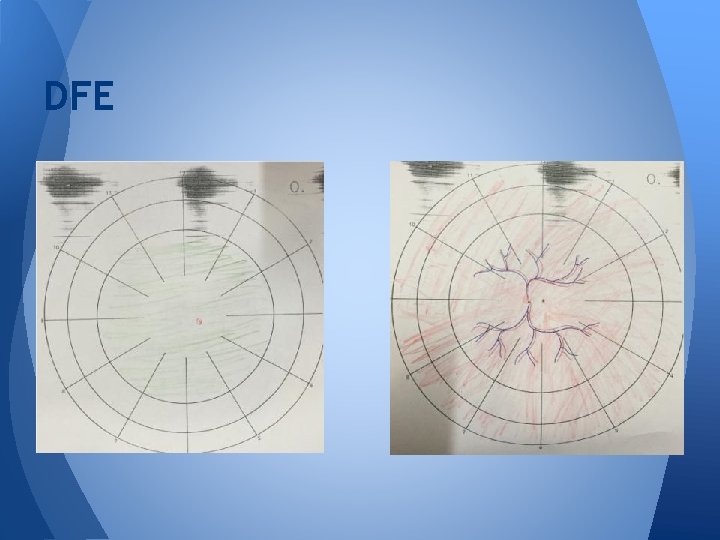
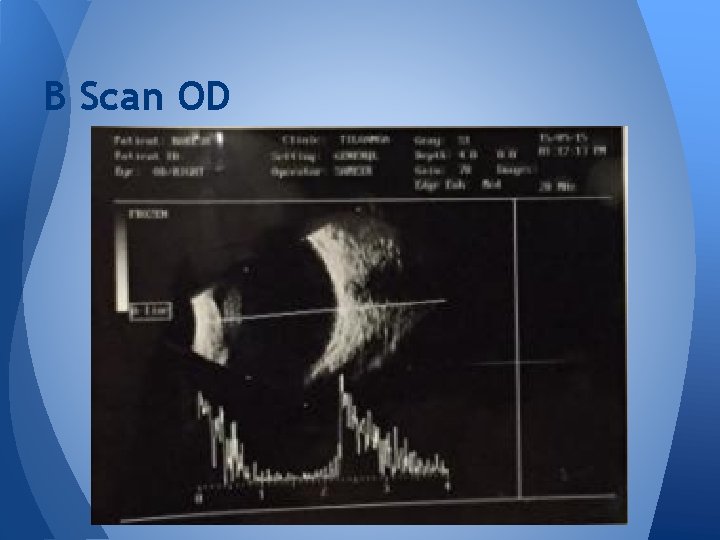
DFE OD OS Vit Dense cells Clear D Bare visibility 0. 3 c/d, pink and sharp M No view Flat V No view Normal C&C P No view No t/h/d
DFE
B Scan OD
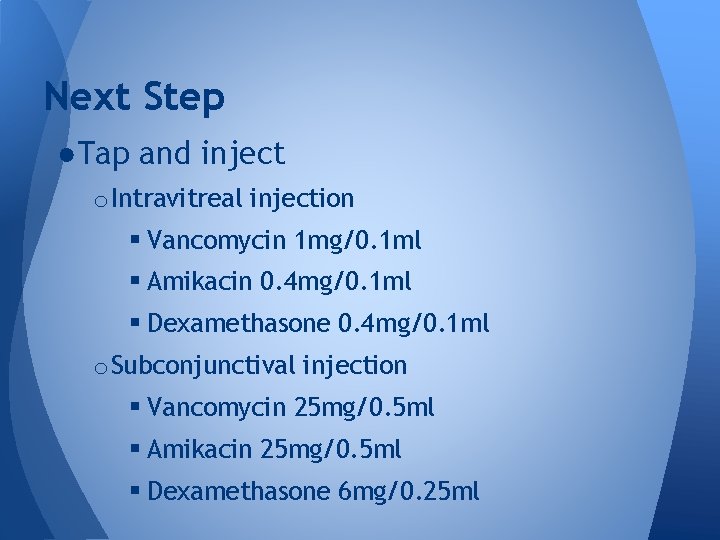
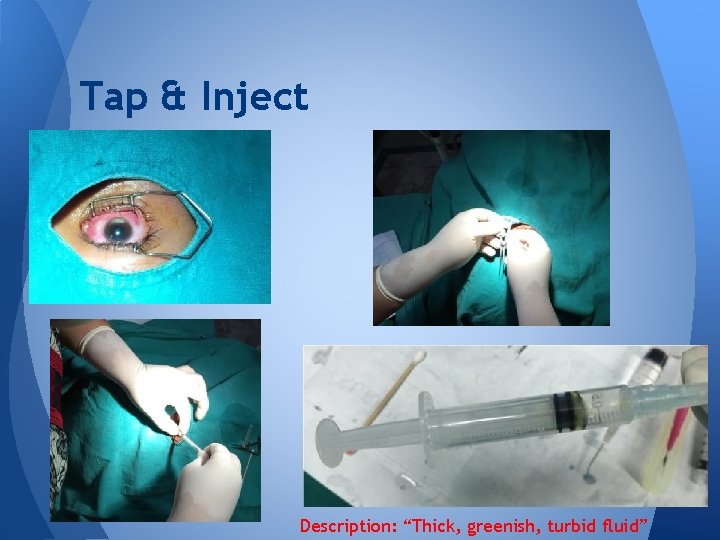
Next Step ●Tap and inject o Intravitreal injection § Vancomycin 1 mg/0. 1 ml § Amikacin 0. 4 mg/0. 1 ml § Dexamethasone 0. 4 mg/0. 1 ml o Subconjunctival injection § Vancomycin 25 mg/0. 5 ml § Amikacin 25 mg/0. 5 ml § Dexamethasone 6 mg/0. 25 ml
Tap & Inject Description: “Thick, greenish, turbid fluid”
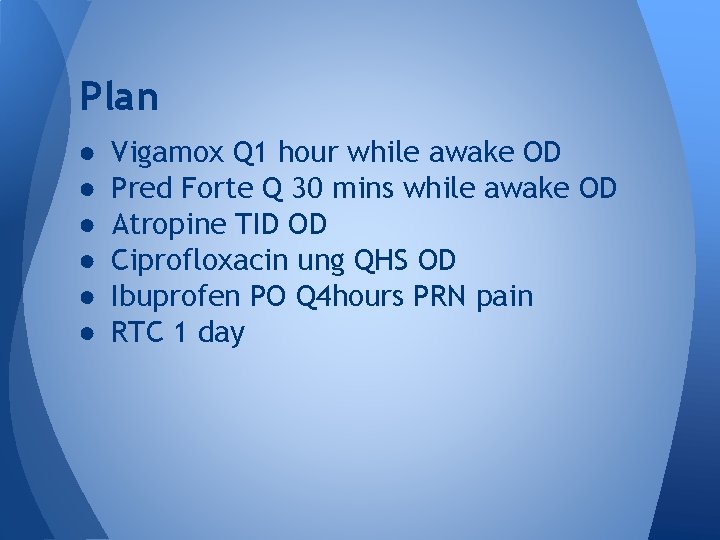
Plan ● ● ● Vigamox Q 1 hour while awake OD Pred Forte Q 30 mins while awake OD Atropine TID OD Ciprofloxacin ung QHS OD Ibuprofen PO Q 4 hours PRN pain RTC 1 day
Day 2 ● A little less pain ● Able to see more light OD
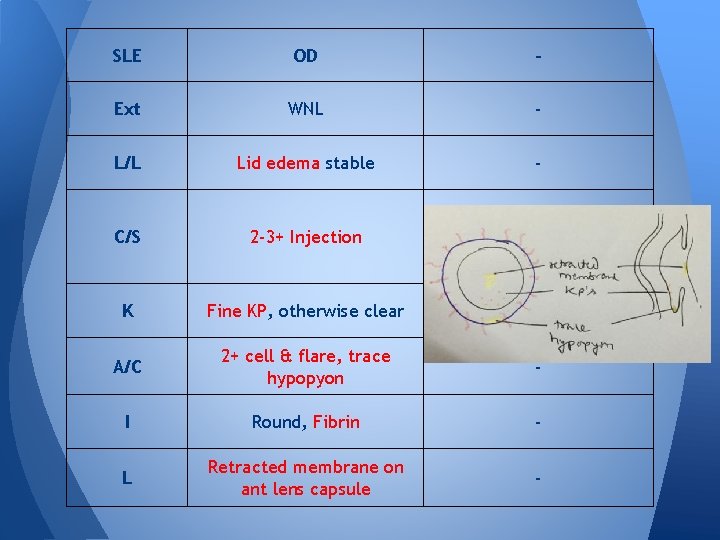
SLE OD - Ext WNL - L/L Lid edema stable - C/S 2 -3+ Injection - K Fine KP, otherwise clear - A/C 2+ cell & flare, trace hypopyon - I Round, Fibrin - L Retracted membrane on ant lens capsule -
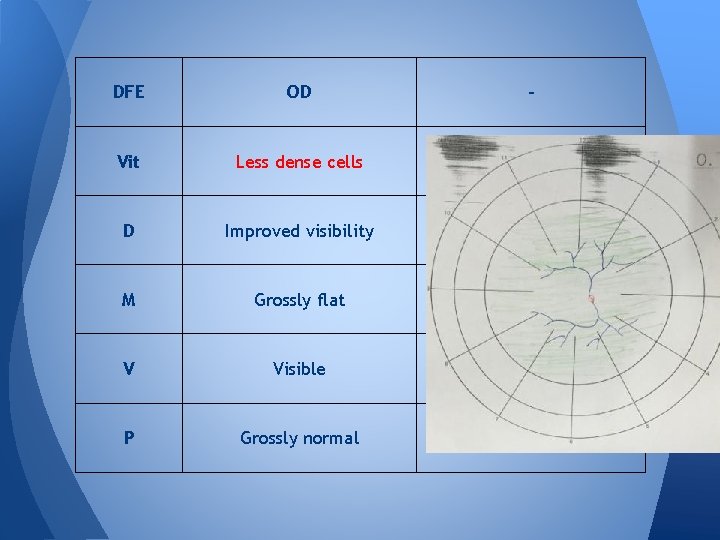
DFE OD - Vit Less dense cells - D Improved visibility - M Grossly flat - V Visible - P Grossly normal -
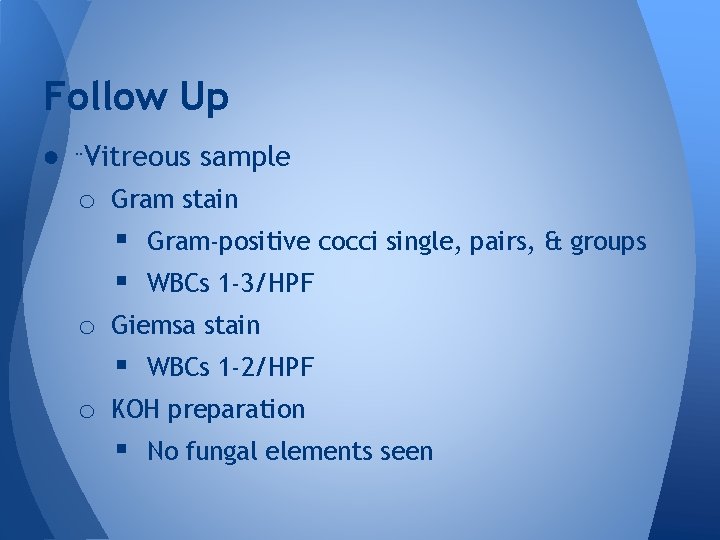
Follow Up ● ¨Vitreous sample o Gram stain § Gram-positive cocci single, pairs, & groups § WBCs 1 -3/HPF o Giemsa stain § WBCs 1 -2/HPF o KOH preparation § No fungal elements seen
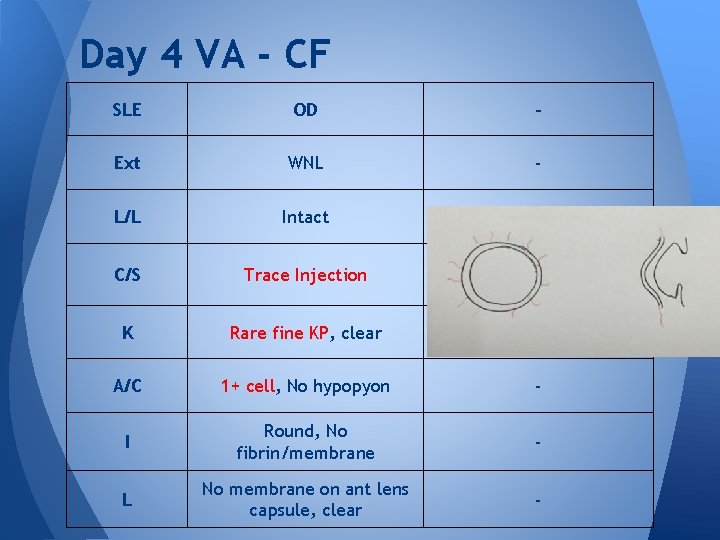
Day 4 VA - CF SLE OD - Ext WNL - L/L Intact - C/S Trace Injection - K Rare fine KP, clear - A/C 1+ cell, No hypopyon - I Round, No fibrin/membrane - L No membrane on ant lens capsule, clear -
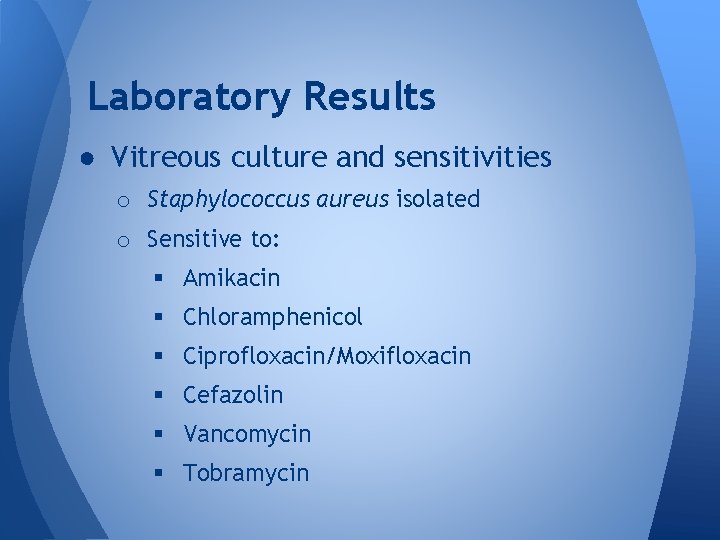
Laboratory Results ● Vitreous culture and sensitivities o Staphylococcus aureus isolated o Sensitive to: § Amikacin § Chloramphenicol § Ciprofloxacin/Moxifloxacin § Cefazolin § Vancomycin § Tobramycin
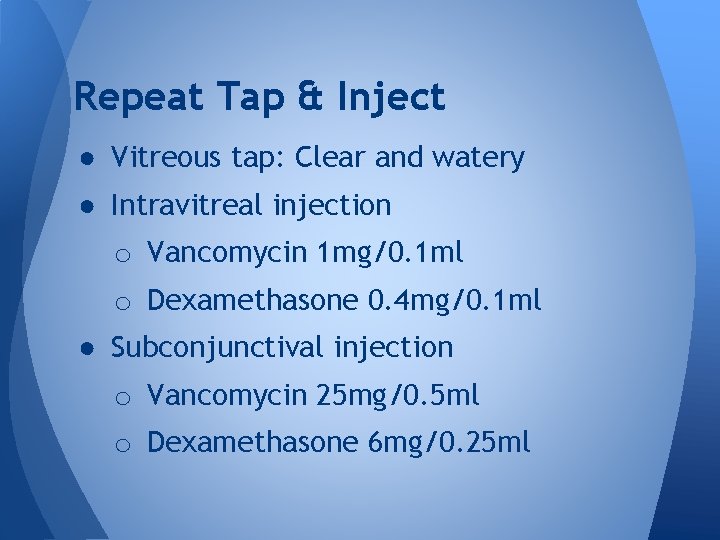
Repeat Tap & Inject ● Vitreous tap: Clear and watery ● Intravitreal injection o Vancomycin 1 mg/0. 1 ml o Dexamethasone 0. 4 mg/0. 1 ml ● Subconjunctival injection o Vancomycin 25 mg/0. 5 ml o Dexamethasone 6 mg/0. 25 ml
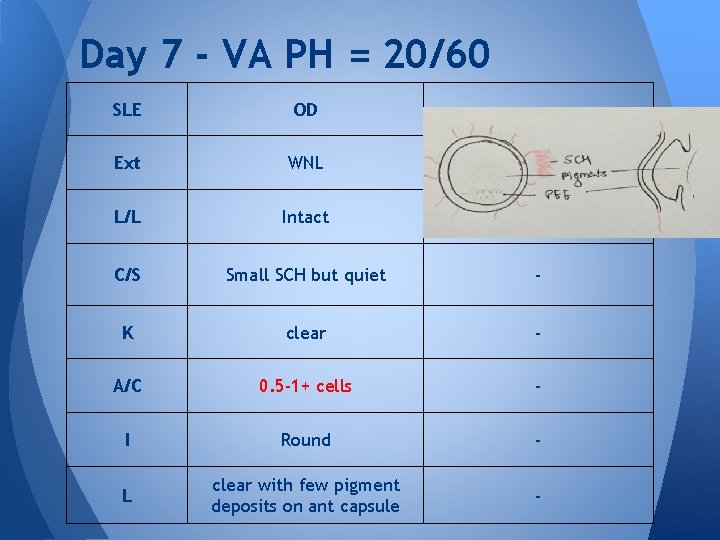
Day 7 - VA PH = 20/60 SLE OD - Ext WNL - L/L Intact - C/S Small SCH but quiet - K clear - A/C 0. 5 -1+ cells - I Round - L clear with few pigment deposits on ant capsule -
Laboratory Results ● Repeat vitreous culture and sensitivities o NGTD ● Continue current regimen
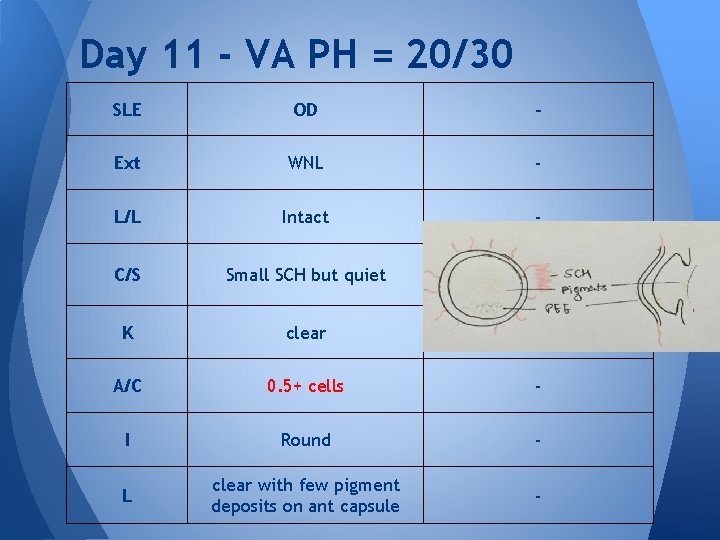
Day 11 - VA PH = 20/30 SLE OD - Ext WNL - L/L Intact - C/S Small SCH but quiet - K clear - A/C 0. 5+ cells - I Round - L clear with few pigment deposits on ant capsule -
Plan ● ● ● ● Vancomycin 50 mg/m. L Q 2 hours WA OD Vigamox Q 2 hours while awake OD Pred Forte Q 2 hours while awake OD Ciprofloxacin ung QHS OD Atropine BID OD PFAT’s TID OD RTC 6 days
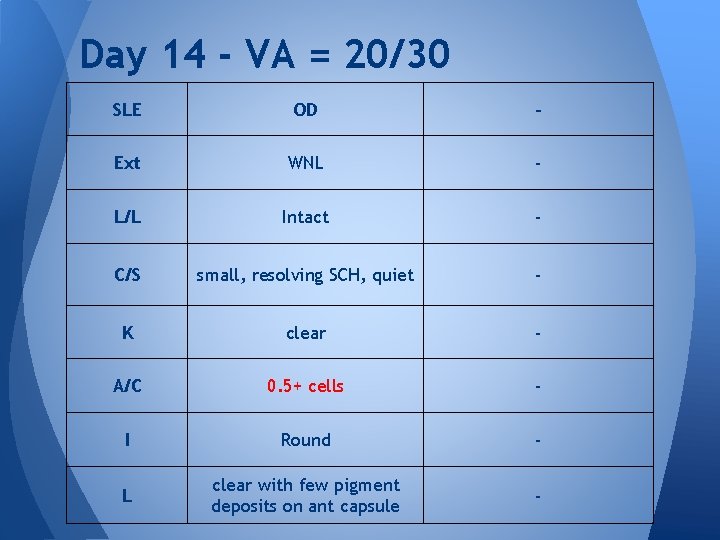
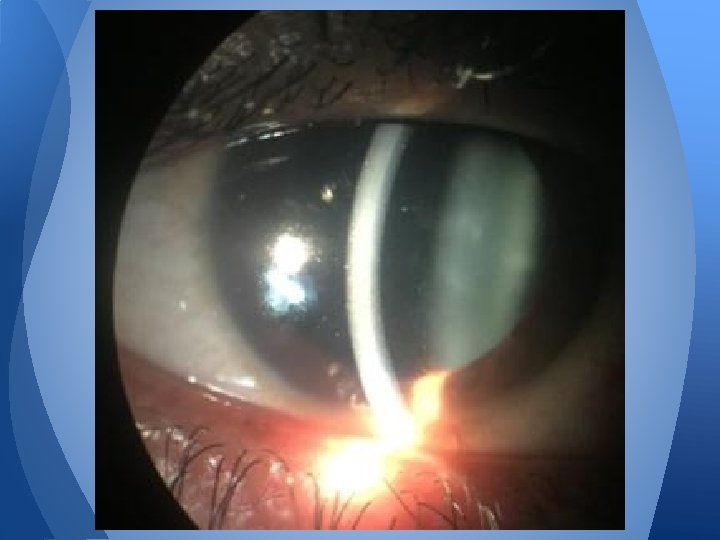
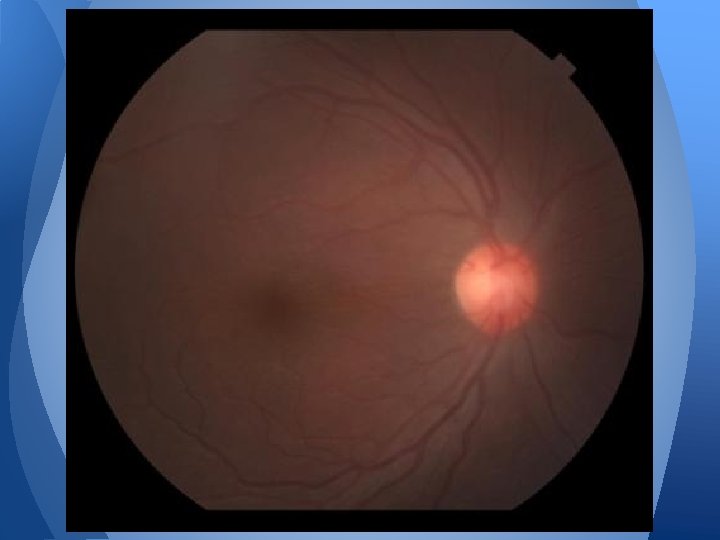
Day 14 - VA = 20/30 SLE OD - Ext WNL - L/L Intact - C/S small, resolving SCH, quiet - K clear - A/C 0. 5+ cells - I Round - L clear with few pigment deposits on ant capsule -
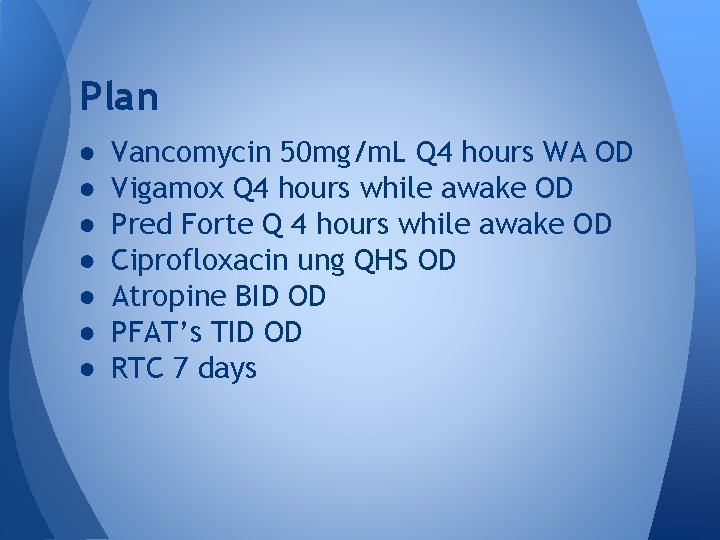
Plan ● ● ● ● Vancomycin 50 mg/m. L Q 4 hours WA OD Vigamox Q 4 hours while awake OD Pred Forte Q 4 hours while awake OD Ciprofloxacin ung QHS OD Atropine BID OD PFAT’s TID OD RTC 7 days
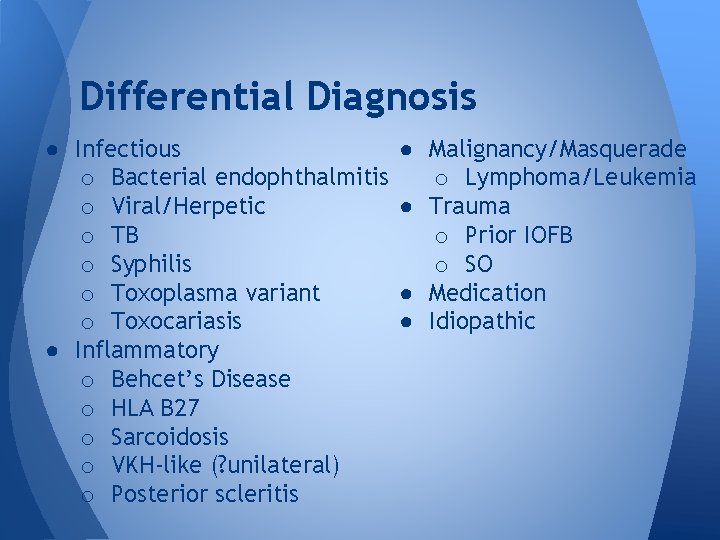
Differential Diagnosis ● Infectious o Bacterial endophthalmitis o Viral/Herpetic o TB o Syphilis o Toxoplasma variant o Toxocariasis ● Inflammatory o Behcet’s Disease o HLA B 27 o Sarcoidosis o VKH-like (? unilateral) o Posterior scleritis ● Malignancy/Masquerade o Lymphoma/Leukemia ● Trauma o Prior IOFB o SO ● Medication ● Idiopathic
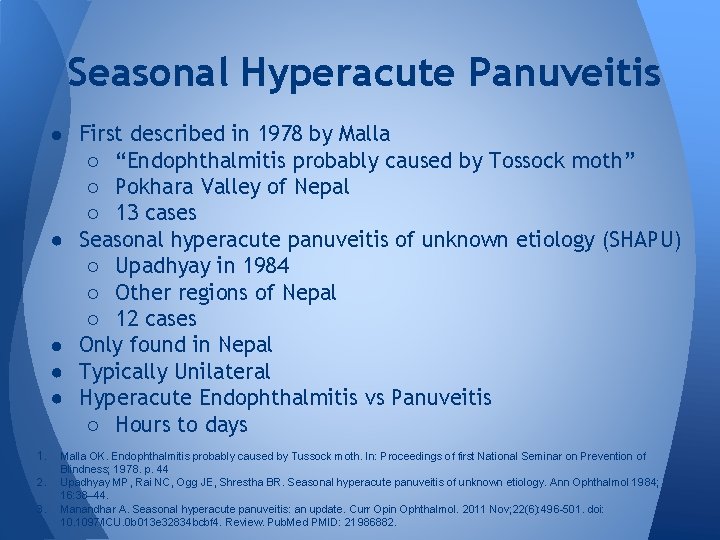
Seasonal Hyperacute Panuveitis ● First described in 1978 by Malla ○ “Endophthalmitis probably caused by Tossock moth” ○ Pokhara Valley of Nepal ○ 13 cases ● Seasonal hyperacute panuveitis of unknown etiology (SHAPU) ○ Upadhyay in 1984 ○ Other regions of Nepal ○ 12 cases ● Only found in Nepal ● Typically Unilateral ● Hyperacute Endophthalmitis vs Panuveitis ○ Hours to days 1. 2. 3. Malla OK. Endophthalmitis probably caused by Tussock moth. In: Proceedings of first National Seminar on Prevention of Blindness; 1978. p. 44 Upadhyay MP, Rai NC, Ogg JE, Shrestha BR. Seasonal hyperacute panuveitis of unknown etiology. Ann Ophthalmol 1984; 16: 38– 44. Manandhar A. Seasonal hyperacute panuveitis: an update. Curr Opin Ophthalmol. 2011 Nov; 22(6): 496 -501. doi: 10. 1097/ICU. 0 b 013 e 32834 bcbf 4. Review. Pub. Med PMID: 21986882.
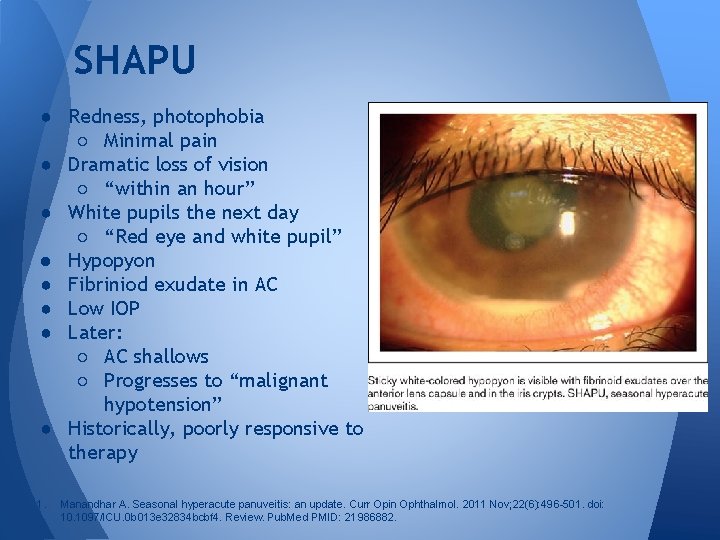
SHAPU ● Redness, photophobia ○ Minimal pain ● Dramatic loss of vision ○ “within an hour” ● White pupils the next day ○ “Red eye and white pupil” ● Hypopyon ● Fibriniod exudate in AC ● Low IOP ● Later: ○ AC shallows ○ Progresses to “malignant hypotension” ● Historically, poorly responsive to therapy 1. Manandhar A. Seasonal hyperacute panuveitis: an update. Curr Opin Ophthalmol. 2011 Nov; 22(6): 496 -501. doi: 10. 1097/ICU. 0 b 013 e 32834 bcbf 4. Review. Pub. Med PMID: 21986882.
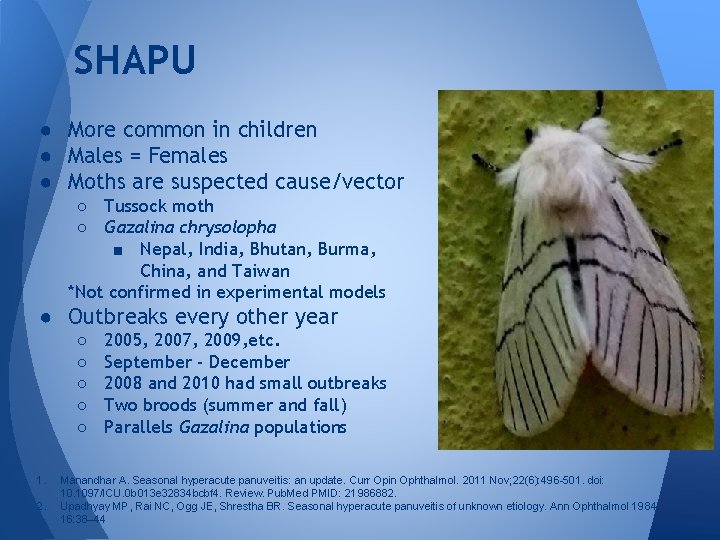
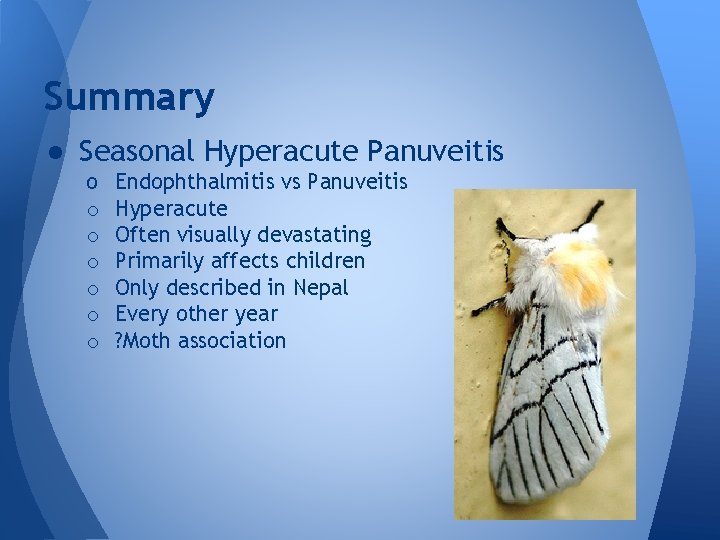
SHAPU ● More common in children ● Males = Females ● Moths are suspected cause/vector ○ Tussock moth ○ Gazalina chrysolopha ■ Nepal, India, Bhutan, Burma, China, and Taiwan *Not confirmed in experimental models ● Outbreaks every other year ○ ○ ○ 1. 2. 2005, 2007, 2009, etc. September - December 2008 and 2010 had small outbreaks Two broods (summer and fall) Parallels Gazalina populations Manandhar A. Seasonal hyperacute panuveitis: an update. Curr Opin Ophthalmol. 2011 Nov; 22(6): 496 -501. doi: 10. 1097/ICU. 0 b 013 e 32834 bcbf 4. Review. Pub. Med PMID: 21986882. Upadhyay MP, Rai NC, Ogg JE, Shrestha BR. Seasonal hyperacute panuveitis of unknown etiology. Ann Ophthalmol 1984; 16: 38– 44
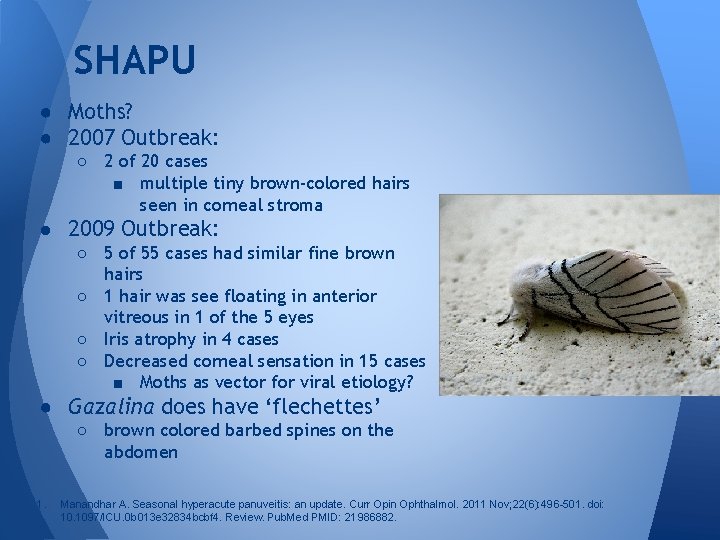
SHAPU ● Moths? ● 2007 Outbreak: ○ 2 of 20 cases ■ multiple tiny brown-colored hairs seen in corneal stroma ● 2009 Outbreak: ○ 5 of 55 cases had similar fine brown hairs ○ 1 hair was see floating in anterior vitreous in 1 of the 5 eyes ○ Iris atrophy in 4 cases ○ Decreased corneal sensation in 15 cases ■ Moths as vector for viral etiology? ● Gazalina does have ‘flechettes’ ○ brown colored barbed spines on the abdomen 1. Manandhar A. Seasonal hyperacute panuveitis: an update. Curr Opin Ophthalmol. 2011 Nov; 22(6): 496 -501. doi: 10. 1097/ICU. 0 b 013 e 32834 bcbf 4. Review. Pub. Med PMID: 21986882.
Recent Developments ● Byanju, et al. (2003) ○ 14 eyes with SHAPU ■ Early vitrectomy ■ 50% had restoration of 20/200 VA or better ● Kathil, et al. (2005) ○ Reported isolation of VZV in aqueous by immunofluorescence ○ PCR for VZV was negative ○ Completely recovered with: ■ Acyclovir IV/PO, cefotaxime PO, prednisone PO ● Manandhar, et al. (2008) ○ First report on bacterial growth in vitreous cultures in 3 of 6 eyes ○ 2 Strep. Pneumoniae ○ 1 Acinetobacter sp. ○ Treated with intravitreal vancomycin, amikacin, & dexamethasone ■ Plus core vitrectomy, topical/oral steroids 1. 2. 3. Byanju RN, Pradhan E, Sapkota YD. Visual outcome of vitrectomy in seasonal hyperacute panuveitis. Kathmandu Univ Med J 2003; 1: 121– 123 Kathil P, Biswas J, Gopal L. Demonstration of varicella zoster virus in a case of presumed seasonal hyperacute panuveitis. Indian J Ophthalmol 2005; 53: 270– 272 Manandhar A, Paudel G, Rai CK, et al. Seasonal hyperacute panuveitis: recent scenario in Nepal Med Coll J 2008; 10: 196– 198.
Recent Developments ● Shrestha, et al. (2010) ○ 20 eyes with SHAPU from the 2007 outbreak ■ Only 2 cases reported moth contact (direct or environment) ■ Treated with intravitreal +/- subconjunctival ● Vancomycin ● Amikacin ● Dexamethasone ■ 43% regained 20/60 vision or better ● 33% only received repeated subconjunctival steroids ■ No eyes received vitrectomy ● Smits, et al. (2012) ○ PCR on vitreous samples from 10 eyes with SHAPU ○ Presence of anellovirus in 2 samples ■ Discovered in 1990’s ■ Associated with MS, SLE, hepatitis, and asthma. 1. 2. Shrestha E. A profile and treatment outcome of seasonal hyper-acute panuveitis. Nep J Ophthalmol 2010; 2: 35– 38 Smits SL, Manandhar A, et al. High prevalence of anelloviruses in vitreous fluid of children with seasonal hyperacute panuveitis. J Infect Dis. 2012 Jun 15; 205(12): 1877 -84. doi: 10. 1093/infdis/jis 284. Epub 2012 Apr 5. Pub. Med PMID: 22492851.
Our Patient ● ● ● Adult Significant improvement Cultured Staph aureus No contact with moths No significant hypotony No vitrectomy
Summary ● Seasonal Hyperacute Panuveitis o o o o Endophthalmitis vs Panuveitis Hyperacute Often visually devastating Primarily affects children Only described in Nepal Every other year ? Moth association