
A Whos Who IN THE LATE ROMAN REPUBLIC

A Who’s Who IN THE LATE ROMAN REPUBLIC
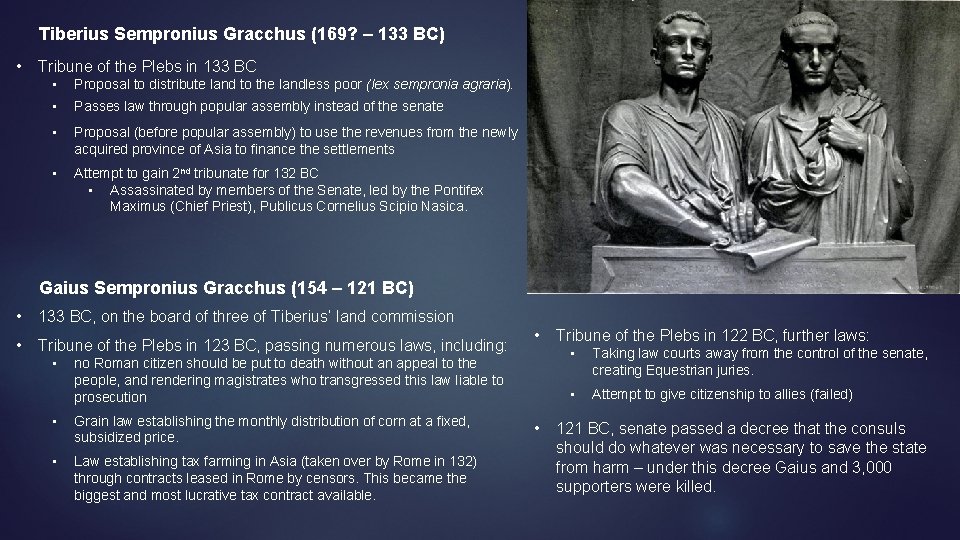
Tiberius Sempronius Gracchus (169? – 133 BC) • Tribune of the Plebs in 133 BC • • Proposal to distribute land to the landless poor (lex sempronia agraria). • Proposal (before popular assembly) to use the revenues from the newly acquired province of Asia to finance the settlements • Attempt to gain 2 nd tribunate for 132 BC • Assassinated by members of the Senate, led by the Pontifex Maximus (Chief Priest), Publicus Cornelius Scipio Nasica. Passes law through popular assembly instead of the senate Gaius Sempronius Gracchus (154 – 121 BC) • 133 BC, on the board of three of Tiberius’ land commission • Tribune of the Plebs in 123 BC, passing numerous laws, including: • • no Roman citizen should be put to death without an appeal to the people, and rendering magistrates who transgressed this law liable to prosecution • Grain law establishing the monthly distribution of corn at a fixed, subsidized price. • Law establishing tax farming in Asia (taken over by Rome in 132) through contracts leased in Rome by censors. This became the biggest and most lucrative tax contract available. • Tribune of the Plebs in 122 BC, further laws: • Taking law courts away from the control of the senate, creating Equestrian juries. • Attempt to give citizenship to allies (failed) 121 BC, senate passed a decree that the consuls should do whatever was necessary to save the state from harm – under this decree Gaius and 3, 000 supporters were killed.
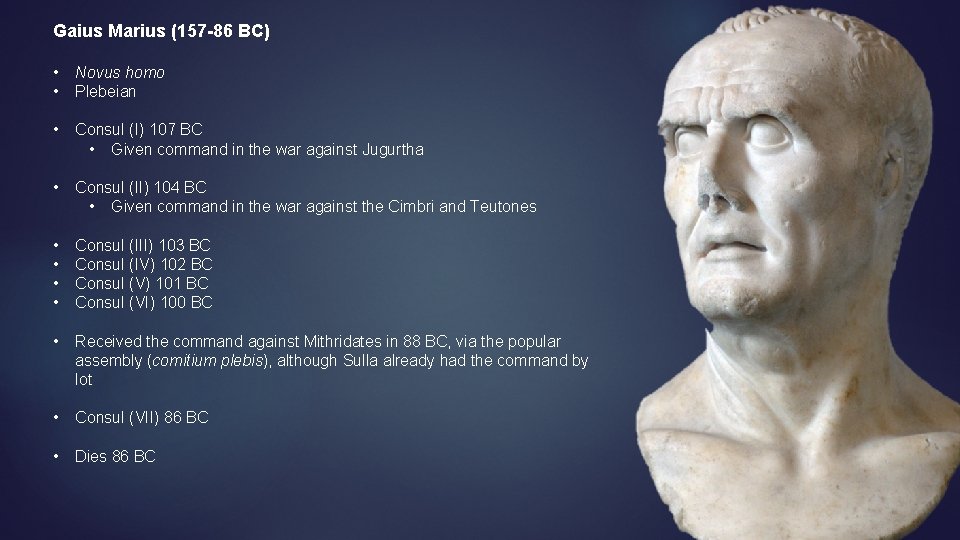
Gaius Marius (157 -86 BC) • • Novus homo Plebeian • Consul (I) 107 BC • Given command in the war against Jugurtha • Consul (II) 104 BC • Given command in the war against the Cimbri and Teutones • • Consul (III) 103 BC Consul (IV) 102 BC Consul (V) 101 BC Consul (VI) 100 BC • Received the command against Mithridates in 88 BC, via the popular assembly (comitium plebis), although Sulla already had the command by lot • Consul (VII) 86 BC • Dies 86 BC
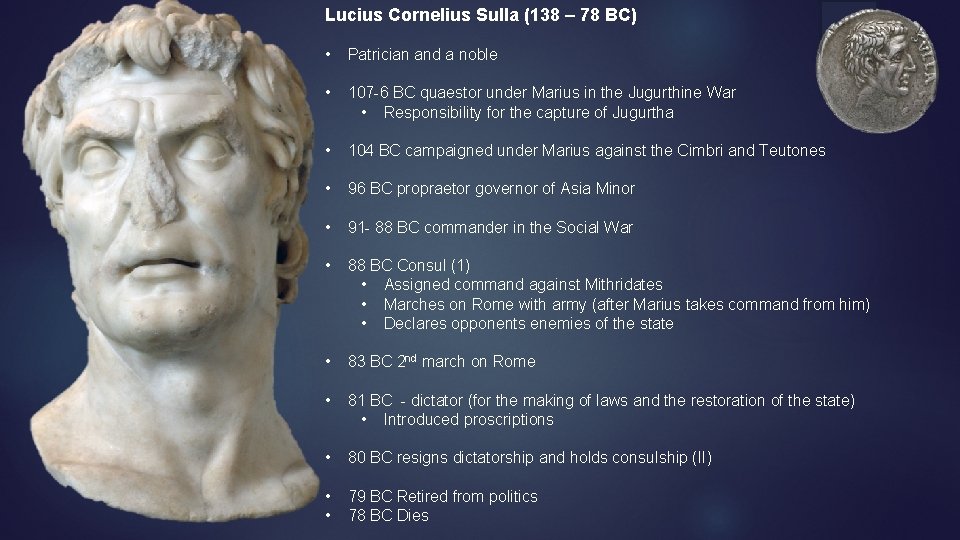
Lucius Cornelius Sulla (138 – 78 BC) • Patrician and a noble • 107 -6 BC quaestor under Marius in the Jugurthine War • Responsibility for the capture of Jugurtha • 104 BC campaigned under Marius against the Cimbri and Teutones • 96 BC propraetor governor of Asia Minor • 91 - 88 BC commander in the Social War • 88 BC Consul (1) • Assigned command against Mithridates • Marches on Rome with army (after Marius takes command from him) • Declares opponents enemies of the state • 83 BC 2 nd march on Rome • 81 BC - dictator (for the making of laws and the restoration of the state) • Introduced proscriptions • 80 BC resigns dictatorship and holds consulship (II) • • 79 BC Retired from politics 78 BC Dies
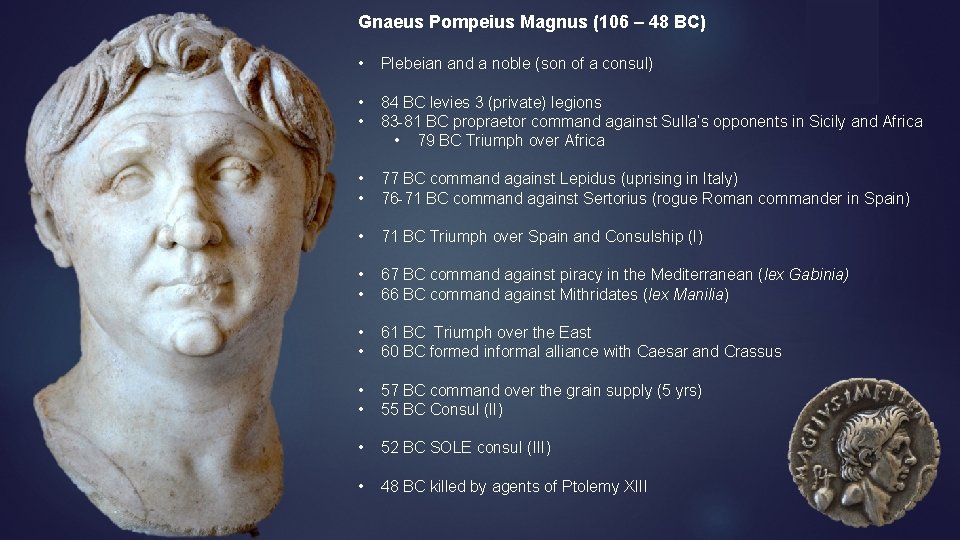
Gnaeus Pompeius Magnus (106 – 48 BC) • Plebeian and a noble (son of a consul) • • 84 BC levies 3 (private) legions 83 -81 BC propraetor command against Sulla’s opponents in Sicily and Africa • 79 BC Triumph over Africa • • 77 BC command against Lepidus (uprising in Italy) 76 -71 BC command against Sertorius (rogue Roman commander in Spain) • 71 BC Triumph over Spain and Consulship (I) • • 67 BC command against piracy in the Mediterranean (lex Gabinia) 66 BC command against Mithridates (lex Manilia) • • 61 BC Triumph over the East 60 BC formed informal alliance with Caesar and Crassus • • 57 BC command over the grain supply (5 yrs) 55 BC Consul (II) • 52 BC SOLE consul (III) • 48 BC killed by agents of Ptolemy XIII
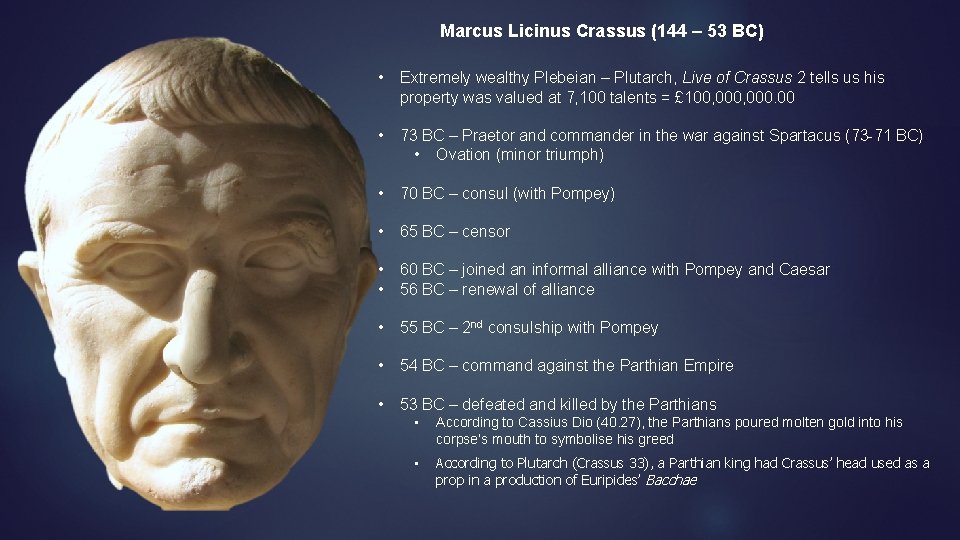
Marcus Licinus Crassus (144 – 53 BC) • Extremely wealthy Plebeian – Plutarch, Live of Crassus 2 tells us his property was valued at 7, 100 talents = £ 100, 000. 00 • 73 BC – Praetor and commander in the war against Spartacus (73 -71 BC) • Ovation (minor triumph) • 70 BC – consul (with Pompey) • 65 BC – censor • • 60 BC – joined an informal alliance with Pompey and Caesar 56 BC – renewal of alliance • 55 BC – 2 nd consulship with Pompey • 54 BC – command against the Parthian Empire • 53 BC – defeated and killed by the Parthians • According to Cassius Dio (40. 27), the Parthians poured molten gold into his corpse’s mouth to symbolise his greed • According to Plutarch (Crassus 33), a Parthian king had Crassus’ head used as a prop in a production of Euripides’ Bacchae
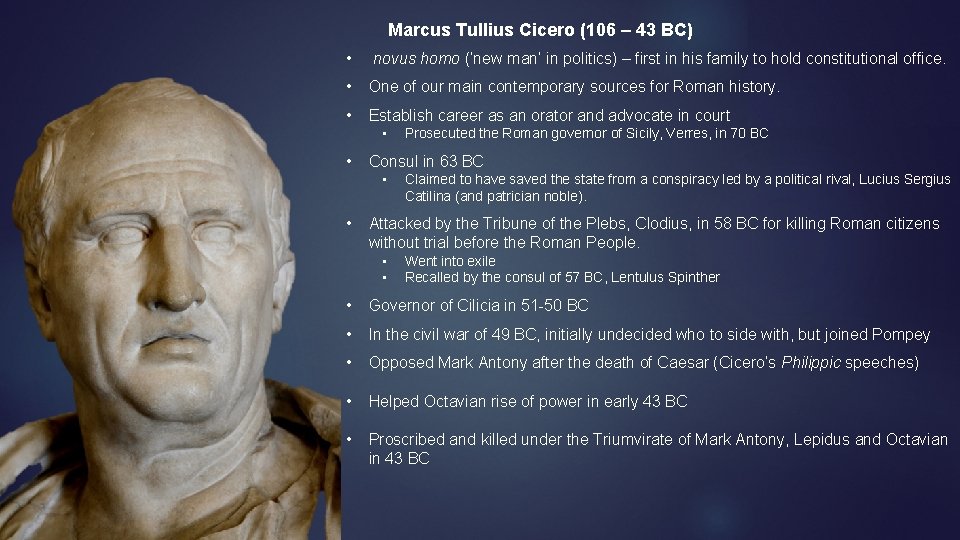
Marcus Tullius Cicero (106 – 43 BC) • novus homo (‘new man’ in politics) – first in his family to hold constitutional office. • One of our main contemporary sources for Roman history. • Establish career as an orator and advocate in court • • Consul in 63 BC • • Prosecuted the Roman governor of Sicily, Verres, in 70 BC Claimed to have saved the state from a conspiracy led by a political rival, Lucius Sergius Catilina (and patrician noble). Attacked by the Tribune of the Plebs, Clodius, in 58 BC for killing Roman citizens without trial before the Roman People. • • Went into exile Recalled by the consul of 57 BC, Lentulus Spinther • Governor of Cilicia in 51 -50 BC • In the civil war of 49 BC, initially undecided who to side with, but joined Pompey • Opposed Mark Antony after the death of Caesar (Cicero’s Philippic speeches) • Helped Octavian rise of power in early 43 BC • Proscribed and killed under the Triumvirate of Mark Antony, Lepidus and Octavian in 43 BC
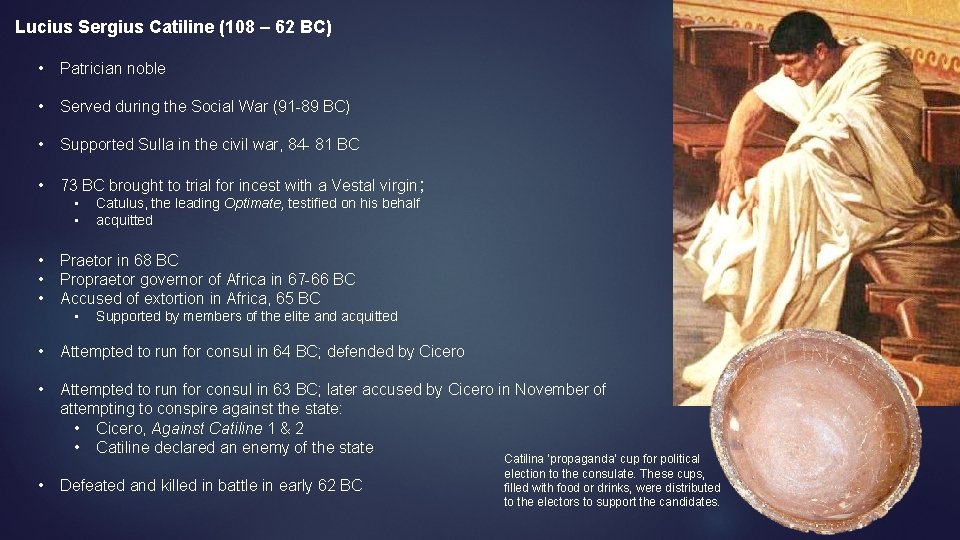
Lucius Sergius Catiline (108 – 62 BC) • Patrician noble • Served during the Social War (91 -89 BC) • Supported Sulla in the civil war, 84 - 81 BC • 73 BC brought to trial for incest with a Vestal virgin; • • • Catulus, the leading Optimate, testified on his behalf acquitted Praetor in 68 BC Propraetor governor of Africa in 67 -66 BC Accused of extortion in Africa, 65 BC • Supported by members of the elite and acquitted • Attempted to run for consul in 64 BC; defended by Cicero • Attempted to run for consul in 63 BC; later accused by Cicero in November of attempting to conspire against the state: • Cicero, Against Catiline 1 & 2 • Catiline declared an enemy of the state • Defeated and killed in battle in early 62 BC Catilina ‘propaganda’ cup for political election to the consulate. These cups, filled with food or drinks, were distributed to the electors to support the candidates.
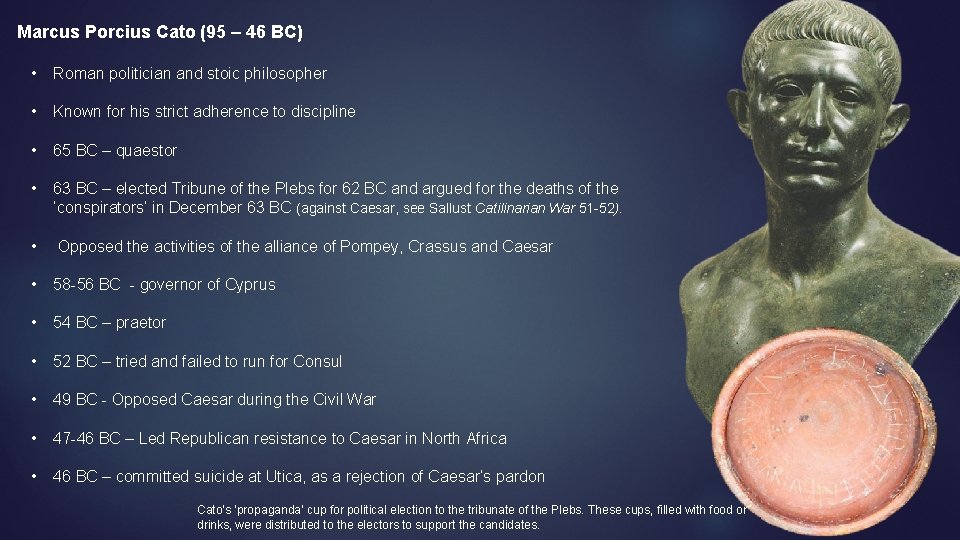
Marcus Porcius Cato (95 – 46 BC) • Roman politician and stoic philosopher • Known for his strict adherence to discipline • 65 BC – quaestor • 63 BC – elected Tribune of the Plebs for 62 BC and argued for the deaths of the ‘conspirators’ in December 63 BC (against Caesar, see Sallust Catilinarian War 51 -52). • Opposed the activities of the alliance of Pompey, Crassus and Caesar • 58 -56 BC - governor of Cyprus • 54 BC – praetor • 52 BC – tried and failed to run for Consul • 49 BC - Opposed Caesar during the Civil War • 47 -46 BC – Led Republican resistance to Caesar in North Africa • 46 BC – committed suicide at Utica, as a rejection of Caesar’s pardon Cato’s ‘propaganda’ cup for political election to the tribunate of the Plebs. These cups, filled with food or drinks, were distributed to the electors to support the candidates.
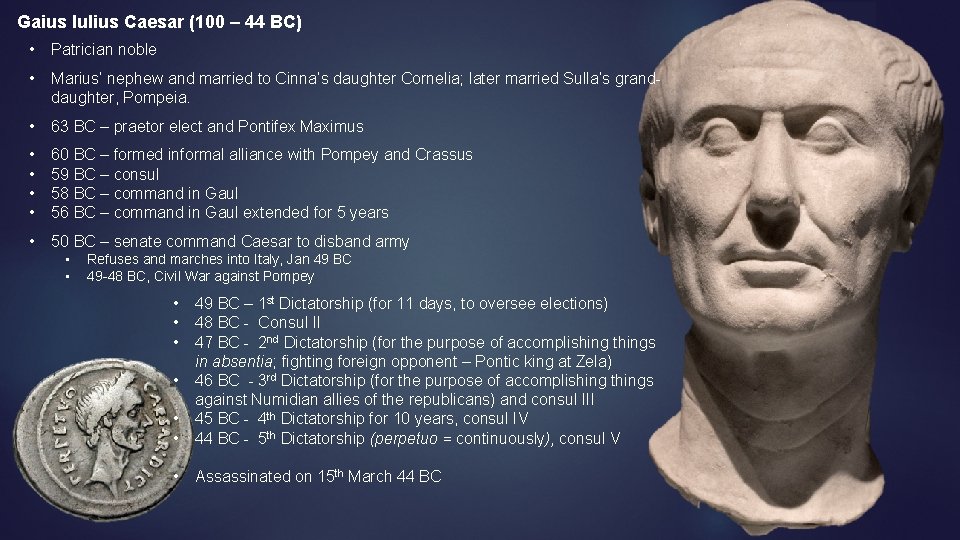
Gaius Iulius Caesar (100 – 44 BC) • Patrician noble • Marius’ nephew and married to Cinna’s daughter Cornelia; later married Sulla’s granddaughter, Pompeia. • 63 BC – praetor elect and Pontifex Maximus • • 60 BC – formed informal alliance with Pompey and Crassus 59 BC – consul 58 BC – command in Gaul 56 BC – command in Gaul extended for 5 years • 50 BC – senate command Caesar to disband army • • Refuses and marches into Italy, Jan 49 BC 49 -48 BC, Civil War against Pompey • • • 49 BC – 1 st Dictatorship (for 11 days, to oversee elections) 48 BC - Consul II 47 BC - 2 nd Dictatorship (for the purpose of accomplishing things in absentia; fighting foreign opponent – Pontic king at Zela) 46 BC - 3 rd Dictatorship (for the purpose of accomplishing things against Numidian allies of the republicans) and consul III 45 BC - 4 th Dictatorship for 10 years, consul IV 44 BC - 5 th Dictatorship (perpetuo = continuously), consul V • Assassinated on 15 th March 44 BC •
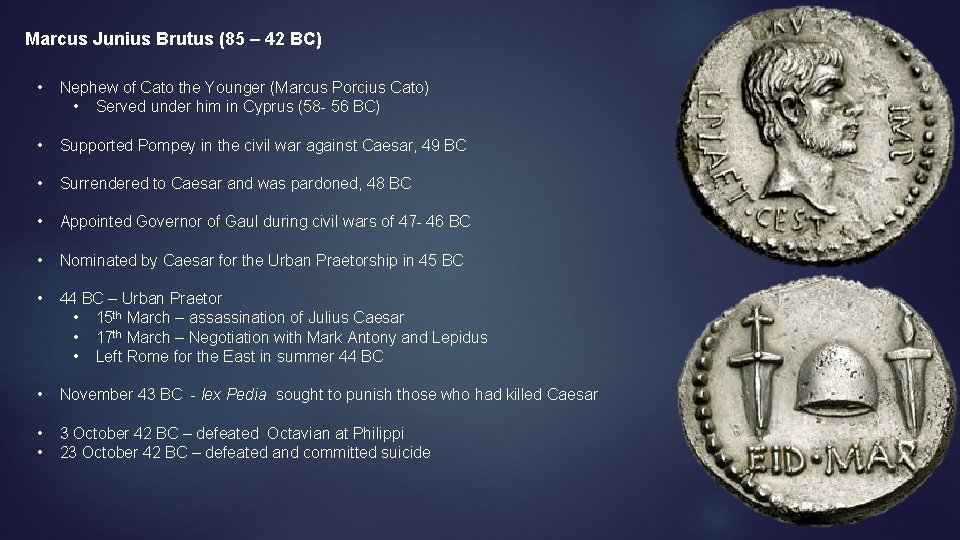
Marcus Junius Brutus (85 – 42 BC) • Nephew of Cato the Younger (Marcus Porcius Cato) • Served under him in Cyprus (58 - 56 BC) • Supported Pompey in the civil war against Caesar, 49 BC • Surrendered to Caesar and was pardoned, 48 BC • Appointed Governor of Gaul during civil wars of 47 - 46 BC • Nominated by Caesar for the Urban Praetorship in 45 BC • 44 BC – Urban Praetor • 15 th March – assassination of Julius Caesar • 17 th March – Negotiation with Mark Antony and Lepidus • Left Rome for the East in summer 44 BC • November 43 BC - lex Pedia sought to punish those who had killed Caesar • • 3 October 42 BC – defeated Octavian at Philippi 23 October 42 BC – defeated and committed suicide
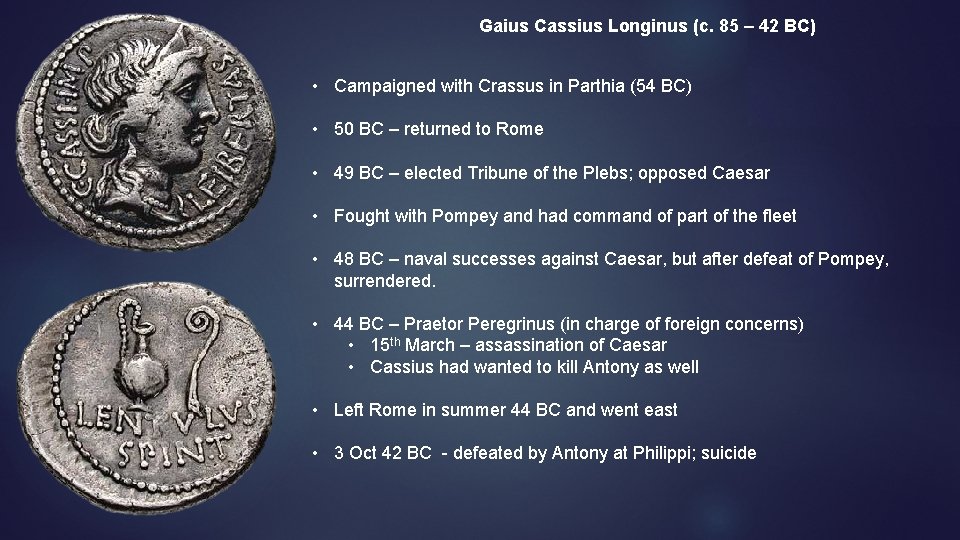
Gaius Cassius Longinus (c. 85 – 42 BC) • Campaigned with Crassus in Parthia (54 BC) • 50 BC – returned to Rome • 49 BC – elected Tribune of the Plebs; opposed Caesar • Fought with Pompey and had command of part of the fleet • 48 BC – naval successes against Caesar, but after defeat of Pompey, surrendered. • 44 BC – Praetor Peregrinus (in charge of foreign concerns) • 15 th March – assassination of Caesar • Cassius had wanted to kill Antony as well • Left Rome in summer 44 BC and went east • 3 Oct 42 BC - defeated by Antony at Philippi; suicide
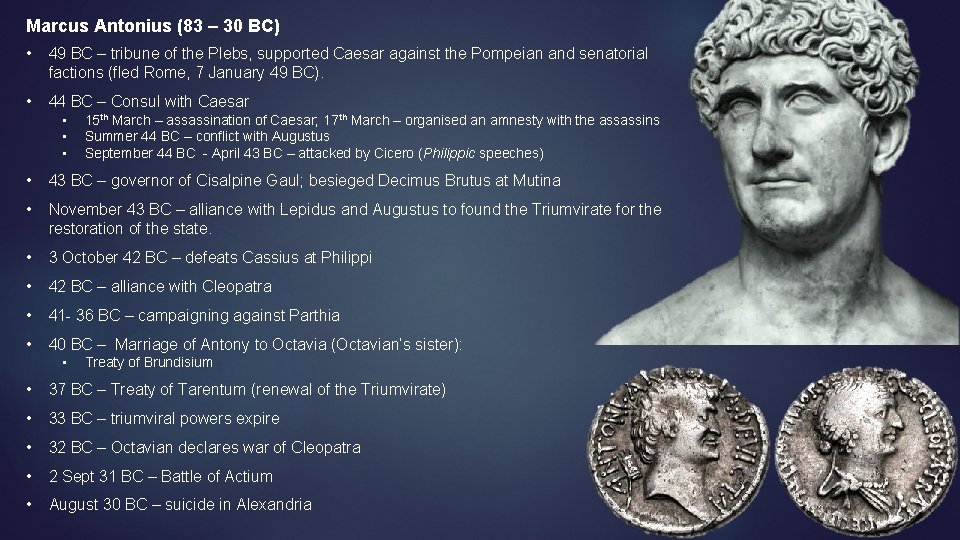
Marcus Antonius (83 – 30 BC) • 49 BC – tribune of the Plebs, supported Caesar against the Pompeian and senatorial factions (fled Rome, 7 January 49 BC). • 44 BC – Consul with Caesar • • • 15 th March – assassination of Caesar; 17 th March – organised an amnesty with the assassins Summer 44 BC – conflict with Augustus September 44 BC - April 43 BC – attacked by Cicero (Philippic speeches) • 43 BC – governor of Cisalpine Gaul; besieged Decimus Brutus at Mutina • November 43 BC – alliance with Lepidus and Augustus to found the Triumvirate for the restoration of the state. • 3 October 42 BC – defeats Cassius at Philippi • 42 BC – alliance with Cleopatra • 41 - 36 BC – campaigning against Parthia • 40 BC – Marriage of Antony to Octavia (Octavian’s sister): • Treaty of Brundisium • 37 BC – Treaty of Tarentum (renewal of the Triumvirate) • 33 BC – triumviral powers expire • 32 BC – Octavian declares war of Cleopatra • 2 Sept 31 BC – Battle of Actium • August 30 BC – suicide in Alexandria
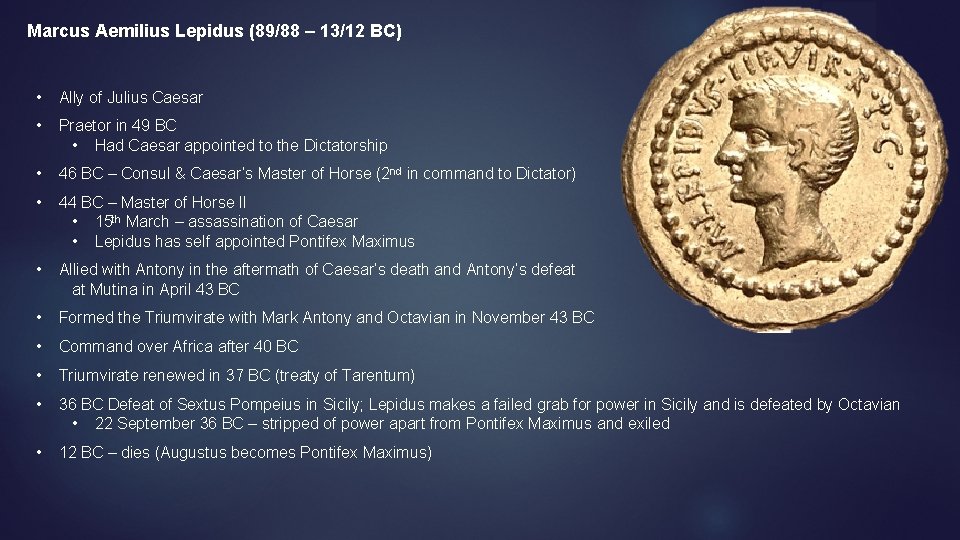
Marcus Aemilius Lepidus (89/88 – 13/12 BC) • Ally of Julius Caesar • Praetor in 49 BC • Had Caesar appointed to the Dictatorship • 46 BC – Consul & Caesar’s Master of Horse (2 nd in command to Dictator) • 44 BC – Master of Horse II • 15 th March – assassination of Caesar • Lepidus has self appointed Pontifex Maximus • Allied with Antony in the aftermath of Caesar’s death and Antony’s defeat at Mutina in April 43 BC • Formed the Triumvirate with Mark Antony and Octavian in November 43 BC • Command over Africa after 40 BC • Triumvirate renewed in 37 BC (treaty of Tarentum) • 36 BC Defeat of Sextus Pompeius in Sicily; Lepidus makes a failed grab for power in Sicily and is defeated by Octavian • 22 September 36 BC – stripped of power apart from Pontifex Maximus and exiled • 12 BC – dies (Augustus becomes Pontifex Maximus)
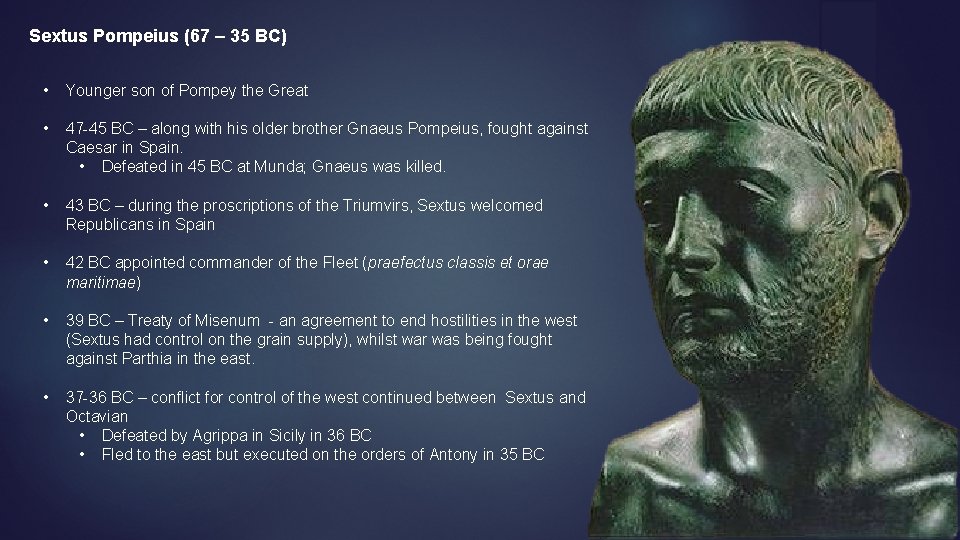
Sextus Pompeius (67 – 35 BC) • Younger son of Pompey the Great • 47 -45 BC – along with his older brother Gnaeus Pompeius, fought against Caesar in Spain. • Defeated in 45 BC at Munda; Gnaeus was killed. • 43 BC – during the proscriptions of the Triumvirs, Sextus welcomed Republicans in Spain • 42 BC appointed commander of the Fleet (praefectus classis et orae maritimae) • 39 BC – Treaty of Misenum - an agreement to end hostilities in the west (Sextus had control on the grain supply), whilst war was being fought against Parthia in the east. • 37 -36 BC – conflict for control of the west continued between Sextus and Octavian • Defeated by Agrippa in Sicily in 36 BC • Fled to the east but executed on the orders of Antony in 35 BC
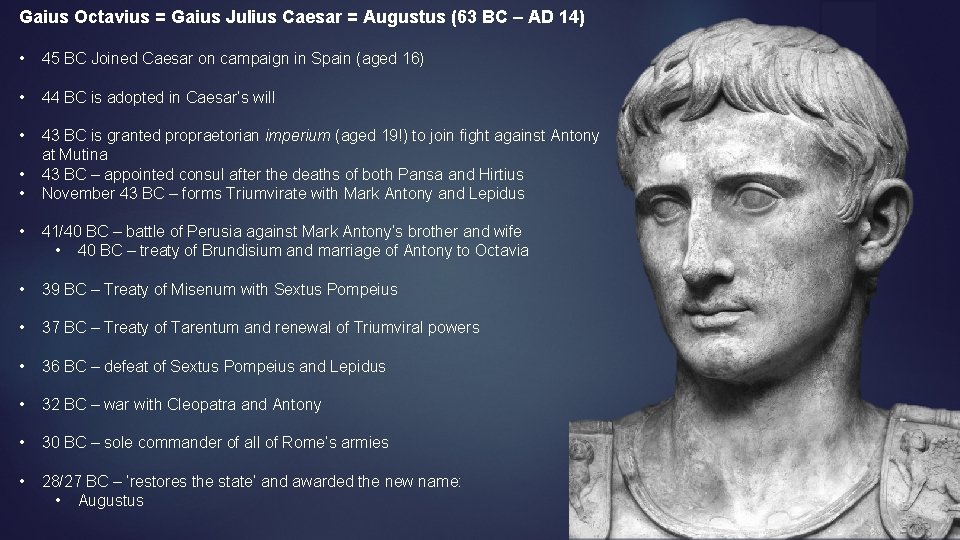
Gaius Octavius = Gaius Julius Caesar = Augustus (63 BC – AD 14) • 45 BC Joined Caesar on campaign in Spain (aged 16) • 44 BC is adopted in Caesar’s will • 43 BC is granted propraetorian imperium (aged 19!) to join fight against Antony at Mutina 43 BC – appointed consul after the deaths of both Pansa and Hirtius November 43 BC – forms Triumvirate with Mark Antony and Lepidus • • • 41/40 BC – battle of Perusia against Mark Antony’s brother and wife • 40 BC – treaty of Brundisium and marriage of Antony to Octavia • 39 BC – Treaty of Misenum with Sextus Pompeius • 37 BC – Treaty of Tarentum and renewal of Triumviral powers • 36 BC – defeat of Sextus Pompeius and Lepidus • 32 BC – war with Cleopatra and Antony • 30 BC – sole commander of all of Rome’s armies • 28/27 BC – ‘restores the state’ and awarded the new name: • Augustus
- Slides: 16