
A WHITE BUS subordinating conjunctions After although as
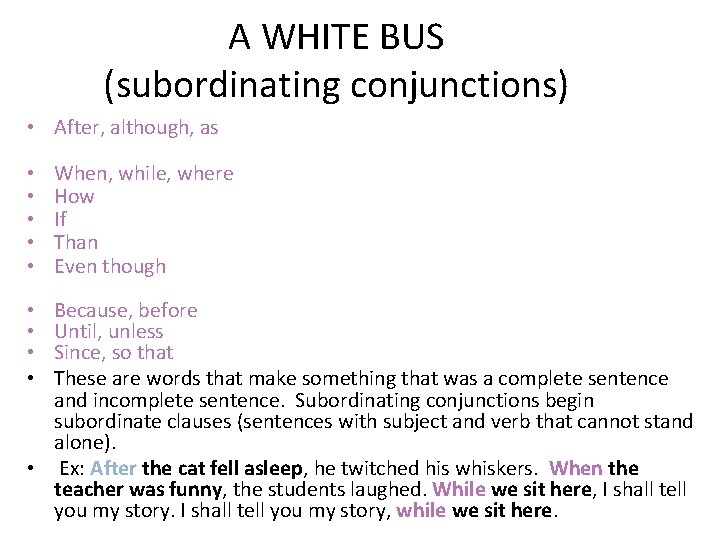
A WHITE BUS (subordinating conjunctions) • After, although, as • • • When, while, where How If Than Even though Because, before Until, unless Since, so that These are words that make something that was a complete sentence and incomplete sentence. Subordinating conjunctions begin subordinate clauses (sentences with subject and verb that cannot stand alone). • Ex: After the cat fell asleep, he twitched his whiskers. When the teacher was funny, the students laughed. While we sit here, I shall tell you my story, while we sit here. • •
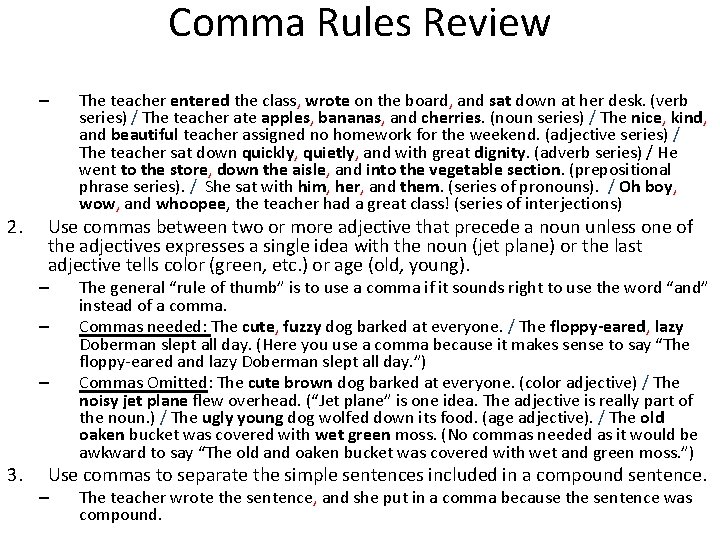
1. Comma Rules Review Use commas to separate items in a series. There are many different kinds of series, one for each part of speech except conjunctions. – 2. Use commas between two or more adjective that precede a noun unless one of the adjectives expresses a single idea with the noun (jet plane) or the last adjective tells color (green, etc. ) or age (old, young). – – – 3. The teacher entered the class, wrote on the board, and sat down at her desk. (verb series) / The teacher ate apples, bananas, and cherries. (noun series) / The nice, kind, and beautiful teacher assigned no homework for the weekend. (adjective series) / The teacher sat down quickly, quietly, and with great dignity. (adverb series) / He went to the store, down the aisle, and into the vegetable section. (prepositional phrase series). / She sat with him, her, and them. (series of pronouns). / Oh boy, wow, and whoopee, the teacher had a great class! (series of interjections) The general “rule of thumb” is to use a comma if it sounds right to use the word “and” instead of a comma. Commas needed: The cute, fuzzy dog barked at everyone. / The floppy-eared, lazy Doberman slept all day. (Here you use a comma because it makes sense to say “The floppy-eared and lazy Doberman slept all day. ”) Commas Omitted: The cute brown dog barked at everyone. (color adjective) / The noisy jet plane flew overhead. (“Jet plane” is one idea. The adjective is really part of the noun. ) / The ugly young dog wolfed down its food. (age adjective). / The old oaken bucket was covered with wet green moss. (No commas needed as it would be awkward to say “The old and oaken bucket was covered with wet and green moss. ”) Use commas to separate the simple sentences included in a compound sentence. – The teacher wrote the sentence, and she put in a comma because the sentence was compound.
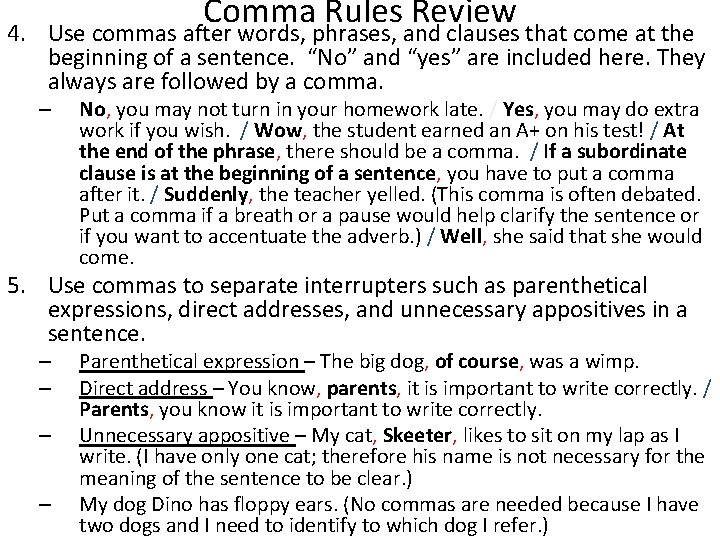
Comma Rules Review 4. Use commas after words, phrases, and clauses that come at the beginning of a sentence. “No” and “yes” are included here. They always are followed by a comma. – No, you may not turn in your homework late. / Yes, you may do extra work if you wish. / Wow, the student earned an A+ on his test! / At the end of the phrase, there should be a comma. / If a subordinate clause is at the beginning of a sentence, you have to put a comma after it. / Suddenly, the teacher yelled. (This comma is often debated. Put a comma if a breath or a pause would help clarify the sentence or if you want to accentuate the adverb. ) / Well, she said that she would come. 5. Use commas to separate interrupters such as parenthetical expressions, direct addresses, and unnecessary appositives in a sentence. – – Parenthetical expression – The big dog, of course, was a wimp. Direct address – You know, parents, it is important to write correctly. / Parents, you know it is important to write correctly. Unnecessary appositive – My cat, Skeeter, likes to sit on my lap as I write. (I have only one cat; therefore his name is not necessary for the meaning of the sentence to be clear. ) My dog Dino has floppy ears. (No commas are needed because I have two dogs and I need to identify to which dog I refer. )
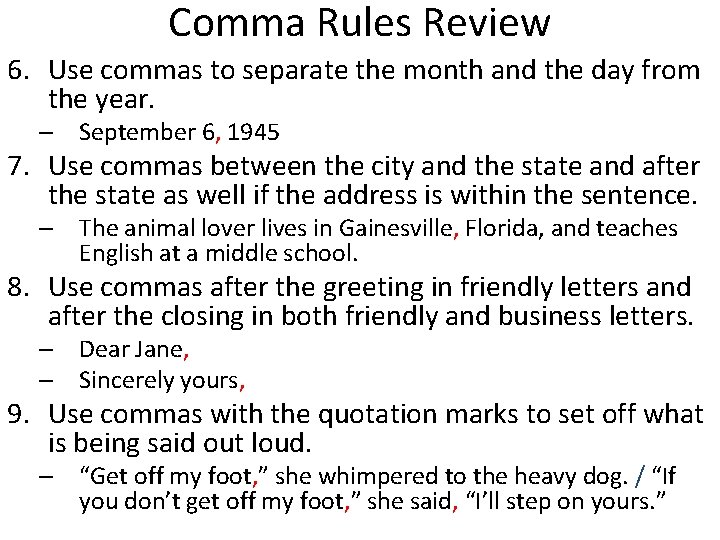
Comma Rules Review 6. Use commas to separate the month and the day from the year. – September 6, 1945 7. Use commas between the city and the state and after the state as well if the address is within the sentence. – The animal lover lives in Gainesville, Florida, and teaches English at a middle school. 8. Use commas after the greeting in friendly letters and after the closing in both friendly and business letters. – Dear Jane, – Sincerely yours, 9. Use commas with the quotation marks to set off what is being said out loud. – “Get off my foot, ” she whimpered to the heavy dog. / “If you don’t get off my foot, ” she said, “I’ll step on yours. ”
- Slides: 4