
A WEIGHTED CALIBRATION METHOD OF INTERFEROMETRIC SAR DATA
A WEIGHTED CALIBRATION METHOD OF INTERFEROMETRIC SAR DATA Yongfei Maosheng Xiang Lideng Wei Daojing Li Bingchen Zhang Institute of Electronics, Chinese Academy of Sciences, Beijing, China

Contents u. Abstract u. Calibrate method based on sensitivity equations u. Weighted calibrate method u. Derivation of the weightings u. Experimental results
u. Abstract ü The accuracy of DEM generated by In. SAR partly depends on the accuracy of system parameters, so it is necessary to calibrate the system parameters. ü The traditional calibration method models the elevation error as a linear function of parameter biases, and solves the biases through the sensitivity equations. ü This paper presents a weighted calibration method. It introduces weightings to the sensitivity equations to discriminate the ground control points with different correlation coefficients and locations ü This weighted calibration method can improve the DEM accuracy.
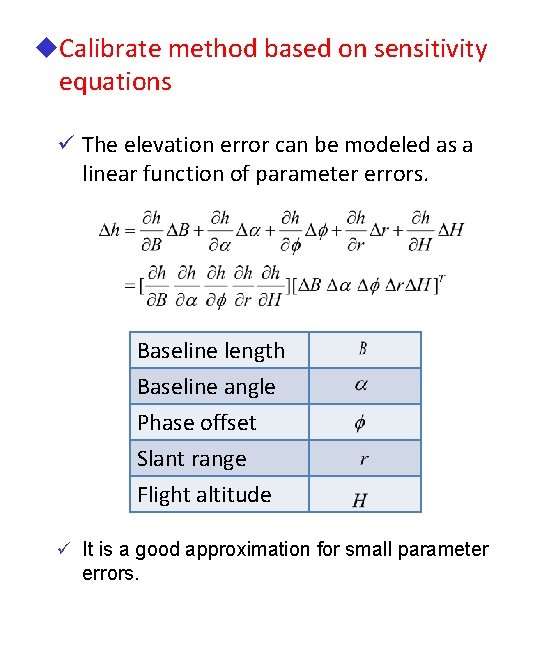
u. Calibrate method based on sensitivity equations ü The elevation error can be modeled as a linear function of parameter errors. Baseline length Baseline angle Phase offset Slant range Flight altitude ü It is a good approximation for small parameter errors.

u. Calibrate method based on sensitivity equations ü All of the control points have sensitivity equations, and they can be written as where
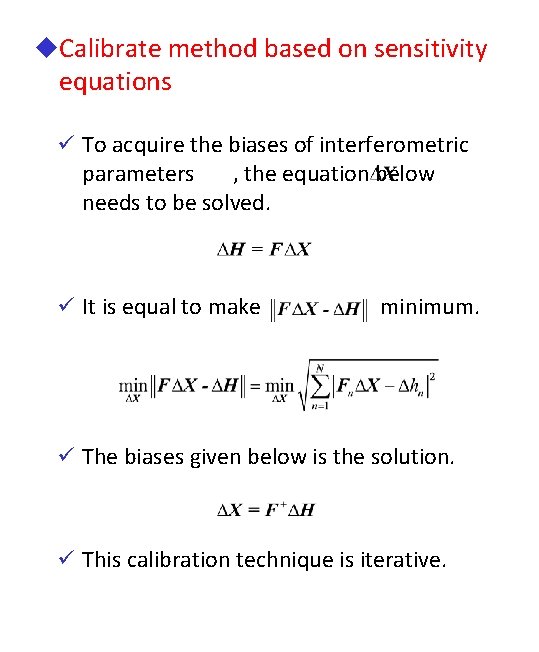
u. Calibrate method based on sensitivity equations ü To acquire the biases of interferometric parameters , the equation below needs to be solved. ü It is equal to make minimum. ü The biases given below is the solution. ü This calibration technique is iterative.
u. Weighted calibrate method ü The error of interferometric phase varies from point to point, so the sensitivity equations of each control point have different errors. ü Therefore, it is reasonable to introduce different weightings to the sensitivity equations of different control points.
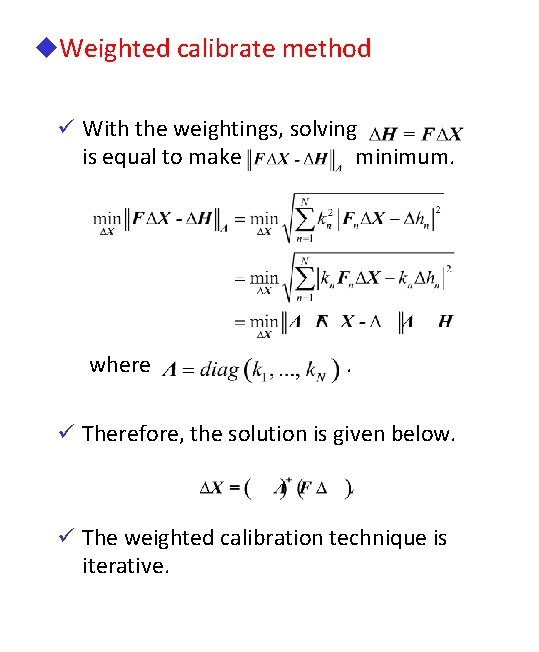
u. Weighted calibrate method ü With the weightings, solving is equal to make where minimum. . ü Therefore, the solution is given below. ü The weighted calibration technique is iterative.
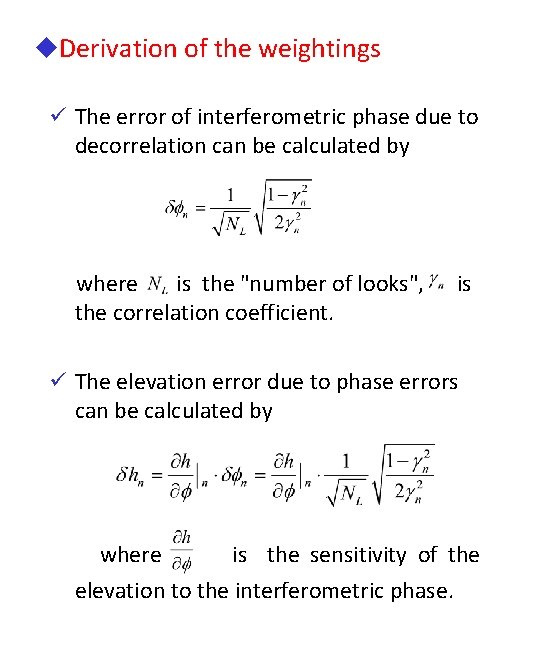
u. Derivation of the weightings ü The error of interferometric phase due to decorrelation can be calculated by where is the "number of looks", the correlation coefficient. is ü The elevation error due to phase errors can be calculated by where is the sensitivity of the elevation to the interferometric phase.
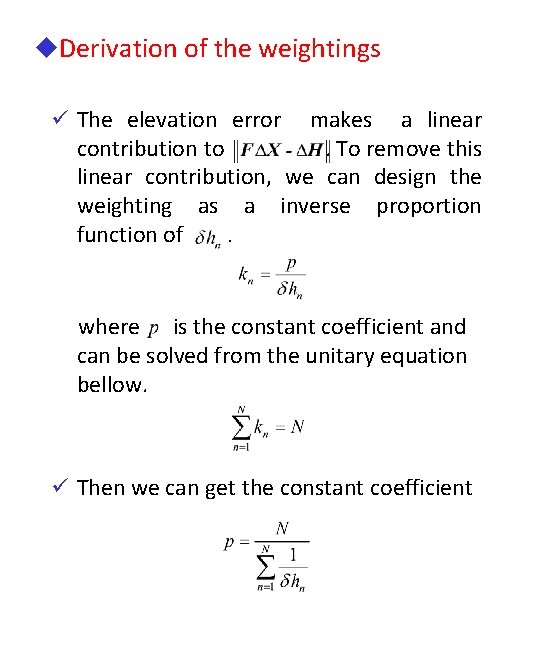
u. Derivation of the weightings ü The elevation error makes a linear contribution to. To remove this linear contribution, we can design the weighting as a inverse proportion function of. where is the constant coefficient and can be solved from the unitary equation bellow. ü Then we can get the constant coefficient
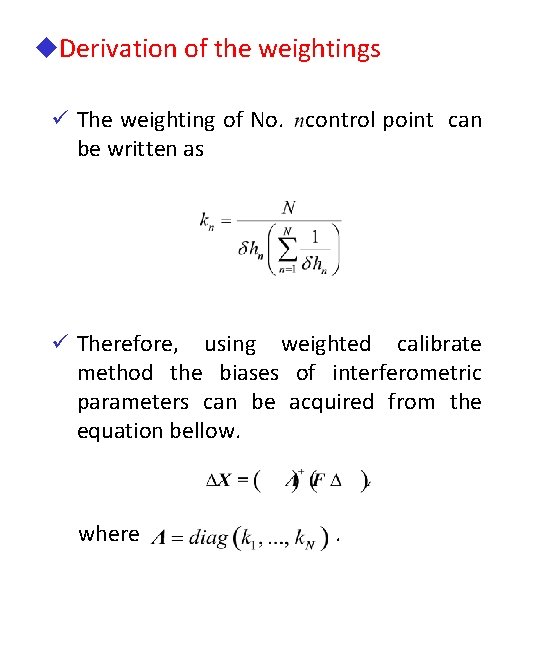
u. Derivation of the weightings ü The weighting of No. control point can be written as ü Therefore, using weighted calibrate method the biases of interferometric parameters can be acquired from the equation bellow. where .
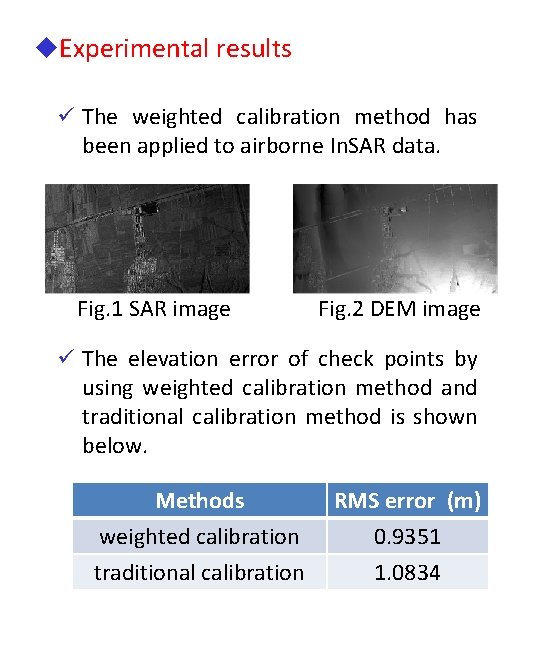
u. Experimental results ü The weighted calibration method has been applied to airborne In. SAR data. Fig. 1 SAR image Fig. 2 DEM image ü The elevation error of check points by using weighted calibration method and traditional calibration method is shown below. Methods RMS error (m) weighted calibration traditional calibration 0. 9351 1. 0834

THANK YOU!
- Slides: 13