
A volcano is an opening in Earths crust
- Slides: 6
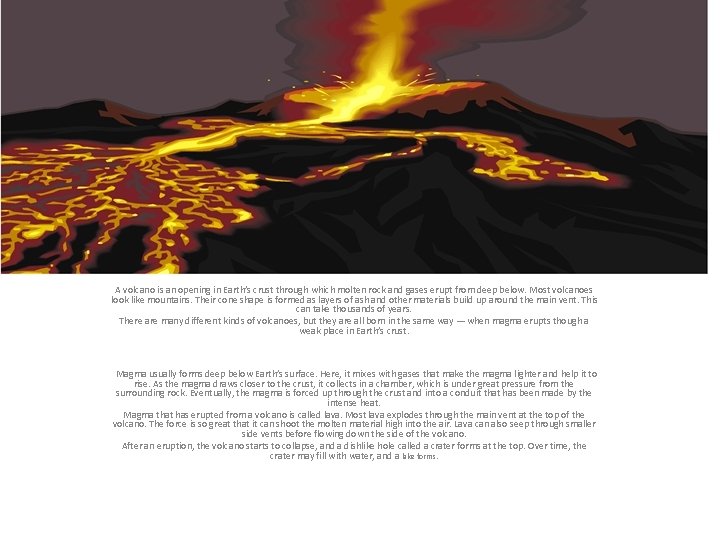
A volcano is an opening in Earth’s crust through which molten rock and gases erupt from deep below. Most volcanoes look like mountains. Their cone shape is formed as layers of ash and other materials build up around the main vent. This can take thousands of years. There are many different kinds of volcanoes, but they are all born in the same way — when magma erupts though a weak place in Earth’s crust. Magma usually forms deep below Earth’s surface. Here, it mixes with gases that make the magma lighter and help it to rise. As the magma draws closer to the crust, it collects in a chamber, which is under great pressure from the surrounding rock. Eventually, the magma is forced up through the crust and into a conduit that has been made by the intense heat. Magma that has erupted from a volcano is called lava. Most lava explodes through the main vent at the top of the volcano. The force is so great that it can shoot the molten material high into the air. Lava can also seep through smaller side vents before flowing down the side of the volcano. After an eruption, the volcano starts to collapse, and a dishlike hole called a crater forms at the top. Over time, the crater may fill with water, and a lake forms.
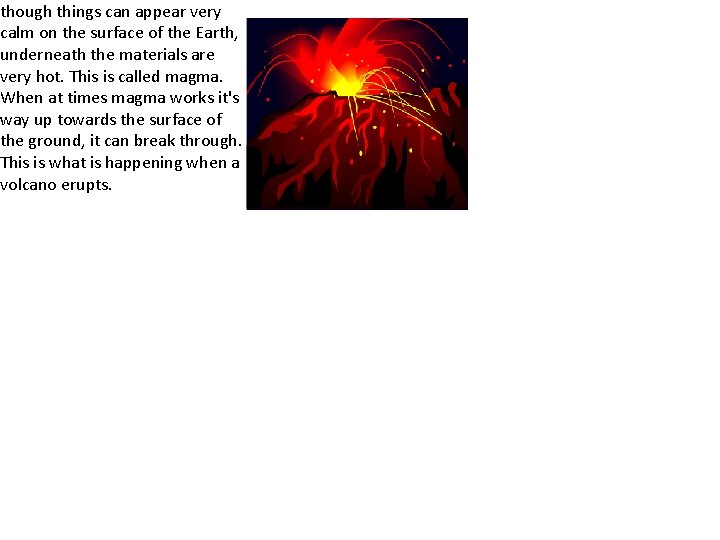
though things can appear very calm on the surface of the Earth, underneath the materials are very hot. This is called magma. When at times magma works it's way up towards the surface of the ground, it can break through. This is what is happening when a volcano erupts.
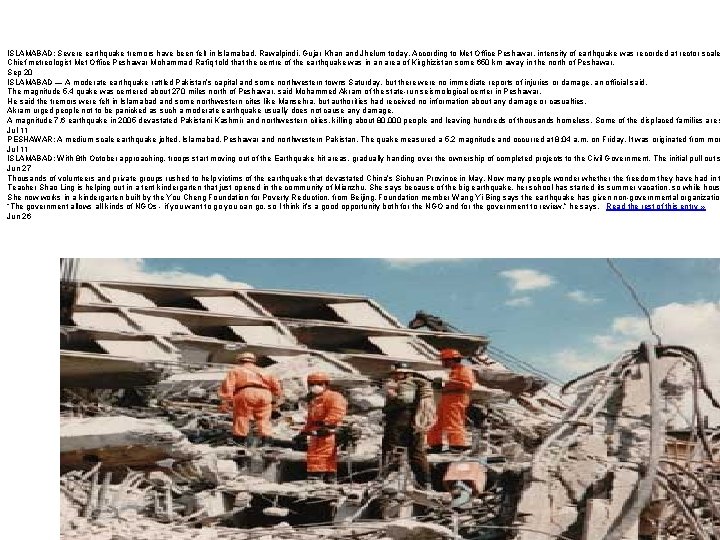
ISLAMABAD: Severe earthquake tremors have been felt in Islamabad, Rawalpindi, Gujar Khan and Jhelum today. According to Met Office Peshawar, intensity of earthquake was recorded at rector scale Chief metreologist Met Office Peshawar Mohammad Rafiq told that the centre of the earthquake was in an area of Kirghizistan some 650 km away in the north of Peshawar. Sep 20 ISLAMABAD — A moderate earthquake rattled Pakistan’s capital and some northwestern towns Saturday, but there were no immediate reports of injuries or damage, an official said. The magnitude 5. 4 quake was centered about 270 miles north of Peshawar, said Mohammed Akram of the state-run seismological center in Peshawar. He said the tremors were felt in Islamabad and some northwestern cites like Mansehra, but authorities had received no information about any damage or casualties. Akram urged people not to be panicked as such a moderate earthquake usually does not cause any damage. A magnitude 7. 6 earthquake in 2005 devastated Pakistani Kashmir and northwestern cities, killing about 80, 000 people and leaving hundreds of thousands homeless. Some of the displaced families are s Jul 11 PESHAWAR: A medium scale earthquake jolted, Islamabad, Peshawar and northwestern Pakistan. The quake measured a 5. 2 magnitude and occurred at 8: 04 a. m. on Friday. It was originated from mou Jul 11 ISLAMABAD: With 8 th October approaching, troops start moving out of the Earthquake hit areas, gradually handing over the ownership of completed projects to the Civil Government. The initial pull out s Jun 27 Thousands of volunteers and private groups rushed to help victims of the earthquake that devastated China’s Sichuan Province in May. Now many people wonder whether the freedom they have had in t Teacher Shao Ling is helping out in a tent kindergarten that just opened in the community of Mianzhu. She says because of the big earthquake, her school has started its summer vacation, so while hous She now works in a kindergarten built by the You Cheng Foundation for Poverty Reduction, from Beijing. Foundation member Wang Yi Bing says the earthquake has given non-governmental organization “The government allows all kinds of NGOs - if you want to go you can go, so I think it’s a good opportunity both for the NGO and for the government to review, ” he says. Read the rest of this entry » Jun 26
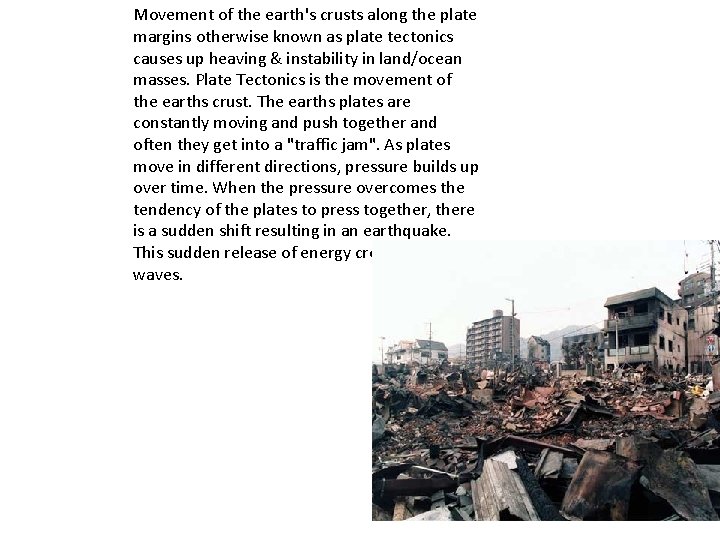
Movement of the earth's crusts along the plate margins otherwise known as plate tectonics causes up heaving & instability in land/ocean masses. Plate Tectonics is the movement of the earths crust. The earths plates are constantly moving and push together and often they get into a "traffic jam". As plates move in different directions, pressure builds up over time. When the pressure overcomes the tendency of the plates to press together, there is a sudden shift resulting in an earthquake. This sudden release of energy creates seismic waves.
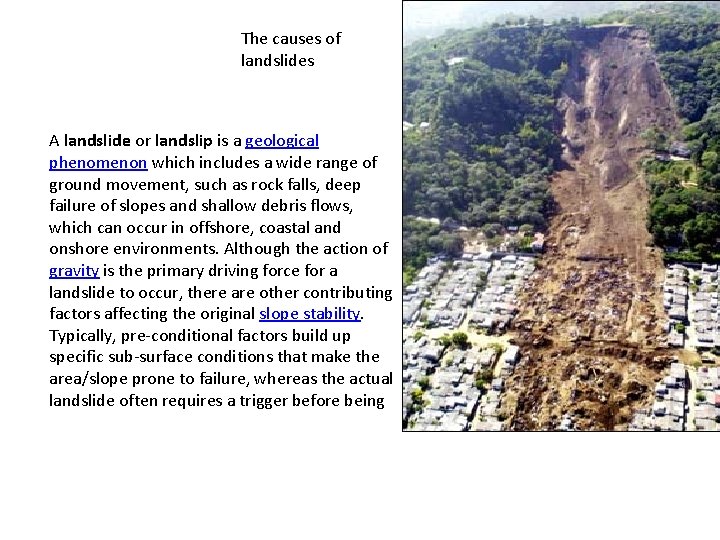
The causes of landslides A landslide or landslip is a geological phenomenon which includes a wide range of ground movement, such as rock falls, deep failure of slopes and shallow debris flows, which can occur in offshore, coastal and onshore environments. Although the action of gravity is the primary driving force for a landslide to occur, there are other contributing factors affecting the original slope stability. Typically, pre-conditional factors build up specific sub-surface conditions that make the area/slope prone to failure, whereas the actual landslide often requires a trigger before being
Debris and mud flows are rivers of rock, earth, and other debris saturated with water. They develop when water rapidly accumulates in the ground, during heavy rainfall or rapid snowmelt, changing the earth into a flowing river of mud or “slurry. ” They can flow rapidly, striking with little or no warning at avalanche speeds. They also can travel several miles from their source, growing in size as they pick up trees, boulders, cars, and other materials.