
A very brief guide to The history of
A very brief guide to … The history of the English language © www. teachit. co. uk 2010 12961 Page 1 of 15
Early beginnings w Before 100 BC, Britain was populated by a mixture of tribes, including the Celts, Picts, Irish and Cornish. w They all spoke a variety of Celtic languages. © www. teachit. co. uk 2010 12961 Page 2 of 15
The origins of English w In the 5 th century AD, settlers from west Germany crossed over to Britain. w These tribes were called Saxons, Jutes and Angles, and set up kingdoms called ‘East Anglia’, ‘West Saxon’, ‘East Saxon’ etc. w They spoke a dialect of the Germanic language and this slowly evolved into the English we speak today. © www. teachit. co. uk 2010 12961 Page 3 of 15
Old English (c. 400– 1100 AD) w The language spoken by the Germanic settlers developed differently to the forms found in what is now known as Germany. w This early form of English is known as ‘Old English’. © www. teachit. co. uk 2010 12961 Page 4 of 15
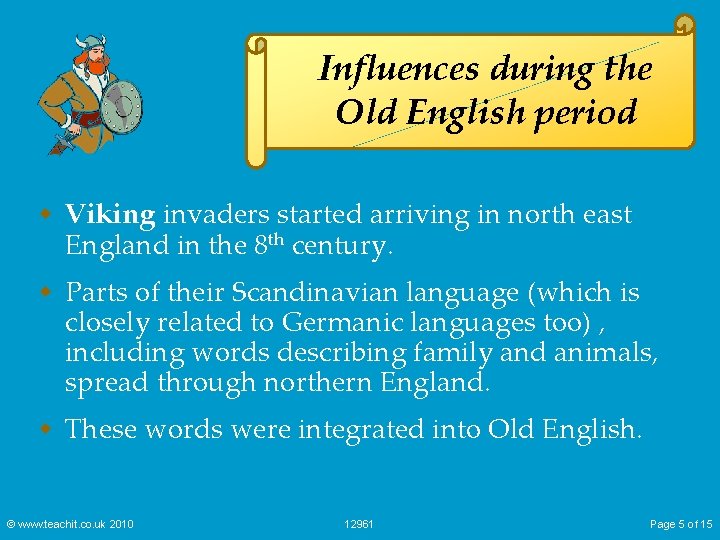
Influences during the Old English period w Viking invaders started arriving in north east England in the 8 th century. w Parts of their Scandinavian language (which is closely related to Germanic languages too) , including words describing family and animals, spread through northern England. w These words were integrated into Old English. © www. teachit. co. uk 2010 12961 Page 5 of 15
Middle English (c. 1100– 1450 AD) w When the Normans invaded in 1066, French became the dominant language (of court, the church, and the nobility) while the rest of the country spoke versions of English. w Gradually, English became more widely used by the educated upper classes and by 1425 English was used universally again in speech and writing. w However, it had changed completely since the Old English period and became known as Middle English. © www. teachit. co. uk 2010 12961 Page 6 of 15
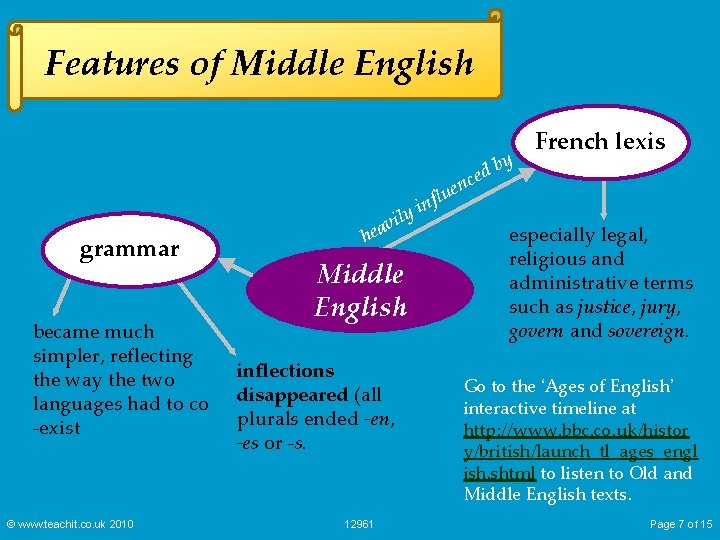
Features of Middle English y grammar became much simpler, reflecting the way the two languages had to co -exist © www. teachit. co. uk 2010 f n i ly i v hea Middle English inflections disappeared (all plurals ended -en, -es or -s. 12961 b d e c n e lu French lexis especially legal, religious and administrative terms such as justice, jury, govern and sovereign. Go to the ‘Ages of English’ interactive timeline at http: //www. bbc. co. uk/histor y/british/launch_tl_ages_engl ish. shtml to listen to Old and Middle English texts. Page 7 of 15
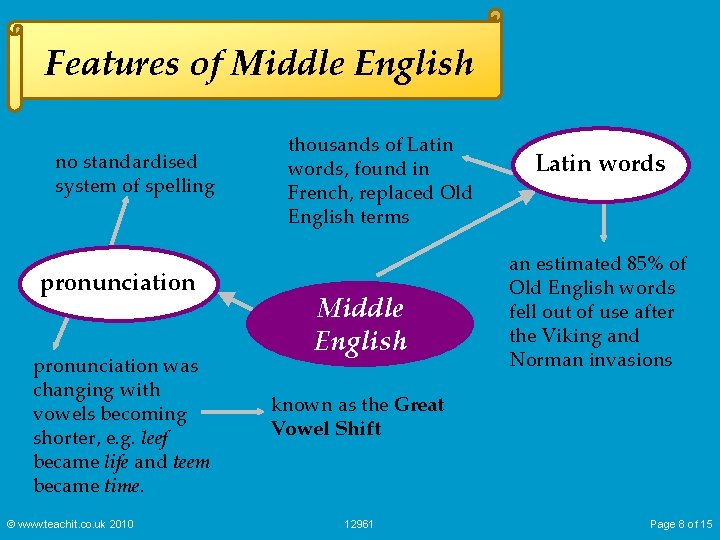
Features of Middle English no standardised system of spelling pronunciation was changing with vowels becoming shorter, e. g. leef became life and teem became time. © www. teachit. co. uk 2010 thousands of Latin words, found in French, replaced Old English terms Middle English Latin words an estimated 85% of Old English words fell out of use after the Viking and Norman invasions known as the Great Vowel Shift 12961 Page 8 of 15
Early Modern English c. 1470– 1700 w In 1476, William Caxton introduced the printing press to Britain. w Many texts could now be mass-produced, which meant that there was a move towards standardisation in how they were printed, in terms of spelling and punctuation. w Many Greek and Latin texts were translated into English. w Caxton chose the East Midlands (London, Oxford, Cambridge) dialect to print works in. This soon became the most prestigious form of English. © www. teachit. co. uk 2010 12961 Page 9 of 15
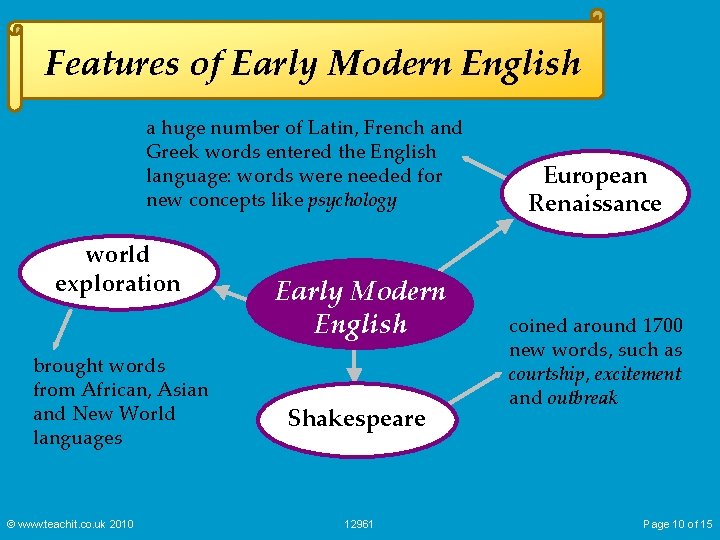
Features of Early Modern English a huge number of Latin, French and Greek words entered the English language: words were needed for new concepts like psychology world exploration brought words from African, Asian and New World languages © www. teachit. co. uk 2010 Early Modern English Shakespeare 12961 European Renaissance coined around 1700 new words, such as courtship, excitement and outbreak Page 10 of 15
Influences of Latin w More than half of our modern English vocabulary is Latinate (of Latin origin), e. g. colossal, dignified, emotion, and history. w Most of our prefixes and suffixes come from Latin, e. g. anti-, post-, pre-, -al, -ate, -ic. © www. teachit. co. uk 2010 12961 Page 11 of 15
Late Modern English c. 1700 – modern day w From 1700 onwards, English became more standardised and similar to the language we recognise today. w In 1755, Samuel Johnson finished the first ‘Dictionary of English’. Many writers had attempted this before but his version was more comprehensive than ever before. w In 1762, Robert Lowth published the first English grammar book, which laid out some of the fundamental rules for ‘correct’ usage. © www. teachit. co. uk 2010 12961 Page 12 of 15
Standardisation and presctiptivism w During this time, many writers made attempts to define the lexicon and grammar of English (Johnson, Lowth etc). w This led to a view that some non-standard varieties of English were inferior – this is called Prescriptivism. w Latin was upheld as the ideal language and used a model for English grammar, even though it had a very different structure. © www. teachit. co. uk 2010 12961 Page 13 of 15
19 th century English w Rail travel, colonial expansion, the spread of literacy and mass production of the printed word extended everyone’s access to a standard written form of English. w The Industrial Revolution changed the way people worked and lived their lives, so new words were needed. w English borrowed huge numbers of words from all over the world. w American English was becoming a language in its own right, with its own rules and spelling. © www. teachit. co. uk 2010 12961 Page 14 of 15
Modern developments w English is now a world language of communication. w Electronic media like mobile phones and the internet have radically changed the way we communicate with each other. w A more colloquial and casual style of language reflects major social changes. w Estuary English (a south-eastern dialect) has become widespread in UK. w American English increasingly influences British English and English worldwide. © www. teachit. co. uk 2010 12961 Page 15 of 15
- Slides: 15