
A Vertical Bubble Flow Network using InductiveCoupling for

A Vertical Bubble Flow Network using Inductive-Coupling for 3 D CMPs Hiroki Matsutani 1, Yasuhiro Take 2, Daisuke Sasaki 2, Masayuki Kimura 2, Yuki Ono 2, Yukinori Nishiyama 2, Michihiro Koibuchi 3, Tadahiro Kuroda 2, Hideharu Amano 2 1) The University of Tokyo, 2) Keio University, 3) National Institute of Informatics
Outline: Wireless 3 D No. C for CMPs • 3 D IC technologies – Wired approach vs. wireless approach – Inductive-coupling technology • Our target: Wireless 3 D CMPs – Type and number of chips stacked in a package can be customized for given applications • Simple wireless 3 D No. C – Ring-based 3 D network – Bubble flow control • Experimental results – Real chip implementation – Full-system simulation results
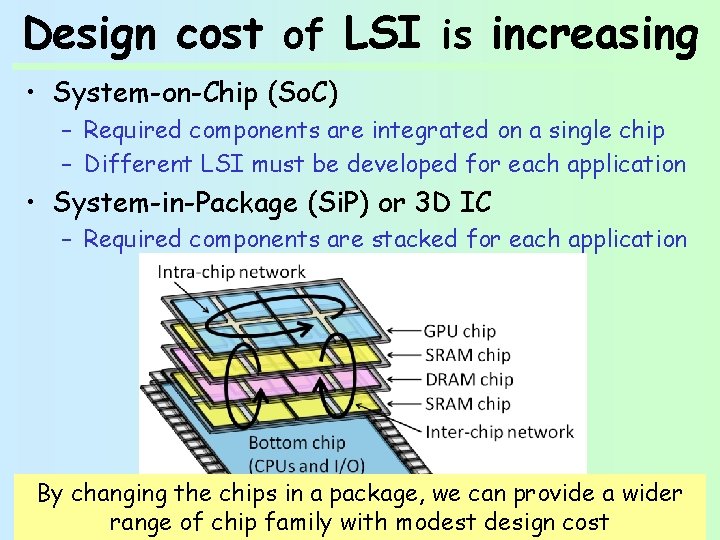
Design cost of LSI is increasing • System-on-Chip (So. C) – Required components are integrated on a single chip – Different LSI must be developed for each application • System-in-Package (Si. P) or 3 D IC – Required components are stacked for each application By changing the chips in a package, we can provide a wider range of chip family with modest design cost
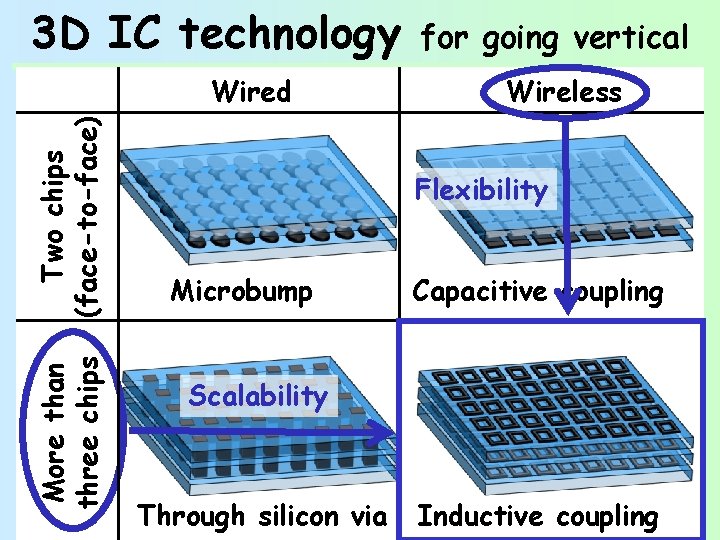
3 D IC technology More than three chips Two chips (face-to-face) Wired for going vertical Wireless Flexibility Microbump Capacitive coupling Scalability Through silicon via Inductive coupling
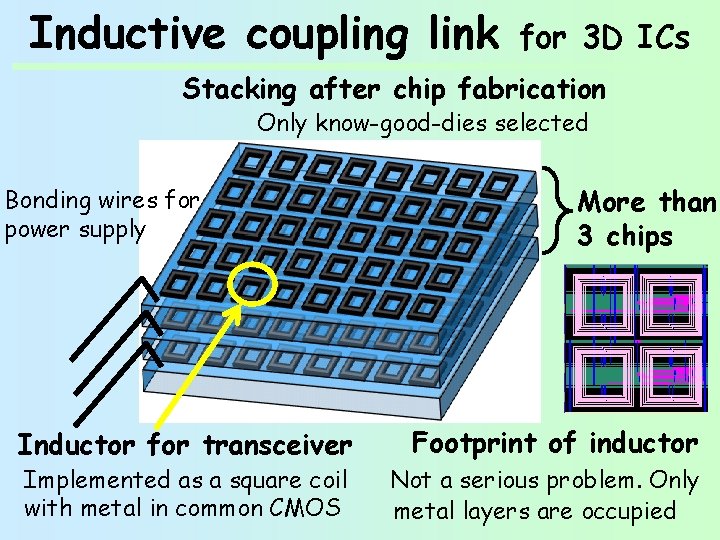
Inductive coupling link for 3 D ICs Stacking after chip fabrication Only know-good-dies selected Bonding wires for power supply Inductor for transceiver Implemented as a square coil with metal in common CMOS More than 3 chips Footprint of inductor Not a serious problem. Only metal layers are occupied
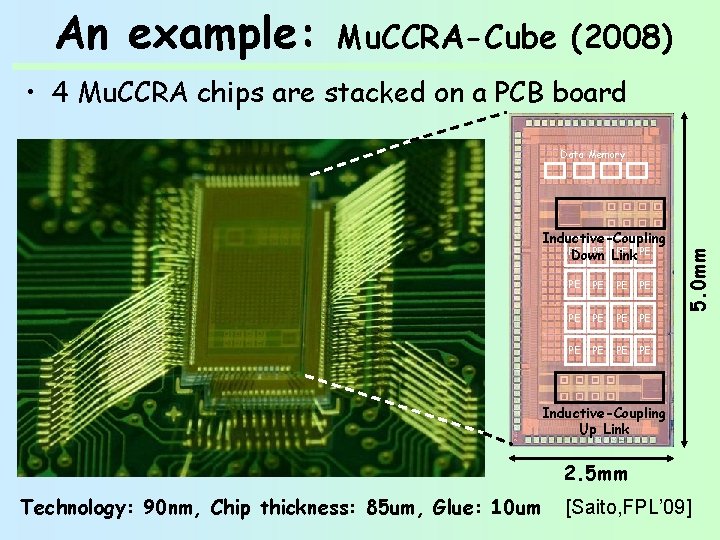
An example: Mu. CCRA-Cube (2008) • 4 Mu. CCRA chips are stacked on a PCB board Inductive-Coupling PE PE Link PE PE Down PE PE PE 5. 0 mm Data Memory Inductive-Coupling Up Link 2. 5 mm Technology: 90 nm, Chip thickness: 85 um, Glue: 10 um [Saito, FPL’ 09]

Chip stacking method: Slide & stack • Inductor has TX/RX/Idle modes (1 -cycle switch) TX Slide & stack TX Inductor (TX) Inductor (RX) Bonding wire TX TX Bonding wir TX TX TX Bonding
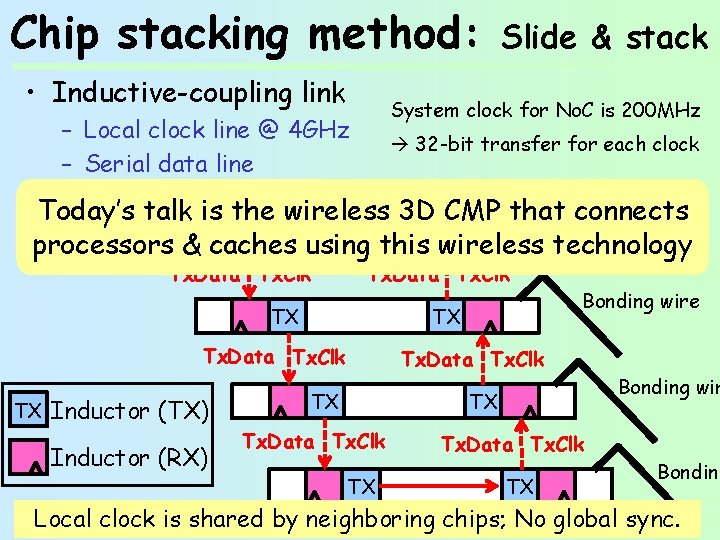
Chip stacking method: • Inductive-coupling link Slide & stack System clock for No. C is 200 MHz – Local clock line @ 4 GHz – Serial data line 32 -bit transfer for each clock Today’s talk is the wireless 3 D CMP that connects Bonding wire TX TX processors & caches using this wireless technology Tx. Data Tx. Clk TX TX Tx. Data Tx. Clk TX Inductor (TX) Inductor (RX) Bonding wire Tx. Data Tx. Clk TX TX Tx. Data Tx. Clk TX Bonding wir Bonding Local clock is shared by neighboring chips; No global sync.
Outline: Wireless 3 D No. C for CMPs • 3 D IC technologies – Wired approach vs. wireless approach – Inductive-coupling technology • Our target: Wireless 3 D CMPs – Type and number of chips stacked in a package can be customized for given applications • Simple wireless 3 D No. C – Ring-based 3 D network – Bubble flow control • Experimental results – Real chip implementation – Full-system simulation results
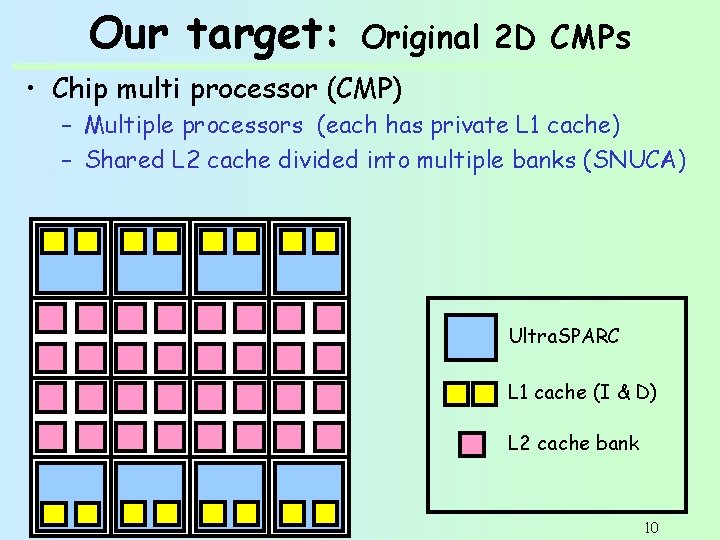
Our target: Original 2 D CMPs • Chip multi processor (CMP) – Multiple processors (each has private L 1 cache) – Shared L 2 cache divided into multiple banks (SNUCA) Processor tile Cache tile Ultra. SPARC L 1 cache (I & D) L 2 cache bank 10
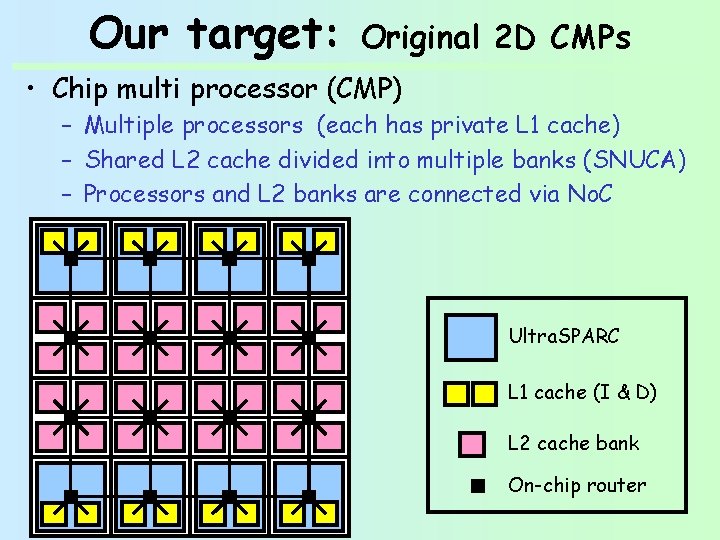
Our target: Original 2 D CMPs • Chip multi processor (CMP) – Multiple processors (each has private L 1 cache) – Shared L 2 cache divided into multiple banks (SNUCA) – Processors and L 2 banks are connected via No. C Ultra. SPARC L 1 cache (I & D) L 2 cache bank On-chip router
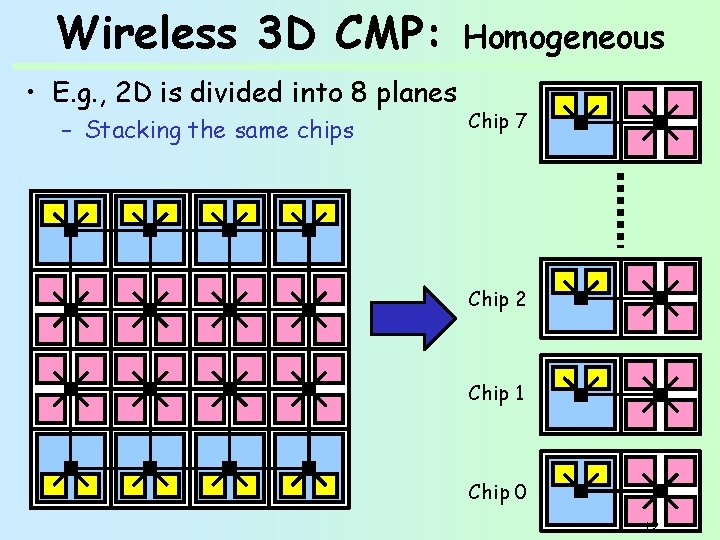
Wireless 3 D CMP: • E. g. , 2 D is divided into 8 planes – Stacking the same chips Homogeneous Chip 7 Chip 2 Chip 1 Chip 0 12
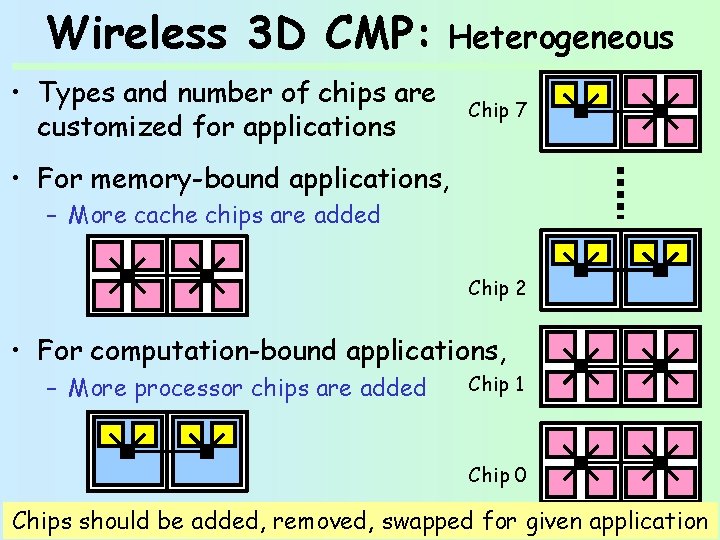
Wireless 3 D CMP: Heterogeneous • Types and number of chips are customized for applications Chip 7 • For memory-bound applications, – More cache chips are added Chip 2 • For computation-bound applications, – More processor chips are added Chip 1 Chip 0 Chips should be added, removed, swapped for given application
Outline: Wireless 3 D No. C for CMPs • 3 D IC technologies – Wired approach vs. wireless approach – Inductive-coupling technology • Our target: Wireless 3 D CMPs – Type and number of chips stacked in a package can be customized for given applications • Simple wireless 3 D No. C – Ring-based 3 D network – Bubble flow control • Experimental results – Real chip implementation – Full-system simulation results
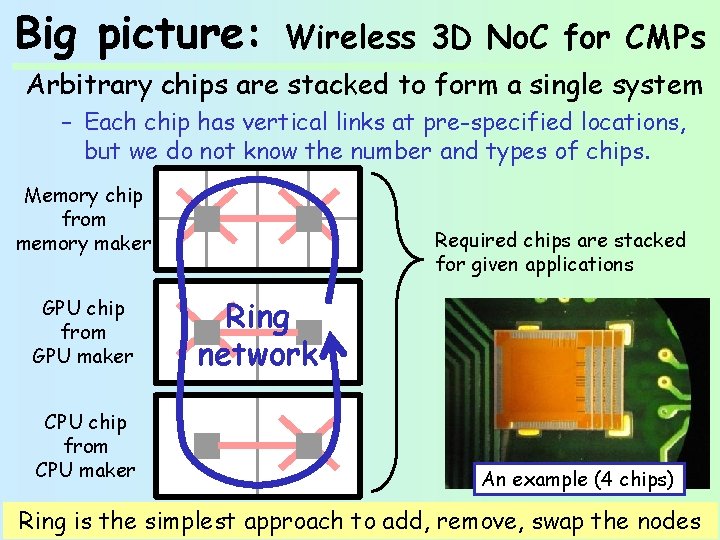
Big picture: Wireless 3 D No. C for CMPs Arbitrary chips are stacked to form a single system – Each chip has vertical links at pre-specified locations, but we do not know the number and types of chips. Memory chip from memory maker GPU chip from GPU maker CPU chip from CPU maker Required chips are stacked for given applications Ring network An example (4 chips) Ring is the simplest approach to add, remove, swap the nodes
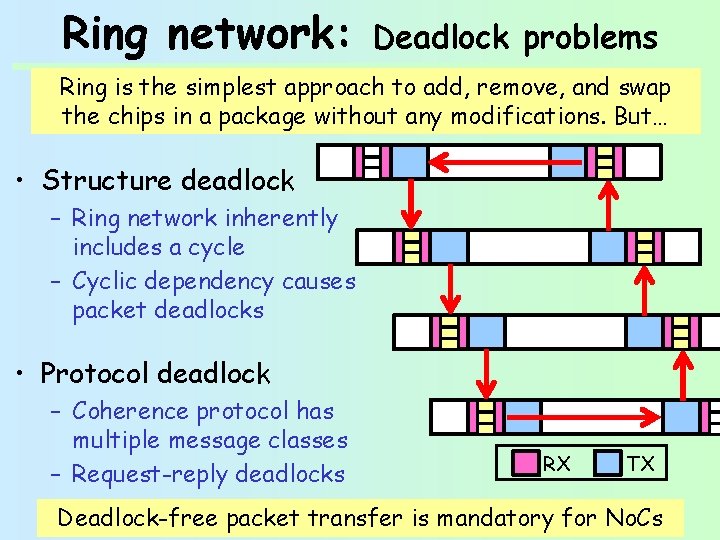
Ring network: Deadlock problems Ring is the simplest approach to add, remove, and swap the chips in a package without any modifications. But… • Structure deadlock – Ring network inherently includes a cycle – Cyclic dependency causes packet deadlocks • Protocol deadlock – Coherence protocol has multiple message classes – Request-reply deadlocks RX TX Deadlock-free packet transfer is mandatory for No. Cs
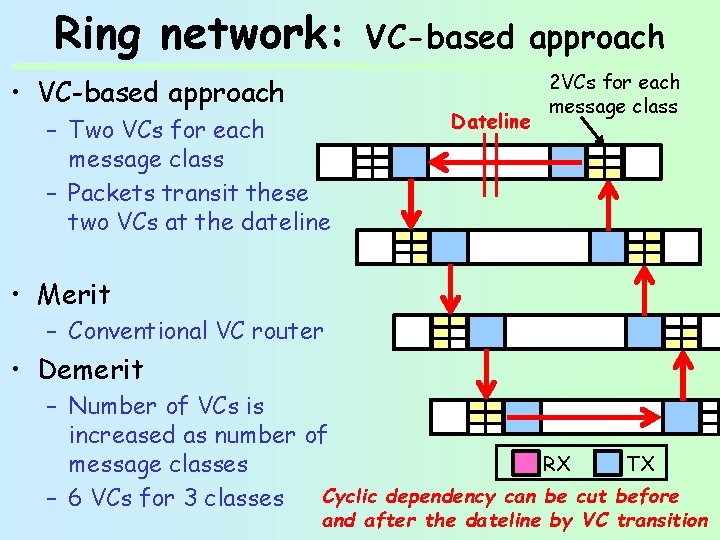
Ring network: • VC-based approach – Two VCs for each message class – Packets transit these two VCs at the dateline VC-based approach Dateline 2 VCs for each message class • Merit – Conventional VC router • Demerit – Number of VCs is increased as number of RX TX message classes Cyclic dependency can be cut before – 6 VCs for 3 classes and after the dateline by VC transition
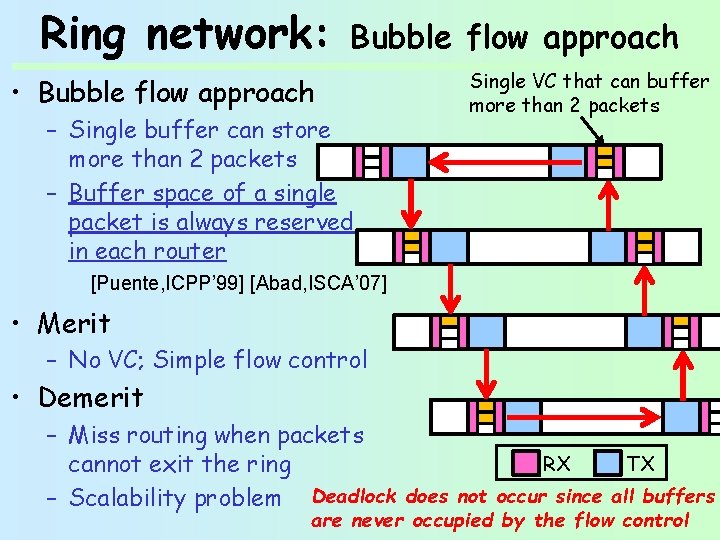
Ring network: Bubble flow approach • Bubble flow approach – Single buffer can store more than 2 packets – Buffer space of a single packet is always reserved in each router Single VC that can buffer more than 2 packets [Puente, ICPP’ 99] [Abad, ISCA’ 07] • Merit – No VC; Simple flow control • Demerit – Miss routing when packets RX TX cannot exit the ring – Scalability problem Deadlock does not occur since all buffers are never occupied by the flow control
Outline: Wireless 3 D No. C for CMPs • 3 D IC technologies – Wired approach vs. wireless approach – Inductive-coupling technology • Our target: Wireless 3 D CMPs – Type and number of chips stacked in a package can be customized for given applications • Simple wireless 3 D No. C – Ring-based 3 D network – Bubble flow control • Experimental results – Real chip implementation – Full-system simulation results
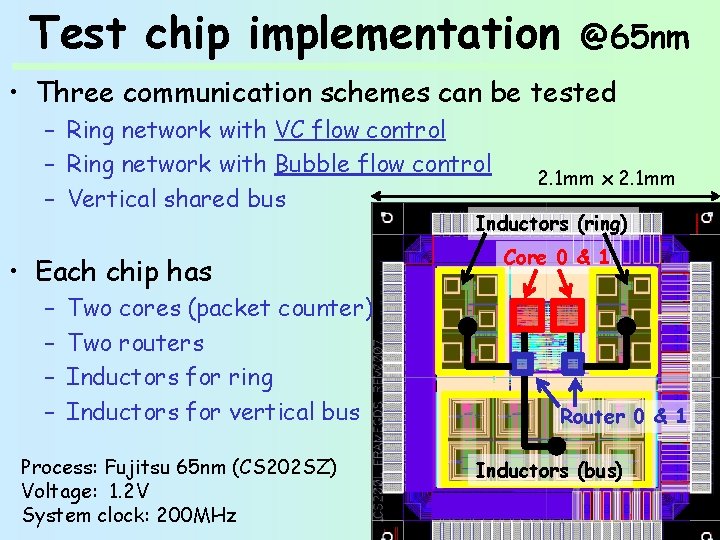
Test chip implementation @65 nm • Three communication schemes can be tested – Ring network with VC flow control – Ring network with Bubble flow control – Vertical shared bus 2. 1 mm x 2. 1 mm Inductors (ring) • Each chip has – – Two cores (packet counter) Two routers Inductors for ring Inductors for vertical bus Process: Fujitsu 65 nm (CS 202 SZ) Voltage: 1. 2 V System clock: 200 MHz Core 0 & 1 Router 0 & 1 Inductors (bus)
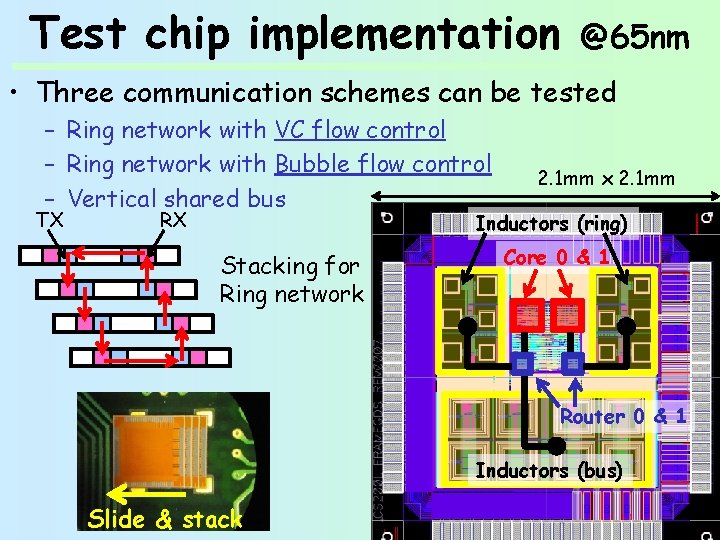
Test chip implementation @65 nm • Three communication schemes can be tested – Ring network with VC flow control – Ring network with Bubble flow control – Vertical shared bus TX RX 2. 1 mm x 2. 1 mm Inductors (ring) Stacking for Ring network Core 0 & 1 Router 0 & 1 Inductors (bus) Slide & stack
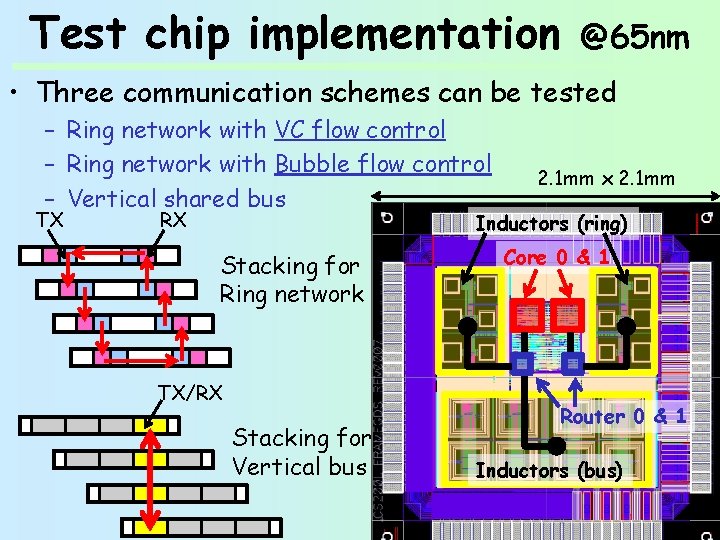
Test chip implementation @65 nm • Three communication schemes can be tested – Ring network with VC flow control – Ring network with Bubble flow control – Vertical shared bus TX RX 2. 1 mm x 2. 1 mm Inductors (ring) Stacking for Ring network TX/RX Stacking for Vertical bus Core 0 & 1 Router 0 & 1 Inductors (bus)
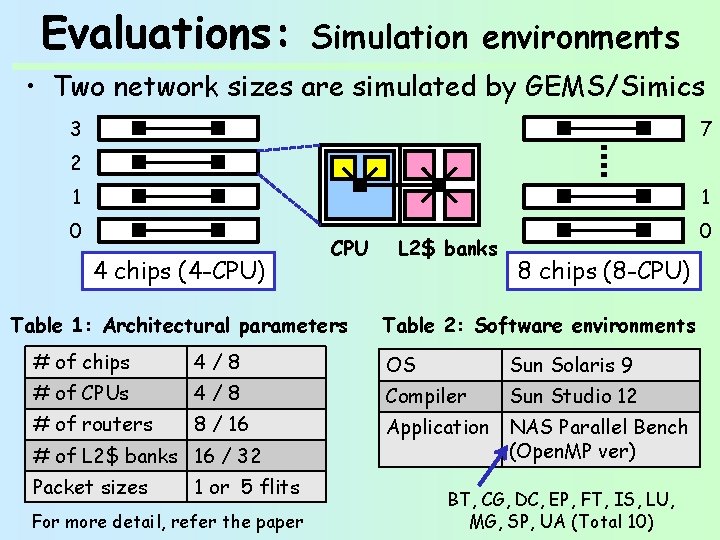
Evaluations: Simulation environments • Two network sizes are simulated by GEMS/Simics 3 7 2 1 1 0 0 4 chips (4 -CPU) CPU Table 1: Architectural parameters L 2$ banks 8 chips (8 -CPU) Table 2: Software environments # of chips 4/8 OS Sun Solaris 9 # of CPUs 4/8 Compiler Sun Studio 12 # of routers 8 / 16 Application NAS Parallel Bench (Open. MP ver) # of L 2$ banks 16 / 32 Packet sizes 1 or 5 flits For more detail, refer the paper BT, CG, DC, EP, FT, IS, LU, MG, SP, UA (Total 10)
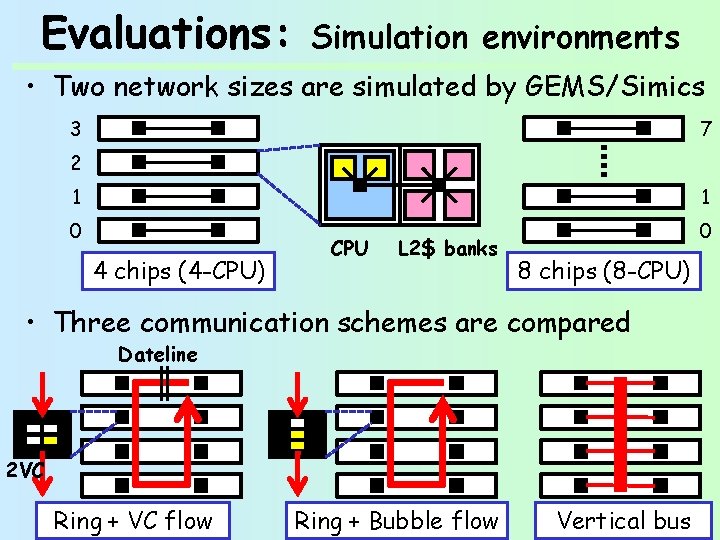
Evaluations: Simulation environments • Two network sizes are simulated by GEMS/Simics 3 7 2 1 1 0 0 4 chips (4 -CPU) CPU L 2$ banks 8 chips (8 -CPU) • Three communication schemes are compared Dateline 2 VC Ring + VC flow Ring + Bubble flow Vertical bus
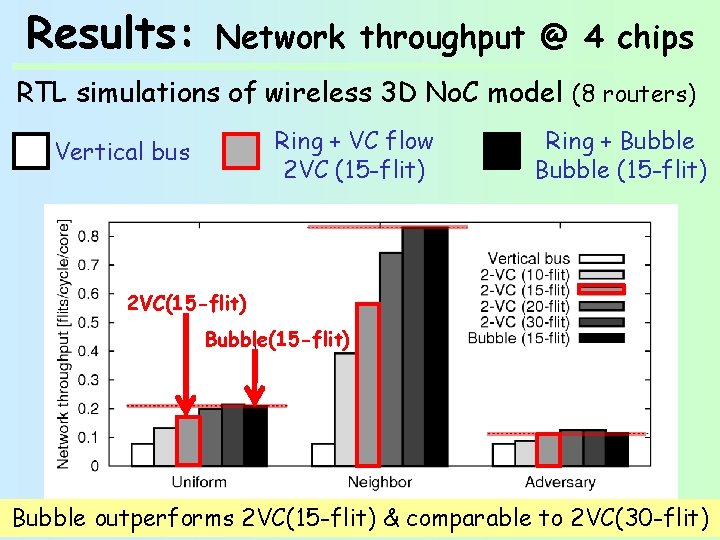
Results: Network throughput @ 4 chips RTL simulations of wireless 3 D No. C model (8 routers) Ring + VC flow 2 VC (15 -flit) Vertical bus Ring + Bubble (15 -flit) 2 VC(15 -flit) Bubble outperforms 2 VC(15 -flit) & comparable to 2 VC(30 -flit)
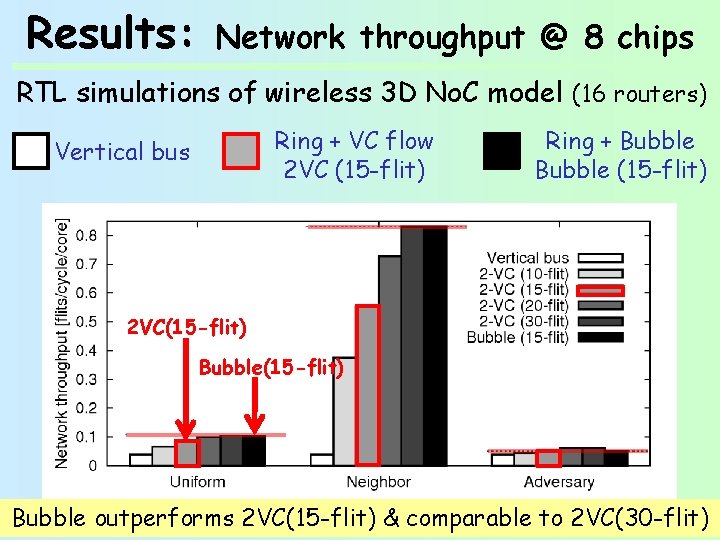
Results: Network throughput @ 8 chips RTL simulations of wireless 3 D No. C model (16 routers) Vertical bus Ring + VC flow 2 VC (15 -flit) Ring + Bubble (15 -flit) 2 VC(15 -flit) Bubble(15 -flit) Bubble outperforms 2 VC(15 -flit) & comparable to 2 VC(30 -flit)
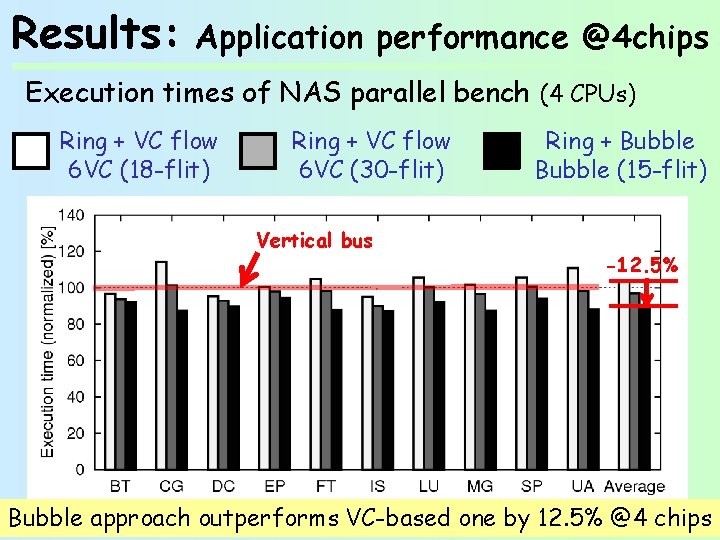
Results: Application performance @4 chips Execution times of NAS parallel bench (4 CPUs) Ring + VC flow 6 VC (18 -flit) Ring + VC flow 6 VC (30 -flit) Vertical bus Ring + Bubble (15 -flit) -12. 5% Bubble approach outperforms VC-based one by 12. 5% @4 chips
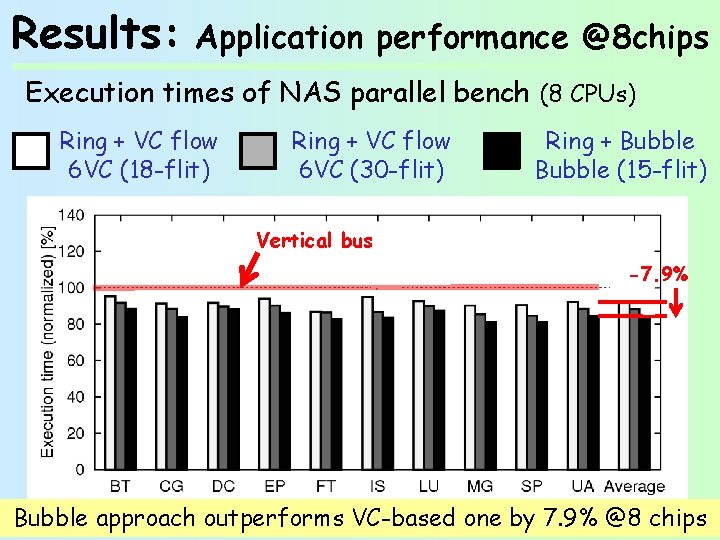
Results: Application performance @8 chips Execution times of NAS parallel bench (8 CPUs) Ring + VC flow 6 VC (18 -flit) Ring + VC flow 6 VC (30 -flit) Ring + Bubble (15 -flit) Vertical bus -7. 9% Bubble approach outperforms VC-based one by 7. 9% @8 chips
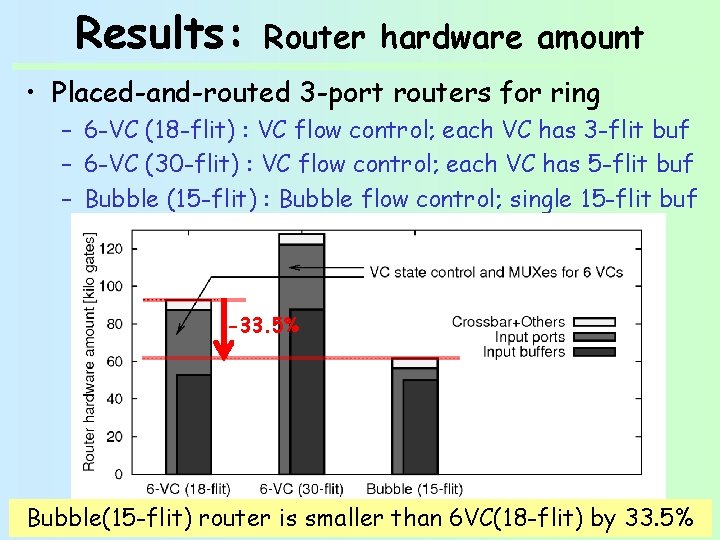
Results: Router hardware amount • Placed-and-routed 3 -port routers for ring – 6 -VC (18 -flit) : VC flow control; each VC has 3 -flit buf – 6 -VC (30 -flit) : VC flow control; each VC has 5 -flit buf – Bubble (15 -flit) : Bubble flow control; single 15 -flit buf -33. 5% Bubble(15 -flit) router is smaller than 6 VC(18 -flit) by 33. 5%
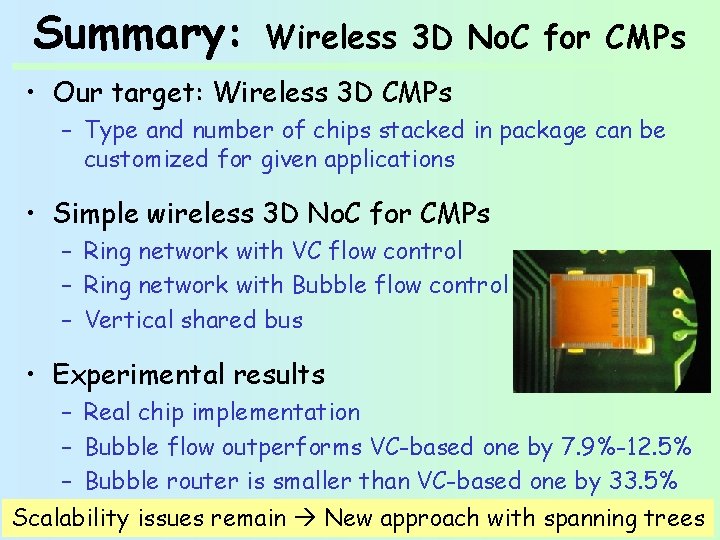
Summary: Wireless 3 D No. C for CMPs • Our target: Wireless 3 D CMPs – Type and number of chips stacked in package can be customized for given applications • Simple wireless 3 D No. C for CMPs – Ring network with VC flow control – Ring network with Bubble flow control – Vertical shared bus • Experimental results – Real chip implementation – Bubble flow outperforms VC-based one by 7. 9%-12. 5% – Bubble router is smaller than VC-based one by 33. 5% Scalability issues remain New approach with spanning trees
- Slides: 30