
A VERB PASSIVE FORM AGAIN A passive form
文法A VERB PASSIVE FORM! AGAIN!
文法A 復習をしましょう!どうやってpassive formを作りま すか。 Group 1 - Use ない form as a base and addれる.書 かない→書かれる 読まない→読まれる Group 2 – Just add られる to verb stem. (Same as potential!) 食べられる、寝られる Group 3 (exceptions) – 来られる、される *The sentence ending –てしまう is often used with passive for emphasis.
文法A Now for the new stuff… a. Direct passives are similar to English passives. The original active sentence is transitive with a direct object. In its passive construction, the original direct object becomes the subject and is marked with はorが. The subject of the original sentence is marked by に as it is now the one who is the actor or agent of the passive sentence.
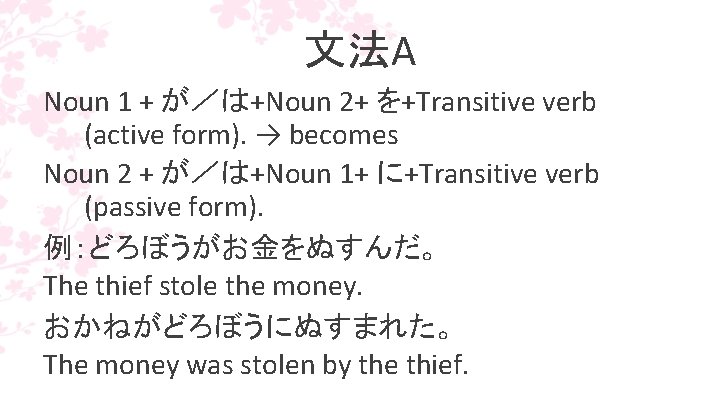
文法A Noun 1 + が/は+Noun 2+ を+Transitive verb (active form). → becomes Noun 2 + が/は+Noun 1+ に+Transitive verb (passive form). 例:どろぼうがお金をぬすんだ。 The thief stole the money. おかねがどろぼうにぬすまれた。 The money was stolen by the thief.
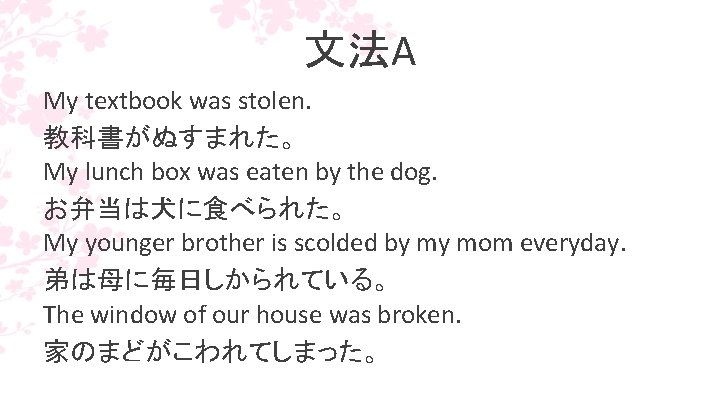
文法A My textbook was stolen. 教科書がぬすまれた。 My lunch box was eaten by the dog. お弁当は犬に食べられた。 My younger brother is scolded by my mom everyday. 弟は母に毎日しかられている。 The window of our house was broken. 家のまどがこわれてしまった。
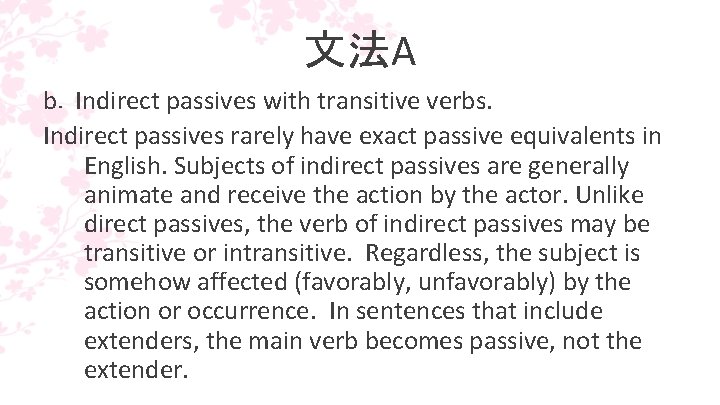
文法A b.Indirect passives with transitive verbs. Indirect passives rarely have exact passive equivalents in English. Subjects of indirect passives are generally animate and receive the action by the actor. Unlike direct passives, the verb of indirect passives may be transitive or intransitive. Regardless, the subject is somehow affected (favorably, unfavorably) by the action or occurrence. In sentences that include extenders, the main verb becomes passive, not the extender.
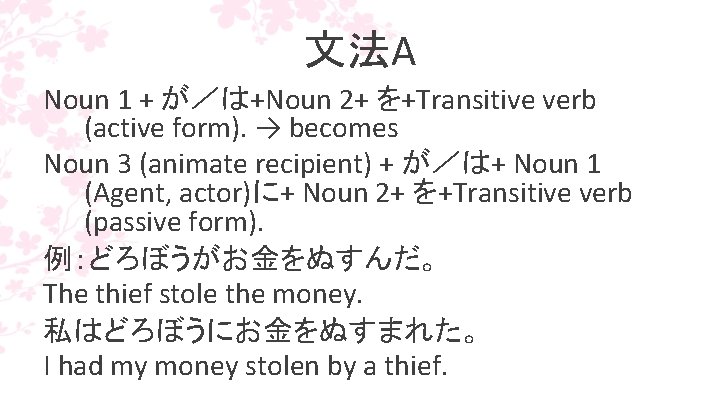
文法A Noun 1 + が/は+Noun 2+ を+Transitive verb (active form). → becomes Noun 3 (animate recipient) + が/は+ Noun 1 (Agent, actor)に+ Noun 2+ を+Transitive verb (passive form). 例:どろぼうがお金をぬすんだ。 The thief stole the money. 私はどろぼうにお金をぬすまれた。 I had my money stolen by a thief.
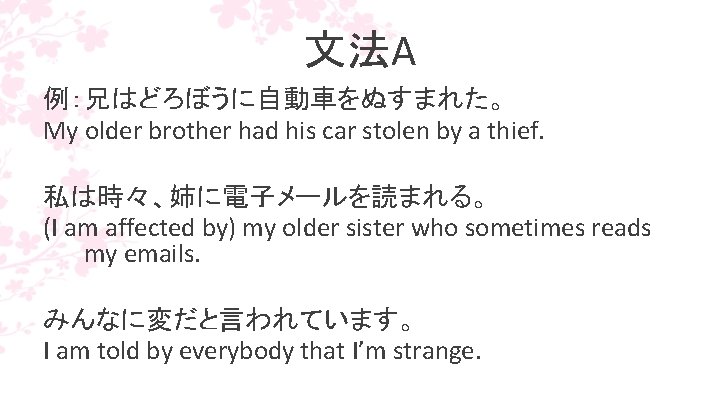
文法A 例:兄はどろぼうに自動車をぬすまれた。 My older brother had his car stolen by a thief. 私は時々、姉に電子メールを読まれる。 (I am affected by) my older sister who sometimes reads my emails. みんなに変だと言われています。 I am told by everybody that I’m strange.
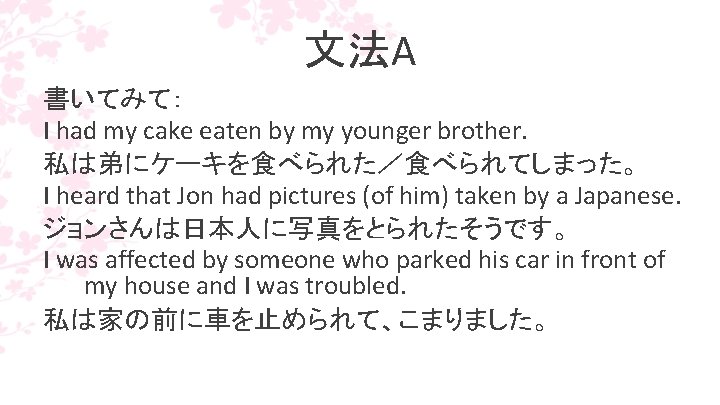
文法A 書いてみて: I had my cake eaten by my younger brother. 私は弟にケーキを食べられた/食べられてしまった。 I heard that Jon had pictures (of him) taken by a Japanese. ジョンさんは日本人に写真をとられたそうです。 I was affected by someone who parked his car in front of my house and I was troubled. 私は家の前に車を止められて、こまりました。
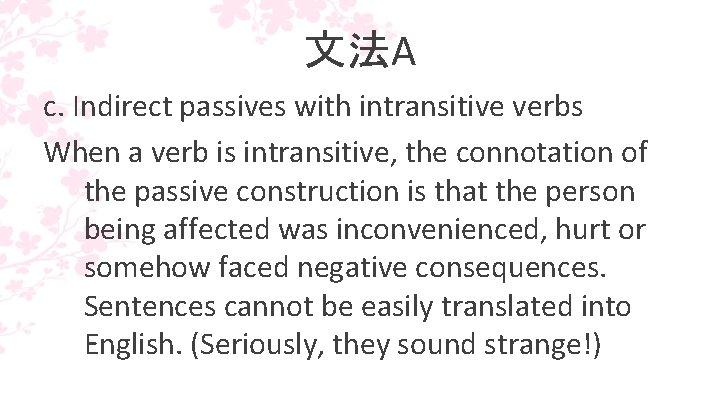
文法A c. Indirect passives with intransitive verbs When a verb is intransitive, the connotation of the passive construction is that the person being affected was inconvenienced, hurt or somehow faced negative consequences. Sentences cannot be easily translated into English. (Seriously, they sound strange!)
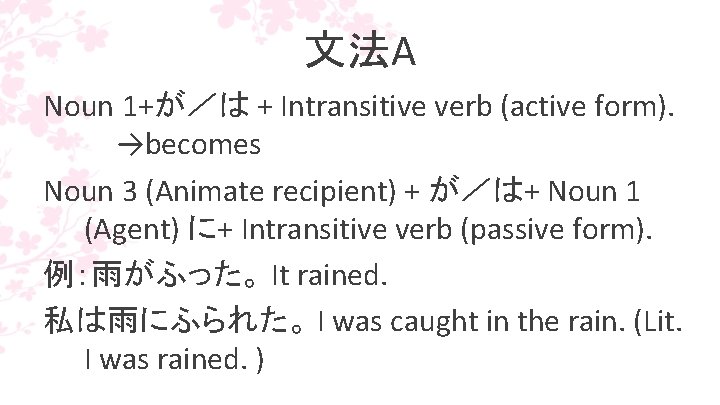
文法A Noun 1+が/は + Intransitive verb (active form). →becomes Noun 3 (Animate recipient) + が/は+ Noun 1 (Agent) に+ Intransitive verb (passive form). 例:雨がふった。 It rained. 私は雨にふられた。 I was caught in the rain. (Lit. I was rained. )
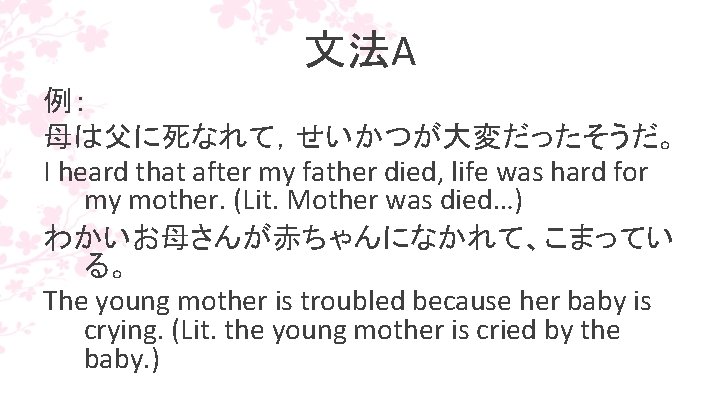
文法A 例: 母は父に死なれて,せいかつが大変だったそうだ。 I heard that after my father died, life was hard for my mother. (Lit. Mother was died…) わかいお母さんが赤ちゃんになかれて、こまってい る。 The young mother is troubled because her baby is crying. (Lit. the young mother is cried by the baby. )
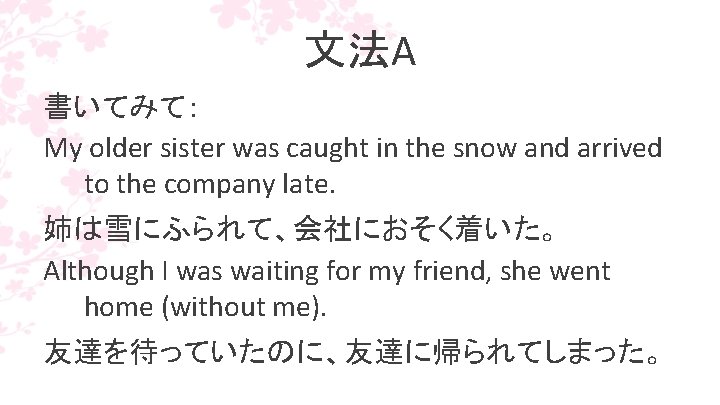
文法A 書いてみて: My older sister was caught in the snow and arrived to the company late. 姉は雪にふられて、会社におそく着いた。 Although I was waiting for my friend, she went home (without me). 友達を待っていたのに、友達に帰られてしまった。
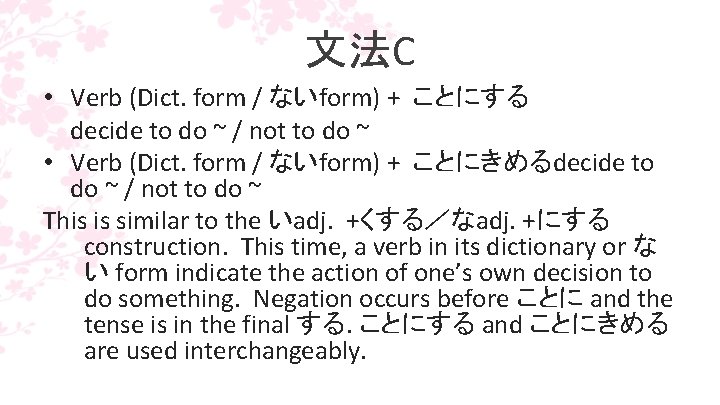
文法C • Verb (Dict. form / ないform) + ことにする decide to do ~ / not to do ~ • Verb (Dict. form / ないform) + ことにきめるdecide to do ~ / not to do ~ This is similar to the いadj. +くする/なadj. +にする construction. This time, a verb in its dictionary or な い form indicate the action of one’s own decision to do something. Negation occurs before ことに and the tense is in the final する. ことにする and ことにきめる are used interchangeably.
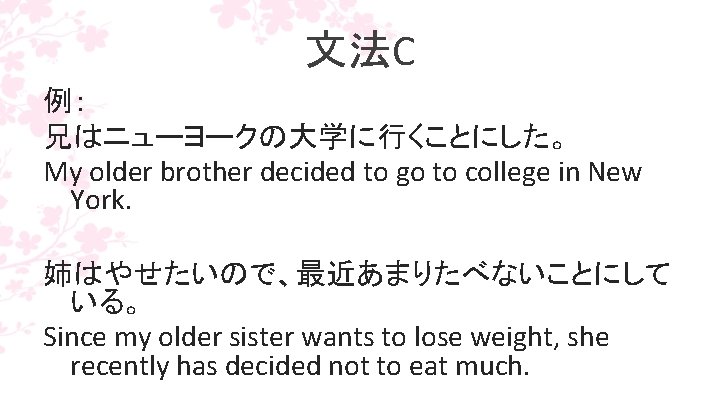
文法C 例: 兄はニューヨークの大学に行くことにした。 My older brother decided to go to college in New York. 姉はやせたいので、最近あまりたべないことにして いる。 Since my older sister wants to lose weight, she recently has decided not to eat much.
文法C • Verb (Dict. form / ないform) + ことになる has been decided to do ~ / not to do~ • Verb (Dict. form / ないform) + ことにきまる has been decided to do ~ / not to do いadj. +くなる/なadj. +になる construction. This time, a verb in its dictionary or ない form indicate the one’s obligation to do something. ことになる and ことにきま る are used interchangeably. Negation occurs before こ とに and the tense is in the final なる.
文法C This structure implies that the speaker is obligated or his doing something not entirely at his/her own will. 例: 学校でTシャツを着てはいけないことになった。 It has been decided that we can no longer wear t-shirts at school. ベンさんはほかの学校へ行くことになったそうだ。 I heard that it has been decided that Ben will go to another school.
文法C 書いてみて: It seems that it was decided to have the next game at our school. つぎの試合は私達の学校ですることに決まったら しい。 Because I got pregnant, it was decided that I would marry. にんしんしたので、結婚することにきまった/なった。
文法D なぜなら、〜からだ/です。 It’s because〜 なぜ(why) and なら(conditional “if”) combine to create a transition that begins a new sentence to explain the reason for the sentence that precedes it.
文法D The form preceding 〜からだ/ですnear the end of the sentence appears in the plain form. For nouns and な adjectives, use だ before 〜からだ /です. 例: 私は医者になりたいです。 なぜなら、病気の人達 をたすけたいからだ。 I want to become a doctor. It’s because I want to help sick people.
文法D 書いてみて: My grandfather decided to come to the U. S. It is because the U. S. is a free country. 祖父はアメリカに来ることにきめた。なぜなら、アメ リカは自由だからだ。 I decided to take Japanese as a foreign language. It’s because I love Japanese anime and manga. 私は外国語として日本語を取ることにした。なぜな ら、日本のアニメとまんがが好きだからだ。
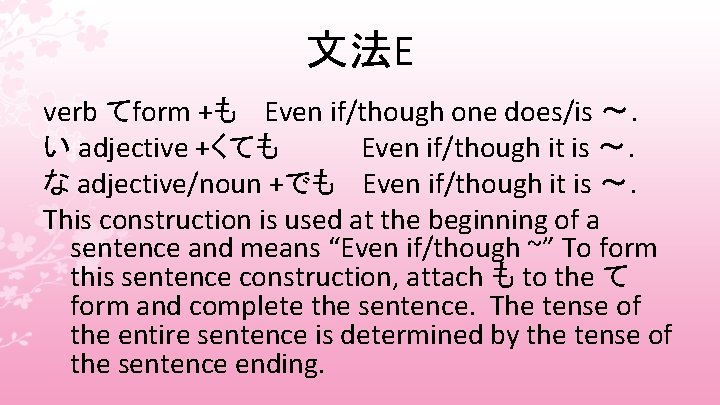
文法E verb てform +も Even if/though one does/is 〜. い adjective +くても Even if/though it is 〜. な adjective/noun +でも Even if/though it is 〜. This construction is used at the beginning of a sentence and means “Even if/though ~” To form this sentence construction, attach も to the て form and complete the sentence. The tense of the entire sentence is determined by the tense of the sentence ending.
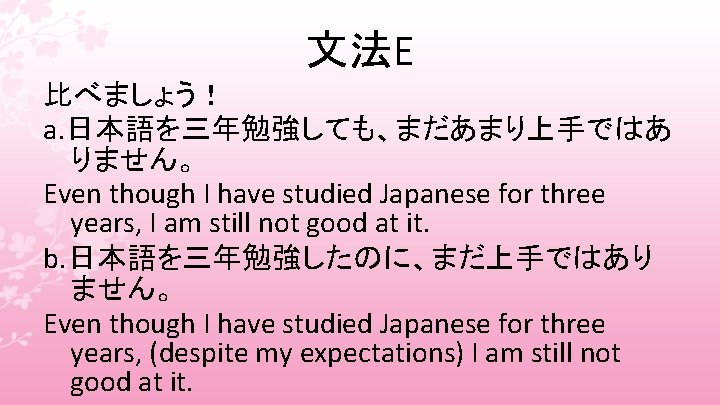
文法E 比べましょう! a. 日本語を三年勉強しても、まだあまり上手ではあ りません。 Even though I have studied Japanese for three years, I am still not good at it. b. 日本語を三年勉強したのに、まだ上手ではあり ません。 Even though I have studied Japanese for three years, (despite my expectations) I am still not good at it.
文法E The use of のに which you learned in J 3 suggests that you had expectations that were not met, or did turn out how you thought it might. The use of ても does not carry the implication of expectation.
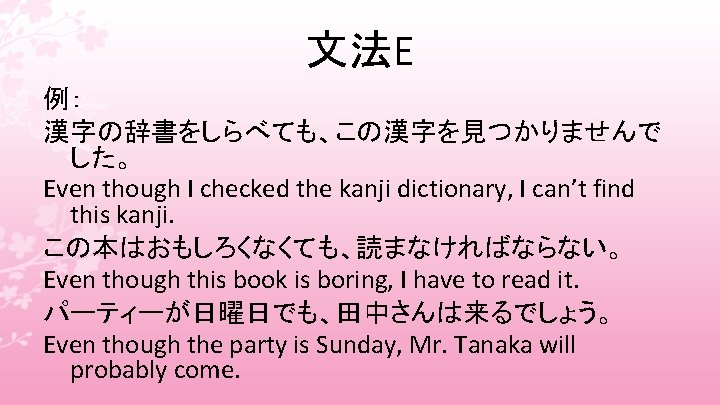
文法E 例: 漢字の辞書をしらべても、この漢字を見つかりませんで した。 Even though I checked the kanji dictionary, I can’t find this kanji. この本はおもしろくなくても、読まなければならない。 Even though this book is boring, I have to read it. パーティーが日曜日でも、田中さんは来るでしょう。 Even though the party is Sunday, Mr. Tanaka will probably come.
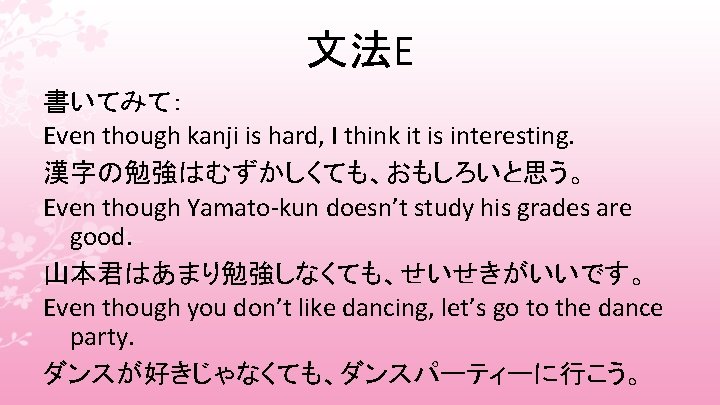
文法E 書いてみて: Even though kanji is hard, I think it is interesting. 漢字の勉強はむずかしくても、おもしろいと思う。 Even though Yamato-kun doesn’t study his grades are good. 山本君はあまり勉強しなくても、せいせきがいいです。 Even though you don’t like dancing, let’s go to the dance party. ダンスが好きじゃなくても、ダンスパーティーに行こう。
- Slides: 29