
A Vehicle for Collaboration The CAI Program Accomplishments
A Vehicle for Collaboration The CAI Program Accomplishments: Established an Industry / Government Team (U. S. Air Force, U. S. Navy, Boeing, Northrop Grumman, Lockheed Martin & GEAE) Provided the Forum for Competitors to Begin Sharing Data Defined Requirements, Planning and Goals Defined Cost Analysis Requirements Developed a Cost Analysis Tool - “CAICAT” Enabled Cost Analysis Tool Validation Verification Encouraged Cost Analysis Tool Acceptance & Utilization © 2002 Galorath Incorporated 1
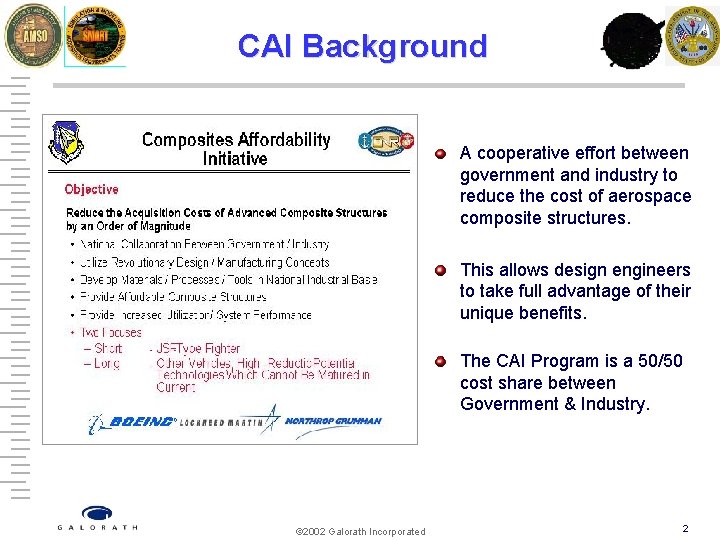
CAI Background A cooperative effort between government and industry to reduce the cost of aerospace composite structures. This allows design engineers to take full advantage of their unique benefits. The CAI Program is a 50/50 cost share between Government & Industry. © 2002 Galorath Incorporated 2
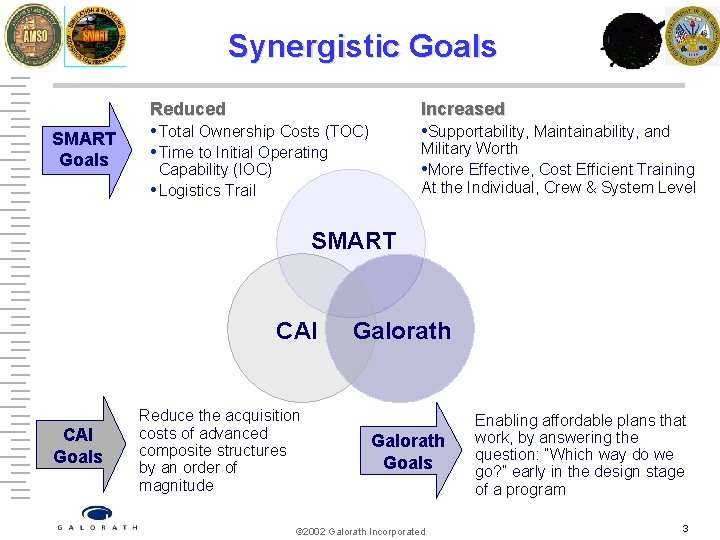
Synergistic Goals SMART Goals Reduced • Total Ownership Costs (TOC) fggf • Time to Initial Operating Increased • Supportability, Maintainability, and Military Worth • More Effective, Cost Efficient Training At the Individual, Crew & System Level Capability (IOC) • Logistics Trail SMART CAI Galorath dfd jljlj CAI Goals Reduce the acquisition costs of advanced composite structures by an order of magnitude Galorath Goals © 2002 Galorath Incorporated Enabling affordable plans that work, by answering the question: “Which way do we go? ” early in the design stage of a program 3
CAICAT Team Objectives Primary Objective Develop a credible and rapid cost evaluation system for a military airframe, that can address state-of-practice, stateof-the-art and emerging design & manufacturing technologies. The Customer The customer for CAICAT is a design integrated product team The Modules The CAICAT modules should work both standalone and as part of an integrated process The data and practices embedded in the CAICAT suite, and the default results of the CAICAT modules, should reflect an industry average The module inputs should be easily modified to reflect differences in design and manufacturing practices Each module should have ability to be enhanced or replaced as member of the CAICAT suite © 2002 Galorath Incorporated 4
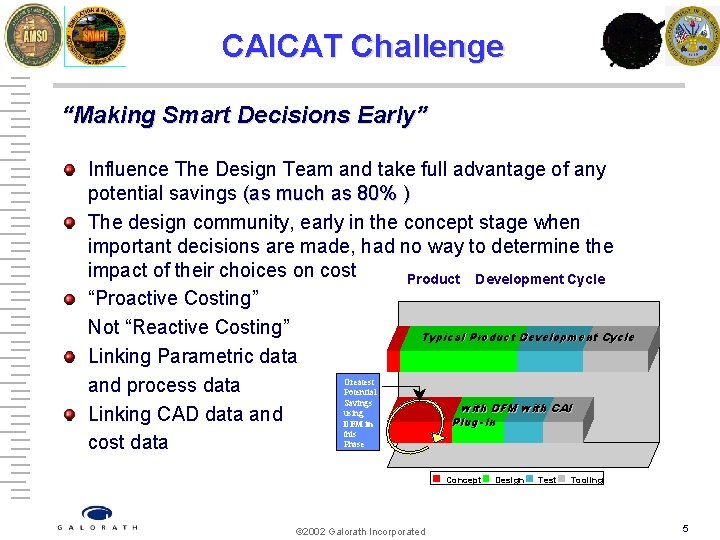
CAICAT Challenge “Making Smart Decisions Early” Influence The Design Team and take full advantage of any potential savings (as much as 80% ) The design community, early in the concept stage when important decisions are made, had no way to determine the impact of their choices on cost Product Development Cycle “Proactive Costing” Not “Reactive Costing” Typical Product Development Cycle Linking Parametric data Greatest and process data Potential Savings with DFM with CAI using Linking CAD data and Plug - In DFM in this Phase cost data Concept © 2002 Galorath Incorporated Design Test Tooling 5
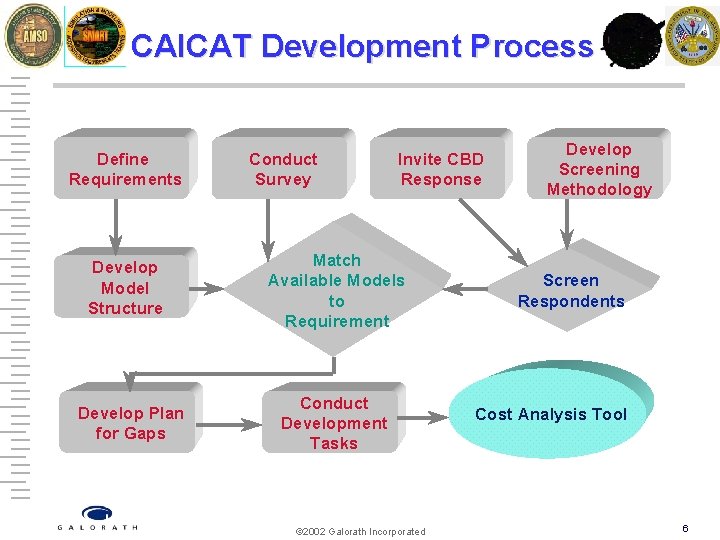
CAICAT Development Process Define Requirements Develop Model Structure Develop Plan for Gaps Conduct Survey Invite CBD Response Match Available Models to Requirement Conduct Development Tasks © 2002 Galorath Incorporated Develop Screening Methodology Screen Respondents Cost Analysis Tool 6
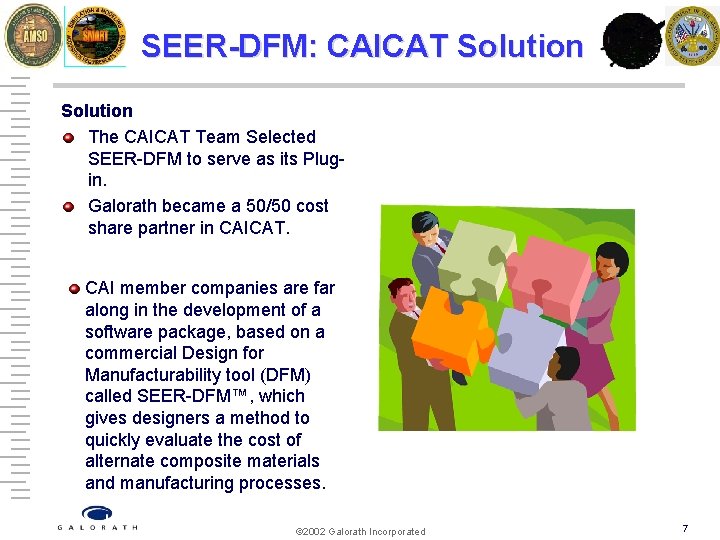
SEER-DFM: CAICAT Solution The CAICAT Team Selected SEER-DFM to serve as its Plugin. Galorath became a 50/50 cost share partner in CAICAT. CAI member companies are far along in the development of a software package, based on a commercial Design for Manufacturability tool (DFM) called SEER-DFM™, which gives designers a method to quickly evaluate the cost of alternate composite materials and manufacturing processes. © 2002 Galorath Incorporated 7
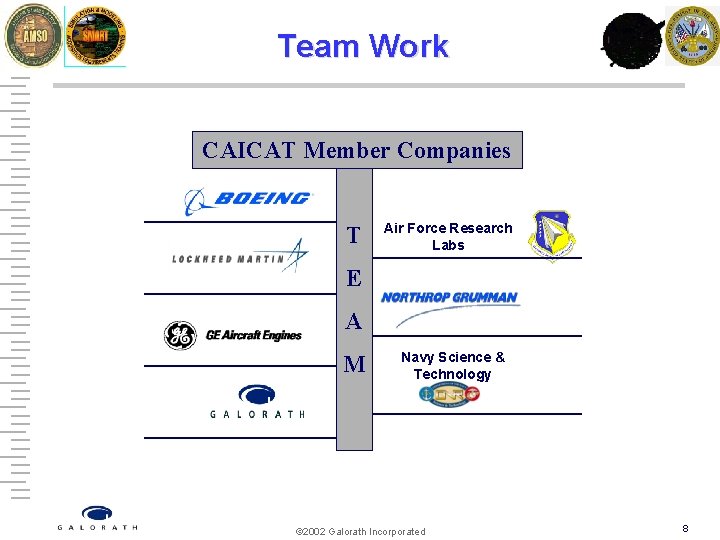
Team Work CAICAT Member Companies T Air Force Research Labs E A M Navy Science & Technology © 2002 Galorath Incorporated 8
Why SEER-DFM? Provides Design Team with the ability to make smart decisions from the “Back of the Napkin” to the CAD Program Phases, which reduces downstream manufacturing costs Provides the Design Team with Real Time Cost Feedback Shortens Development Cycle Provides a Cost Compass Documents Trade Study Process Increases Trades Quantity Multiple Site Collaboration Customization Via Plug-in © 2002 Galorath Incorporated COTS Solution Commercialization Expandable Auto Data Import/Export Linking to PDM’s 24/7 Support 9
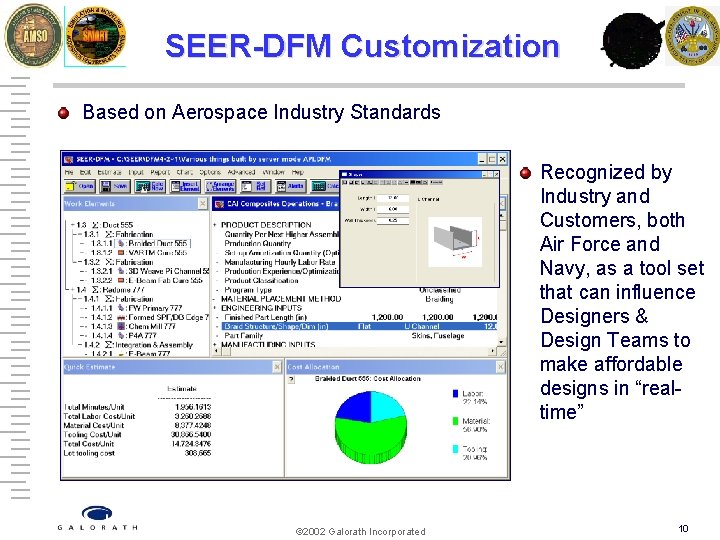
SEER-DFM Customization Based on Aerospace Industry Standards Recognized by Industry and Customers, both Air Force and Navy, as a tool set that can influence Designers & Design Teams to make affordable designs in “realtime” © 2002 Galorath Incorporated 10
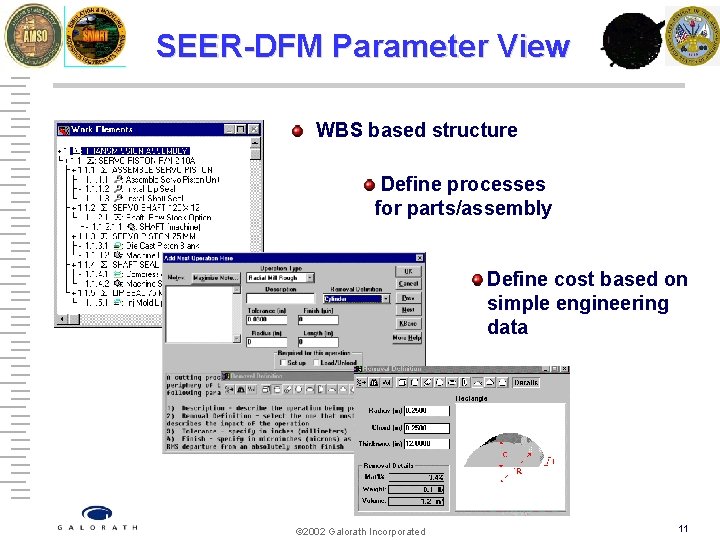
SEER-DFM Parameter View WBS based structure Define processes for parts/assembly Define cost based on simple engineering data © 2002 Galorath Incorporated 11
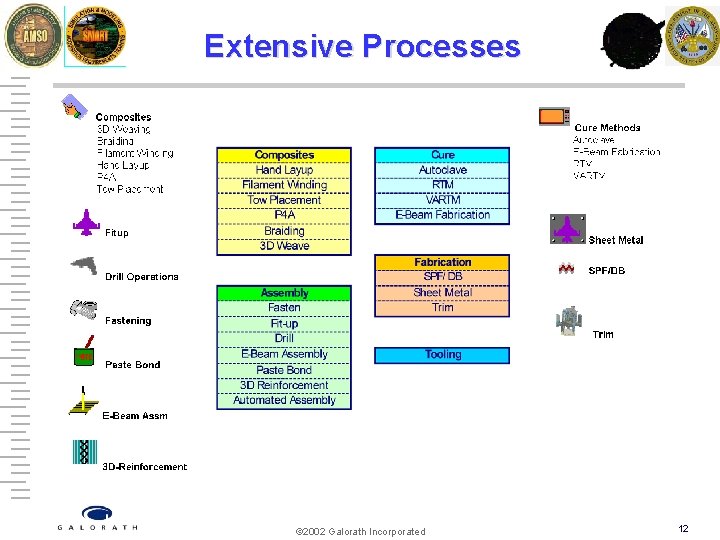
Extensive Processes © 2002 Galorath Incorporated 12
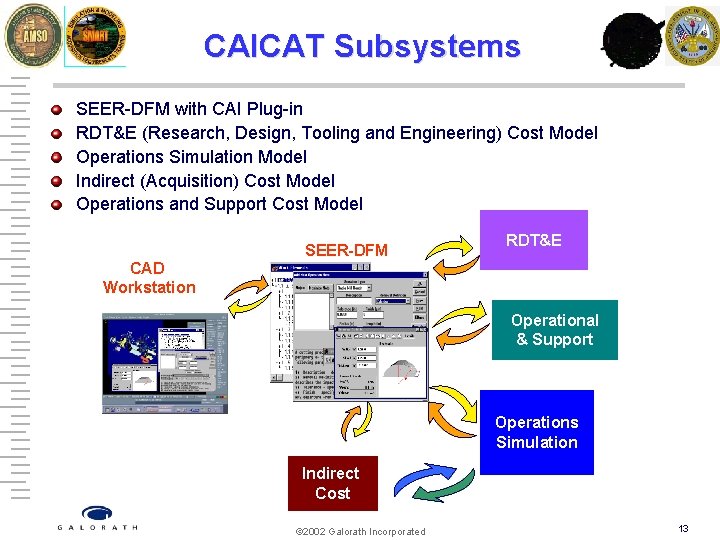
CAICAT Subsystems SEER-DFM with CAI Plug-in RDT&E (Research, Design, Tooling and Engineering) Cost Model Operations Simulation Model Indirect (Acquisition) Cost Model Operations and Support Cost Model SEER-DFM RDT&E CAD Workstation Operational & Support Operations Simulation Indirect Cost © 2002 Galorath Incorporated 13
Where Are We Now? CAICAT Status: The team is currently in phase 3 of its multi-phase program. In phase 2, the CAI program developed the contributing systems, or cost models, and a prototype integration of those models. The CAI program also developed a trial integration with CATIA and UNIGRAPHICS. The present task is intended for completion of the integration of the above models in a CAD (CATIA and UNIGRAPHICS) environment so that the entire system can be maintained and commercialized in the future. The industry participants and the government each have a variety of legacy tools, processes and data that must be integrated by each member to be directly useful within each member’s organization. © 2002 Galorath Incorporated 14
Conclusion Fostering Collaboration: A Success Story Although it’s difficult to attach an ROI to collaboration, the success of the CAI Team can easily be measured by its accomplishments, such as: Creating a forum for contractors to share data between each other; the first forum of its kind. Contractors sharing their data with the government agencies and model builders; another first of its kind. A suite of commercially available software tools for all of the U. S. industrial base to use Parametric based tools and process based tools linked together and sharing Data © 2002 Galorath Incorporated 15
Contact Information To Learn More J. P. Falque Product Director, Galorath Incorporated Tel: 480 -821 -9100 jfalque@galorath. com www. galorath. com © 2002 Galorath Incorporated 16
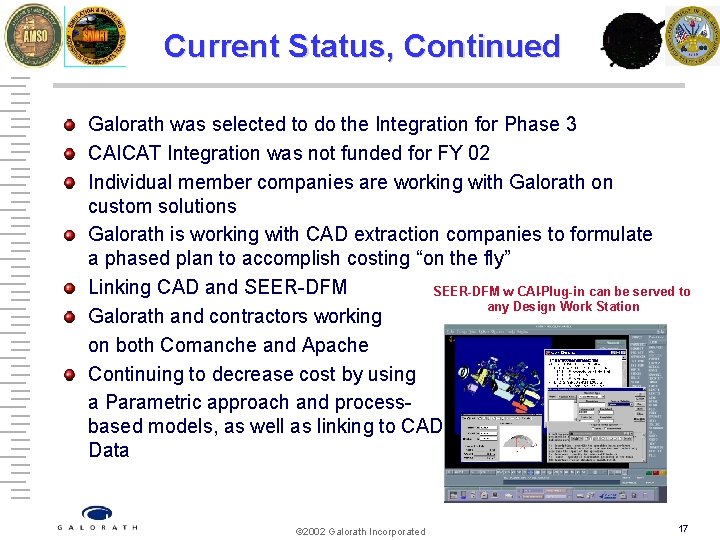
Current Status, Continued Galorath was selected to do the Integration for Phase 3 CAICAT Integration was not funded for FY 02 Individual member companies are working with Galorath on custom solutions Galorath is working with CAD extraction companies to formulate a phased plan to accomplish costing “on the fly” Linking CAD and SEER-DFM w CAI-Plug-in can be served to any Design Work Station Galorath and contractors working on both Comanche and Apache Continuing to decrease cost by using a Parametric approach and processbased models, as well as linking to CAD Data © 2002 Galorath Incorporated 17
Success in Design Affordability The building of specific design cost tool modules for the U. S Aerospace industry has become the foundation from which to begin the process of setting cost analysis standards and metrics. Through its effort, the CAI has: Produced a common approach to cost analysis which is a fundamental way to lower costs, inject change and project future cost with confidence. Proven the use of multiple techniques, such as parametric and process based estimating in conjunction with risk analysis, is not only possible but is encouraged. Set Goals to combine the use of commercially available solid or computer aided design models (CAD), parametric, process based and risk analysis cost modeling all integrated to work as one modeling space. © 2002 Galorath Incorporated 18
The Composites Affordability Initiative (CAI) The Benefits of Getting the U. S. Government and Airframe Producers to Cooperate ARMY /SMART Conference Salt Lake City, UT April 2002 By J. P. Falque Product Director, Galorath Incorporated
- Slides: 19