
A vector space with a basis B containing


A vector space with a basis B containing n vectors is isomorphic to Rn. ‘n’ is intrinsic property called Dimension
If a vector space V has a basis B = {b 1, … , bn}, then any set in V containing more than n vectors must be linearly dependent.
If a vector space V has a basis of n vectors, then every basis of V must consist of exactly n vectors.
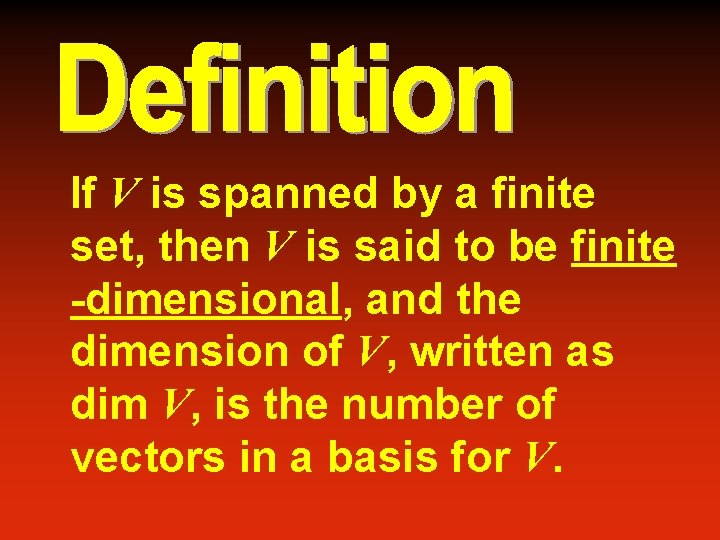
If V is spanned by a finite set, then V is said to be finite -dimensional, and the dimension of V, written as dim V, is the number of vectors in a basis for V.
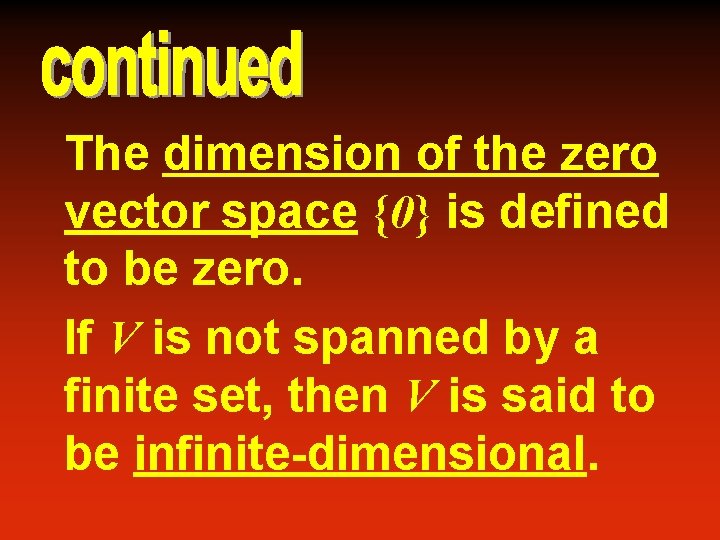
The dimension of the zero vector space {0} is defined to be zero. If V is not spanned by a finite set, then V is said to be infinite-dimensional.
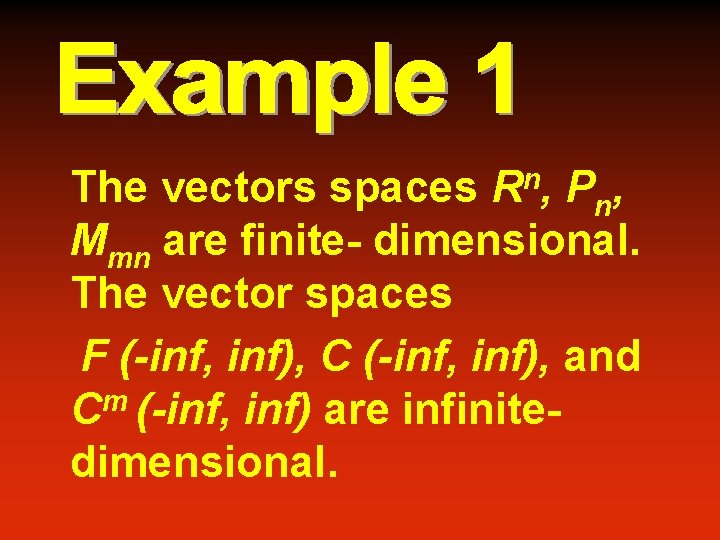
The vectors spaces Rn, Pn, Mmn are finite- dimensional. The vector spaces F (-inf, inf), C (-inf, inf), and m C (-inf, inf) are infinitedimensional.

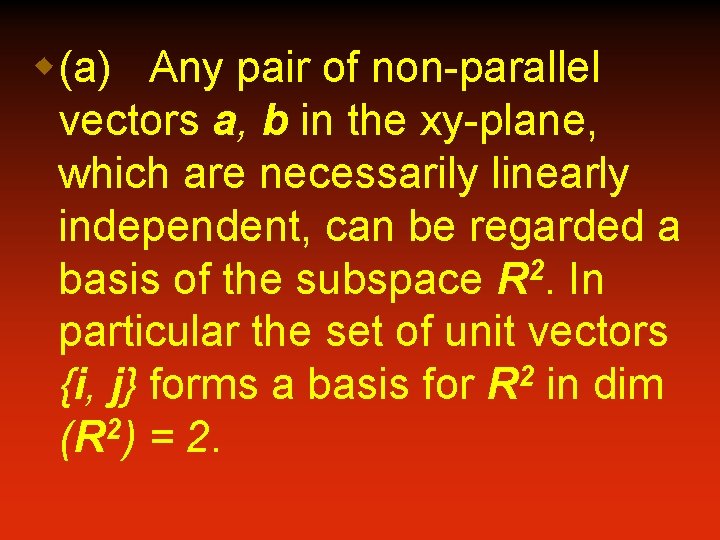
w(a) Any pair of non-parallel vectors a, b in the xy-plane, which are necessarily linearly independent, can be regarded a basis of the subspace R 2. In particular the set of unit vectors {i, j} forms a basis for R 2 in dim (R 2) = 2.
w Any set of three non coplanar vectors {a, b, c} in ordinary (physical) space, which will be necessarily linearly independent, span the space R 3. Therefore any set of such vectors forms a basis for R 3. In particular the set of unit vectors {i, j, k} forms a basis of R 3. This basis is called standard basis for R 3. Therefore dim (R 3) = 3.
w The set of vectors {e 1, e 2, …, en } where e 1 = (1, 0, 0, 0, …, 0), e 2 = (0, 1, 0, 0, …, 0) w e 3 = (0, 0, 1, 0, …, 0), …, en = (0, 0, …, 1) is linearly independent. Moreover any vector w x = (x 1, x 2 , …, xn) in Rn can be expressed as a linear combination of these vectors as w x = x 1 e 1 + x 2 e 2 + x 3 e 3 +…+ xnen. Hence the set {e 1, e 2, …, en} forms a basis for Rn. It is called the standard basis of Rn therefore dim (Rn) = n. Any other set of n linearly independent vectors in Rn will furnish a non-standard basis.
w(b) The set B = {1, x, , … n , x } forms a basis for the vector space Pn of polynomials of degree < n. It is called the standard basis n dim (P ) = n + 1 2 x
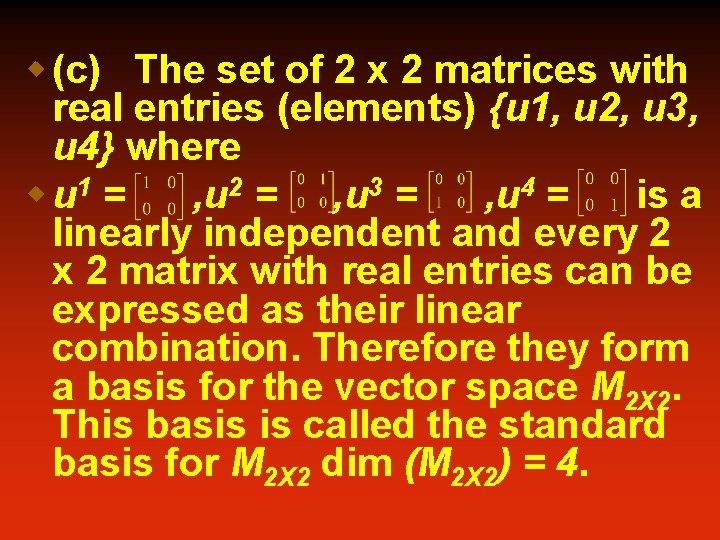
w (c) The set of 2 x 2 matrices with real entries (elements) {u 1, u 2, u 3, u 4} where w u 1 = , u 2 = , u 3 = , u 4 = is a linearly independent and every 2 x 2 matrix with real entries can be expressed as their linear combination. Therefore they form a basis for the vector space M 2 X 2. This basis is called the standard basis for M 2 X 2 dim (M 2 X 2) = 4.
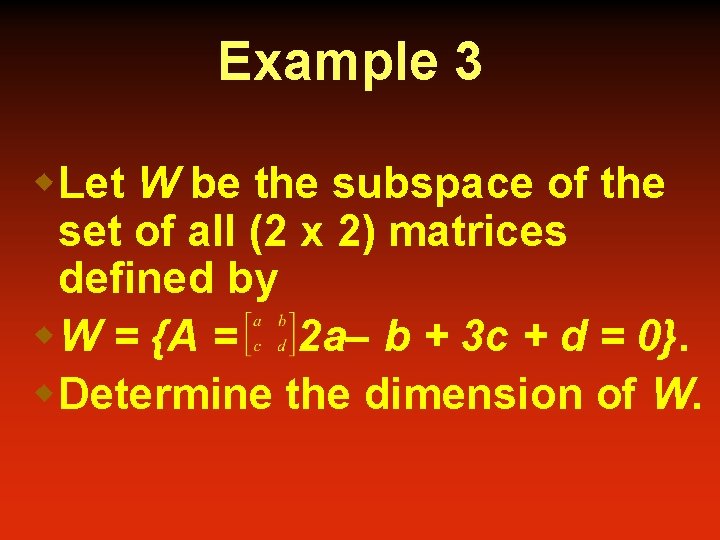
Example 3 w. Let W be the subspace of the set of all (2 x 2) matrices defined by w. W = {A = 2 a– b + 3 c + d = 0}. w. Determine the dimension of W.
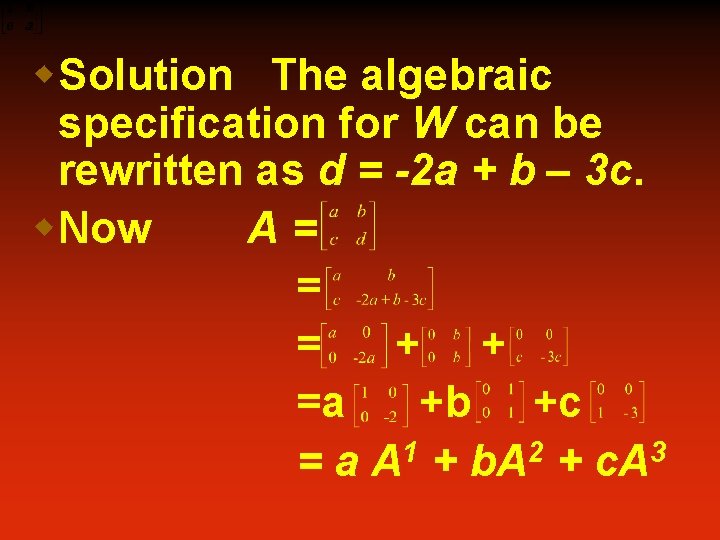
w. Solution The algebraic specification for W can be rewritten as d = -2 a + b – 3 c. w. Now A= = = + + =a +b +c = a A 1 + b. A 2 + c. A 3
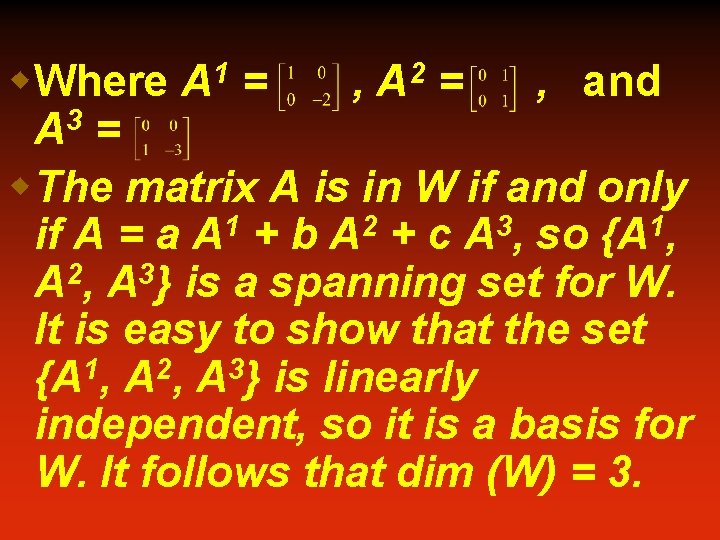
w. Where = , and A 3 = w. The matrix A is in W if and only if A = a A 1 + b A 2 + c A 3, so {A 1, 2 3 A , A } is a spanning set for W. It is easy to show that the set {A 1, A 2, A 3} is linearly independent, so it is a basis for W. It follows that dim (W) = 3. 1 A 2 A
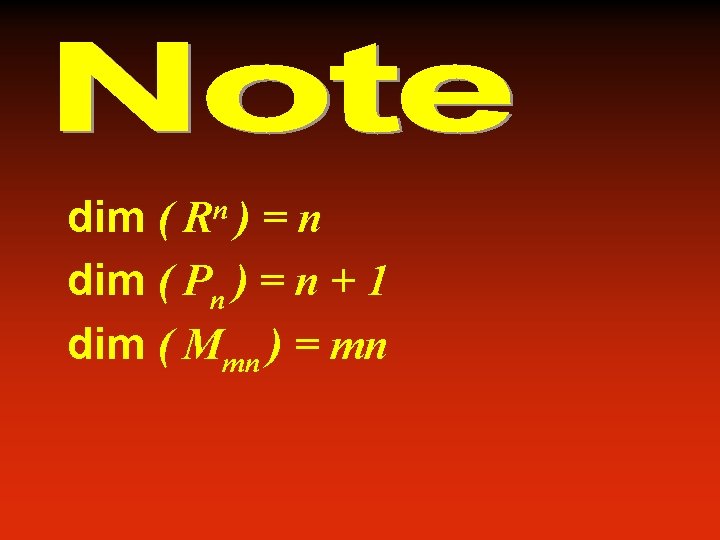
dim ( =n dim ( Pn ) = n + 1 dim ( Mmn ) = mn n R )


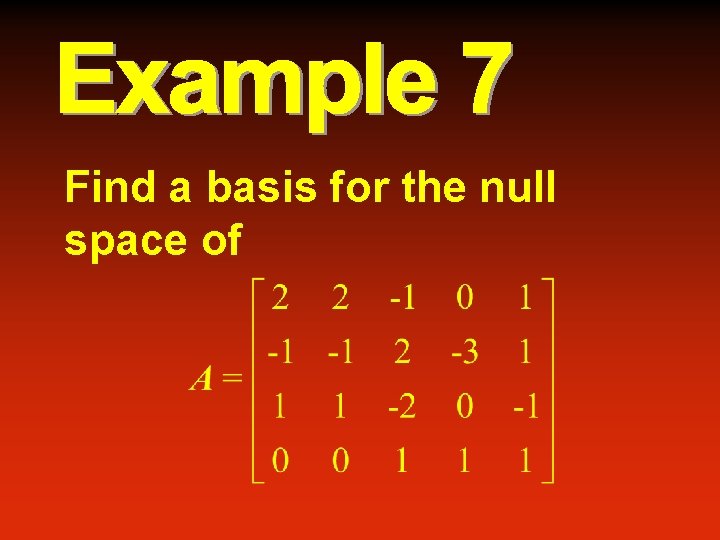
Find a basis for the null space of
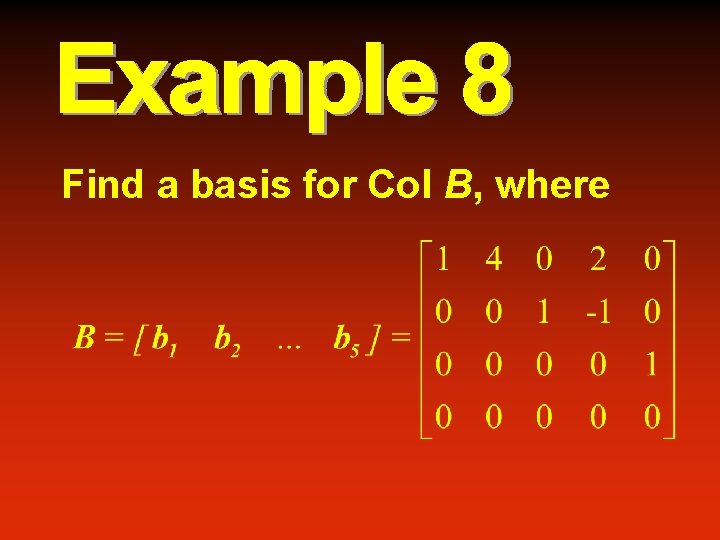
Find a basis for Col B, where
Elementary row operations on a matrix do not affect the linear dependence relations among the column of the matrix.
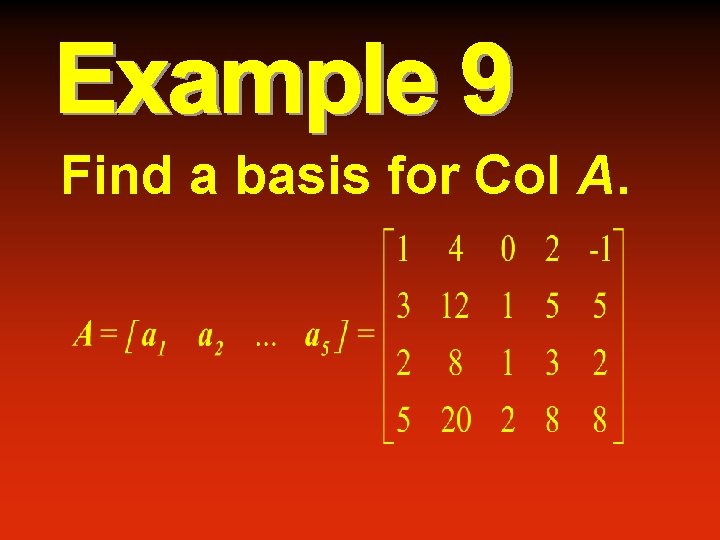
Find a basis for Col A.
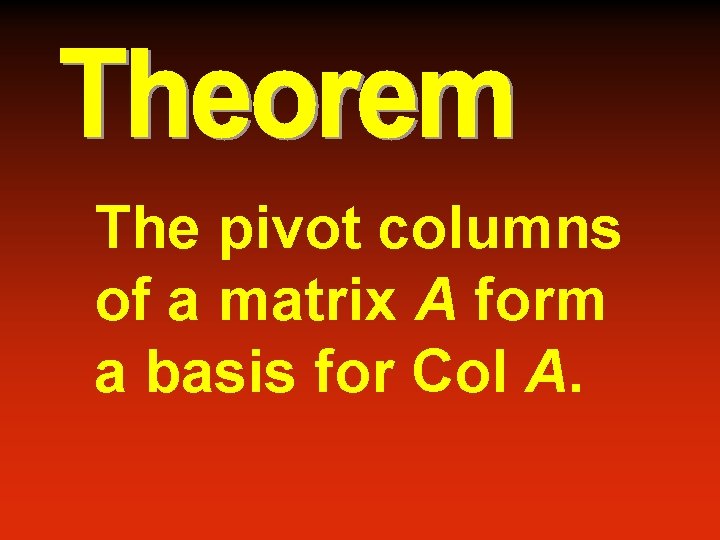
The pivot columns of a matrix A form a basis for Col A.
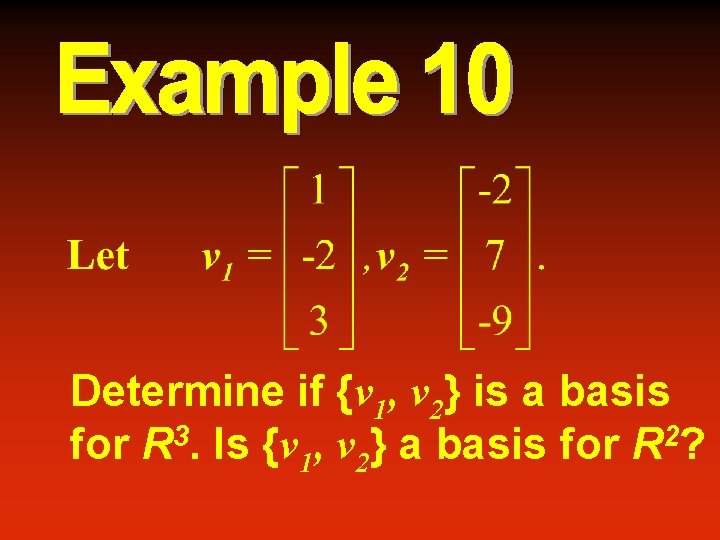
Determine if {v 1, v 2} is a basis for R 3. Is {v 1, v 2} a basis for R 2?
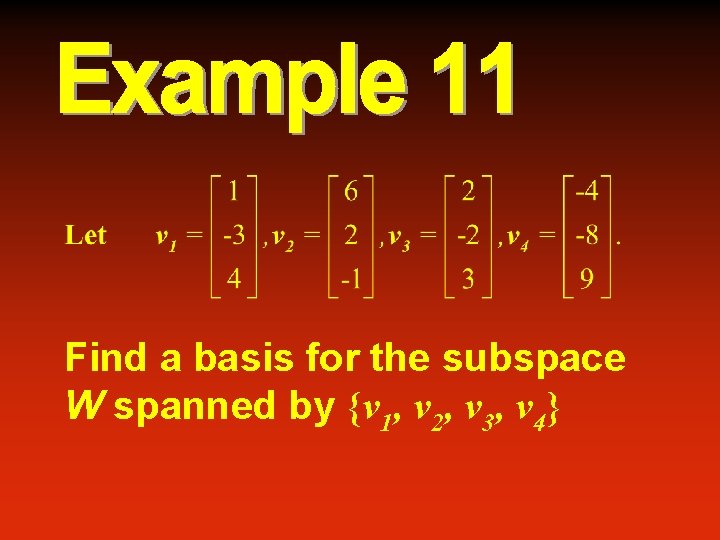
Find a basis for the subspace W spanned by {v 1, v 2, v 3, v 4}

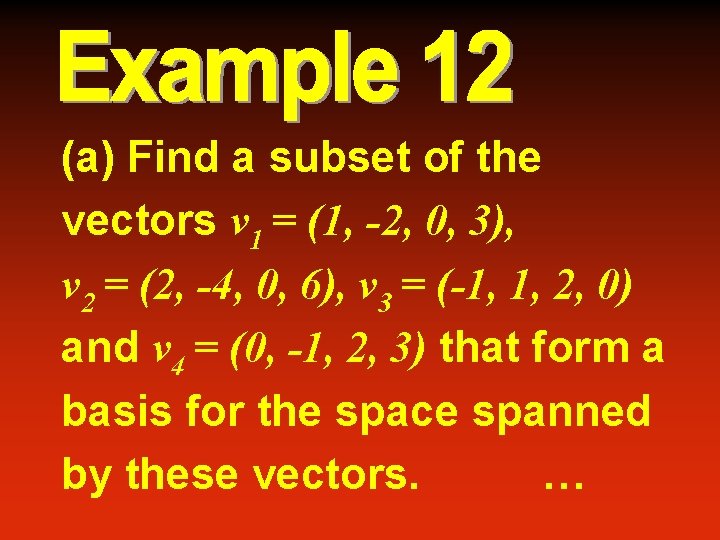
(a) Find a subset of the vectors v 1 = (1, -2, 0, 3), v 2 = (2, -4, 0, 6), v 3 = (-1, 1, 2, 0) and v 4 = (0, -1, 2, 3) that form a basis for the space spanned by these vectors. …
(b) Express each vector not in the basis as a linear combination of the basis vectors.
Theorem Let H be a subspace of a finite -dimensional vector space V. Any linearly independent set in H can be expanded, if necessary, to a basis for H. Also H is finite-dimensional and dim. H < dim. V

Let V be a p-dimensional vector space, p> 1. Any linearly independent set of exactly p elements in V is automatically a basis for V. Any set of exactly p elements that spans V is automatically a basis for V.

The dimension of Nul A is the number of free variables in the equation Ax = 0. The dimension of Col A is the number of pivot columns in A
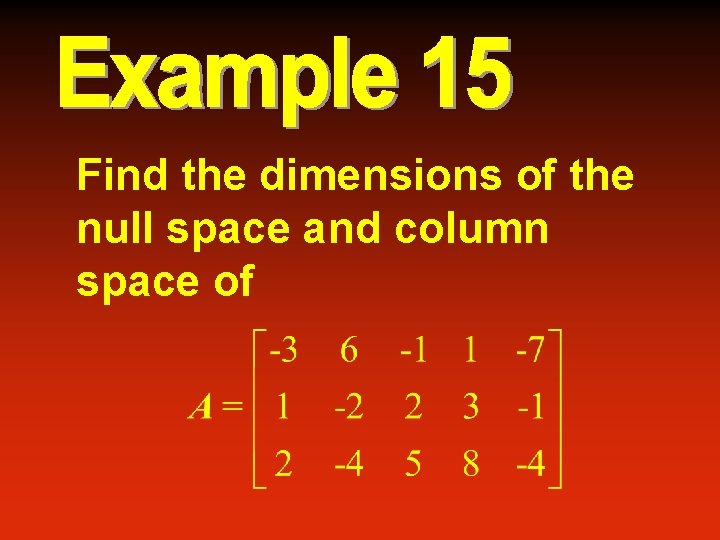
Find the dimensions of the null space and column space of
Decide whether each statement is true or false, and give a reason for each answer. Here V is a nonzero finite-dimensional vector space. …
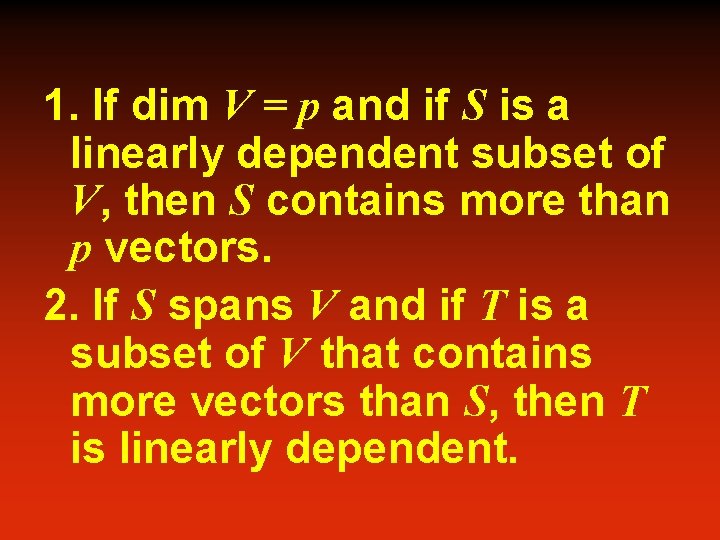
1. If dim V = p and if S is a linearly dependent subset of V, then S contains more than p vectors. 2. If S spans V and if T is a subset of V that contains more vectors than S, then T is linearly dependent.
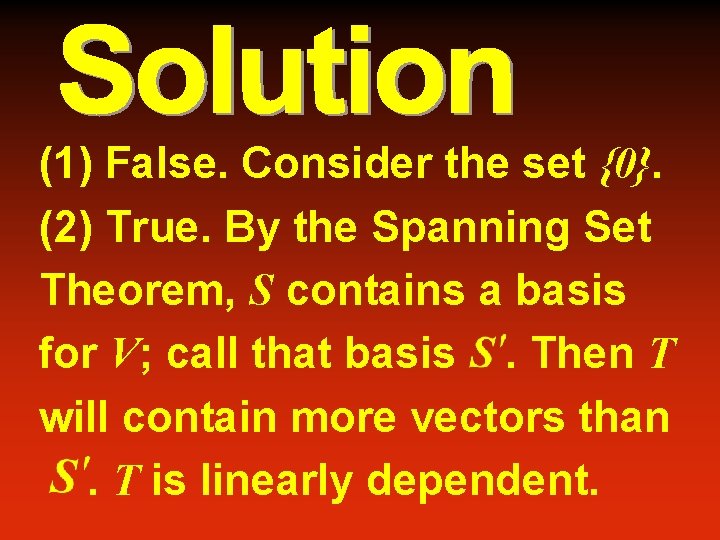
(1) False. Consider the set {0}. (2) True. By the Spanning Set Theorem, S contains a basis for V; call that basis. Then T will contain more vectors than. T is linearly dependent.
- Slides: 41