
A variety of intrinsic and extrinsic factors can
- Slides: 7
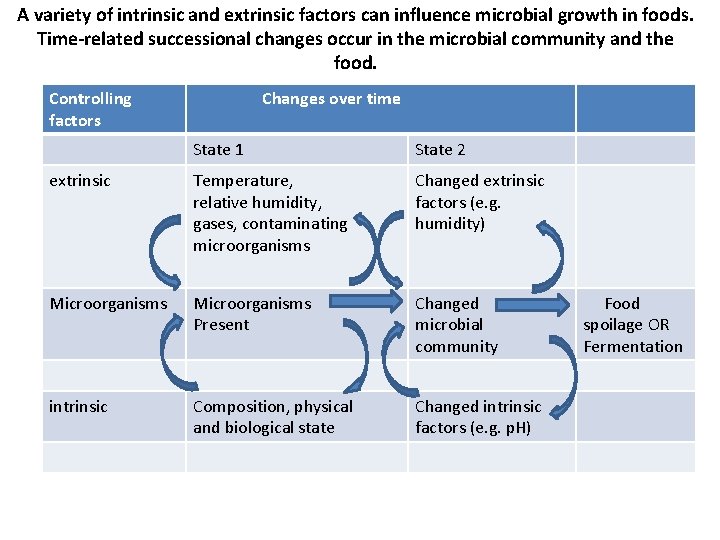
A variety of intrinsic and extrinsic factors can influence microbial growth in foods. Time-related successional changes occur in the microbial community and the food. Controlling factors Changes over time State 1 State 2 extrinsic Temperature, relative humidity, gases, contaminating microorganisms Changed extrinsic factors (e. g. humidity) Microorganisms Present Changed microbial community intrinsic Composition, physical and biological state Changed intrinsic factors (e. g. p. H) Food spoilage OR Fermentation
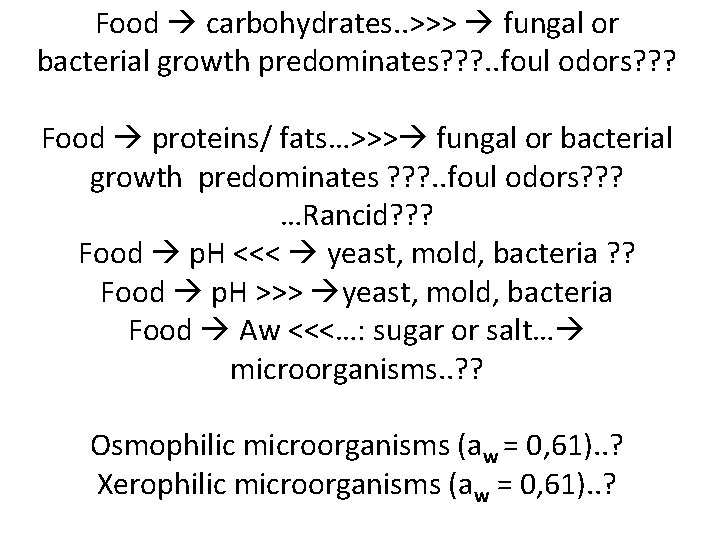
Food carbohydrates. . >>> fungal or bacterial growth predominates? ? ? . . foul odors? ? ? Food proteins/ fats…>>> fungal or bacterial growth predominates ? ? ? . . foul odors? ? ? …Rancid? ? ? Food p. H <<< yeast, mold, bacteria ? ? Food p. H >>> yeast, mold, bacteria Food Aw <<<…: sugar or salt… microorganisms. . ? ? Osmophilic microorganisms (aw = 0, 61). . ? Xerophilic microorganisms (aw = 0, 61). . ?
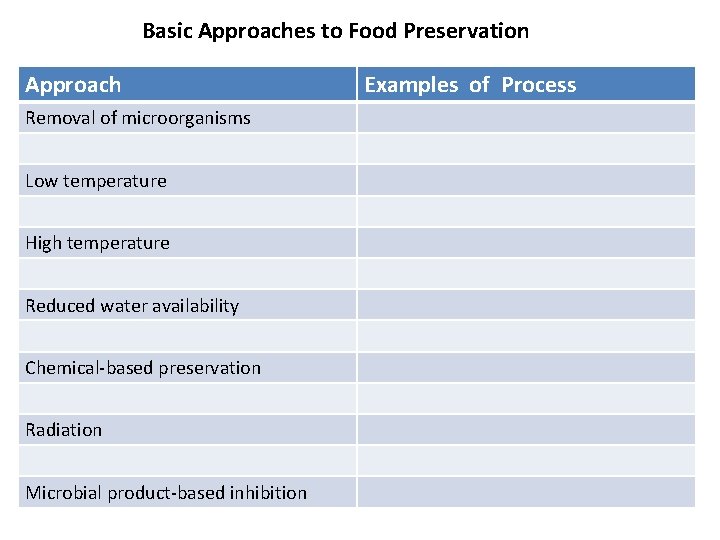
Basic Approaches to Food Preservation Approach Removal of microorganisms Low temperature High temperature Reduced water availability Chemical-based preservation Radiation Microbial product-based inhibition Examples of Process
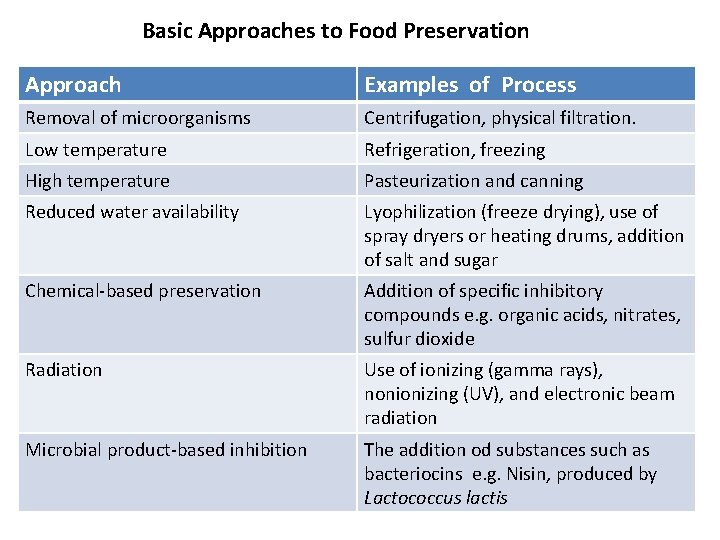
Basic Approaches to Food Preservation Approach Examples of Process Removal of microorganisms Centrifugation, physical filtration. Low temperature Refrigeration, freezing High temperature Pasteurization and canning Reduced water availability Lyophilization (freeze drying), use of spray dryers or heating drums, addition of salt and sugar Chemical-based preservation Addition of specific inhibitory compounds e. g. organic acids, nitrates, sulfur dioxide Radiation Use of ionizing (gamma rays), nonionizing (UV), and electronic beam radiation Microbial product-based inhibition The addition od substances such as bacteriocins e. g. Nisin, produced by Lactococcus lactis
Food Preservation : Physical processes…? Chemical processes…? Biological processes…?
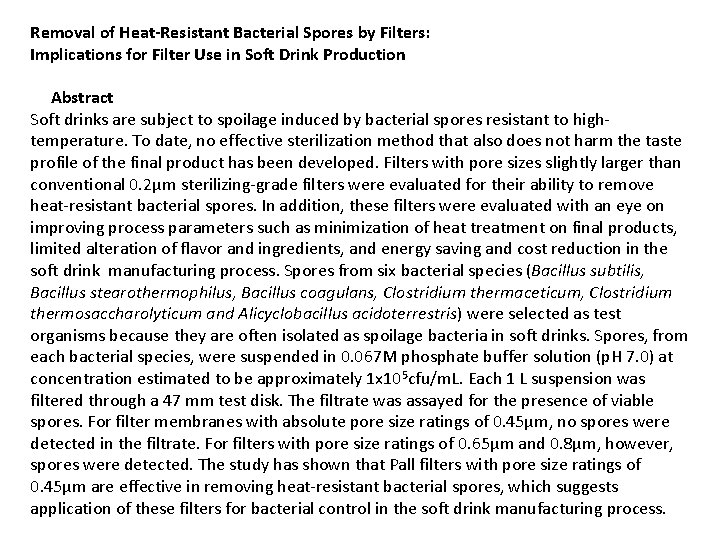
Removal of Heat-Resistant Bacterial Spores by Filters: Implications for Filter Use in Soft Drink Production Abstract Soft drinks are subject to spoilage induced by bacterial spores resistant to hightemperature. To date, no effective sterilization method that also does not harm the taste profile of the final product has been developed. Filters with pore sizes slightly larger than conventional 0. 2µm sterilizing-grade filters were evaluated for their ability to remove heat-resistant bacterial spores. In addition, these filters were evaluated with an eye on improving process parameters such as minimization of heat treatment on final products, limited alteration of flavor and ingredients, and energy saving and cost reduction in the soft drink manufacturing process. Spores from six bacterial species (Bacillus subtilis, Bacillus stearothermophilus, Bacillus coagulans, Clostridium thermaceticum, Clostridium thermosaccharolyticum and Alicyclobacillus acidoterrestris) were selected as test organisms because they are often isolated as spoilage bacteria in soft drinks. Spores, from each bacterial species, were suspended in 0. 067 M phosphate buffer solution (p. H 7. 0) at concentration estimated to be approximately 1 x 10⁵ cfu/m. L. Each 1 L suspension was filtered through a 47 mm test disk. The filtrate was assayed for the presence of viable spores. For filter membranes with absolute pore size ratings of 0. 45µm, no spores were detected in the filtrate. For filters with pore size ratings of 0. 65µm and 0. 8µm, however, spores were detected. The study has shown that Pall filters with pore size ratings of 0. 45µm are effective in removing heat-resistant bacterial spores, which suggests application of these filters for bacterial control in the soft drink manufacturing process.
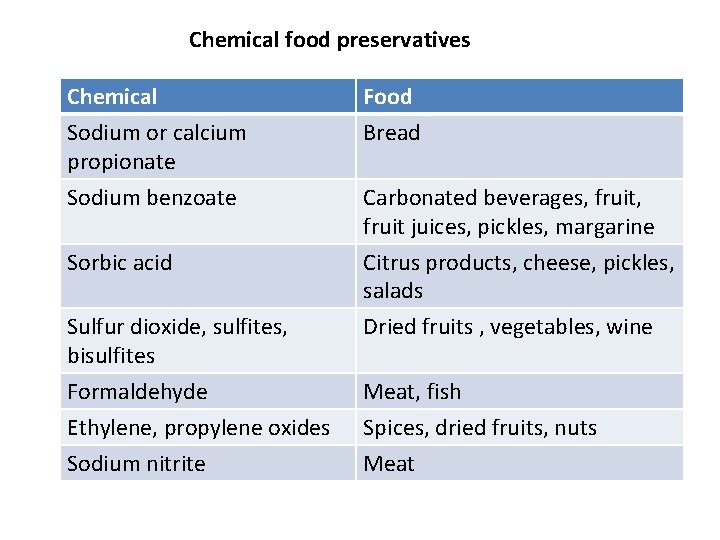
Chemical food preservatives Chemical Sodium or calcium propionate Sodium benzoate Food Bread Sorbic acid Citrus products, cheese, pickles, salads Sulfur dioxide, sulfites, bisulfites Formaldehyde Ethylene, propylene oxides Dried fruits , vegetables, wine Sodium nitrite Meat Carbonated beverages, fruit juices, pickles, margarine Meat, fish Spices, dried fruits, nuts