
A variable is a letter or a symbol
A variable is a letter or a symbol used to represent a value that can change. A constant is a value that does not change. A numerical expression contains only constants and operations. An algebraic expression may contain variables, constants, and operations.
An equation is a mathematical statement that two expressions are equal. A solution of an equation is a value of the variable that makes the equation true. To find solutions, isolate the variable. A variable is isolated when it appears by itself on one side of an equation, and not at all on the other side.
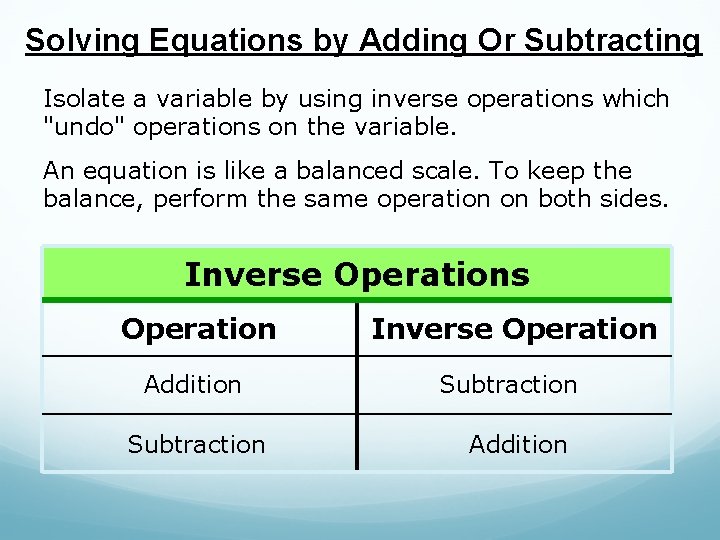
Solving Equations by Adding Or Subtracting Isolate a variable by using inverse operations which "undo" operations on the variable. An equation is like a balanced scale. To keep the balance, perform the same operation on both sides. Inverse Operations Operation Inverse Operation Addition Subtraction Addition
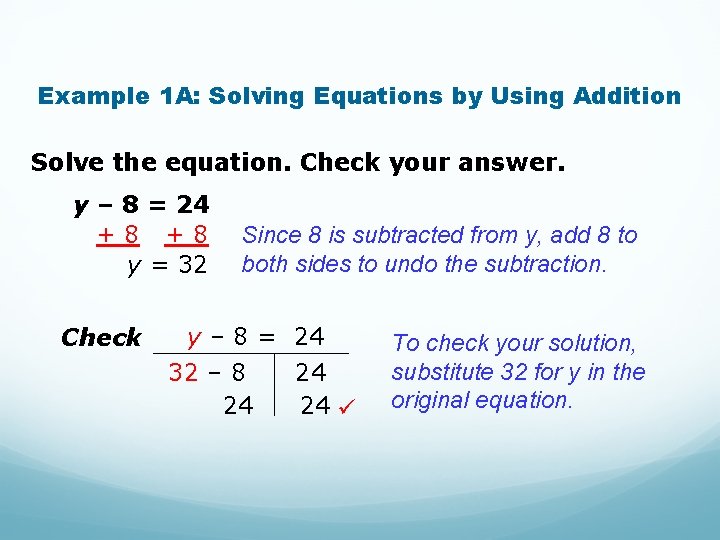
Example 1 A: Solving Equations by Using Addition Solve the equation. Check your answer. y – 8 = 24 +8 +8 y = 32 Check Since 8 is subtracted from y, add 8 to both sides to undo the subtraction. y – 8 = 24 32 – 8 24 24 24 To check your solution, substitute 32 for y in the original equation.
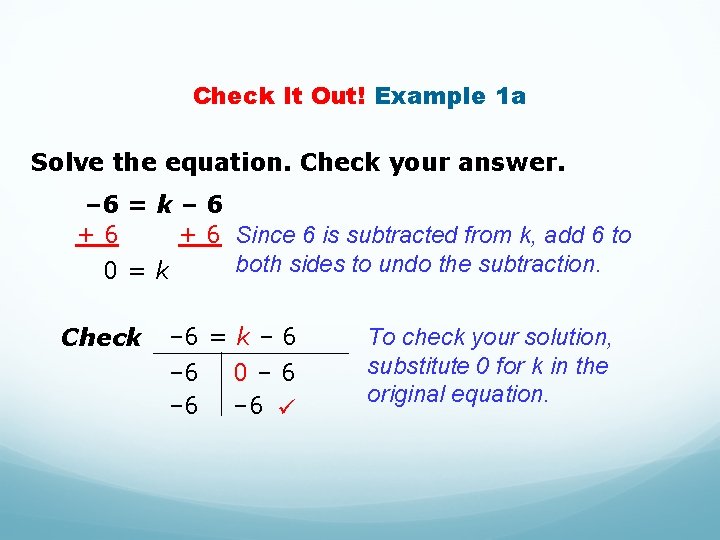
Check It Out! Example 1 a Solve the equation. Check your answer. – 6 = k – 6 +6 + 6 Since 6 is subtracted from k, add 6 to both sides to undo the subtraction. 0=k Check – 6 = k – 6 0 – 6 – 6 To check your solution, substitute 0 for k in the original equation.
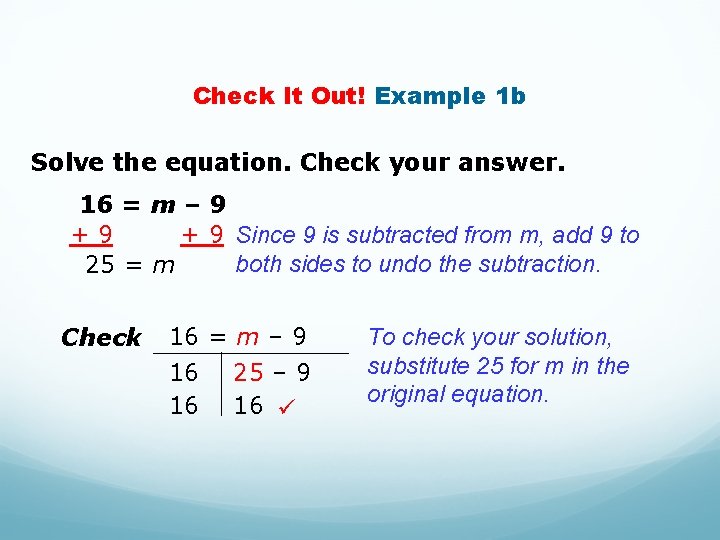
Check It Out! Example 1 b Solve the equation. Check your answer. 16 = m – 9 +9 + 9 Since 9 is subtracted from m, add 9 to both sides to undo the subtraction. 25 = m Check 16 = m – 9 16 25 – 9 16 16 To check your solution, substitute 25 for m in the original equation.
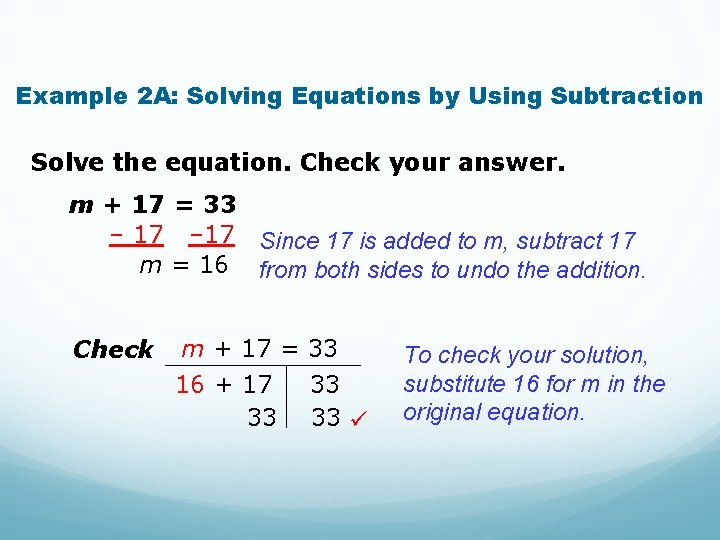
Example 2 A: Solving Equations by Using Subtraction Solve the equation. Check your answer. m + 17 = 33 – 17 Since 17 is added to m, subtract 17 m = 16 from both sides to undo the addition. Check m + 17 = 33 16 + 17 33 33 33 To check your solution, substitute 16 for m in the original equation.
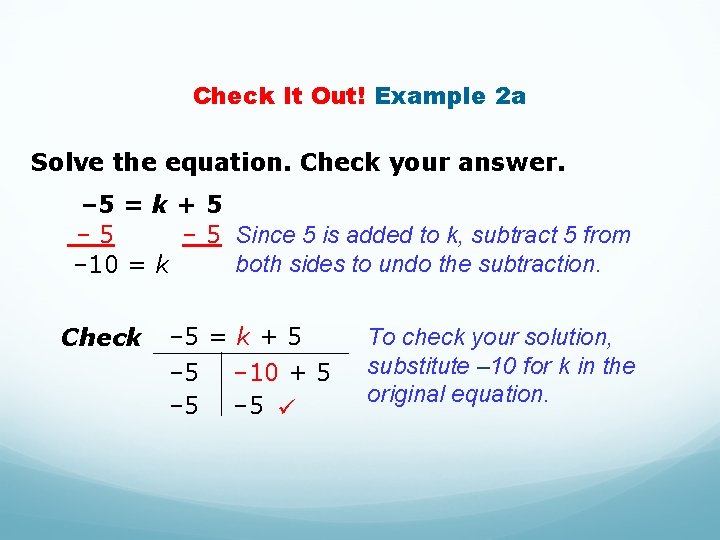
Check It Out! Example 2 a Solve the equation. Check your answer. – 5 = k + 5 – 5 Since 5 is added to k, subtract 5 from both sides to undo the subtraction. – 10 = k Check – 5 = k + 5 – 10 + 5 – 5 To check your solution, substitute – 10 for k in the original equation.
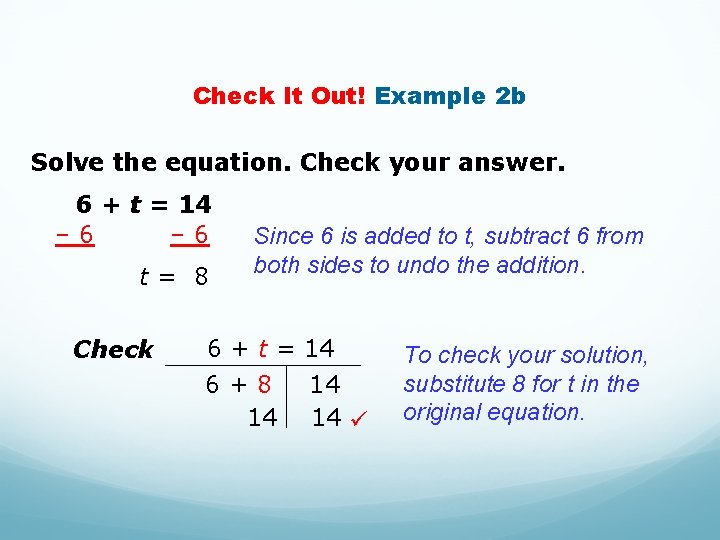
Check It Out! Example 2 b Solve the equation. Check your answer. 6 + t = 14 – 6 t= 8 Check Since 6 is added to t, subtract 6 from both sides to undo the addition. 6 + t = 14 6+8 14 14 14 To check your solution, substitute 8 for t in the original equation.
Remember that subtracting is the same as adding the opposite. When solving equations, you will sometimes find it easier to add an opposite to both sides instead of subtracting.
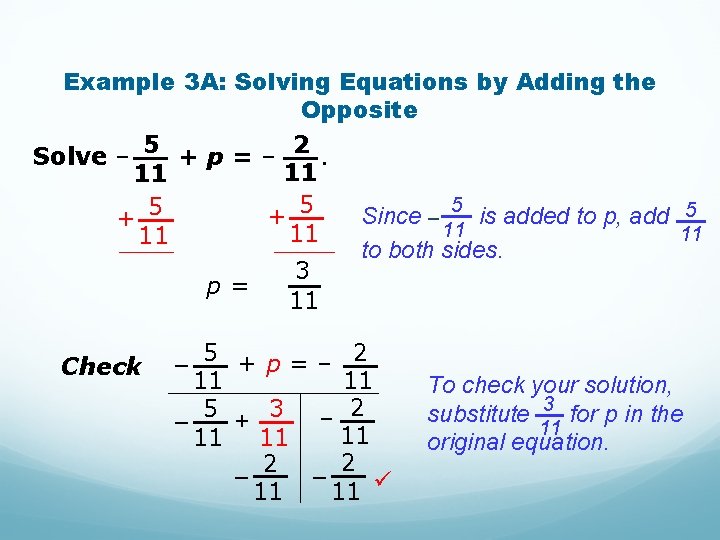
Example 3 A: Solving Equations by Adding the Opposite 2. Solve – 5 + p = – 11 11 5 5 5 Since – is added to p, add 5 + + 11 11 to both sides. 3 p= 11 Check – 5 +p=– 2 11 11 2 5 3 – – + 11 11 11 2 2 – – 11 To check your solution, substitute 3 for p in the 11 original equation.
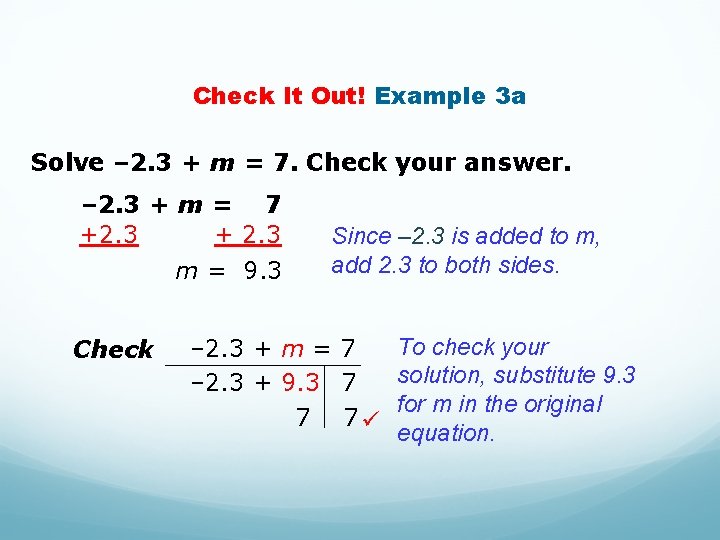
Check It Out! Example 3 a Solve – 2. 3 + m = 7. Check your answer. – 2. 3 + m = 7 +2. 3 + 2. 3 m = 9. 3 Check Since – 2. 3 is added to m, add 2. 3 to both sides. To check your – 2. 3 + m = 7 solution, substitute 9. 3 – 2. 3 + 9. 3 7 for m in the original 7 7 equation.
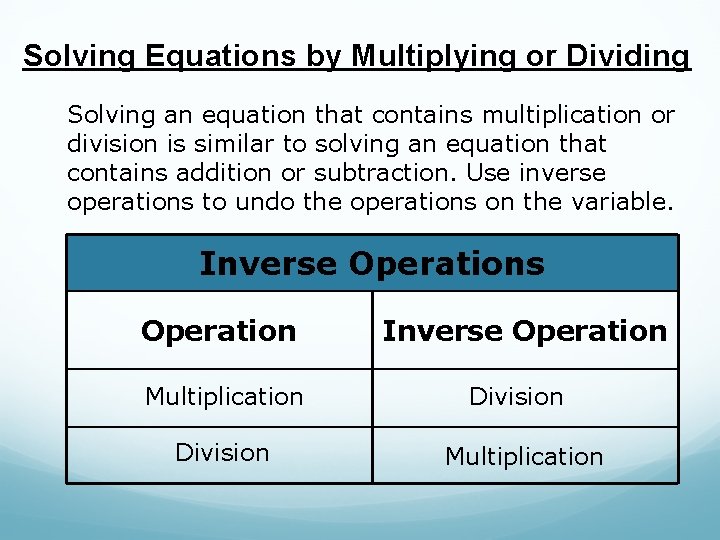
Solving Equations by Multiplying or Dividing Solving an equation that contains multiplication or division is similar to solving an equation that contains addition or subtraction. Use inverse operations to undo the operations on the variable. Inverse Operations Operation Multiplication Division Inverse Operation Division Multiplication
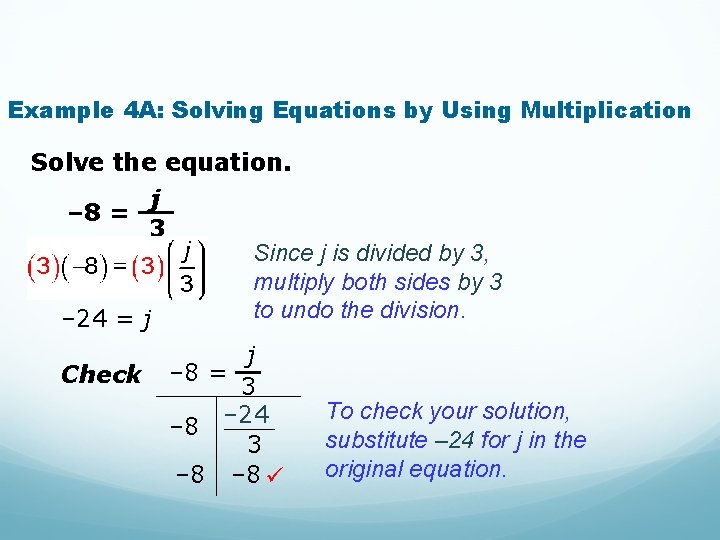
Example 4 A: Solving Equations by Using Multiplication Solve the equation. j – 8 = 3 Since j is divided by 3, multiply both sides by 3 to undo the division. – 24 = j Check j – 8 = 3 – 8 – 24 3 – 8 To check your solution, substitute – 24 for j in the original equation.
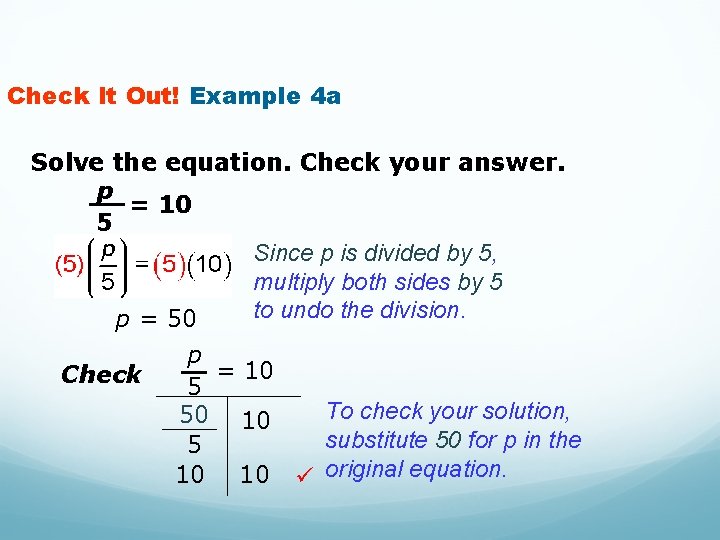
Check It Out! Example 4 a Solve the equation. Check your answer. p = 10 5 Since p is divided by 5, multiply both sides by 5 to undo the division. p = 50 Check p = 10 5 To check your solution, 50 10 substitute 50 for p in the 5 10 10 original equation.
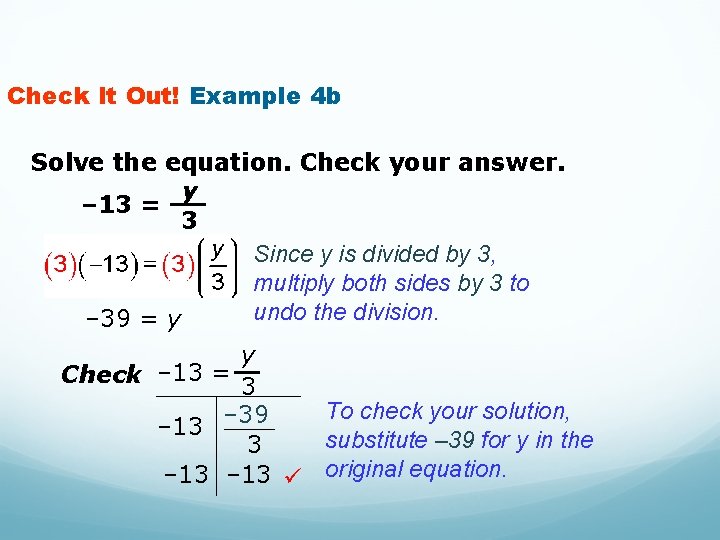
Check It Out! Example 4 b Solve the equation. Check your answer. y – 13 = 3 Since y is divided by 3, multiply both sides by 3 to undo the division. – 39 = y y Check – 13 = 3 To check your solution, – 39 – 13 substitute – 39 for y in the 3 – 13 original equation.
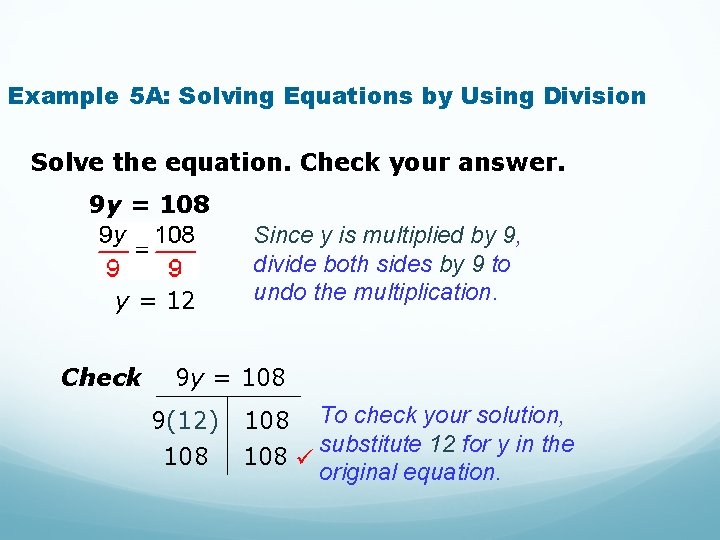
Example 5 A: Solving Equations by Using Division Solve the equation. Check your answer. 9 y = 108 y = 12 Check Since y is multiplied by 9, divide both sides by 9 to undo the multiplication. 9 y = 108 9(12) 108 To check your solution, substitute 12 for y in the 108 original equation.
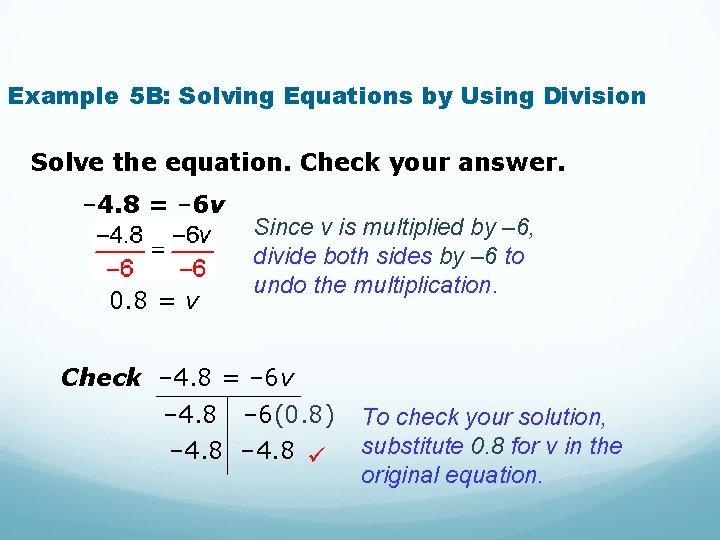
Example 5 B: Solving Equations by Using Division Solve the equation. Check your answer. – 4. 8 = – 6 v 0. 8 = v Since v is multiplied by – 6, divide both sides by – 6 to undo the multiplication. Check – 4. 8 = – 6 v – 4. 8 – 6(0. 8) – 4. 8 To check your solution, substitute 0. 8 for v in the original equation.
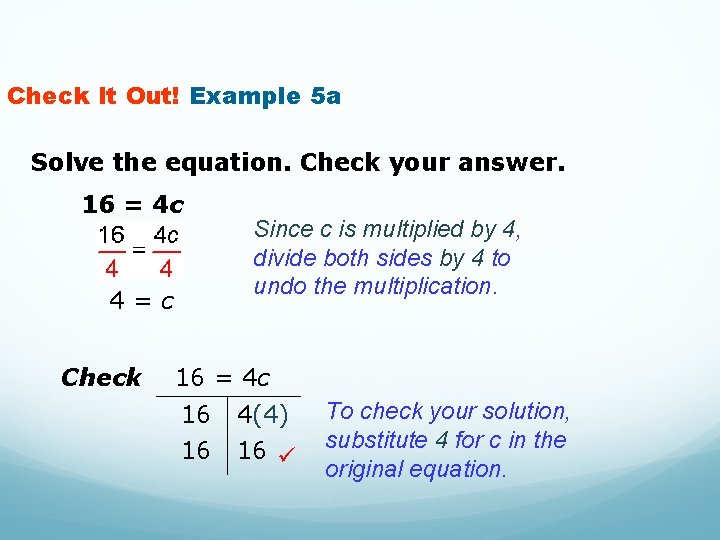
Check It Out! Example 5 a Solve the equation. Check your answer. 16 = 4 c 4=c Check Since c is multiplied by 4, divide both sides by 4 to undo the multiplication. 16 = 4 c 16 16 4(4) 16 To check your solution, substitute 4 for c in the original equation.
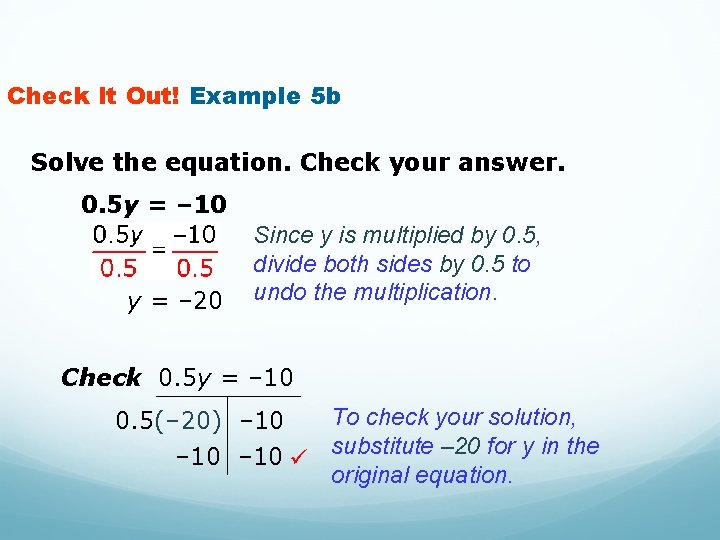
Check It Out! Example 5 b Solve the equation. Check your answer. 0. 5 y = – 10 y = – 20 Since y is multiplied by 0. 5, divide both sides by 0. 5 to undo the multiplication. Check 0. 5 y = – 10 To check your solution, 0. 5(– 20) – 10 substitute – 20 for y in the original equation.
Remember that dividing is the same as multiplying by the reciprocal. When solving equations, you will sometimes find it easier to multiply by a reciprocal instead of dividing. This is often true when an equation contains fractions.
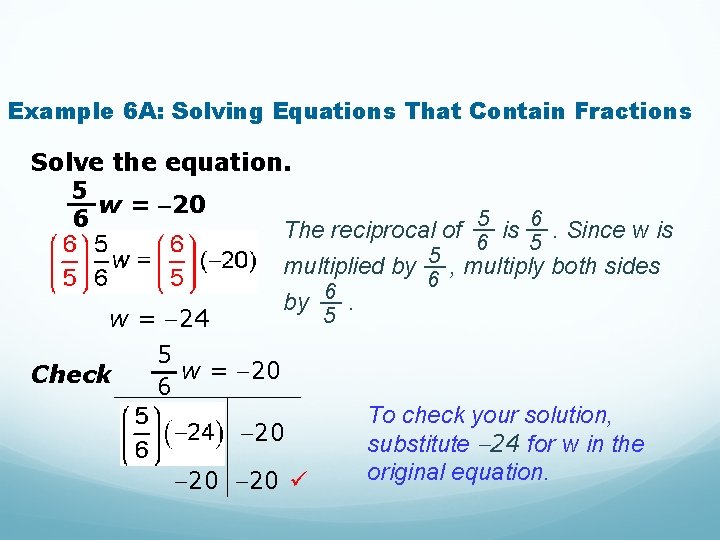
Example 6 A: Solving Equations That Contain Fractions Solve the equation. 5 w = 20 6 The reciprocal of 5 is 6. Since w is 6 5 5 multiplied by , multiply both sides 6 6 by. 5 w = 24 Check 5 w = 20 6 20 20 20 To check your solution, substitute 24 for w in the original equation.
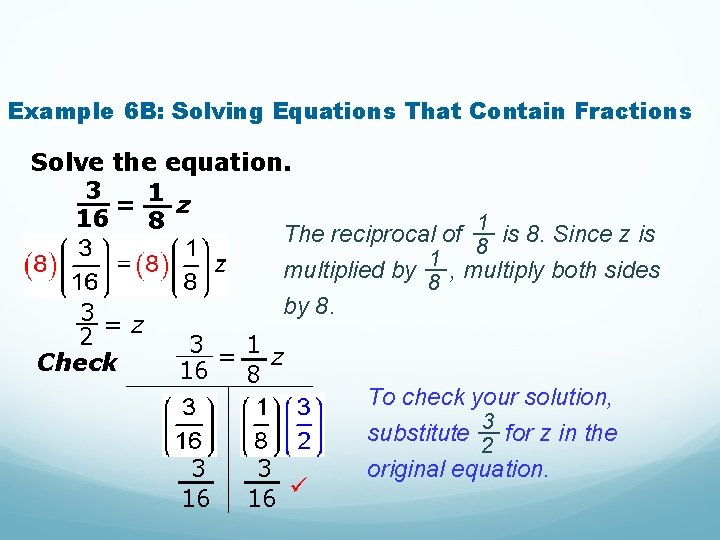
Example 6 B: Solving Equations That Contain Fractions Solve the equation. 3 = 1 z 16 8 The reciprocal of 1 is 8. Since z is 8 1 multiplied by , multiply both sides 8 by 8. 3=z 2 3 =1 z Check 16 8 To check your solution, substitute 3 for z in the 2 original equation. 3 3 16 16
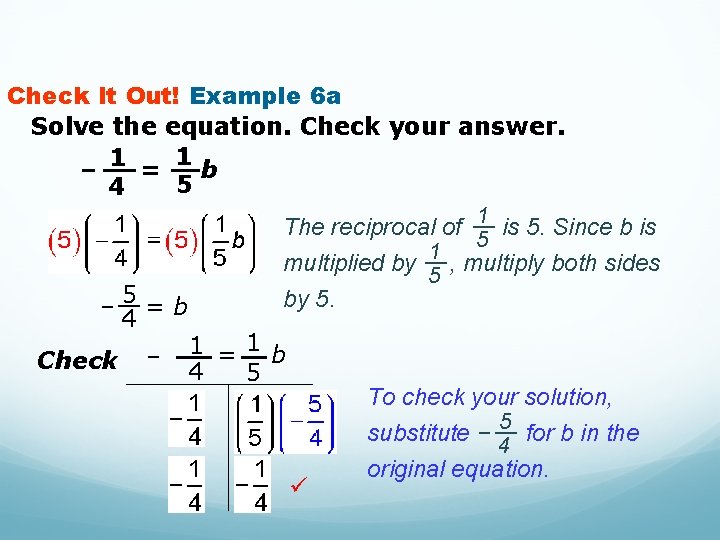
Check It Out! Example 6 a Solve the equation. Check your answer. 1 – 1 = b 5 4 5=b – 4 Check – The reciprocal of 1 is 5. Since b is 5 1 multiplied by , multiply both sides 5 by 5. 1 =1 b 4 5 To check your solution, substitute – 5 for b in the 4 original equation.
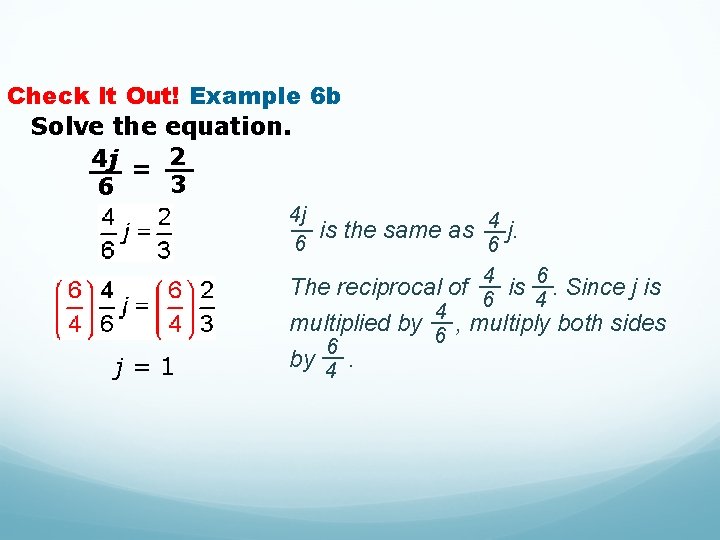
Check It Out! Example 6 b Solve the equation. 4 j = 2 3 6 j=1 4 j is the same as 4 j. 6 6 The reciprocal of 4 is 6. Since j is 6 4 4 multiplied by , multiply both sides 6 6 by 4.
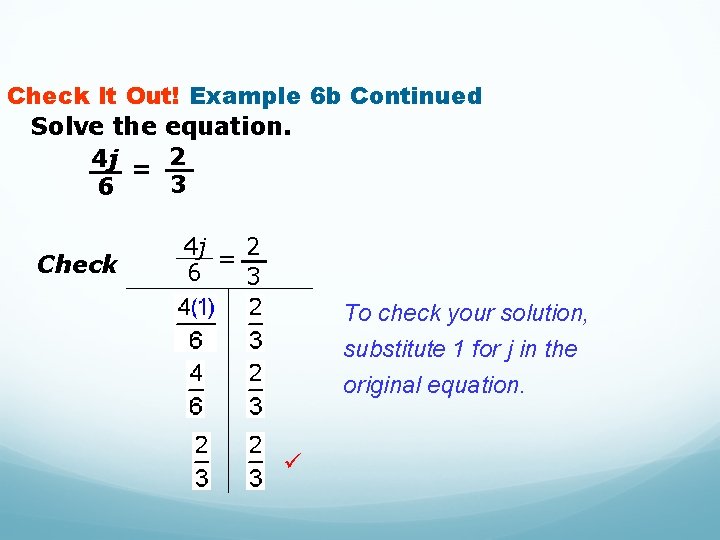
Check It Out! Example 6 b Continued Solve the equation. 4 j = 2 3 6 Check 4 j =2 6 3 To check your solution, substitute 1 for j in the original equation.
- Slides: 26