
A UNIFYING MEASUREMENT FRAMEWORK Stimulating improvement through measurement




- Slides: 41
A UNIFYING MEASUREMENT FRAMEWORK Stimulating improvement through measurement An overview and commentary on New Zealand’s journey on the Integrated Performance and Incentive Framework Andrew Terris EPSO Conference September 2015, Helsinki
Presentation coverage • Context – New Zealand its health system – Structures and monitoring frameworks • • Current drivers Desired outcomes and focus for the health system in NZ The role of measurement – monitor, aid or catalyst Whole (of) system measurement framework - approach Progress on the journey (a work in progress) Observations The role of monitoring groups in such a framework 2
Or… If: “Every system is perfectly designed to get the results it gets. ” (prof Don Berwick) then: What is the role of measurement in the complex adaptive system of healthcare? And What is the role of monitoring agencies in such a framework? 3
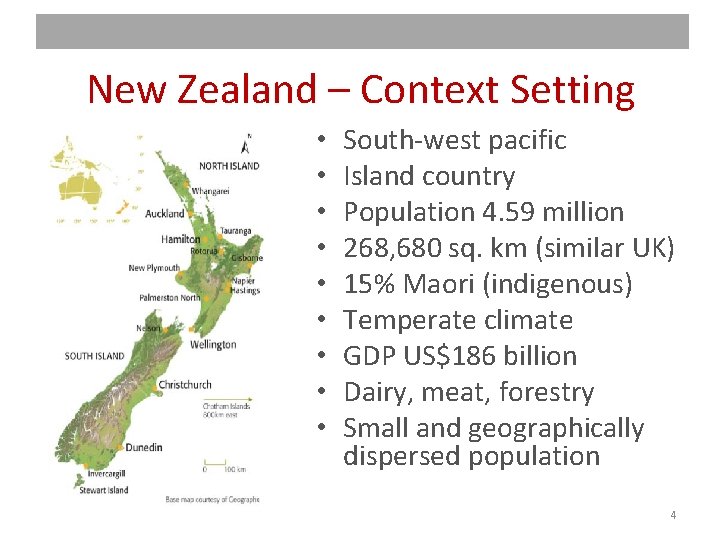
New Zealand – Context Setting • • • South-west pacific Island country Population 4. 59 million 268, 680 sq. km (similar UK) 15% Maori (indigenous) Temperate climate GDP US$186 billion Dairy, meat, forestry Small and geographically dispersed population 4
Famous New Zealanders Sir Edmund Hilary Lord Rutherford Sir Peter Jackson Weta Studios Lord of the Rings King Kong The Hobbit The All Blacks 5
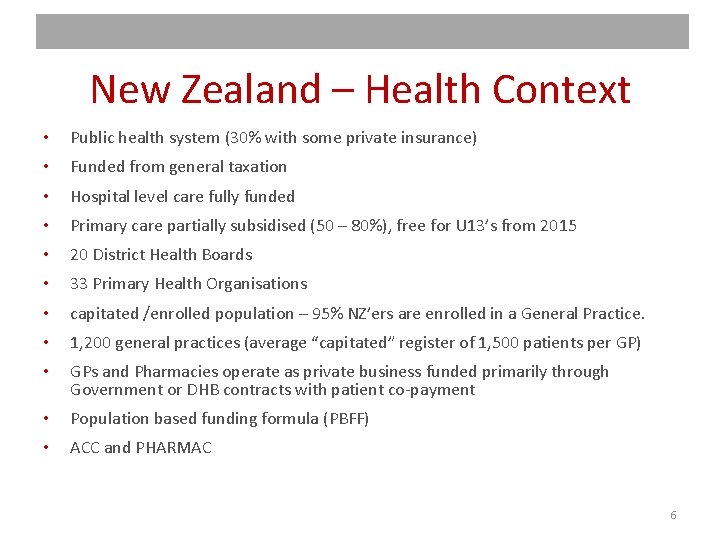
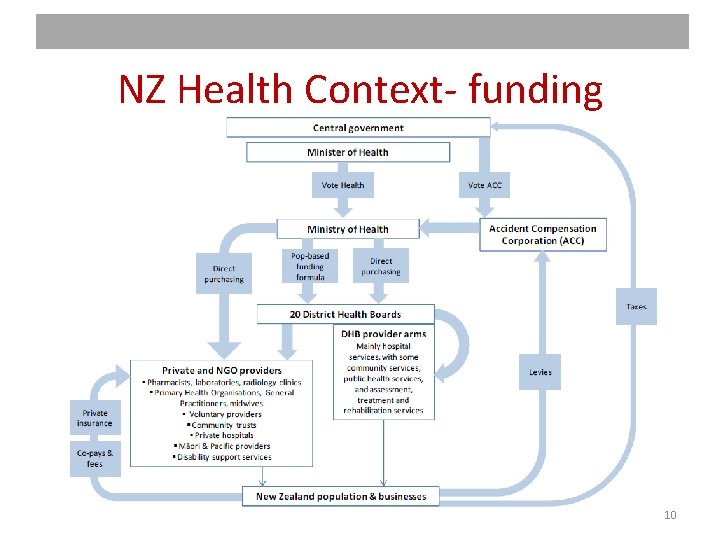
New Zealand – Health Context • Public health system (30% with some private insurance) • Funded from general taxation • Hospital level care fully funded • Primary care partially subsidised (50 – 80%), free for U 13’s from 2015 • 20 District Health Boards • 33 Primary Health Organisations • capitated /enrolled population – 95% NZ’ers are enrolled in a General Practice. • 1, 200 general practices (average “capitated” register of 1, 500 patients per GP) • GPs and Pharmacies operate as private business funded primarily through Government or DHB contracts with patient co-payment • Population based funding formula (PBFF) • ACC and PHARMAC 6
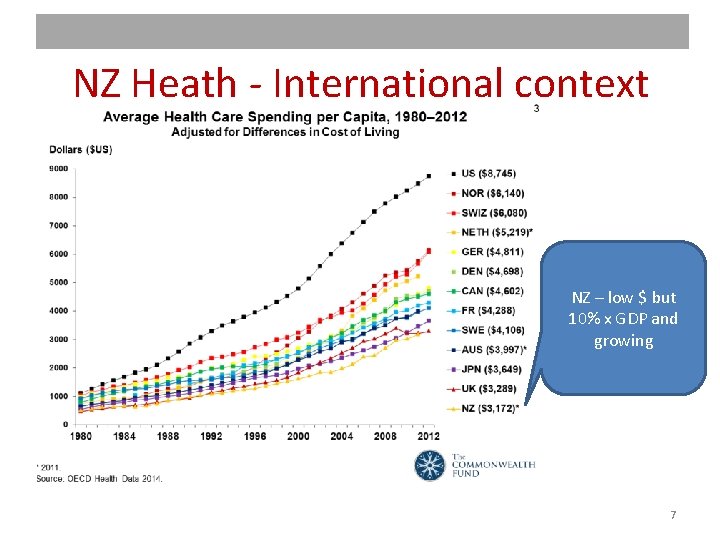
NZ Heath - International context NZ – low $ but 10% x GDP and growing 7
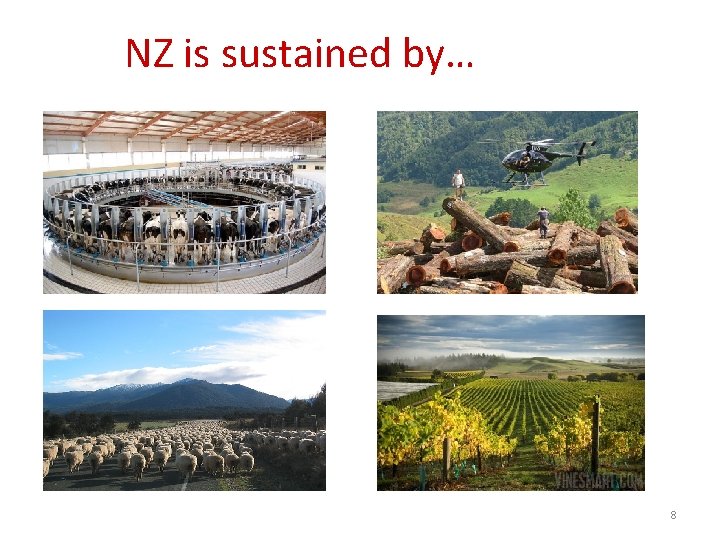
NZ is sustained by… 8
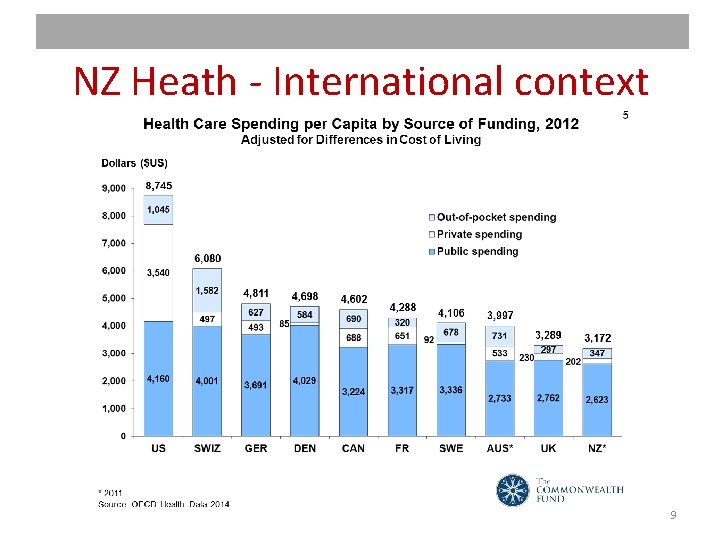
NZ Heath - International context 9
NZ Health Context- funding 10
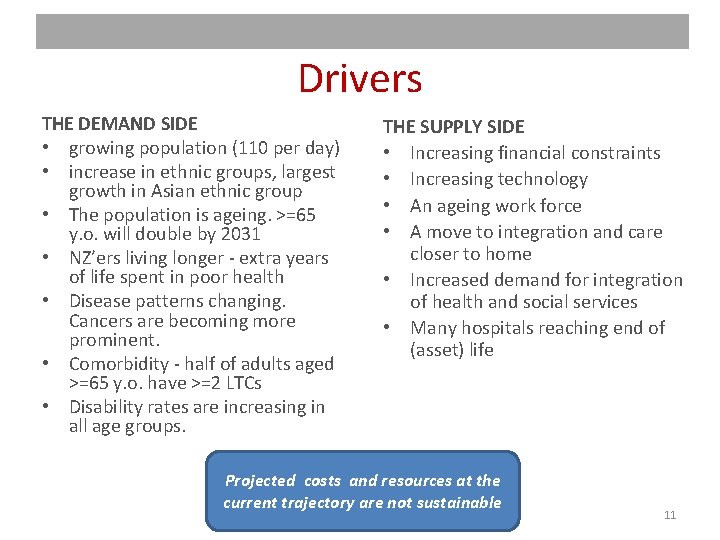
Drivers THE DEMAND SIDE • growing population (110 per day) • increase in ethnic groups, largest growth in Asian ethnic group • The population is ageing. >=65 y. o. will double by 2031 • NZ’ers living longer - extra years of life spent in poor health • Disease patterns changing. Cancers are becoming more prominent. • Comorbidity - half of adults aged >=65 y. o. have >=2 LTCs • Disability rates are increasing in all age groups. THE SUPPLY SIDE • Increasing financial constraints • Increasing technology • An ageing work force • A move to integration and care closer to home • Increased demand for integration of health and social services • Many hospitals reaching end of (asset) life Projected costs and resources at the current trajectory are not sustainable 11
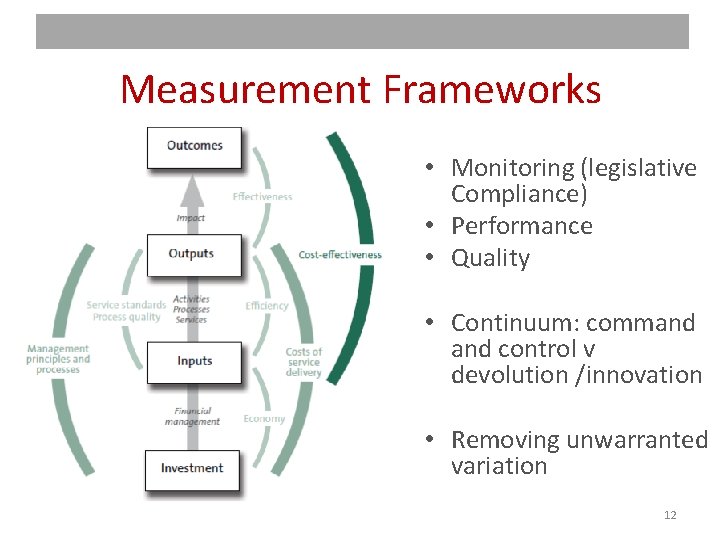
Measurement Frameworks • Monitoring (legislative Compliance) • Performance • Quality • Continuum: command control v devolution /innovation • Removing unwarranted variation 12
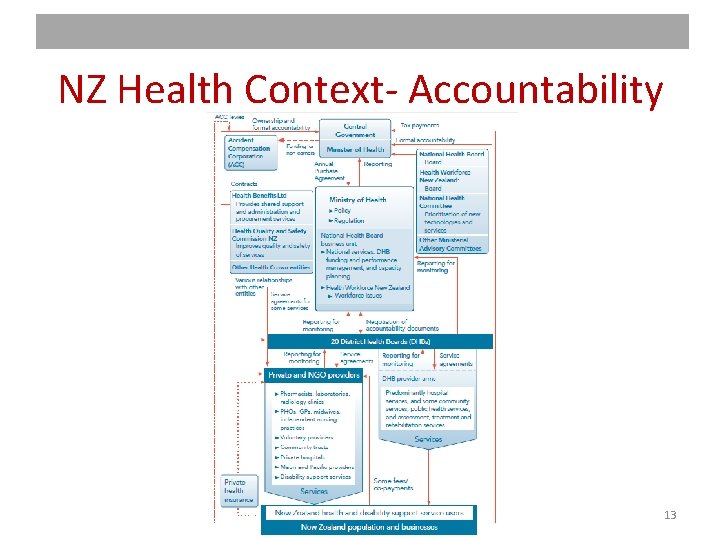
NZ Health Context- Accountability 13
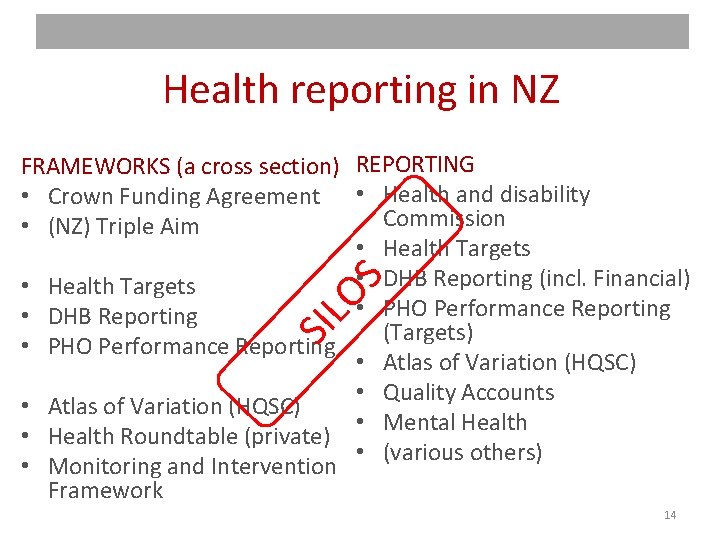
Health reporting in NZ SIL OS FRAMEWORKS (a cross section) REPORTING • Crown Funding Agreement • Health and disability Commission • (NZ) Triple Aim • Health Targets • DHB Reporting (incl. Financial) • Health Targets • PHO Performance Reporting • DHB Reporting (Targets) • PHO Performance Reporting • Atlas of Variation (HQSC) • Quality Accounts • Atlas of Variation (HQSC) • Mental Health • Health Roundtable (private) • (various others) • Monitoring and Intervention Framework 14
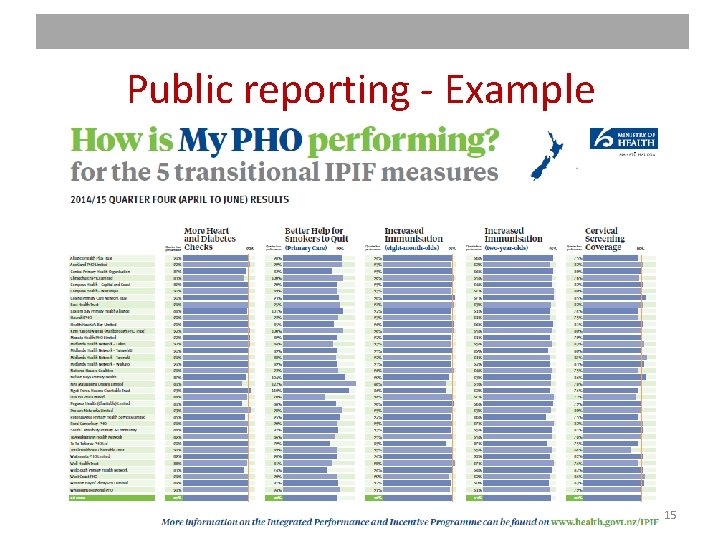
Public reporting - Example 15
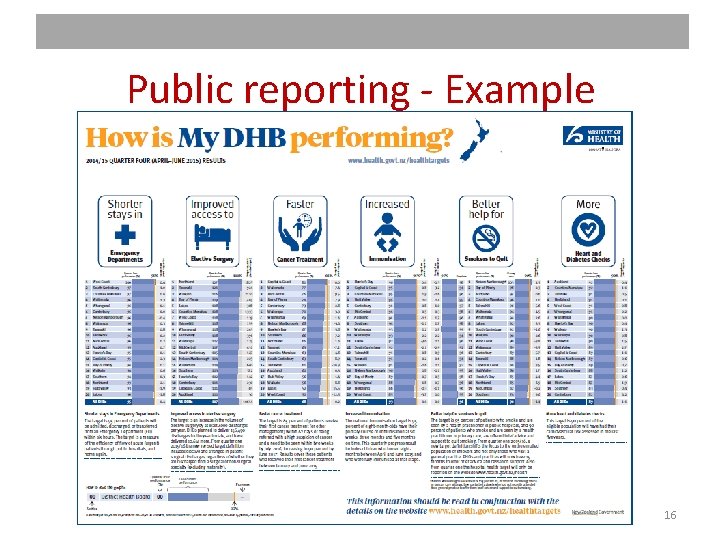
Public reporting - Example 16
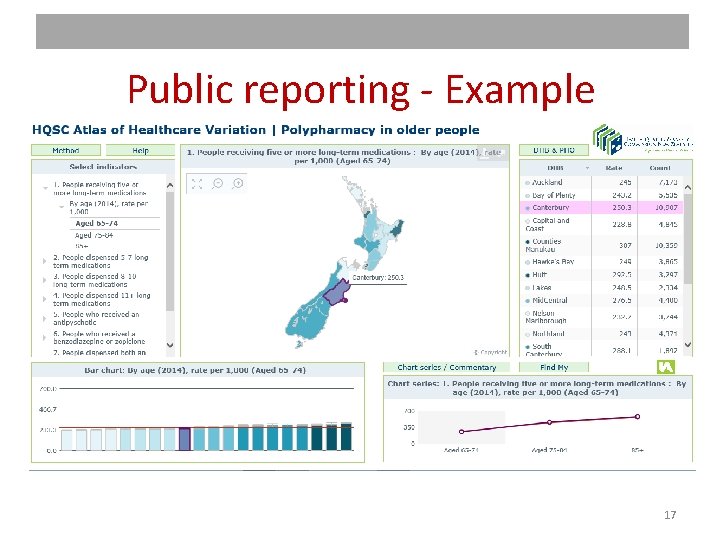
Public reporting - Example 17
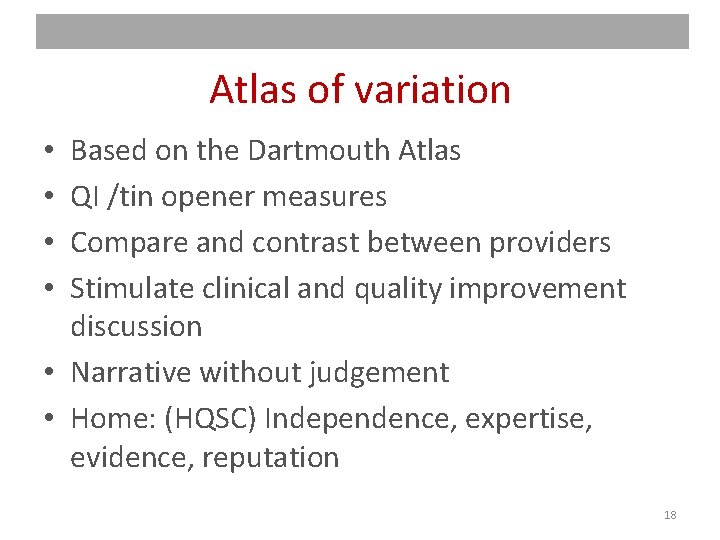
Atlas of variation Based on the Dartmouth Atlas QI /tin opener measures Compare and contrast between providers Stimulate clinical and quality improvement discussion • Narrative without judgement • Home: (HQSC) Independence, expertise, evidence, reputation • • 18
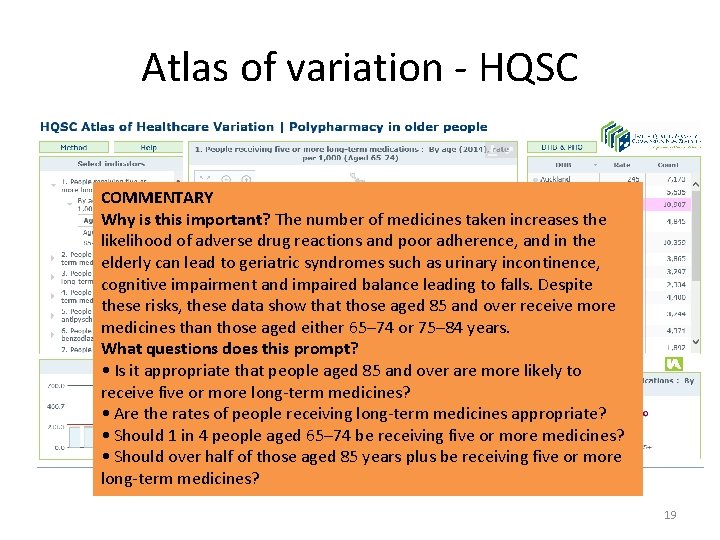
Atlas of variation - HQSC COMMENTARY Why is this important? The number of medicines taken increases the likelihood of adverse drug reactions and poor adherence, and in the elderly can lead to geriatric syndromes such as urinary incontinence, cognitive impairment and impaired balance leading to falls. Despite these risks, these data show that those aged 85 and over receive more medicines than those aged either 65– 74 or 75– 84 years. What questions does this prompt? • Is it appropriate that people aged 85 and over are more likely to receive five or more long-term medicines? • Are the rates of people receiving long-term medicines appropriate? • Should 1 in 4 people aged 65– 74 be receiving five or more medicines? • Should over half of those aged 85 years plus be receiving five or more long-term medicines? 19
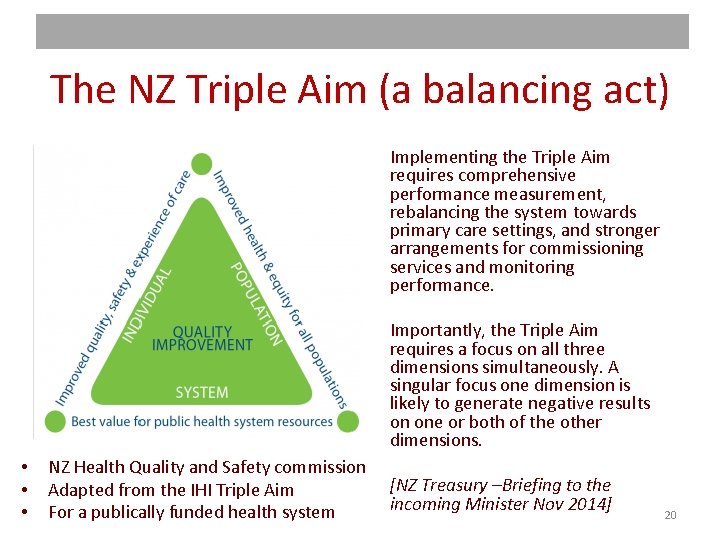
The NZ Triple Aim (a balancing act) Implementing the Triple Aim requires comprehensive performance measurement, rebalancing the system towards primary care settings, and stronger arrangements for commissioning services and monitoring performance. Importantly, the Triple Aim requires a focus on all three dimensions simultaneously. A singular focus one dimension is likely to generate negative results on one or both of the other dimensions. • • • NZ Health Quality and Safety commission Adapted from the IHI Triple Aim For a publically funded health system [NZ Treasury –Briefing to the incoming Minister Nov 2014] 20
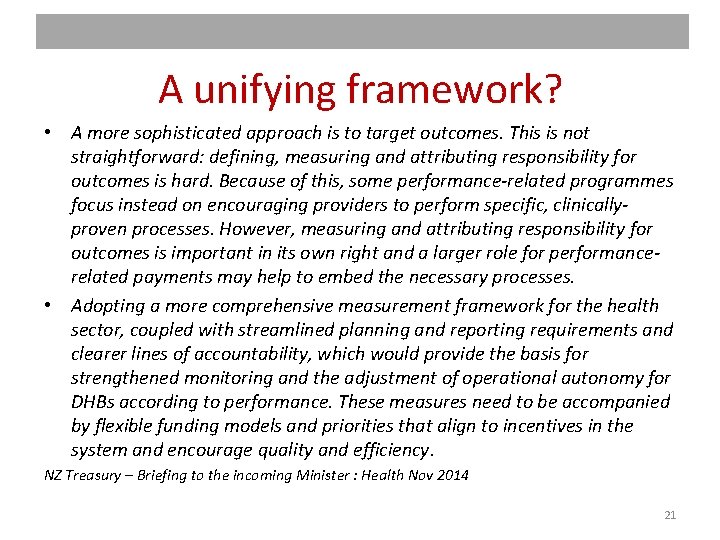
A unifying framework? • A more sophisticated approach is to target outcomes. This is not straightforward: defining, measuring and attributing responsibility for outcomes is hard. Because of this, some performance-related programmes focus instead on encouraging providers to perform specific, clinicallyproven processes. However, measuring and attributing responsibility for outcomes is important in its own right and a larger role for performancerelated payments may help to embed the necessary processes. • Adopting a more comprehensive measurement framework for the health sector, coupled with streamlined planning and reporting requirements and clearer lines of accountability, which would provide the basis for strengthened monitoring and the adjustment of operational autonomy for DHBs according to performance. These measures need to be accompanied by flexible funding models and priorities that align to incentives in the system and encourage quality and efficiency. NZ Treasury – Briefing to the incoming Minister : Health Nov 2014 21
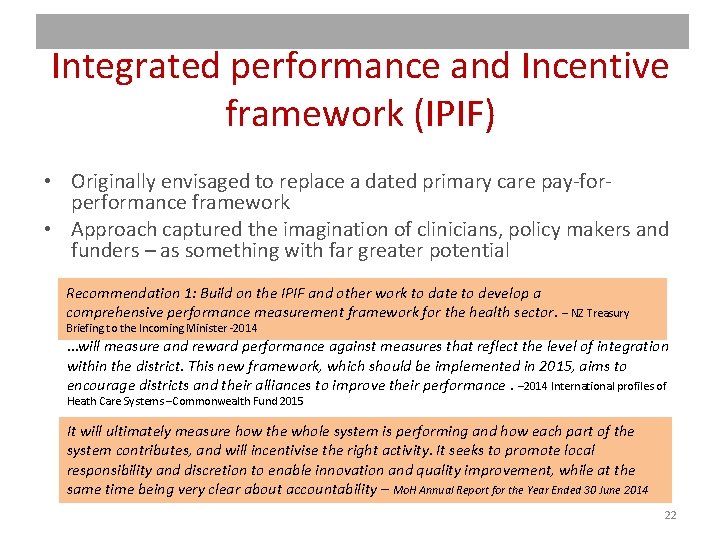
Integrated performance and Incentive framework (IPIF) • Originally envisaged to replace a dated primary care pay-forperformance framework • Approach captured the imagination of clinicians, policy makers and funders – as something with far greater potential Recommendation 1: Build on the IPIF and other work to date to develop a comprehensive performance measurement framework for the health sector. – NZ Treasury Briefing to the Incoming Minister -2014 …will measure and reward performance against measures that reflect the level of integration within the district. This new framework, which should be implemented in 2015, aims to encourage districts and their alliances to improve their performance. – 2014 International profiles of Heath Care Systems –Commonwealth Fund 2015 It will ultimately measure how the whole system is performing and how each part of the system contributes, and will incentivise the right activity. It seeks to promote local responsibility and discretion to enable innovation and quality improvement, while at the same time being very clear about accountability – Mo. H Annual Report for the Year Ended 30 June 2014 22
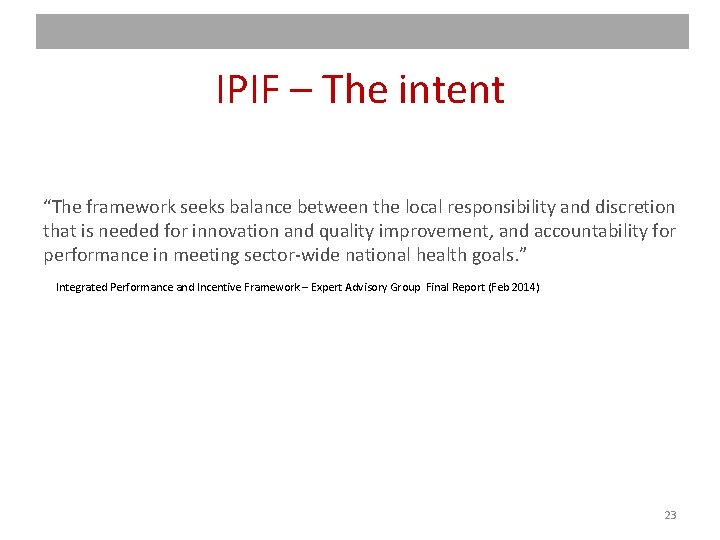
IPIF – The intent “The framework seeks balance between the local responsibility and discretion that is needed for innovation and quality improvement, and accountability for performance in meeting sector-wide national health goals. ” Integrated Performance and Incentive Framework – Expert Advisory Group Final Report (Feb 2014) 23
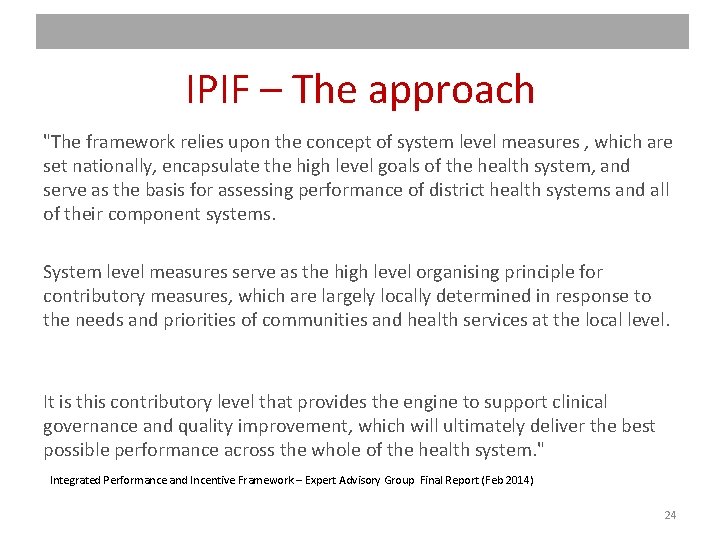
IPIF – The approach "The framework relies upon the concept of system level measures , which are set nationally, encapsulate the high level goals of the health system, and serve as the basis for assessing performance of district health systems and all of their component systems. System level measures serve as the high level organising principle for contributory measures, which are largely locally determined in response to the needs and priorities of communities and health services at the local level. It is this contributory level that provides the engine to support clinical governance and quality improvement, which will ultimately deliver the best possible performance across the whole of the health system. " Integrated Performance and Incentive Framework – Expert Advisory Group Final Report (Feb 2014) 24
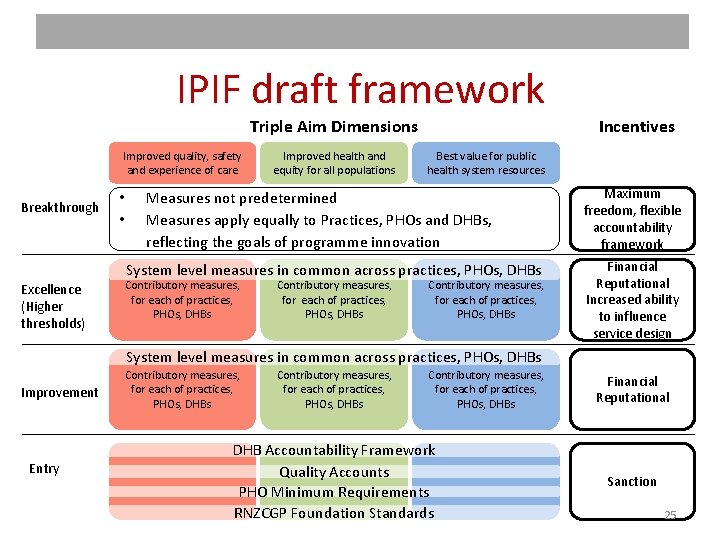
IPIF draft framework Triple Aim Dimensions Improved quality, safety and experience of care Breakthrough • • Improved health and equity for all populations Best value for public health system resources Measures not predetermined Measures apply equally to Practices, PHOs and DHBs, reflecting the goals of programme innovation System level measures in common across practices, PHOs, DHBs Contributory measures, for each of practices, PHOs, DHBs Excellence (Higher thresholds) Contributory measures, for each of practices, PHOs, DHBs Incentives Contributory measures, for each of practices, PHOs, DHBs Maximum freedom, flexible accountability framework Financial Reputational Increased ability to influence service design System level measures in common across practices, PHOs, DHBs Contributory measures, for each of practices, PHOs, DHBs Improvement Entry Contributory measures, for each of practices, PHOs, DHBs DHB Accountability Framework Quality Accounts PHO Minimum Requirements RNZCGP Foundation Standards Financial Reputational Sanction 25
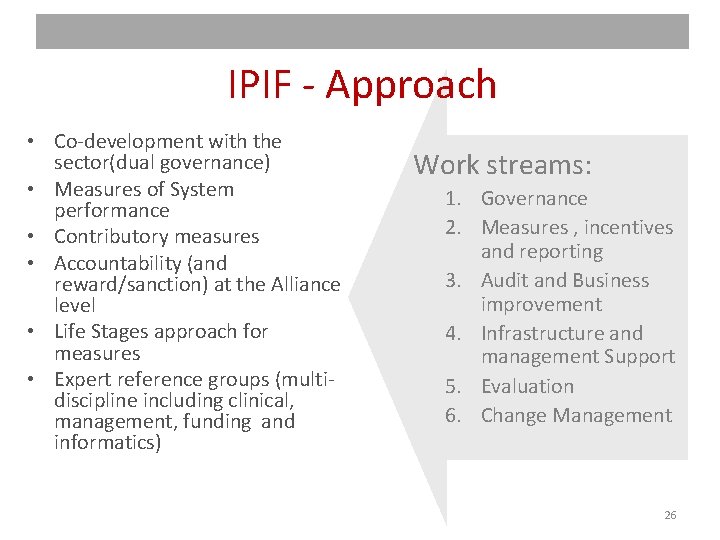
IPIF - Approach • Co-development with the sector(dual governance) • Measures of System performance • Contributory measures • Accountability (and reward/sanction) at the Alliance level • Life Stages approach for measures • Expert reference groups (multidiscipline including clinical, management, funding and informatics) Work streams: 1. Governance 2. Measures , incentives and reporting 3. Audit and Business improvement 4. Infrastructure and management Support 5. Evaluation 6. Change Management 26
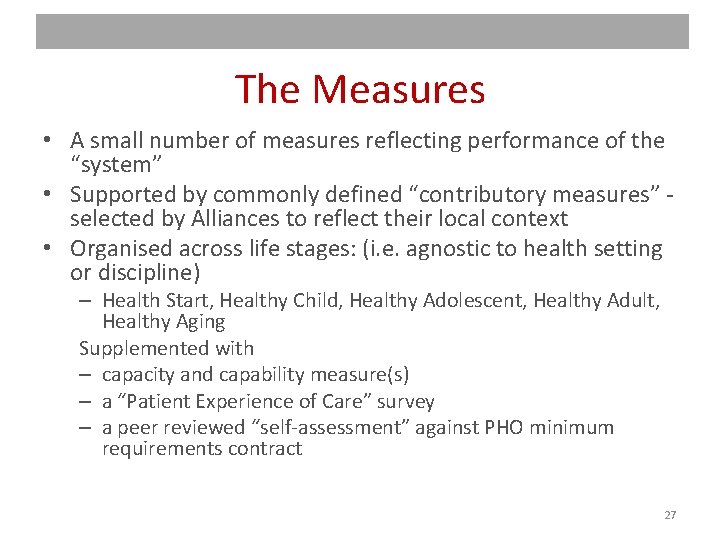
The Measures • A small number of measures reflecting performance of the “system” • Supported by commonly defined “contributory measures” selected by Alliances to reflect their local context • Organised across life stages: (i. e. agnostic to health setting or discipline) – Health Start, Healthy Child, Healthy Adolescent, Healthy Adult, Healthy Aging Supplemented with – capacity and capability measure(s) – a “Patient Experience of Care” survey – a peer reviewed “self-assessment” against PHO minimum requirements contract 27
• • Selection and Development of Measures Common definition System level v contributory (big dot, little dot theory) Life stages Candidate measures (headings) – – – • • Polypharmacy (Childhood) obesity Immunisations Before School Checks Ambulatory Sensitive Hospitalisations Caries Free (tooth decay in infants/adolescents) Mental Health (youth access) Sexual Health (youth access) Smoking (adult and elderly) Acute demand Palliative care Patent experience of Care survey Patient access to e. Portals 28
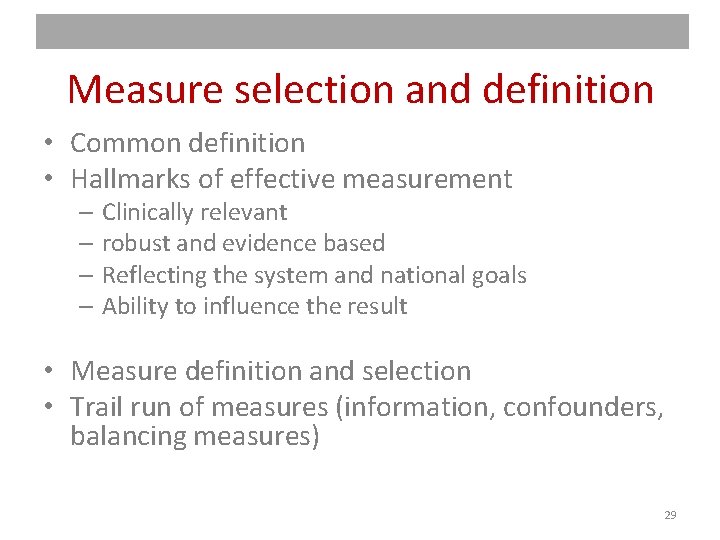
Measure selection and definition • Common definition • Hallmarks of effective measurement – Clinically relevant – robust and evidence based – Reflecting the system and national goals – Ability to influence the result • Measure definition and selection • Trail run of measures (information, confounders, balancing measures) 29
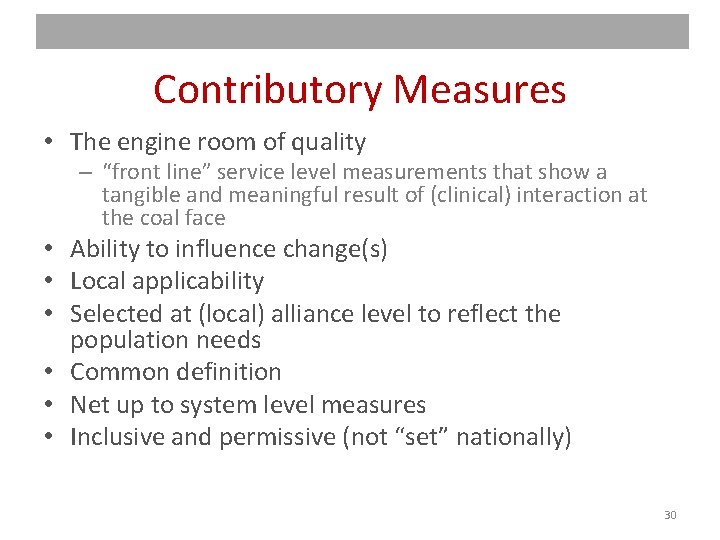
Contributory Measures • The engine room of quality – “front line” service level measurements that show a tangible and meaningful result of (clinical) interaction at the coal face • Ability to influence change(s) • Local applicability • Selected at (local) alliance level to reflect the population needs • Common definition • Net up to system level measures • Inclusive and permissive (not “set” nationally) 30
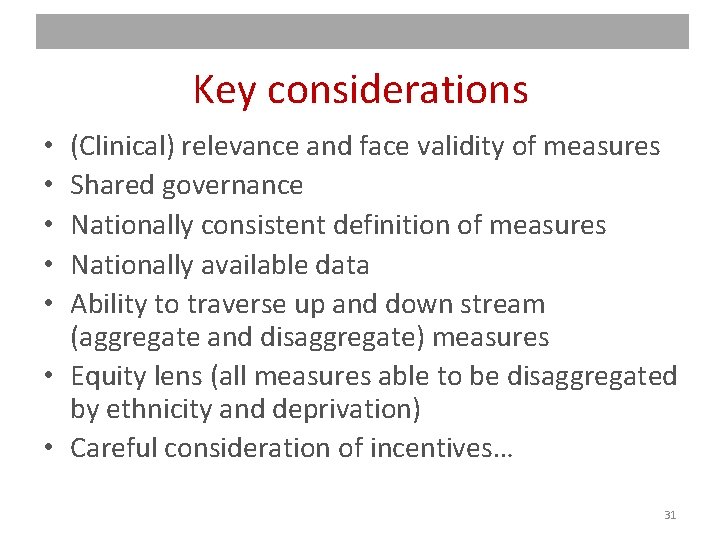
Key considerations (Clinical) relevance and face validity of measures Shared governance Nationally consistent definition of measures Nationally available data Ability to traverse up and down stream (aggregate and disaggregate) measures • Equity lens (all measures able to be disaggregated by ethnicity and deprivation) • Careful consideration of incentives… • • • 31
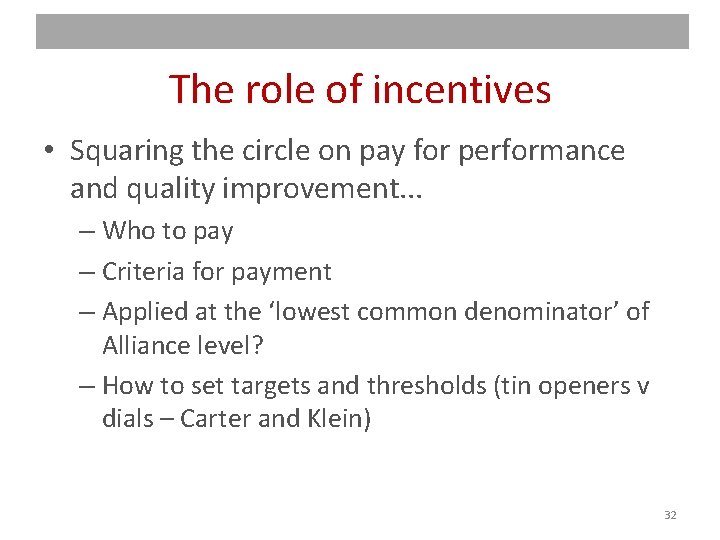
The role of incentives • Squaring the circle on pay for performance and quality improvement. . . – Who to pay – Criteria for payment – Applied at the ‘lowest common denominator’ of Alliance level? – How to set targets and thresholds (tin openers v dials – Carter and Klein) 32
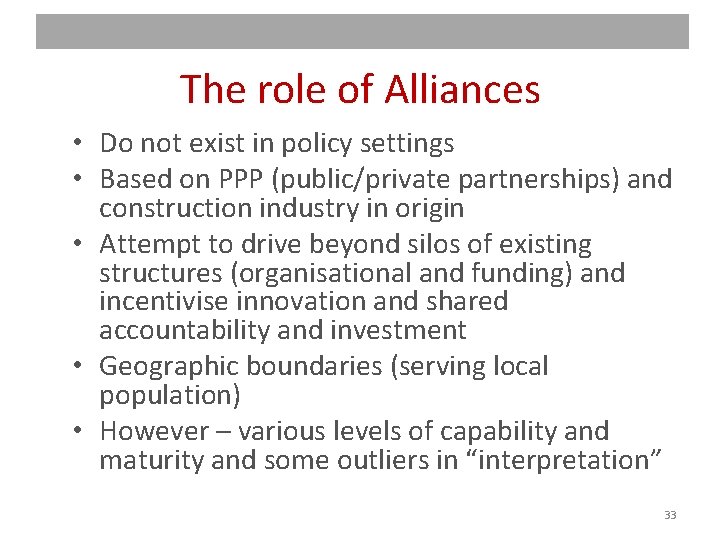
The role of Alliances • Do not exist in policy settings • Based on PPP (public/private partnerships) and construction industry in origin • Attempt to drive beyond silos of existing structures (organisational and funding) and incentivise innovation and shared accountability and investment • Geographic boundaries (serving local population) • However – various levels of capability and maturity and some outliers in “interpretation” 33
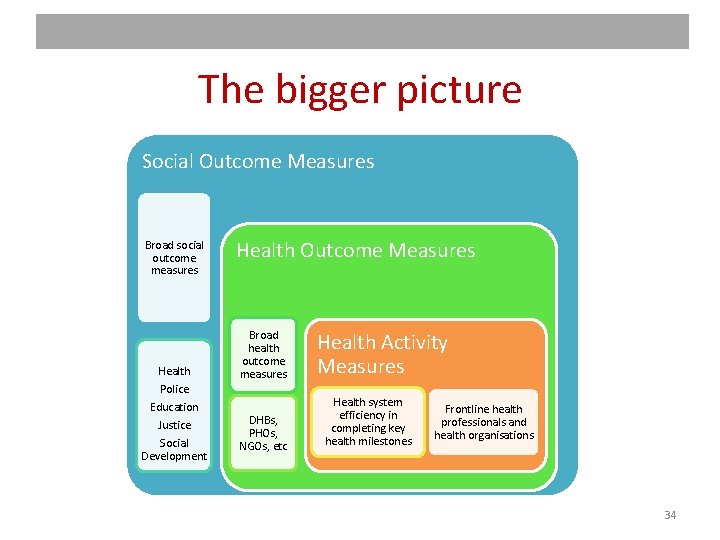
The bigger picture Social Outcome Measures Broad social outcome measures Health Police Education Justice Social Development Health Outcome Measures Broad health outcome measures DHBs, PHOs, NGOs, etc Health Activity Measures Health system efficiency in completing key health milestones Frontline health professionals and health organisations 34
Challenges and Constraints • • Veracity of information Evidence base - what makes a good measure? Mixing QA and QI ingredients in a common pot Autonomy v control – achieving the right balance Earned autonomy Incentives - Rewards and Sanctions The role of pathways • The biggest challenge is… 35
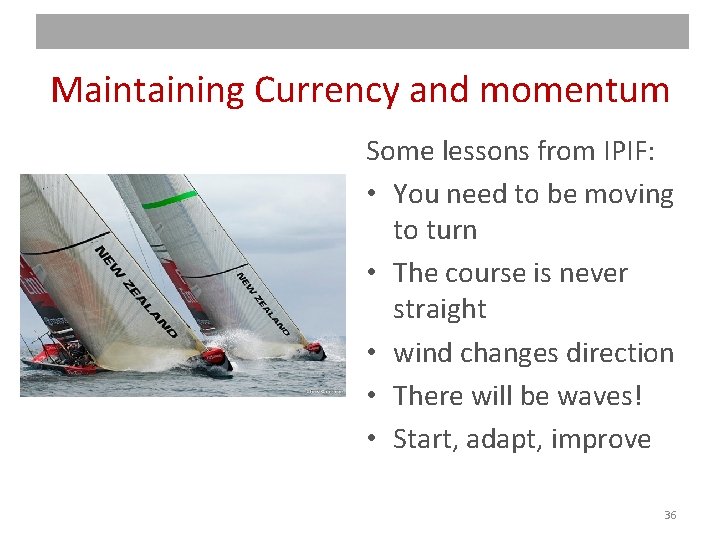
Maintaining Currency and momentum Some lessons from IPIF: • You need to be moving to turn • The course is never straight • wind changes direction • There will be waves! • Start, adapt, improve 36
Current progress of IPIF in NZ • New Minister • Revision of NZ (primary care) health strategy • Move to a bolder set of measures – a high level set that reflect performance of the system • Put incentives discussion on hold and focus on the measures first • Overarching/unifying framework • Life stages approach not explicit (though implicit) 37
The role of monitors • Moving from QA to QI – a different lens • Identifying and documenting outliers – at both ends of the spectrum – Shepherds at the safety margins – Diffusion of innovation /quality and improvement • • • Research and input to measurement Benchmarking Independent facilitators / moderators Creating the accompanying narrative from the results Enduring narrative and reference point (mitigating against the risk of losing institutional knowledge) 38
What hope for IPIF? Too soon to tell However, a central and recurring theme “…none of us are as smart as all of us” 39
To include…References • International Profiles Of Health Care Systems, 2014 - The Commonwealth Fund • http: //www. hiirc. org. nz/page/45527/expertadvisory-group-eag-report-on-theintegrated/? q=IPIF&highlight=ipif§ion=35 484 • www. treasury. govt. nz/publications/briefings • http: //www. hqsc. govt. nz/ • http: //www. health. govt. nz/ 40
About the author and this presentation This presentation has been prepared by Andrew Terris (Andrew. Terris@dotjoiner. net) in an independent capacity and is not purported to represent the views of the NZ Ministry of Health. The author has held a number of national and strategic roles in New Zealand in the areas of health process, information and measurement. He has worked in a number of industries and countries and has a background in consulting, process improvement and programme leadership. He now resides in Europe. 41