
A Uniform Approach to Analogies Synonyms Antonyms and
- Slides: 38
A Uniform Approach to Analogies, Synonyms, Antonyms, and Associations Peter D. Turney Institute for Information Technology National Research Council of Canada Coling 2008
Outline • Introduction • Classifying Analogous Word Pairs • Experiments – – SAT Analogies TOEFL Synonyms and Antonyms Similar, Associated, and Both • Discussion • Limitations and Future Work • Conclusion 2008/9/10 2
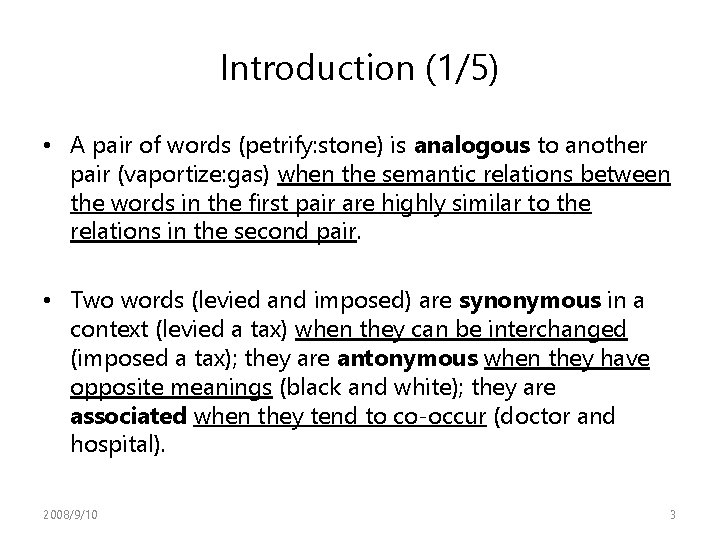
Introduction (1/5) • A pair of words (petrify: stone) is analogous to another pair (vaportize: gas) when the semantic relations between the words in the first pair are highly similar to the relations in the second pair. • Two words (levied and imposed) are synonymous in a context (levied a tax) when they can be interchanged (imposed a tax); they are antonymous when they have opposite meanings (black and white); they are associated when they tend to co-occur (doctor and hospital). 2008/9/10 3
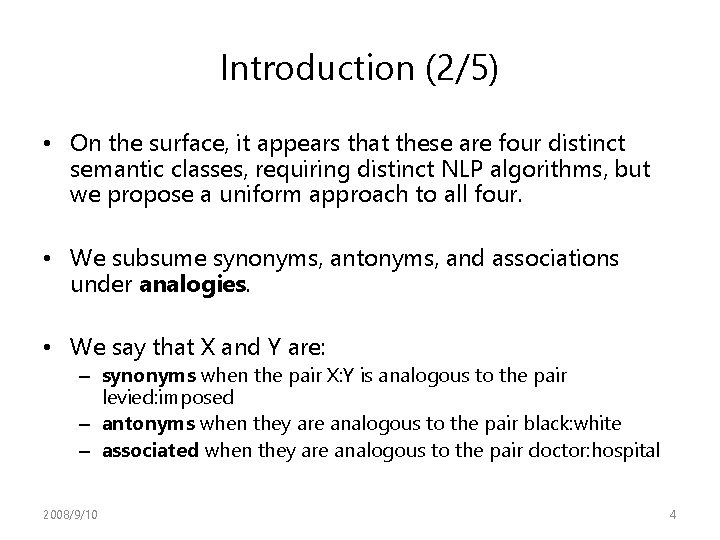
Introduction (2/5) • On the surface, it appears that these are four distinct semantic classes, requiring distinct NLP algorithms, but we propose a uniform approach to all four. • We subsume synonyms, antonyms, and associations under analogies. • We say that X and Y are: – synonyms when the pair X: Y is analogous to the pair levied: imposed – antonyms when they are analogous to the pair black: white – associated when they are analogous to the pair doctor: hospital 2008/9/10 4
Introduction (3/5) • There is past work on recognizing analogies, synonyms, antonyms, and associations, but each of these four tasks has been examined separately, in isolation from the others. • As far as we know, the algorithm proposed here is the first attempt to deal with all four tasks using a uniform approach. 2008/9/10 5
Introduction (4/5) • We believe that it is important to seek NLP algorithms that can handle a broad range of semantic phenomena, because developing a specialized algorithm for each phenomena is a very inefficient research strategy. • It might seem that a lexicon, such as Word. Net, contains all the information we need to handle these four tasks. 2008/9/10 6
Introduction (5/5) • However, we prefer to take a corpus-based approach to semantics. – Veale (2004) used Word. Net to answer 374 multiple-choice SAT analogy questions, achieving an accuracy of 43%, but the best corpus-based approach attains an accuracy of 56% (Turney, 2006). – Another reason to prefer a corpus-based approach to a lexiconbased approach is that the former requires less human labour, and thus it is easier to extend to other languages. 2008/9/10 7
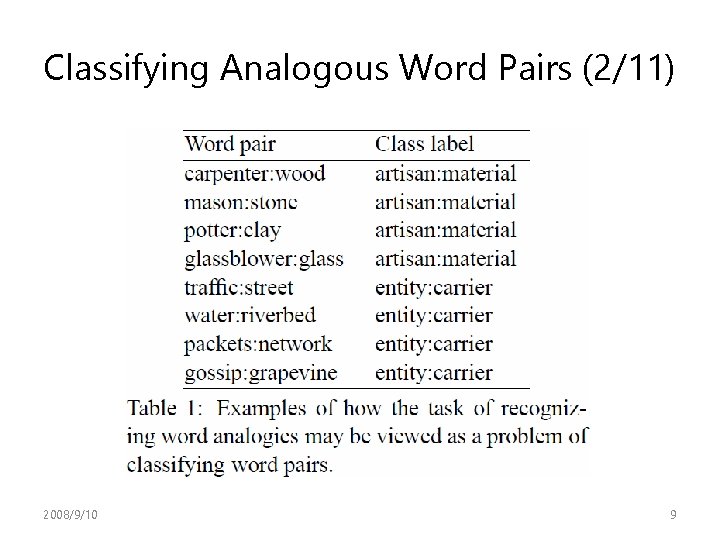
Classifying Analogous Word Pairs (1/11) • An analogy, A: B: : C: D, asserts that A is to B as C is to D. – for example, traffic: street: : water: riverbed asserts that traffic is to street as water is to riverbed. – that is, the semantic relations between traffic and street are highly similar to the semantic relations between water and riverbed. • We may view the task of recognizing word analogies as a problem of classifying word pairs. 2008/9/10 8
Classifying Analogous Word Pairs (2/11) 2008/9/10 9
Classifying Analogous Word Pairs (3/11) • We approach this as a standard classification problem for supervised machine learning. • The algorithm takes as input a training set of word pairs with class labels and a testing set of word pairs without labels. • Each word pair is represented as a vector in a feature space and a supervised learning algorithm is used to classify the feature vectors. 2008/9/10 10
Classifying Analogous Word Pairs (4/11) • The elements in the feature vectors are based on the frequencies of automatically defined patterns in a large corpus. • The output of the algorithm is an assignment of labels to the word pairs in the testing set. • For some of the experiments, we select a unique label for each word pair; for other experiments, we assign probabilities to each possible label for each word pair. 2008/9/10 11
Classifying Analogous Word Pairs (5/11) • For a given word pair, such as mason: stone, the first step is to generate morphological variations, such as masons: stones. • The second step is to search in a large corpus for all phrases of the following form: [0 to 1 words] X [0 to 3 words] Y [0 to 1 words] • In this template, X: Y consists of morphological variations of the given word pair, in either order. – Ex: mason: stone, stone: mason, masons: stones, and so on. 2008/9/10 12
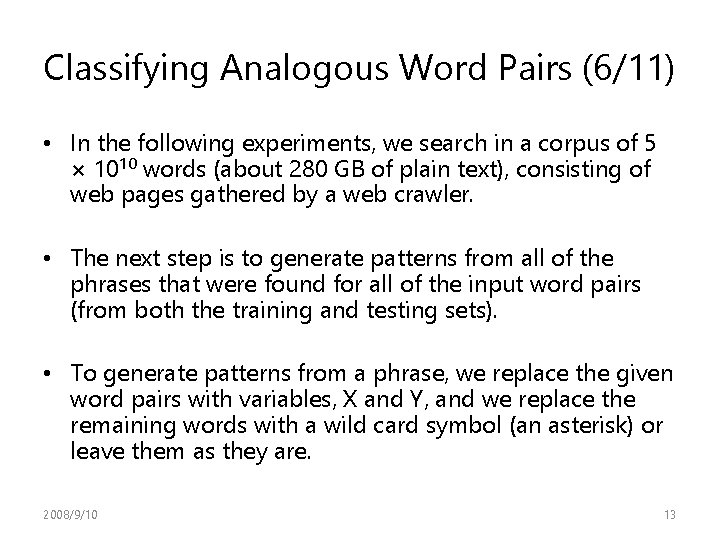
Classifying Analogous Word Pairs (6/11) • In the following experiments, we search in a corpus of 5 × 10¹⁰ words (about 280 GB of plain text), consisting of web pages gathered by a web crawler. • The next step is to generate patterns from all of the phrases that were found for all of the input word pairs (from both the training and testing sets). • To generate patterns from a phrase, we replace the given word pairs with variables, X and Y, and we replace the remaining words with a wild card symbol (an asterisk) or leave them as they are. 2008/9/10 13
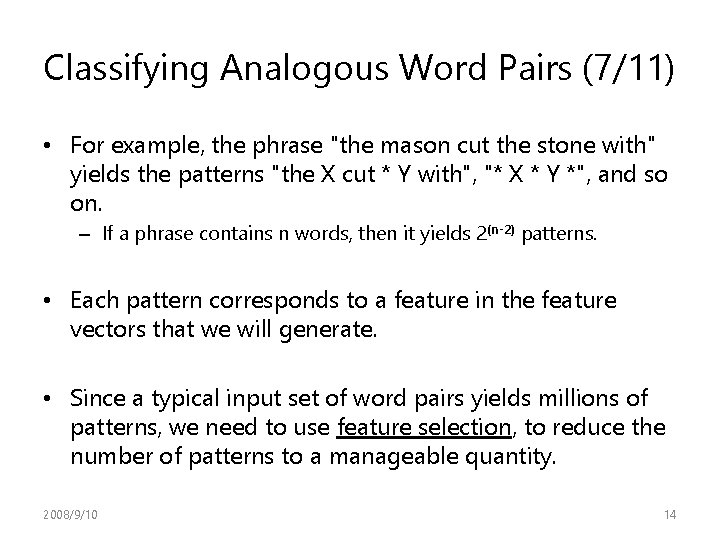
Classifying Analogous Word Pairs (7/11) • For example, the phrase "the mason cut the stone with" yields the patterns "the X cut * Y with", "* X * Y *", and so on. – If a phrase contains n words, then it yields 2 (n-2) patterns. • Each pattern corresponds to a feature in the feature vectors that we will generate. • Since a typical input set of word pairs yields millions of patterns, we need to use feature selection, to reduce the number of patterns to a manageable quantity. 2008/9/10 14
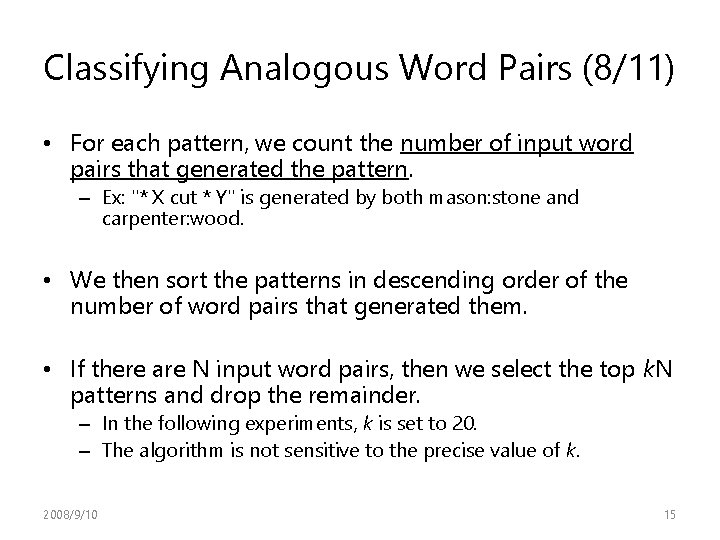
Classifying Analogous Word Pairs (8/11) • For each pattern, we count the number of input word pairs that generated the pattern. – Ex: "* X cut * Y" is generated by both mason: stone and carpenter: wood. • We then sort the patterns in descending order of the number of word pairs that generated them. • If there are N input word pairs, then we select the top k. N patterns and drop the remainder. – In the following experiments, k is set to 20. – The algorithm is not sensitive to the precise value of k. 2008/9/10 15
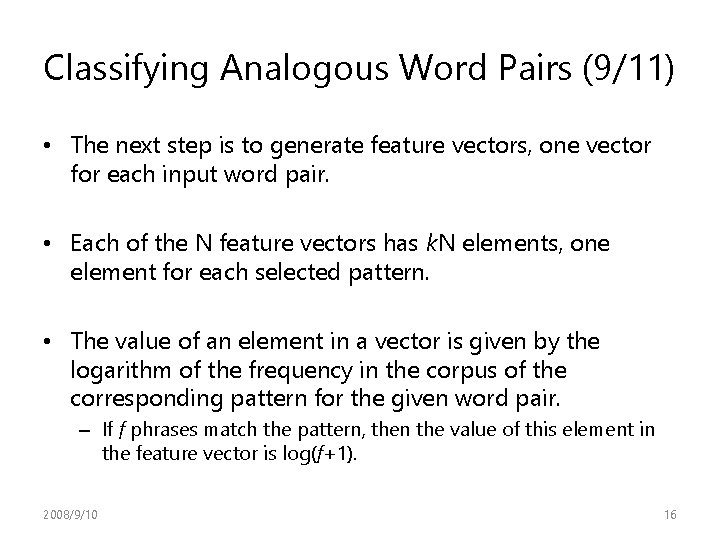
Classifying Analogous Word Pairs (9/11) • The next step is to generate feature vectors, one vector for each input word pair. • Each of the N feature vectors has k. N elements, one element for each selected pattern. • The value of an element in a vector is given by the logarithm of the frequency in the corpus of the corresponding pattern for the given word pair. – If f phrases match the pattern, then the value of this element in the feature vector is log(f+1). 2008/9/10 16
Classifying Analogous Word Pairs (10/11) • Each feature vector is normalized to unit length. – The normalization ensures that features in vectors for highfrequency word pairs (traffic: street) are comparable to features in vectors for low-frequency word pairs (water: riverbed). • Now that we have a feature vector for each input word pair, we can apply a standard supervised learning algorithm. • In the following experiment, we use a sequential minimal optimization (SMO) support vector machine (SVM) with a radial basis function (RBF) kernel. 2008/9/10 17
Classifying Analogous Word Pairs (11/11) • The algorithm generates probability estimates for each class by fitting logistic regression models to the output of the SVM. • We chose the SMO RBF algorithm because it is fast, robust, and it easily handles large numbers of features. • For convenience, we will refer to the above algorithm as Pair. Class. – In the following experiments, Pair. Class is applied to each of the four problems with no adjustments or tuning to the specific problems. 2008/9/10 18
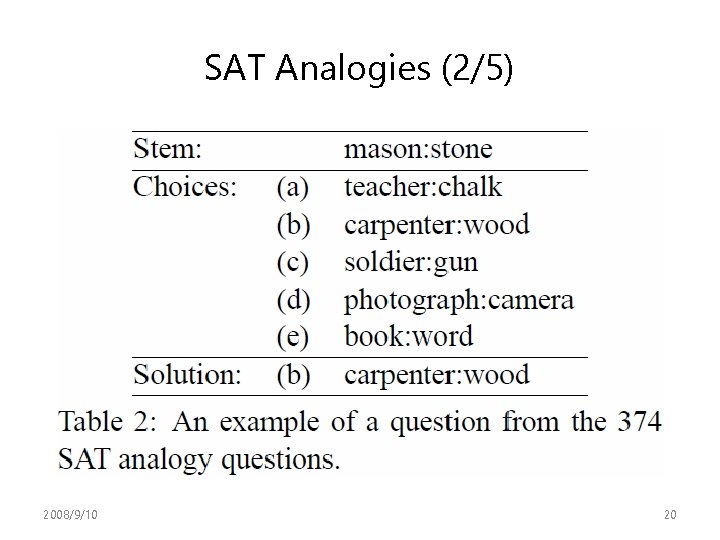
SAT Analogies (1/5) • In this section, we apply Pair. Class to the task of recognizing analogies. • To evaluate the performance, we use a set of 374 multiple-choice questions from the SAT college entrance exam. • The target pair is called the stem, and the task is to select the choice pair that is most analogous to the stem pair. 2008/9/10 19
SAT Analogies (2/5) 2008/9/10 20
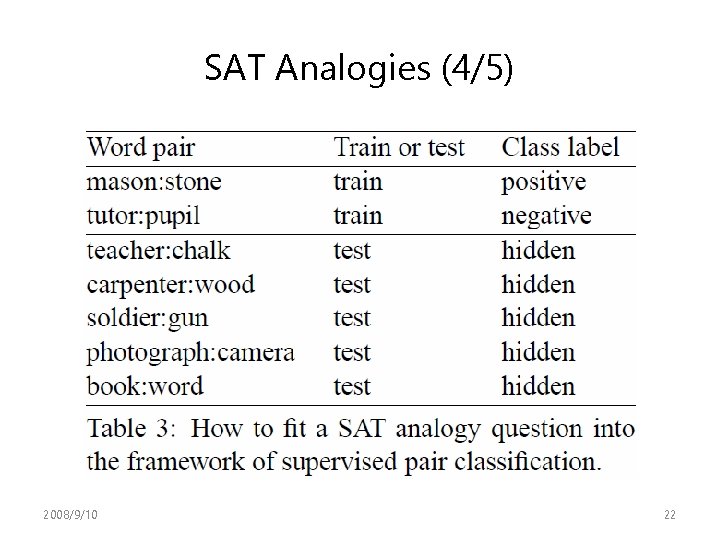
SAT Analogies (3/5) • We may view Table 2 as a binary classification problem, in which mason: stone and carpenter: wood are positive examples and the remaining word pairs are negative examples. – That is, the training set consists of one positive example (the stem pair) and the testing set consists of five unlabeled examples (the five choice pairs). • To make this task more tractable, we randomly choose a stem pair from one of the 373 other SAT analogy questions, and we assume that this new stem pair is a negative example. 2008/9/10 21
SAT Analogies (4/5) 2008/9/10 22
SAT Analogies (5/5) • To answer the SAT question, we use Pair. Class to estimate the probability that each testing example is positive, and we guess the testing examples with the highest probability. • To increase the stability, we repeat the learning process 10 times, using a different randomly chosen negative training example each time. • For each testing word pair, the 10 probability estimates are averaged together. 2008/9/10 23
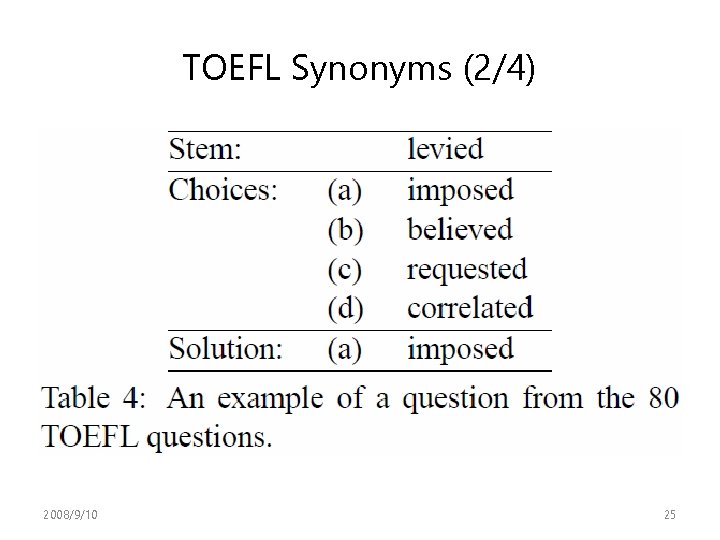
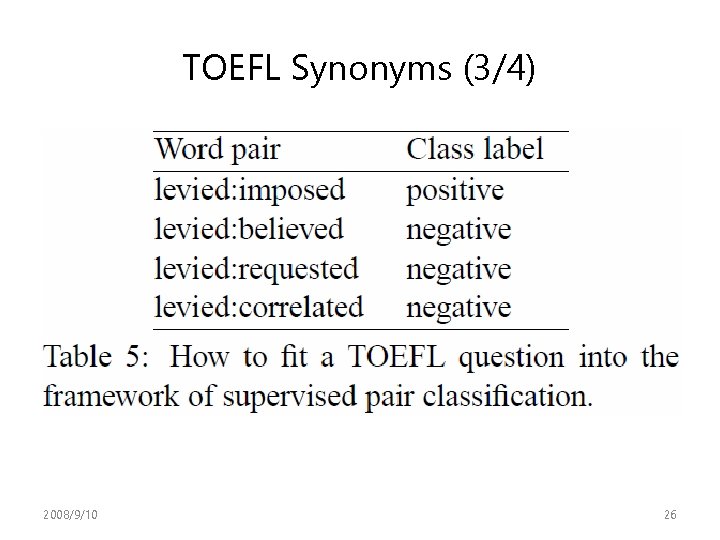
TOEFL Synonyms (1/4) • Now we apply Pair. Class to the task of recognizing synonyms, using a set of 80 multiple-choice synonym questions from the TOEFL (test of English as a foreign language). • The task is to select the choice word that is most similar to the stem word. • We may view Table 4 as a binary classification problem, in which the pair levied: imposed is a positive example of the class synonyms and the other possible pairs are negative examples. 2008/9/10 24
TOEFL Synonyms (2/4) 2008/9/10 25
TOEFL Synonyms (3/4) 2008/9/10 26
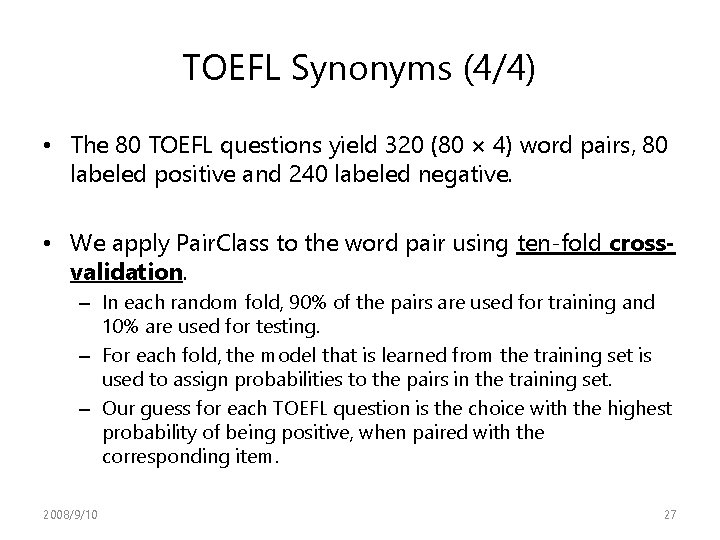
TOEFL Synonyms (4/4) • The 80 TOEFL questions yield 320 (80 × 4) word pairs, 80 labeled positive and 240 labeled negative. • We apply Pair. Class to the word pair using ten-fold crossvalidation. – In each random fold, 90% of the pairs are used for training and 10% are used for testing. – For each fold, the model that is learned from the training set is used to assign probabilities to the pairs in the training set. – Our guess for each TOEFL question is the choice with the highest probability of being positive, when paired with the corresponding item. 2008/9/10 27
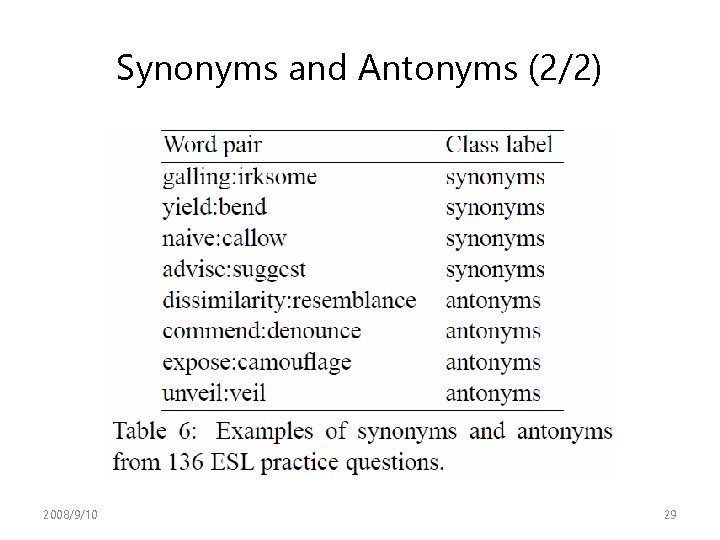
Synonyms and Antonyms (1/2) • The task of classifying word pairs as either synonyms or antonyms readily fit into the framework of supervised classification of word pairs. • Table 6 shows some examples from a set of 136 ESL (English as a second language) practice questions that we collected from various ESL websites. • Ten-fold cross-validation is used. 2008/9/10 28
Synonyms and Antonyms (2/2) 2008/9/10 29
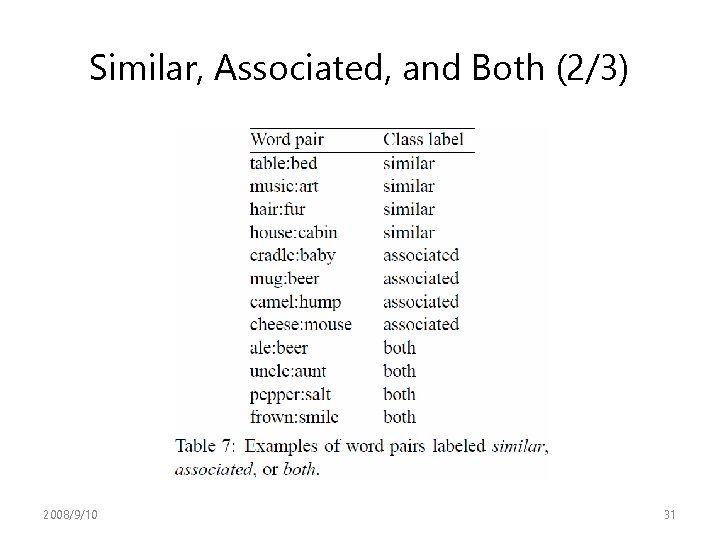
Similar, Associated, and Both (1/3) • A common criticism of corpus-based measures of word similarity (as opposed to lexicon-based measures) is that they are merely detecting associations (co-occurrence), rather than actual semantic similarity. • To address this criticism, Lund et al. (1995) evaluated their algorithm for measuring word similarity with word pairs that were labeled similar, associated, or both. • Table 7 shows some examples from this collection of 144 word pairs (48 pairs in each of the three classes). 2008/9/10 30
Similar, Associated, and Both (2/3) 2008/9/10 31
Similar, Associated, and Both (3/3) • Lund et al. (1995) did not measure the accuracy of their algorithm on this three-classification problem. • Instead, following standard practice in cognitive psychology, they showed that their algorithm’s similarity scores for the 144 word pairs were correlated with the response times of human subjects in priming tests. – In a typical priming test, a human subject reads a priming test word (cradle) and is then asked to complete a partial word (complete bab as baby). • Ten-fold cross-validation is used. 2008/9/10 32
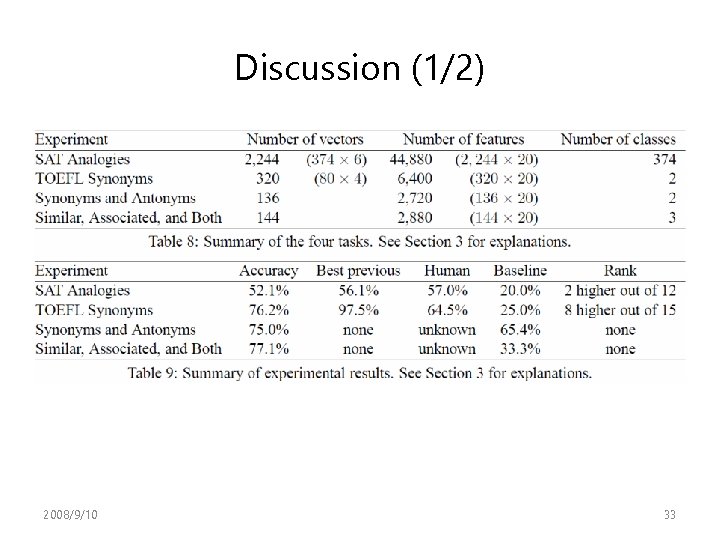
Discussion (1/2) 2008/9/10 33
Discussion (2/2) • As far as we know, this is the first time a standard supervised learning algorithm has been applied to any of these four problems. • The advantage of being able to cast these problem in the framework of standard supervised learning problems is that we can now exploit the huge literature on supervised learning. 2008/9/10 34
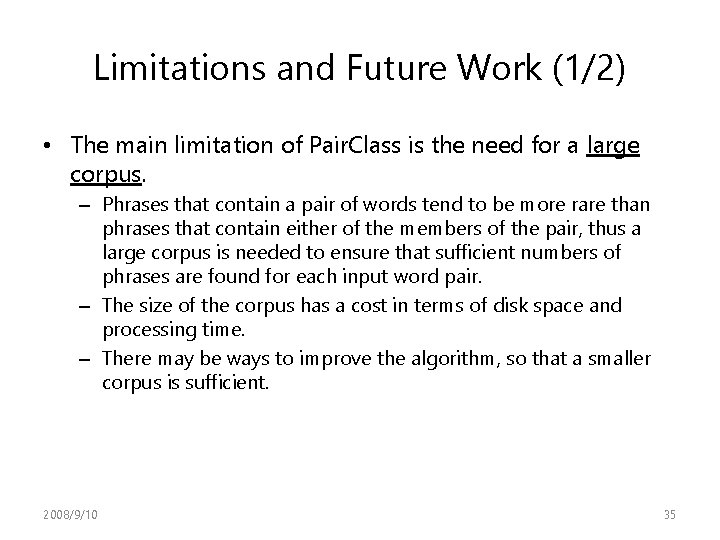
Limitations and Future Work (1/2) • The main limitation of Pair. Class is the need for a large corpus. – Phrases that contain a pair of words tend to be more rare than phrases that contain either of the members of the pair, thus a large corpus is needed to ensure that sufficient numbers of phrases are found for each input word pair. – The size of the corpus has a cost in terms of disk space and processing time. – There may be ways to improve the algorithm, so that a smaller corpus is sufficient. 2008/9/10 35
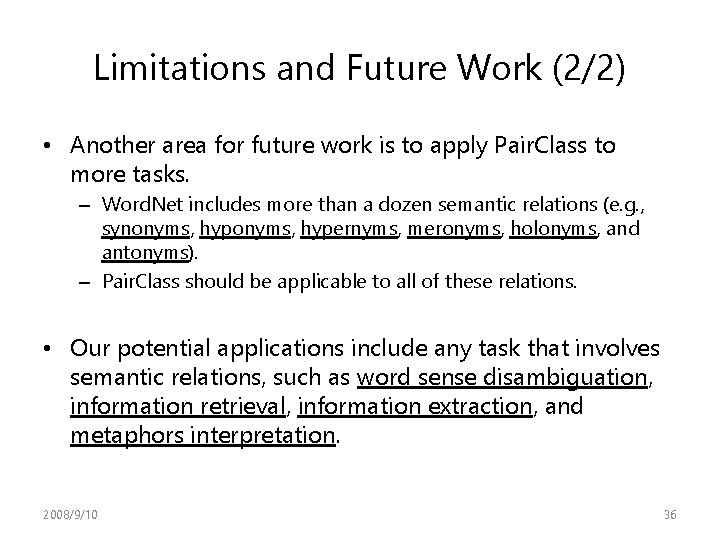
Limitations and Future Work (2/2) • Another area for future work is to apply Pair. Class to more tasks. – Word. Net includes more than a dozen semantic relations (e. g. , synonyms, hypernyms, meronyms, holonyms, and antonyms). – Pair. Class should be applicable to all of these relations. • Our potential applications include any task that involves semantic relations, such as word sense disambiguation, information retrieval, information extraction, and metaphors interpretation. 2008/9/10 36
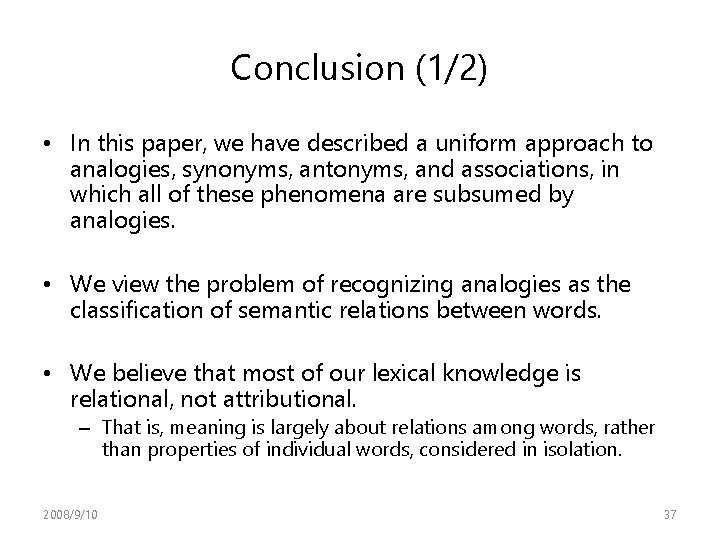
Conclusion (1/2) • In this paper, we have described a uniform approach to analogies, synonyms, antonyms, and associations, in which all of these phenomena are subsumed by analogies. • We view the problem of recognizing analogies as the classification of semantic relations between words. • We believe that most of our lexical knowledge is relational, not attributional. – That is, meaning is largely about relations among words, rather than properties of individual words, considered in isolation. 2008/9/10 37
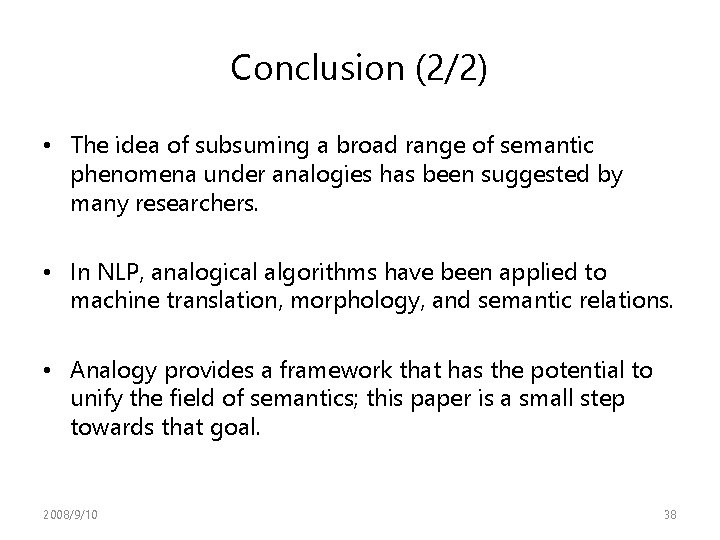
Conclusion (2/2) • The idea of subsuming a broad range of semantic phenomena under analogies has been suggested by many researchers. • In NLP, analogical algorithms have been applied to machine translation, morphology, and semantic relations. • Analogy provides a framework that has the potential to unify the field of semantics; this paper is a small step towards that goal. 2008/9/10 38