
A Unified Relational Approach to Grid Information Services


- Slides: 32
A Unified Relational Approach to Grid Information Services (GWD-GIS-012 -1 (Informational)) Peter A. Dinda, Northwestern Beth Plale, Georgia Tech http: //www. cs. nwu. edu/~pdinda/relational-gis
Related Work • Steve Fisher, RAL – Relational model for Grid Performance Working group – Interesting thoughts on how to provide distributed relational model • Jennifer Schopf, “The Dictionary Project” 2
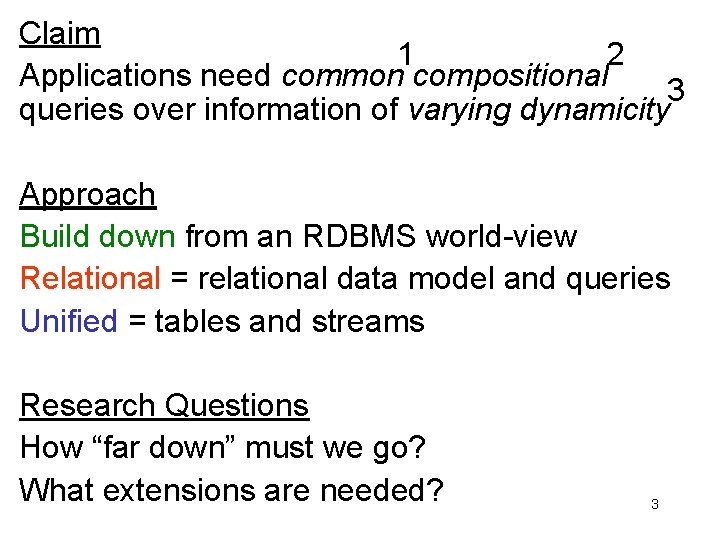
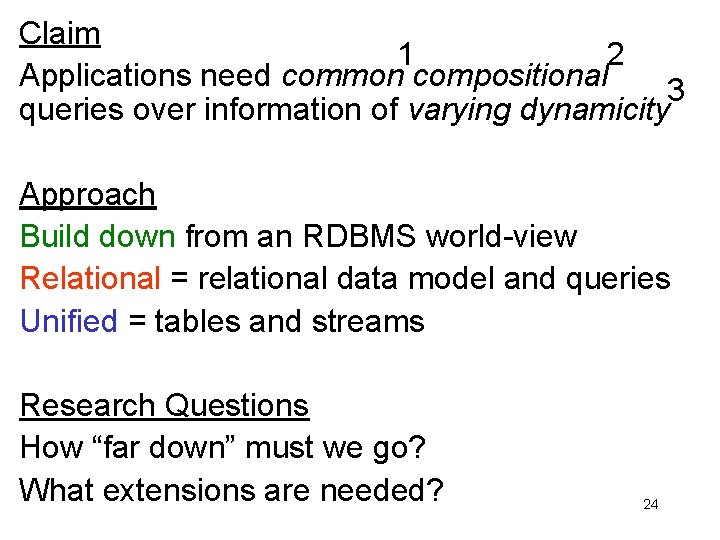
Claim 1 2 Applications need common compositional 3 queries over information of varying dynamicity Approach Build down from an RDBMS world-view Relational = relational data model and queries Unified = tables and streams Research Questions How “far down” must we go? What extensions are needed? 3
Outline • Needs of Grid applications • Why RDBMS? • Our approach (and research) – Existence proofs • Call for participation 4
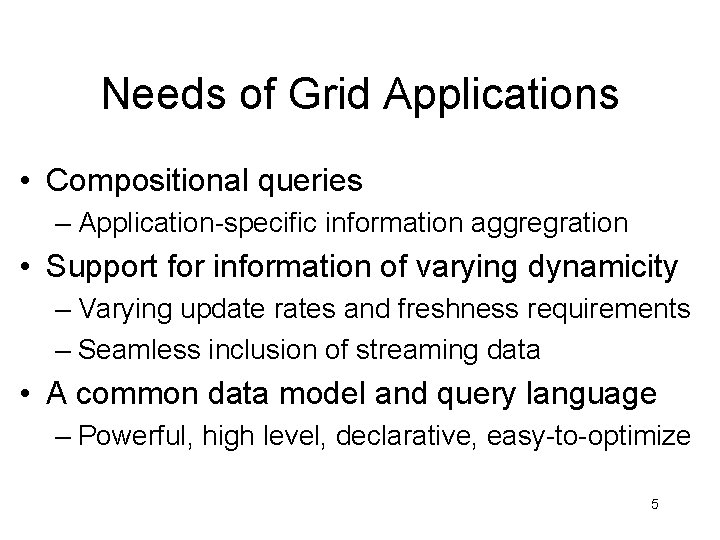
Needs of Grid Applications • Compositional queries – Application-specific information aggregration • Support for information of varying dynamicity – Varying update rates and freshness requirements – Seamless inclusion of streaming data • A common data model and query language – Powerful, high level, declarative, easy-to-optimize 5
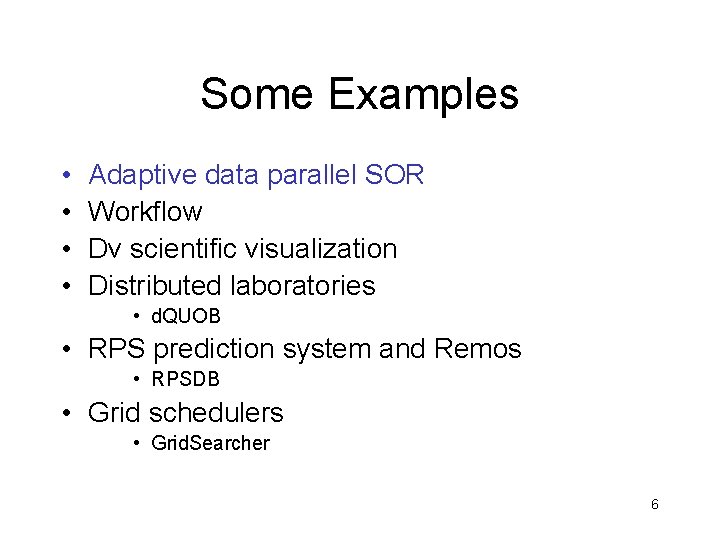
Some Examples • • Adaptive data parallel SOR Workflow Dv scientific visualization Distributed laboratories • d. QUOB • RPS prediction system and Remos • RPSDB • Grid schedulers • Grid. Searcher 6
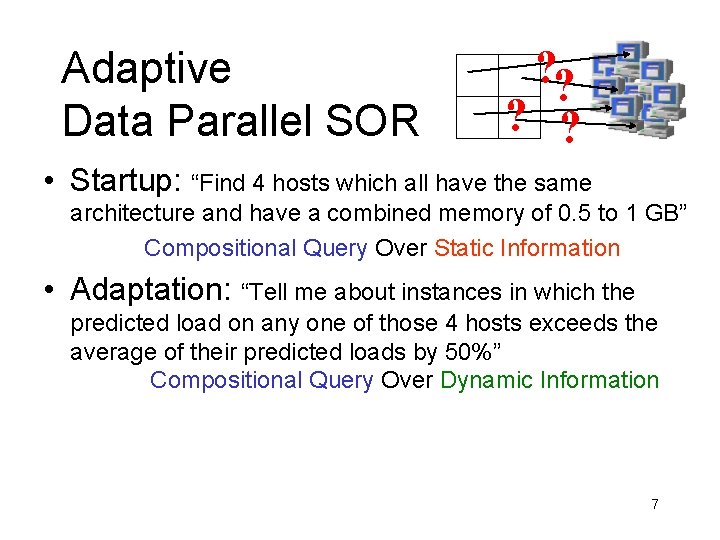
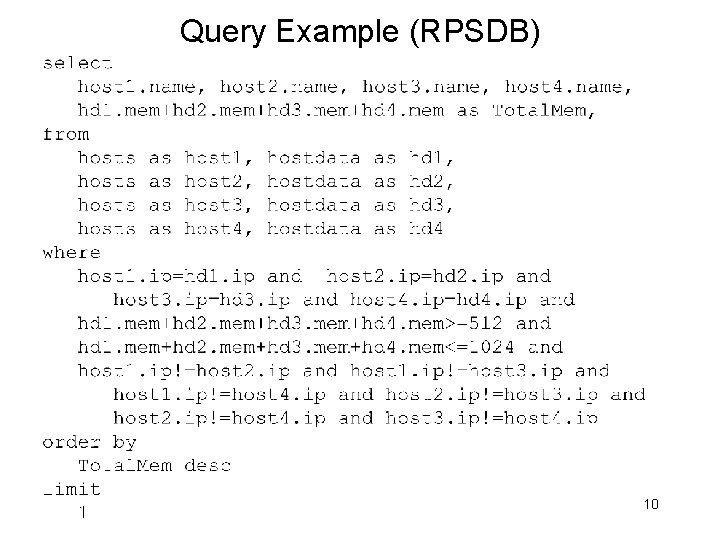
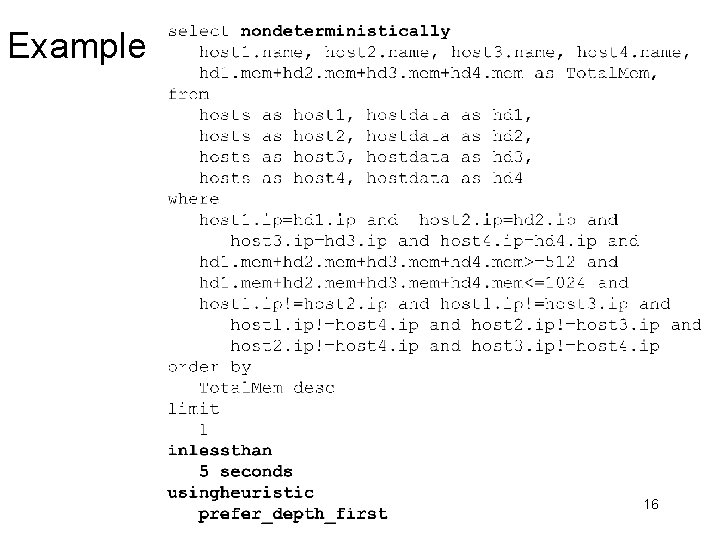
Adaptive Data Parallel SOR ? ? • Startup: “Find 4 hosts which all have the same architecture and have a combined memory of 0. 5 to 1 GB” Compositional Query Over Static Information • Adaptation: “Tell me about instances in which the predicted load on any one of those 4 hosts exceeds the average of their predicted loads by 50%” Compositional Query Over Dynamic Information 7
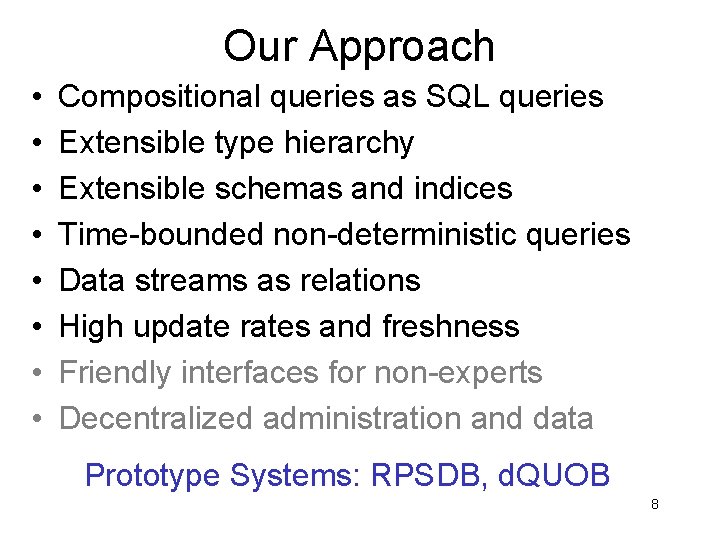
Our Approach • • Compositional queries as SQL queries Extensible type hierarchy Extensible schemas and indices Time-bounded non-deterministic queries Data streams as relations High update rates and freshness Friendly interfaces for non-experts Decentralized administration and data Prototype Systems: RPSDB, d. QUOB 8
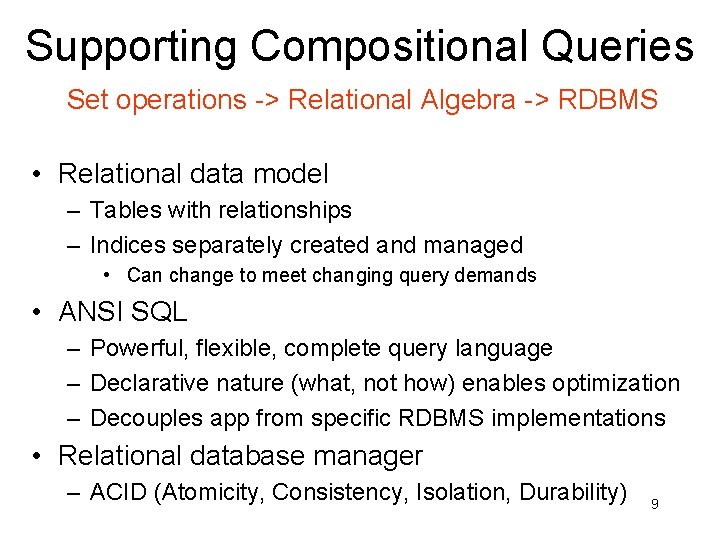
Supporting Compositional Queries Set operations -> Relational Algebra -> RDBMS • Relational data model – Tables with relationships – Indices separately created and managed • Can change to meet changing query demands • ANSI SQL – Powerful, flexible, complete query language – Declarative nature (what, not how) enables optimization – Decouples app from specific RDBMS implementations • Relational database manager – ACID (Atomicity, Consistency, Isolation, Durability) 9
Query Example (RPSDB) 10
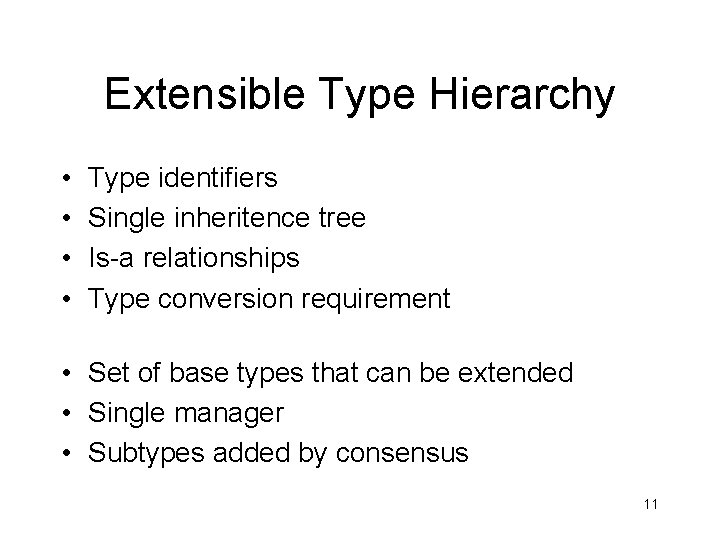
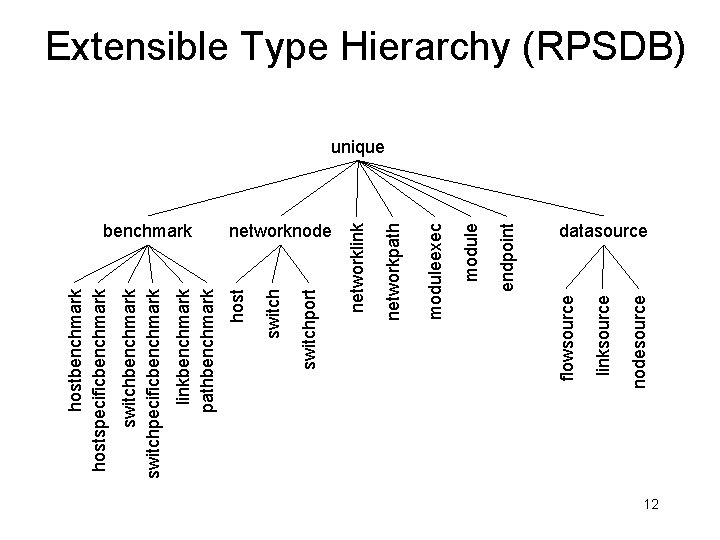
Extensible Type Hierarchy • • Type identifiers Single inheritence tree Is-a relationships Type conversion requirement • Set of base types that can be extended • Single manager • Subtypes added by consensus 11
networknodesource linksource flowsource endpoint moduleexec networkpath networklink switchport switch benchmark host linkbenchmark pathbenchmark switchpecificbenchmark hostspecificbenchmark Extensible Type Hierarchy (RPSDB) unique datasource 12
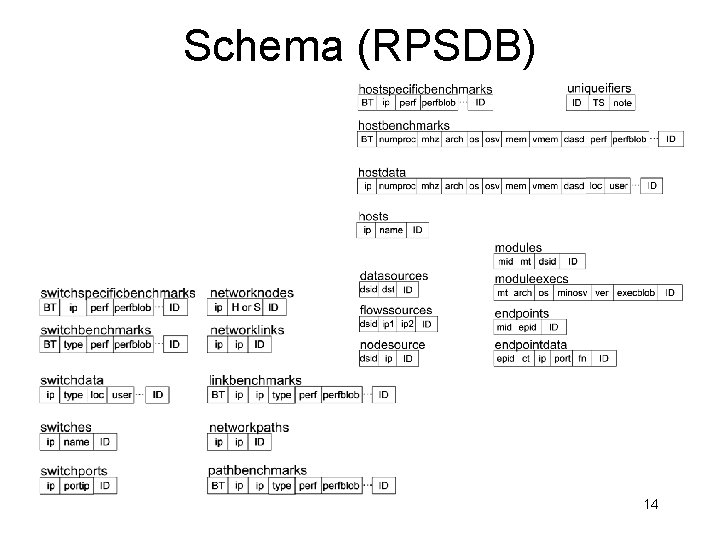
Schemas and Indices • Schemas encode types into tables and establish relationships between the tables • Indices determine which relationships are fast with respect to queries 13
Schema (RPSDB) 14
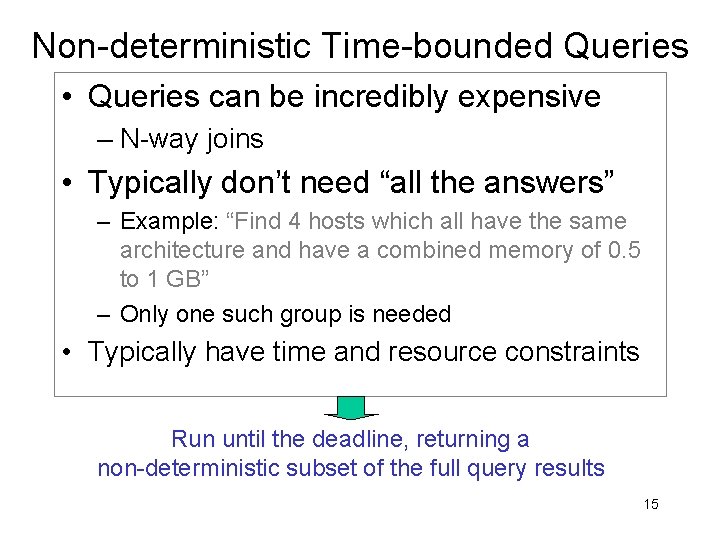
Non-deterministic Time-bounded Queries • Queries can be incredibly expensive – N-way joins • Typically don’t need “all the answers” – Example: “Find 4 hosts which all have the same architecture and have a combined memory of 0. 5 to 1 GB” – Only one such group is needed • Typically have time and resource constraints Run until the deadline, returning a non-deterministic subset of the full query results 15
Example 16
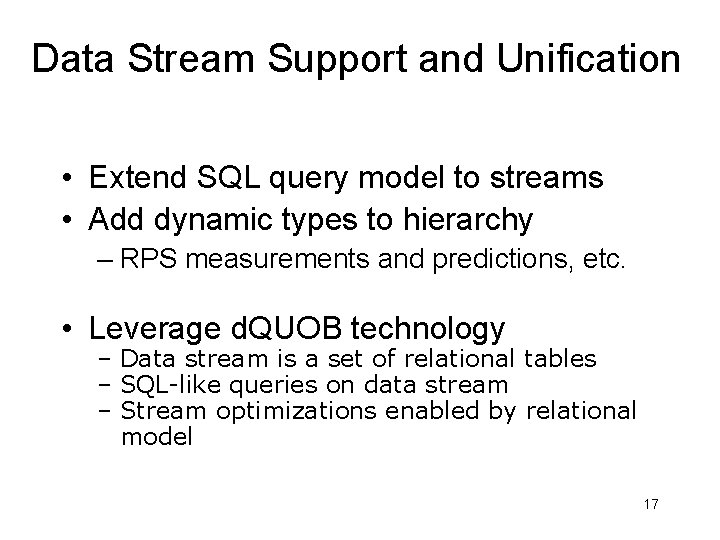
Data Stream Support and Unification • Extend SQL query model to streams • Add dynamic types to hierarchy – RPS measurements and predictions, etc. • Leverage d. QUOB technology – Data stream is a set of relational tables – SQL-like queries on data stream – Stream optimizations enabled by relational model 17
d. QUOB Quoblet bounding box extraction units conversion violation notification user- SQL query userdefined action MPEG compression C 2 D D D C 3 D D DC 1 DDDATADDD D S T R E A M D DC 4 DDD 18
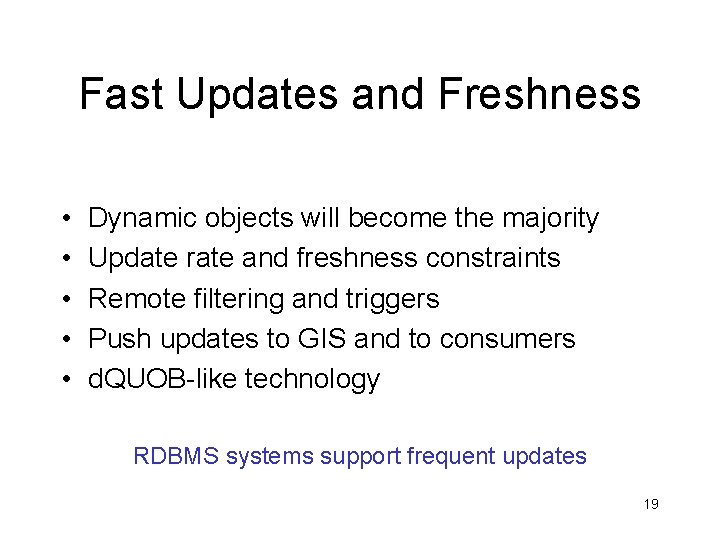
Fast Updates and Freshness • • • Dynamic objects will become the majority Update rate and freshness constraints Remote filtering and triggers Push updates to GIS and to consumers d. QUOB-like technology RDBMS systems support frequent updates 19
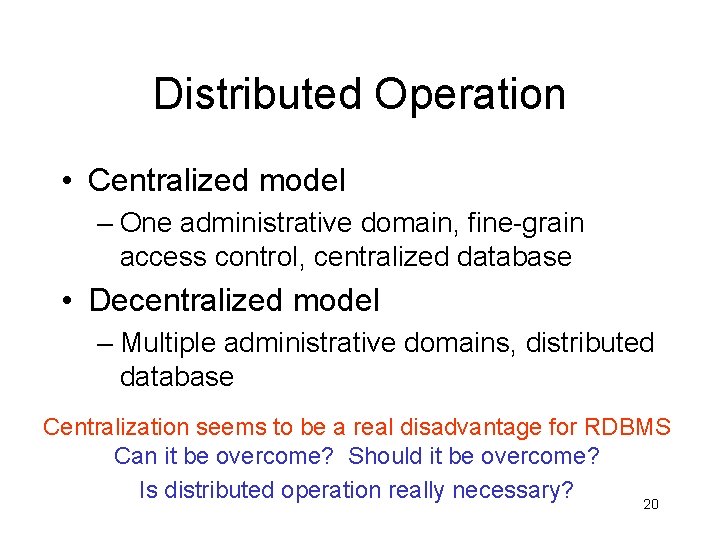
Distributed Operation • Centralized model – One administrative domain, fine-grain access control, centralized database • Decentralized model – Multiple administrative domains, distributed database Centralization seems to be a real disadvantage for RDBMS Can it be overcome? Should it be overcome? Is distributed operation really necessary? 20
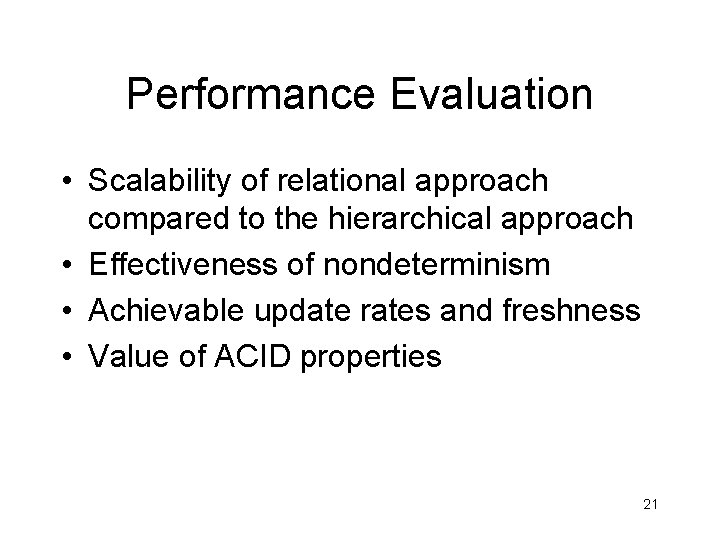
Performance Evaluation • Scalability of relational approach compared to the hierarchical approach • Effectiveness of nondeterminism • Achievable update rates and freshness • Value of ACID properties 21
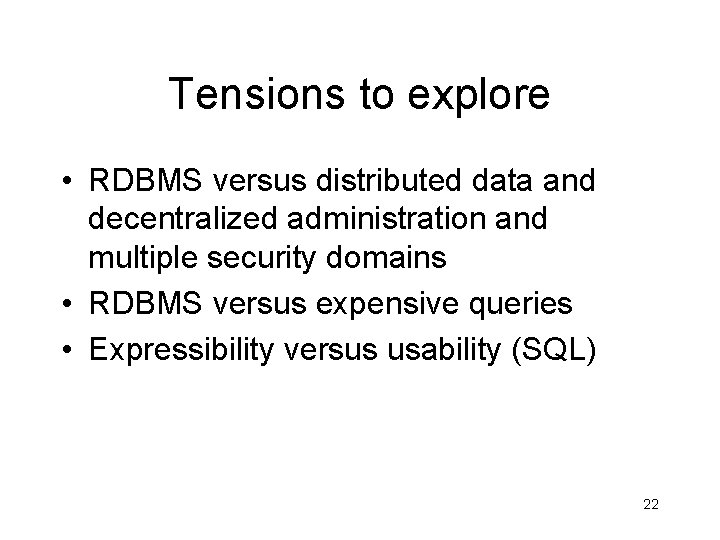
Tensions to explore • RDBMS versus distributed data and decentralized administration and multiple security domains • RDBMS versus expensive queries • Expressibility versus usability (SQL) 22
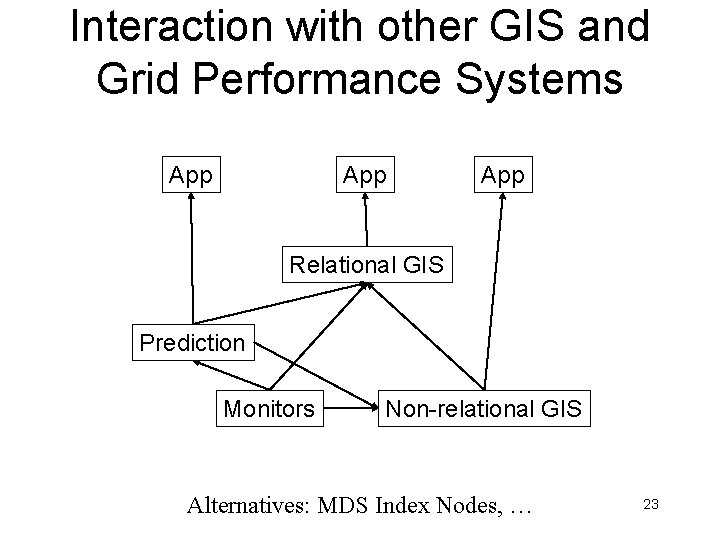
Interaction with other GIS and Grid Performance Systems App App Relational GIS Prediction Monitors Non-relational GIS Alternatives: MDS Index Nodes, … 23
Claim 1 2 Applications need common compositional 3 queries over information of varying dynamicity Approach Build down from an RDBMS world-view Relational = relational data model and queries Unified = tables and streams Research Questions How “far down” must we go? What extensions are needed? 24
Come Join Us • Peter A. Dinda, Northwestern, pdinda@cs. nwu. edu • Beth Plale, Georgia Tech, beth@cc. gatech. edu • Relational Task Group, http: //www. cs. nwu. edu/~pdinda/relational-gis 25
Proposed Areas/Papers AREAS RIPE FOR PARTICIPATION! • Use cases • Expand on the examples in our paper • Type hierarchy and set of base types • Useful independent of data model • • The vision paper (Plale) Schema design / critique Reference implementations Interaction with Steve Fisher’s work 26
Implementation of Non-deterministic, Time-bounded Queries • • Current research Leverage work by Olken and Tan, et al Query-rewriting approach Hopefully RDBMS-independent 27
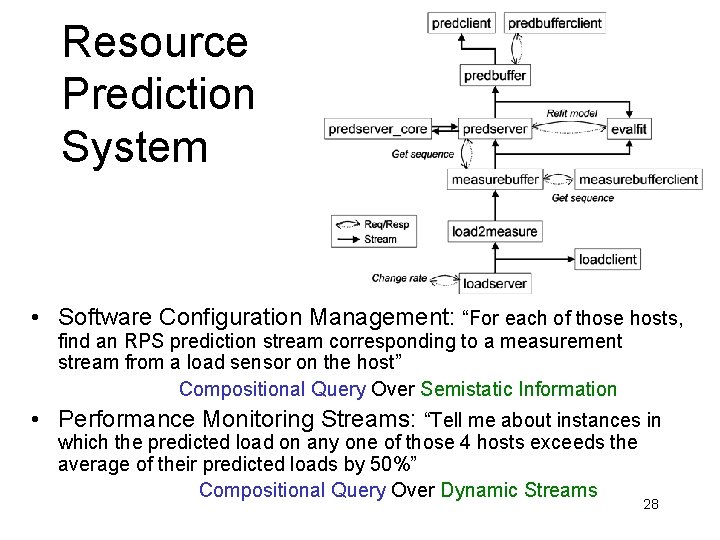
Resource Prediction System • Software Configuration Management: “For each of those hosts, find an RPS prediction stream corresponding to a measurement stream from a load sensor on the host” Compositional Query Over Semistatic Information • Performance Monitoring Streams: “Tell me about instances in which the predicted load on any one of those 4 hosts exceeds the average of their predicted loads by 50%” Compositional Query Over Dynamic Streams 28
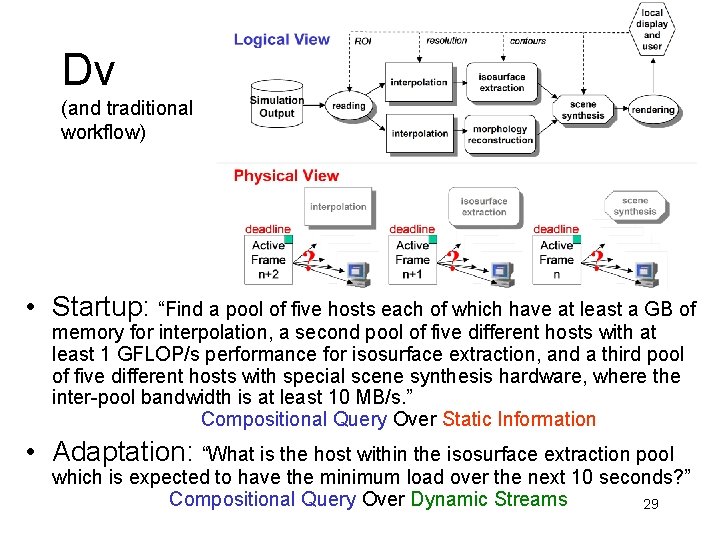
Dv (and traditional workflow) • Startup: “Find a pool of five hosts each of which have at least a GB of memory for interpolation, a second pool of five different hosts with at least 1 GFLOP/s performance for isosurface extraction, and a third pool of five different hosts with special scene synthesis hardware, where the inter-pool bandwidth is at least 10 MB/s. ” Compositional Query Over Static Information • Adaptation: “What is the host within the isosurface extraction pool which is expected to have the minimum load over the next 10 seconds? ” Compositional Query Over Dynamic Streams 29
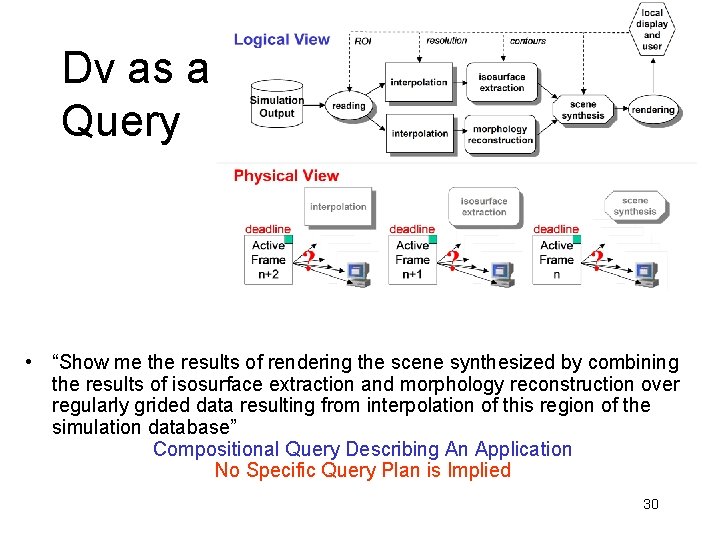
Dv as a Query • “Show me the results of rendering the scene synthesized by combining the results of isosurface extraction and morphology reconstruction over regularly grided data resulting from interpolation of this region of the simulation database” Compositional Query Describing An Application No Specific Query Plan is Implied 30
Grid Schedulers • Similar needs, more flexibility • But these abstractions are important – Grid. Searcher [Schopf] • Compositional Queries over MDS 31
Our Approach • • Compositional queries as SQL queries Type hierarchy Schema and indices (including example) Time-bounded non-deterministic queries Data stream support with d. QUOB Fast updates and streaming Tensions and questions Prototype Systems: RPSDB, d. QUOB 32