
A Unified Framework for Sequential Decision Analytics Olin

- Slides: 50
A Unified Framework for Sequential Decision Analytics Olin Business School University of Washington, St. Louis November 5 -6, 2019 Warren B. Powell Princeton University Department of Operations Research and Financial Engineering
Stochastic lookahead policies
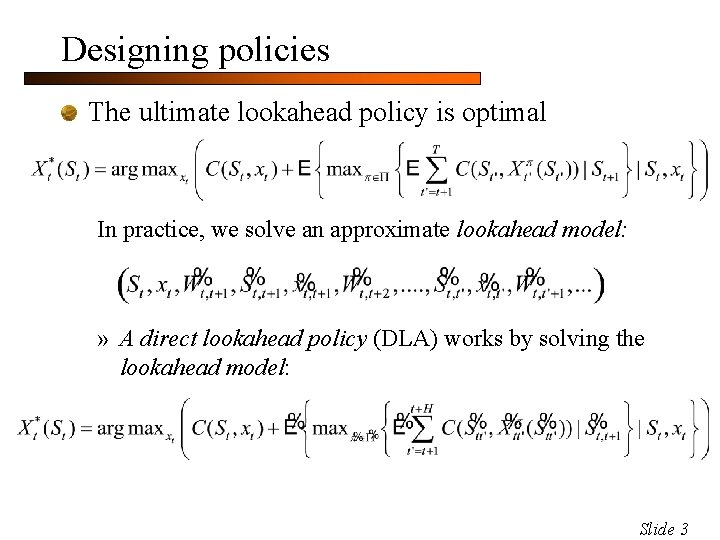
Designing policies The ultimate lookahead policy is optimal In practice, we solve an approximate lookahead model: » A direct lookahead policy (DLA) works by solving the lookahead model: Slide 3
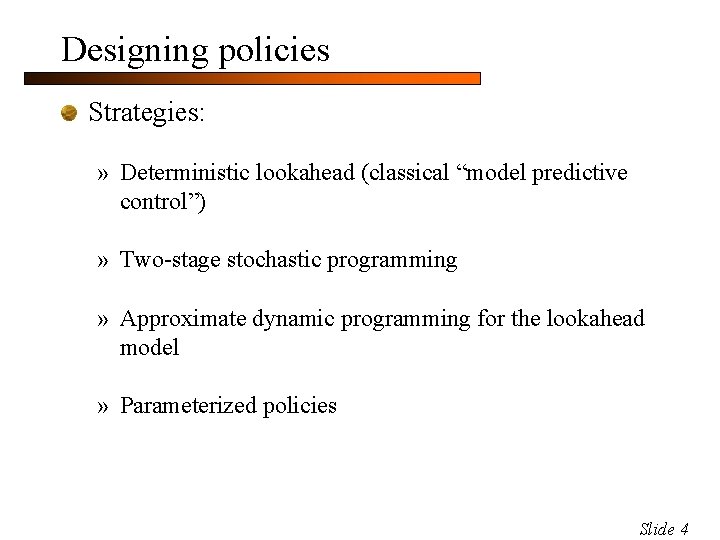
Designing policies Strategies: » Deterministic lookahead (classical “model predictive control”) » Two-stage stochastic programming » Approximate dynamic programming for the lookahead model » Parameterized policies Slide 4
Scenario trees
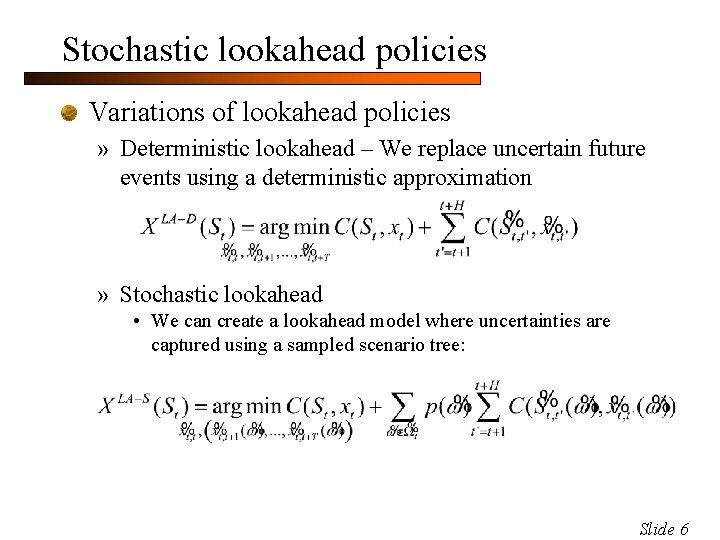
Stochastic lookahead policies Variations of lookahead policies » Deterministic lookahead – We replace uncertain future events using a deterministic approximation » Stochastic lookahead • We can create a lookahead model where uncertainties are captured using a sampled scenario tree: Slide 6
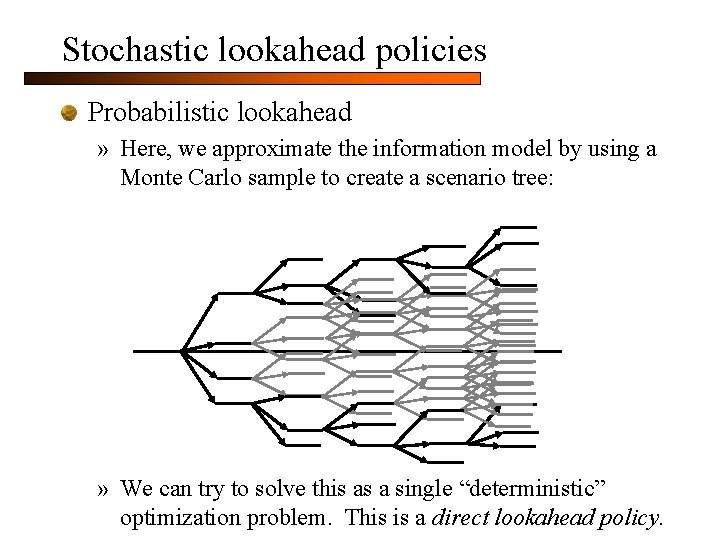
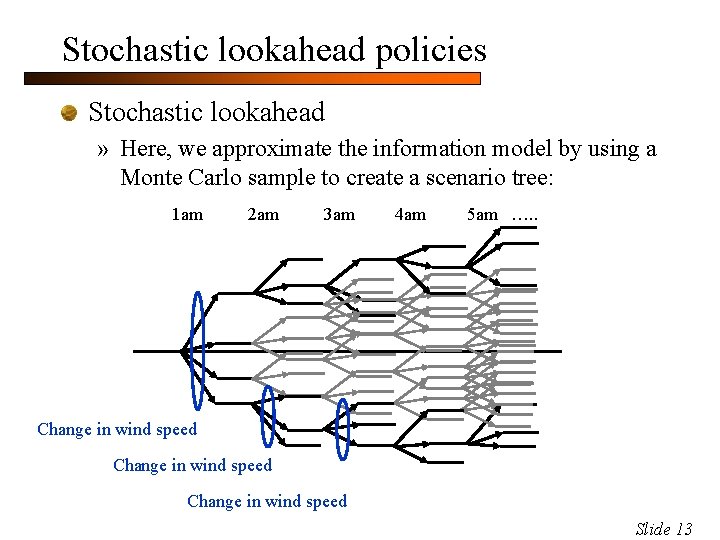
Stochastic lookahead policies Probabilistic lookahead » Here, we approximate the information model by using a Monte Carlo sample to create a scenario tree: » We can try to solve this as a single “deterministic” optimization problem. This is a direct lookahead policy.
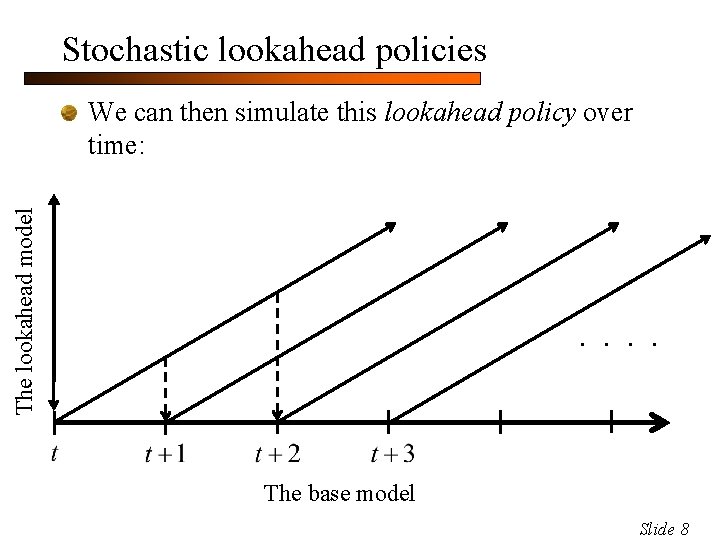
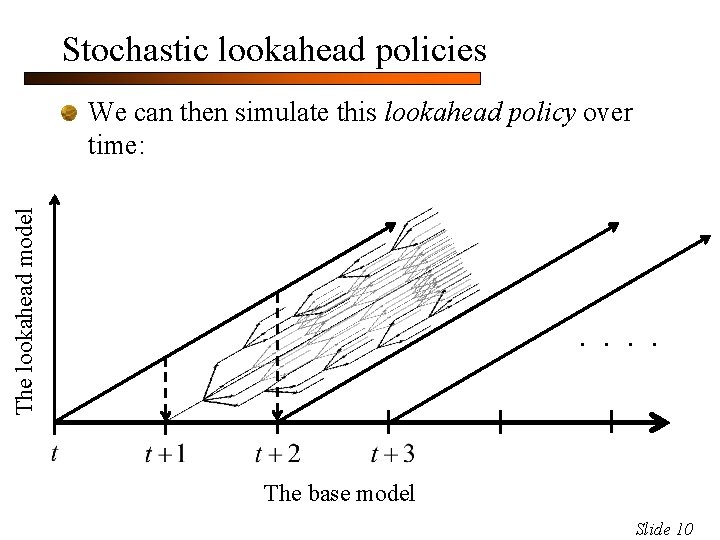
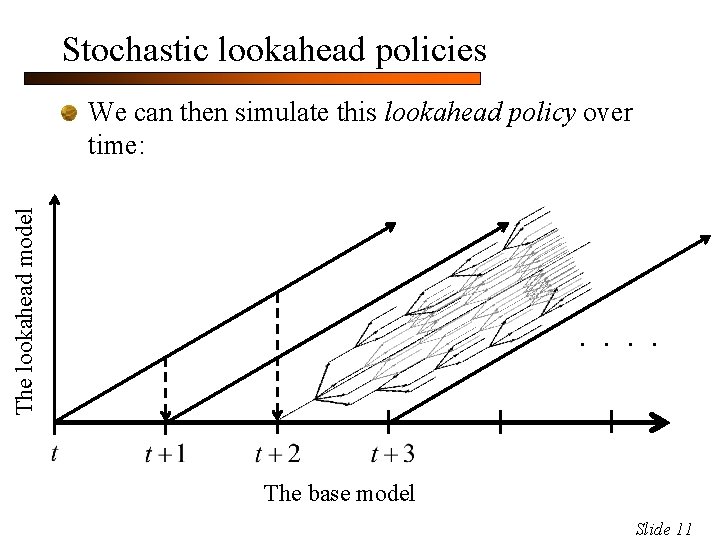
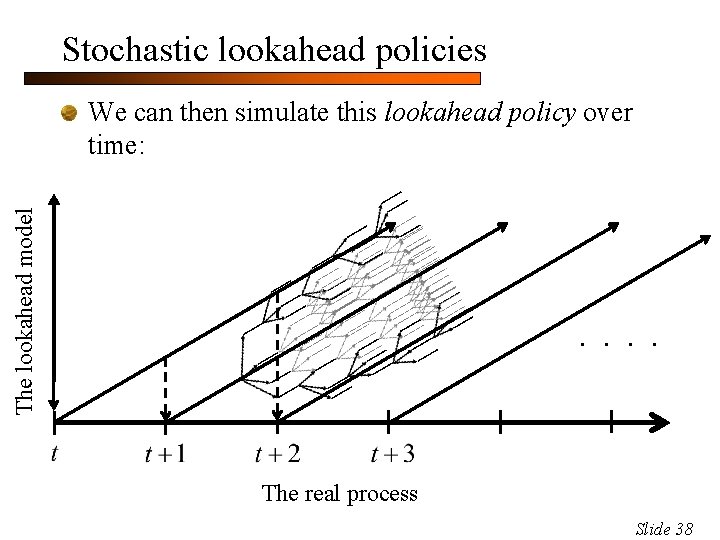
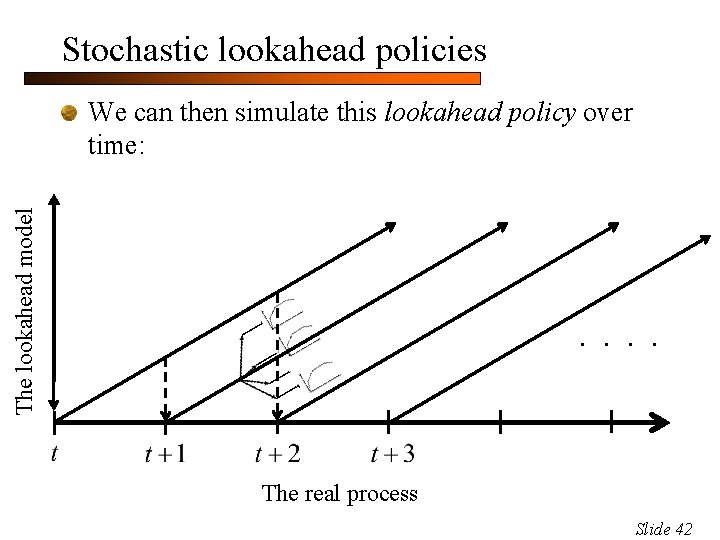
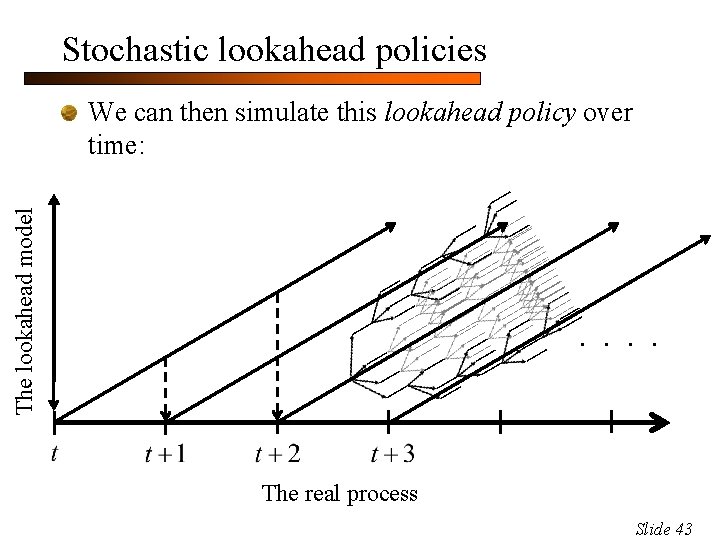
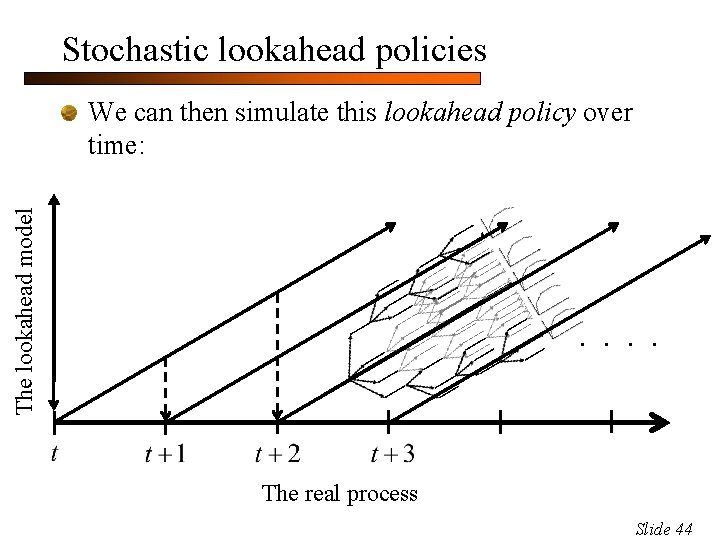
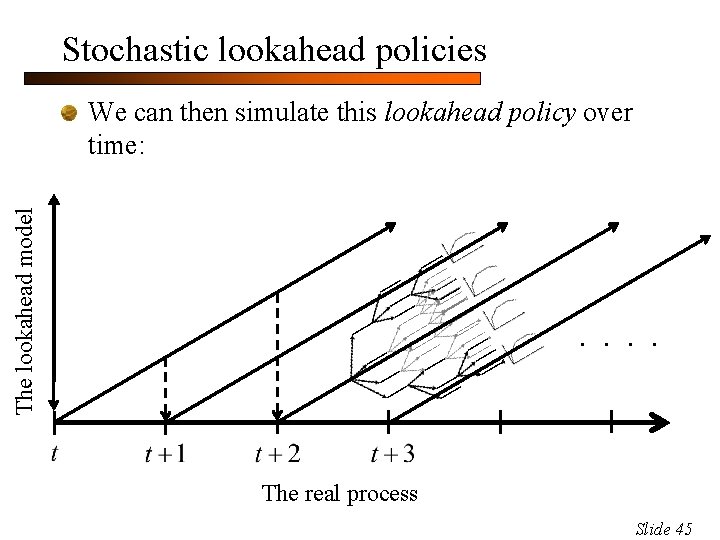
Stochastic lookahead policies The lookahead model We can then simulate this lookahead policy over time: . . The base model Slide 8
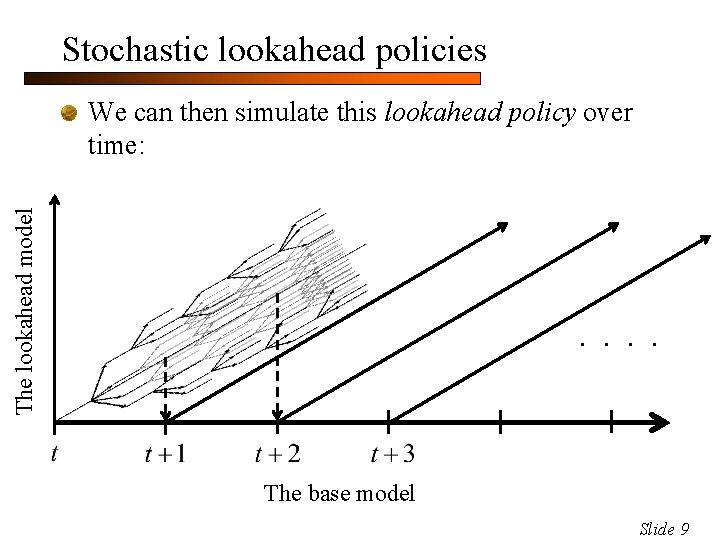
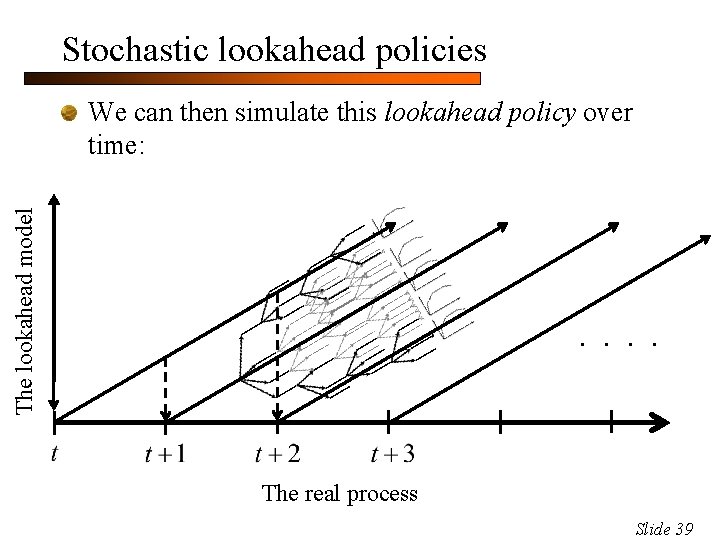
Stochastic lookahead policies The lookahead model We can then simulate this lookahead policy over time: . . The base model Slide 9
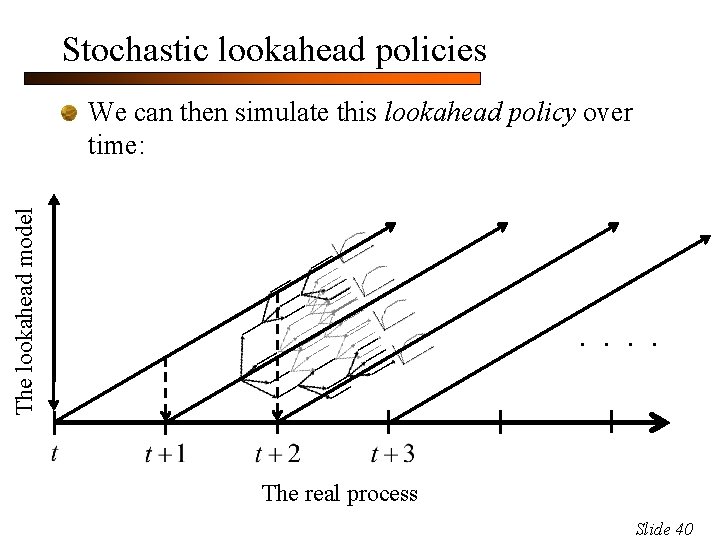
Stochastic lookahead policies The lookahead model We can then simulate this lookahead policy over time: . . The base model Slide 10
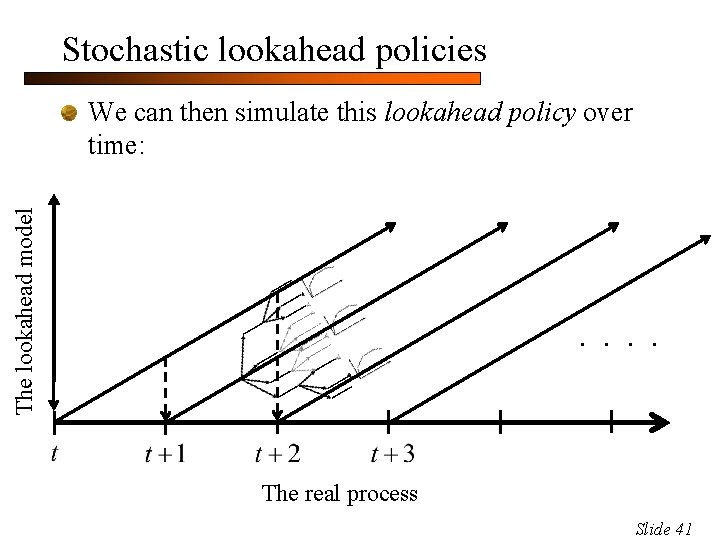
Stochastic lookahead policies The lookahead model We can then simulate this lookahead policy over time: . . The base model Slide 11
Two-stage approximation
Stochastic lookahead policies Stochastic lookahead » Here, we approximate the information model by using a Monte Carlo sample to create a scenario tree: 1 am 2 am 3 am 4 am 5 am …. . Change in wind speed Slide 13
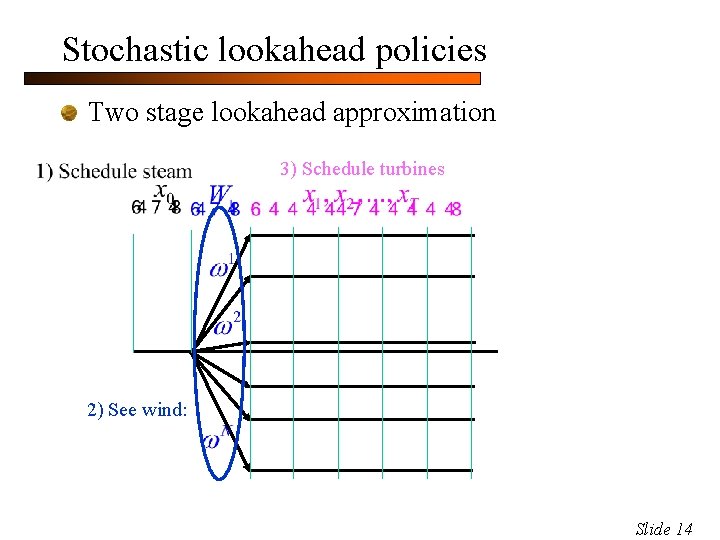
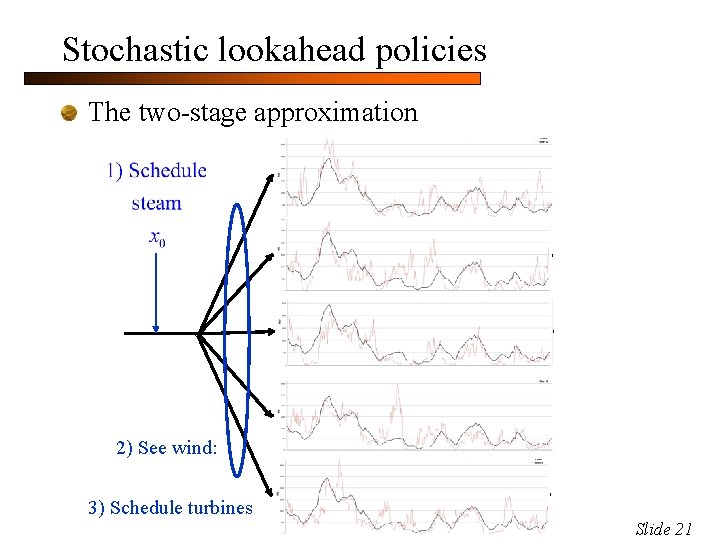
Stochastic lookahead policies Two stage lookahead approximation 3) Schedule turbines 2) See wind: Slide 14
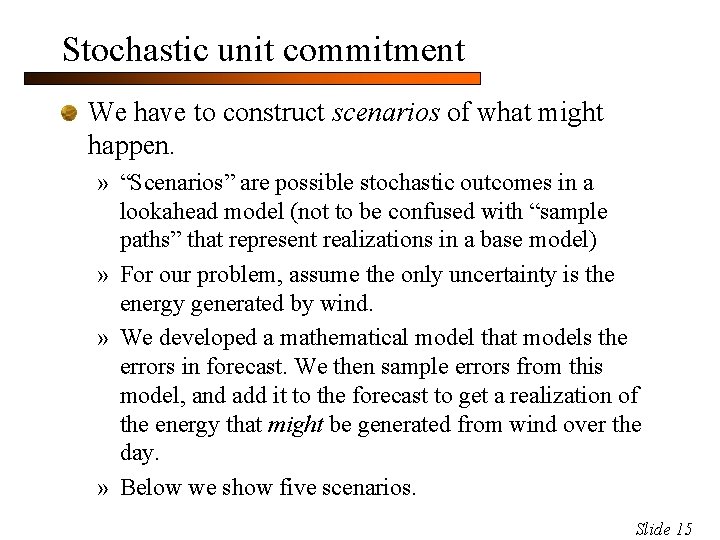
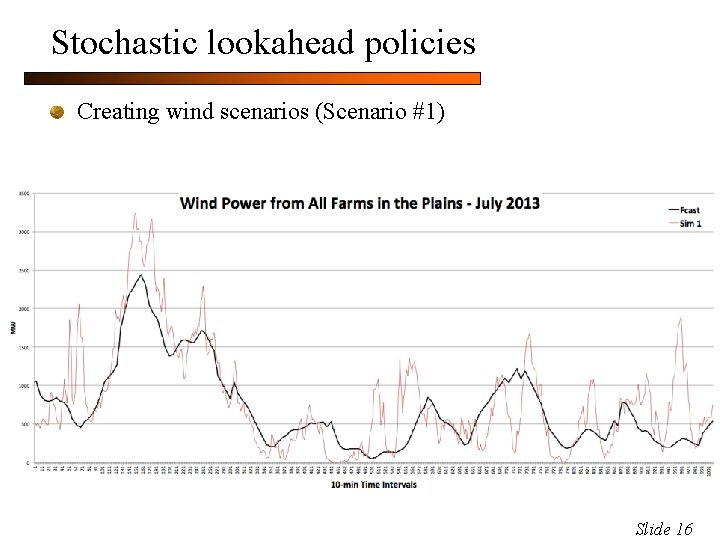
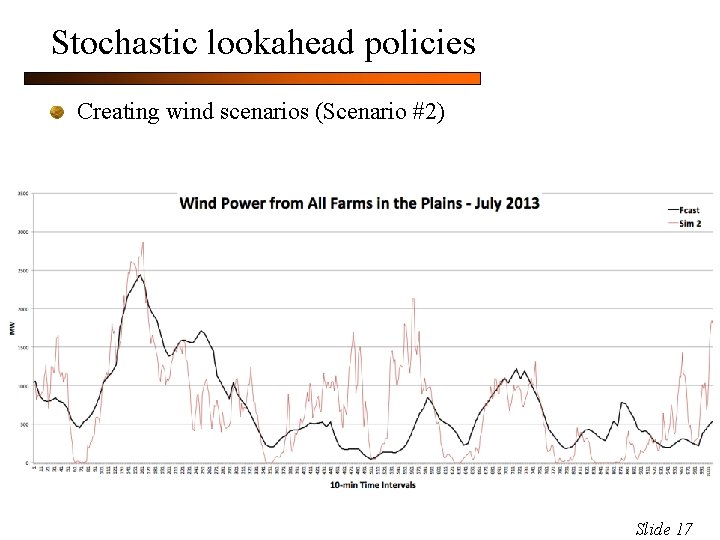
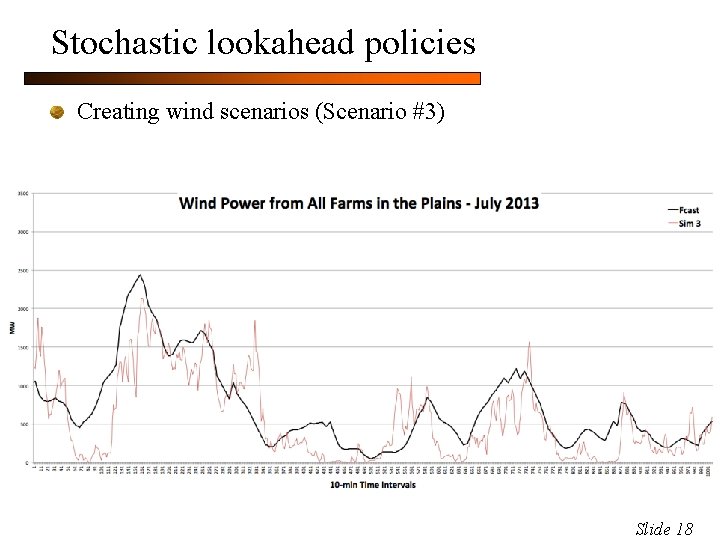
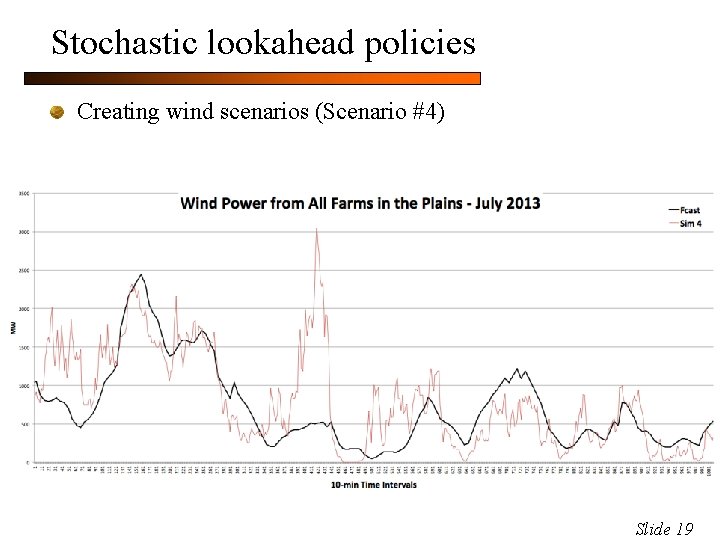
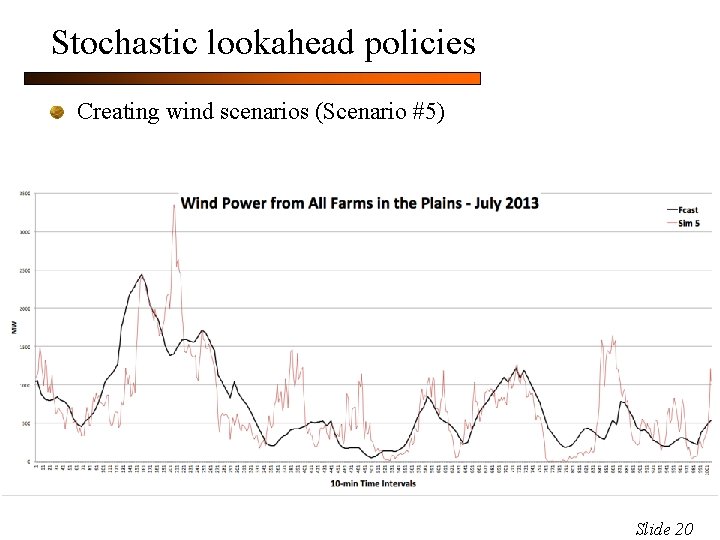
Stochastic unit commitment We have to construct scenarios of what might happen. » “Scenarios” are possible stochastic outcomes in a lookahead model (not to be confused with “sample paths” that represent realizations in a base model) » For our problem, assume the only uncertainty is the energy generated by wind. » We developed a mathematical model that models the errors in forecast. We then sample errors from this model, and add it to the forecast to get a realization of the energy that might be generated from wind over the day. » Below we show five scenarios. Slide 15
Stochastic lookahead policies Creating wind scenarios (Scenario #1) Slide 16
Stochastic lookahead policies Creating wind scenarios (Scenario #2) Slide 17
Stochastic lookahead policies Creating wind scenarios (Scenario #3) Slide 18
Stochastic lookahead policies Creating wind scenarios (Scenario #4) Slide 19
Stochastic lookahead policies Creating wind scenarios (Scenario #5) Slide 20
Stochastic lookahead policies The two-stage approximation 2) See wind: 3) Schedule turbines Slide 21
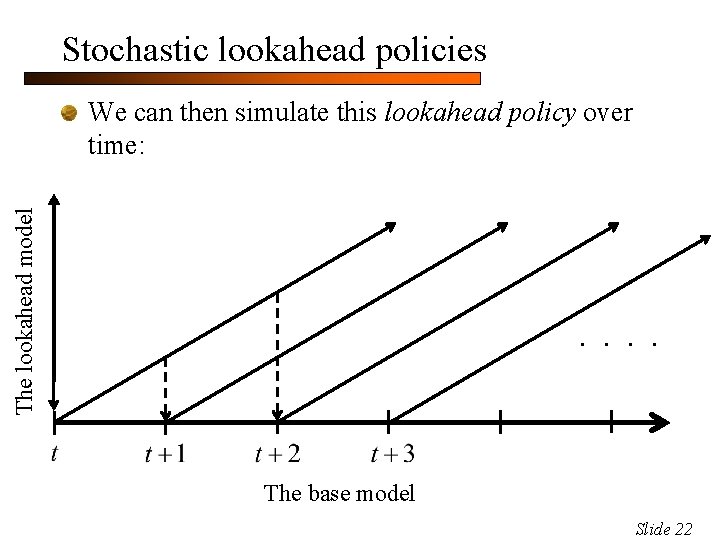
Stochastic lookahead policies The lookahead model We can then simulate this lookahead policy over time: . . The base model Slide 22
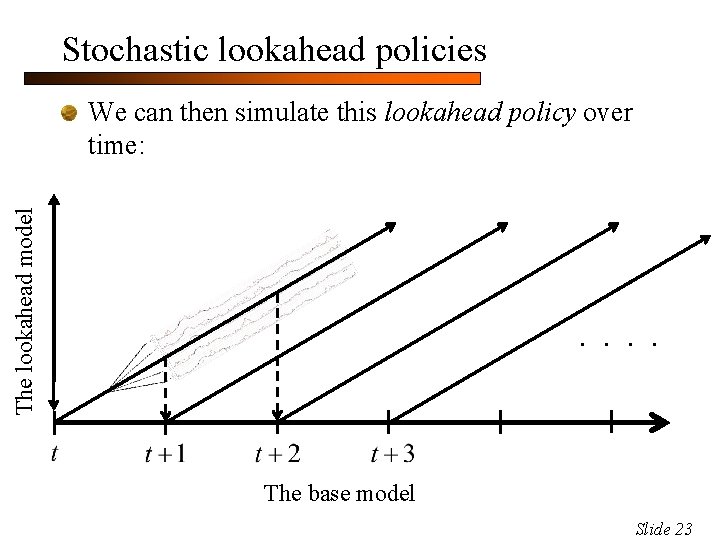
Stochastic lookahead policies The lookahead model We can then simulate this lookahead policy over time: . . The base model Slide 23
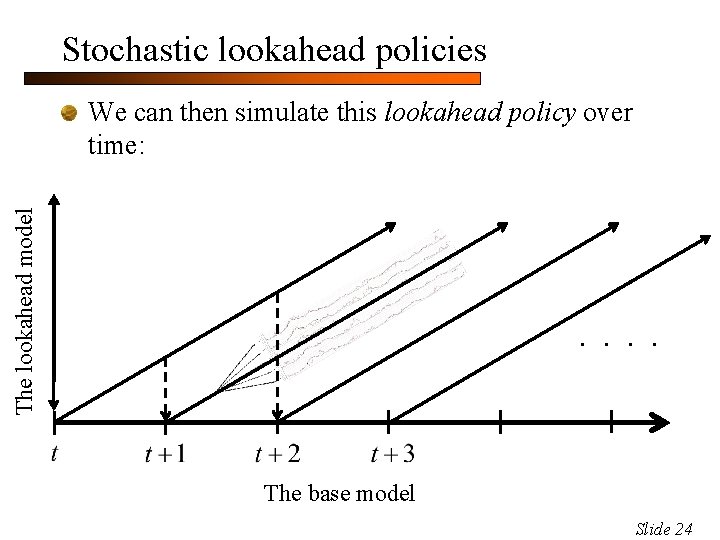
Stochastic lookahead policies The lookahead model We can then simulate this lookahead policy over time: . . The base model Slide 24
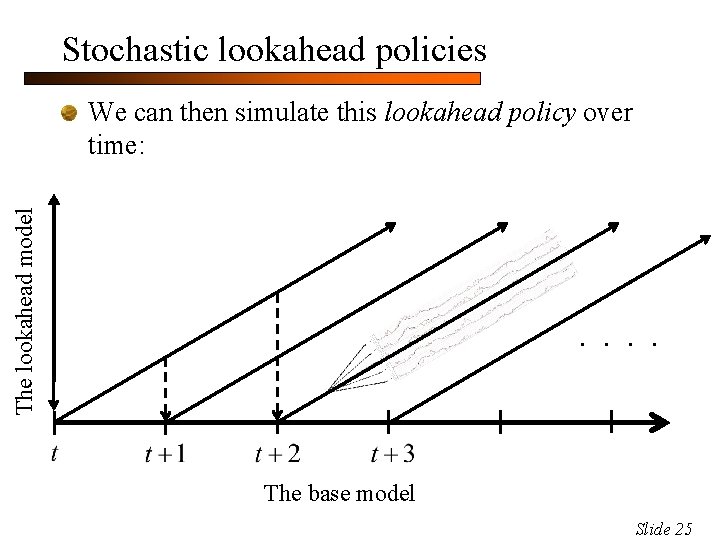
Stochastic lookahead policies The lookahead model We can then simulate this lookahead policy over time: . . The base model Slide 25
Stochastic lookahead Notes: » Virtually all stochastic programming models use a twostage approximation. » It is often the case that these two-stage approximations are hard to solve (research groups have spent years developing efficient algorithms). » However, an optimal solution to a stochastic program is not an optimal policy! » The errors introduced by the two-stage approximation are problem dependent, but largely ignored. » Myth: to solve a stochastic optimization problem, you have to use a stochastic lookahead model. Slide 26
Using approximate dynamic programming
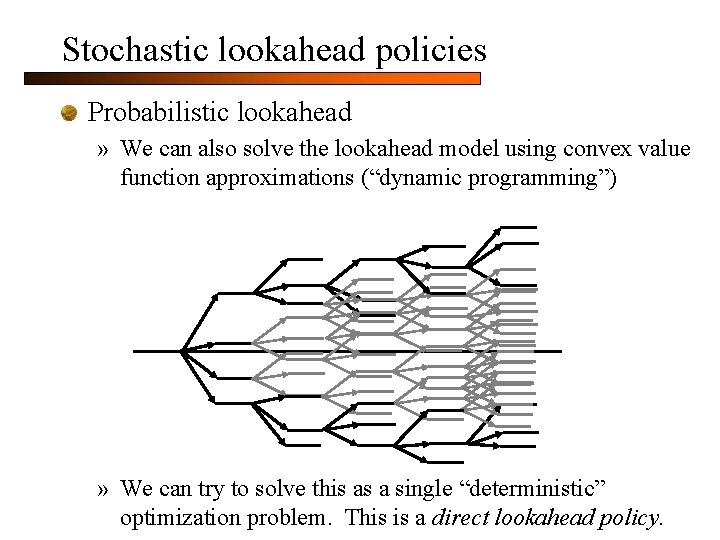
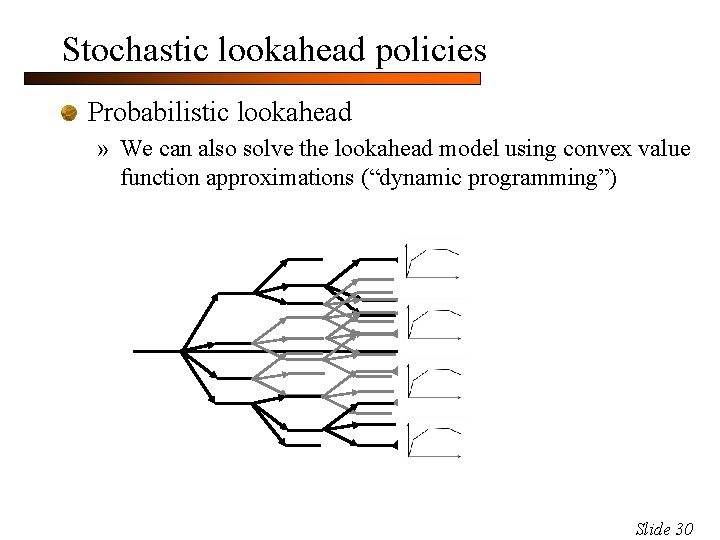
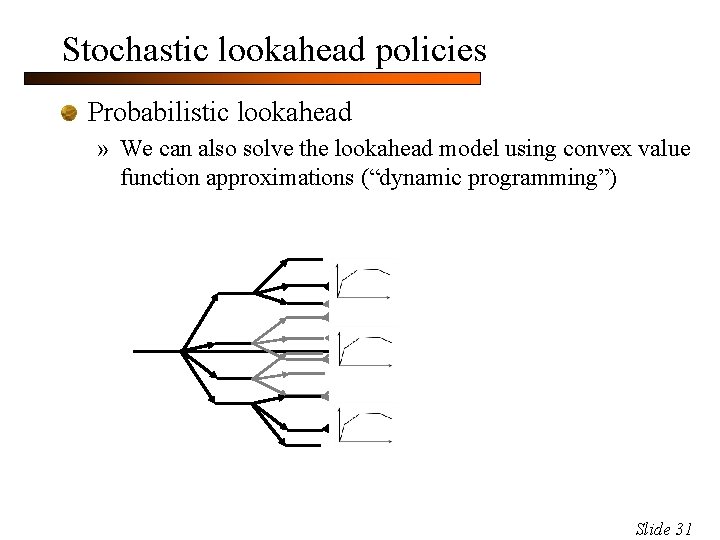
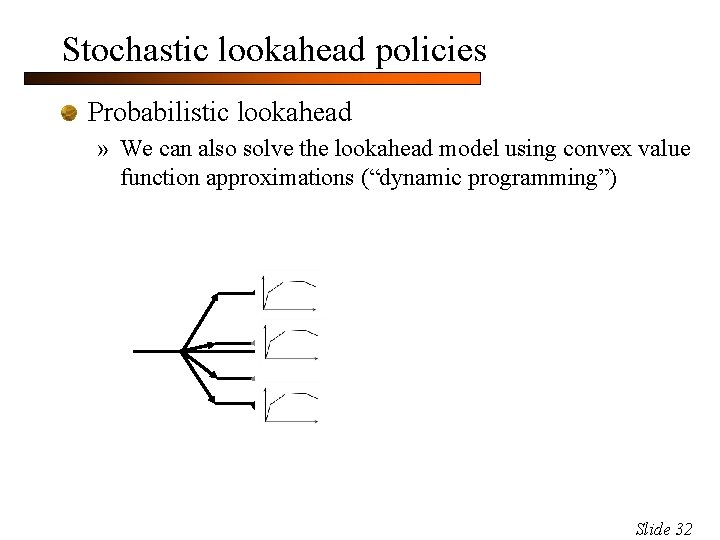
Stochastic lookahead policies Probabilistic lookahead » We can also solve the lookahead model using convex value function approximations (“dynamic programming”) » We can try to solve this as a single “deterministic” optimization problem. This is a direct lookahead policy.
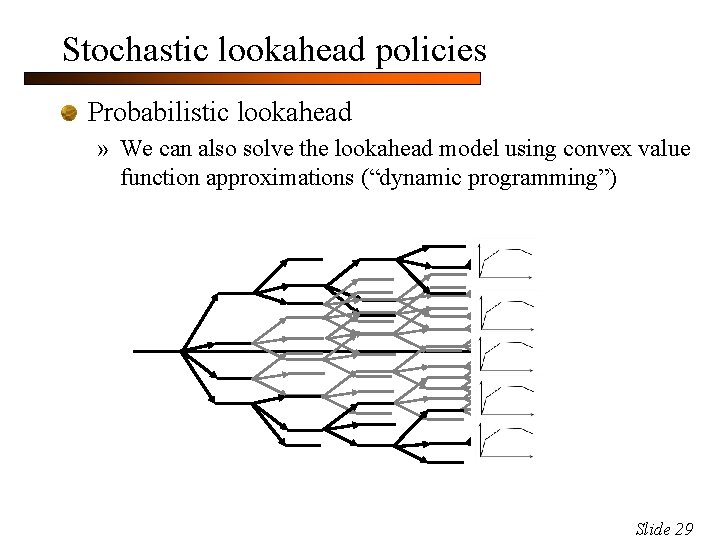
Stochastic lookahead policies Probabilistic lookahead » We can also solve the lookahead model using convex value function approximations (“dynamic programming”) Slide 29
Stochastic lookahead policies Probabilistic lookahead » We can also solve the lookahead model using convex value function approximations (“dynamic programming”) Slide 30
Stochastic lookahead policies Probabilistic lookahead » We can also solve the lookahead model using convex value function approximations (“dynamic programming”) Slide 31
Stochastic lookahead policies Probabilistic lookahead » We can also solve the lookahead model using convex value function approximations (“dynamic programming”) Slide 32
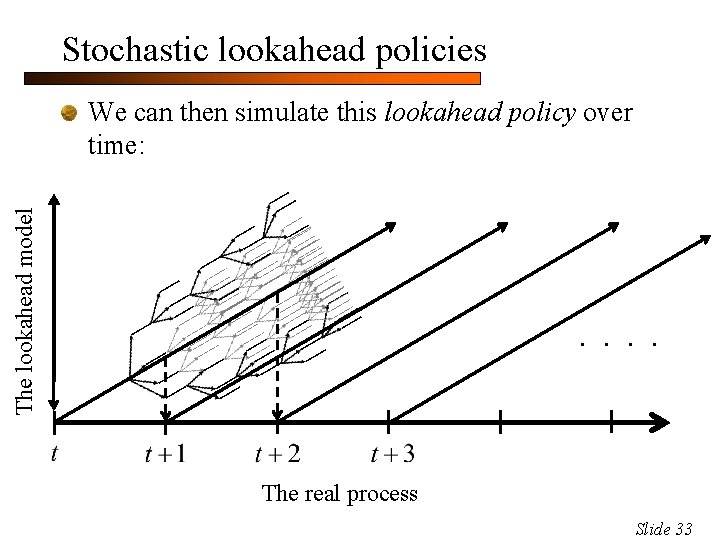
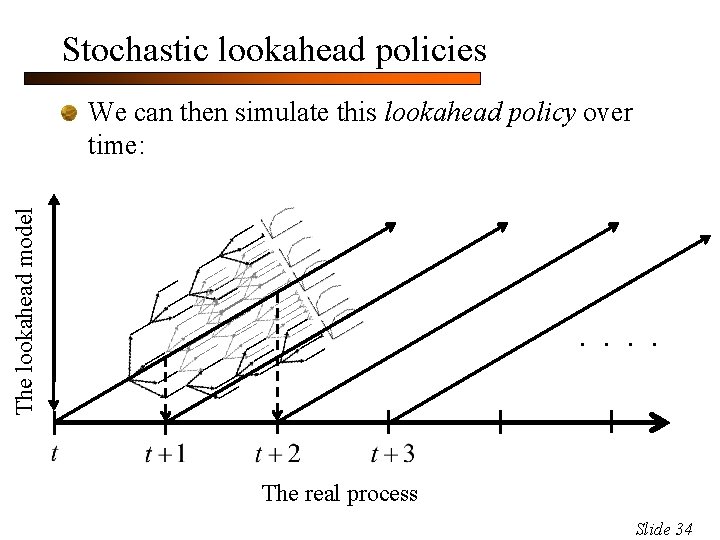
Stochastic lookahead policies The lookahead model We can then simulate this lookahead policy over time: . . The real process Slide 33
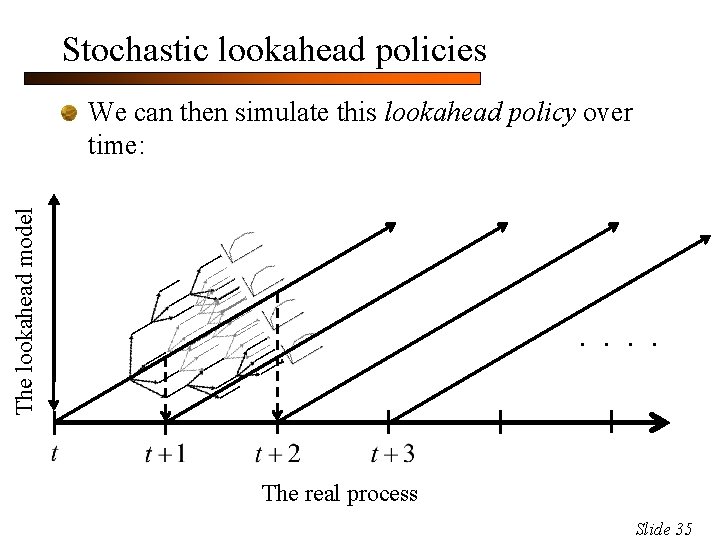
Stochastic lookahead policies The lookahead model We can then simulate this lookahead policy over time: . . The real process Slide 34
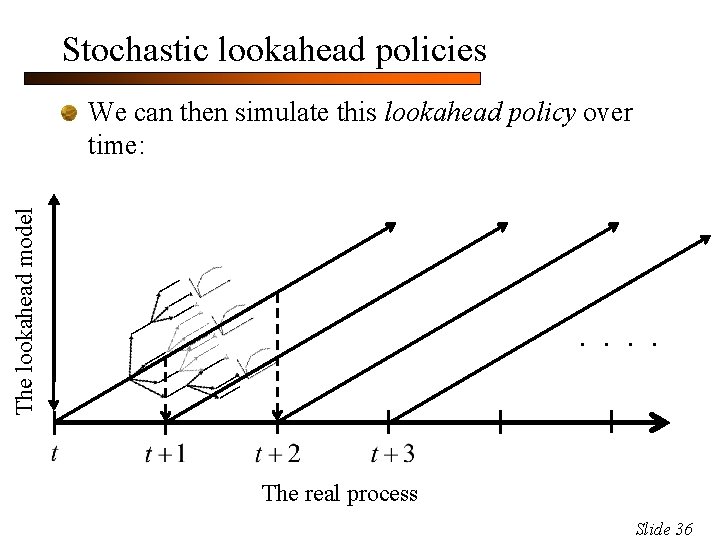
Stochastic lookahead policies The lookahead model We can then simulate this lookahead policy over time: . . The real process Slide 35
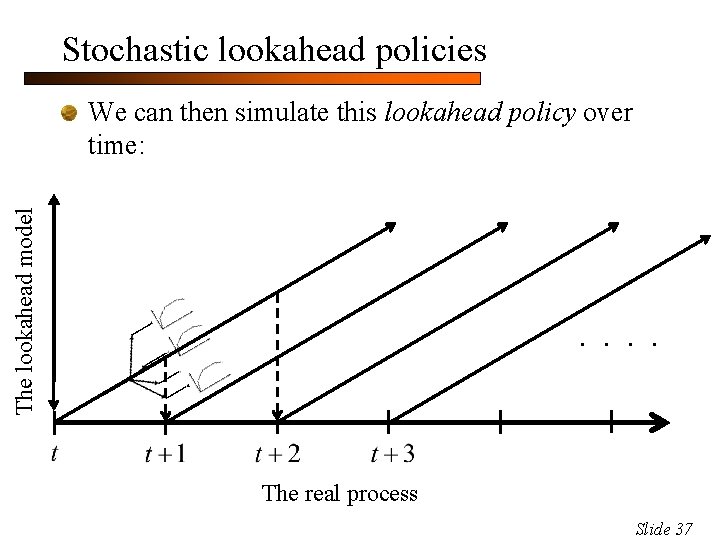
Stochastic lookahead policies The lookahead model We can then simulate this lookahead policy over time: . . The real process Slide 36
Stochastic lookahead policies The lookahead model We can then simulate this lookahead policy over time: . . The real process Slide 37
Stochastic lookahead policies The lookahead model We can then simulate this lookahead policy over time: . . The real process Slide 38
Stochastic lookahead policies The lookahead model We can then simulate this lookahead policy over time: . . The real process Slide 39
Stochastic lookahead policies The lookahead model We can then simulate this lookahead policy over time: . . The real process Slide 40
Stochastic lookahead policies The lookahead model We can then simulate this lookahead policy over time: . . The real process Slide 41
Stochastic lookahead policies The lookahead model We can then simulate this lookahead policy over time: . . The real process Slide 42
Stochastic lookahead policies The lookahead model We can then simulate this lookahead policy over time: . . The real process Slide 43
Stochastic lookahead policies The lookahead model We can then simulate this lookahead policy over time: . . The real process Slide 44
Stochastic lookahead policies The lookahead model We can then simulate this lookahead policy over time: . . The real process Slide 45
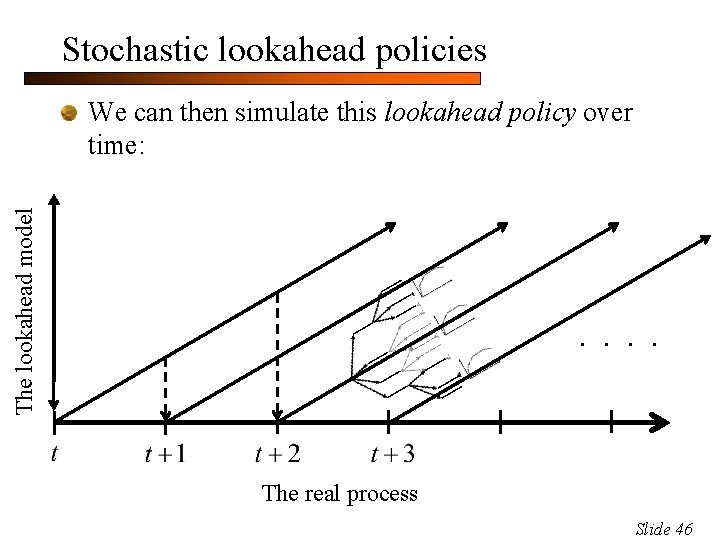
Stochastic lookahead policies The lookahead model We can then simulate this lookahead policy over time: . . The real process Slide 46
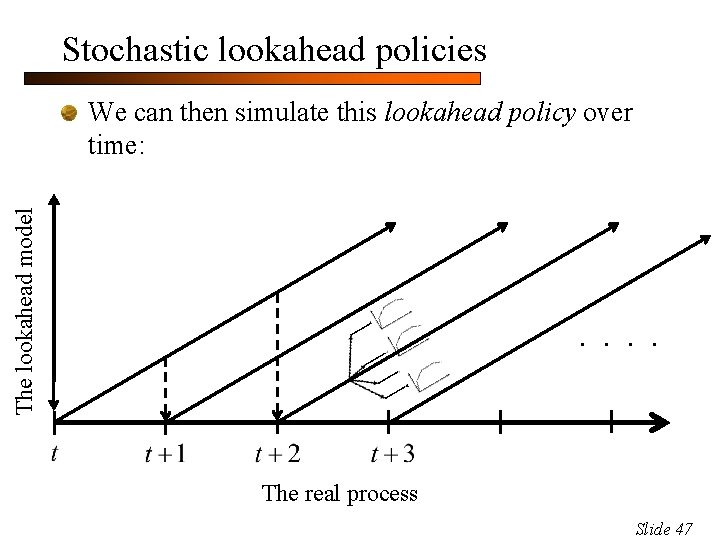
Stochastic lookahead policies The lookahead model We can then simulate this lookahead policy over time: . . The real process Slide 47
Stochastic lookahead policies Notes: » There are many people who equate “stochastic optimization” with a “stochastic lookahead model. ” » Later, we will show to use a parameterized version of a deterministic lookahead to produce robust solutions in a stochastic environment. Slide 48
Stochastic lookahead policies Lookahead models vs base models » There are many papers on stochastic optimization problems where it is not clear if the paper is solving a base model or a lookahead model. » Hints that you are solving a base model: • The model is used as a simulator to answer strategic questions (e. g. fleet size, pricing policies, capacity investments in reservoirs). » Hints that you are solving a lookahead model • You are solving a problem over a horizon, but you are only interested in the first-period solution. • You have an imbedded forecast which is not updated on a rolling basis over the course of the planning horizon (forecasts are treated as a latent variable). • There are other variables that would change over time, but which are being held constant.
Stochastic lookahead policies Lookahead models vs base models » Some models can only be lookahead models: • Stochastic programs which represent the future using scenario trees. • Deterministic models that are clearly being solved in the context of a stochastic problem. • Robust optimization in the context of a sequential decision problem.