
A Unified Framework for Sequential Decision Analytics Olin



- Slides: 11
A Unified Framework for Sequential Decision Analytics Olin Business School University of Washington, St. Louis November 5 -6, 2019 Warren B. Powell Princeton University Department of Operations Research and Financial Engineering
Guidelines for choosing policies From the real-world to the model
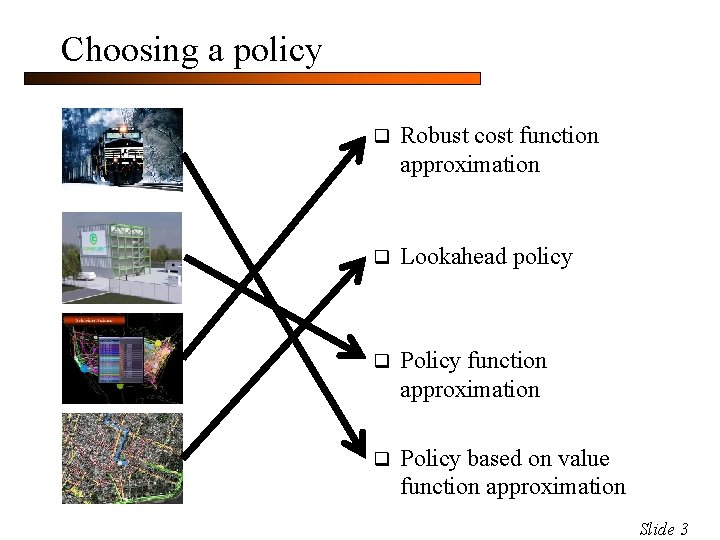
Choosing a policy q Robust cost function approximation q Lookahead policy q Policy function approximation q Policy based on value function approximation Slide 3
Choosing a policy Policy function approximations » PFAs are best for low-dimensional problems where the structure of the policy is apparent from the problem. » Potential architectures: • • Lookup table rules (this was AI in the 1970’s) Linear models? Nonlinear models? Neural networks? Slide 4
Choosing a policy Cost function approximations » CFAs work for both low-and high-dimensional problems, where we again have strong intuition of how uncertainty would affect the solution. » Parameterizations: • Schedule slack? • Buffer stock? • Parameterized forecasts? Slide 5
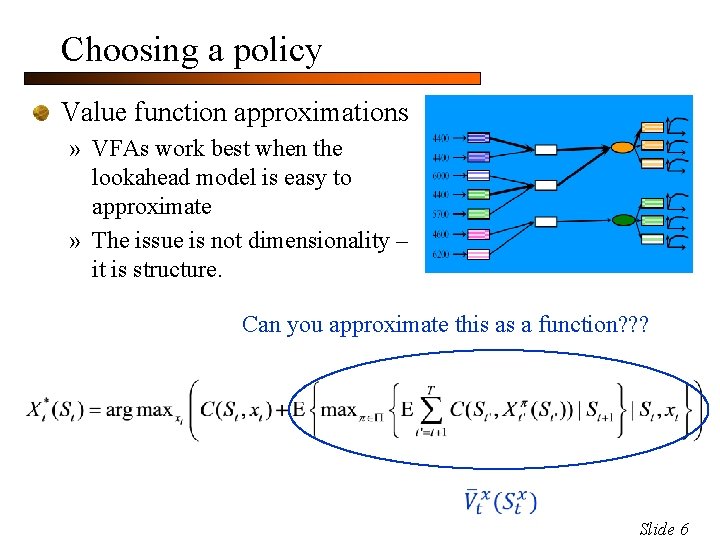
Choosing a policy Value function approximations » VFAs work best when the lookahead model is easy to approximate » The issue is not dimensionality – it is structure. Can you approximate this as a function? ? ? Slide 6
Choosing a policy Direct lookahead approximations » Direct lookahead models should be used only when all else fails (which is often). DLAs are important when decisions now depend on future plans and forecasts. » Question: How are you going to compute downstream costs? • Deterministic? Scenario trees? • Simulating a parametric policy? • MCTS? Slide 7
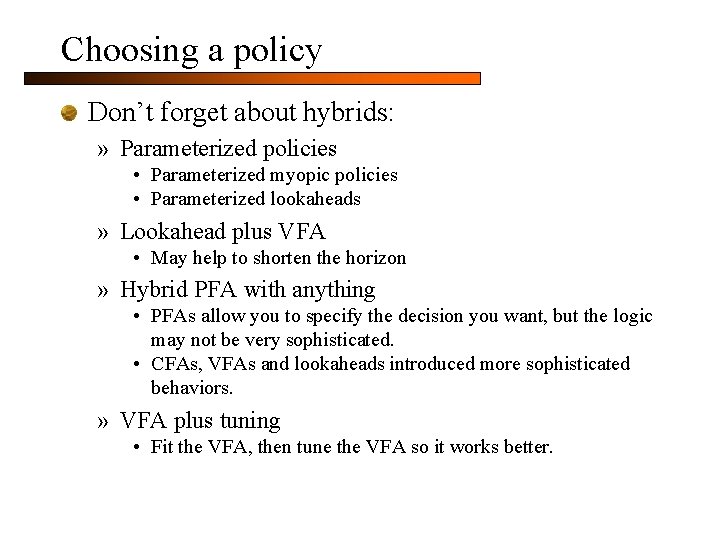
Choosing a policy Don’t forget about hybrids: » Parameterized policies • Parameterized myopic policies • Parameterized lookaheads » Lookahead plus VFA • May help to shorten the horizon » Hybrid PFA with anything • PFAs allow you to specify the decision you want, but the logic may not be very sophisticated. • CFAs, VFAs and lookaheads introduced more sophisticated behaviors. » VFA plus tuning • Fit the VFA, then tune the VFA so it works better.
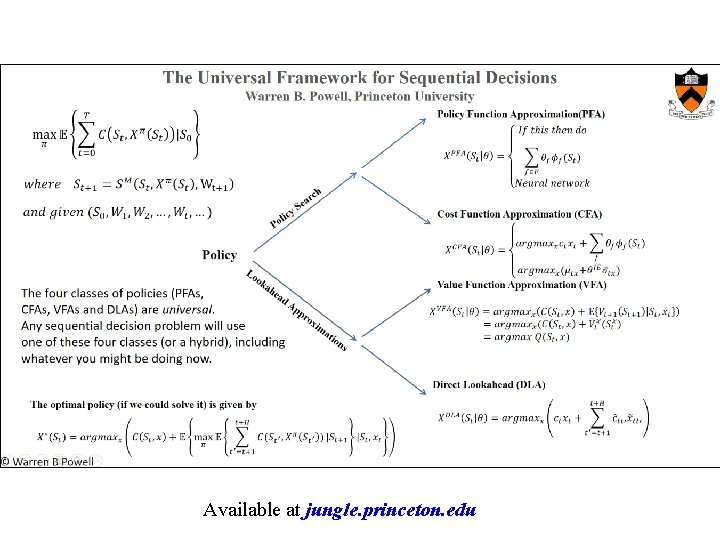
Available at jungle. princeton. edu
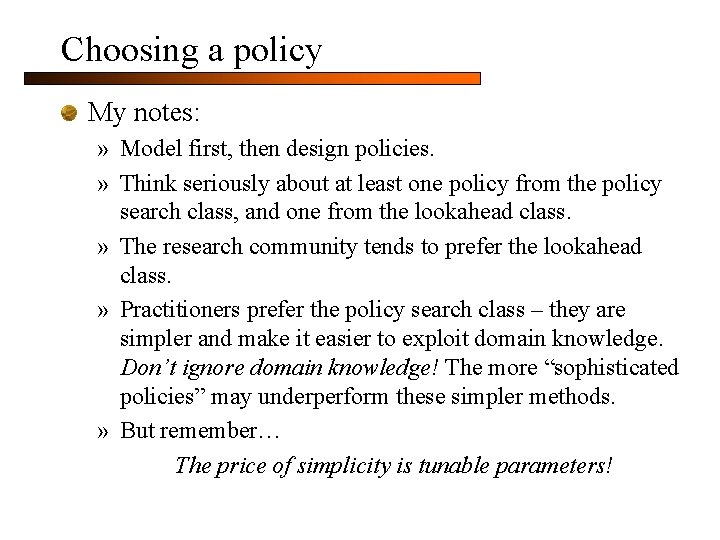
Choosing a policy My notes: » Model first, then design policies. » Think seriously about at least one policy from the policy search class, and one from the lookahead class. » The research community tends to prefer the lookahead class. » Practitioners prefer the policy search class – they are simpler and make it easier to exploit domain knowledge. Don’t ignore domain knowledge! The more “sophisticated policies” may underperform these simpler methods. » But remember… The price of simplicity is tunable parameters!
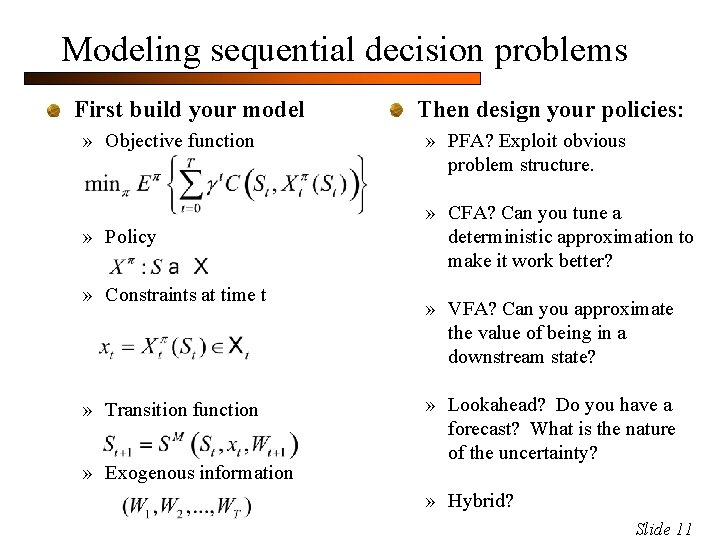
Modeling sequential decision problems First build your model » Objective function » Policy » Constraints at time t » Transition function » Exogenous information Then design your policies: » PFA? Exploit obvious problem structure. » CFA? Can you tune a deterministic approximation to make it work better? » VFA? Can you approximate the value of being in a downstream state? » Lookahead? Do you have a forecast? What is the nature of the uncertainty? » Hybrid? Slide 11