
A Unied Model for Extractive and Abstractive Summarization
A Unified Model for Extractive and Abstractive Summarization using Inconsistency Loss Project page Wan-Ting Hsu Chieh-Kai Lin National Tsing Hua University 1
Outline • Motivation • Our Method • Training Procedures • Experiments and Results • Conclusion 2
Outline • Motivation • Our Method • Training Procedures • Experiments and Results • Conclusion 3

Overview Textual Media People spend 12 hours everyday consuming media in 2018. – e. Marketer https: //www. emarketer. com/topics/topic/time-spent-with-media 4
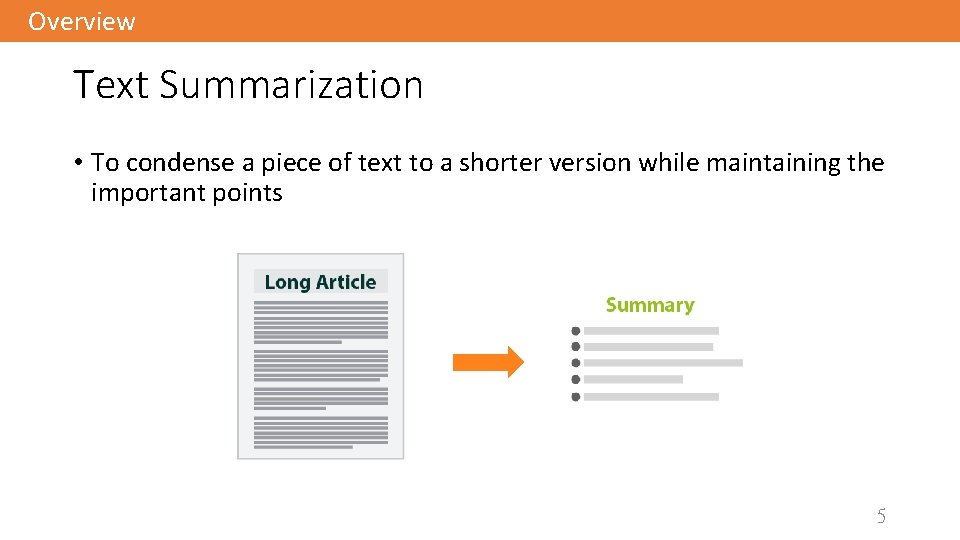
Overview Text Summarization • To condense a piece of text to a shorter version while maintaining the important points 5

Overview Examples of Text Summarization • Article headlines • Meeting minutes • Movie/book reviews • Bulletins (weather forecasts/stock market reports) 6
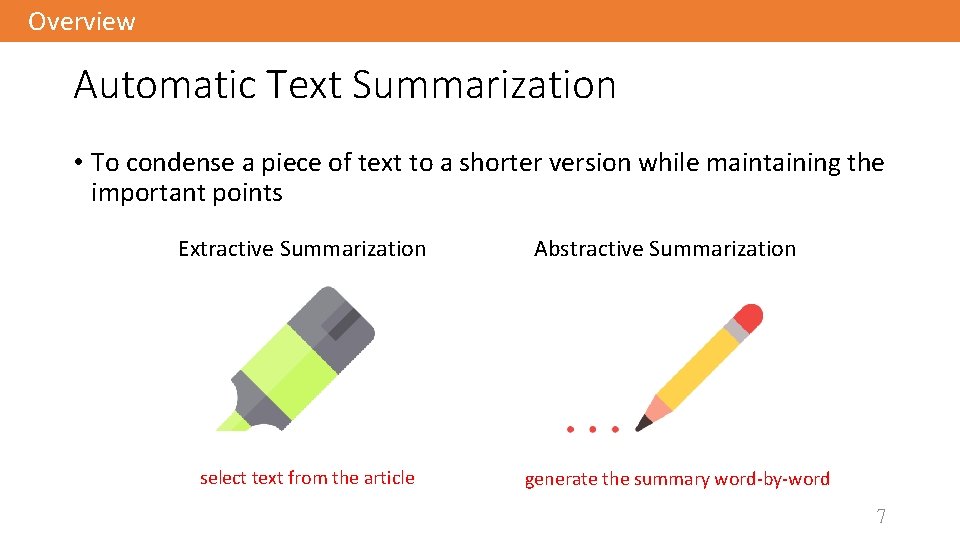
Overview Automatic Text Summarization • To condense a piece of text to a shorter version while maintaining the important points Extractive Summarization select text from the article Abstractive Summarization generate the summary word-by-word 7

Overview Extractive Summarization • Select phrases or sentences from the source document Representation sentence 1 1 3 9 2 sentence 2 5 6 5 7 sentence 3 8 1 1 4 … - Shen, D. ; Sun, J. -T. ; Li, H. ; Yang, Q. ; and Chen, Z. 2007. Document summarization using conditional random fields. IJCAI 2007. Kågebäck, M. , Mogren, O. , Tahmasebi, N. , & Dubhashi, D. Extractive Summarization using Continuous Vector Space Models. EACL 2014. Cheng, J. , and Lapata, M. Neural summarization by extracting sentences and words. ACL 2016. Ramesh Nallapati, Feifei Zhai, and Bowen Zhou. Summarunner: A recurrent neural network based sequence model for extractive summarization of documents. AAAI 2017 8
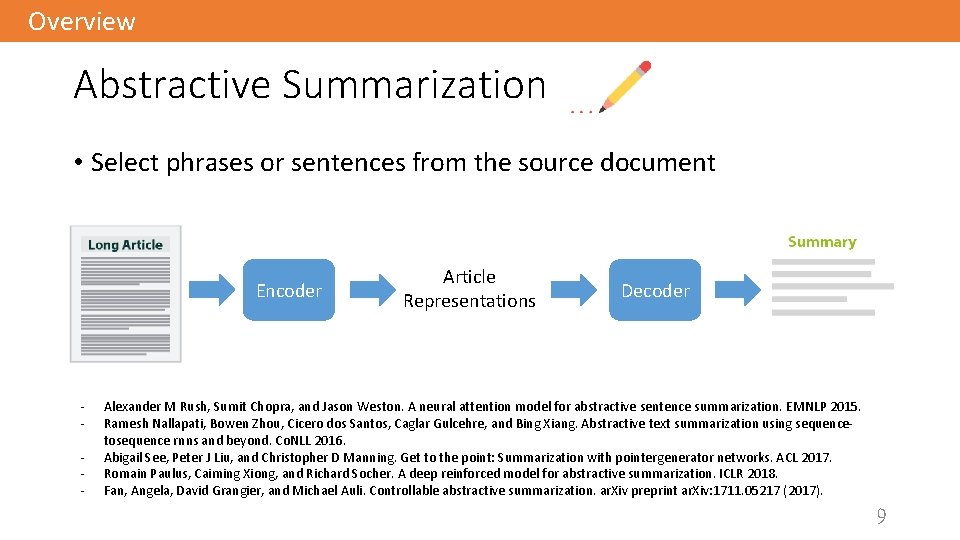
Overview Abstractive Summarization • Select phrases or sentences from the source document Encoder - Article Representations Decoder Alexander M Rush, Sumit Chopra, and Jason Weston. A neural attention model for abstractive sentence summarization. EMNLP 2015. Ramesh Nallapati, Bowen Zhou, Cicero dos Santos, Caglar Gulcehre, and Bing Xiang. Abstractive text summarization using sequencetosequence rnns and beyond. Co. NLL 2016. Abigail See, Peter J Liu, and Christopher D Manning. Get to the point: Summarization with pointergenerator networks. ACL 2017. Romain Paulus, Caiming Xiong, and Richard Socher. A deep reinforced model for abstractive summarization. ICLR 2018. Fan, Angela, David Grangier, and Michael Auli. Controllable abstractive summarization. ar. Xiv preprint ar. Xiv: 1711. 05217 (2017). 9
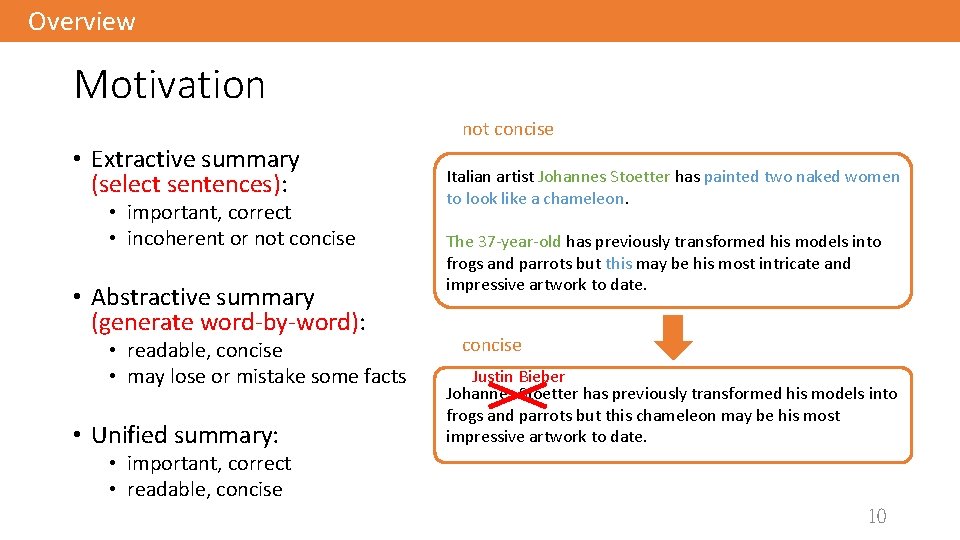
Overview Motivation not concise • Extractive summary (select sentences): • important, correct • incoherent or not concise • Abstractive summary (generate word-by-word): • readable, concise • may lose or mistake some facts • Unified summary: Italian artist Johannes Stoetter has painted two naked women to look like a chameleon. The 37 -year-old has previously transformed his models into frogs and parrots but this may be his most intricate and impressive artwork to date. concise Justin Bieber Johannes Stoetter has previously transformed his models into frogs and parrots but this chameleon may be his most impressive artwork to date. • important, correct • readable, concise 10
Outline • Motivation • Our Method • Training Procedures • Experiments and Results • Conclusion 11
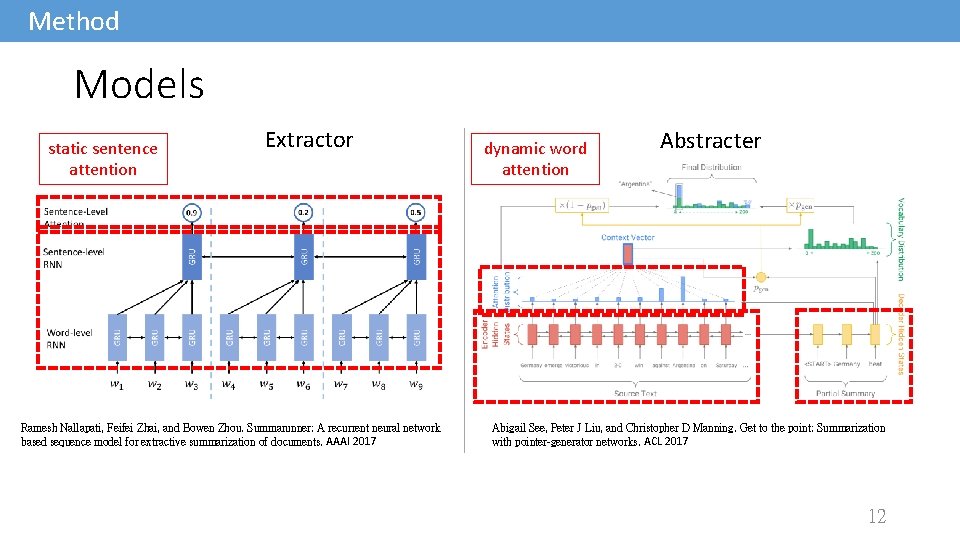
Method Models static sentence attention Extractor Ramesh Nallapati, Feifei Zhai, and Bowen Zhou. Summarunner: A recurrent neural network based sequence model for extractive summarization of documents. AAAI 2017 dynamic word attention Abstracter Abigail See, Peter J Liu, and Christopher D Manning. Get to the point: Summarization with pointer-generator networks. ACL 2017 12
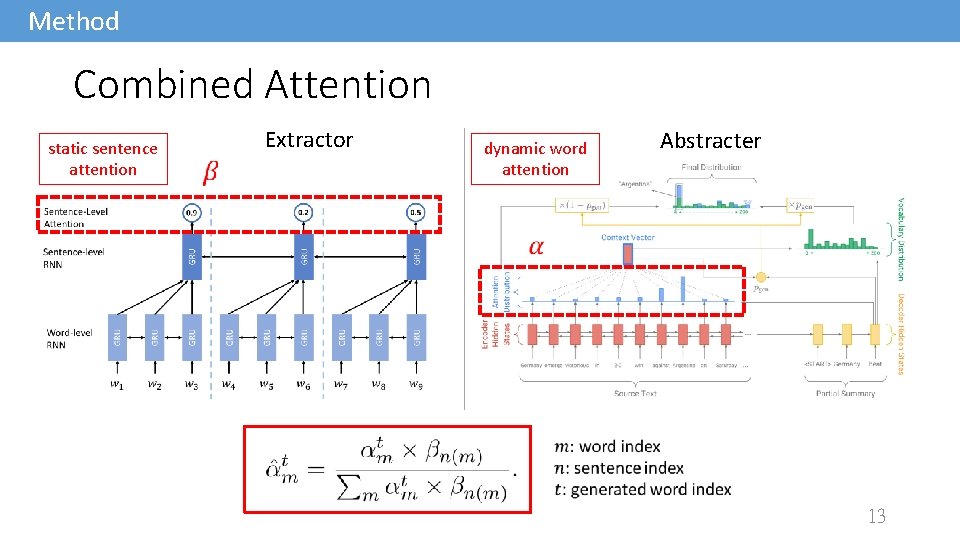
Method Combined Attention static sentence attention Extractor dynamic word attention Abstracter 13
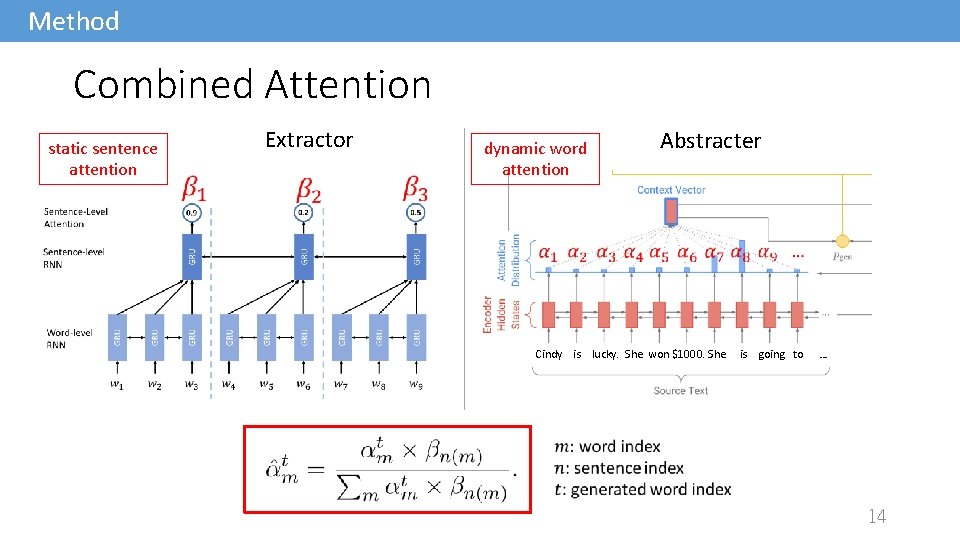
Method Combined Attention static sentence attention Extractor dynamic word attention Abstracter Cindy is lucky. She won $1000. She is going to … 14
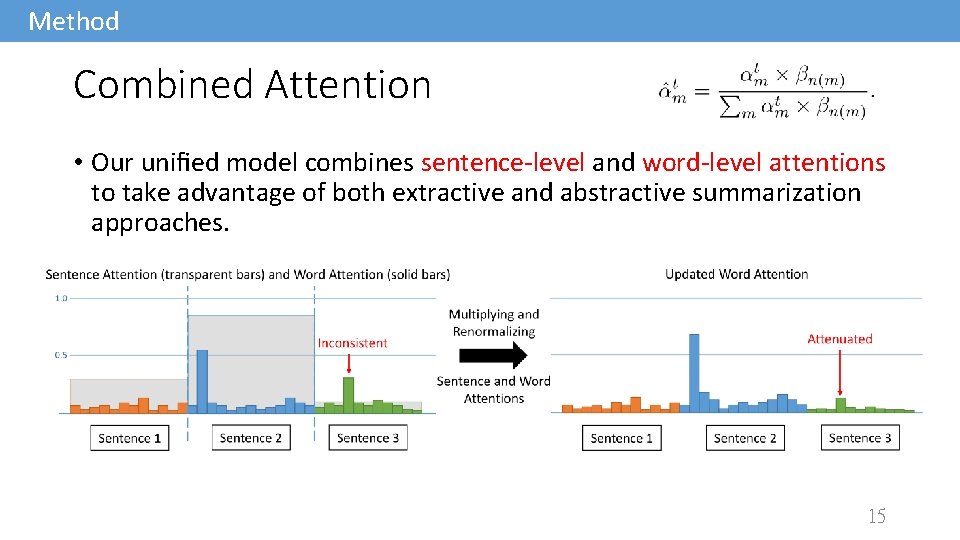
Method Combined Attention • Our unified model combines sentence-level and word-level attentions to take advantage of both extractive and abstractive summarization approaches. 15

Method Combined Attention • Updated word attention is used for calculating the context vector and final word distribution 16
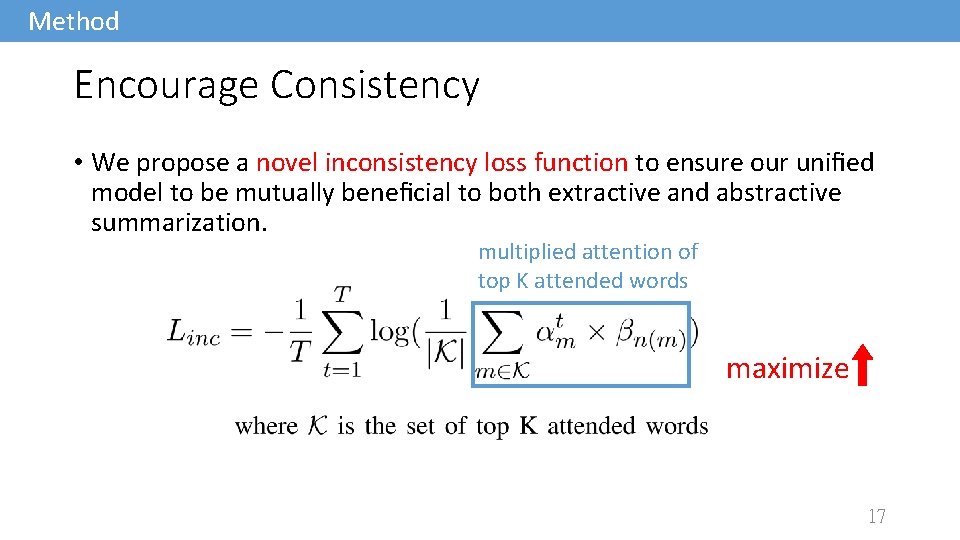
Method Encourage Consistency • We propose a novel inconsistency loss function to ensure our unified model to be mutually beneficial to both extractive and abstractive summarization. multiplied attention of top K attended words maximize 17

Method Encourage Consistency • encourage consistency of the top K attended words at each decoder time step. inconsistency loss: consistent < inconsistent 1. 0 consistent K=2 inconsistent 0. 5 Sentence 1 Sentence 2 Sentence 3 18

Method Encourage Consistency • encourage consistency of the top K attended words at each decoder time step. 1. 0 consistent K=2 inconsistent 0. 5 Sentence 1 Sentence 2 Sentence 3 19
Outline • Motivation • Our Method • Training Procedures • Experiments and Results • Conclusion 20
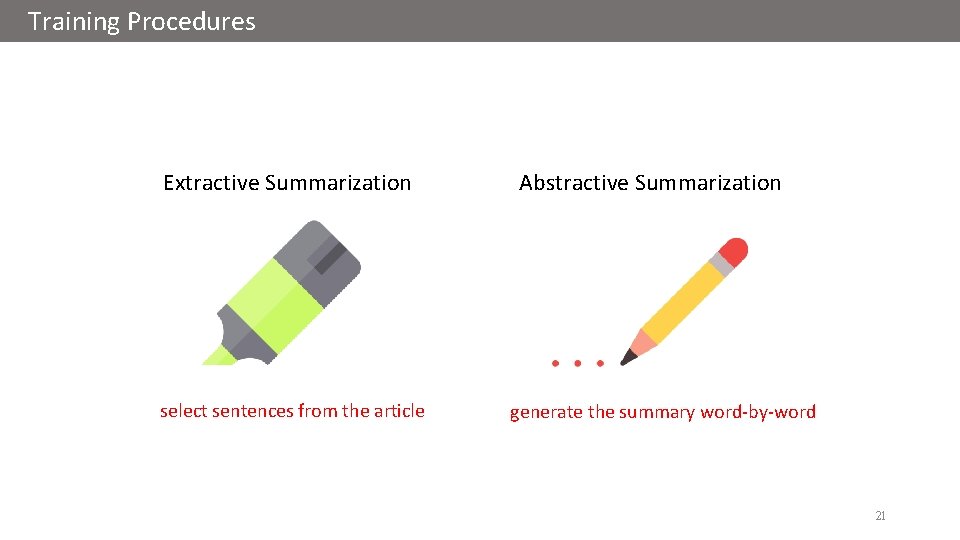
Training Procedures Extractive Summarization select sentences from the article Abstractive Summarization generate the summary word-by-word 21

Training Procedures • 3 types of loss functions: 1. extractor loss 2. abstracter loss + coverage loss 3. inconsistency loss 22

Training Procedures • 3 types of loss functions: 1. extractor loss 2. abstracter loss + coverage loss 3. inconsistency loss 23
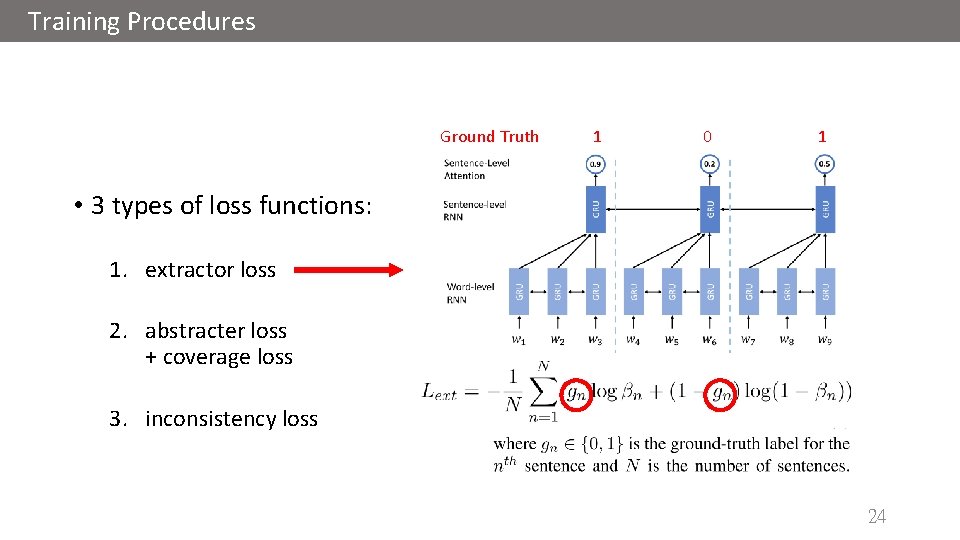
Training Procedures Ground Truth 1 0 1 • 3 types of loss functions: 1. extractor loss 2. abstracter loss + coverage loss 3. inconsistency loss 24
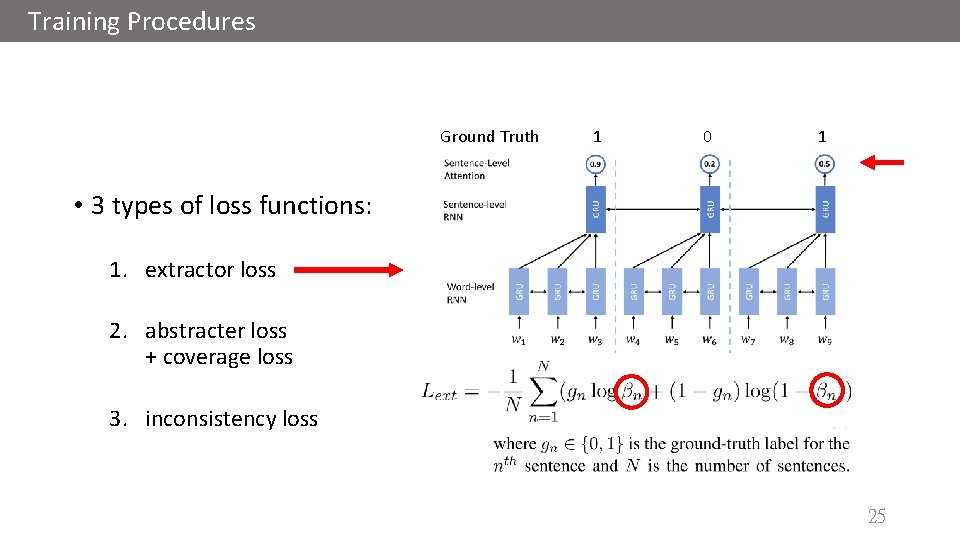
Training Procedures Ground Truth 1 0 1 • 3 types of loss functions: 1. extractor loss 2. abstracter loss + coverage loss 3. inconsistency loss 25
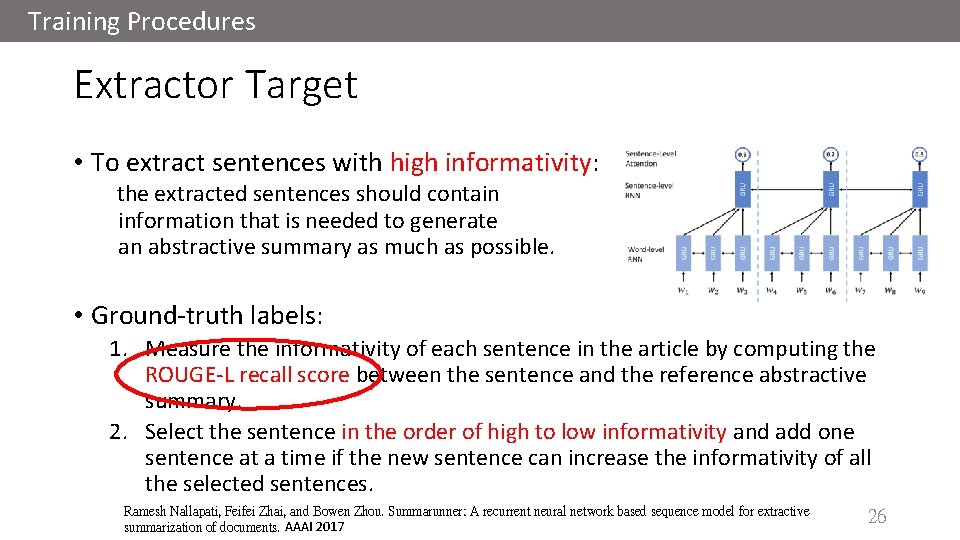
Training Procedures Extractor Target • To extract sentences with high informativity: the extracted sentences should contain information that is needed to generate an abstractive summary as much as possible. • Ground-truth labels: 1. Measure the informativity of each sentence in the article by computing the ROUGE-L recall score between the sentence and the reference abstractive summary. 2. Select the sentence in the order of high to low informativity and add one sentence at a time if the new sentence can increase the informativity of all the selected sentences. Ramesh Nallapati, Feifei Zhai, and Bowen Zhou. Summarunner: A recurrent neural network based sequence model for extractive summarization of documents. AAAI 2017 26
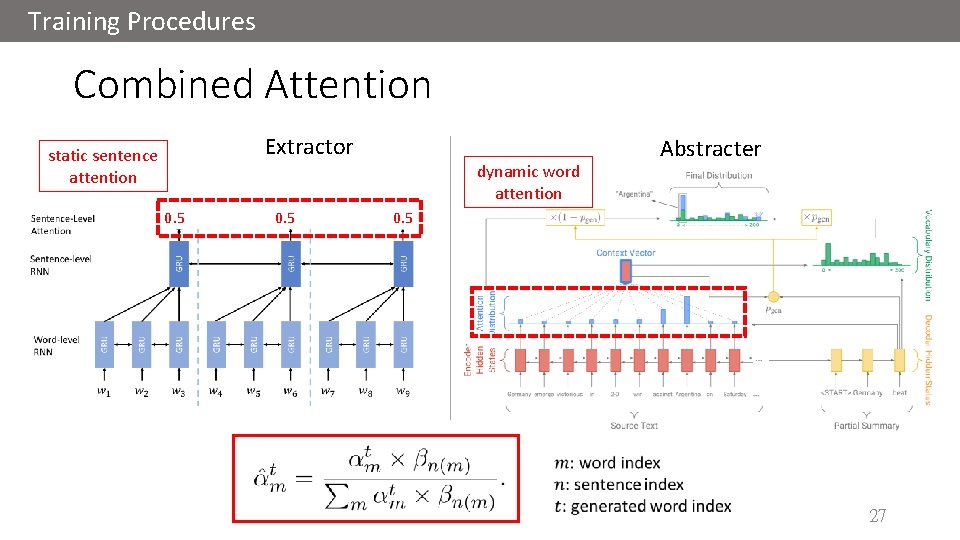
Training Procedures Combined Attention Extractor static sentence attention 0. 5 dynamic word attention Abstracter 0. 5 27
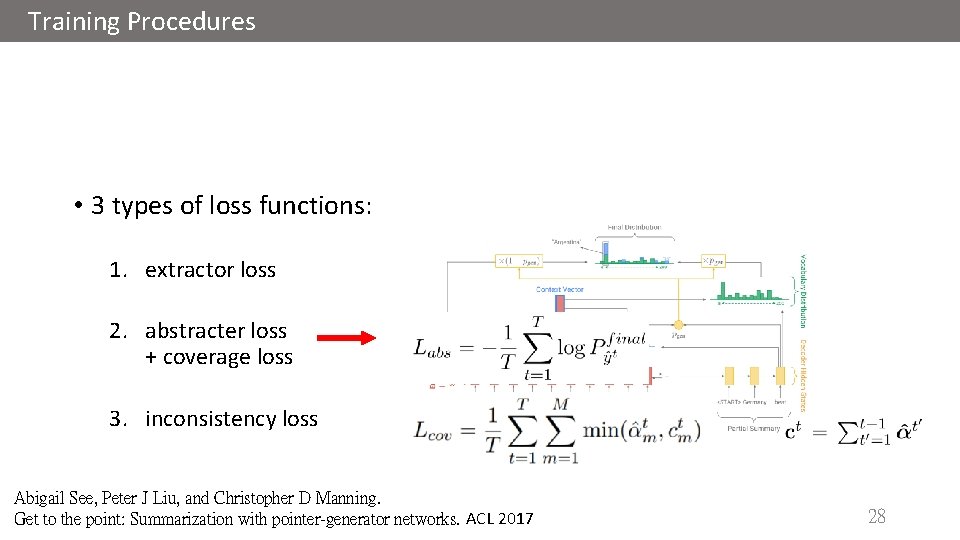
Training Procedures • 3 types of loss functions: 1. extractor loss 2. abstracter loss + coverage loss 3. inconsistency loss Abigail See, Peter J Liu, and Christopher D Manning. Get to the point: Summarization with pointer-generator networks. ACL 2017 28
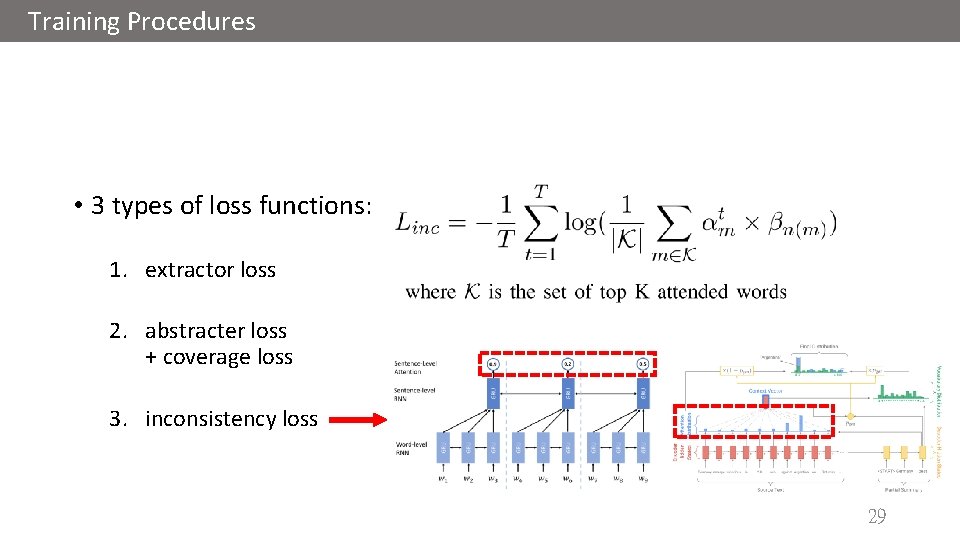
Training Procedures • 3 types of loss functions: 1. extractor loss 2. abstracter loss + coverage loss 3. inconsistency loss 29
Training Procedures 1. Two-stages training 2. End-to-end training without inconsistency loss 3. End-to-end training with inconsistency loss 30
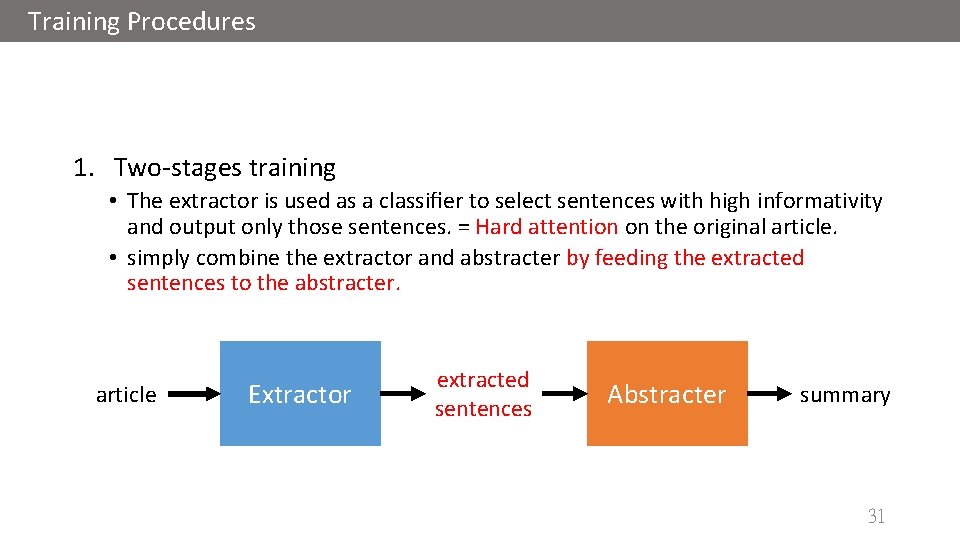
Training Procedures 1. Two-stages training • The extractor is used as a classifier to select sentences with high informativity and output only those sentences. = Hard attention on the original article. • simply combine the extractor and abstracter by feeding the extracted sentences to the abstracter. article Extractor extracted sentences Abstracter summary 31
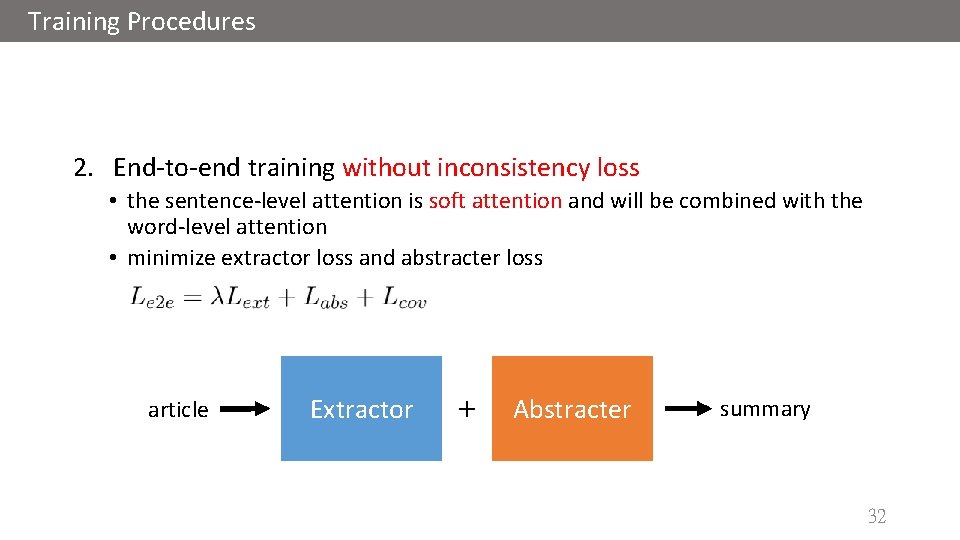
Training Procedures 2. End-to-end training without inconsistency loss • the sentence-level attention is soft attention and will be combined with the word-level attention • minimize extractor loss and abstracter loss article Extractor + Abstracter summary 32
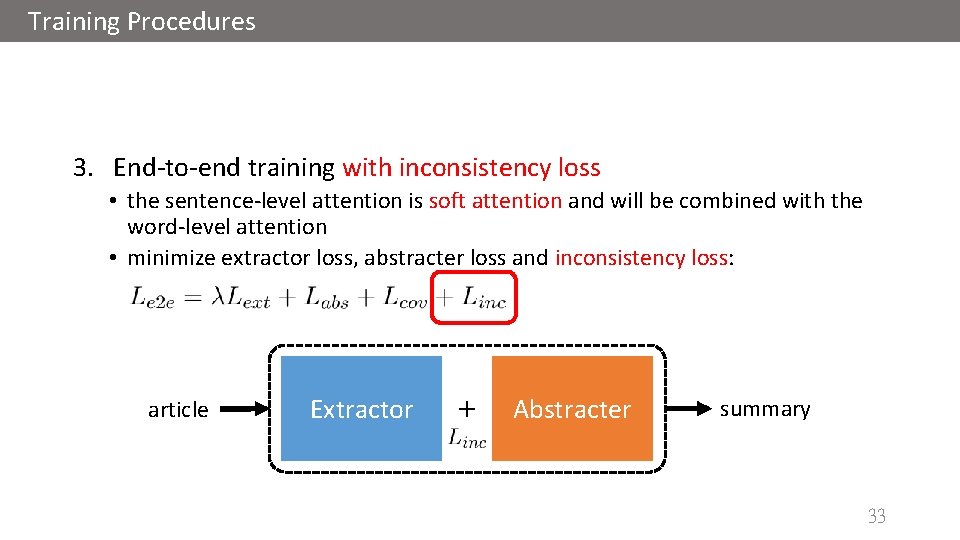
Training Procedures 3. End-to-end training with inconsistency loss • the sentence-level attention is soft attention and will be combined with the word-level attention • minimize extractor loss, abstracter loss and inconsistency loss: article Extractor + Abstracter summary 33
Outline • Motivation • Our Method • Training Procedures • Experiments and Results • Conclusion 34
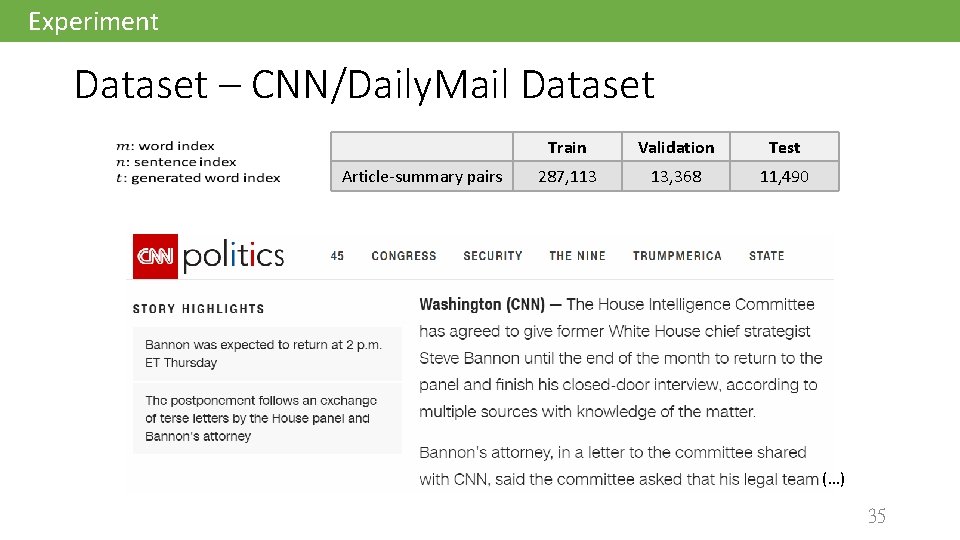
Experiment Dataset – CNN/Daily. Mail Dataset Article-summary pairs Train Validation Test 287, 113 13, 368 11, 490 (…) 35
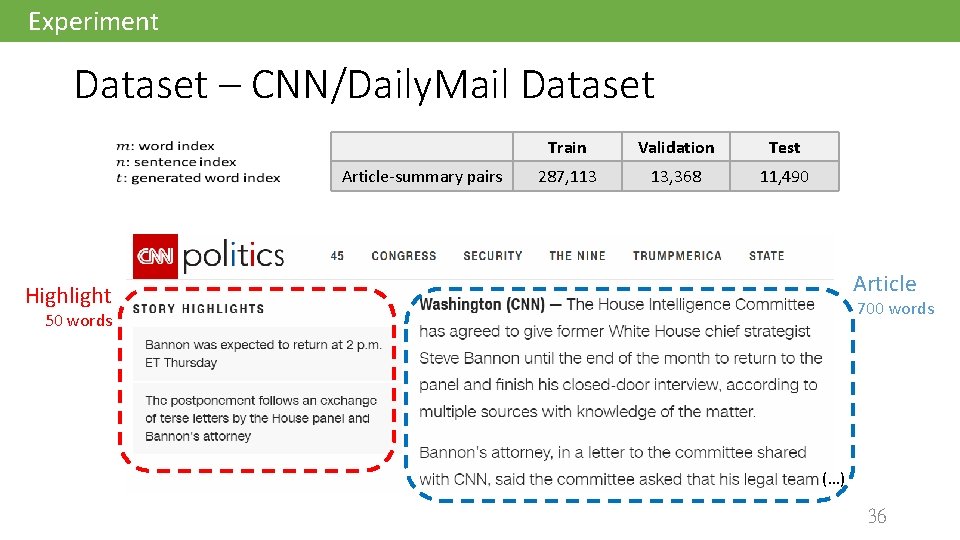
Experiment Dataset – CNN/Daily. Mail Dataset Article-summary pairs Train Validation Test 287, 113 13, 368 11, 490 Article Highlight 700 words 50 words (…) 36
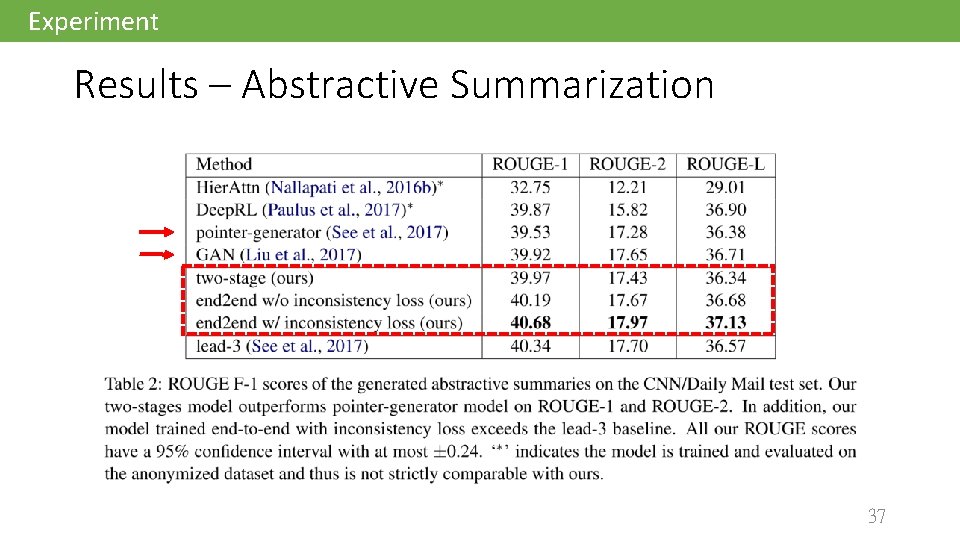
Experiment Results – Abstractive Summarization 37
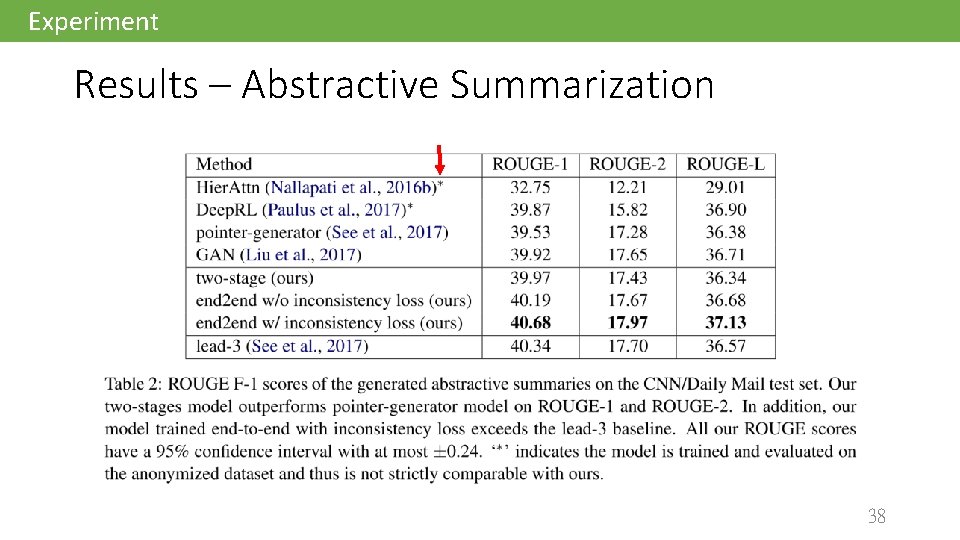
Experiment Results – Abstractive Summarization 38
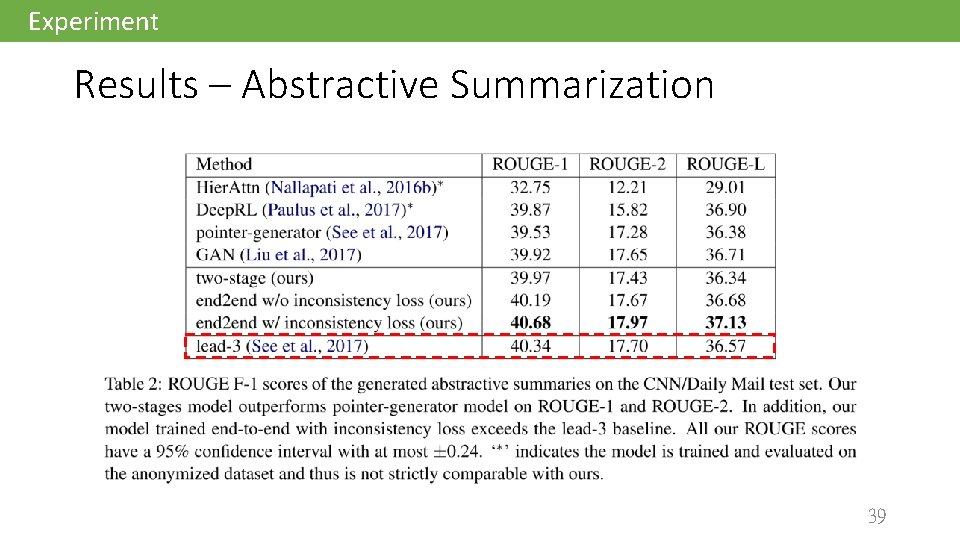
Experiment Results – Abstractive Summarization 39
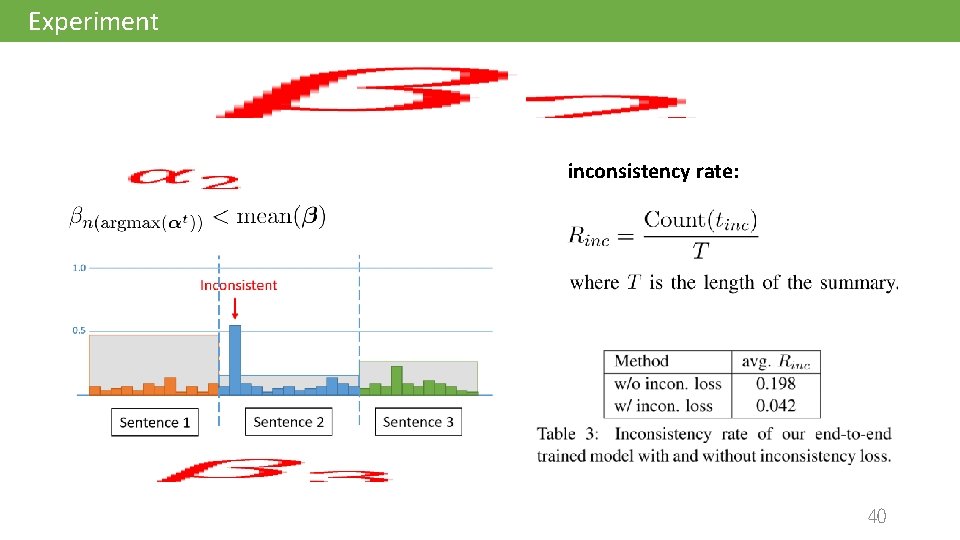
Experiment inconsistency rate: 40
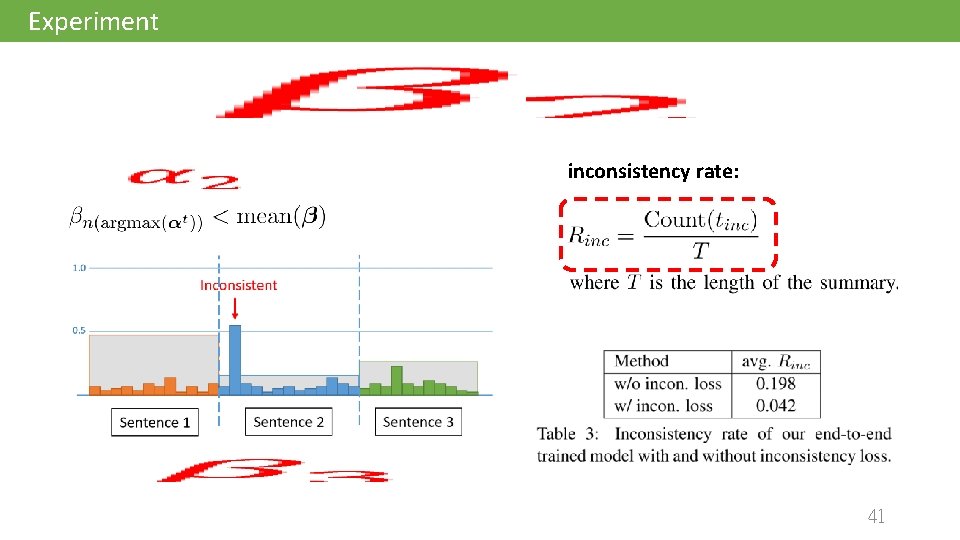
Experiment inconsistency rate: 41
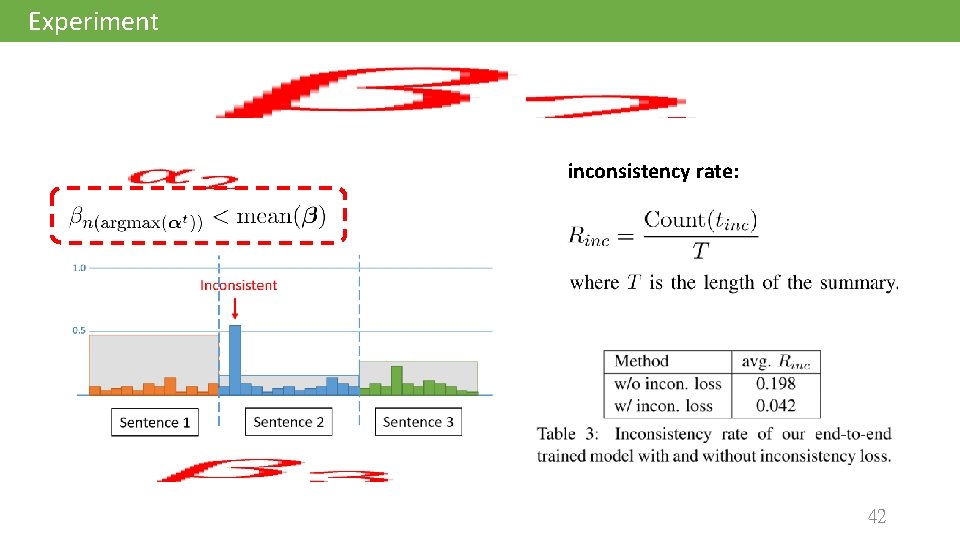
Experiment inconsistency rate: 42

Experiment inconsistency rate: 43
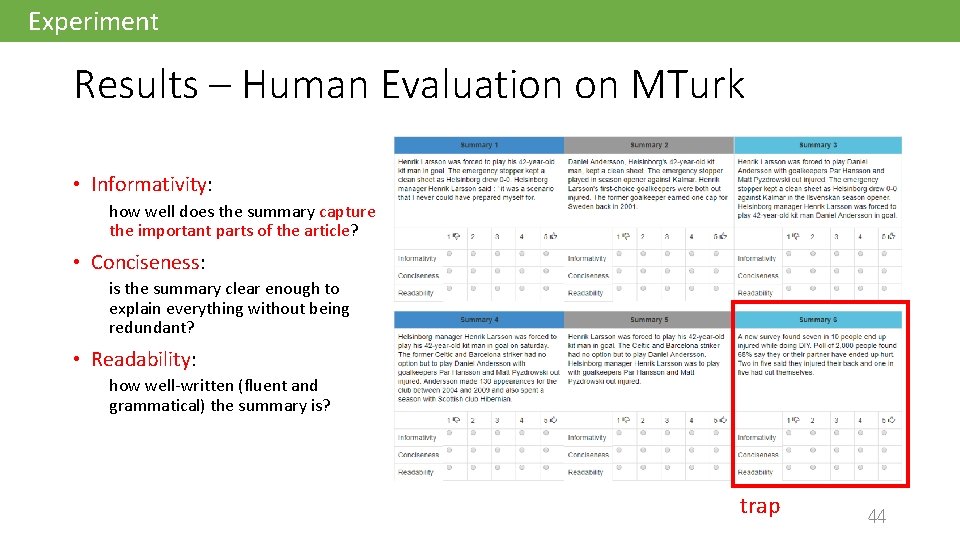
Experiment Results – Human Evaluation on MTurk • Informativity: how well does the summary capture the important parts of the article? • Conciseness: is the summary clear enough to explain everything without being redundant? • Readability: how well-written (fluent and grammatical) the summary is? trap 44
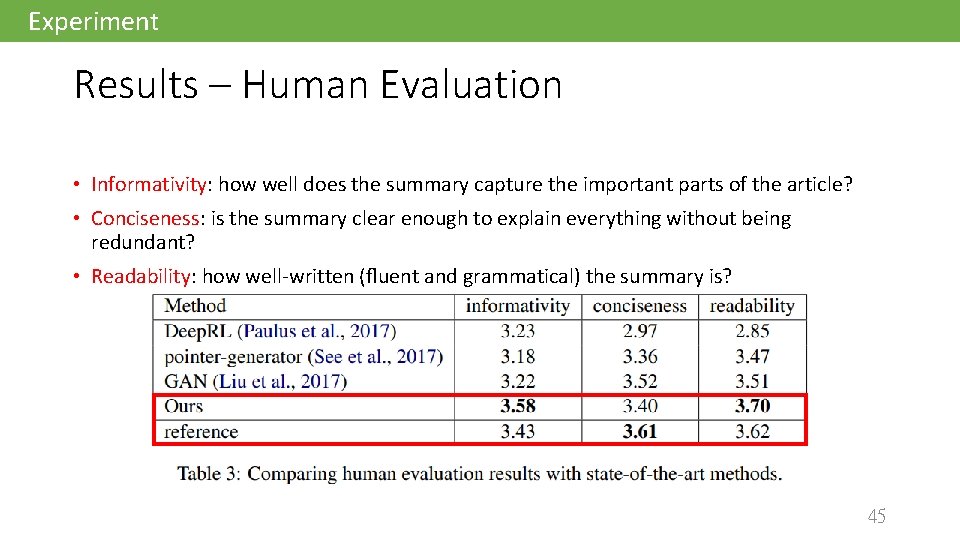
Experiment Results – Human Evaluation • Informativity: how well does the summary capture the important parts of the article? • Conciseness: is the summary clear enough to explain everything without being redundant? • Readability: how well-written (fluent and grammatical) the summary is? 45

Outline • Motivation • Our Method • Training Procedures • Experiments and Results • Conclusion 46

Conclusion and Future work Conclusion • We propose a unified model combining the strength of extractive and abstractive summarization. • A novel inconsistency loss function is introduced to penalize the inconsistency between two levels of attentions. The inconsistency loss enables extractive and abstractive summarization to be mutually beneficial. • By end-to-end training of our model, we achieve the best ROUGE scores while being the most informative and readable summarization on the CNN/Daily Mail dataset in a solid human evaluation. 47

Acknowledgements Min Sun Wen-Ting Tsu Chieh-Kai Lin Ming-Ying Lee Kerui Min Jing Tang 48

Q&A Project page • Code • Test output • Supplementary material https: //hsuwanting. github. io/unified_summ/ 49
- Slides: 49