
A Typology of the Pygmalion paradigm NINA BEGU
A Typology of the Pygmalion paradigm NINA BEGUŠ nbegus@fas. harvard. edu POGGIOLI COLLOQUIUM MARCH 21
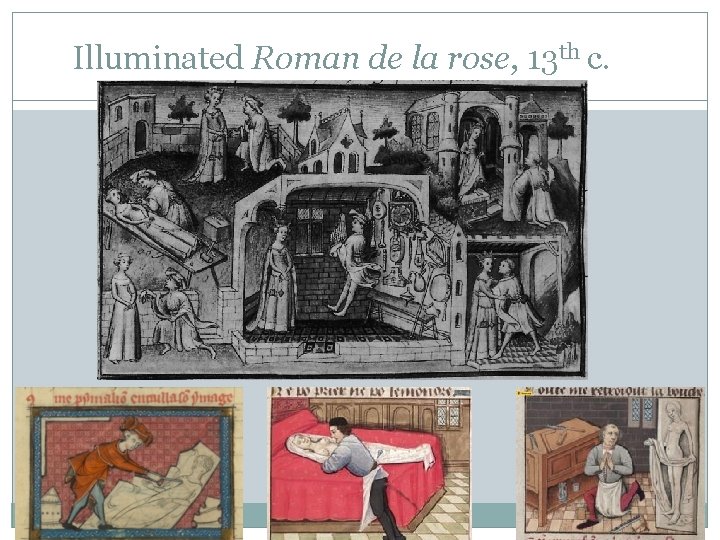
Illuminated Roman de la rose, 13 th c.
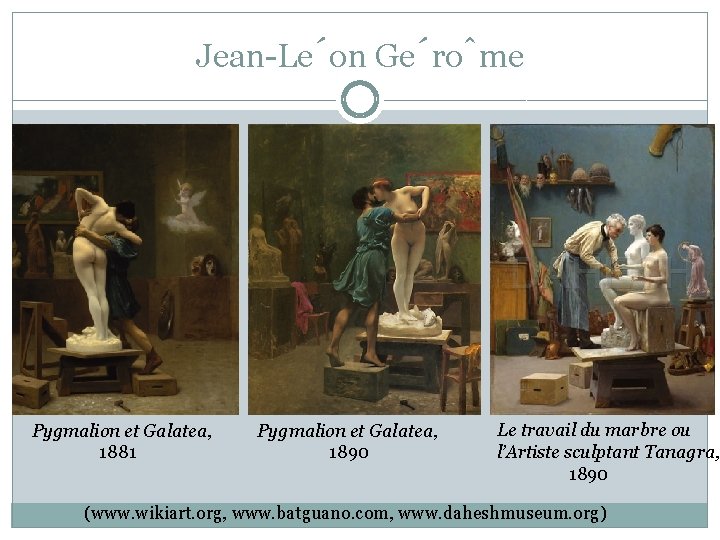
Jean-Le on Ge ro me Pygmalion et Galatea, 1881 Pygmalion et Galatea, 1890 Le travail du marbre ou l’Artiste sculptant Tanagra, 1890 (www. wikiart. org, www. batguano. com, www. daheshmuseum. org)
The Pygmalion Paradigm � Bloom, Michelle E. “Pygmalionesque delusions and illusions of movement: Animation from Hoffmann to Truffaut. ” Comparative Literature 52/4 (2000): 291 -320. � Materassi, Mario. “Artificial Women, the Pygmalion Paradigm, and Faulkner's Gordon in Mosquitoes. ” Global Faulkner: Faulkner and Yoknapatawpha. Eds. Annette Trefzer, Ann J. Abadie. Jackson: UP of Mississippi, 2009. 135 -150. � Gacoin-Marks, Florence. “Pigmalion. ” Tematologija: izbrana poglavja. Ed. Tone Smolej. Ljubljana: Študentska založba, 2007. 136 -149.
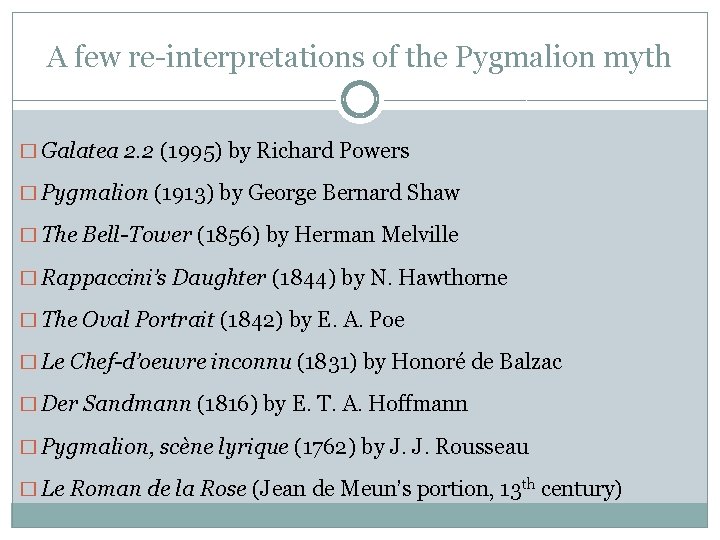
A few re-interpretations of the Pygmalion myth � Galatea 2. 2 (1995) by Richard Powers � Pygmalion (1913) by George Bernard Shaw � The Bell-Tower (1856) by Herman Melville � Rappaccini’s Daughter (1844) by N. Hawthorne � The Oval Portrait (1842) by E. A. Poe � Le Chef-d’oeuvre inconnu (1831) by Honoré de Balzac � Der Sandmann (1816) by E. T. A. Hoffmann � Pygmalion, scène lyrique (1762) by J. J. Rousseau � Le Roman de la Rose (Jean de Meun’s portion, 13 th century)
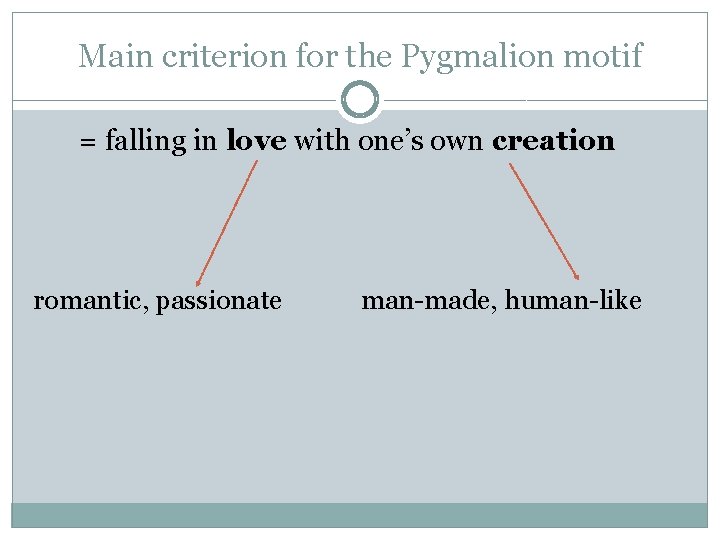
Main criterion for the Pygmalion motif = falling in love with one’s own creation romantic, passionate man-made, human-like
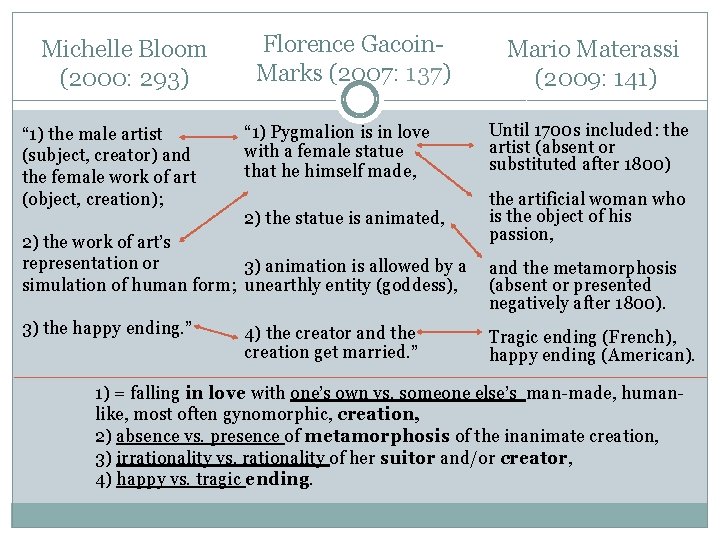
Michelle Bloom (2000: 293) “ 1) the male artist (subject, creator) and the female work of art (object, creation); Florence Gacoin. Marks (2007: 137) “ 1) Pygmalion is in love with a female statue that he himself made, Until 1700 s included: the artist (absent or substituted after 1800) 2) the statue is animated, the artificial woman who is the object of his passion, 2) the work of art’s representation or 3) animation is allowed by a simulation of human form; unearthly entity (goddess), 3) the happy ending. ” Mario Materassi (2009: 141) 4) the creator and the creation get married. ” and the metamorphosis (absent or presented negatively after 1800). Tragic ending (French), happy ending (American). 1) = falling in love with one’s own vs. someone else’s man-made, humanlike, most often gynomorphic, creation, 2) absence vs. presence of metamorphosis of the inanimate creation, 3) irrationality vs. rationality of her suitor and/or creator, 4) happy vs. tragic ending.

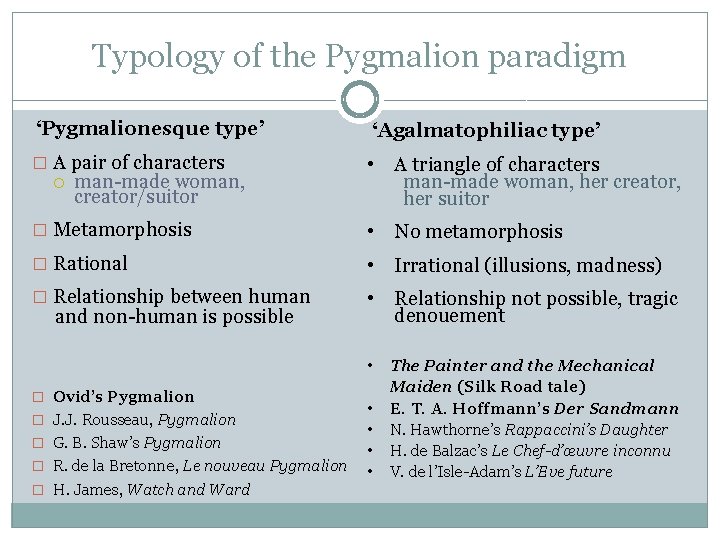
Typology of the Pygmalion paradigm ‘Pygmalionesque type’ � A pair of characters man-made woman, creator/suitor � Metamorphosis � Rational ‘Agalmatophiliac type’ � A triangle of characters man-made woman, her creator, her suitor � No metamorphosis � Irrational (illusions, madness) � Relationship between human and non-human is possible � Relationship not possible, tragic denouement � Ovid’s Pygmalion � The Painter and the Mechanical Maiden � J. J. Rousseau, Pygmalion � E. T. A. Hoffmann’s Der Sandmann � G. B. Shaw’s Pygmalion � N. Hawthorne’s Rappaccini’s Daughter � R. de la Bretonne, Le nouveau Pygmalion � H. de Balzac’s Le Chef-d’œuvre inconnu � H. James, Watch and Ward � V. de l’Isle-Adam’s L’Eve future
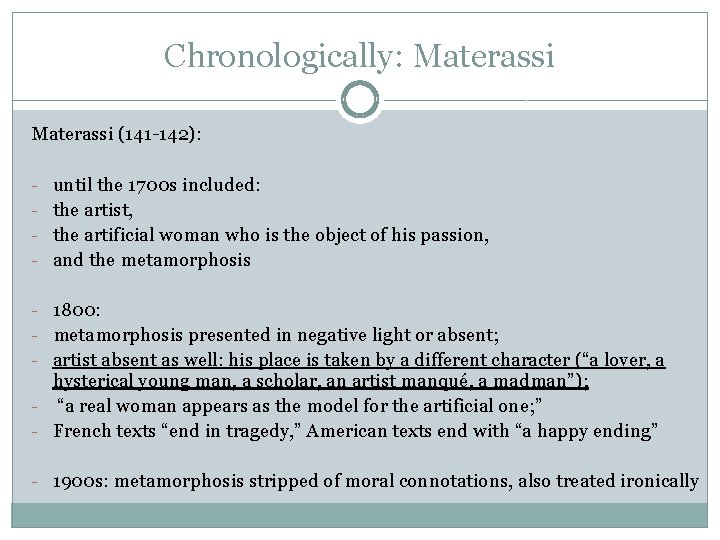
Chronologically: Materassi (141 -142): - until the 1700 s included: - the artist, - the artificial woman who is the object of his passion, - and the metamorphosis - 1800: - metamorphosis presented in negative light or absent; - artist absent as well: his place is taken by a different character (“a lover, a hysterical young man, a scholar, an artist manqué, a madman”); - “a real woman appears as the model for the artificial one; ” - French texts “end in tragedy, ” American texts end with “a happy ending” - 1900 s: metamorphosis stripped of moral connotations, also treated ironically
Chronologically (19 th c. ): Bloom � ‘Pygmalion complex’ afflicts much of the literature of the nineteenth century (Lathers 36). � “Pygmalion’s story […] became a major locus classicus of both literature and the fine arts in the nineteenth and the early twentieth centuries” (Materassi 140). � “The Pygmalion myth fails or undergoes what I call ‘dissolution, ’ as nineteenth-century Pygmalion figures experience the ‘Pygmalionesque delusions’ […]—‘delusions’ that in turn metamorphose at the end of the century into ‘illusions of movement’ made possible by the advent of cinema” (Bloom 291).
Thematologically: Gacoin-Marks � Pygmalion, the artist: art vs. life Rousseau’s Pygmalion, Balzac’s Le chef d’œuvre inconnu, Zola’s L’Œuvre, Cankar’s Tujci, Poe’s Oval Portrait, Gautier’s Le Roi Candule, Huysman’s Tam � Pygmalion, the scientist: illusions of science Hoffmann’s Der Sandmann, Villiers de l’Isle-Adam’s L’Éve Future � Pygmalion, the educator: groom, guardian, teacher Bretonne’s Le nouveau Pygmalion, Immerman’s Der neue Pygmalion, Gide’s La Symphonie pastorale, Shaw’s Pygmalion
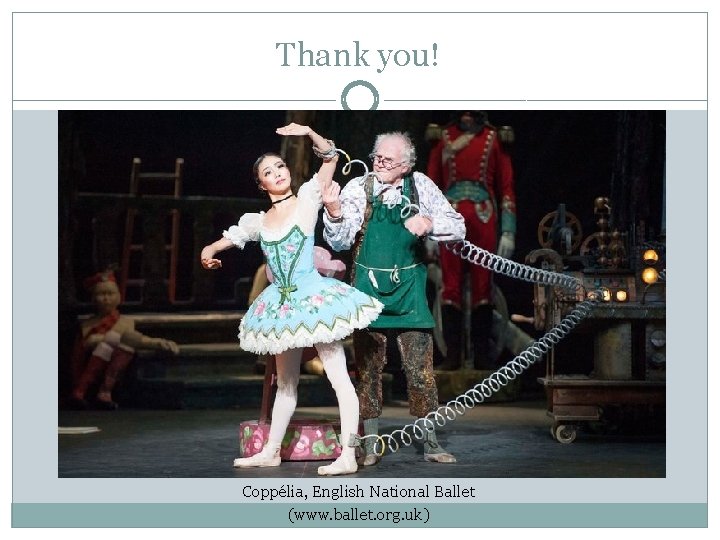
Thank you! Coppélia, English National Ballet (www. ballet. org. uk)
Typology of the Pygmalion paradigm ‘Pygmalionesque type’ ‘Agalmatophiliac type’ � A pair of characters • A triangle of characters man-made woman, her creator, her suitor man-made woman, creator/suitor � Metamorphosis • No metamorphosis � Rational • Irrational (illusions, madness) � Relationship between human • Relationship not possible, tragic denouement and non-human is possible • � Ovid’s Pygmalion � J. J. Rousseau, Pygmalion � G. B. Shaw’s Pygmalion � R. de la Bretonne, Le nouveau Pygmalion � H. James, Watch and Ward • • The Painter and the Mechanical Maiden (Silk Road tale) E. T. A. Hoffmann’s Der Sandmann N. Hawthorne’s Rappaccini’s Daughter H. de Balzac’s Le Chef-d’œuvre inconnu V. de l’Isle-Adam’s L’Eve future
- Slides: 13