
A Typical Essay Structure Four Ds Define Divide


- Slides: 14
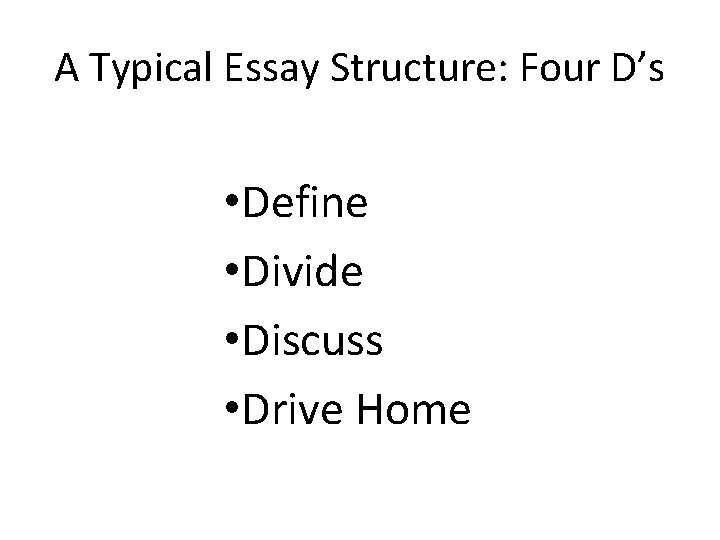
A Typical Essay Structure: Four D’s • Define • Divide • Discuss • Drive Home
INTRODUCTIONS The introduction is not a disposable redundancy. It should not merely summarize what your essay will cover.
INTRODUCTIONS An essay is an exploration of an idea that needs to be defined before it is developed. Because the material in an essay always relates to thesis, it is important to first introduce that thesis and make the reader aware of its importance and relevance.
INTRODUCTIONS You can think of the introduction like an inverted triangle, starting out with general ideas that gradually narrow until the specific thesis statement. • Define traditional notions of plot. • Discuss why literature that deviates from tradition is relevant. • Thesis that claims Waiting for Godot subverts traditional notions of plot.
GENERAL-TO-SPECIFIC When many people hear the word Africa, they picture steaming jungles and gorillas. Hollywood films have shrunk the public image of this immense, varied continent into a small segment of its actual diversity. To have a more accurate picture of the whole continent, however, one should remember that there are, roughly, three Africas, each with its distinct climate and terrain and with a style of life suited to the environment. The continent can be divided into the northern desert areas, the southeastern grasslands, and the tropical jungles to the southwest.
INTRODUCTIONS Place your essay in a broader context.
HOW TO BEGIN 1. With an anecdote that leads into the main topic: A student editor, criticizing the draft of a catalogue for a new college, three times deleted the words “liberal education” from the draft. Coming upon it again, she circled the words and wrote in the margin: “What in the world is it? ” —Harris Wolfford, “In Search of Liberal Education”
HOW TO BEGIN 2. With the setting as background for what will follow: Roman Wortman first decided to turn to organic farming one day in the spring of 1972, when he rode out on his tractor to spray his fields with a new pesticide and found that he was leaving a trail of dead birds behind him. “There was half a dozen of them at the edge of the field, ” he told me as we stood under the blazing Nebraska sun looking over his cornfields. “I rode back into the yard and there was more dead birds along the driveway where I had sprayed only a half hour before. ” He fixed his keen brown eyes on me for a moment. “I turned around and I said to myself, ‘What the hell am I doing out here? ’ From that day to this, I’ve never used another pesticide, herbicide, or fertilizer on this farm. ” He waved his arm out over his fields of corn and alfalfa, which were shimmering with a bright, deep green. “Look what I have to show for it, ” he said. —William Tucker, “The Next American Dust Bowl… and How to Avert It”
HOW TO BEGIN 3. With narration, beginning in the middle of things, inviting further reading: You wake up one morning with a vague sense of unease. Everything seems normal—until you move. And then, brother, you scream. A demon seems to be stabbing at the base of your big toe with a sharp, red-hot poker. Even the light touch of the sheet gouges your nerves. Carefully, delicately, you remove the bedclothes and examine the shiny red swelling at the tender joint. Try to wiggle the toe—and scream again. Cautiously swing your legs to the floor and the whole foot throbs in agony. Wondering how you broke your toe, you limp into your doctor’s office and get the news, as I did a few years ago: No broken bones, my friend; it’s the gout. —Rafael Steingberg, “If You Are Highly Sexed, Achievement Oriented, and a Wine Connoisseur, This May Be Your Disease”
HOW TO BEGIN 4. With a quotation relevant to the thought: “Yes, we are revolutionaries, ” acknowledged the fortyish executive, a top salesman for one of America’s largest and fastest-growing corporations. “What we are doing will no doubt leave a very lasting impression on America. We are going to turn the world of white-collar work upside down, inside out, and make it do what it’s supposed to do—work. ” No small boast, that. But this man, who prefers to be an anonymous revolutionary, speaks confidently, for he has seen a vision of the future—and it is electronic. —Jon Stewart, “Computer Shock: The Inhuman Office of the Future”
HOW TO BEGIN 5. With a firm statement of opinion, arousing the reader’s feelings: The first year of the 1980’s may or may not bring a new president to the White House, but it will, for certain, see a new incumbent in a high artistic post that has had a lot less changes over seven decades. After all those years in which the direction of the great Philadelphia Orchestra has been in the hands of only two men (Leopold Stokowski and Eugene Ormandy), it will pass to Riccardo Muti. This move is somewhat like elevating a parish priest to the papacy. —Irving Kolodin, “Music to My Ears: Provincialism on the Podium”
HOW TO BEGIN 6. With a prediction: America is facing a manpower crisis of awesome and dangerous proportions. What is done, or not done, about it in the next few years will affect the quality of life in this country for generations. Nor is it any exaggeration to say that if the correct solutions for the problem are not conceived and carried out, the United States will be confronted with potential disaster. —John Tebbel, “People and Jobs"
HOW TO BEGIN 7. With unusual or sensational detail: Physicians may one day treat patients who have shattered limbs, crippled joints, and injured spines in a way that man never before dared to dream of: regrowing the damaged part—whole, perfect, and undiseased. —Susan Schiefelbein, “The Miracle of Regeneration: Can Human Limbs Grow Back? ”
HOW TO BEGIN 8. With humor: There’s good news in the paper. America has its first drive-in funeral parlor. I had almost given up hope that the country could ever reach the goal that it is so obviously striving for---the day when we will be able to do everything without getting out of the car. But now I know that the impossible dream is possible. —William Zinsser, “Time-Saver for Busy Mourners”