
A TwoLevel Architecture for Internet Signaling Bob Braden
A Two-Level Architecture for Internet Signaling Bob Braden USC Information Sciences Institute IETF 54 July 15, 2002 Braden@isi. edu NSIS IETF 54 July 2002 1
A Two-Level Architecture for Signaling • draft-braden-2 level-signaling-00. txt, Nov 2001 ~http: //www. isi. edu/rsvp/ site or ~http: //www. isi. edu/~braden/draft-braden-2 level-signaling-00. txt • Intended as a partial design for “RSVP v 2” – i. e. , an RSVP-like signaling protocol for a much broader range of signaling applications than the original RSVP design goal. Braden@isi. edu NSIS IETF 54 July 2002 2
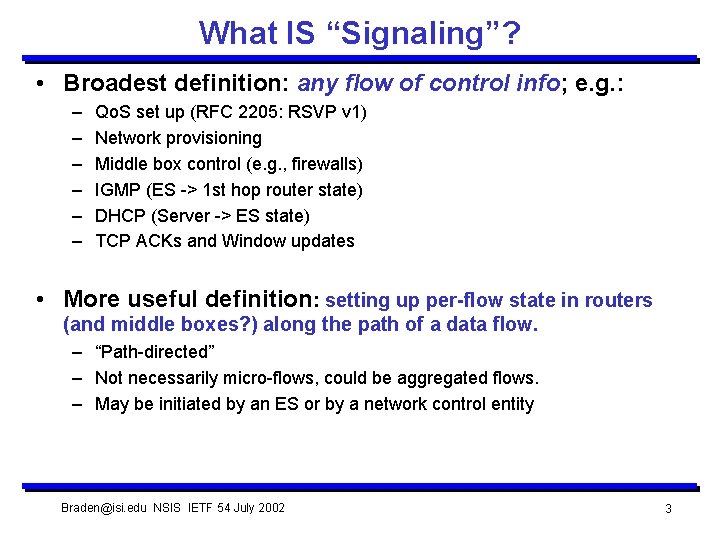
What IS “Signaling”? • Broadest definition: any flow of control info; e. g. : – – – Qo. S set up (RFC 2205: RSVP v 1) Network provisioning Middle box control (e. g. , firewalls) IGMP (ES -> 1 st hop router state) DHCP (Server -> ES state) TCP ACKs and Window updates • More useful definition: setting up per-flow state in routers (and middle boxes? ) along the path of a data flow. – “Path-directed” – Not necessarily micro-flows, could be aggregated flows. – May be initiated by an ES or by a network control entity Braden@isi. edu NSIS IETF 54 July 2002 3
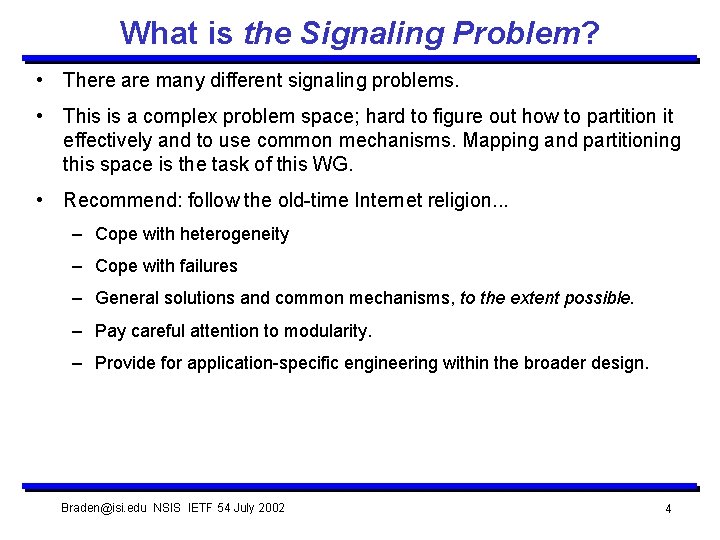
What is the Signaling Problem? • There are many different signaling problems. • This is a complex problem space; hard to figure out how to partition it effectively and to use common mechanisms. Mapping and partitioning this space is the task of this WG. • Recommend: follow the old-time Internet religion. . . – Cope with heterogeneity – Cope with failures – General solutions and common mechanisms, to the extent possible. – Pay careful attention to modularity. – Provide for application-specific engineering within the broader design. Braden@isi. edu NSIS IETF 54 July 2002 4
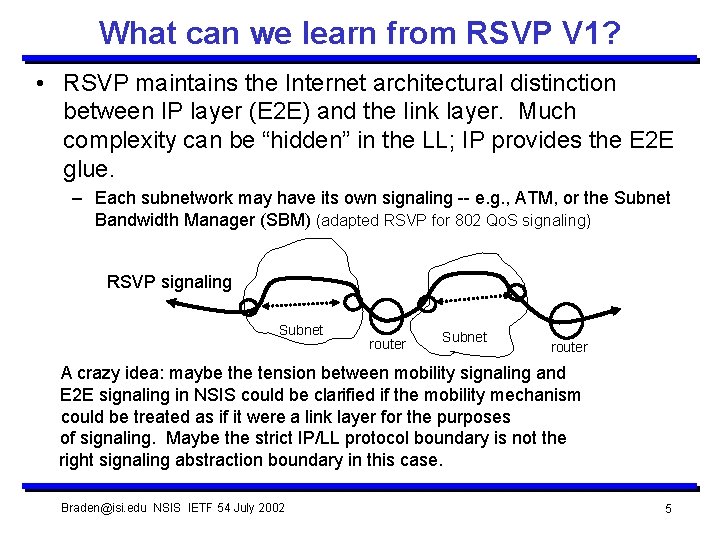
What can we learn from RSVP V 1? • RSVP maintains the Internet architectural distinction between IP layer (E 2 E) and the link layer. Much complexity can be “hidden” in the LL; IP provides the E 2 E glue. – Each subnetwork may have its own signaling -- e. g. , ATM, or the Subnet Bandwidth Manager (SBM) (adapted RSVP for 802 Qo. S signaling) RSVP signaling Subnet router A crazy idea: maybe the tension between mobility signaling and E 2 E signaling in NSIS could be clarified if the mobility mechanism could be treated as if it were a link layer for the purposes of signaling. Maybe the strict IP/LL protocol boundary is not the right signaling abstraction boundary in this case. Braden@isi. edu NSIS IETF 54 July 2002 5
What can we learn from RSVP V 1? (2) • RSVP V 1 came to the IETF with the basic requirements and protocol design already published, simulated, and prototyped. And then it took 3 years. . . • RSVP is adaptable to a wide variety of signaling problems. . . “RSVP-like”: • • • MPLS Path setup VPN provisioning Optical network configuration Link-layer QOS setup TIST -- Topology-Insensitive Service Protocol (Middle boxes) AFSP -- Active Filter Signaling Protocol -- setting filters for effcient multicast publish/subscribe system (US Do. D distributed simulations) Braden@isi. edu NSIS IETF 54 July 2002 6
What Can We Learn from RSVP V 1? • RSVP V 1 is adaptable both: – syntactically (TLV encoding) and – semantically (path-directed signaling mechanism) • But it does not fit together well. . . Confusion, overlap, conflicts among features and signaling models. What IS a conforming RSVP v 1 implementation today? ? • Can we do better? Braden@isi. edu NSIS IETF 54 July 2002 7
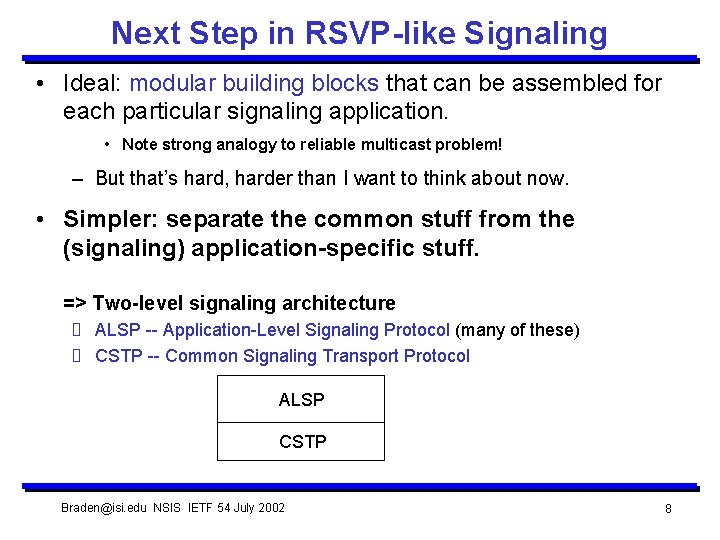
Next Step in RSVP-like Signaling • Ideal: modular building blocks that can be assembled for each particular signaling application. • Note strong analogy to reliable multicast problem! – But that’s hard, harder than I want to think about now. • Simpler: separate the common stuff from the (signaling) application-specific stuff. => Two-level signaling architecture ALSP -- Application-Level Signaling Protocol (many of these) CSTP -- Common Signaling Transport Protocol ALSP CSTP Braden@isi. edu NSIS IETF 54 July 2002 8
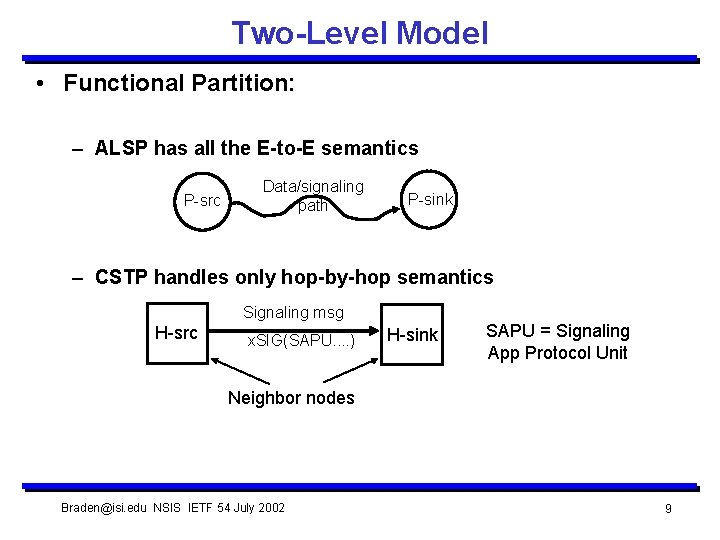
Two-Level Model • Functional Partition: – ALSP has all the E-to-E semantics P-src Data/signaling path P-sink – CSTP handles only hop-by-hop semantics Signaling msg H-src x. SIG(SAPU. . ) H-sink SAPU = Signaling App Protocol Unit Neighbor nodes Braden@isi. edu NSIS IETF 54 July 2002 9
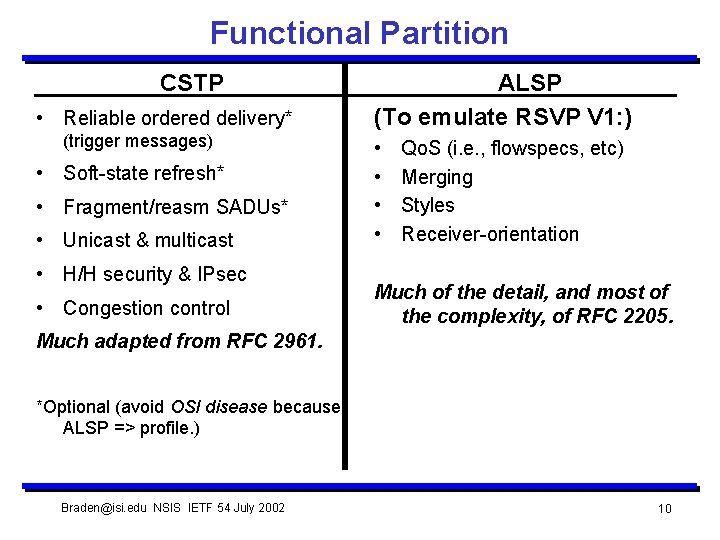
Functional Partition CSTP • Reliable ordered delivery* (trigger messages) • Soft-state refresh* • Fragment/reasm SADUs* • Unicast & multicast • H/H security & IPsec • Congestion control ALSP (To emulate RSVP V 1: ) • • Qo. S (i. e. , flowspecs, etc) Merging Styles Receiver-orientation Much of the detail, and most of the complexity, of RFC 2205. Much adapted from RFC 2961. *Optional (avoid OSI disease because ALSP => profile. ) Braden@isi. edu NSIS IETF 54 July 2002 10
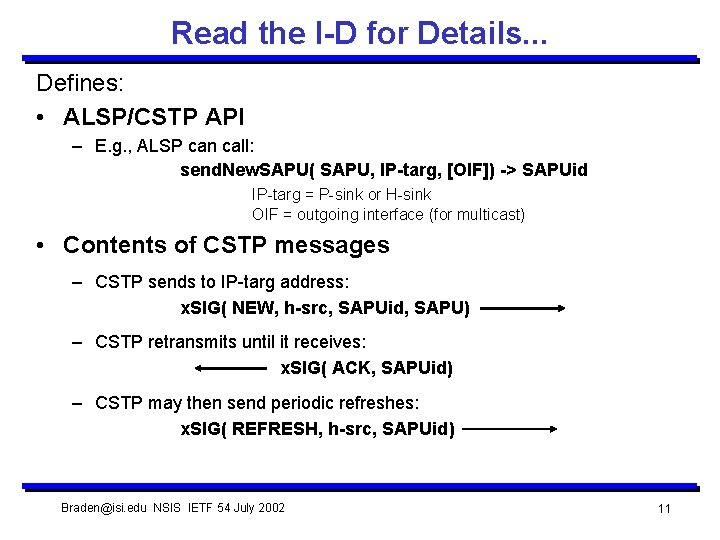
Read the I-D for Details. . . Defines: • ALSP/CSTP API – E. g. , ALSP can call: send. New. SAPU( SAPU, IP-targ, [OIF]) -> SAPUid IP-targ = P-sink or H-sink OIF = outgoing interface (for multicast) • Contents of CSTP messages – CSTP sends to IP-targ address: x. SIG( NEW, h-src, SAPUid, SAPU) – CSTP retransmits until it receives: x. SIG( ACK, SAPUid) – CSTP may then send periodic refreshes: x. SIG( REFRESH, h-src, SAPUid) Braden@isi. edu NSIS IETF 54 July 2002 11
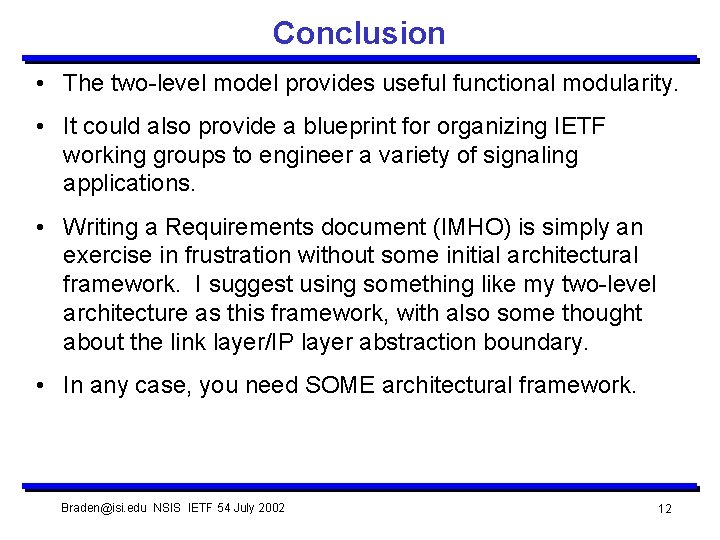
Conclusion • The two-level model provides useful functional modularity. • It could also provide a blueprint for organizing IETF working groups to engineer a variety of signaling applications. • Writing a Requirements document (IMHO) is simply an exercise in frustration without some initial architectural framework. I suggest using something like my two-level architecture as this framework, with also some thought about the link layer/IP layer abstraction boundary. • In any case, you need SOME architectural framework. Braden@isi. edu NSIS IETF 54 July 2002 12
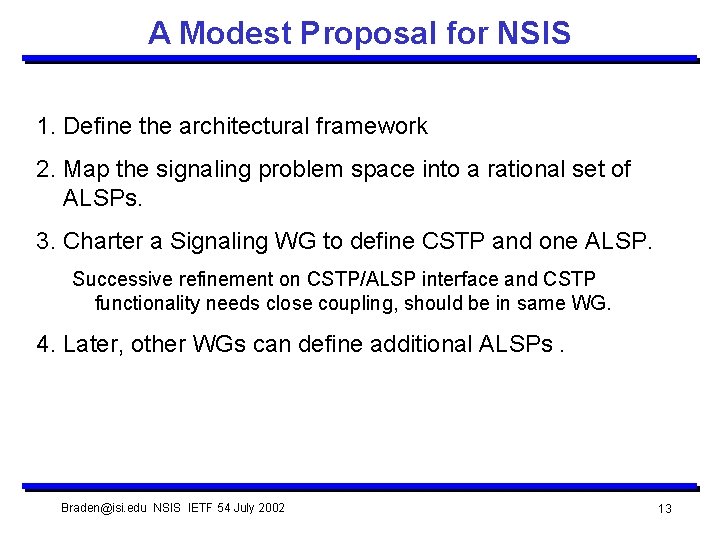
A Modest Proposal for NSIS 1. Define the architectural framework 2. Map the signaling problem space into a rational set of ALSPs. 3. Charter a Signaling WG to define CSTP and one ALSP. Successive refinement on CSTP/ALSP interface and CSTP functionality needs close coupling, should be in same WG. 4. Later, other WGs can define additional ALSPs. Braden@isi. edu NSIS IETF 54 July 2002 13
- Slides: 13