
A Tutorial Introduction to Proof Complexity Paul Beame
A Tutorial Introduction to Proof Complexity Paul Beame University of Washington
Proof Systems and Their Complexity 2
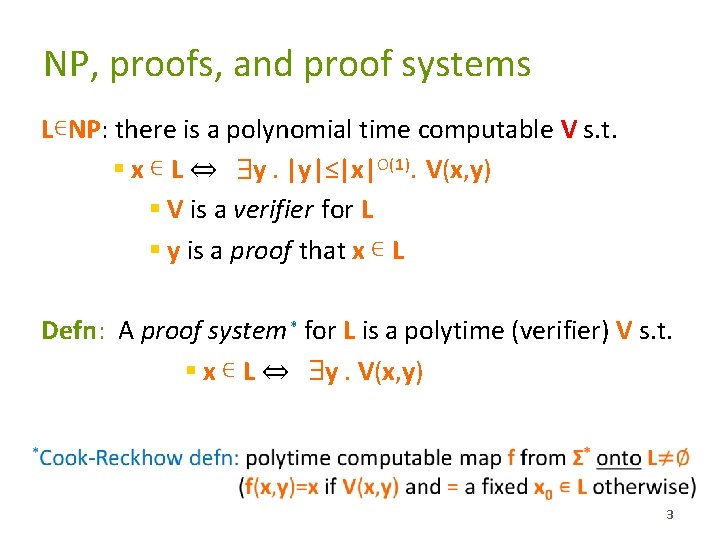
NP, proofs, and proof systems L∊NP: there is a polynomial time computable V s. t. § x ∊ L ⇔ y. |y|≤|x|O(1). V(x, y) § V is a verifier for L § y is a proof that x ∊ L Defn: A proof system * for L is a polytime (verifier) V s. t. § x ∊ L ⇔ y. V(x, y) � 3
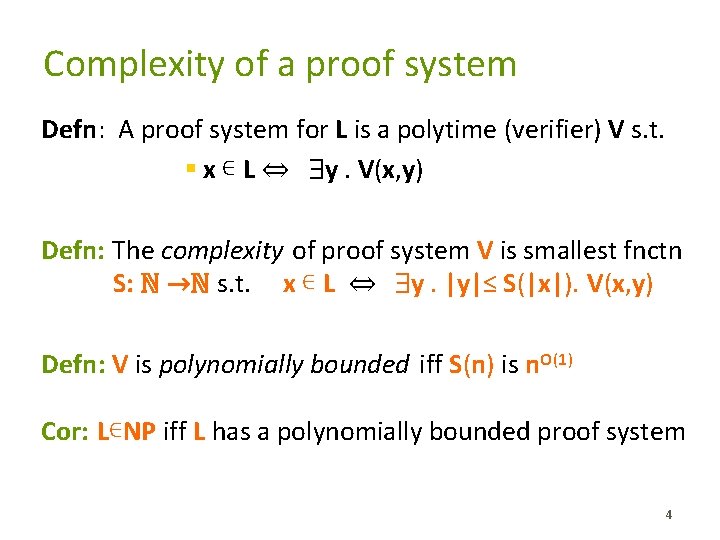
Complexity of a proof system Defn: A proof system for L is a polytime (verifier) V s. t. § x ∊ L ⇔ y. V(x, y) Defn: The complexity of proof system V is smallest fnctn S: ℕ →ℕ s. t. x ∊ L ⇔ y. |y|≤ S(|x|). V(x, y) Defn: V is polynomially bounded iff S(n) is n. O(1) Cor: L∊NP iff L has a polynomially bounded proof system 4
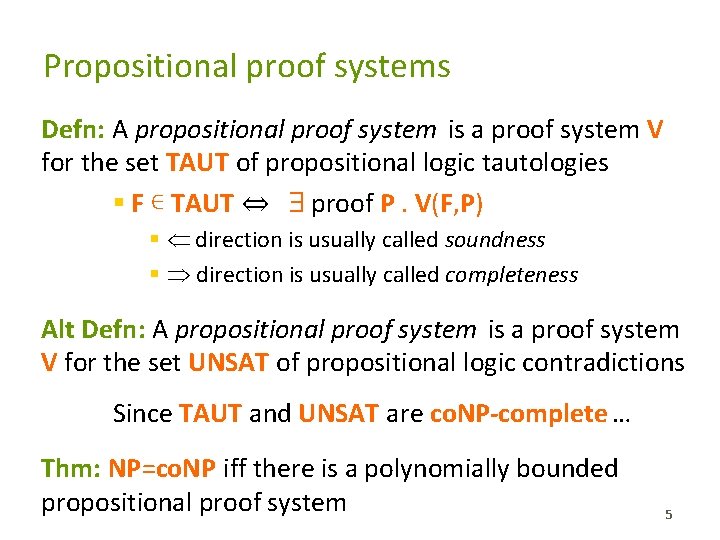
Propositional proof systems Defn: A propositional proof system is a proof system V for the set TAUT of propositional logic tautologies § F ∊ TAUT ⇔ proof P. V(F, P) § direction is usually called soundness § direction is usually called completeness Alt Defn: A propositional proof system is a proof system V for the set UNSAT of propositional logic contradictions Since TAUT and UNSAT are co. NP-complete … Thm: NP=co. NP iff there is a polynomially bounded propositional proof system 5

Proof complexity vs search § Proof complexity only measures how large proofs must be, not how easy they are to find § Lower bounds on proof complexity imply lower bounds on nondeterministic algorithms § Stronger than lower bounds on deterministic search § Any complete SAT solver yields a propositional proof system § Proof that F∊UNSAT is transcript of failed search on input F § Size of proof ≈ running time of SAT solver on input F 6
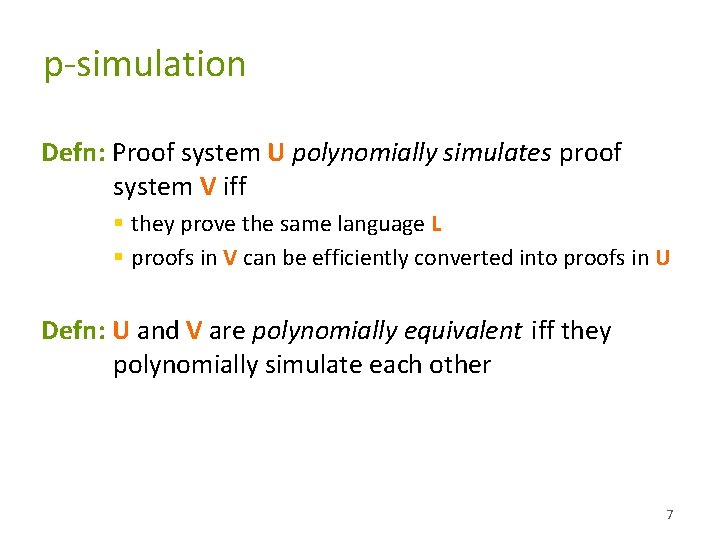
p-simulation Defn: Proof system U polynomially simulates proof system V iff § they prove the same language L § proofs in V can be efficiently converted into proofs in U Defn: U and V are polynomially equivalent iff they polynomially simulate each other 7
![Proof systems using CNF input By same trick [Tseitin 68, Cook 71] that reduces](http://slidetodoc.com/presentation_image_h2/f4575e7ce1f43f79c290a3d4eb6d8ab7/image-8.jpg "Proof systems using CNF input By same trick [Tseitin 68, Cook 71] that reduces")
Proof systems using CNF input By same trick [Tseitin 68, Cook 71] that reduces SAT to CNFSAT, can assume w. l. o. g. that propositional proof systems are for the language CNF-UNSAT § Given propositional formula F produce CNF formula F’ § Add an extra variable y. G corresponding to each sub -formula G of F § F’ has clauses expressing the fact that y. G takes on the value of G determined by the inputs to F § Add clause y. F to express that F is must be true Thm: F’ ∊ CNF-UNSAT iff F ∊ UNSAT 8
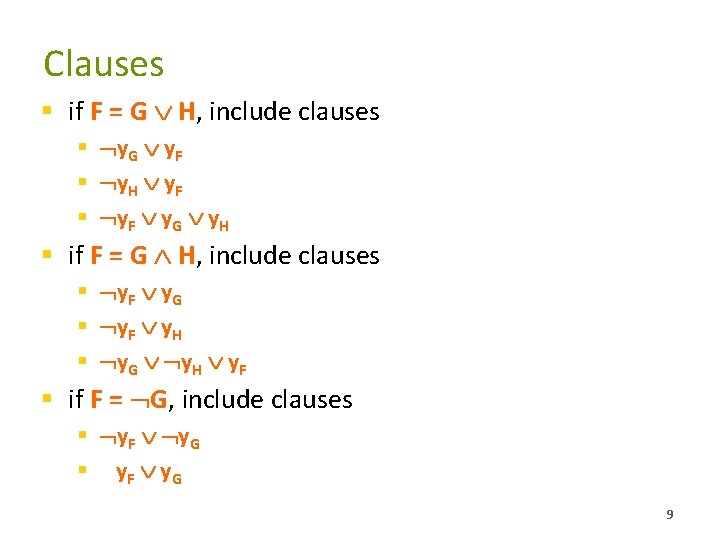
Clauses § if F = G H, include clauses § y. G y. F § y. H y. F § y. F y. G y. H § if F = G H, include clauses § y. F y. G § y. F y. H § y. G y. H y. F § if F = G, include clauses § y. F y. G 9
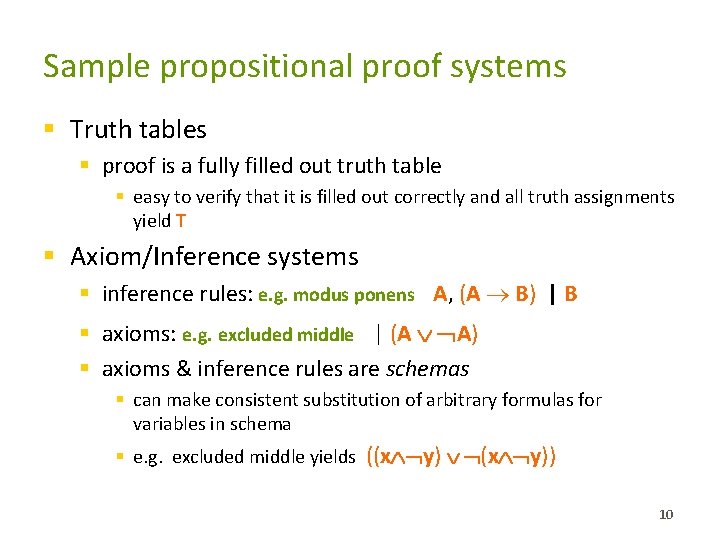
Sample propositional proof systems § Truth tables § proof is a fully filled out truth table § easy to verify that it is filled out correctly and all truth assignments yield T § Axiom/Inference systems § inference rules: e. g. modus ponens A, (A B) | B § axioms: e. g. excluded middle | (A A) § axioms & inference rules are schemas § can make consistent substitution of arbitrary formulas for variables in schema § e. g. excluded middle yields ((x y) (x y)) 10
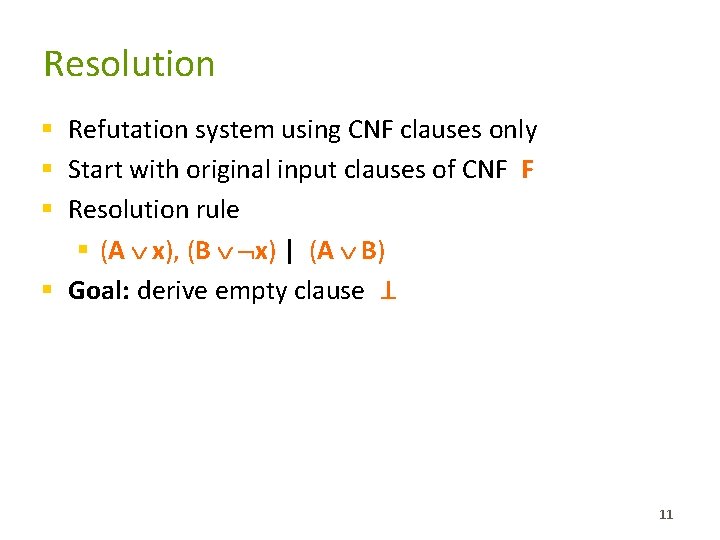
Resolution § Refutation system using CNF clauses only § Start with original input clauses of CNF F § Resolution rule § (A x), (B x) | (A B) § Goal: derive empty clause ⊥ 11
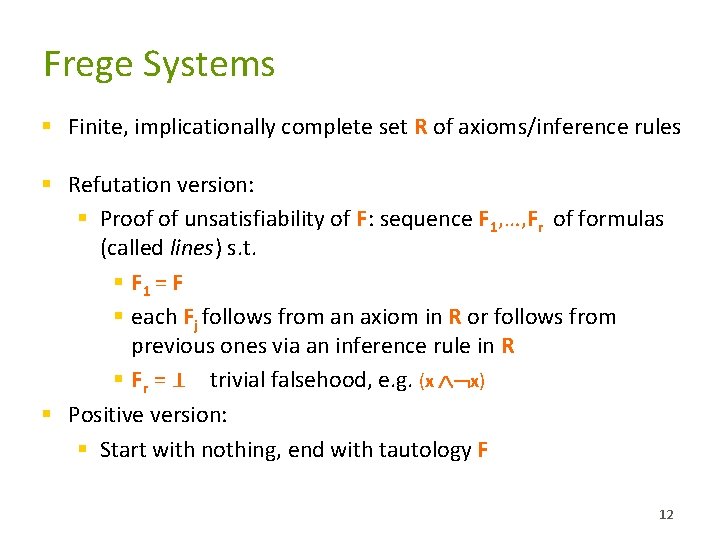
Frege Systems § Finite, implicationally complete set R of axioms/inference rules § Refutation version: § Proof of unsatisfiability of F: sequence F 1, …, Fr of formulas (called lines) s. t. § F 1 = F § each Fj follows from an axiom in R or follows from previous ones via an inference rule in R § Fr = ⊥ trivial falsehood, e. g. (x x) § Positive version: § Start with nothing, end with tautology F 12
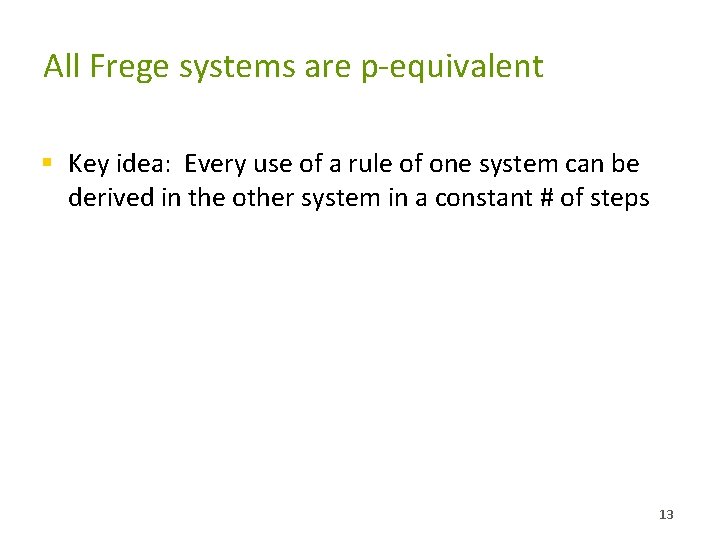
All Frege systems are p-equivalent § Key idea: Every use of a rule of one system can be derived in the other system in a constant # of steps 13
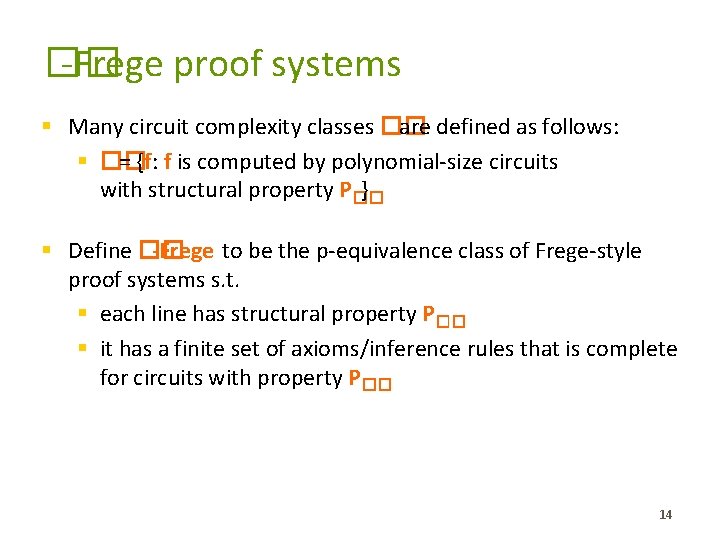
�� -Frege proof systems § Many circuit complexity classes �� are defined as follows: § �� = {f: f is computed by polynomial-size circuits with structural property P�� } § Define �� -Frege to be the p-equivalence class of Frege-style proof systems s. t. § each line has structural property P�� § it has a finite set of axioms/inference rules that is complete for circuits with property P�� 14
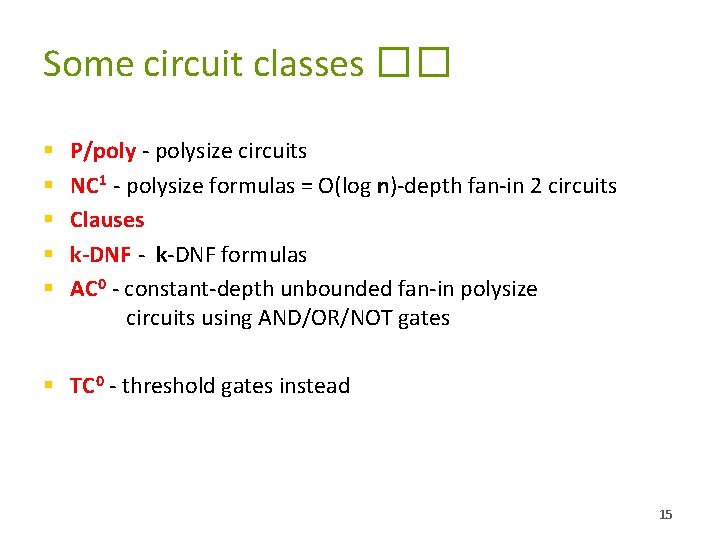
Some circuit classes �� § § § P/poly - polysize circuits NC 1 - polysize formulas = O(log n)-depth fan-in 2 circuits Clauses k-DNF - k-DNF formulas AC 0 - constant-depth unbounded fan-in polysize circuits using AND/OR/NOT gates § TC 0 - threshold gates instead 15
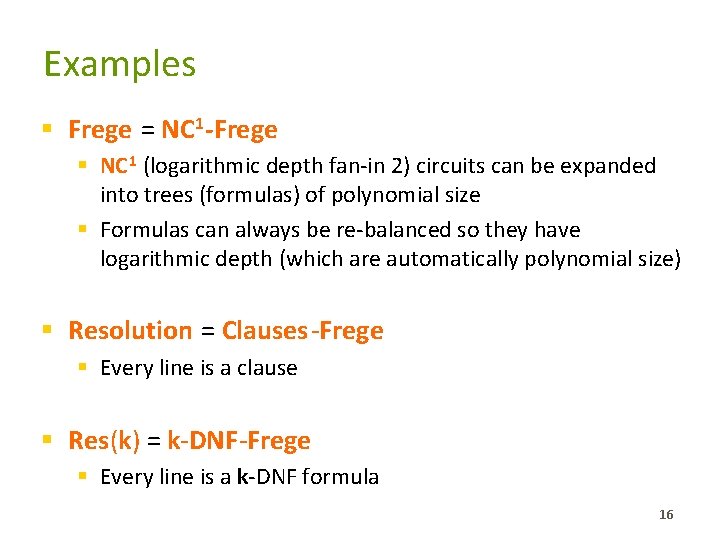
Examples § Frege = NC 1 -Frege § NC 1 (logarithmic depth fan-in 2) circuits can be expanded into trees (formulas) of polynomial size § Formulas can always be re-balanced so they have logarithmic depth (which are automatically polynomial size) § Resolution = Clauses-Frege § Every line is a clause § Res(k) = k-DNF-Frege § Every line is a k-DNF formula 16
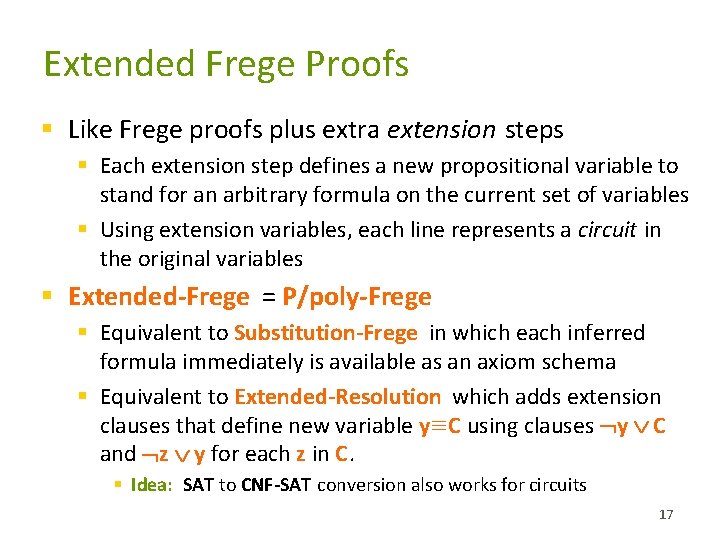
Extended Frege Proofs § Like Frege proofs plus extra extension steps § Each extension step defines a new propositional variable to stand for an arbitrary formula on the current set of variables § Using extension variables, each line represents a circuit in the original variables § Extended-Frege = P/poly-Frege § Equivalent to Substitution-Frege in which each inferred formula immediately is available as an axiom schema § Equivalent to Extended-Resolution which adds extension clauses that define new variable y≡C using clauses y C and z y for each z in C. § Idea: SAT to CNF-SAT conversion also works for circuits 17
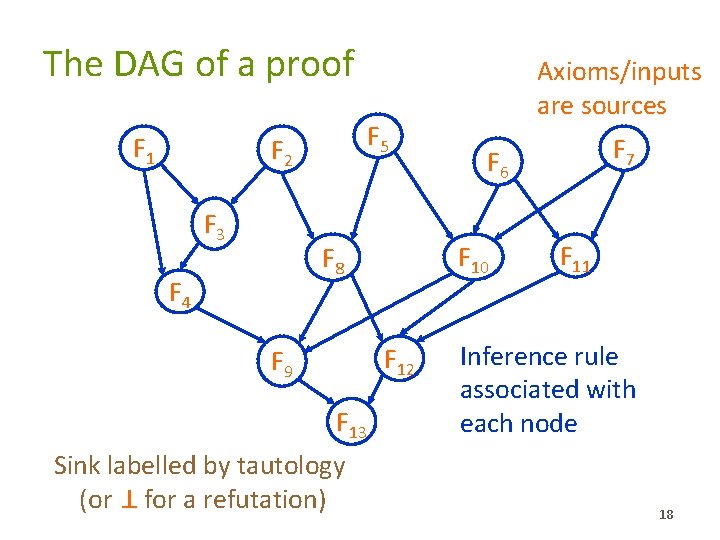
The DAG of a proof F 1 F 5 F 2 F 3 F 12 F 9 F 13 Sink labelled by tautology (or ⊥ for a refutation) F 7 F 6 F 10 F 8 F 4 Axioms/inputs are sources F 11 Inference rule associated with each node 18
Proof structure § For any axiom/inference system can consider § Tree-like proofs § Restricted version in which the proof DAG must be a tree. (Source formulas may be repeated. ) § General (DAG-like) proofs § No restriction on the proof DAG § Other systems can be static (in which the entire proof string can only be seen as one large inference) § E. g. Truth tables § Can sometimes use a similar idea for all three kinds of proofs. Proof size: static ≥ tree-like ≥ general 19
Note: Special structure for resolution proofs So far § Resolution § Proof structure is an unrestricted DAG § Tree-like resolution § Proof structure is a tree Also § Regular resolution § A clause that is derived by resolving on variable x can never lead to a clause in which variable x is re-introduced § Generalizes tree resolution which has this property wlog. 20
Davis-Putnam-Logemann-Loveland (DPLL) Procedure § A family of complete SAT solvers § a collection of algorithms for finding SAT assignments/proofs § Its traces form proofs of unsatifiability § ≡ tree-like resolution refutations 21
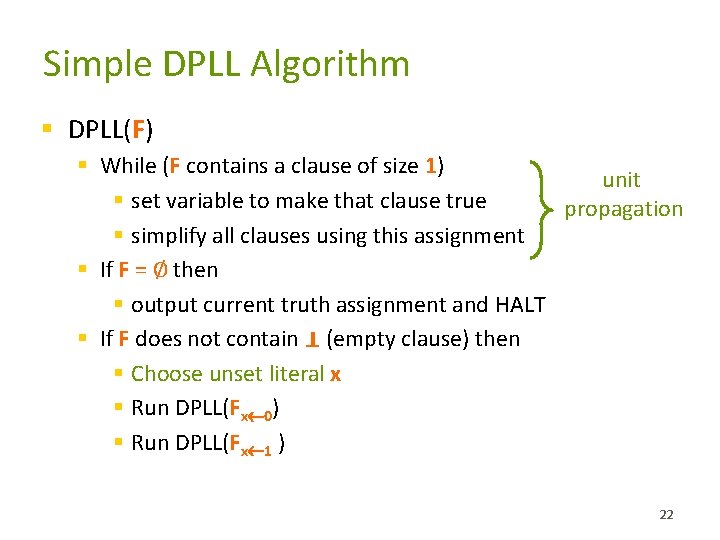
Simple DPLL Algorithm § DPLL(F) § While (F contains a clause of size 1) unit § set variable to make that clause true propagation § simplify all clauses using this assignment § If F = ∅ then § output current truth assignment and HALT § If F does not contain ⊥ (empty clause) then § Choose unset literal x § Run DPLL(Fx 0) § Run DPLL(Fx 1 ) 22
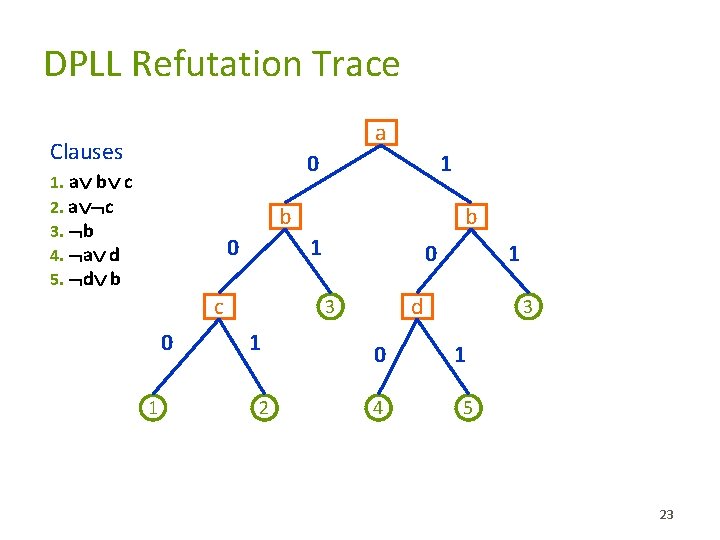
DPLL Refutation Trace a Clauses 0 1. a b c 2. a c 3. b 4. a d 5. d b 1 b 0 1 c 0 1 b 0 d 3 1 2 1 0 4 3 1 5 23
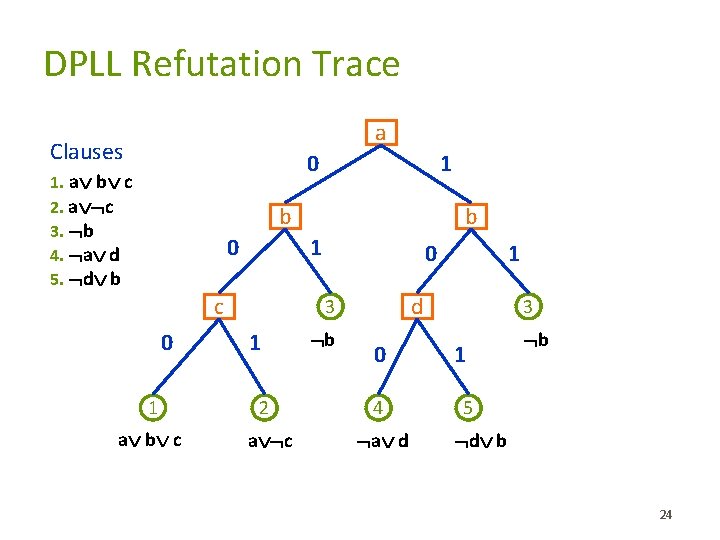
DPLL Refutation Trace a Clauses 0 1. a b c 2. a c 3. b 4. a d 5. d b 1 b 0 1 c 0 b 0 d 3 1 b 1 0 1 2 4 a b c a c a d 3 1 b 5 d b 24
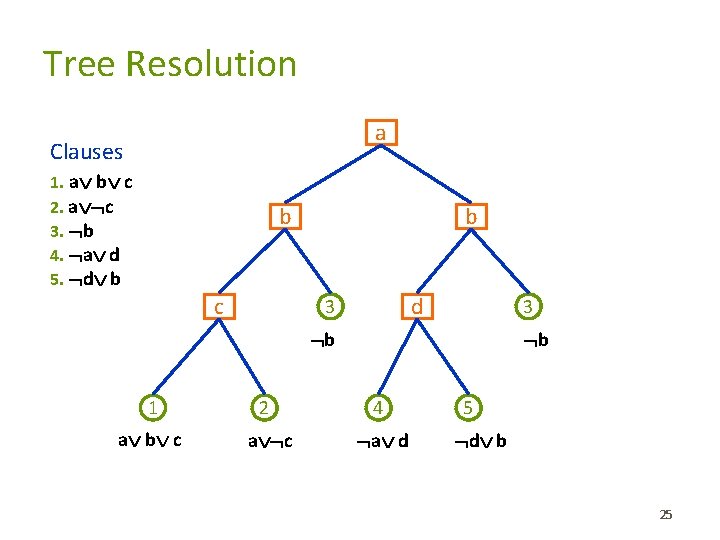
Tree Resolution a Clauses 1. a b c 2. a c 3. b 4. a d 5. d b b c b d 3 3 b b 1 2 4 a b c a c a d 5 d b 25
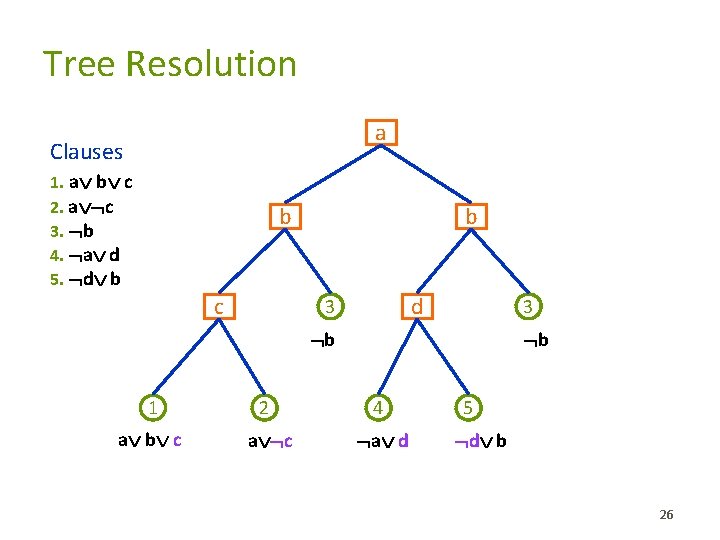
Tree Resolution a Clauses 1. a b c 2. a c 3. b 4. a d 5. d b b c b d 3 3 b b 1 2 4 a b c a c a d 5 d b 26
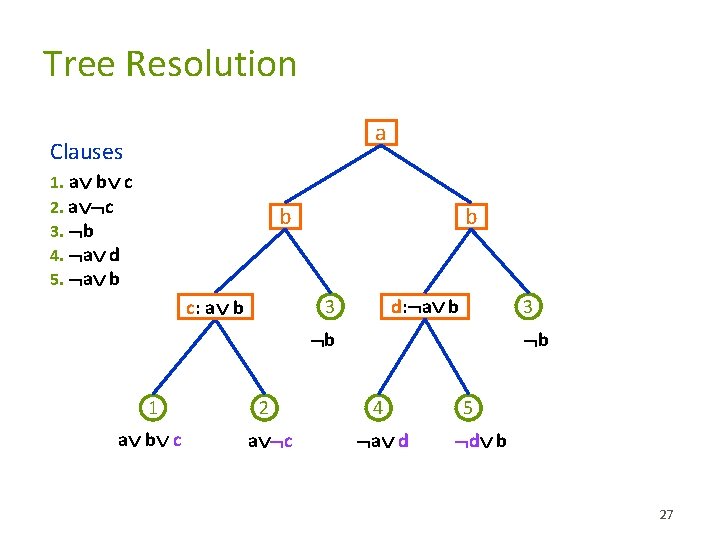
Tree Resolution a Clauses 1. a b c 2. a c 3. b 4. a d 5. a b b b d: a b 3 c: a b 3 b b 1 2 4 a b c a c a d 5 d b 27
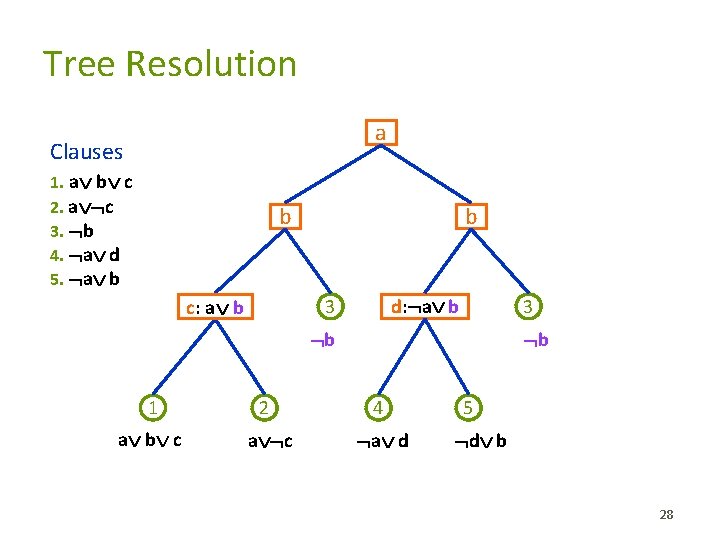
Tree Resolution a Clauses 1. a b c 2. a c 3. b 4. a d 5. a b b b d: a b 3 c: a b 3 b b 1 2 4 a b c a c a d 5 d b 28
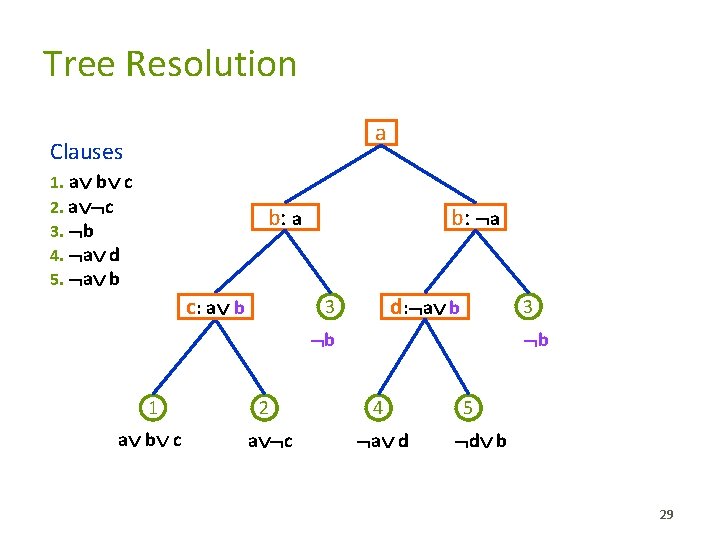
Tree Resolution a Clauses 1. a b c 2. a c 3. b 4. a d 5. a b b: a c: a b b: a d: a b 3 3 b b 1 2 4 a b c a c a d 5 d b 29
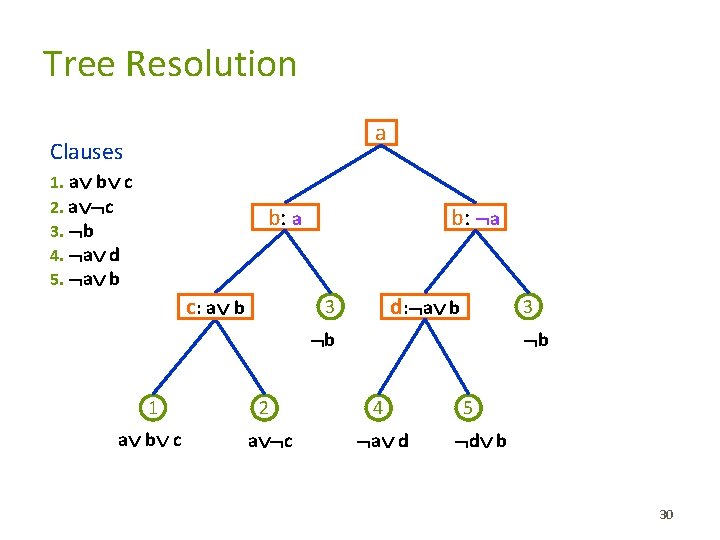
Tree Resolution a Clauses 1. a b c 2. a c 3. b 4. a d 5. a b b: a c: a b b: a d: a b 3 3 b b 1 2 4 a b c a c a d 5 d b 30
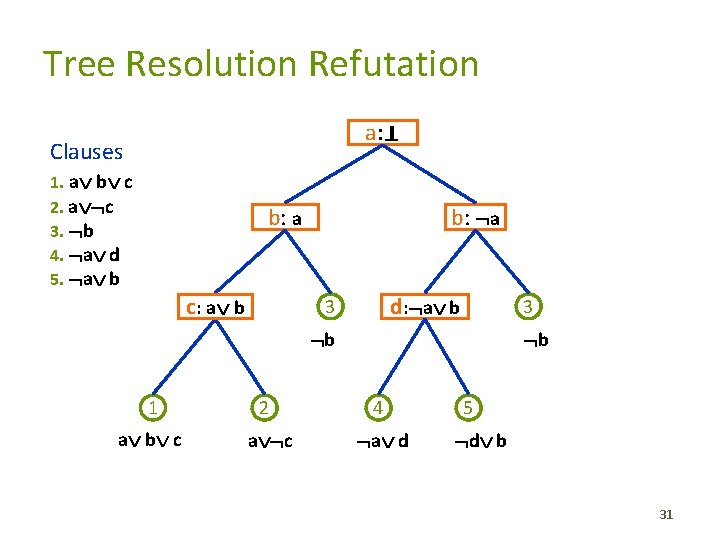
Tree Resolution Refutation a: ⊥ Clauses 1. a b c 2. a c 3. b 4. a d 5. a b b: a c: a b b: a d: a b 3 3 b b 1 2 4 a b c a c a d 5 d b 31
Conflict-Directed Clause-Learning (CDCL) § Complete SAT solvers that extend DPLL with clauses inferred via special forms of resolution inference § Traces on unsatisfiable formulas yield resolution refutations. § See tomorrow’s tutorial by Sam Buss to see their generality 32
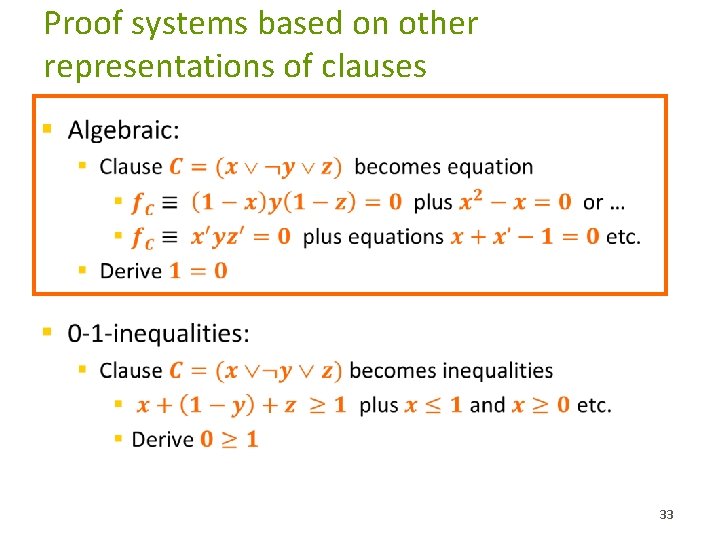
Proof systems based on other representations of clauses § 33
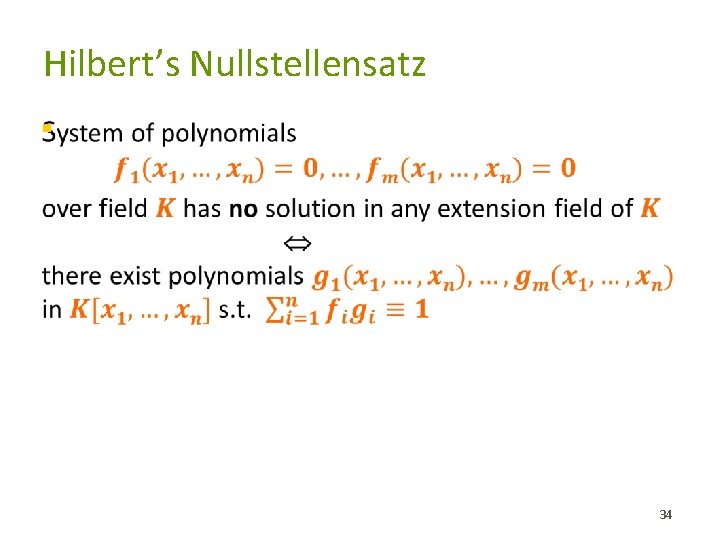
Hilbert’s Nullstellensatz § 34
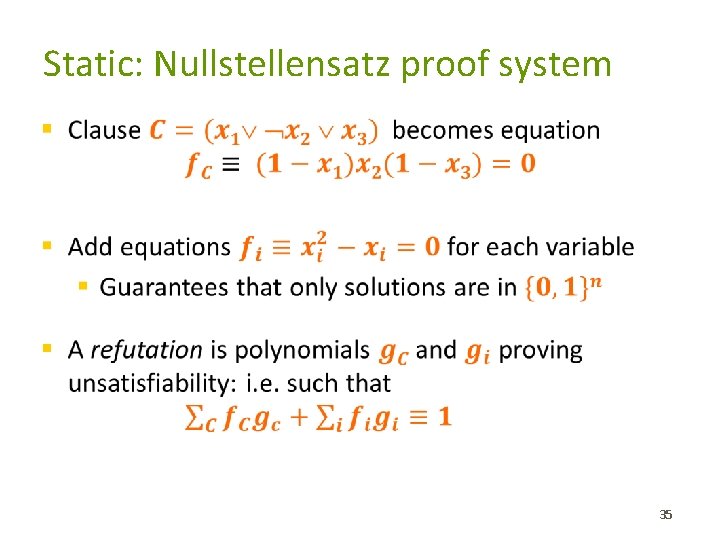
Static: Nullstellensatz proof system § 35
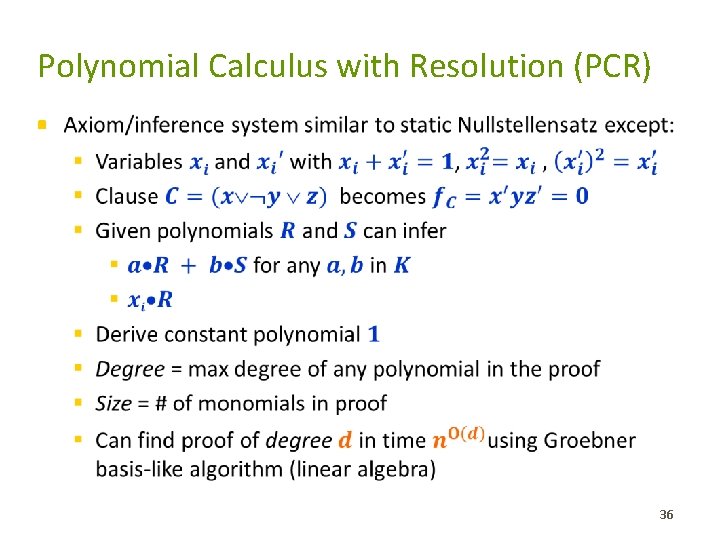
Polynomial Calculus with Resolution (PCR) § 36
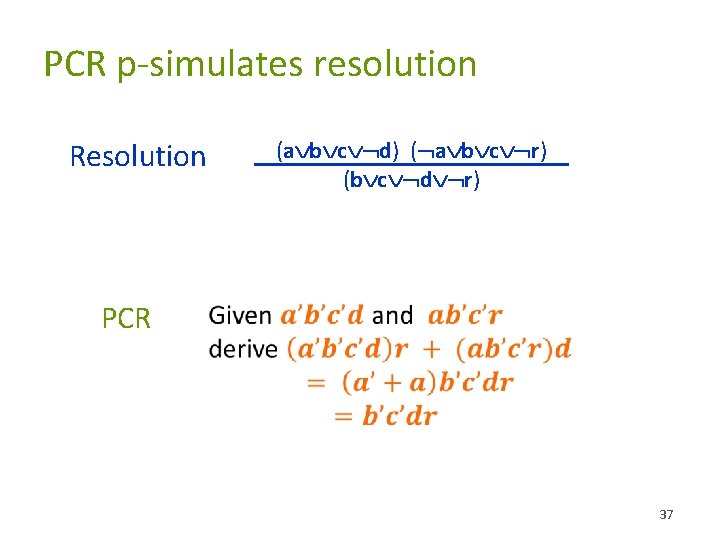
PCR p-simulates resolution Resolution PCR (a b c d) ( a b c r) (b c d r) � 37
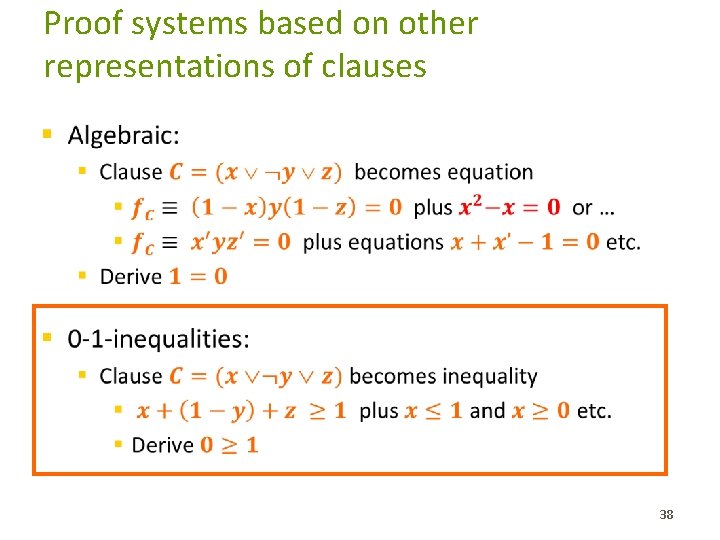
Proof systems based on other representations of clauses § 38
![Cutting Planes [Gomory 59, Chvatal 73]: § addition: a 1 x 1 +. .](http://slidetodoc.com/presentation_image_h2/f4575e7ce1f43f79c290a3d4eb6d8ab7/image-39.jpg "Cutting Planes [Gomory 59, Chvatal 73]: § addition: a 1 x 1 +. .")
Cutting Planes [Gomory 59, Chvatal 73]: § addition: a 1 x 1 +. . . + a nxn A b 1 x 1 +. . . + b nxn B (a 1+b 1)x 1+. . . +(a n+bn)xn A+B § multiplication by positive integer: a 1 x 1 +. . . + a nxn A ca 1 x 1 +. . . + ca nxn c. A § Division by positive integer: ca 1 x 1 +. . . + ca nxn B a 1 x 1 +. . . + a nxn B/c 39
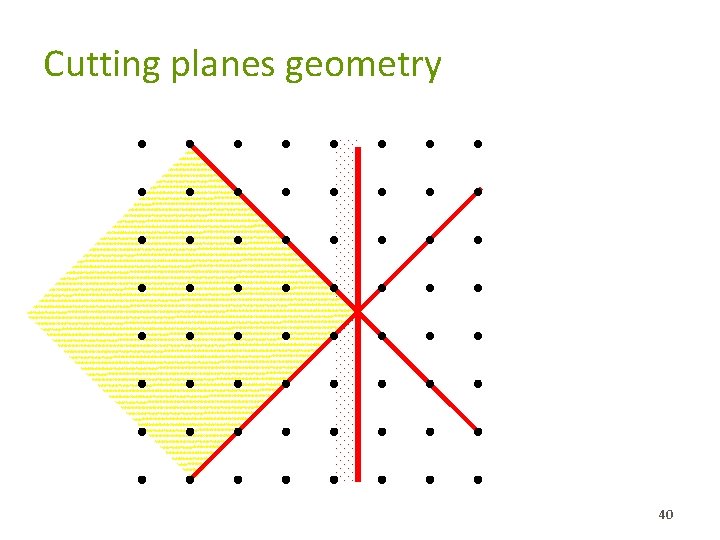
Cutting planes geometry 40
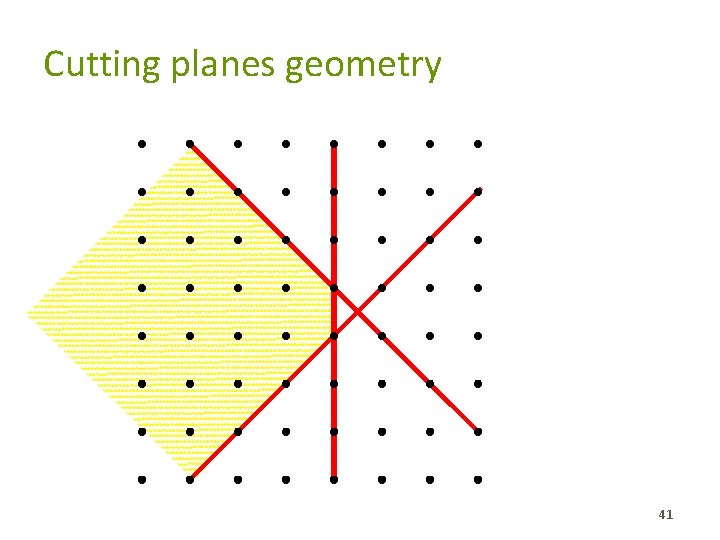
Cutting planes geometry 41
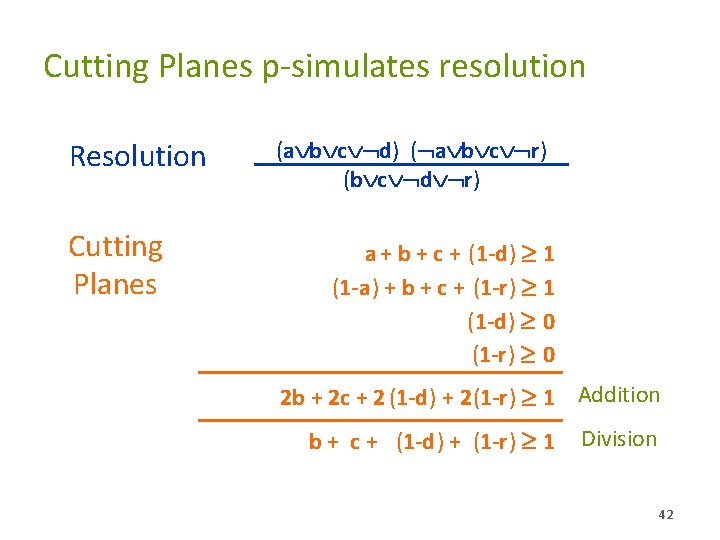
Cutting Planes p-simulates resolution Resolution Cutting Planes (a b c d) ( a b c r) (b c d r) a + b + c + (1 -d) 1 (1 -a) + b + c + (1 -r) 1 (1 -d) 0 (1 -r) 0 2 b + 2 c + 2 (1 -d) + 2(1 -r) 1 Addition b + c + (1 -d) + (1 -r) 1 Division 42
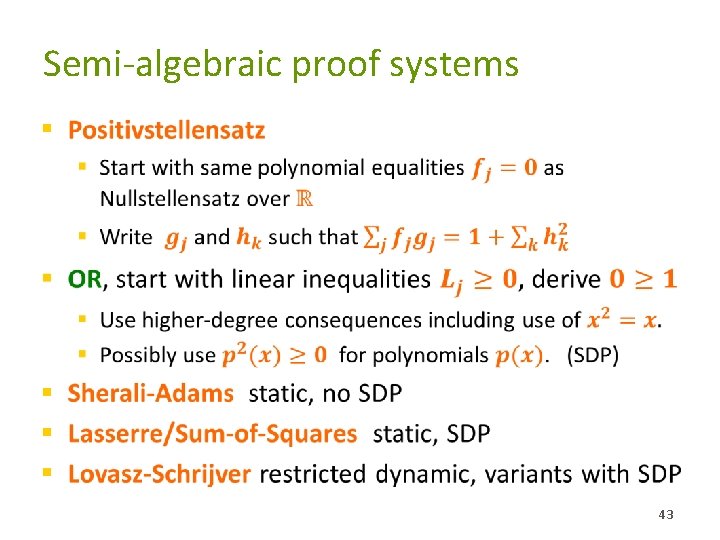
Semi-algebraic proof systems § 43
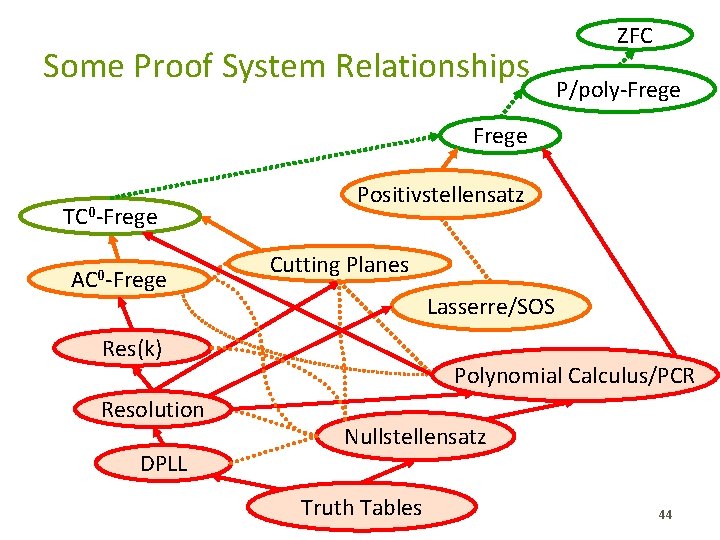
Some Proof System Relationships ZFC P/poly-Frege TC 0 -Frege AC 0 -Frege Positivstellensatz Cutting Planes Lasserre/SOS Res(k) Resolution DPLL Polynomial Calculus/PCR Nullstellensatz Truth Tables 44
Why all these proof systems? § Proof systems formalize different types of reasoning § Why even include the weaker systems within a given type of reasoning? § many weaker proof systems have better associated proof search strategies, e. g. DPLL, Polynomial Calculus. § Natural correspondence with circuit complexity classes § analyze systems working upwards in proof strength to gain insight for techniques § Some proof systems correspond to our best algorithms for NP-hard optimization problems § e. g. semi-definite programming and Lasserre/SOS 45
Lower Bound Methods 46
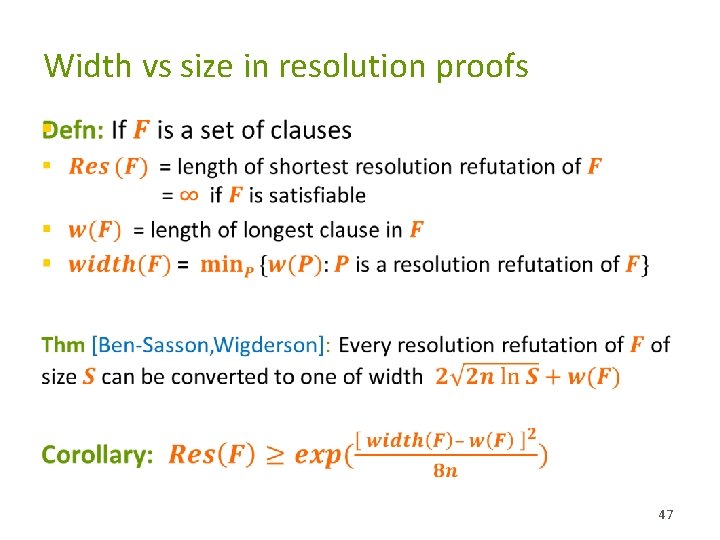
Width vs size in resolution proofs § 47
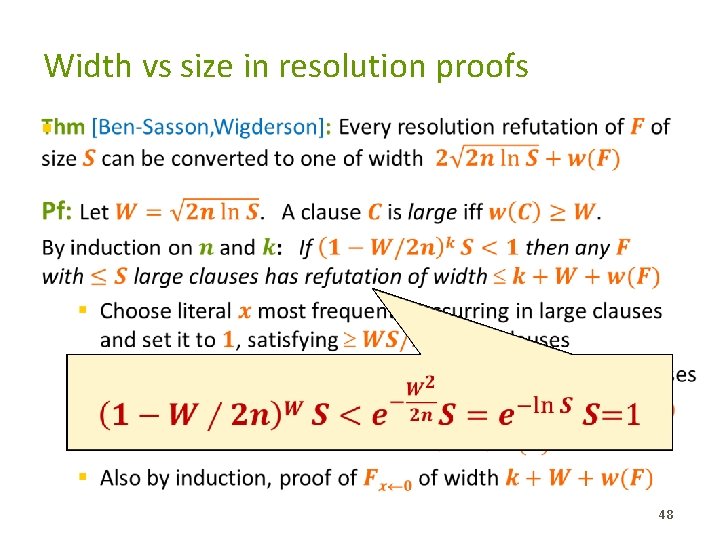
Width vs size in resolution proofs § � 48
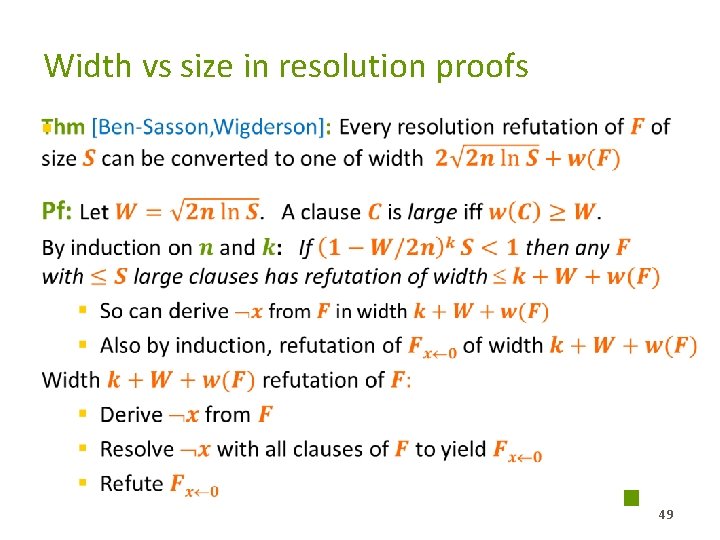
Width vs size in resolution proofs § 49
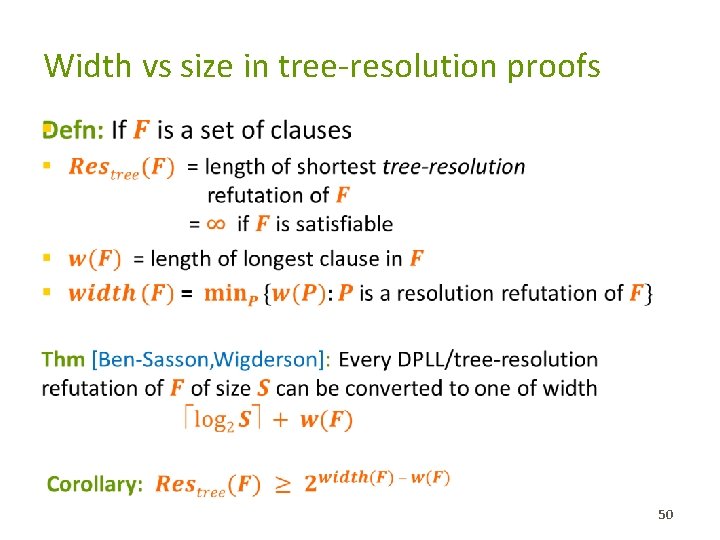
Width vs size in tree-resolution proofs § 50
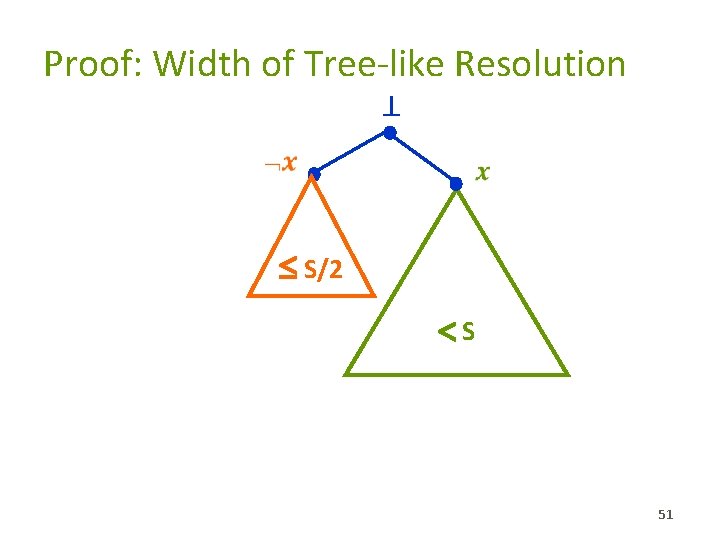
Proof: Width of Tree-like Resolution ⊥ � � S/2 S 51
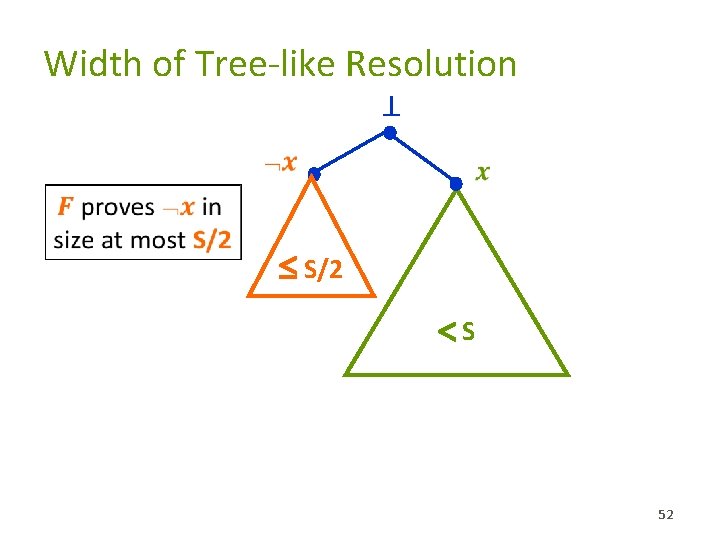
Width of Tree-like Resolution ⊥ � � � S/2 S 52
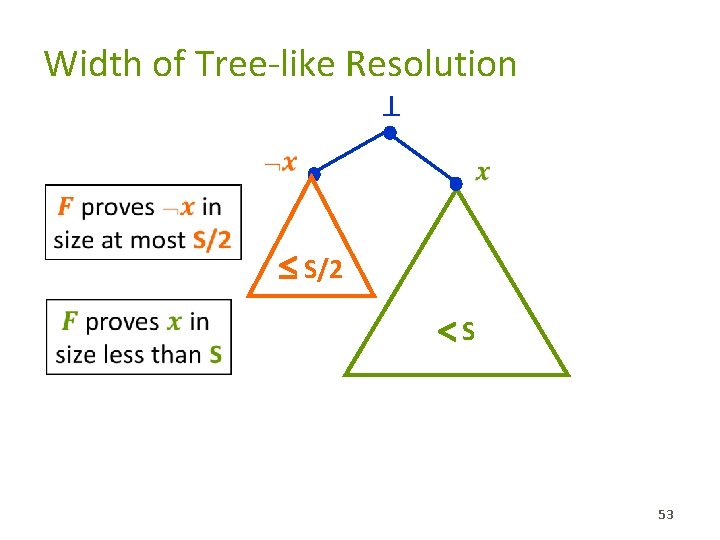
Width of Tree-like Resolution ⊥ � � � S/2 � S 53
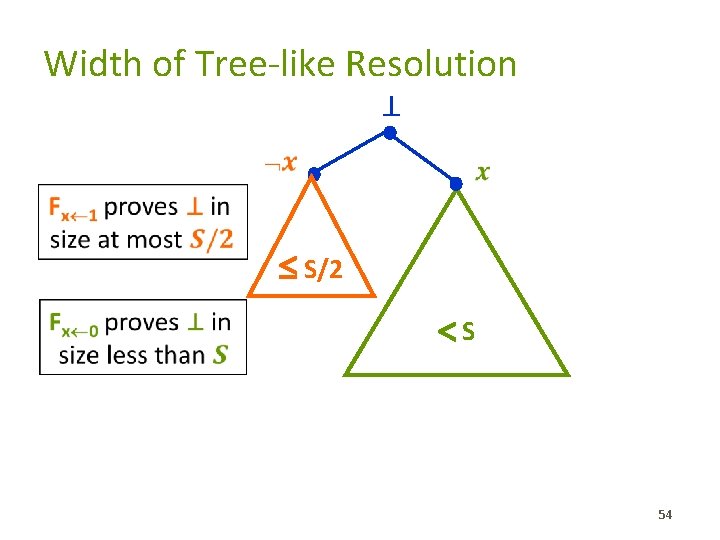
Width of Tree-like Resolution ⊥ � � � S/2 � S 54
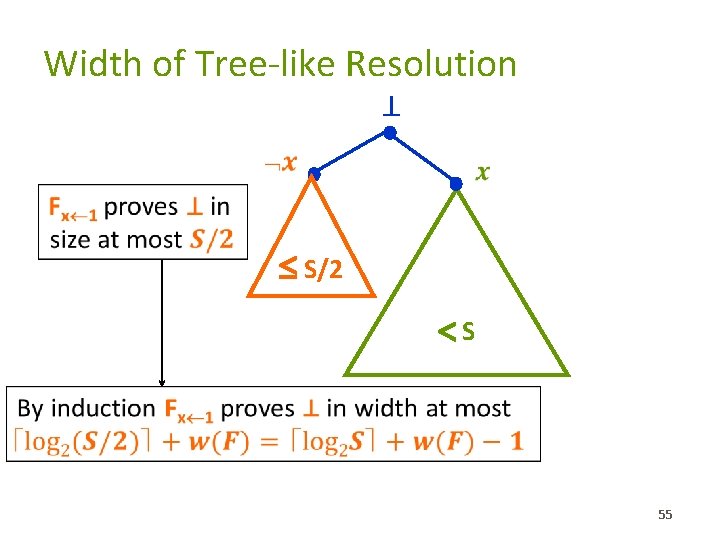
Width of Tree-like Resolution ⊥ � � � S/2 S � 55
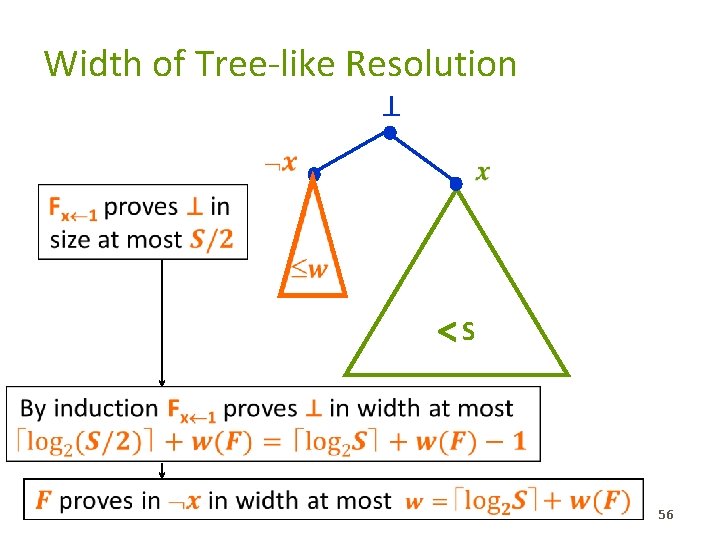
Width of Tree-like Resolution ⊥ � � S � � 56
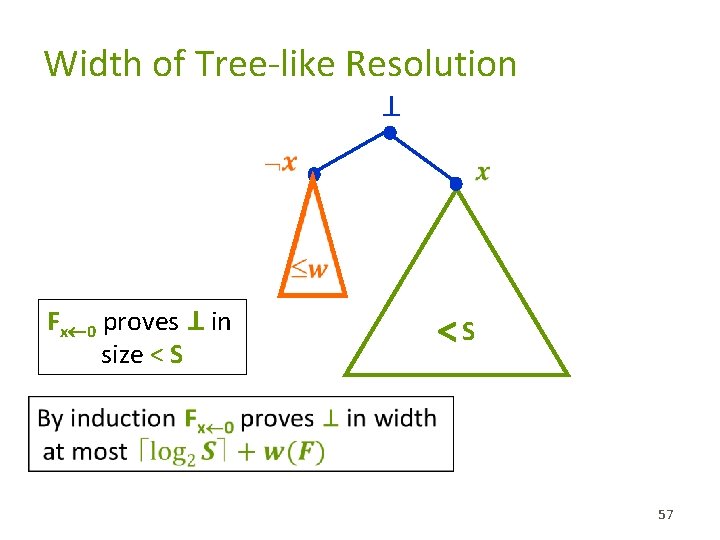
Width of Tree-like Resolution ⊥ � � � Fx 0 proves ⊥ in size < S S � 57
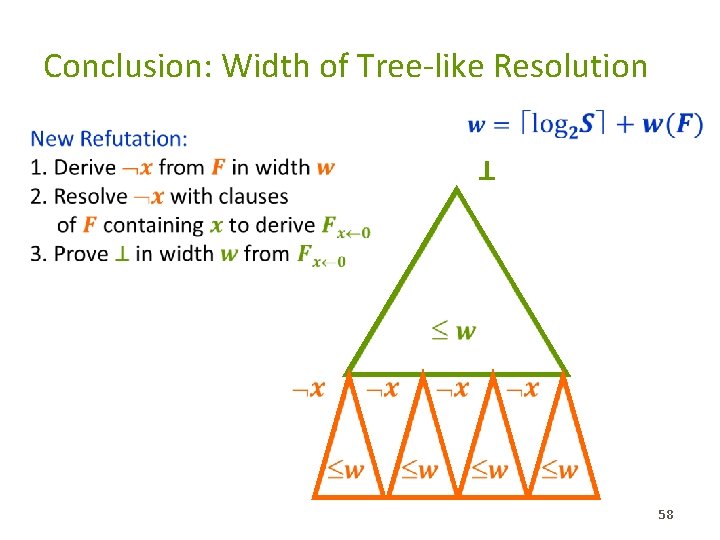
Conclusion: Width of Tree-like Resolution � � ⊥ � � � � � 58
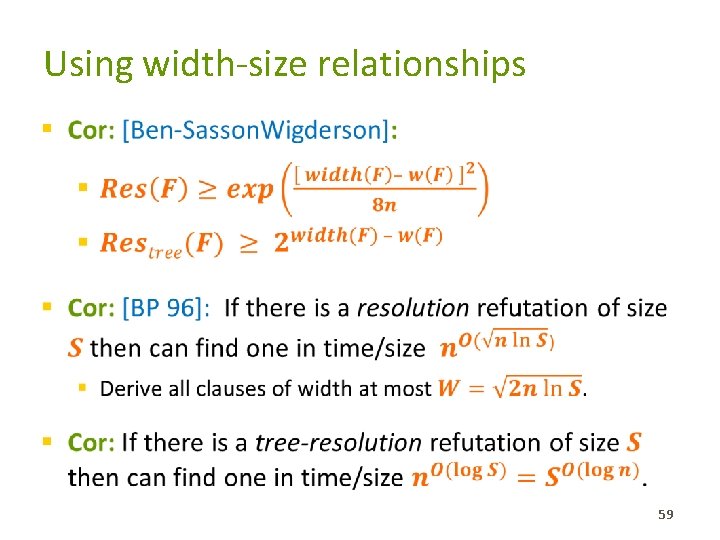
Using width-size relationships § 59
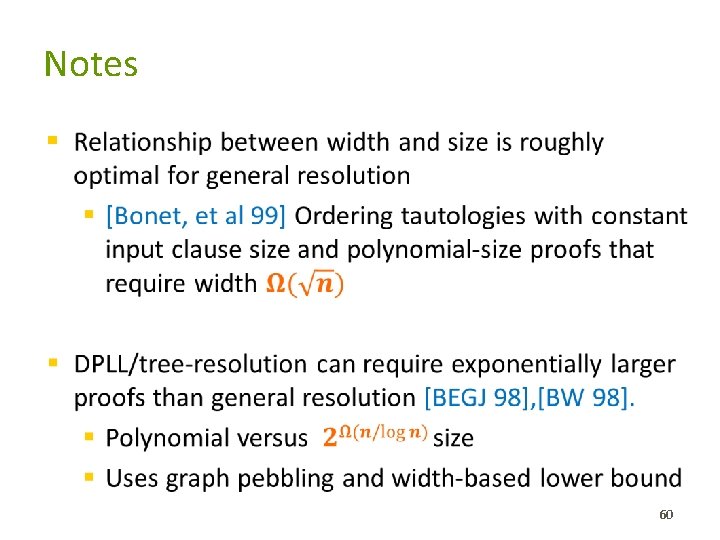
Notes § 60
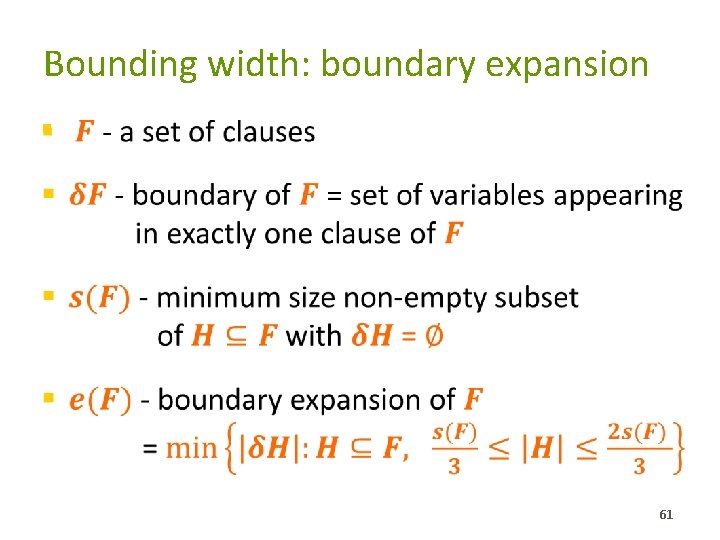
Bounding width: boundary expansion § 61
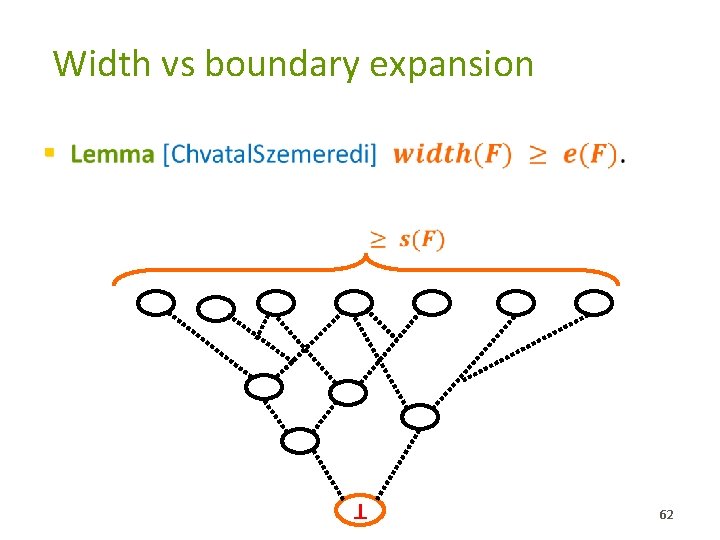
Width vs boundary expansion § � ⊥ 62
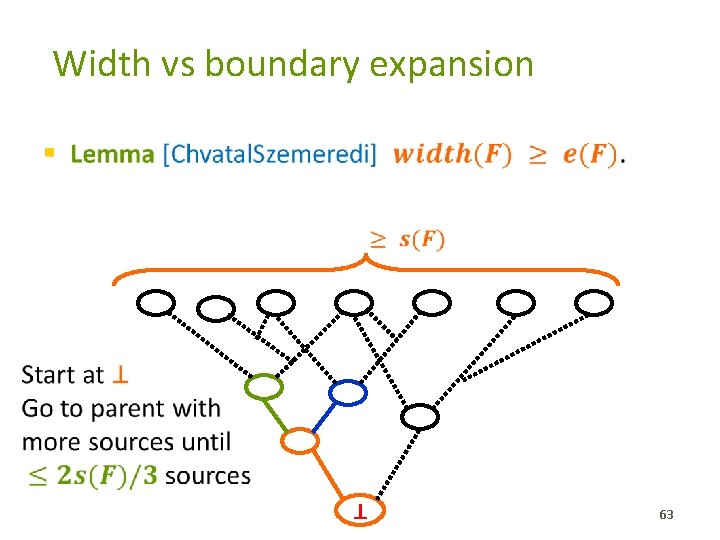
Width vs boundary expansion § � � ⊥ 63
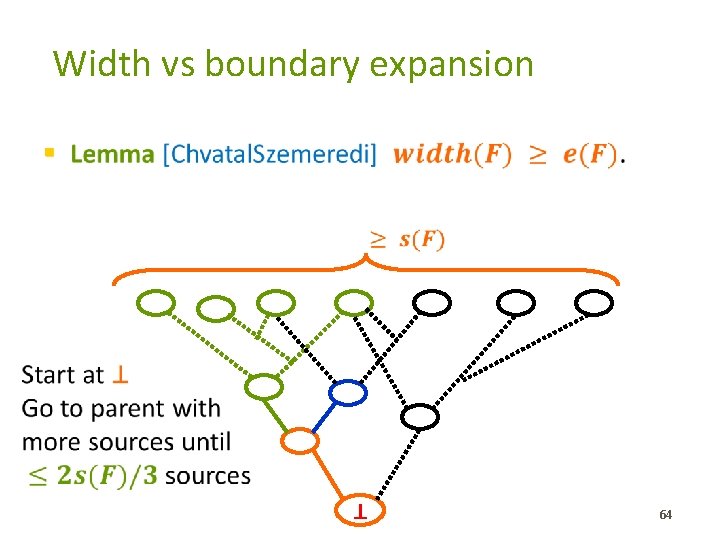
Width vs boundary expansion § � � ⊥ 64
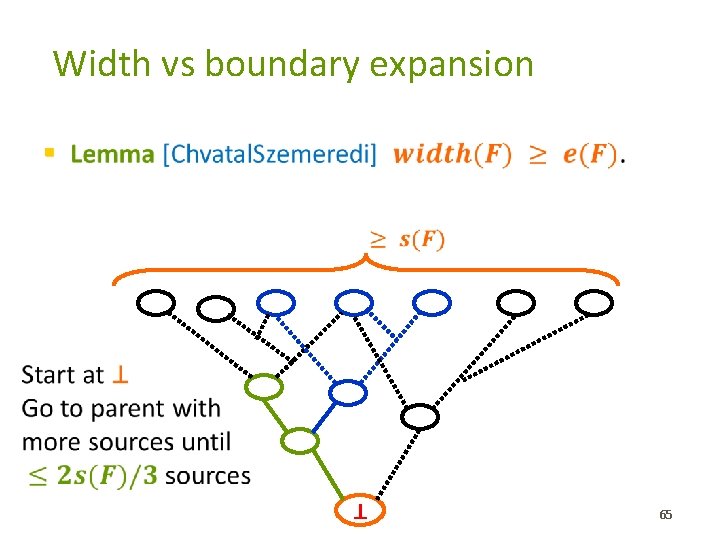
Width vs boundary expansion § � � ⊥ 65
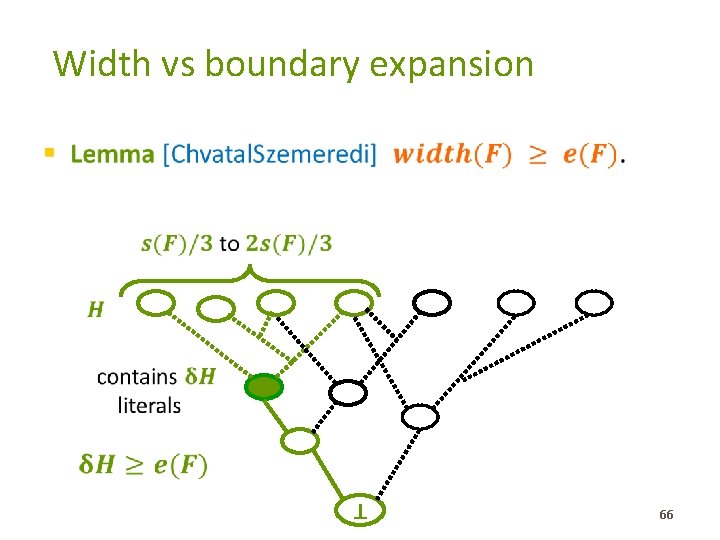
Width vs boundary expansion § � � ⊥ 66
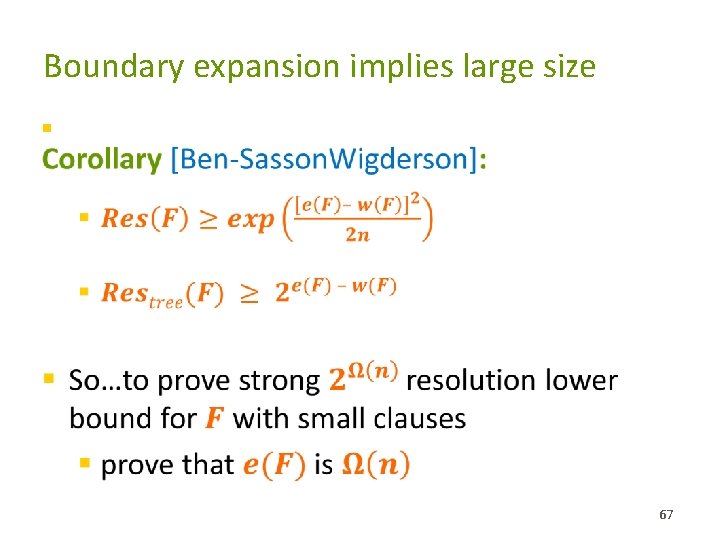
Boundary expansion implies large size § 67
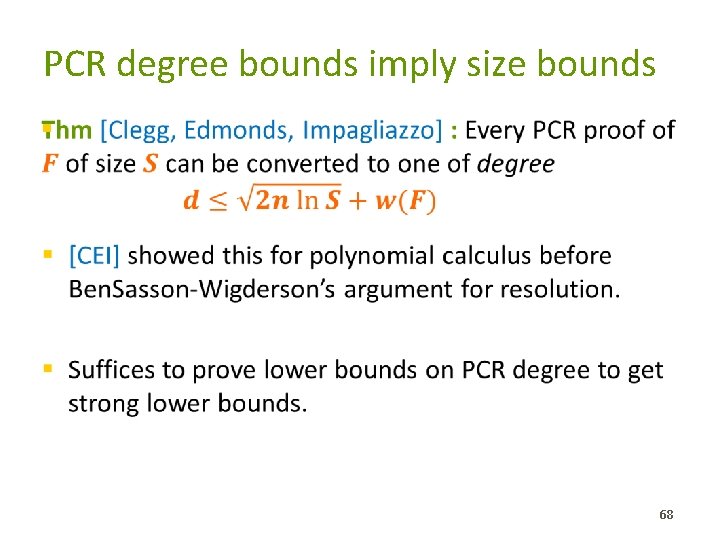
PCR degree bounds imply size bounds § 68
Hard examples 69
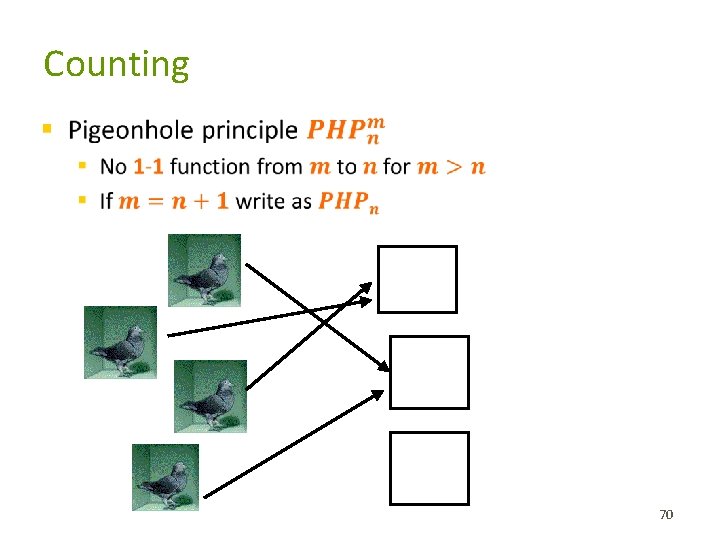
Counting § 70
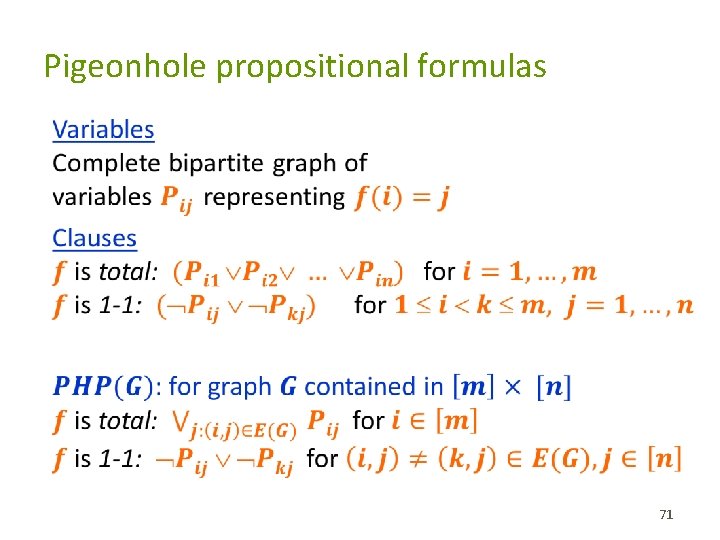
Pigeonhole propositional formulas � � � 71
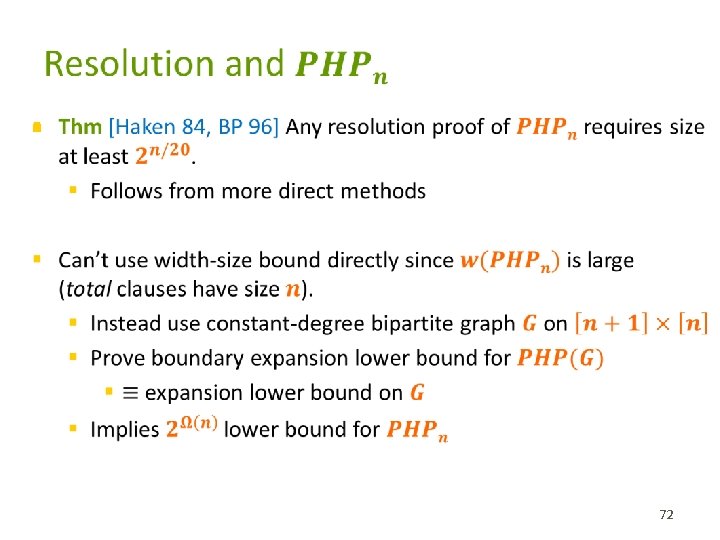
§ 72
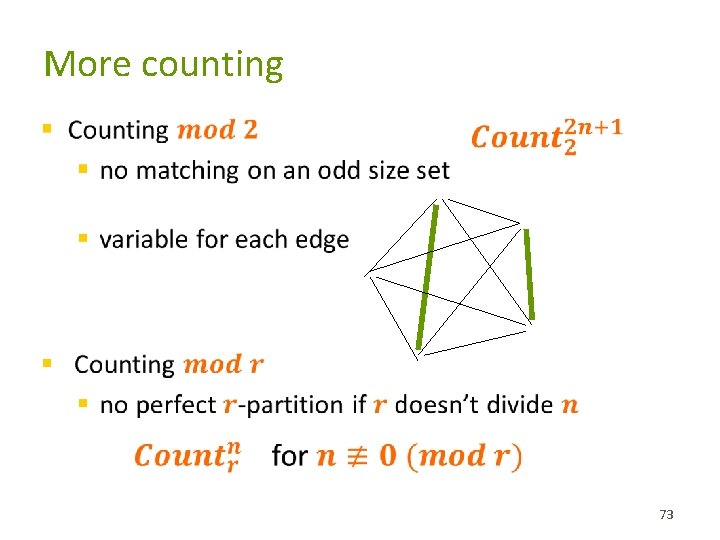
More counting § � � 73
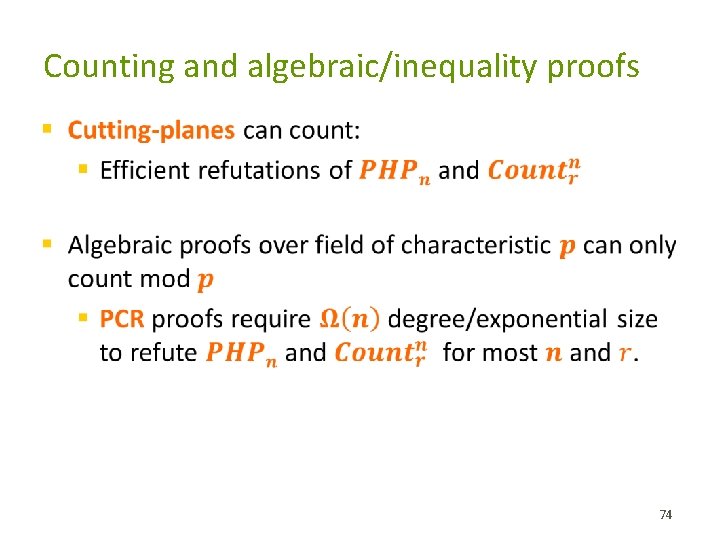
Counting and algebraic/inequality proofs § 74
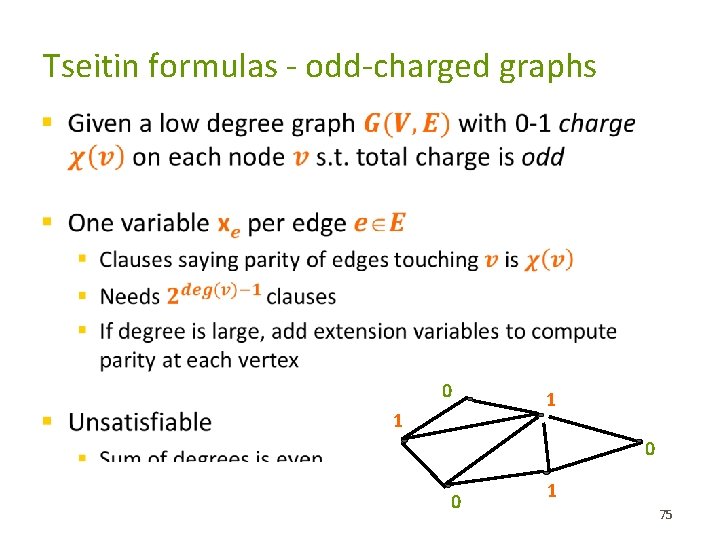
Tseitin formulas - odd-charged graphs § 0 1 1 0 0 1 75
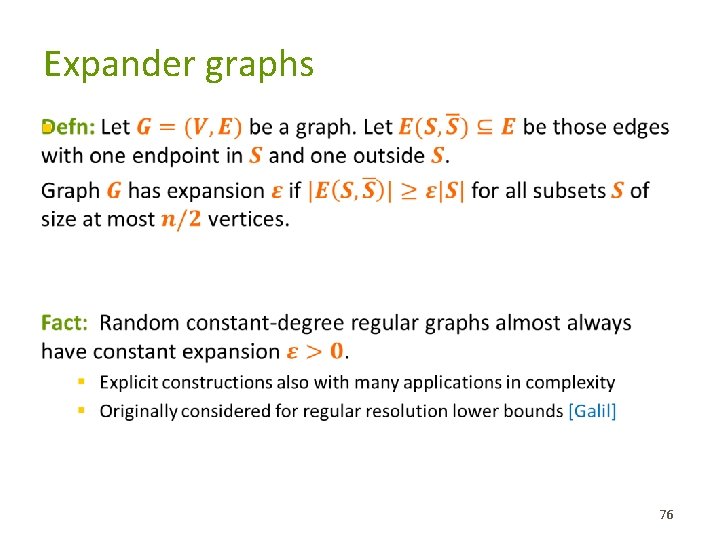
Expander graphs § 76
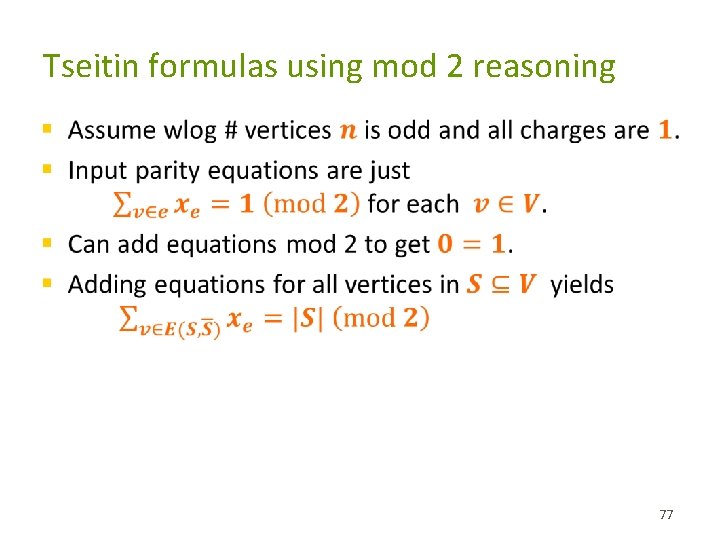
Tseitin formulas using mod 2 reasoning § 77
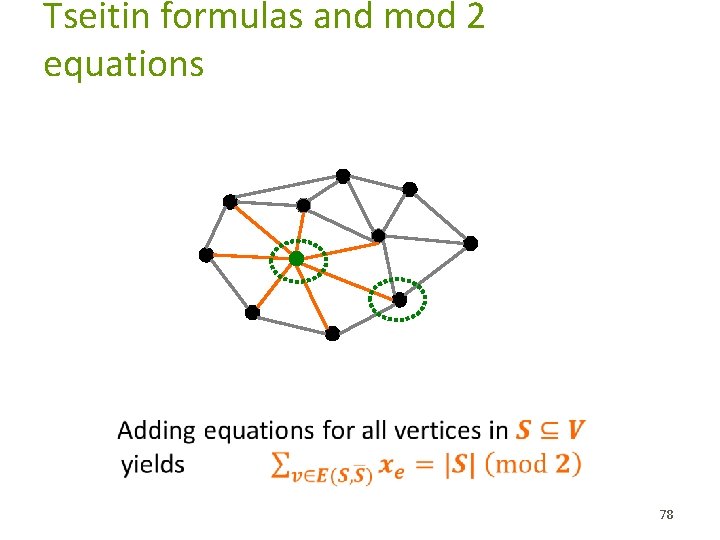
Tseitin formulas and mod 2 equations � 78
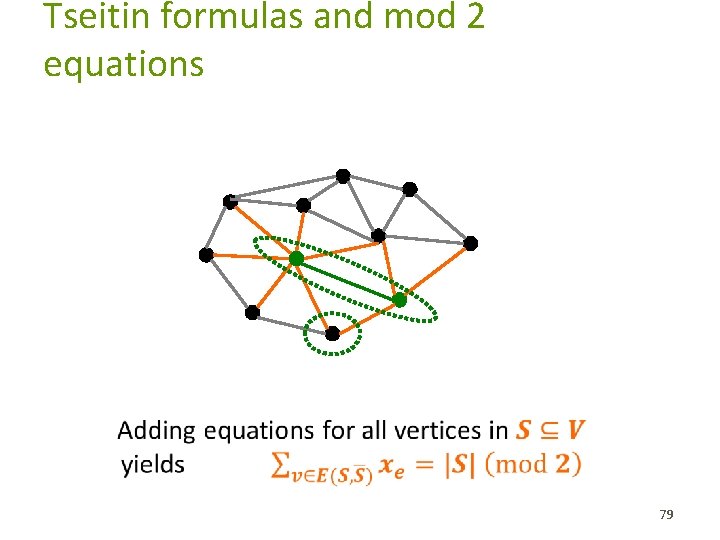
Tseitin formulas and mod 2 equations � 79
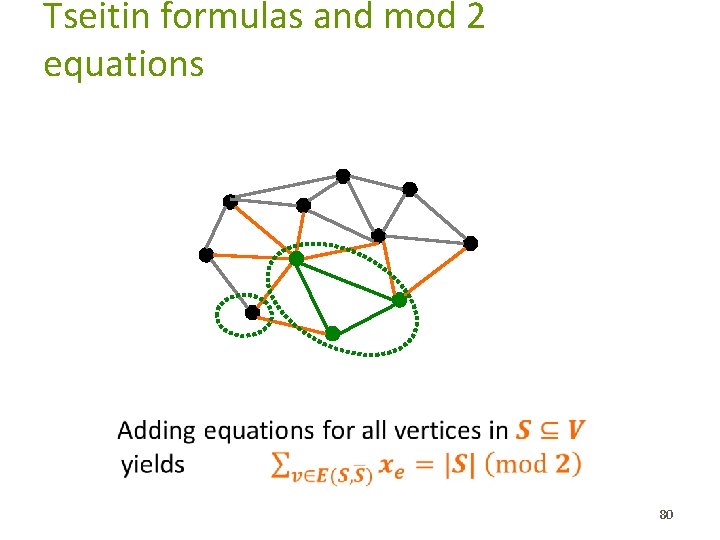
Tseitin formulas and mod 2 equations � 80
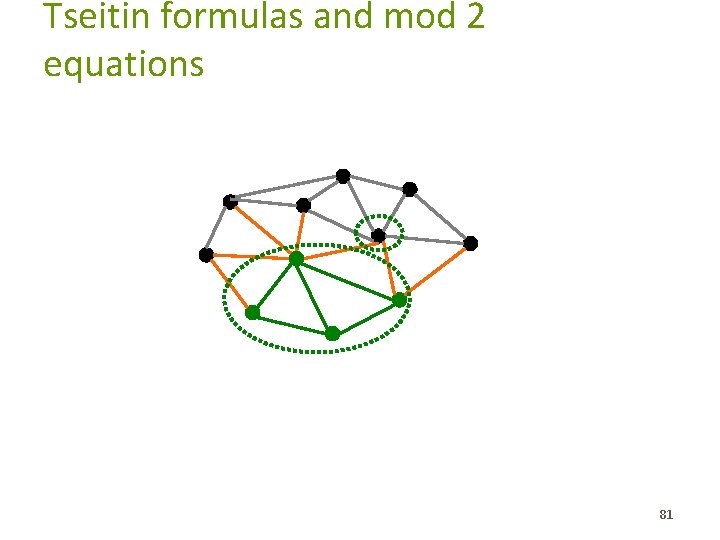
Tseitin formulas and mod 2 equations 81
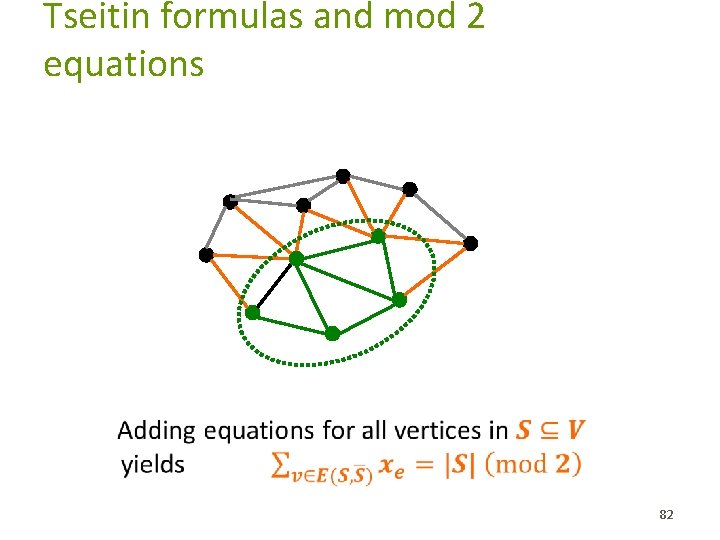
Tseitin formulas and mod 2 equations � 82
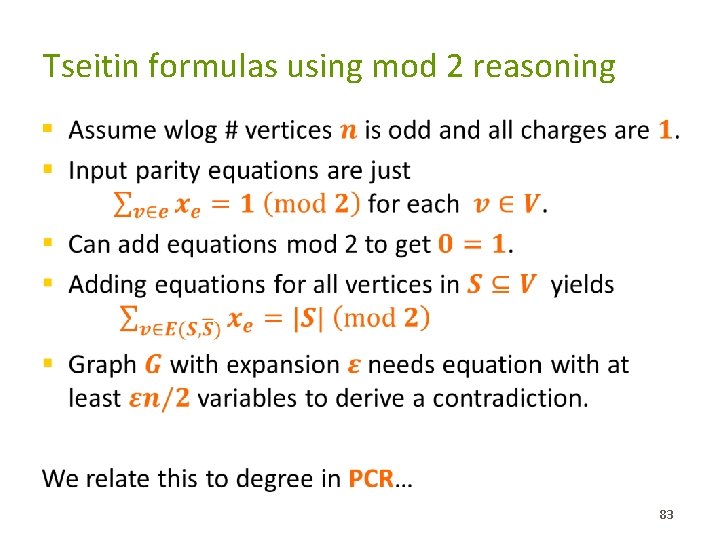
Tseitin formulas using mod 2 reasoning § 83
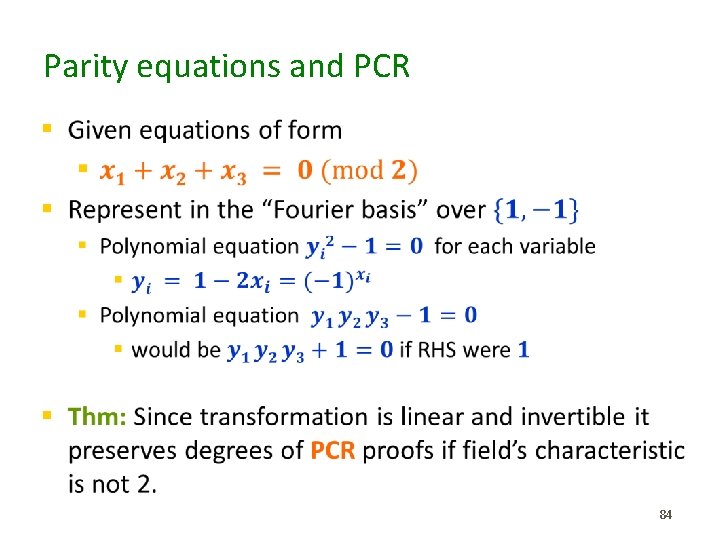
Parity equations and PCR § 84
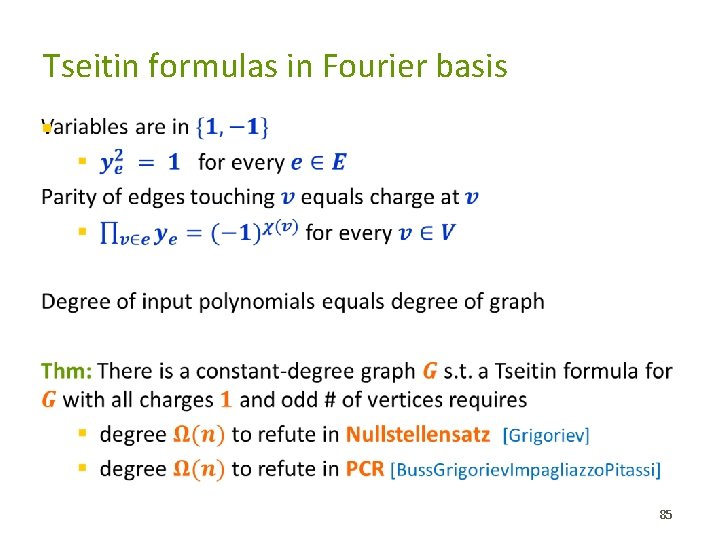
Tseitin formulas in Fourier basis § 85
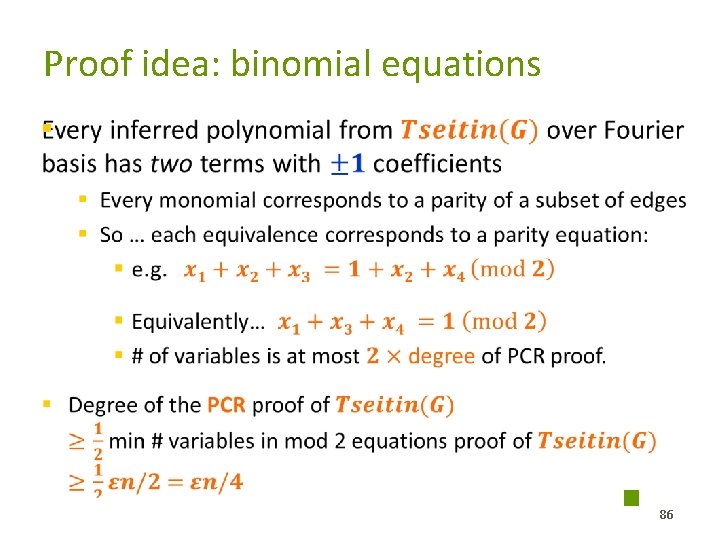
Proof idea: binomial equations § 86
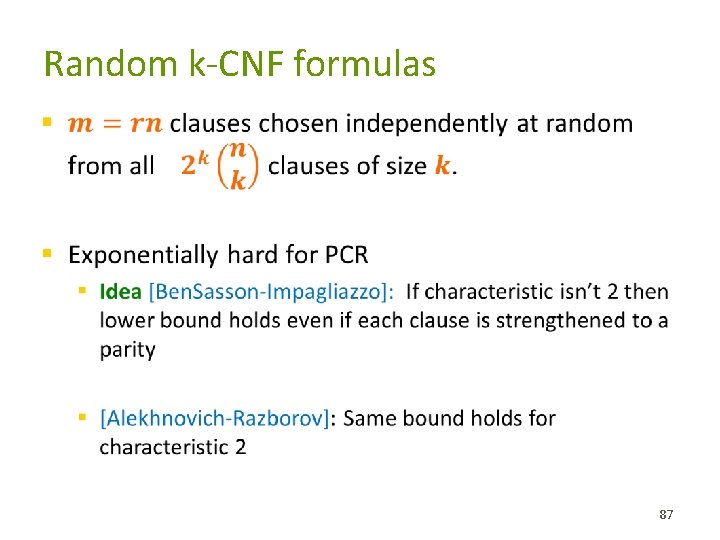
Random k-CNF formulas § 87
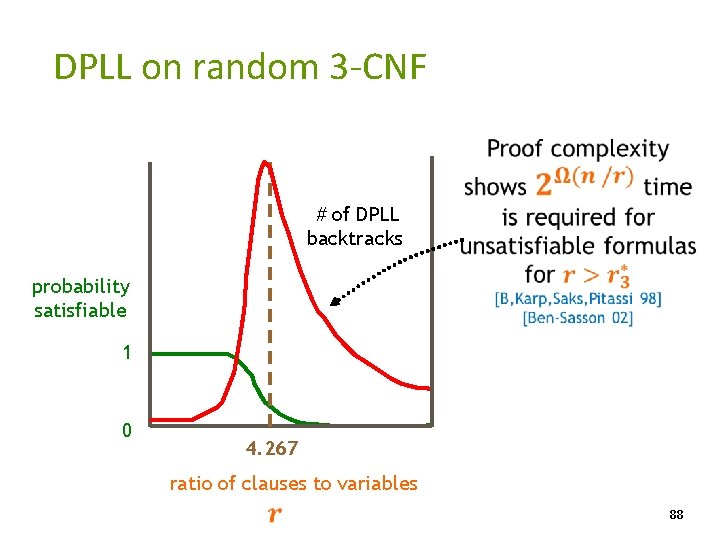
DPLL on random 3 -CNF � # of DPLL backtracks probability satisfiable 1 0 4. 267 ratio of clauses to variables � 88
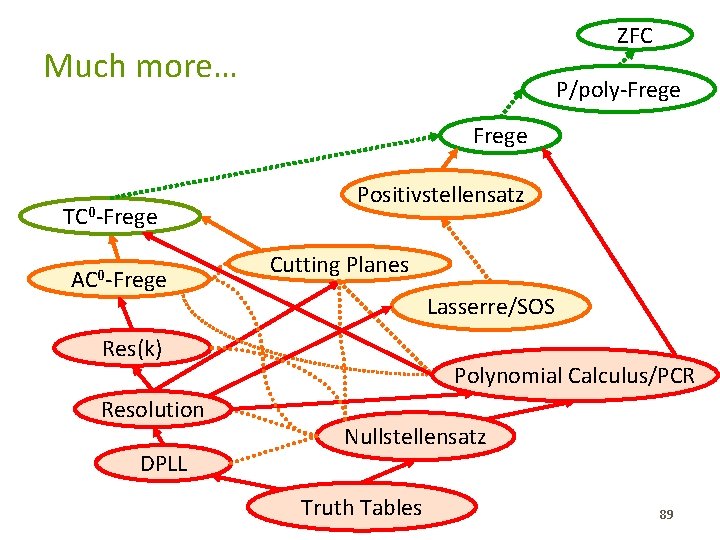
ZFC Much more… P/poly-Frege TC 0 -Frege AC 0 -Frege Positivstellensatz Cutting Planes Lasserre/SOS Res(k) Resolution DPLL Polynomial Calculus/PCR Nullstellensatz Truth Tables 89
Thanks for listening! Questions…? 90
- Slides: 90