
A Turn to Engineering Curriculum Change in Technology
- Slides: 51
A Turn to Engineering –Curriculum Change in Technology Education in the United States By Theodore Lewis Professor Department of Work and Human Resource Education University of Minnesota
Technology Education in the U. S. is looking to Engineering as Content Base n The impetus for change comes from both communities—Engineering & Tech Ed n Engineer Shortages & Engineering Curriculum reform as impetus for the interest of engineering n Status enhancement as impetus for the Technology Education community
Objectives n n Characterize the dynamics of the nascent engineering movement in the US Examine reasons why there is now healthy rapprochement between the technology education, Science, and Engineering Communities Discuss important engineering initiatives Discuss challenges inherent in the shift to engineering design
Future. Work: Engineer Shortage Looms The United States faces a crisis in engineering — the nucleus of many vital industries — that menaces its economic future. Pacific Rim nations are graduating great numbers of engineers and threatening to seize the mantle of industrial innovation that was pivotal to making the U. S. economy globally dominant. Last year, foreign nationals completed almost 60 percent of American engineering doctorates
Ad for an upcoming event in Minnesota n The Minnesota High Technology Association (MHTA) is partnering with the University of St. Thomas School of Engineering to co-present "Engineering, Minnesota's Future, " an event featuring Dr. William Wulf, President of the National Academy of Engineering. Dr. Wulf's speech, The Imperative for Educating More Scientists and Engineers in the U. S. will provide his insights and roadmap for sustaining our competitive edge.
On shortfall in engineering production n Engineering Trends did an exhaustive study and determined that the United States ranked 16 th per capita in the number of doctoral graduates and 25 th in engineering undergraduates per million citizens.
Recommendation from Educating the Engineer of 2020 n Whatever other creative approaches are taken in the four-year engineering curriculum, the essence of engineering – the iterative process of designing, predicting performance, building, and testing – should be taught from the earliest stages of the curriculum, including the first year.
Recommendation from Educating the Engineer of 2020 n Engineering schools should lend their energies to a national effort to improve math, science, and engineering education at the K -12 level.
Recommendation from Educating the Engineer of 2020 n The engineering education establishment must participate in a coordinated national effort to promote public understanding of engineering and technological literacy of the public.
Technology Education’s struggle for curricular status n n n A history of existence at the margins of the curriculum Name change historically a status enhancing mechanism Manual training to Manual arts to Industrial arts to technology New stirrings for a change from technology to engineering
Association with the science and engineering establishment a new status enhancing strategy n Fruitful connections with the American Association for the Advancement of Science (AAAS) through Project 2061—(Technology in the K-12 science standards) n Fruitful connections with the NSF (Numerous grants, including funding of Standards for Technological Literacy)
Evidence of interest among the engineering community n Institute of Electrical and Electronics Engineers. (2000). Technological Literacy Counts. Proceedings of a Workshop, Baltimore, Maryland, October 9 -10, 1998. n Pearson, G. & Young, A. T. (2002). Technically Speaking: Why All Americans Need to Know About Technology. Washington DC: National Academy Press.
Special Connection with the National Science Foundation n Rotating Visiting Program Officer’s position established by the NSF for technology education (typically one or two years of residency).
Endorsement of Standards for Technological Literacy n The Foreword of the Standards for Technological Literacy was written by William Wulf, President of the National Academy of Engineering
Why are the science and engineering communities interested in Technology Education? Design in the science standards (the eggdrop problem) n Wulf validating the STL ---------n The answer is they see in us an untapped solution to problems of their fields n They see the mousetrap cars and rockets n
Technology education is cool n Technology education is the only place in the curriculum where children (of both genders) can rehearse creatively inspired inventive action n Super-mileage vehicles, robots, jigs and fixtures, disassembling small engines, creating CAD blueprints
Four Conceptions of Engineering as Content n n Career academy model Magnet school model Regular model Movement model
Conceptions explained n n Career academies--combine a college preparatory curriculum with a career theme Magnet Schools—(Special district schools) Also thematic—e. g. Technology/Engineering/Computers Regular—Increasing focus on design in the regular Tech-ed classroom Movement—Project Lead The Way
Project Lead the Way- An endowed preengineering curriculum program n High school program Foundation Courses: Principles Of Engineering , Introduction to Engineering Design, Digital Electronics Specialization Courses: Computer Integrated Manufacturing, Biotechnical Engineering, Civil Engineering and Architectural, Aerospace Engineering
Project Lead The Way n n n An Endowed Program Aim is to create an engineering “pipeline” Can be found in most states Funds programs in schools Conducts its own teacher in-service programs Works with some existing technology teacher -education programs
Project Lead the Way—The middle grades A four course sequence n Gateway to technology (Includes design and modeling) n The Magic of electrons n The science of technology n Automation and robotics
The National Center for Engineering and Technology Education n An NSF-Funded consortium of nine universities n Goal and Approach The ultimate goal of NCETE is to infuse engineering content and design, problem solving, and analytical skills into technology education to increase the quality, quantity, and diversity of engineering and technology educators. NCETE will increase the number and diversity of students who select engineering, science, mathematics and technology careers.
NCETE Partners n n Doctoral Partners University of Georgia University of Illinois University of Minnesota Utah State University Technology Teacher Education Partners n n n Brigham Young University California State University, Los Angeles Illinois State University North Carolina A&T State University of Wisconsin-Stout School District Partners
NCETE intended impact n Impact NCETE will: Increase the number of doctoral-level professionals and improve the national capability to conduct research in emerging engineering and technology areas. Renew the cadre of national leaders in engineering and technology by supporting 20 Ph. D and 50 MS students. Conduct research, with the help of doctoral-level partners, that improves the understanding of teaching and learning engineering and technology subjects.
Intended Impact Cont’d n Prepare over 250 new technology education teachers. Conduct teacher professional development workshops in over 10 school district across the country, providing 120 hours of in-service education to over 150 teachers. Revitalize engineering and technology education and prepare a diverse instructional workforce. Infuse the curriculum with engineering content through teachers in grades 9 -12
NCETE logic n n n At each site, technology education faculty must collaborate with engineering faculty Each Research university must train 5 Ph. Ds Each Teaching University must conduct model in-service activities with school district partners, based on engineering design.
Core doctoral courses (Offered on-line) n n Cognition Design thinking in engineering and technology education Engineering design problems across the spectrum of engineering disciplines. Applying engineering principles to successful design solutions.
NCETE debate over the approach to teaching design Two camps: n. Design as a rational endeavor n. Design as a creative endeavor A key issue here is what role should mathematics play in the teaching and learning of engineering design.
Problem with the rational model n The rational model says its not engineering unless we arrive at an equation that predicts physical phenomena n The model ignores the human inventive impulse that got us the wheel, ball bearings, the Viking ships, and the telescope.
The challenge of turning to engineering n n How should design teaching be approached? What set of competencies should the technology education teacher now possess? The question of professional development for practicing teachers Absence of good prototypic models of design teaching in action
Other challenges n n Stereotypic ways of teaching problem solving Context-independent approaches to design that leave open the question “what have children learned? ”
Need for pedagogies of engineering suitable for K-12 n A design problem--How can engineering be made fun for children and adolescents? q q Ground it in the everyday Have an inventive component (how do we catch that squirrel? )
New pedagogies should put creativity and invention first n n n Engage children in fun projects, such as sending up rockets, building mousetrap vehicles. Encourage them to find or pose problems Introduce the mathematics and science just in time.
Nature of Engineering Design n n n Has both creative and rational dimensions Engineers work under conditions of change, uncertainty and resource constraints Reliance on heuristic rather than scientific laws Role of trade-offs Role of failure as a design consideration Process is iterative—not linear
Is design analytic problem solving? n n n This question recognizes an ontology in which the design process is divided into two related phases: (a) Conceptual design …open-ended, searching for solution schemes… (b) Analytic design …stage that examines the technical merits of the solution concept.
Creativity as Framework for Engineering Design n Expert designers can be a source of knowledge about design, including the conditions under which creative design is best yielded (e. g. conception of flow— Csiksentmihalyi, 1996) n We do not know enough about creativity development in children, or about the conditions under which it is best nurtured.
Is engineering design creative problem solving? n Yes, but not always. 1. Freezing soil in the great Boston dig, an example of engineering as creative problem solving. Sizing steam-pipes in the power plant is not as creative, but the sums must be correct. 2.
Creative cognition and the teaching of engineering design Generative abilities need to be nurtured in the technology education classroom through cognitive processes such as n q q Metaphorical thinking— ‘the internet as information highway” Analogical thinking—Tactical. . e. g. Parallelism between fluid and electric current flow
Generative processes cont’d n Combinatorial creation—Design in which two or more entities are combined to yield a third n Divergent thinking—yields a variety of solutions, composed of: Fluency originality Flexibility Elaboration (Guilford, 1967).
Productive thinking (Duncker, 1945) n The act of design/problem solving involves reformulating the problem more productively —such as separating out peripheral from core features n Avoiding functional fixedness
Role of cognition and creativity n New engineering design pedagogies should be based upon what cognition and creativity theory and research tell us about children and adolescents. n Maley excluded, we have had no tradition of interest in the disposition of children
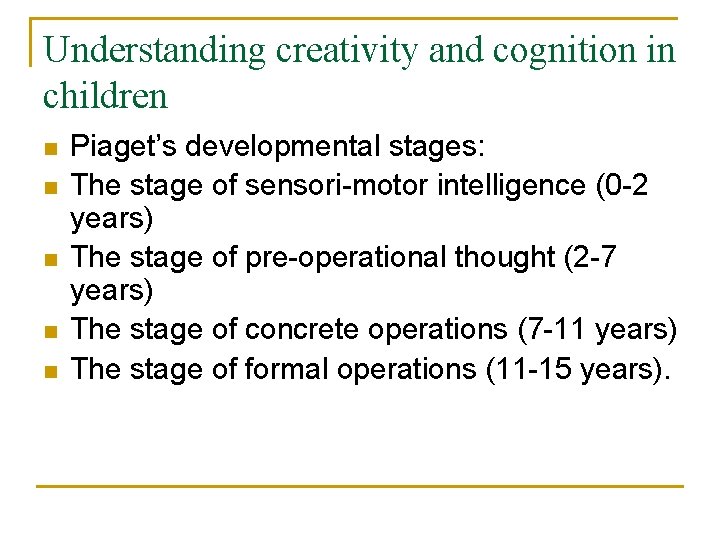
Understanding creativity and cognition in children n n Piaget’s developmental stages: The stage of sensori-motor intelligence (0 -2 years) The stage of pre-operational thought (2 -7 years) The stage of concrete operations (7 -11 years) The stage of formal operations (11 -15 years).
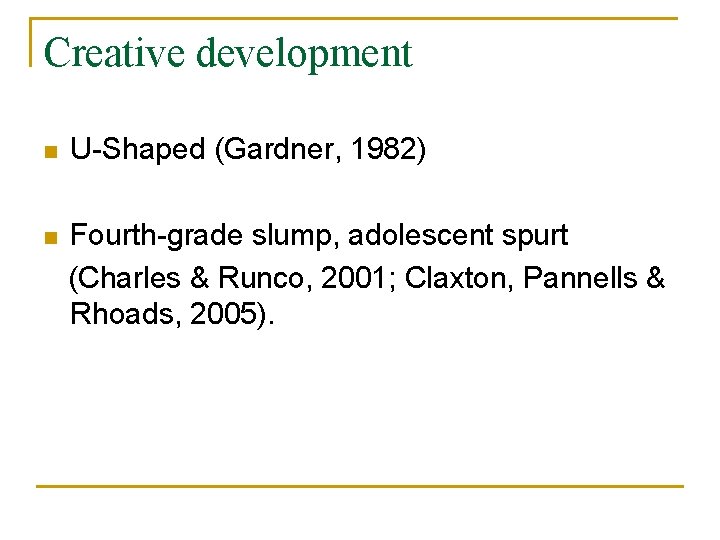
Creative development n U-Shaped (Gardner, 1982) n Fourth-grade slump, adolescent spurt (Charles & Runco, 2001; Claxton, Pannells & Rhoads, 2005).
To what extent can engineering be taught in technology education classrooms? n n This is central, and made complicated if we specify in the design brief that we mean K-12. Challenge is to arrive at a conception of engineering that is not filtered by the universities.
Immersion in conceptual design n We can teach engineering in technology education classrooms by immersing children and adolescents in real problems and having them rehearse conceptual design.
Analytic design n We should work out ways, including collaboration with mathematics colleagues, to extend our range to analytic design.
On the conceptual/Analytic boundary n The boundary between conceptual and analytic design might constitute a limit for technology education, but that is a boundary over which we can engage in healthy dispute.
Implications of the turn to engineering n Question of boundary limits—How authentically can technology education interpret engineering design?
Name change in a few states n n Utah, Wisconsin and Massachusetts are states that now call the subject engineering design These changes are consequential--they are suggestive of what is to come.
Research needs n We need studies that will help us understand how creativity and cognition connect in children and adolescents, and on what strategies we can employ to help them comprehend engineering design knowledge better. n We need to arrive at non-rational pedagogies that have greater chances of turning on girls and minorities to engineering.
NCETE and Change to Engineering We in the NCETE plan to be important drivers of the change to engineering Thank You!