
A Tragedy To Life And Property Department computer

















- Slides: 47
A Tragedy To Life And Property Department: -computer Year: -3 rd year(5 th sem) Created By: Ghanva Krishna Gides: Ankita Parmar Sapan parekh SCET(Surat)
Introduction Earthquakes constitute one of the worst natural hazards which often turn into disaster causing widespread destruction and loss to human life. The effects of earthquake vary upon the magnitude and intensity. Earthquakes occur every now and then all round the world, except in some places where earthquakes occur rarely. The devastation of cities and towns is one of the effects of earthquake.
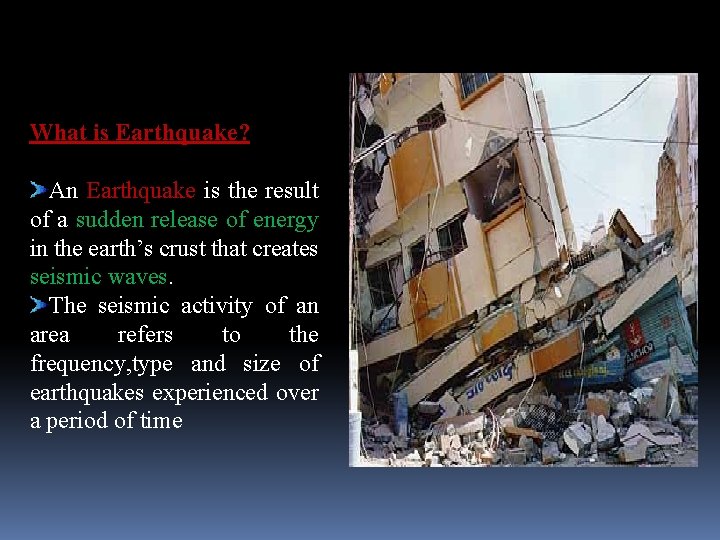
What is Earthquake? An Earthquake is the result of a sudden release of energy in the earth’s crust that creates seismic waves. The seismic activity of an area refers to the frequency, type and size of earthquakes experienced over a period of time
For example: If you throw stone in a pond of still water, series of waves are produced on the surface of water, these waves spread out in all directions from the point where the stone strikes the water. similarly, any sudden disurbances in the earth’s crust may produce vibration in the crust which travel in all direction from point of disturbances.
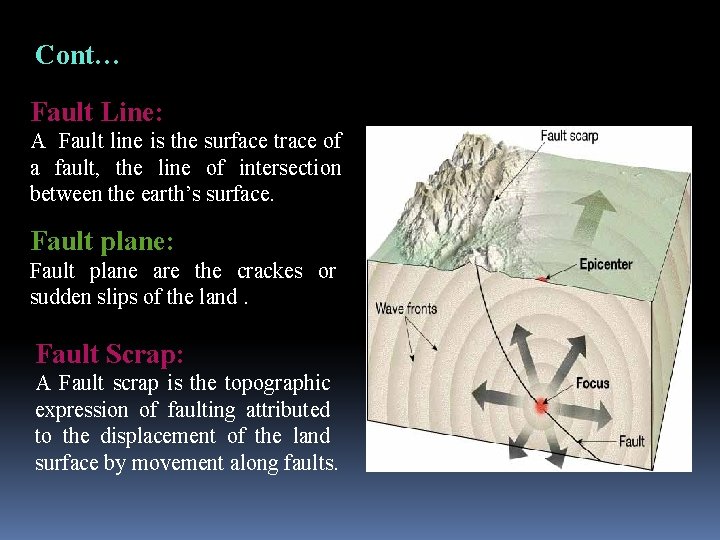
Terms Related To Earthquake Focus(Hypocenter): Focus is the point on the fault where rupture occurs and the location from which seismic waves are released. Epicenter: Epicenter is the point on the earth’s surface that is directly above the focus , the point where an earthquake or underground explosion originates.
Cont… Fault Line: A Fault line is the surface trace of a fault, the line of intersection between the earth’s surface. Fault plane: Fault plane are the crackes or sudden slips of the land. Fault Scrap: A Fault scrap is the topographic expression of faulting attributed to the displacement of the land surface by movement along faults.
Causes Of Earthquake The primary cause of an earthquake is faults on the crust of the earth. “A Fault is a break or fracture b/w two blocks of rocks in response to stress. ” q. This movement may occur rapidly, in the form of an earthquake or may occur slowly, in the form of creep. q. Earth scientists use the angle of the fault with respect to the surface (known as the dip) and the direction of slip along the fault to classify faults.
1. Thrust (reverse)fault: Classification Of Faults Normal fault: a dip-slip fault in which the block above the fault has moved downward relative to the block below. Thrust (reverse)fault: a dip-slip fault in which the upper block, above the fault plane, moves up and over the lower block.
Strike-slip fault: A left-lateral strike-slip fault : It is one on which the displacement of the far block is to the left when viewed from either side. A right-lateral strike-slip fault: s displacement of the far block is to the right when viewed from either side.
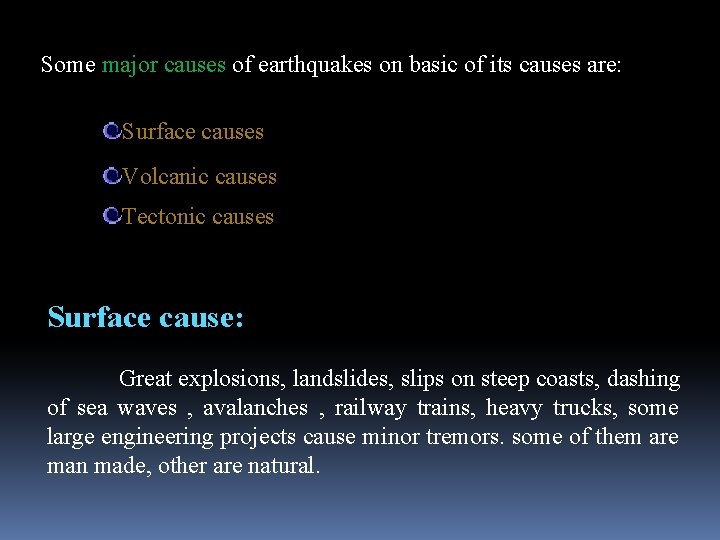
Some major causes of earthquakes on basic of its causes are: Surface causes Volcanic causes Tectonic causes Surface cause: Great explosions, landslides, slips on steep coasts, dashing of sea waves , avalanches , railway trains, heavy trucks, some large engineering projects cause minor tremors. some of them are man made, other are natural.
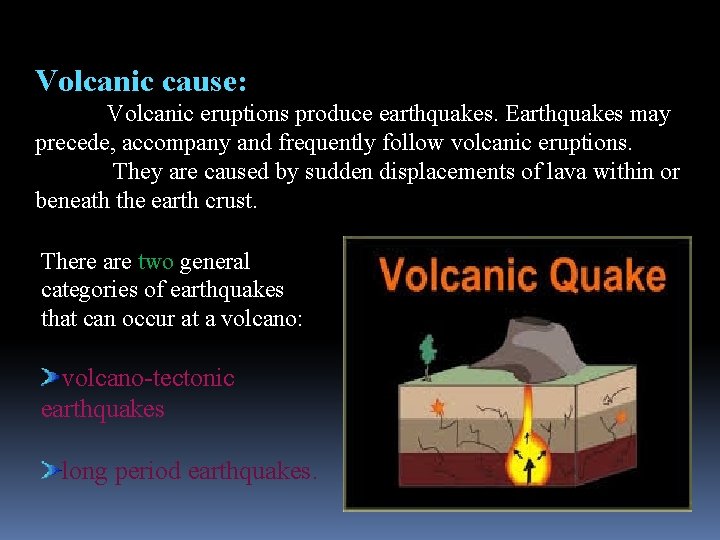
Volcanic cause: Volcanic eruptions produce earthquakes. Earthquakes may precede, accompany and frequently follow volcanic eruptions. They are caused by sudden displacements of lava within or beneath the earth crust. There are two general categories of earthquakes that can occur at a volcano: volcano-tectonic earthquakes long period earthquakes.
Tectonic cause: Structural disturbances resulting in the parts of the lithosphere is the main cause of this type of earthquake. Most of the disastrous earthquakes belong to this category and occur in areas of great faults and fractures. Sudden yielding to strain produced on the rocks of accumulating stress causes displacements especially along old fault zones known as great transform faults. Plate Boundary Overview. flv
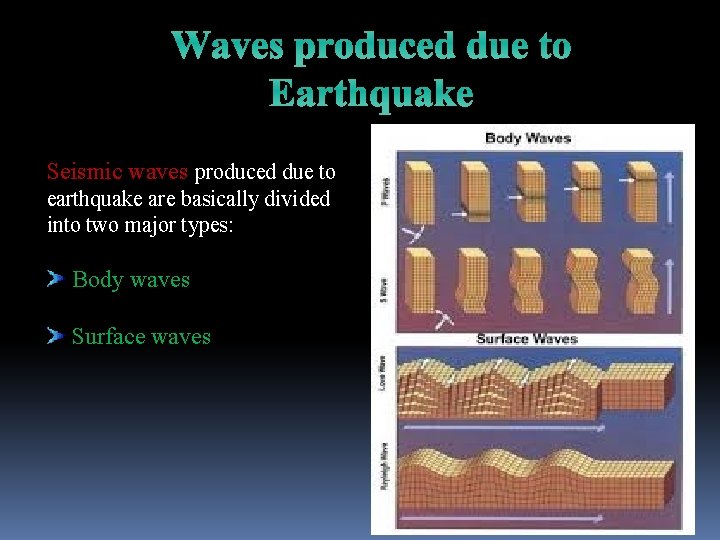
Waves produced due to Earthquake Seismic waves produced due to earthquake are basically divided into two major types: Body waves Surface waves
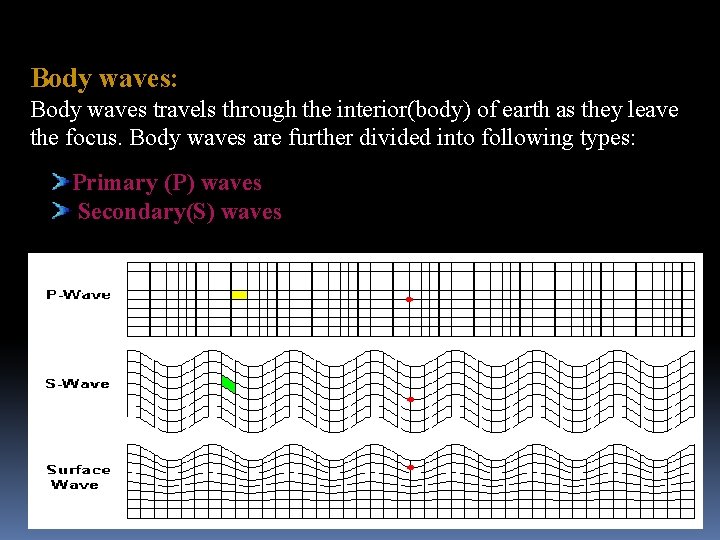
Body waves: Body waves travels through the interior(body) of earth as they leave the focus. Body waves are further divided into following types: Primary (P) waves Secondary(S) waves
Primary Waves (P-waves) Secondary Waves(S-wave) High frequency Short Wavelength Longitudinal waves Transverse waves Pass trough both solids and Can not move through liquids Move forwards and backwards Move in all direction from as it compressed and their source decompressed P-wave is faster S-wave is more slower than Pwave First P-wave arrive After P-wave, S-wave is arrive
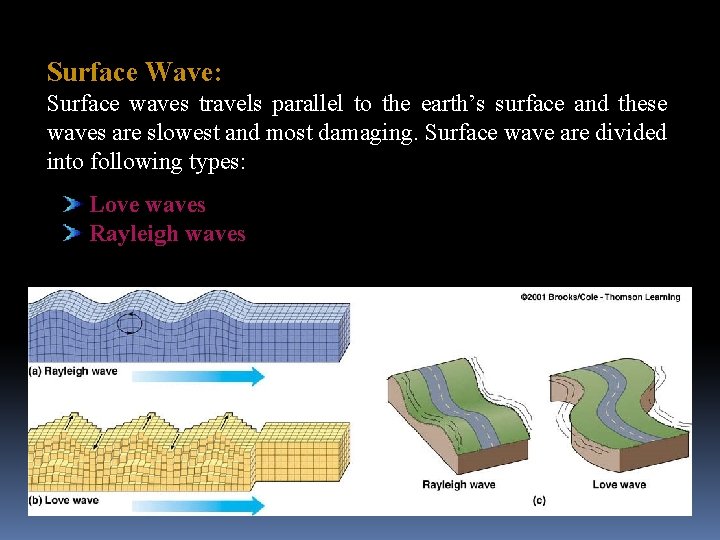
Surface Wave: Surface waves travels parallel to the earth’s surface and these waves are slowest and most damaging. Surface wave are divided into following types: Love waves Rayleigh waves
Love Waves Guided waves Rayleigh wave Guided waves Displacement is parallel to the Displacement is perpendicular free surface to love-wave displacement Love wave is faster Rayleigh wave is slower Causes horizontal shifting of the earth surface. Ground move in circular motion.
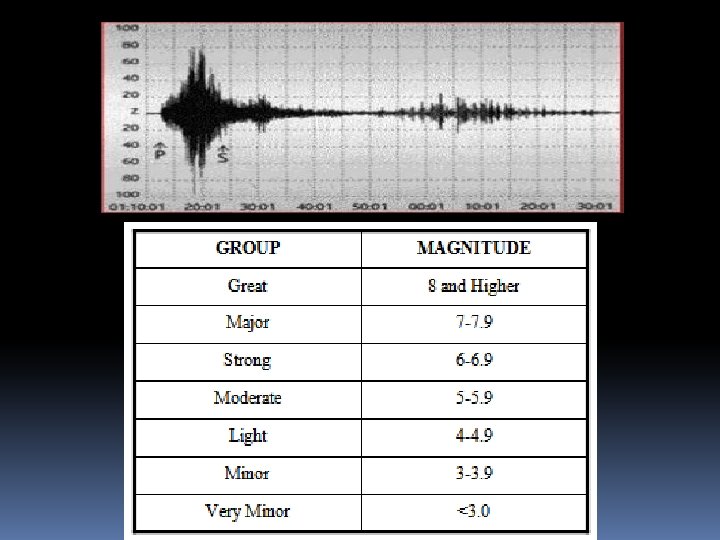
Strength Of Earthquake The intensity and strength of an earthquake is measured on Richter scale, the scale invented by Charles Richter California , USA in 1935. which categories earthquake on the basis of energy released. Defintion: “the logarithm to base ten of the maximum seismic-wave amplitude recorded on a standard seismograph at a distance of 100 kilometers from the earthquake epicenter. ” Scientists measure the strength of earthquakes using machines known as seismographs. q. Seismology is the scientific study of earthquakes and the propagation of elastic waves through the Earth.
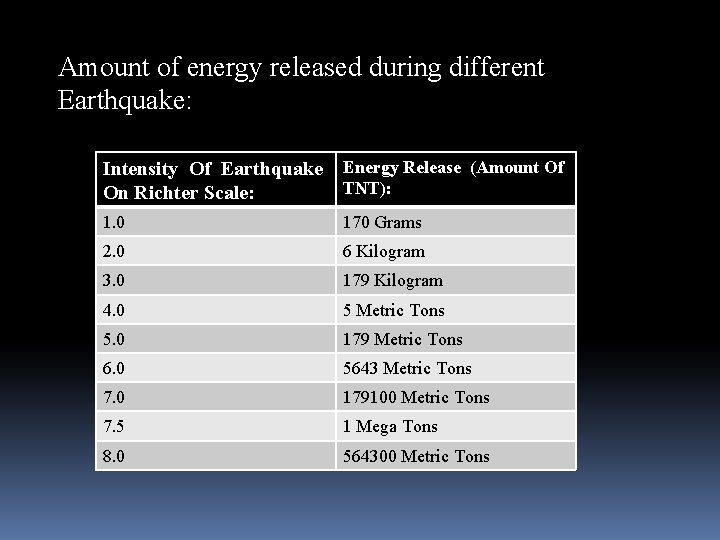
Amount of energy released during different Earthquake: Intensity Of Earthquake Energy Release (Amount Of TNT): On Richter Scale: 1. 0 170 Grams 2. 0 6 Kilogram 3. 0 179 Kilogram 4. 0 5 Metric Tons 5. 0 179 Metric Tons 6. 0 5643 Metric Tons 7. 0 179100 Metric Tons 7. 5 1 Mega Tons 8. 0 564300 Metric Tons
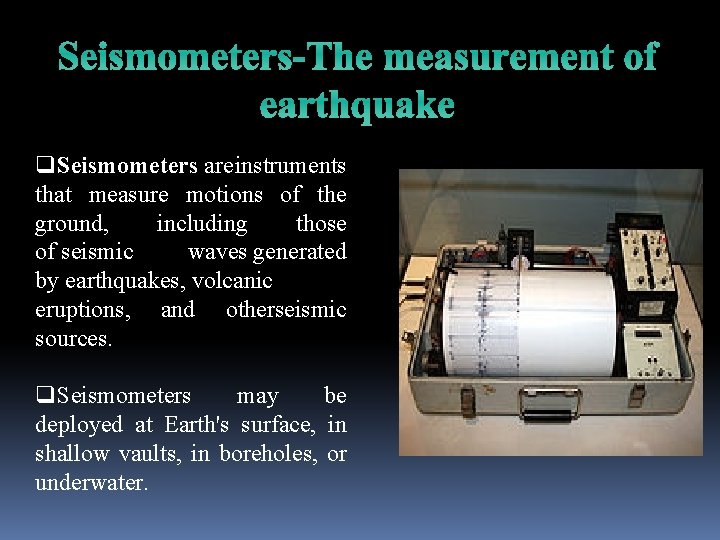
Seismometers-The measurement of earthquake q. Seismometers are instruments that measure motions of the ground, including those of seismic waves generated by earthquakes, volcanic eruptions, and otherseismic sources. q. Seismometers may be deployed at Earth's surface, in shallow vaults, in boreholes, or underwater.
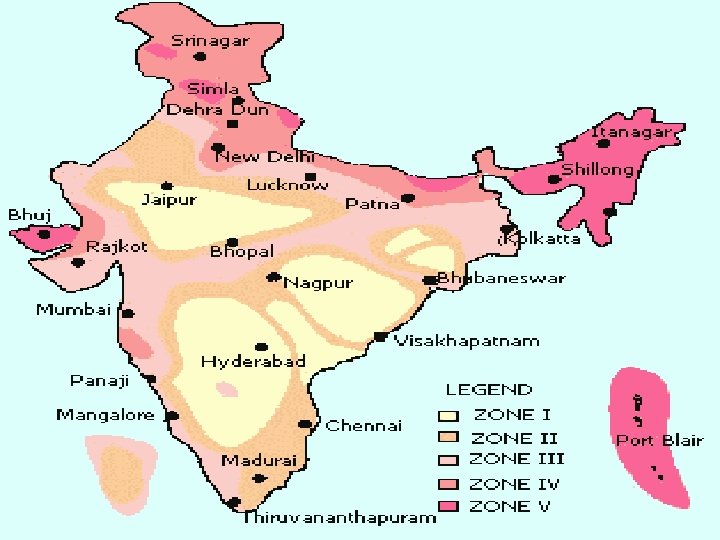
Types Of Zones The earthquake zoning map of India divides India into 4 seismic zones Based on the observations of the affected area due to Earthquake india divided into four types of zones: Zone - II: This is said to be the least active seismic zone. Zone - III: It is included in the moderate seismic zone. Zone - IV: This is considered to be the high seismic zone. Zone - V: It is the highest seismic zone.
Earthquake Prediction Earthquake prediction is usually defined as the specification of the time , location , and magnitude of a future earthquake within stated limits. But some evidence of upcoming Earthquake are following: Ø Unusual animal behavior ØWater level in wells ØLarge scale of fluctuation of oil flow from oil wells ØForeshocks or minor shocks before major earthquake ØTemperature change ØUplifting of earth surface ØChange in seismic wave velocity
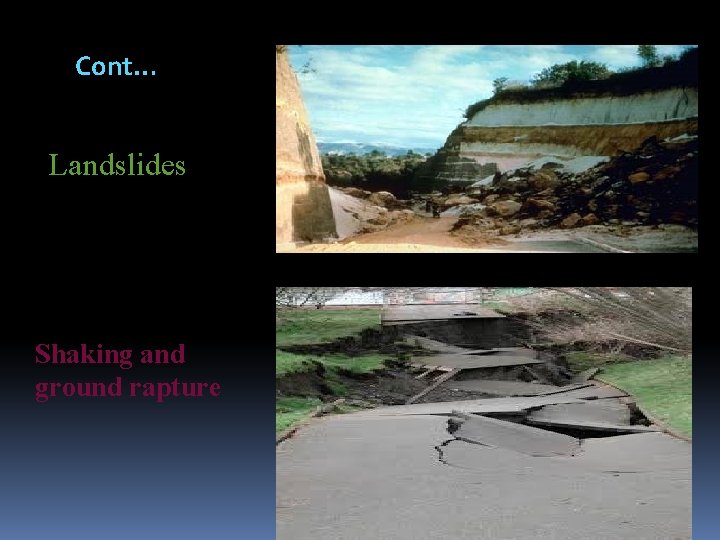
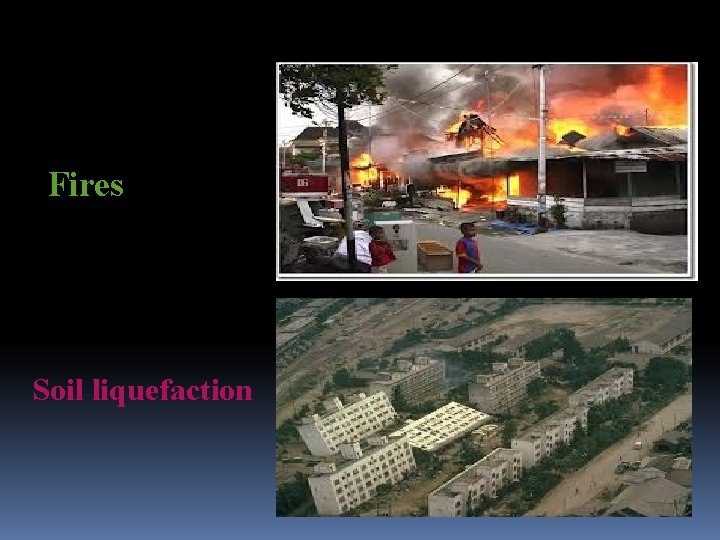
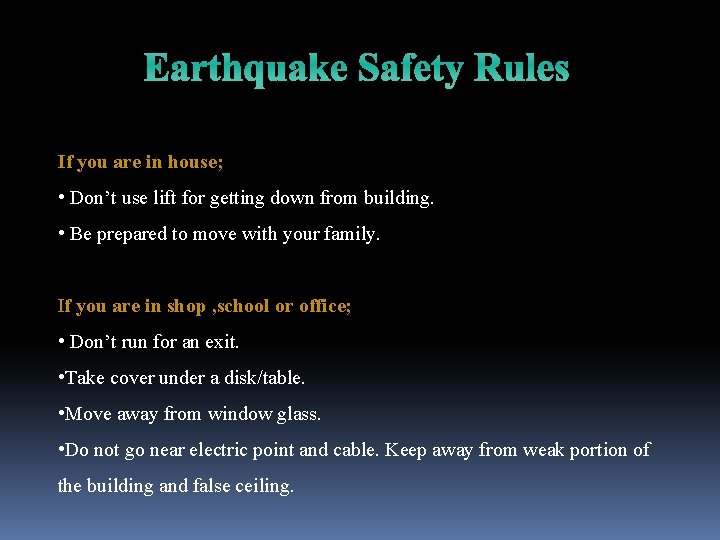
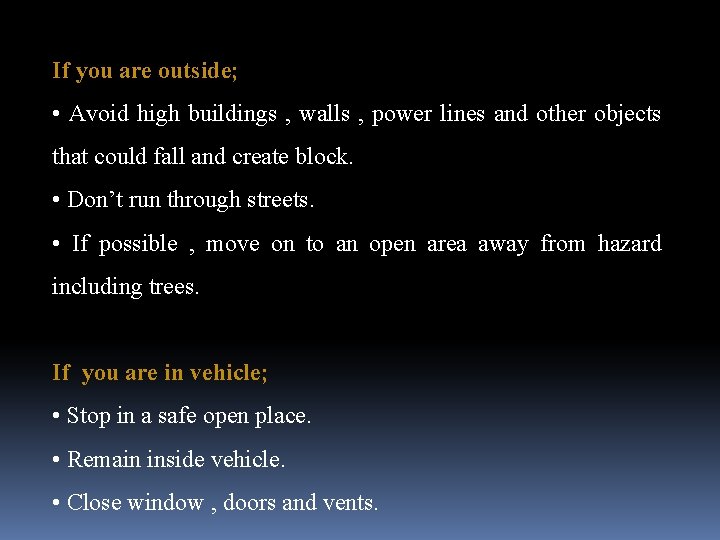
Effect Of Earthquake ØLoss of life and property ØDamage to transport system i. e. roads, railways, highways, airports, marine ØDamage to infrastructure. ØChances of Floods – Develop cracks in Dams ØChances of fire short-circuit. ØCommunications such as telephone wires are damaged. ØWater pipes, sewers are disrupted ØEconomic activities like agriculture, industry, trade and transport are severely affected.
Cont… Landslides Shaking and ground rapture
Fires Soil liquefaction
Tsunami Floods
Earthquake Safety Rules If you are in house; • Don’t use lift for getting down from building. • Be prepared to move with your family. If you are in shop , school or office; • Don’t run for an exit. • Take cover under a disk/table. • Move away from window glass. • Do not go near electric point and cable. Keep away from weak portion of the building and false ceiling.
If you are outside; • Avoid high buildings , walls , power lines and other objects that could fall and create block. • Don’t run through streets. • If possible , move on to an open area away from hazard including trees. If you are in vehicle; • Stop in a safe open place. • Remain inside vehicle. • Close window , doors and vents.
After An Earthquake Keep calm, switch on the transistor radio and obey instructions. Keep away from beaches and low banks of river. A huge wave may sweep in Do not re enter badly damaged buildings and do not go near damage structures. Turn off the water, gas and electricity. Do not smoke, light match or use a cigarette lighter Do not turn on switches there may be gas leak or short circuit If there is any fire, try to put it out or call fire brigade.
Do not drink water from open containers without having examined it. If you aware of people have been buried, tell the rescue team. Do not rush and try not to worsen the situation. Avoid places where there are loose electric wires and do not come in contact with any metal object. Eat something. You will better and more capable of helping other. Do not walk around the streets to see what is happening. Keep the streets clear so rescue vehicles can access the roads easily.
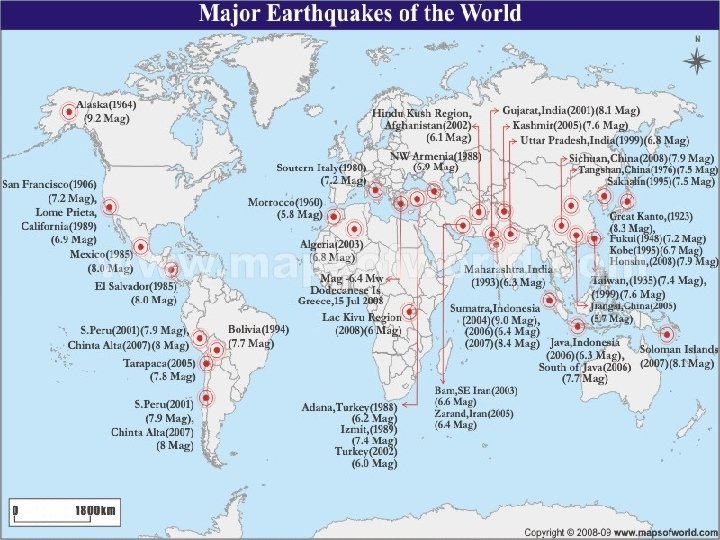
Date Place Scale Damage Sept 2, 1993 Latur (maharashtra) 6. 3 Large areas of Maharashtra rocked. 10, 000 people lost lives. May 22, 1997 Jabalpur (Maharashtra) 6. 0 40 person killed and over 100 injured. March 29, Nandprayag 1999 6. 8 widespread destruction in chamoli , rudraprayag and other areas. Massive loss of human life. Jan. 26, 2001 Bhuj (gujrat) 7. 8 Tremors left by India and its neighboring countries. Over 1 lakh people killed. Huge loss to property and infrastructure. Oct. 8, 2005 Muzzaffarabad in Pakistan occupied Kashmir 7. 4 Heavy damage to life and property. Death toll about one lakh in Pakistan and nearly 2000 in India.
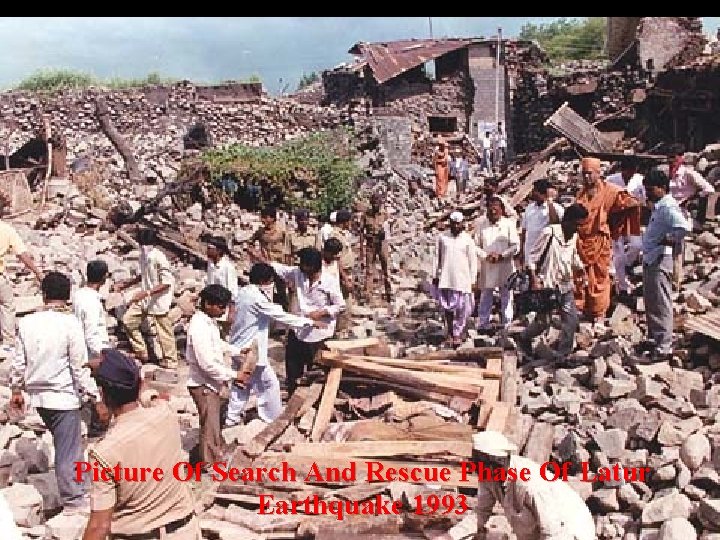
Picture Of Search And Rescue Phase Of Latur Earthquake 1993
Helpless man being trapped under debris
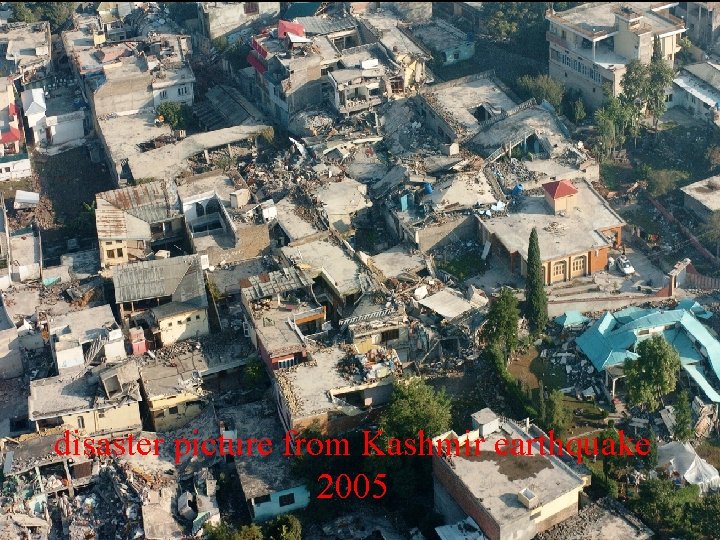
disaster picture from Kashmir earthquake 2005
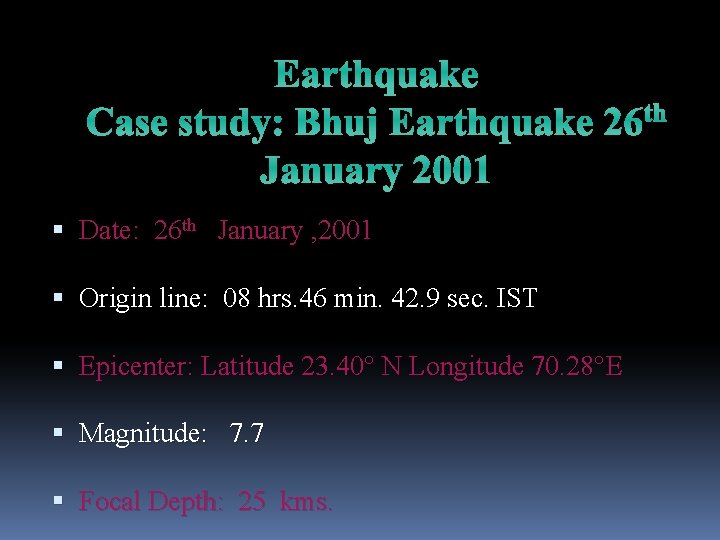
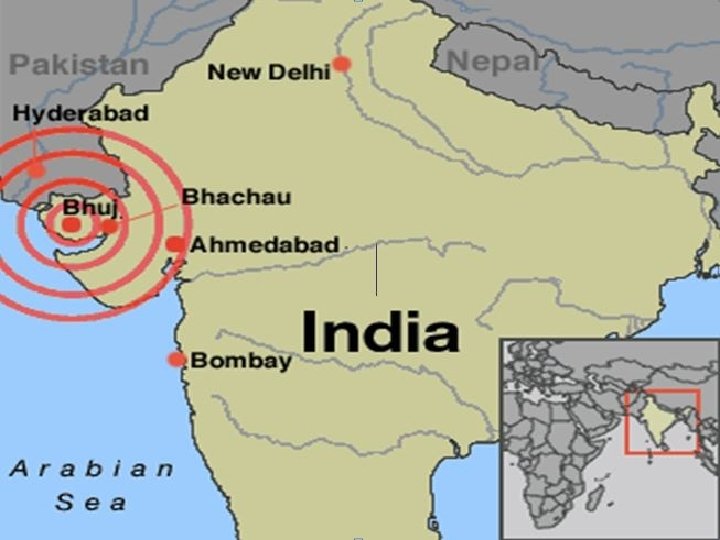
Earthquake th Case study: Bhuj Earthquake 26 January 2001 Date: 26 th January , 2001 Origin line: 08 hrs. 46 min. 42. 9 sec. IST Epicenter: Latitude 23. 40° N Longitude 70. 28°E Magnitude: 7. 7 Focal Depth: 25 kms.
q. On the morning of January 26, 2001, the Nation’s 52 nd Republic Day, a devastating earthquake occurred in the Kutchh district of the state of Gujarat. q The earthquake was felt as far away as Delhi in the north, Kolkata in the east. q Bhuj town and the village Bhachau, 60 km east of Bhuj, were the worst affected and many other areas of Gujarat including its state headquarters Ahmedabad, were badly affected.
Damage assessment There were more than 20, 000 deaths and 167, 000 people injured Four districts of Gujarat lay in ruin and altogether, 21 districts were affected. Around 300, 000 families and at least 3 million children under 14 aged were affected. Around 600, 000 people were left homeless. In the city of Bhuj, more than 3, 000 Population of the city lost their lives; the main hospital was crushed and close to 90% of the buildings was destroyed. There was significant damage to infrastructure with facilities such as hospitals, schools, electric power and water systems, bridges and roads damaged or destroyed.
Damage to high rise building in Bhuj
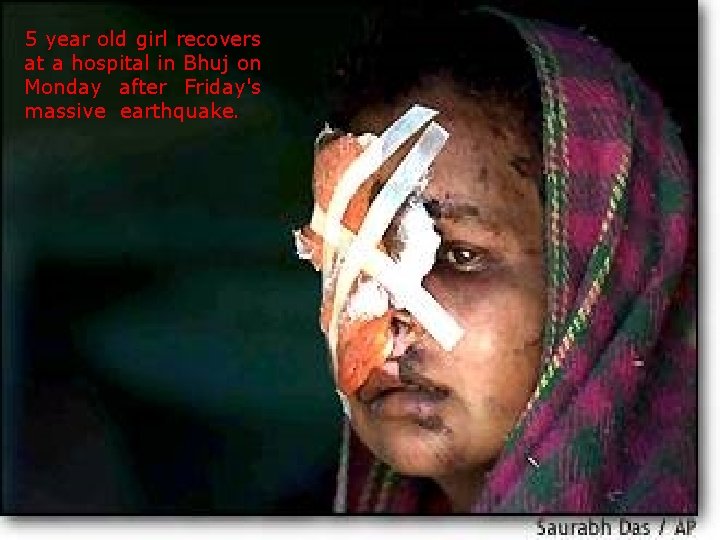
5 year old girl recovers at a hospital in Bhuj on Monday after Friday's massive earthquake.
Local response The response within India was immediate. The national and state governments quickly provided assistance in many forms including cash, medical supplies, communications teams, shelters, food, clothing, transport and relief workers. There were more than 185 non-government organizations (NGOs), mostly Indian charities, which undertook earthquake-related activities
International response Search and Rescue teams soon arrived from Switzerland, United Kingdom, Russia and Turkey to find and rescue survivors buried under debris. Relief teams and supplies soon followed from 38 countries as well as United Nations agencies and many international NGOs such as the Red Cross. The world bank and Asian development bank sanction loans in less than three months after the earthquake.
Relief And Reconstruction Gujarat earthquake emergency reconstruction project (GEERP) was started by GSDMA(Gujrat State Disaster Management Authority), with financial help from world bank, Asian development bank, govt of India and other donor agencies. Several state governments came forward to participate in, the reconstruction work in different villages. The UN system, multilateral and bilateral agencies, NGOs and the corporate sector participated in the relief and reconstruction work.
Cont… Government of Gujarat provided assistance in the form of materials and cash to about 218, 000 families. NGOs supplemented the efforts by providing shelter to about 7000 families. About 65 NGOs were active in kutch alone who adopted 211 villages and constructed 32, 297 houses at the cost of Rs. 185. 80 crores. The technical support was made available to the owners who were provided loan to reconstruct the houses.