
A Tour of the Cell Chapter 7 How
- Slides: 47
A Tour of the Cell Chapter 7
How Do We Study Cells?
Light Microscopes
Electron Microscopes
Cell Fractionation
All cells have:
Prokaryotic Cells
Eukaryotic Cells
Limits on Cell Sizes
Compartmentalization • Internal membranes allow eukaryotic cells to battle the surface area-to-volume ratio problem that limits cell size. • Eukaryotic cells can form “compartments” which segregate certain reactions that interfere with each other (local environments) • These internal membranes participate directly in the cells metabolism (enzymes) • Each membrane has a unique composistion enzymes for cellular respiration - mitochondria
Nucleus: Cell’s Genetic Library – contains most of the genes in a eukaryotic cell (some genes are found in mitochondria and chloroplast) – nucleus is enclosed by the nuclear envelope • separates nuclear content from the cytoplasm • envelope is a double membrane, each is a lipid bilayer with associated proteins • envelope is perforated by nuclear pores, lined by a pore complex which regulates transport • nuclear lamina - maintains nuclear shape
Nuclear Organization • • DNA Histones Chromatin Chromosomes Homologous Chromosomes Genome Nucleolus
Ribosomes build a cell’s proteins • sites of protein synthesis = translation • cells with high rates of protein synthesis have …large numbers of ribosomes • free ribosomes - suspended in the cytosol; make proteins that work in the cytosol • bound ribosomes - attached to the outside of the membranes of the nuclear envelope and ER; make proteins that are (1) included in the membrane; (2) packaging within an organelle; (3) exported from the cell
Endomembrane System • The membranes of the cell that are either directly related through physical contact or by the transfer of membrane segments by tiny vesicles • the various membranes are not identical in S+F – thickness, molecular composition, and metabolic behavior can change • includes: nuclear envelope, ER, Golgi, lysosomes, various vacuoles, and the plasma membrane
Endoplasmic Reticulum • extensive membranes which may account for over half of the cell’s total membrane – network of sacs and tubules called cisternae – cisternal space is continuous with the space between the two membranes of the nuclear envelope – ER membrane separates these spaces from the cytosol
Rough ER - ribosomes on surface – bound ribosomes on the rough ER make secretory proteins • cells that are specialized for secretion often have tremendous amounts of rough ER • as ribosome makes protein it is threaded into the cisternal space where it assumes its native conformation • most are glycoproteins; have oligo-saccharides covalently bonded to the protein • rough ER - also the membrane factory of the cell
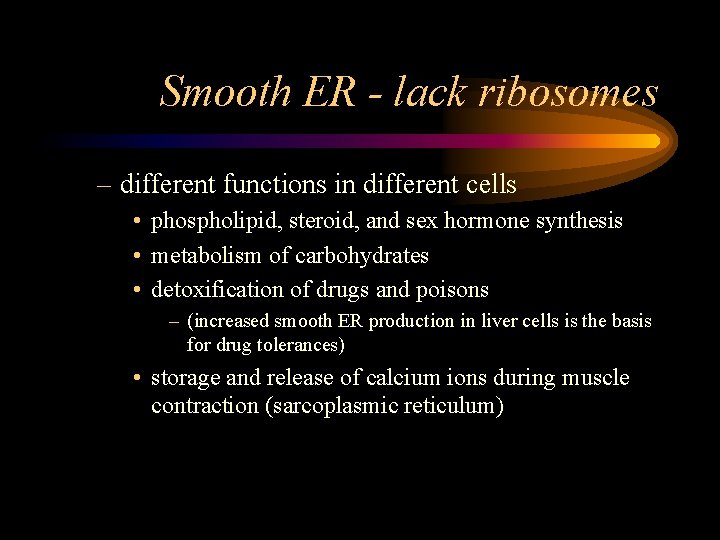
Smooth ER - lack ribosomes – different functions in different cells • phospholipid, steroid, and sex hormone synthesis • metabolism of carbohydrates • detoxification of drugs and poisons – (increased smooth ER production in liver cells is the basis for drug tolerances) • storage and release of calcium ions during muscle contraction (sarcoplasmic reticulum)
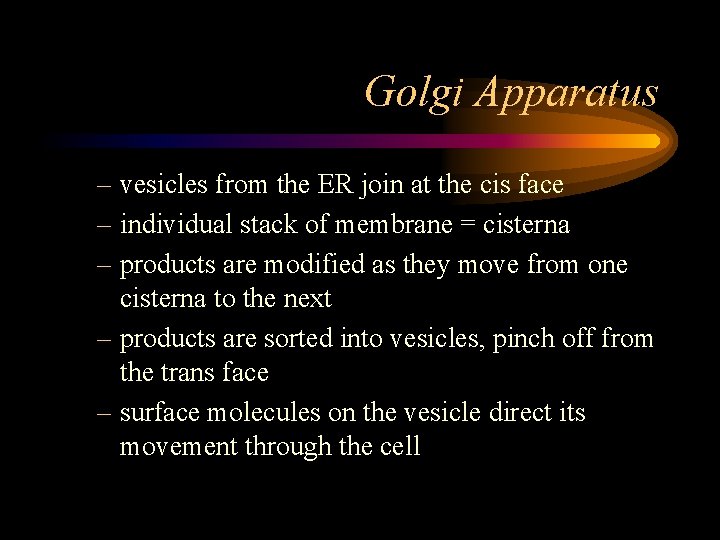
Golgi Apparatus – vesicles from the ER join at the cis face – individual stack of membrane = cisterna – products are modified as they move from one cisterna to the next – products are sorted into vesicles, pinch off from the trans face – surface molecules on the vesicle direct its movement through the cell
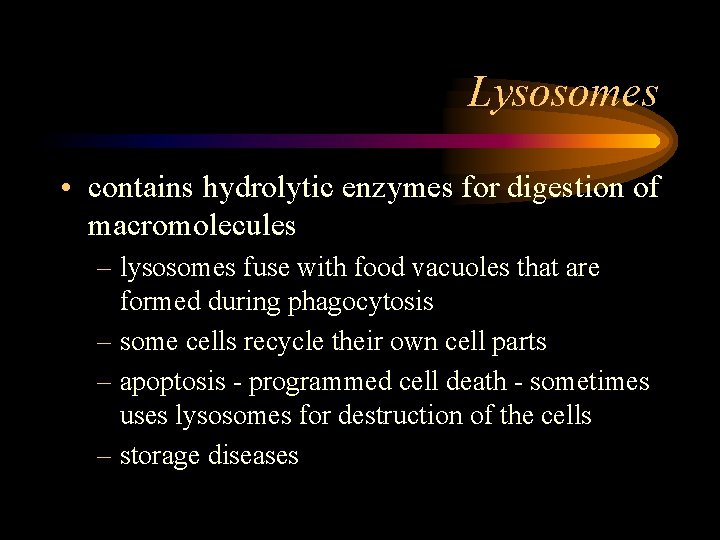
Lysosomes • contains hydrolytic enzymes for digestion of macromolecules – lysosomes fuse with food vacuoles that are formed during phagocytosis – some cells recycle their own cell parts – apoptosis - programmed cell death - sometimes uses lysosomes for destruction of the cells – storage diseases
Vacuoles • food vacuoles • contractile vacuoles • central vacuole
Mitochondria • site of cell respiration, catabolic processing of fuels to produce ATP • two membranes with a narrow intermembrane space between them • inner membrane - highly folded - cristae • encloses the mitochondrial matrix • respiratory enzymes are found throughout the mitochondria
Chloroplasts • one of a group of organelles called plastids – amyloplasts – chromoplasts • chloroplasts • two membranes - inner membranes make up the thylakoids • space between outer membrane and thylakoids is the stroma
Peroxisomes
Cytoskeleton • • • mechanical support maintain or change cell shape anchor and direct organelle movement control movement of cellular appendages muscle contraction
Microtubules • hollow rods constructed of globular proteins called tubulin – major supporting framework of the cell – serve as tracks along which organelles move with the aid of motor molecules – radiate out from the centrosome – animal cells have a pair of centrioles – cilia, flagella, basal body, dynein
Intermediate Filaments • Filaments that are intermediate in diameter between microtubules and microfilaments – made from keratin subunits – more permanent than other filaments • Function: – bear tension – reinforce cell shape – compose the nuclear lamina
Microfilaments • composed of two actin chains wound into a helix; built from G-actin subunits • Function: – provide cellular support – participate in muscle contraction – cause localized contraction of cells – cytoplasmic streaming
Plant cell walls • composed of cellulose • primary cell wall - thin, flexible walls that are joined to adjacent cells by the middle lamella made of pectins • secondary cell wall may be added after the cell stops growing; added between the primary wall and the plasma membrane
Animal cells have an extracellular matrix (ECM) • meshwork of macromolecules outside the membrane of animal cells • the ECM is: – secreted locally by cells – composed mostly of glycoproteins like collagen – attached directly to cells or by another group of glycoproteins-fibronectins – has fibronectins that attach to transmembrane binding sites called integrins
Intercellular Junctions • Allow neighboring cells to adhere and interact through direct physical contact • Plants have: – plasmodesma/plasmodesmata = channels that perforate the cell walls • Animals have: – tight junctions: prevent transport through the intercellular space; desmosomes: allow transport; gap junctions: cytoplasmic exchange
Chapter 8 Review • Test - 9/17/03
Plasma Membrane • • • Fluid Mosaic Model Phospholipids Bilayers Membrane Proteins Cholesterol
Phospholipids: • are amphipathic • contain a polar and nonpolar region • head – phosphate – polar, hydrophilic, interacts with water • tails (2) – fatty acids (saturated or unsaturated) – nonpolar, hydrophobic, repelled by water
Bilayers: • form when phospholipids are put in water • are arranged from two layers of phospholipids; arranged tail-to-tail • are the basic structure for all membranes • have a hydrophobic region (lipid tails) that acts as a selectively permeable barrier • give membranes their semi-permeability
Membrane Proteins: • are either inserted through the membrane = integral proteins – transport proteins - channels and carriers – enzymes – receptor proteins • or are associated w/ the membrane surface = peripheral proteins – act as sites for attachment to the cytoskeleton or extracellular matrix
Cholesterol: • is the major derivative of steroid molecules • acts to stabilize the structure of membranes • provides stability by increasing the hydrophobic interactions of the membrane • affects the “fluidity” of the membrane
Membrane Fluidity • is affected by membrane composition – ratio of saturated to unsaturated fatty acid tails – amount of cholesterol (animal cells) • unsaturated fatty acids are more oily than saturated ones = increase mem fluidity • cholesterol stabilizes membranes at extreme temperatures – keeps membrane together at very high temps – keeps membranes fluid at low temps
Selective Permeability • many molecules are present in the cell’s internal and external environment, the cell must have some way to sort out what can enter and leave the cell = membranes must be selectively permeable • what crosses easily vs. what doesn’t
Two ways substances move: • Bulk Flow • Constant, Random Motion (Diffusion)
Passive Transport • diffusion • osmosis – hypertonic – hypotonic – isotonic – osmotic pressure (see lab and discussion of water potential) • facilitated diffusion
Water Balance • w/out walls – hypertonic-lose water and shrivel (crenation) – hypotonic-gain water, swell, and possibly burst (lyse) – must live in isotonic environments or have adaptations for osmoregulation
Water Balance - cont’d. • with walls – hypotonic-water moves into the cell and presses against the wall, causing a turgid cell – isotonic solutions-flaccid cells – hypertonic-plasmolysis - membrane pulls away from the cell wall as it shrivels
Examples of Transport • Facilitated diffusion: ion channels – voltage-gated ion channels are important in excitable cells (muscles and neurons) • Active transport: pumps – Na+-K+ pump: important in establishing an electrochemical gradient – proton pumps: • Cotransport: using an ATP driven pump to establish an ion gradient for symport.
Membrane Potential • voltage can be created across a membrane using ion pumps – 2 forces involved in the passive transport of ions: • concentration gradient • effect of charge on the ion – Electrochemical gradients: diffusion gradient resulting from combined forces – electrogenic pumps: any transport pump that generates voltage across a membrane
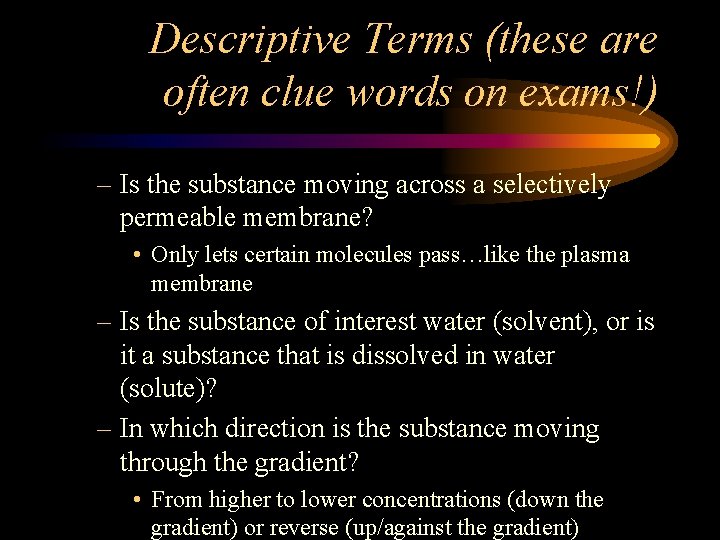
Descriptive Terms (these are often clue words on exams!) – Is the substance moving across a selectively permeable membrane? • Only lets certain molecules pass…like the plasma membrane – Is the substance of interest water (solvent), or is it a substance that is dissolved in water (solute)? – In which direction is the substance moving through the gradient? • From higher to lower concentrations (down the gradient) or reverse (up/against the gradient)
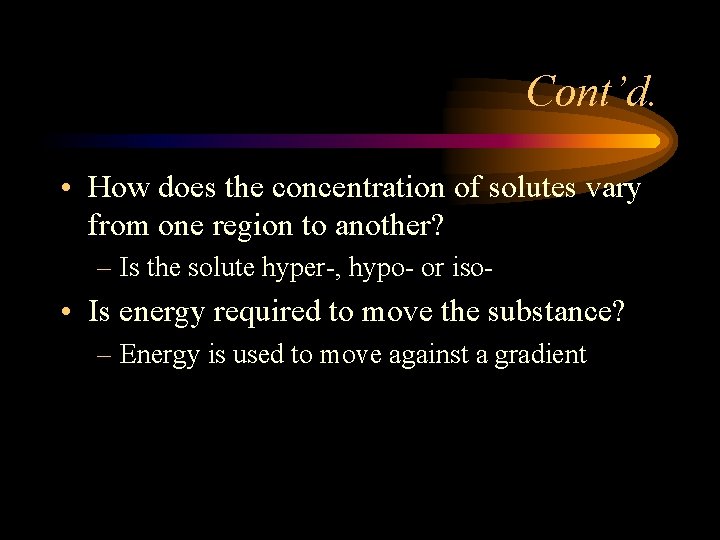
Cont’d. • How does the concentration of solutes vary from one region to another? – Is the solute hyper-, hypo- or iso- • Is energy required to move the substance? – Energy is used to move against a gradient
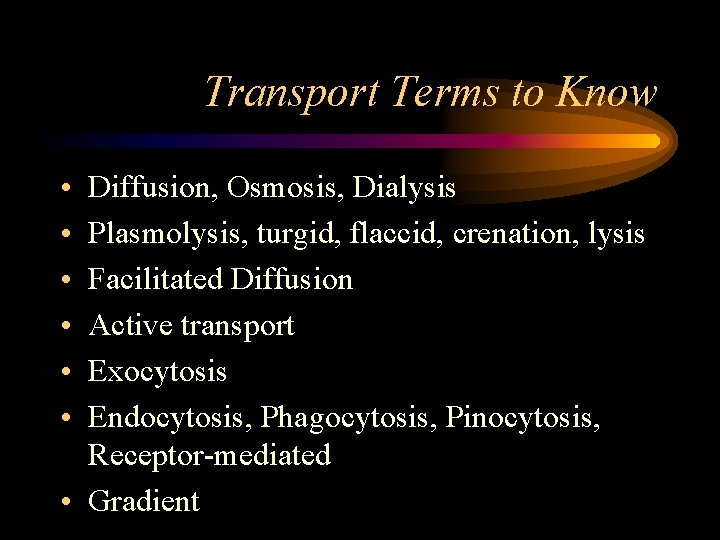
Transport Terms to Know • • • Diffusion, Osmosis, Dialysis Plasmolysis, turgid, flaccid, crenation, lysis Facilitated Diffusion Active transport Exocytosis Endocytosis, Phagocytosis, Pinocytosis, Receptor-mediated • Gradient