
A Tour of Machine Learning Security Florian Tramr

- Slides: 45
A Tour of Machine Learning Security Florian Tramèr CISPA August 6 th 2018
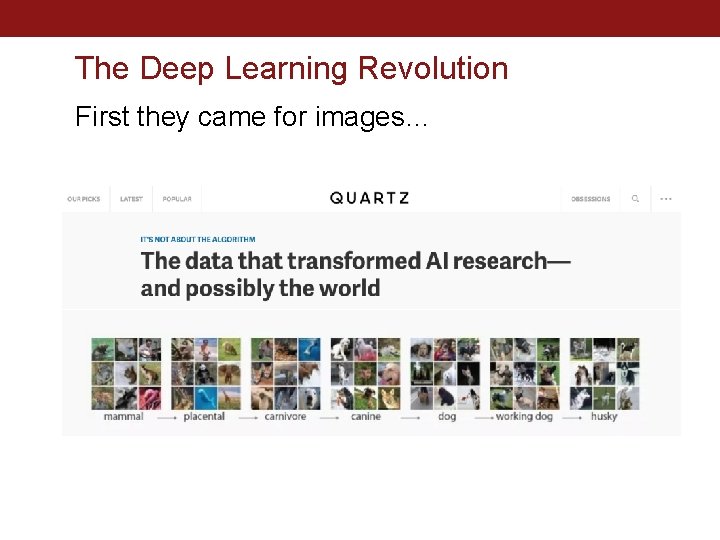
The Deep Learning Revolution First they came for images…
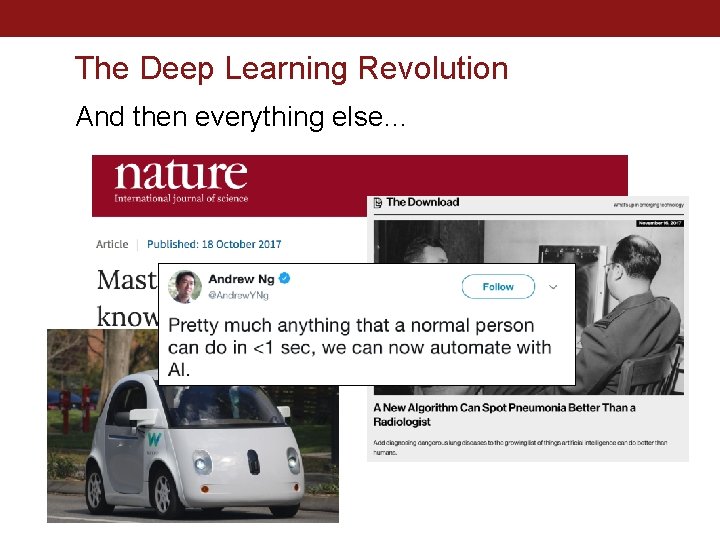
The Deep Learning Revolution And then everything else…
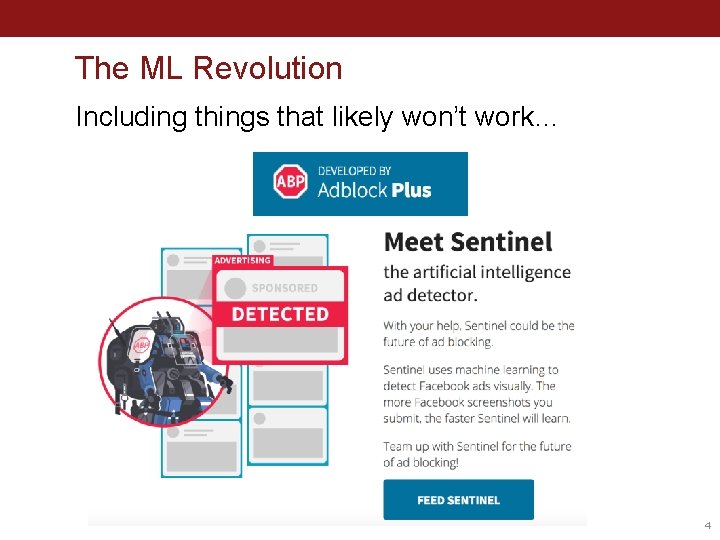
The ML Revolution Including things that likely won’t work… 4
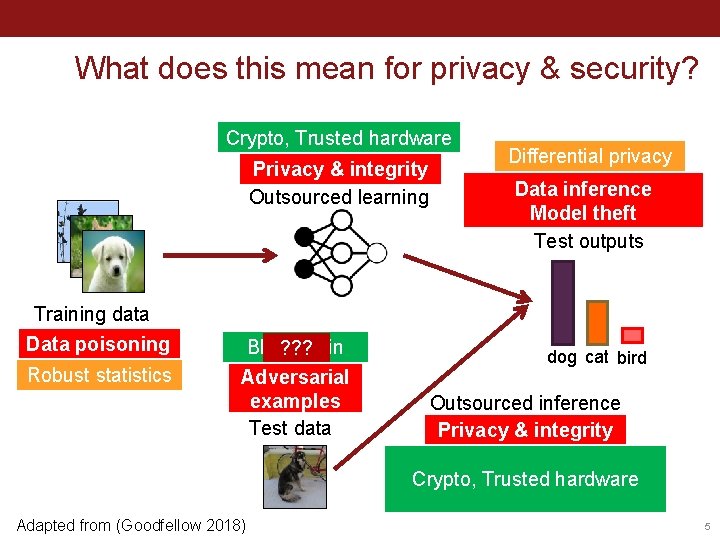
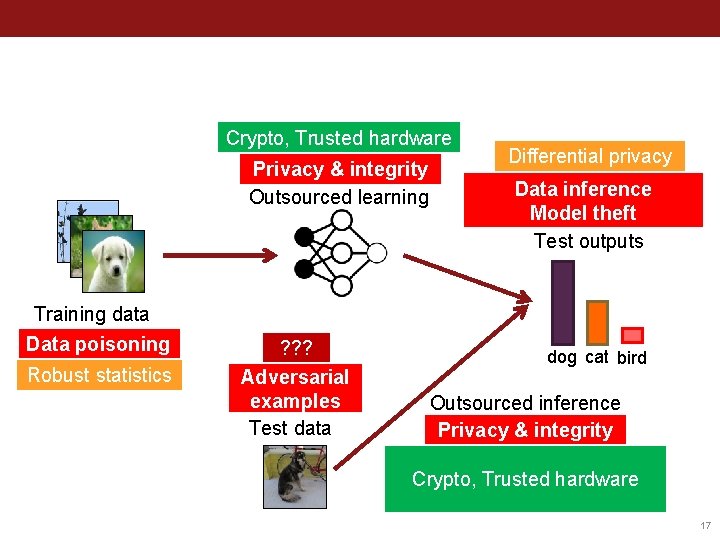
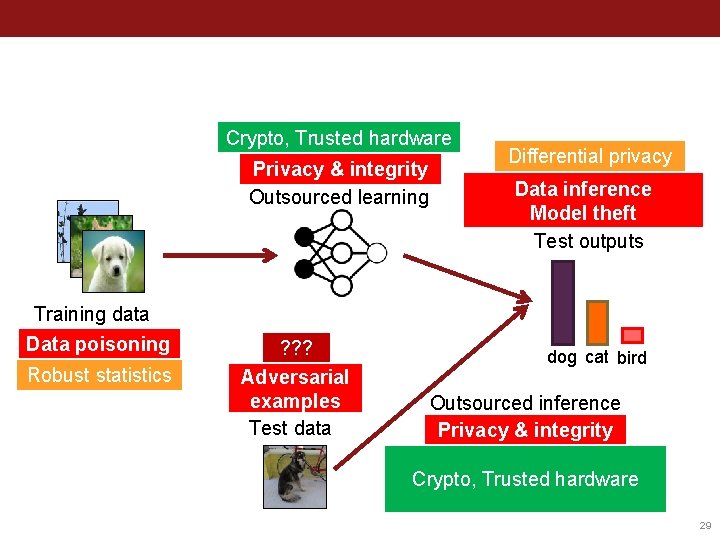
What does this mean for privacy & security? Crypto, Trusted hardware Privacy & integrity Outsourced learning Training data Data poisoning Robust statistics Blockchain ? ? ? Adversarial examples Test data Differential privacy Data inference Model theft Test outputs dog cat bird Outsourced inference Privacy & integrity Crypto, Trusted hardware Adapted from (Goodfellow 2018) 5
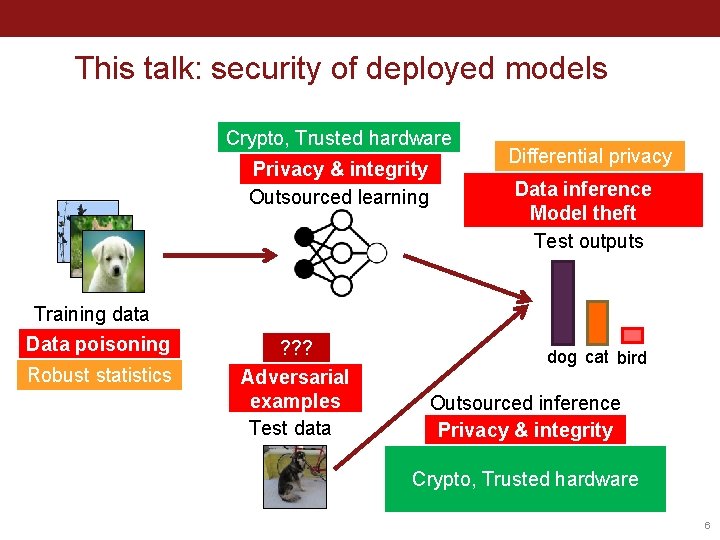
This talk: security of deployed models Crypto, Trusted hardware Privacy & integrity Outsourced learning Training data Data poisoning Robust statistics ? ? ? Adversarial examples Test data Differential privacy Data inference Model theft Test outputs dog cat bird Outsourced inference Privacy & integrity Crypto, Trusted hardware 6
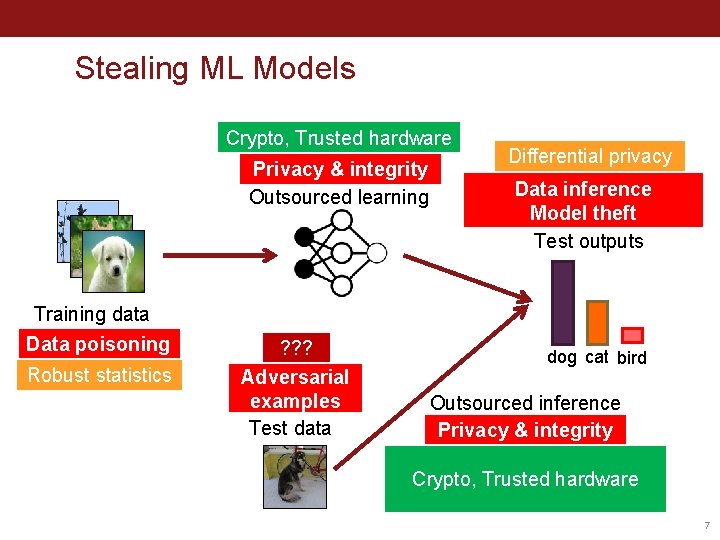
Stealing ML Models Crypto, Trusted hardware Privacy & integrity Outsourced learning Training data Data poisoning Robust statistics ? ? ? Adversarial examples Test data Differential privacy Data inference Model theft Test outputs dog cat bird Outsourced inference Privacy & integrity Crypto, Trusted hardware 7
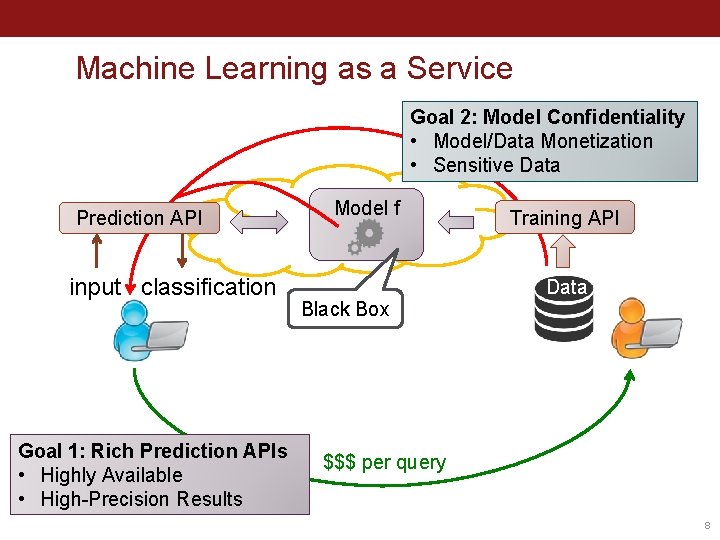
Machine Learning as a Service Goal 2: Model Confidentiality • Model/Data Monetization • Sensitive Data Prediction API input classification Goal 1: Rich Prediction APIs • Highly Available • High-Precision Results Model f Training API Data Black Box $$$ per query 8
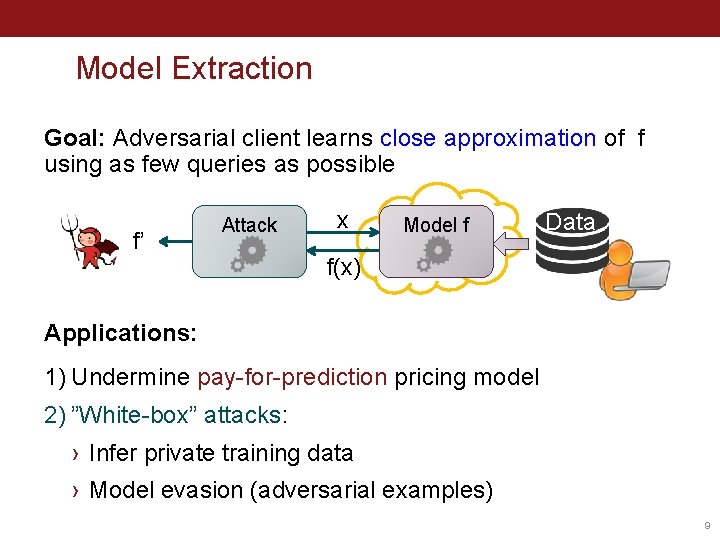
Model Extraction Goal: Adversarial client learns close approximation of f using as few queries as possible f’ Attack x Model f Data f(x) Applications: 1) Undermine pay-for-prediction pricing model 2) ”White-box” attacks: › Infer private training data › Model evasion (adversarial examples) 9
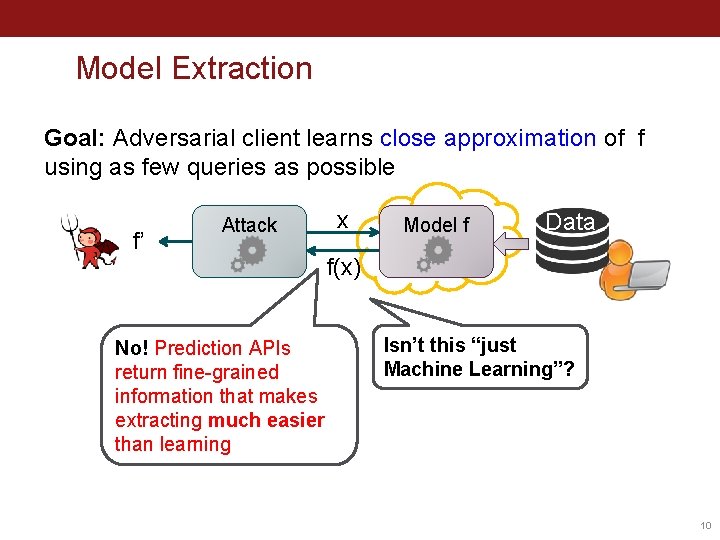
Model Extraction Goal: Adversarial client learns close approximation of f using as few queries as possible f’ Attack No! Prediction APIs return fine-grained information that makes extracting much easier than learning x Model f Data f(x) Isn’t this “just Machine Learning”? 10
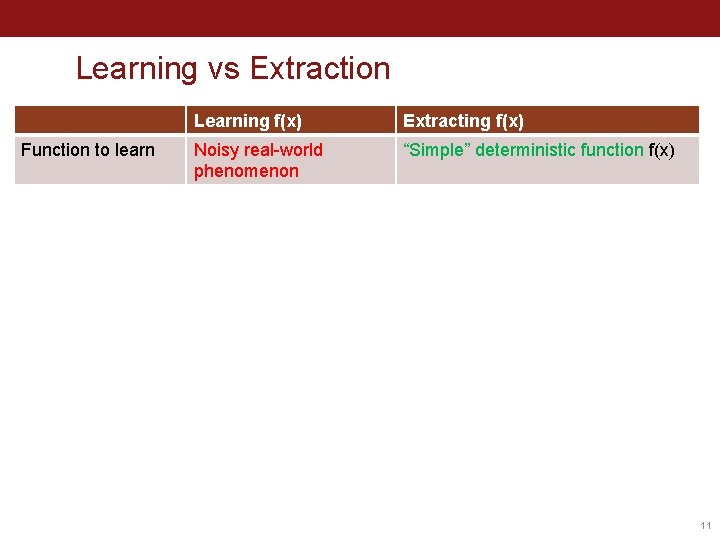
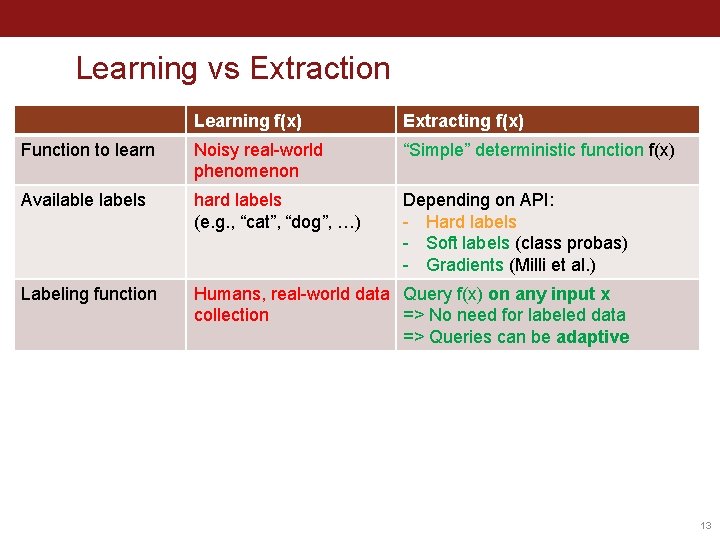
Learning vs Extraction Function to learn Learning f(x) Extracting f(x) Noisy real-world phenomenon “Simple” deterministic function f(x) 11
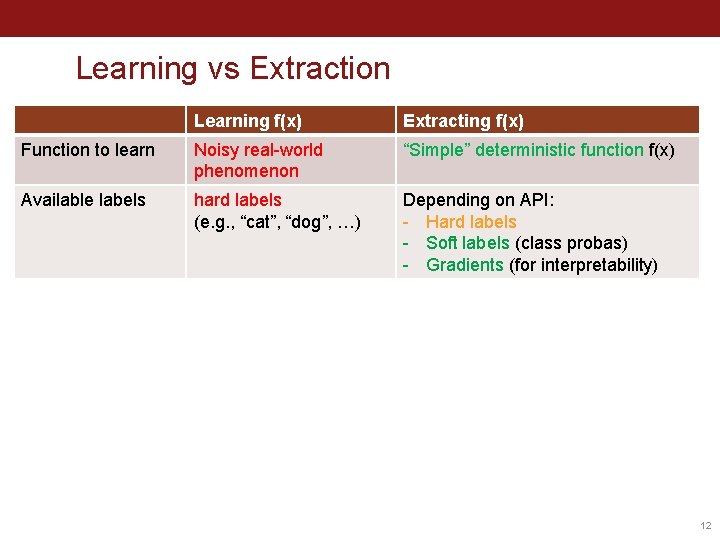
Learning vs Extraction Learning f(x) Extracting f(x) Function to learn Noisy real-world phenomenon “Simple” deterministic function f(x) Available labels hard labels (e. g. , “cat”, “dog”, …) Depending on API: - Hard labels - Soft labels (class probas) - Gradients (for interpretability) 12
Learning vs Extraction Learning f(x) Extracting f(x) Function to learn Noisy real-world phenomenon “Simple” deterministic function f(x) Available labels hard labels (e. g. , “cat”, “dog”, …) Depending on API: - Hard labels - Soft labels (class probas) - Gradients (Milli et al. ) Labeling function Humans, real-world data Query f(x) on any input x collection => No need for labeled data => Queries can be adaptive 13
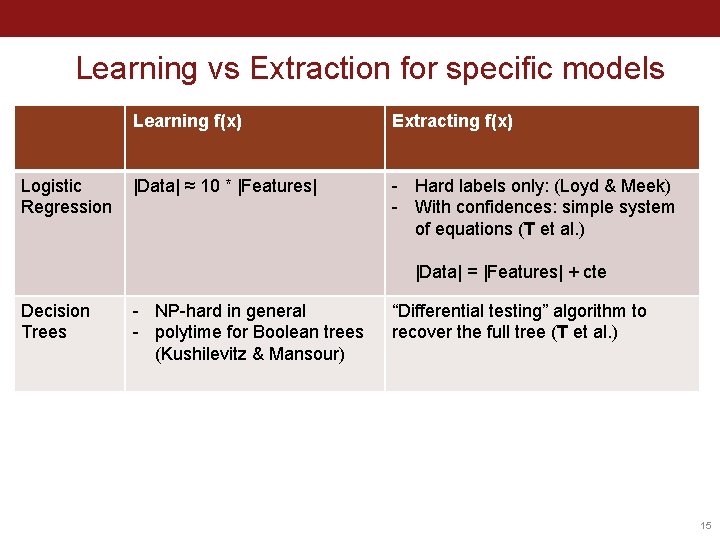
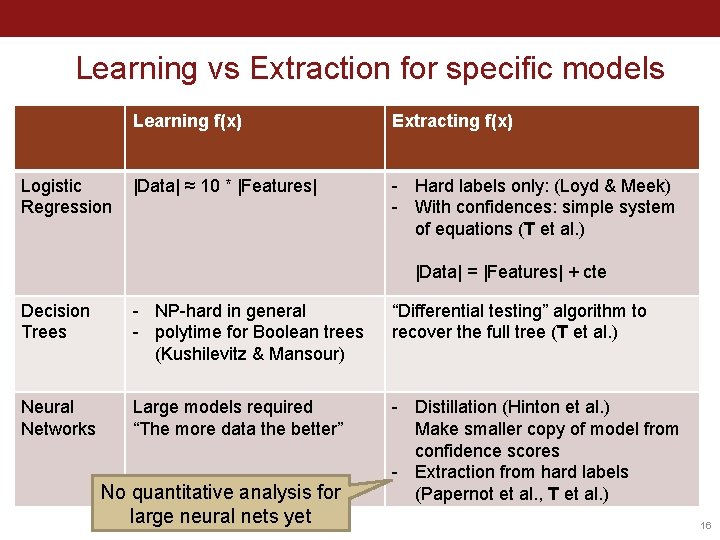
Learning vs Extraction for specific models Logistic Regression Learning f(x) Extracting f(x) |Data| ≈ 10 * |Features| - Hard labels only: (Loyd & Meek) - With confidences: simple system of equations (T et al. ) |Data| = |Features| + cte 14
Learning vs Extraction for specific models Logistic Regression Learning f(x) Extracting f(x) |Data| ≈ 10 * |Features| - Hard labels only: (Loyd & Meek) - With confidences: simple system of equations (T et al. ) |Data| = |Features| + cte Decision Trees - NP-hard in general - polytime for Boolean trees (Kushilevitz & Mansour) “Differential testing” algorithm to recover the full tree (T et al. ) 15
Learning vs Extraction for specific models Logistic Regression Learning f(x) Extracting f(x) |Data| ≈ 10 * |Features| - Hard labels only: (Loyd & Meek) - With confidences: simple system of equations (T et al. ) |Data| = |Features| + cte Decision Trees - NP-hard in general - polytime for Boolean trees (Kushilevitz & Mansour) “Differential testing” algorithm to recover the full tree (T et al. ) Neural Networks Large models required “The more data the better” - Distillation (Hinton et al. ) Make smaller copy of model from confidence scores - Extraction from hard labels (Papernot et al. , T et al. ) No quantitative analysis for large neural nets yet 16
Crypto, Trusted hardware Privacy & integrity Outsourced learning Training data Data poisoning Robust statistics ? ? ? Adversarial examples Test data Differential privacy Data inference Model theft Test outputs dog cat bird Outsourced inference Privacy & integrity Crypto, Trusted hardware 17
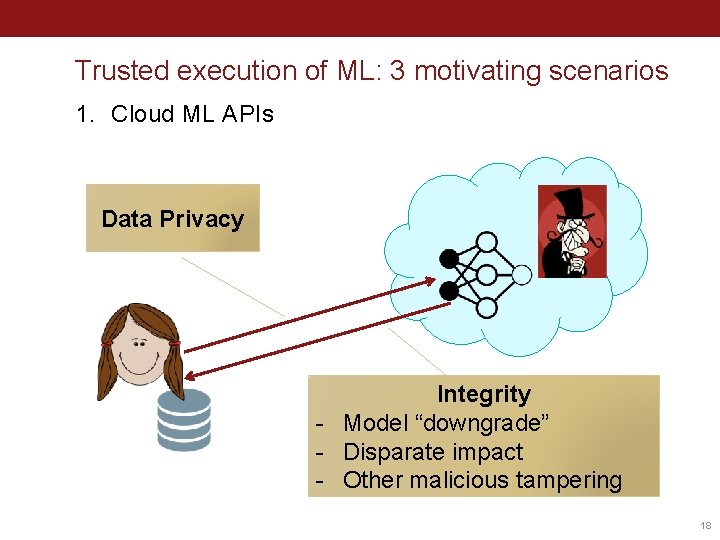
Trusted execution of ML: 3 motivating scenarios 1. Cloud ML APIs Data Privacy Integrity - Model “downgrade” - Disparate impact - Other malicious tampering 18
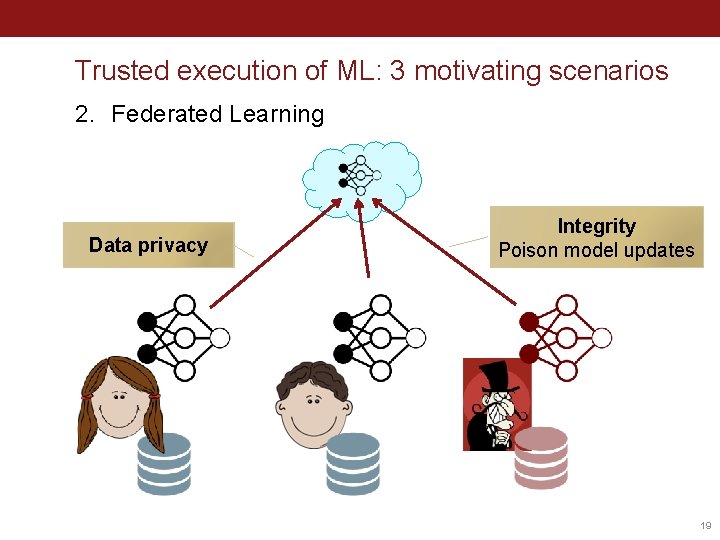
Trusted execution of ML: 3 motivating scenarios 2. Federated Learning Data privacy Integrity Poison model updates 19
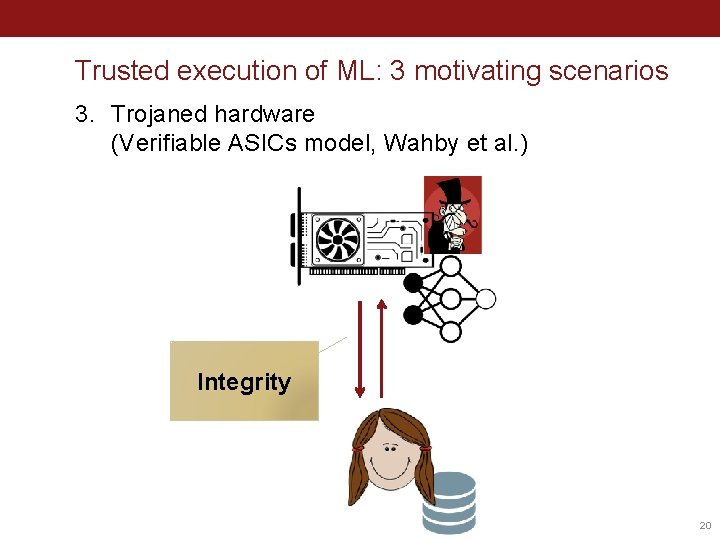
Trusted execution of ML: 3 motivating scenarios 3. Trojaned hardware (Verifiable ASICs model, Wahby et al. ) Integrity 20
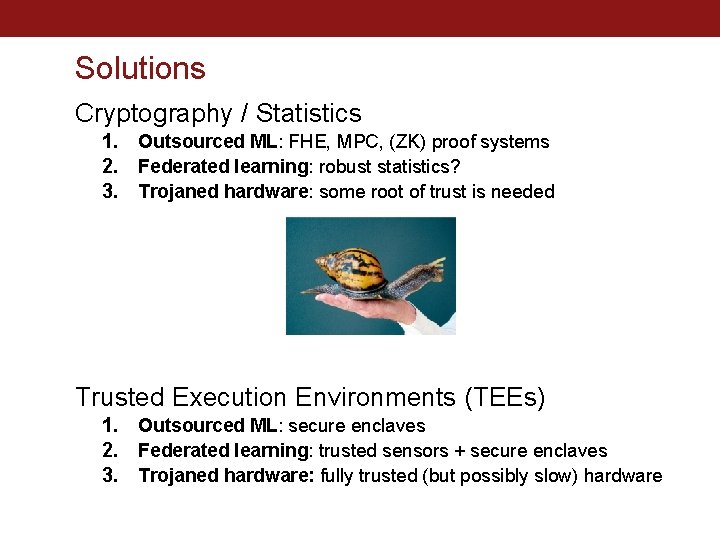
Solutions Cryptography / Statistics 1. Outsourced ML: FHE, MPC, (ZK) proof systems 2. Federated learning: robust statistics? 3. Trojaned hardware: some root of trust is needed Trusted Execution Environments (TEEs) 1. Outsourced ML: secure enclaves 2. Federated learning: trusted sensors + secure enclaves 3. Trojaned hardware: fully trusted (but possibly slow) hardware
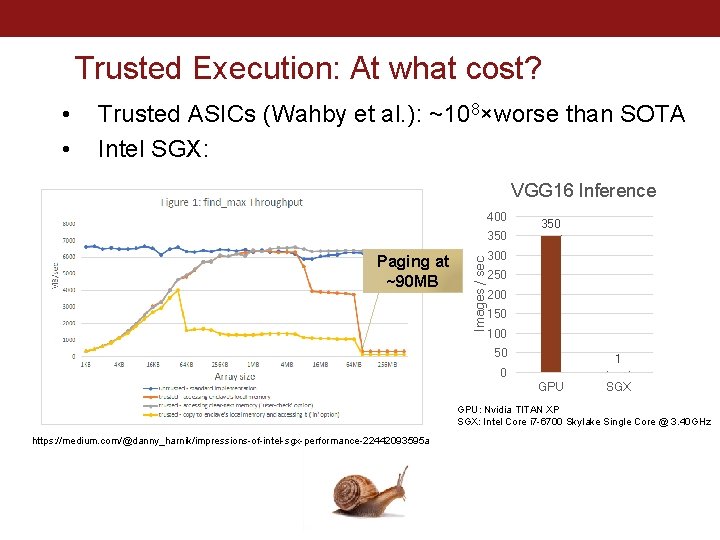
Trusted Execution: At what cost? • • Trusted ASICs (Wahby et al. ): ~108×worse than SOTA Intel SGX: VGG 16 Inference 400 Paging at ~90 MB Images / sec 350 300 250 200 150 100 50 1 0 GPU SGX GPU: Nvidia TITAN XP SGX: Intel Core i 7 -6700 Skylake Single Core @ 3. 40 GHz https: //medium. com/@danny_harnik/impressions-of-intel-sgx-performance-22442093595 a
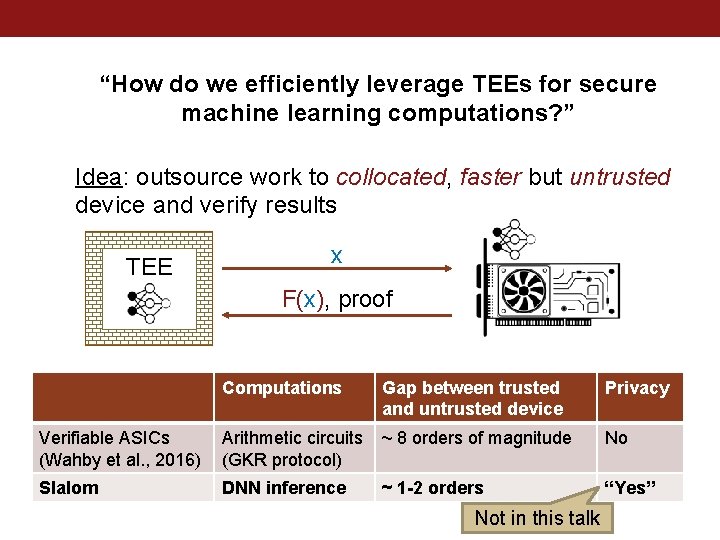
“How do we efficiently leverage TEEs for secure machine learning computations? ” Idea: outsource work to collocated, faster but untrusted device and verify results TEE x F(x), proof Computations Gap between trusted and untrusted device Privacy Verifiable ASICs (Wahby et al. , 2016) Arithmetic circuits (GKR protocol) ~ 8 orders of magnitude No Slalom DNN inference ~ 1 -2 orders “Yes” Not in this talk
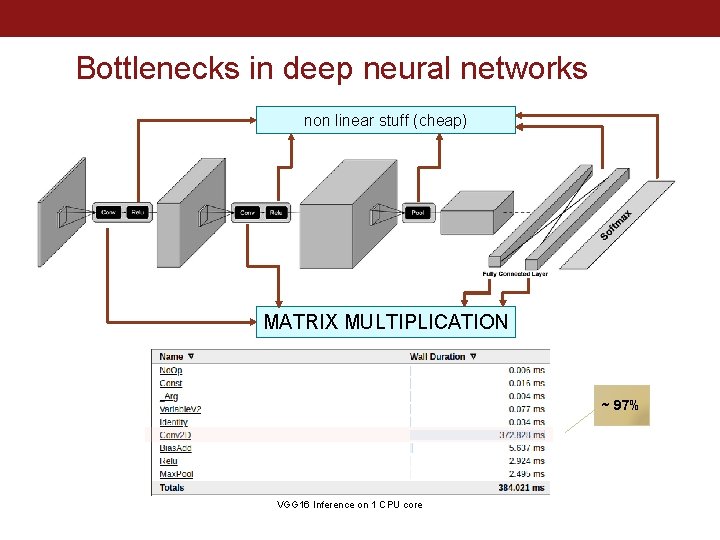
Bottlenecks in deep neural networks non linear stuff (cheap) MATRIX MULTIPLICATION ~ 97% VGG 16 Inference on 1 CPU core
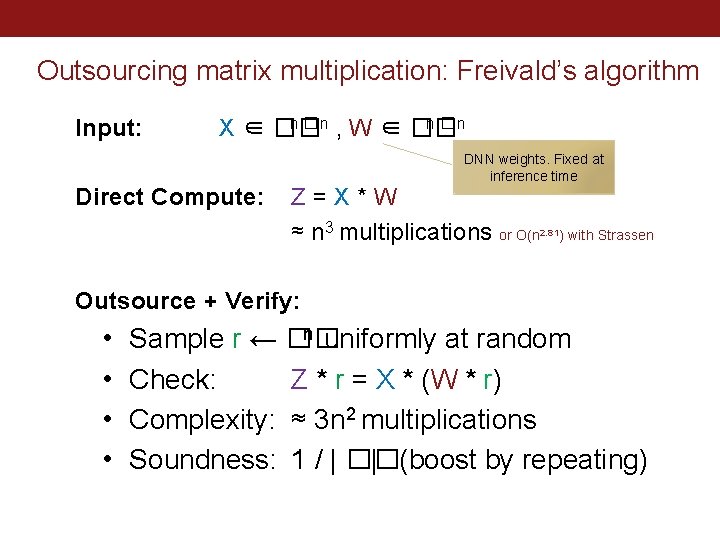
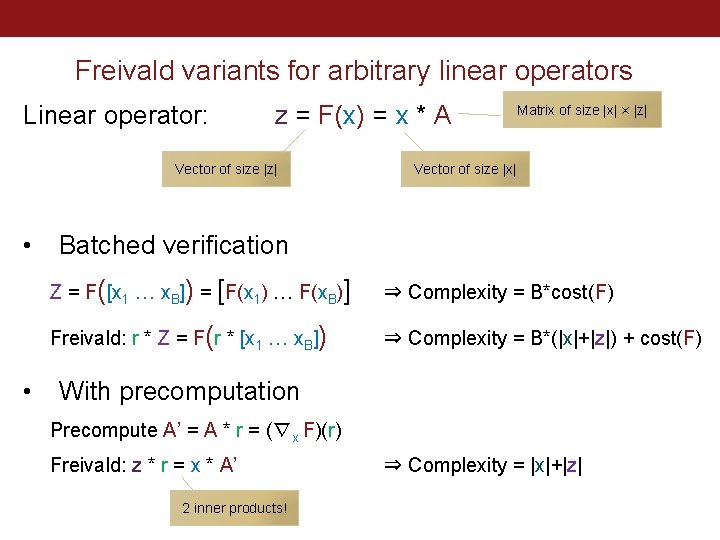
Outsourcing matrix multiplication: Freivald’s algorithm Input: n � n , W ∈ �� n �n X ∈ �� Direct Compute: DNN weights. Fixed at inference time Z=X*W ≈ n 3 multiplications or O(n 2. 81) with Strassen Outsource + Verify: • • n uniformly at random Sample r ← �� Check: Z * r = X * (W * r) Complexity: ≈ 3 n 2 multiplications Soundness: 1 / | �� | (boost by repeating)
Freivald variants for arbitrary linear operators Linear operator: z = F(x) = x * A Vector of size |z| • • Matrix of size |x| × |z| Vector of size |x| Batched verification Z = F([x 1 … x. B]) = [F(x 1) … F(x. B)] ⇒ Complexity = B*cost(F) Freivald: r * Z = F(r * [x 1 … x. B]) ⇒ Complexity = B*(|x|+|z|) + cost(F) With precomputation Precompute A’ = A * r = (∇x F)(r) Freivald: z * r = x * A’ 2 inner products! ⇒ Complexity = |x|+|z|
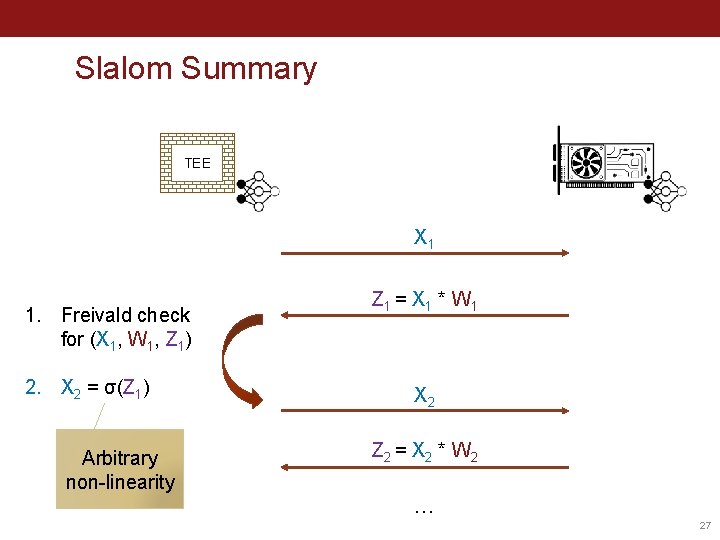
Slalom Summary TEE X 1 1. Freivald check for (X 1, W 1, Z 1) 2. X 2 = σ(Z 1) Arbitrary non-linearity Z 1 = X 1 * W 1 X 2 Z 2 = X 2 * W 2 … 27
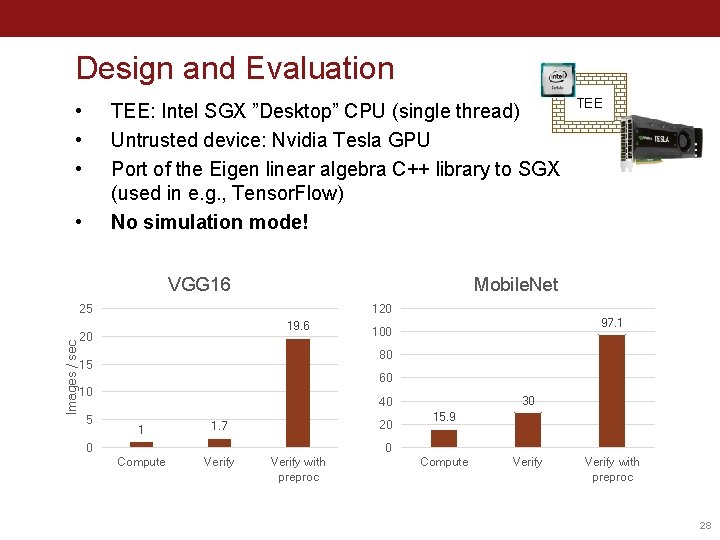
Design and Evaluation • • • TEE: Intel SGX ”Desktop” CPU (single thread) Untrusted device: Nvidia Tesla GPU Port of the Eigen linear algebra C++ library to SGX (used in e. g. , Tensor. Flow) No simulation mode! • VGG 16 Mobile. Net 25 Images / sec TEE 120 19. 6 20 97. 1 100 80 15 60 10 5 30 40 1 1. 7 Compute Verify 20 0 15. 9 0 Verify with preproc Compute Verify with preproc 28
Crypto, Trusted hardware Privacy & integrity Outsourced learning Training data Data poisoning Robust statistics ? ? ? Adversarial examples Test data Differential privacy Data inference Model theft Test outputs dog cat bird Outsourced inference Privacy & integrity Crypto, Trusted hardware 29
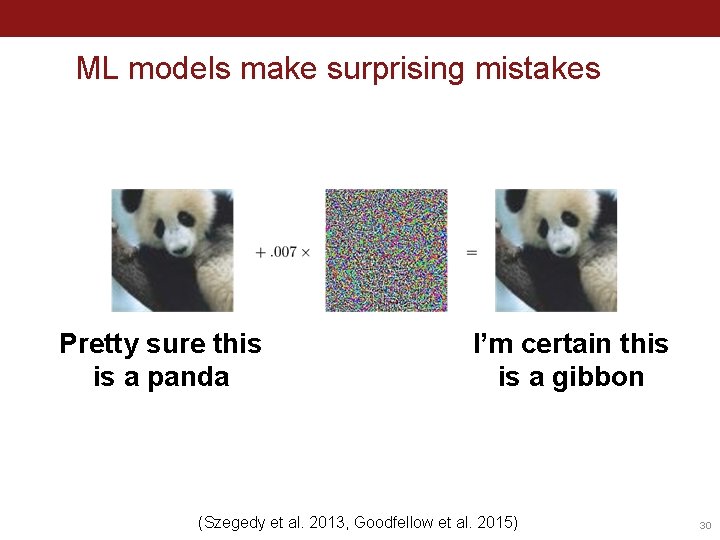
ML models make surprising mistakes Pretty sure this is a panda I’m certain this is a gibbon (Szegedy et al. 2013, Goodfellow et al. 2015) 30
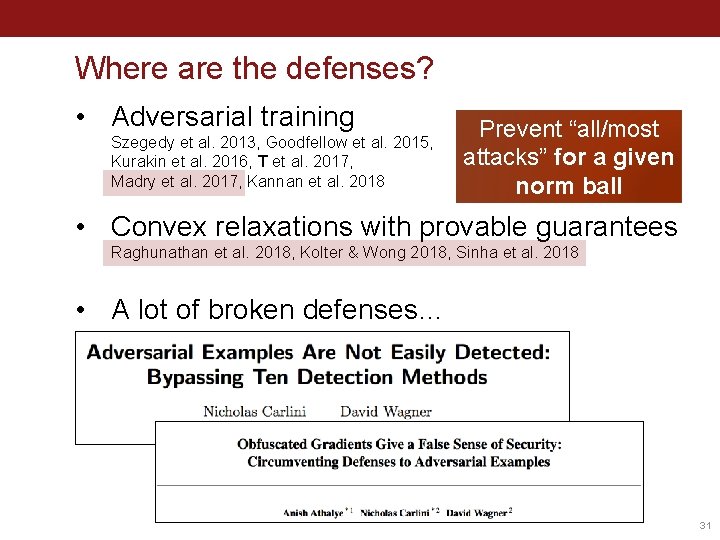
Where are the defenses? • Adversarial training Szegedy et al. 2013, Goodfellow et al. 2015, Kurakin et al. 2016, T et al. 2017, Madry et al. 2017, Kannan et al. 2018 Prevent “all/most attacks” for a given norm ball • Convex relaxations with provable guarantees Raghunathan et al. 2018, Kolter & Wong 2018, Sinha et al. 2018 • A lot of broken defenses… 31
Do we have a realistic threat model? (no…) Current approach: 1. Fix a ”toy” attack model (e. g. , some l∞ ball) 2. Directly optimize over the robustness measure Þ Defenses do not generalize to other attack models Þ Defenses are meaningless for applied security What do we want? • Model is “always correct” (sure, why not? ) • Model has blind spots that are “hard to find” • “Non-information-theoretic” notions of robustness? • CAPTCHA threat model is interesting to think about 32
ADVERSARIAL EXAMPLES ARE HERE TO STAY! For many things that humans can do “robustly”, ML will fail miserably! 33
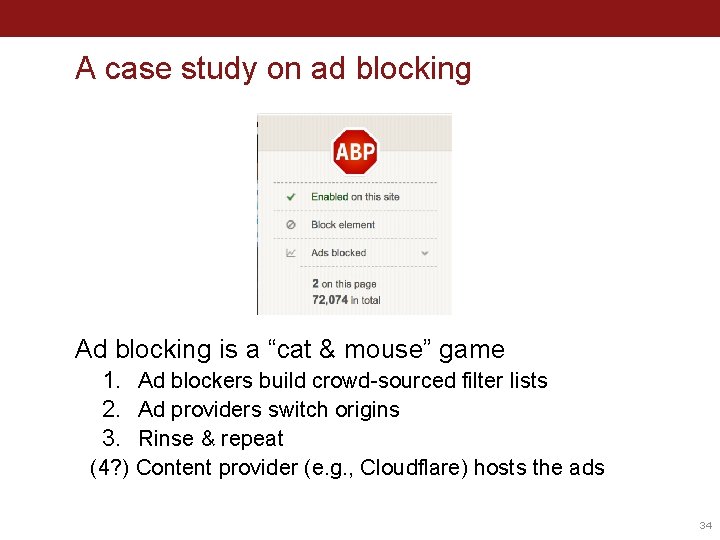
A case study on ad blocking Ad blocking is a “cat & mouse” game 1. Ad blockers build crowd-sourced filter lists 2. Ad providers switch origins 3. Rinse & repeat (4? ) Content provider (e. g. , Cloudflare) hosts the ads 34
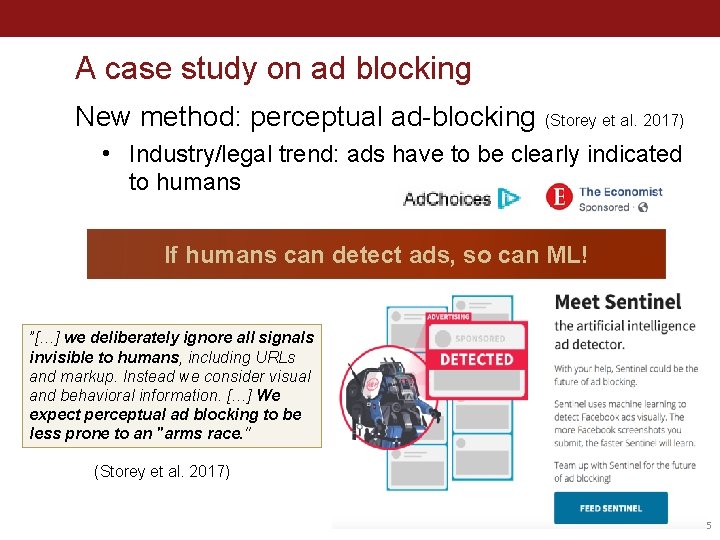
A case study on ad blocking New method: perceptual ad-blocking (Storey et al. 2017) • Industry/legal trend: ads have to be clearly indicated to humans If humans can detect ads, so can ML! ”[…] we deliberately ignore all signals invisible to humans, including URLs and markup. Instead we consider visual and behavioral information. […] We expect perceptual ad blocking to be less prone to an "arms race. " (Storey et al. 2017) 35
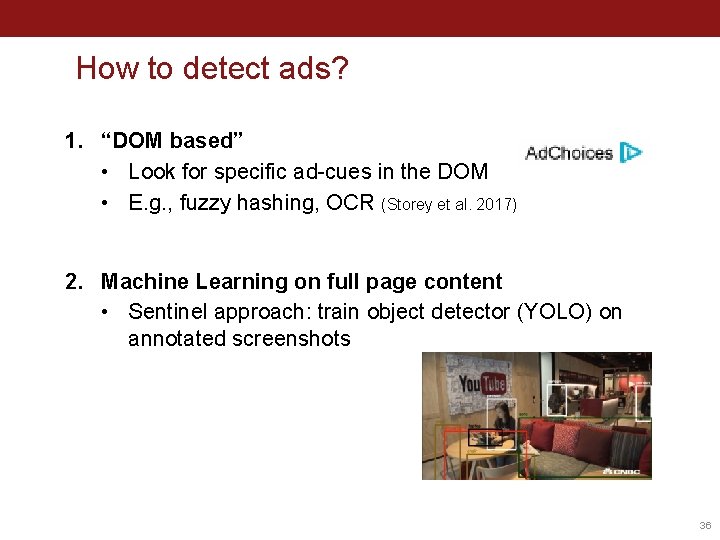
How to detect ads? 1. “DOM based” • Look for specific ad-cues in the DOM • E. g. , fuzzy hashing, OCR (Storey et al. 2017) 2. Machine Learning on full page content • Sentinel approach: train object detector (YOLO) on annotated screenshots 36
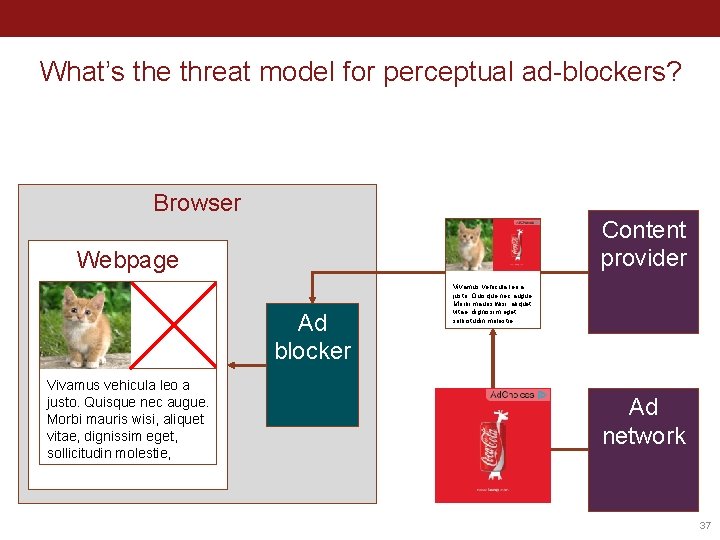
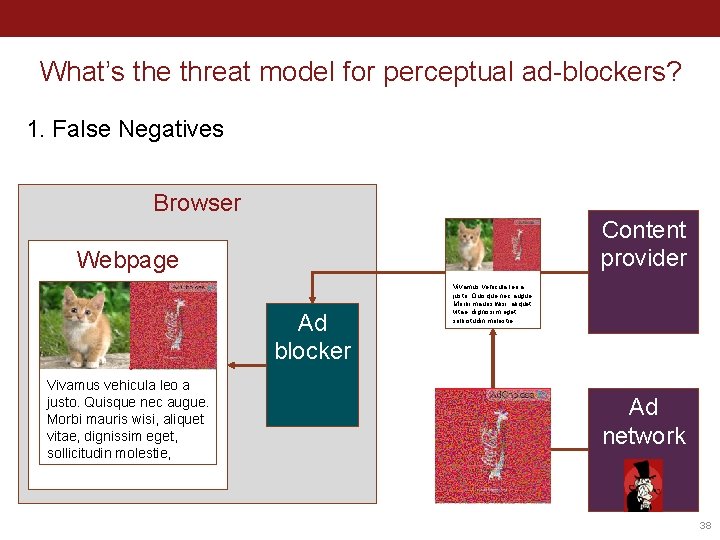
What’s the threat model for perceptual ad-blockers? Browser Content provider Webpage Ad blocker Vivamus vehicula leo a justo. Quisque nec augue. Morbi mauris wisi, aliquet vitae, dignissim eget, sollicitudin molestie, Ad network 37
What’s the threat model for perceptual ad-blockers? 1. False Negatives Browser Content provider Webpage Ad blocker Vivamus vehicula leo a justo. Quisque nec augue. Morbi mauris wisi, aliquet vitae, dignissim eget, sollicitudin molestie, Ad network 38
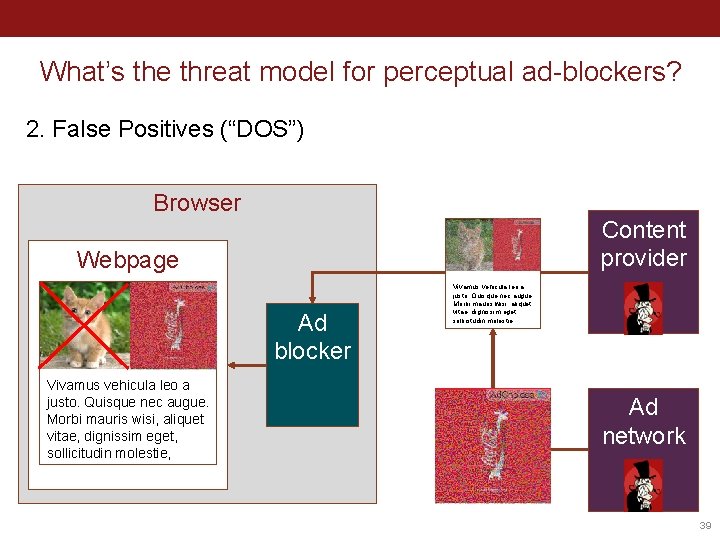
What’s the threat model for perceptual ad-blockers? 2. False Positives (“DOS”) Browser Content provider Webpage Ad blocker Vivamus vehicula leo a justo. Quisque nec augue. Morbi mauris wisi, aliquet vitae, dignissim eget, sollicitudin molestie, Ad network 39
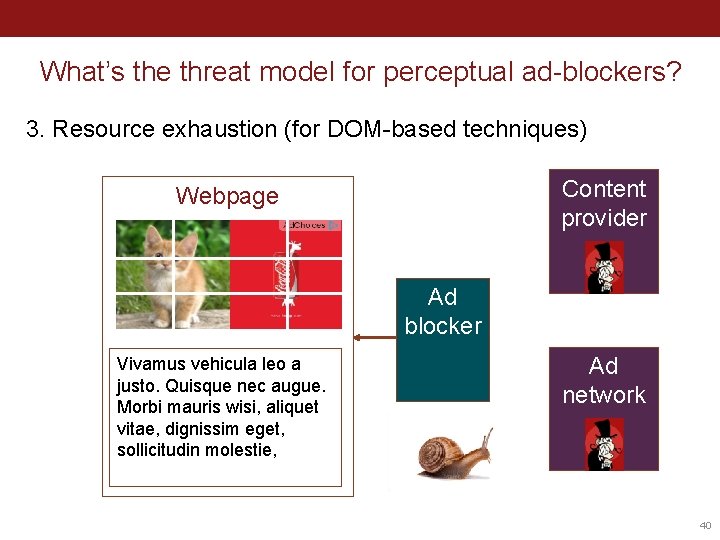
What’s the threat model for perceptual ad-blockers? 3. Resource exhaustion (for DOM-based techniques) Content provider Webpage Ad blocker Vivamus vehicula leo a justo. Quisque nec augue. Morbi mauris wisi, aliquet vitae, dignissim eget, sollicitudin molestie, Ad network 40
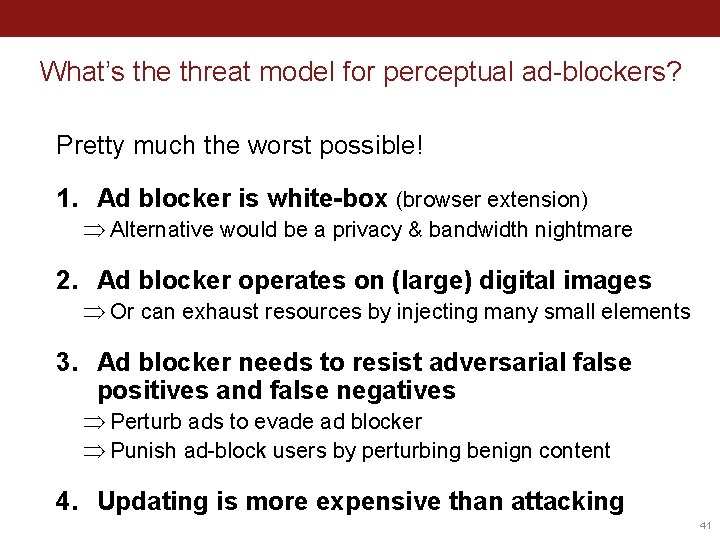
What’s the threat model for perceptual ad-blockers? Pretty much the worst possible! 1. Ad blocker is white-box (browser extension) Þ Alternative would be a privacy & bandwidth nightmare 2. Ad blocker operates on (large) digital images Þ Or can exhaust resources by injecting many small elements 3. Ad blocker needs to resist adversarial false positives and false negatives Þ Perturb ads to evade ad blocker Þ Punish ad-block users by perturbing benign content 4. Updating is more expensive than attacking 41
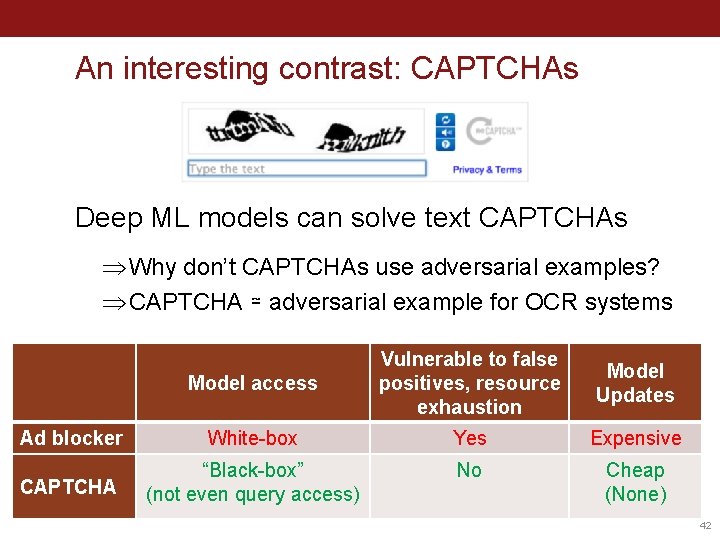
An interesting contrast: CAPTCHAs Deep ML models can solve text CAPTCHAs Þ Why don’t CAPTCHAs use adversarial examples? Þ CAPTCHA ≃ adversarial example for OCR systems Model access Vulnerable to false positives, resource exhaustion Model Updates Ad blocker White-box Yes Expensive CAPTCHA “Black-box” (not even query access) No Cheap (None) 42
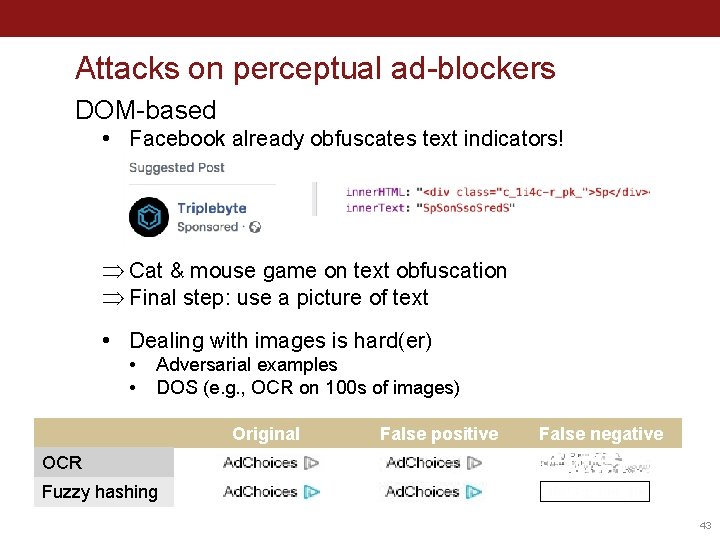
Attacks on perceptual ad-blockers DOM-based • Facebook already obfuscates text indicators! Þ Cat & mouse game on text obfuscation Þ Final step: use a picture of text • Dealing with images is hard(er) • • Adversarial examples DOS (e. g. , OCR on 100 s of images) Original False positive False negative OCR Fuzzy hashing 43
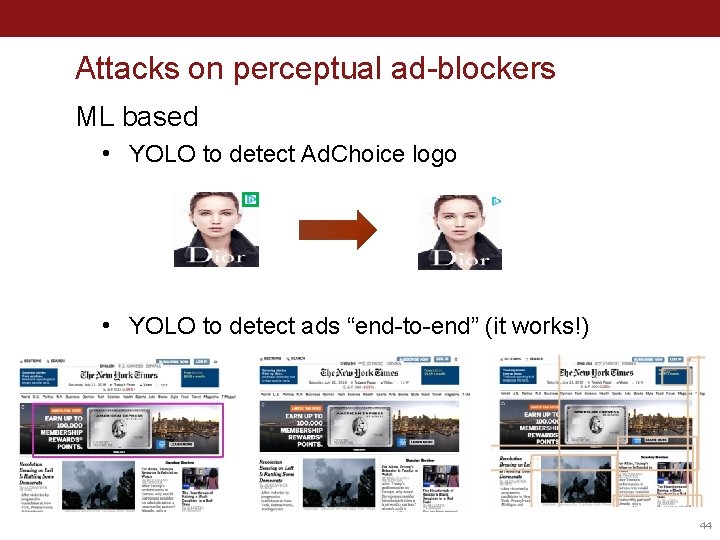
Attacks on perceptual ad-blockers ML based • YOLO to detect Ad. Choice logo • YOLO to detect ads “end-to-end” (it works!) 44
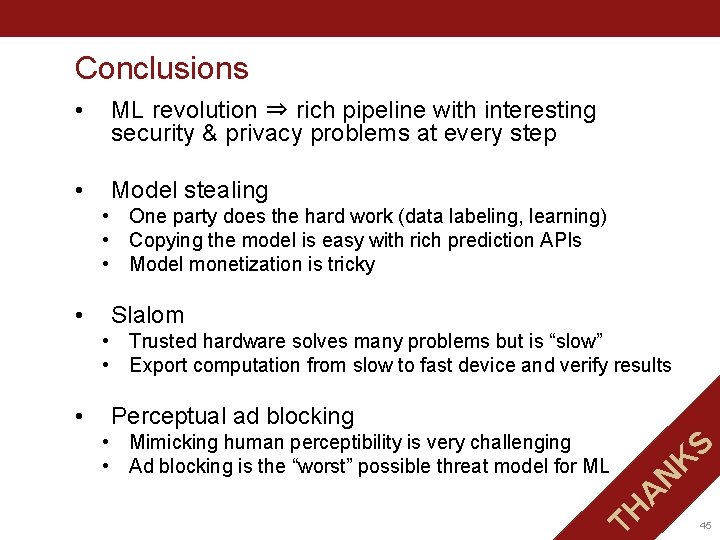
Conclusions • ML revolution ⇒ rich pipeline with interesting security & privacy problems at every step • Model stealing • One party does the hard work (data labeling, learning) • Copying the model is easy with rich prediction APIs • Model monetization is tricky • Slalom • Trusted hardware solves many problems but is “slow” • Export computation from slow to fast device and verify results K N A • Mimicking human perceptibility is very challenging • Ad blocking is the “worst” possible threat model for ML S Perceptual ad blocking TH • 45