
A topological view of 3 D global magnetic
A topological view of 3 D global magnetic field reversal in the solar corona Rhona Maclean Armagh Observatory 5 th December 2006
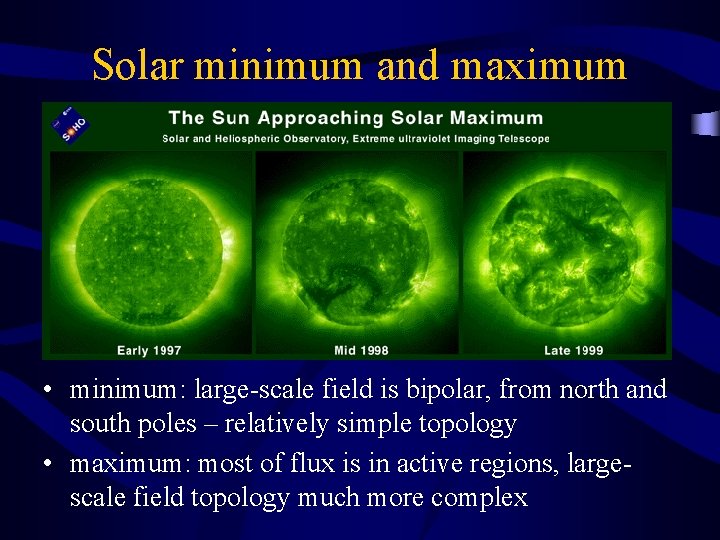
Solar minimum and maximum • minimum: large-scale field is bipolar, from north and south poles – relatively simple topology • maximum: most of flux is in active regions, largescale field topology much more complex
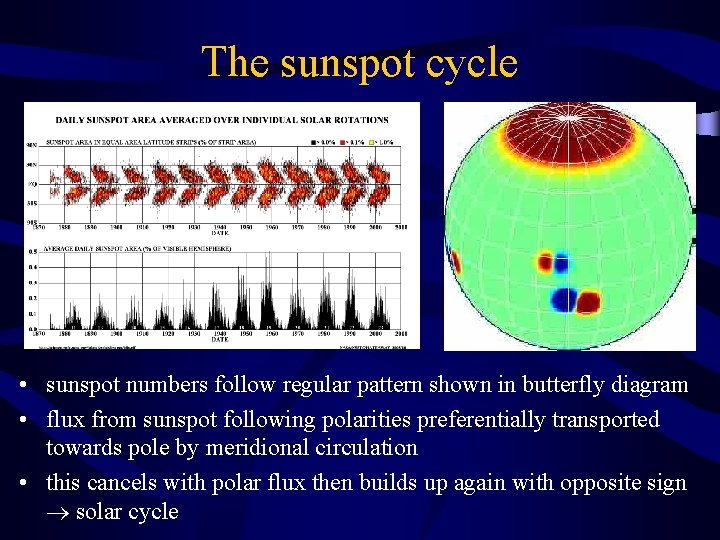
The sunspot cycle • sunspot numbers follow regular pattern shown in butterfly diagram • flux from sunspot following polarities preferentially transported towards pole by meridional circulation • this cancels with polar flux then builds up again with opposite sign solar cycle
What is magnetic topology? • topological analysis of magnetic fields • tool for understanding fields’ – 3 D structure – connectivity – evolution • can be applied to theoretical models or numerical/observational datasets • topological features are prime sites for magnetic reconnection coronal heating
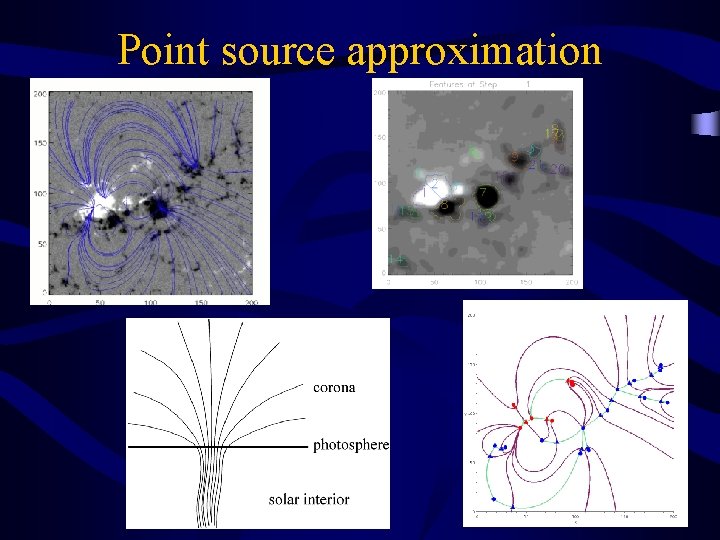
Point source approximation

Magnetic null points • structure of magnetic field near generic potential null point with B=0 • fan/separatrix surfaces divide space into regions of different magnetic connectivity: flux domains • separatrices can intersect in separator fieldlines that join two null points
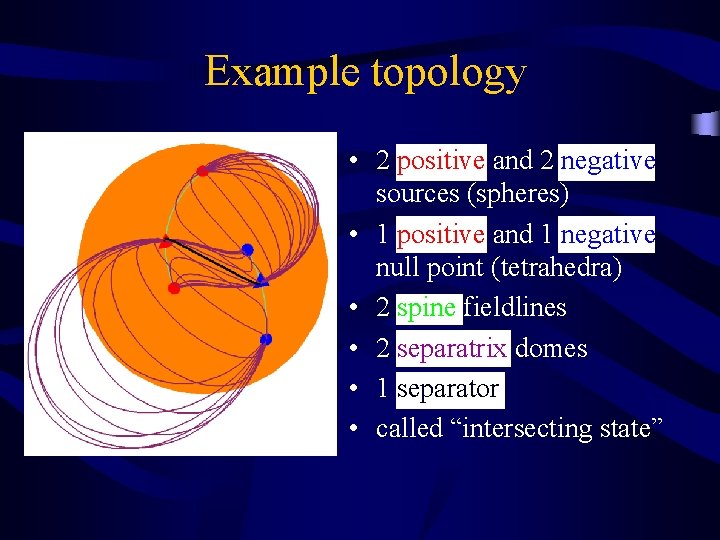
Example topology • 2 positive and 2 negative sources (spheres) • 1 positive and 1 negative null point (tetrahedra) • 2 spine fieldlines • 2 separatrix domes • 1 separator • called “intersecting state”
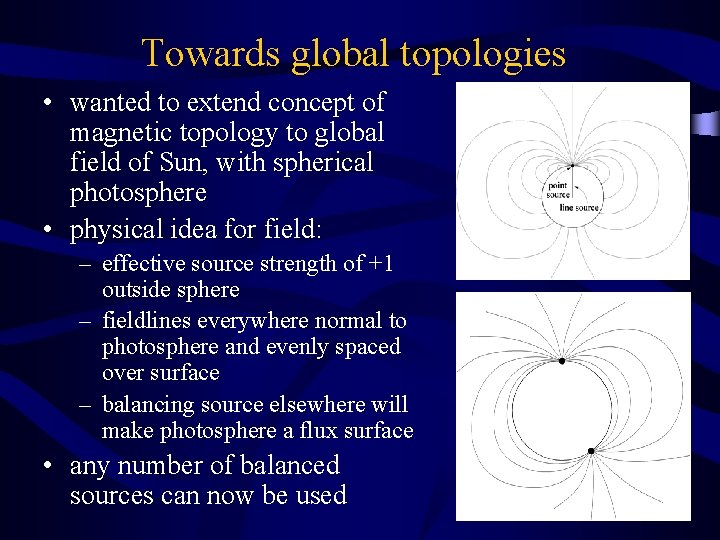
Towards global topologies • wanted to extend concept of magnetic topology to global field of Sun, with spherical photosphere • physical idea for field: – effective source strength of +1 outside sphere – fieldlines everywhere normal to photosphere and evenly spaced over surface – balancing source elsewhere will make photosphere a flux surface • any number of balanced sources can now be used
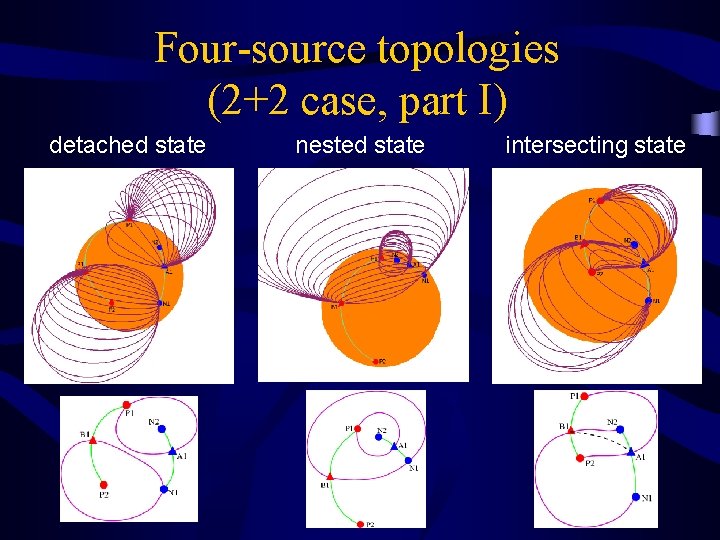
Four-source topologies (2+2 case, part I) detached state nested state intersecting state
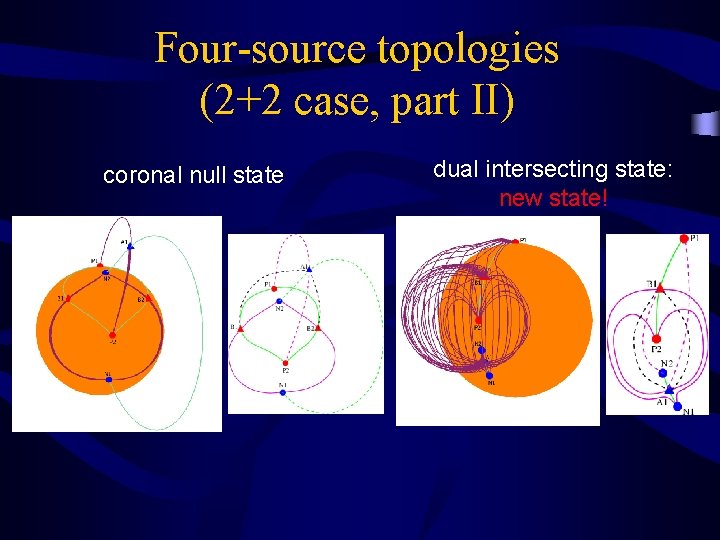
Four-source topologies (2+2 case, part II) coronal null state dual intersecting state: new state!
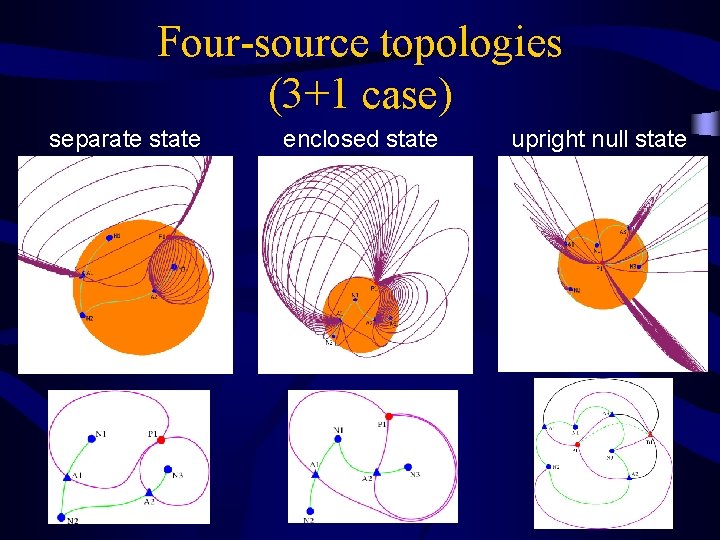
Four-source topologies (3+1 case) separate state enclosed state upright null state

Bifurcations: changes in topology • local bifurcations: – create or destroy null points – do not change connectivity • global bifurcations: – create or destroy flux domains – leave nulls unchanged • quasi-bifurcations: – change dominant flux domain – no effect on nulls or connectivity
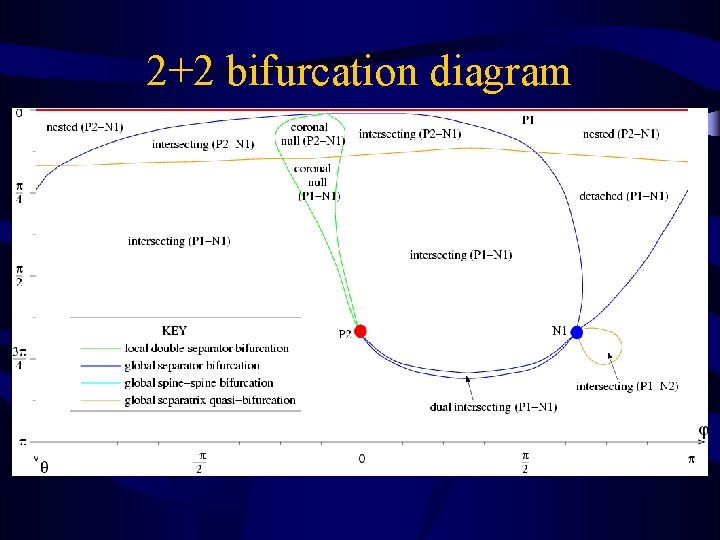
2+2 bifurcation diagram
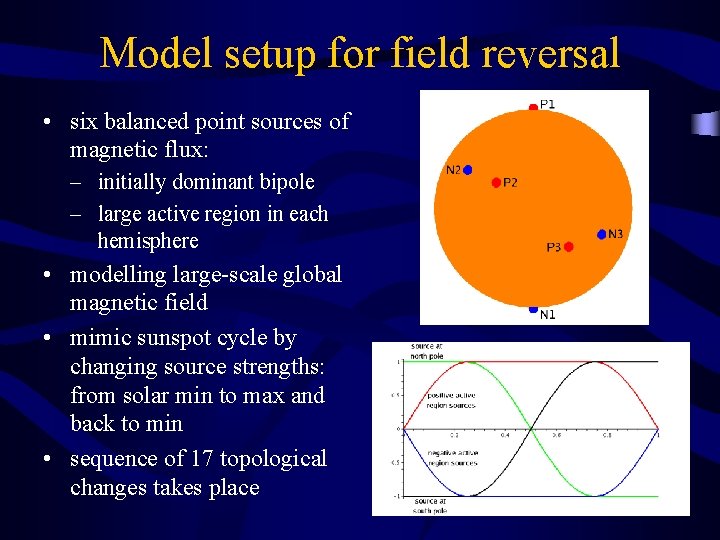
Model setup for field reversal • six balanced point sources of magnetic flux: – initially dominant bipole – large active region in each hemisphere • modelling large-scale global magnetic field • mimic sunspot cycle by changing source strengths: from solar min to max and back to min • sequence of 17 topological changes takes place
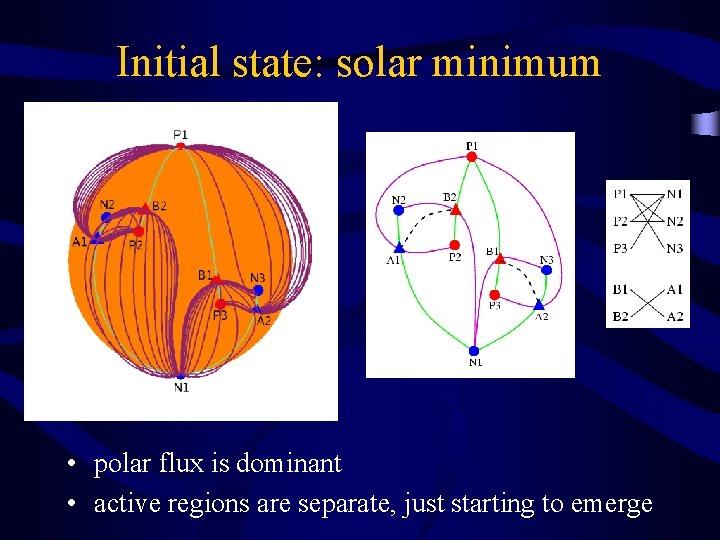
Initial state: solar minimum • polar flux is dominant • active regions are separate, just starting to emerge
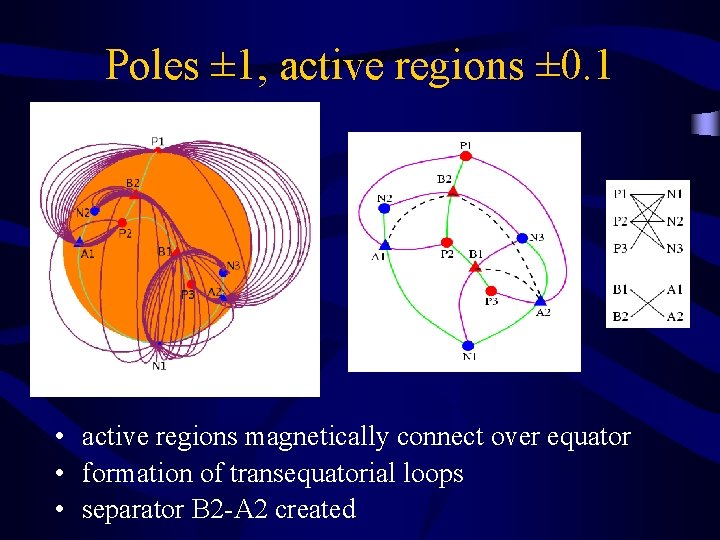
Poles ± 1, active regions ± 0. 1 • active regions magnetically connect over equator • formation of transequatorial loops • separator B 2 -A 2 created
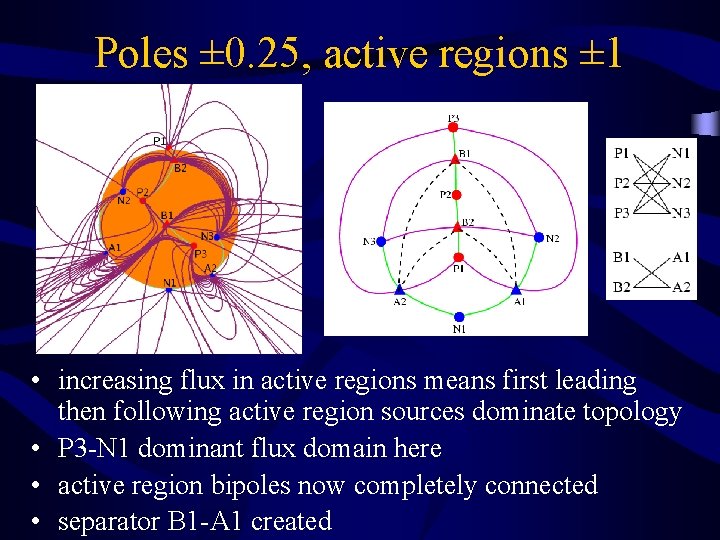
Poles ± 0. 25, active regions ± 1 • increasing flux in active regions means first leading then following active region sources dominate topology • P 3 -N 1 dominant flux domain here • active region bipoles now completely connected • separator B 1 -A 1 created
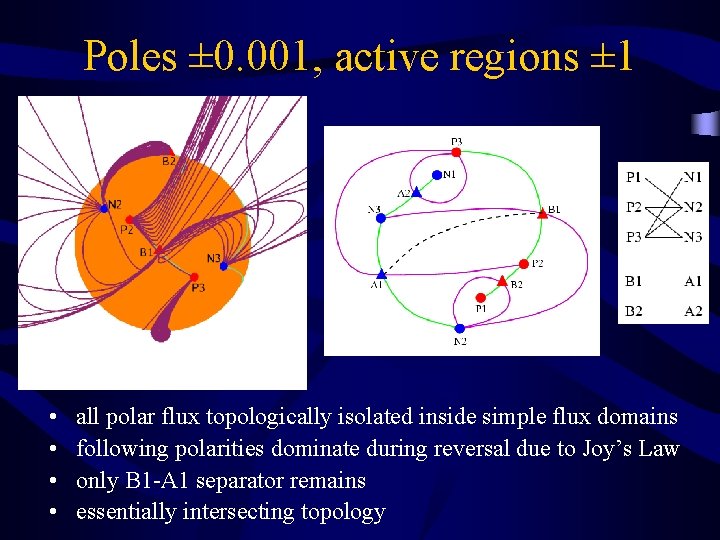
Poles ± 0. 001, active regions ± 1 • • all polar flux topologically isolated inside simple flux domains following polarities dominate during reversal due to Joy’s Law only B 1 -A 1 separator remains essentially intersecting topology
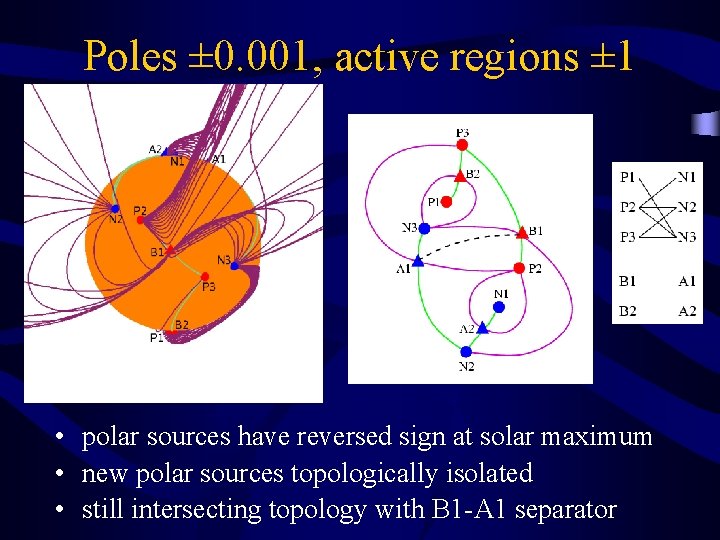
Poles ± 0. 001, active regions ± 1 • polar sources have reversed sign at solar maximum • new polar sources topologically isolated • still intersecting topology with B 1 -A 1 separator
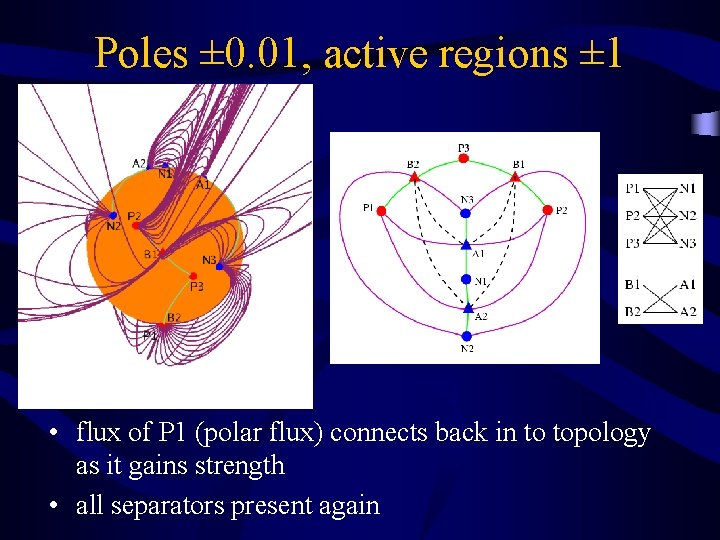
Poles ± 0. 01, active regions ± 1 • flux of P 1 (polar flux) connects back in to topology as it gains strength • all separators present again
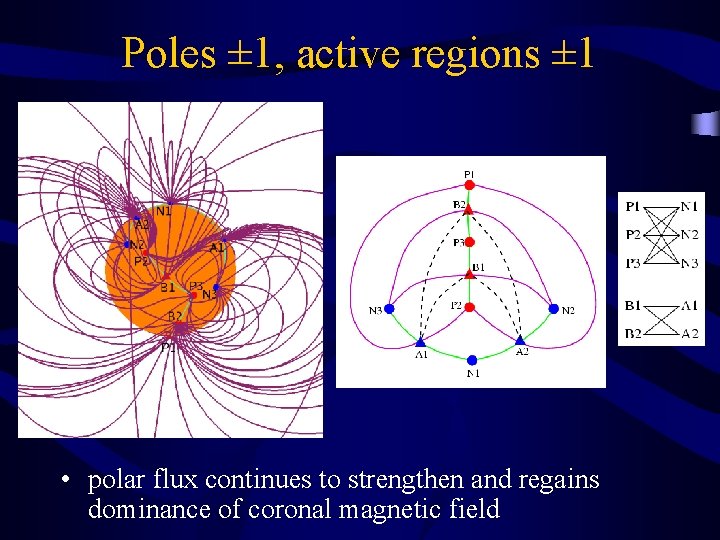
Poles ± 1, active regions ± 1 • polar flux continues to strengthen and regains dominance of coronal magnetic field
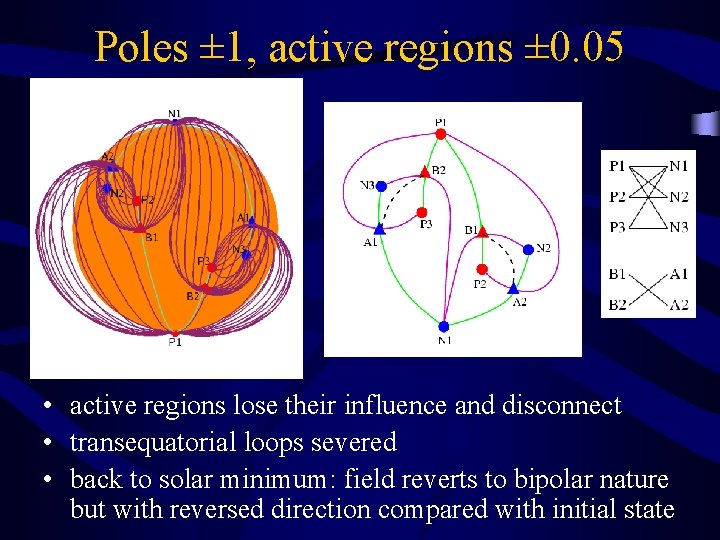
Poles ± 1, active regions ± 0. 05 • active regions lose their influence and disconnect • transequatorial loops severed • back to solar minimum: field reverts to bipolar nature but with reversed direction compared with initial state
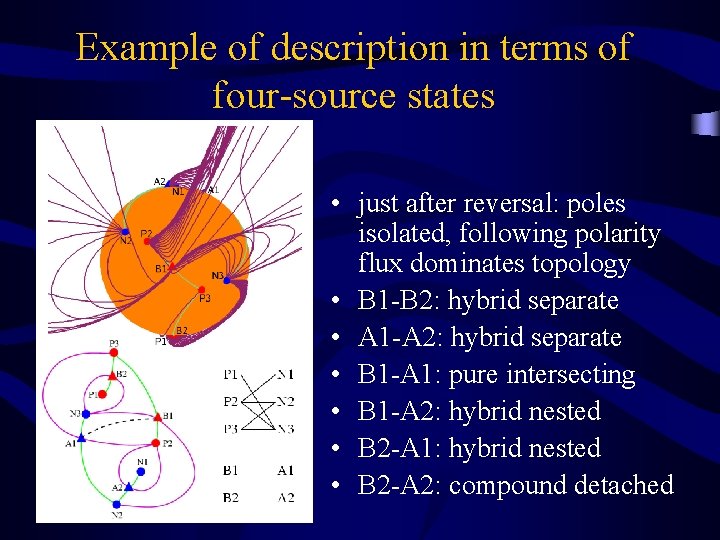
Example of description in terms of four-source states • just after reversal: poles isolated, following polarity flux dominates topology • B 1 -B 2: hybrid separate • A 1 -A 2: hybrid separate • B 1 -A 1: pure intersecting • B 1 -A 2: hybrid nested • B 2 -A 1: hybrid nested • B 2 -A 2: compound detached
Conclusions • modelled topological nature of global magnetic field reversal • simple model of large-scale field captures many features that could be compared with observations • sequence of 17 topological changes • each state can be described in terms of combination of four-source states

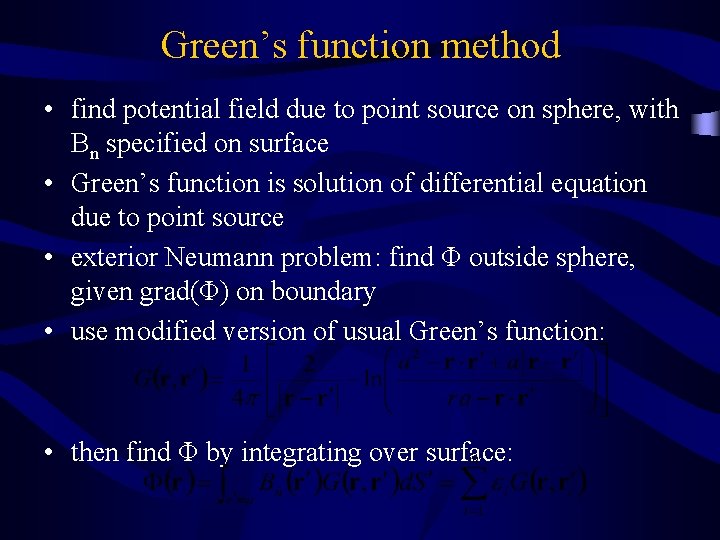
Green’s function method • find potential field due to point source on sphere, with Bn specified on surface • Green’s function is solution of differential equation due to point source • exterior Neumann problem: find Φ outside sphere, given grad(Φ) on boundary • use modified version of usual Green’s function: • then find Φ by integrating over surface:
- Slides: 26