
A Topological Analysis of the Magnetic Breakout Model

A Topological Analysis of the Magnetic Breakout Model by Rhona Maclean University of St Andrews 10 th August 2004 Collaborators: Colin Beveridge, Dana Longcope, Dan Brown and Eric Priest
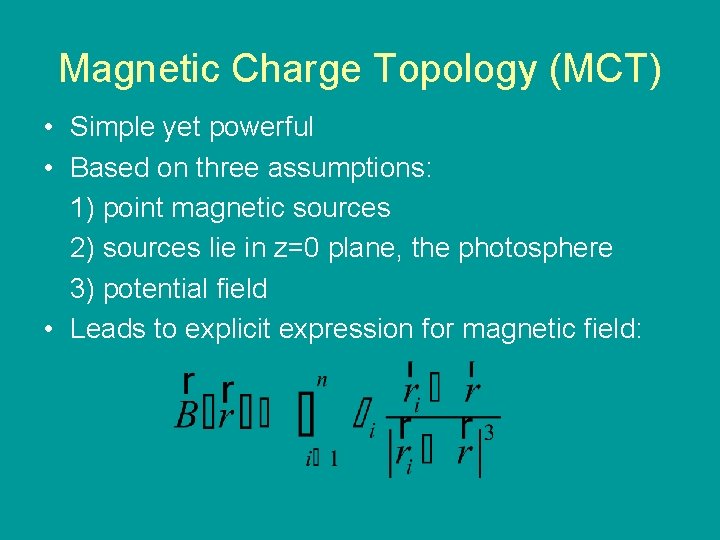
Magnetic Charge Topology (MCT) • Simple yet powerful • Based on three assumptions: 1) point magnetic sources 2) sources lie in z=0 plane, the photosphere 3) potential field • Leads to explicit expression for magnetic field:
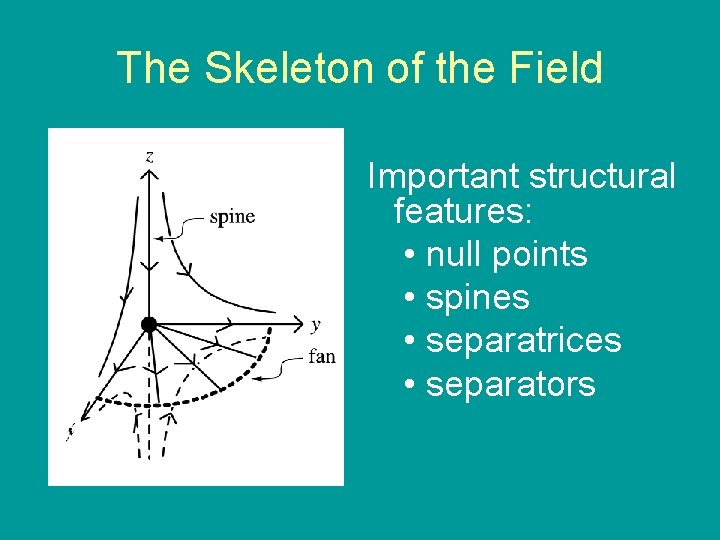
The Skeleton of the Field Important structural features: • null points • spines • separatrices • separators

Topological Bifurcations • Changes from one topological state to another • Two types: – local: change in number of nulls – global: change in structure of field; number of nulls unaffected

What is Magnetic Breakout? • Explanation for onset of solar flare – central flux system initially enclosed by overlying arcade – shear applied near neutral line in photosphere – magnetic reconnection in vicinity of coronal null – overlying field weakens and allows originally enclosed flux to ‘break out’ explosively • Simplest configuration is delta sunspot – new flux emerging inside pre-existing sunspot region
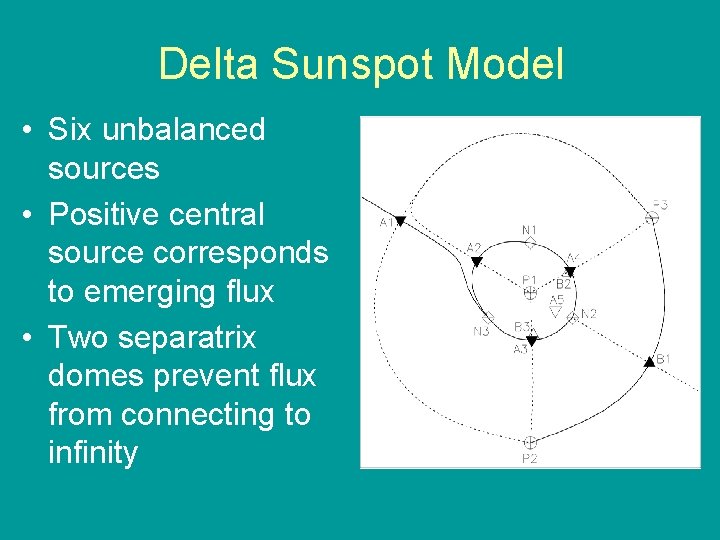
Delta Sunspot Model • Six unbalanced sources • Positive central source corresponds to emerging flux • Two separatrix domes prevent flux from connecting to infinity

Experiment 1: Source Strength Before global spine-fan bifurcation: After bifurcation:
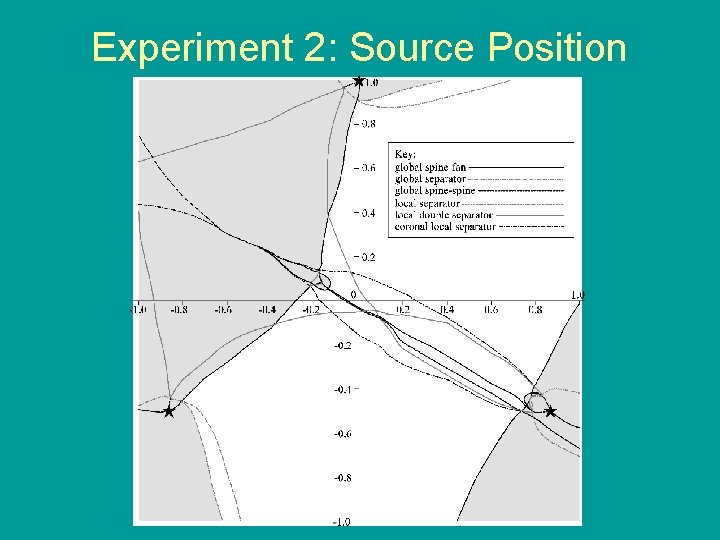
Experiment 2: Source Position
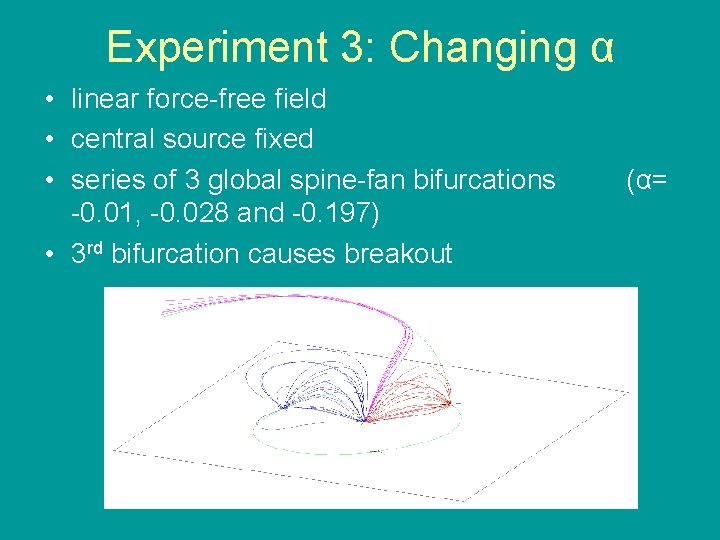
Experiment 3: Changing α • linear force-free field • central source fixed • series of 3 global spine-fan bifurcations -0. 01, -0. 028 and -0. 197) • 3 rd bifurcation causes breakout (α=

Conclusions • New flux domain created in process of breakout • This can only be caused by global bifurcations • Examples here are global spine-fan and global separator • Breakout behaviour can occur due to change of: – source strength – source position – force-free parameter α
- Slides: 10